
Racing playlists are often stuffed with highway anthems and road-trip songs. But a reference to speed or an engine tells you little about why a song belongs to motorsport. Some songs earn that connection through a specific track, a person, or a recognizable car number. Others become part of racing through shared race-day rituals. This guide explores those four routes, and shows how a local short track, race team, or fan club can use them to build an anthem of its own.
What Connects a Song to Racing?
Open almost any motorsport playlist online, and you will find tracks about highway speed limits and daily traffic. Sammy Hagar’s “I Can’t Drive 55”, the Eagles’ “Life in the Fast Lane”, and Tracy Chapman’s “Fast Car” show up on these lists all the time. Yet none of those tracks tells a story about competition. They are songs about personal travel, speeding tickets, and escaping hard circumstances.
In February 2025, an Indianapolis sports radio station, 93.5/107.5 The Fan, published a list of “100 Songs That Relate To Racing” ahead of the Indianapolis 500. The list entries offered bare titles with no commentary, and a huge share of the selections were simple driving or vehicle tunes. When any track that mentions an engine counts as a motorsport anthem, the word loses its meaning.
Start with the lyrics: do they name a race, a track or a competitor? If not, ask whether fans connect the song to a recurring race-day or broadcast moment. A fast-car reference alone does not establish that connection.
A Real Place Gives Fans Something to Claim
A specific venue gives listeners ground they can claim for themselves. When a track name sits right in the title, fans know immediately that the music belongs to their world.
Look at Eric Church’s “Talladega”. Co-written with Luke Laird, the song appeared on his 2014 album The Outsiders. The story follows a man looking back on a trip to Talladega Superspeedway with friends right after his senior year of high school.
Church and Laird explained that the song was not really about racing. Instead, the track stands for the people you went with and a time that won’t come back. Fans adopted it because the place holds that memory.
In an amusing twist, the official music video was filmed at Nashville Superspeedway rather than Talladega. The track name in the title still did the work.
Mark Knopfler took the same route on his 2000 album Sailing to Philadelphia with the track “Speedway at Nazareth”, named after Nazareth Speedway in Pennsylvania.
A Person Gives Listeners Someone to Pull For
A driver gives listeners someone to pull for. Their pressure, commitment and setbacks give a songwriter more to work with than horsepower ratings alone.
George Harrison highlighted this approach in 1979 with his song “Faster”, from his self-titled album George Harrison. Harrison spent much of 1977 attending Formula 1 races, forming friendships with drivers including Jackie Stewart, Emerson Fittipaldi, and Niki Lauda.
Harrison drew inspiration from Lauda’s comeback after his near-fatal crash at the Nürburgring in 1976. Harrison shared the song title with Jackie Stewart’s book, Faster: A Racer’s Diary. The UK single raised money for a cancer research fund set up by Swedish driver Gunnar Nilsson, and it commemorated Ronnie Peterson, who died after injuries suffered at the 1978 Italian Grand Prix. In the official music video, Harrison sings in the back of a car driven by Stewart.
The chorus of “Faster” never mentions horsepower or mechanical parts. It focuses entirely on a driver, using the word “he” to describe the pressure and commitment required to compete, giving listeners a person to pull for. Jim Croce took a similar character-driven approach on his April 1972 album You Don’t Mess Around with Jim with “Rapid Roy (The Stock Car Boy)”. The title alone gives you a nickname and a stock car driver, not a machine.
Car Numbers Work Like Names, With a Shelf Life
In stock car racing, car numbers function as shorthand for human personalities. Fans often talk about numbers rather than last names, treating the digits on the door like the drivers themselves.
Brad Paisley leaned on this tradition in his single “Country Nation”, released in 2015, from the album Moonshine in the Trunk. Paisley wove NASCAR culture directly into the lyrics by mentioning cheers for numbers 14, 24, 48, and 88 alongside college football team nicknames such as the Crimson Tide, Longhorns, and Buckeyes.
In 2015, Cup Series fans could connect those car numbers to Tony Stewart, Jeff Gordon, Jimmie Johnson, and Dale Earnhardt Jr. Paisley did not need to name the drivers.
Relying on car numbers comes with a clear trade-off. Numbers root a song firmly in a single era, giving current fans an instant connection. Over time, drivers retire and different racers take over the car, turning what was once immediate into a snapshot of the past.
Play It at the Same Moment Enough Times and It Becomes a Racing Song
Some tracks never started with any link to motorsport. Instead, television broadcasts turned them into racing anthems through repetition. When a piece of music plays at the exact same point in a race program, habit takes over.
Fleetwood Mac’s “The Chain”, from their 1977 album Rumours, is a clear example. The song was never written about sports. Yet its closing section features a driving bass line played by John McVie.
The BBC Formula One broadcast team used that closing bass line as its theme music from 1978 until 1996, and returned to it from 2009 to 2015. Channel 4’s F1 coverage also used the instrumental section. For UK fans, that bass line still means the race is about to start. The music became part of racing culture through regular exposure.
Brazilian television achieved a similar result with “Tema da Vitória” (“Victory Theme”). Composed by Eduardo Souto Neto and recorded by the group Roupa Nova in 1981, the instrumental track was created for TV Globo’s Formula 1 broadcasts. Starting in 1986, the network played the song only for Brazilian race wins. Because Ayrton Senna won so frequently during that period, the tune became associated with him.
Building a Song for Your Home Track, Team or Fan Club
Local short tracks, regional teams, and fan clubs rarely have large recording budgets, but you do not need commercial studio backing to make music race fans want to sing. By using the traits found in lasting racing songs, any local organization can produce something authentic.
Turn those traits into four specific decisions:
- Name your place, and mention a detail only local regulars recognize. You could mention the rough pavement off turn two, the narrow gate leading onto pit road, or the grassy hill behind turn three where families set up folding chairs. That local detail tells your crowd that the song belongs exclusively to them.
- Feature a real person or a car number. Write about a track founder, a family that has raced at the speedway for decades, or a fan-favorite car number that packs the grandstands. Accept that naming a specific number will date the song once that driver retires, but that trade-off gives the track immediate energy.
- Pick the exact moment the song plays and keep it there. Play it during the feature winner’s cool-down lap, during driver introductions on opening night, or at the end-of-season banquet. Repetition is what cements the song into fan memory.
- Keep the repeated hook short enough to shout over engines. A short, clear line gives fans something they can join in with from the bleachers.
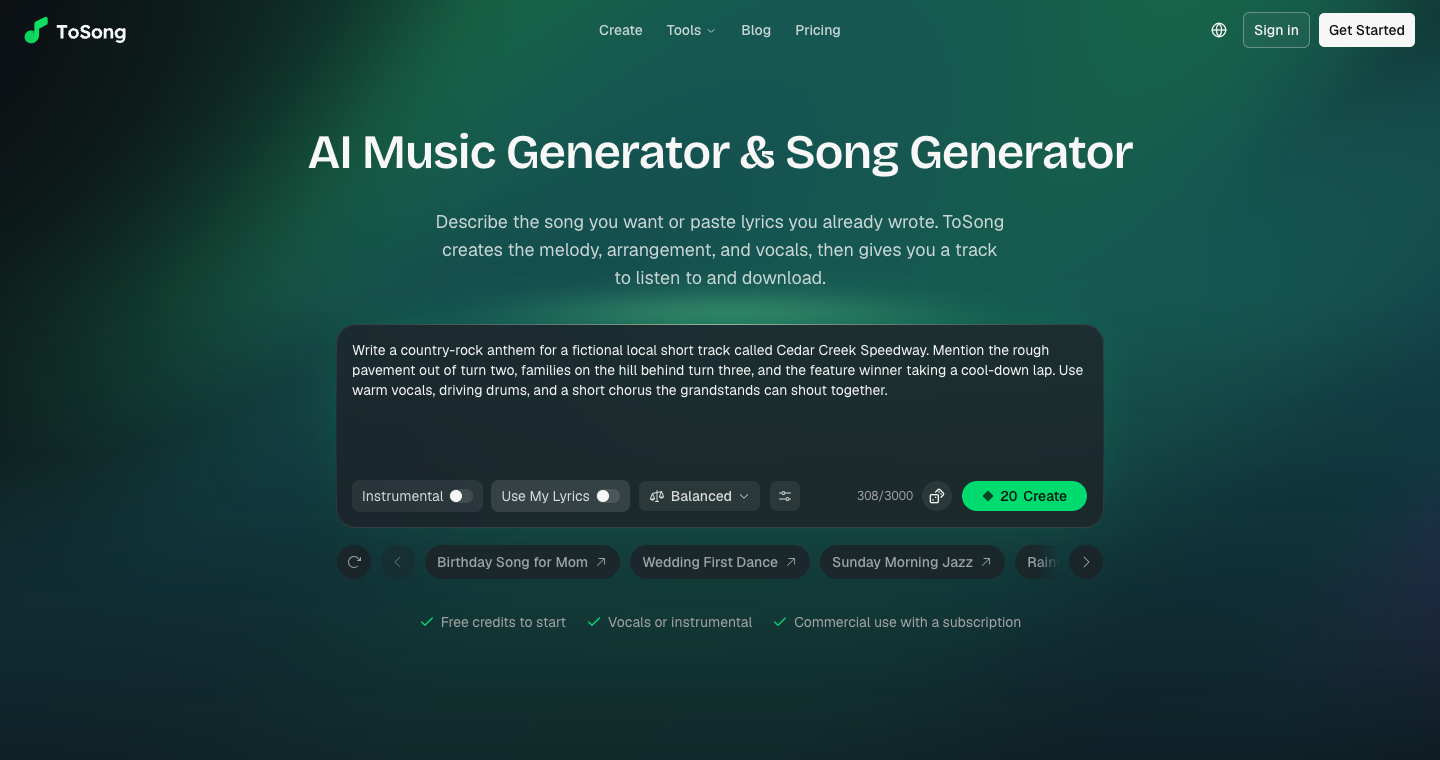
To produce the track, you have three sensible options. You can work with a local musician who knows the track, organize an anthem contest among your own fans, or generate an initial draft using an AI Music Generator that your group can edit. ToSong is an example of such a tool that writes lyrics from a short description and returns finished songs with vocals. Even a rough draft gives the group something to argue over, which is usually how the best line gets found.
Regardless of who makes the song, check who owns the result and what uses your agreement permits before the track builds anything around it. Before using the song over the PA, in ads or in video recaps, confirm that your agreement covers the composition, the recording and those intended uses.
Before you debut the song, test it against a simple decision rule: if you could swap your track’s name for any other and nothing in the song breaks, it is not your song yet. Go back and add the local details until the lyrics fit your home track alone.