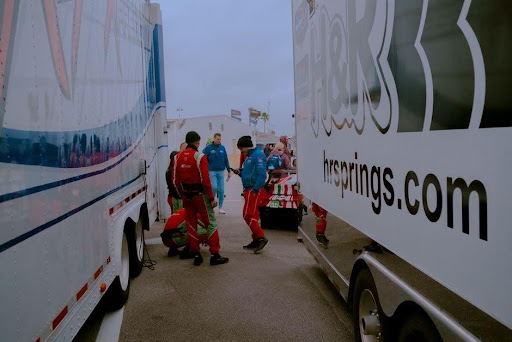
Every race weekend starts long before the green flag. It starts on an interstate, usually in the dark, with a transporter carrying two race cars, spare parts, tool boxes and most of a team’s working garage. Fans see the haulers roll into the track in a neat line. Few people think about the hundreds of miles behind them.
Hauler drivers are some of the least visible people in the sport and some of the most important. If the transporter is late, practice is late. If it doesn’t show up, nothing else matters. Their job looks a lot like long-haul trucking, with one big difference: the delivery window is set by a TV schedule.
A trucker’s job with a pit crew’s deadline
A NASCAR transporter is a full-size tractor-trailer, and the person behind the wheel needs a commercial driver’s license like any other professional driver. Many teams put two drivers on each hauler so they can split the long runs.
The season runs from February to November, often with back-to-back weekends in different corners of the country. A trip from the race shops around Charlotte to a West Coast track is a cross-country haul. The trip home starts as soon as the cars are loaded after the checkered flag.
The clock you can’t argue with
Like other interstate truck drivers, hauler drivers work under federal hours-of-service rules set by the FMCSA. For drivers hauling property, the basics are simple to read and hard to live with:
- Up to 11 hours of driving after 10 consecutive hours off duty.
- No driving after the 14th hour on duty.
- A 30-minute break after 8 hours of driving.
Those rules don’t bend for a qualifying session or a rain delay that pushed the race into Monday. So a good trip plan covers more than distance. It answers a harder question: where will the truck stop when the clock runs out?
Where does a 70-foot rig spend the night?
This is the part of trucking that’s hardest to plan. When the hours are used up, the driver needs a legal, safe place for a full tractor-trailer. Across the industry, more drivers now book that spot ahead instead of hunting for an open space at 2 a.m. Platforms like TruxSpot let drivers and dispatchers reserve parking for a semi or trailer by the hour, day, week or month, with instant confirmation.
The reason is simple: there aren’t enough spaces. In the Federal Highway Administration’s Jason’s Law truck parking survey, 72% of states reported truck parking problems, and shortages were worst along major freight corridors and near big freight hubs. Plenty of tracks on the calendar sit right next to those corridors.
On race weekend, the track’s hauler lot is waiting. The trouble comes on the way there and back: a Wednesday night outside a big metro, a layover between two West Coast races, or a truck sent out early for a tire test. For anyone planning a 2,000-mile run, knowing exactly where the truck will sit during its 10-hour break turns a guess into a schedule.
It isn’t only the Cup teams
The transporters in the garage are only part of the convoy. Race weeks pull in show-car trailers, sponsor display rigs, merchandise haulers, hospitality units, media trucks, and the suppliers that bring tires and fuel. Smaller teams in the Truck Series, ARCA and regional series often run tighter budgets and fewer drivers, so every stop has to count.
All of those trucks land in the same area during the same few days. Truck stops near a speedway can fill up fast on race week, just like the hotels do.
What the best hauler drivers do differently
Talk to people who move race equipment for a living and the same habits come up:
- They plan stops around the clock, not the map. The question isn’t “how far can we get?” It’s “where will we be when the 11 hours are up, and where do we park there?”
- They book ahead near big events. A reserved spot near the track or on the approach takes the stress out of arriving late at night.
- They keep a backup. Weather, wrecks and road closures happen. A second parking option along the route saves a lot of scrambling.
- They keep the paperwork clean. Electronic logs, permits and inspections all have to be in order. A roadside inspection that finds a problem can cost more time than any traffic jam.
- They treat rest as part of the job. A tired driver at the wheel of an 80,000-pound truck is a risk to everyone on the road. Good rest is how the cars, the crew’s work and the driver all get there in one piece.
The quiet part of a loud sport
Racing celebrates speed, but the sport runs on patience: miles logged at the legal limit, breaks taken on time, and parking spots found before they’re needed. The next time the transporters roll through the tunnel on Friday morning, remember the night drive that got them there. Somewhere behind each one is a driver who planned every stop so the team could focus on going fast.