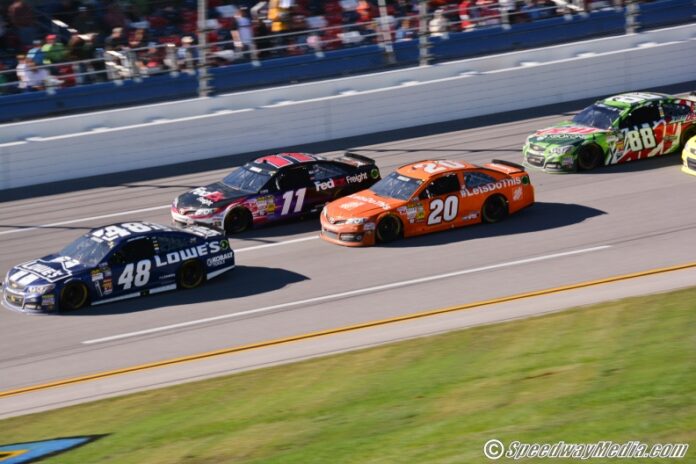

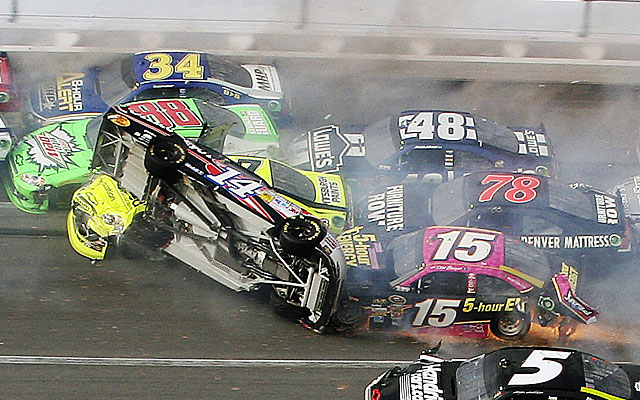
At the conclusion of the Bank of America 500, fans were raving about the finish and seemed generally satisfied. The first 300 laps though featured very little passing with rare, evanescent battles but the enthralling fight for the win still made it a good race in the eyes of many. Talladega on the other hand was a non-stop thrill ride and had everyone on the edge of their seat until the anti-climatic finish that left fans with a bitter taste in their mouths. That begs the question; does the finish make or break a race? Should we be basing the quality of a four hour event simply on how it ends? What makes a NASCAR race a good race and what do fans really want to see?
I judge a NASCAR race based on four factors. Said factors are the racing, the finish, the wrecks and the unexpected variables that are sometimes described as the “wow” moments. A perfect NASCAR race in my mind has incredible racing from green flag to checkered flag, a photo finish with a winner being someone we don’t get to see much. I don’t want to see any track clearing pile ups but a good dose of spins and small crashes to keep the race from getting dull and strung out. A fantastic race with a disappointing finish like Talladega’s is better than an awful race with a good finish like Charlotte’s in my book although some will argue otherwise.
I see a contingent of fans out there that only care about the finish and the three hours of racing prior to the white flag means very little in their minds which is very shortsighted and not fair to the race. We live in a society full of people with short attention spans who need constant stimulation of their senses to keep them engrossed in an event and NASCAR is not the kind of event to satisfy those needs. The NFL has a stop-and-go feel to it with an intense few seconds of action followed by a pause and then they do it again…perfect for the people that I just described. Baseball has suffered a decline in ratings just as NASCAR has due to the fact that they aren’t able to hold the attention of these people.
An idea to keep less people from tuning out would be to shorten the races or do what the V8 Supercar series does for many of its events…they have two or three sprint races over the course of one weekend and the races are always wild. Their popularity has exploded over the last few years because of all the action. Many now call it the 3rd most popular motorsport on the planet next to NASCAR and Formula 1. I would love to see a few (not all) races on the calendar cut down into short, sprint races to add excitement to them and draw in a bigger audience. It works for V8 Supercars and it works for local short tracks so why wouldn’t it work for NASCAR? The sense of urgency would raise the level of intensity and aggression to riveting levels that would entertain both the die-hards and the new age fans.
There is another contingent of fans out there that I’d like to address for a moment and they kind of tick me off. I’m talking about the ones that love to see large, vicious crashes and watch for that specific reason. When you tell these pervasive people off, they will say you’re a liar and you love to watch wrecks too. My answer to that…there is a big difference between being captivated by a terrifying accident and wishing or cheering for it. It’s no secret that we have a primal instinct that craves violence and brutality; that is why so many people enjoy horror movies, gory video games and also why some of our ancestors went to the Colosseum to watch gladiators fight to the death. When some of us went to YouTube after the Cup race, it was most likely to see Austin Dillon’s airborne crash out of awe, amazement and curiosity; nothing wrong with that but if you only watch racing because you enjoy seeing drivers brush shoulders with death in horrifying accidents, then I say good riddance when you walk away.
There is so much emphasis put on violence in our culture today and people are becoming numb or desensitized to the reality of it. I don’t think these people that wish for wrecks want drivers to get hurt but they seem ignorant and blind to the fact that it can and will happen. I see a handful of tweets from people every time there is a big crash stating how awesome that wreck was before they even think about the welfare of the driver(s) involved. Then they are disappointed when we go to Talladega and don’t wad up at least half the field.
With the fast-paced tempo of the world today, the attention span of the average human has gotten shorter and shorter which hinders the growth of sports such as baseball and NASCAR. Like I stated before, a way NASCAR can counter this is by replacing some of the 500 mile marathons throughout the season with short, intense sprint races that last no more than an hour or so. We can either adapt and capitalize on the ever-changing needs of today’s society or be doomed by it…our choice.
Lastly, next time you tune into a race, I’d like you to ask yourself this question…
Why do you watch?
I watch for good, hard racing with hopes of a thrilling finish to cap it off but a monotonous ending doesn’t undermine the greatness of the race itself for me.
I hope that’s how you feel too.