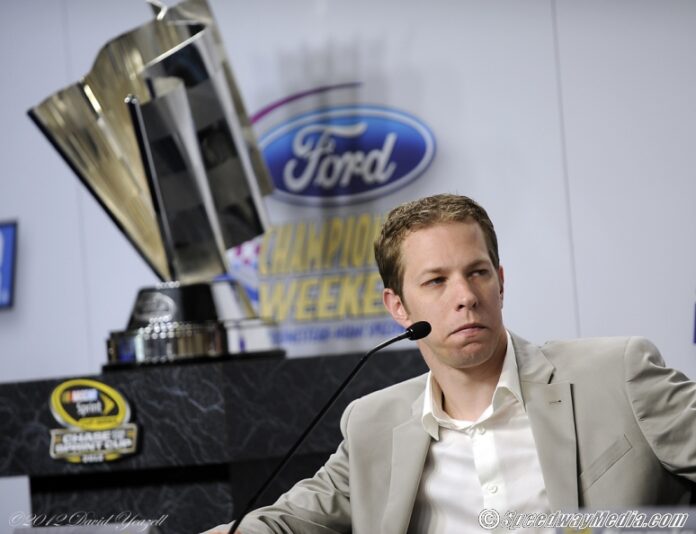
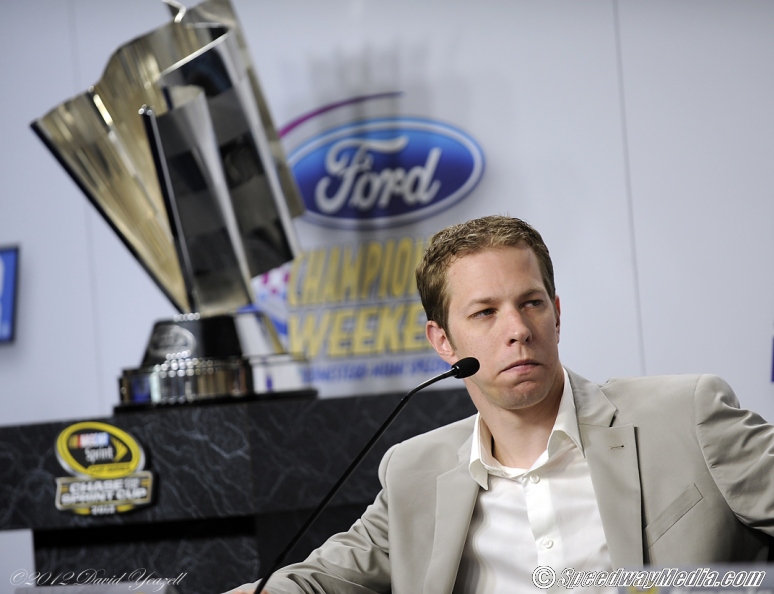
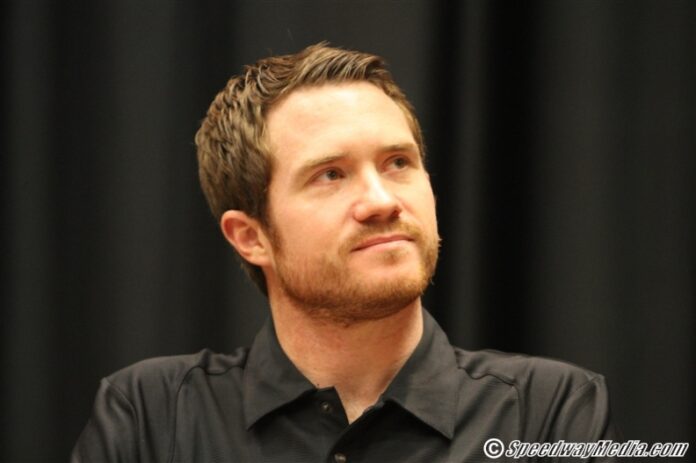
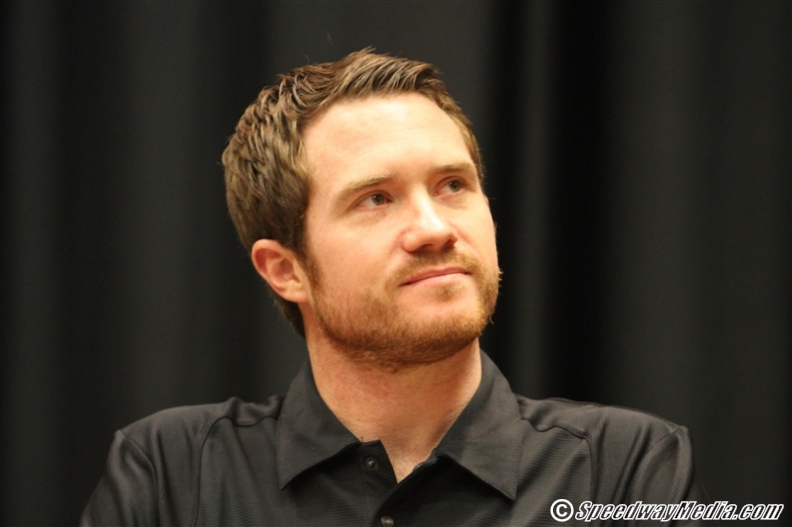
When he was a youngster, it seems that Brad Keselowski had a personal occupation list of two jobs that he thought would be very cool. The first fantasy job was driving a race car for a living. Obviously, he can check that one off of his list of things to do. He more than earned that right in 2012 when he won the NASCAR Sprint Cup championship for Roger Penske Racing.
It seems that Keselowski’s second fantasy job involved the broadcast industry: radio DJ to be exact. That occupational opportunity is going to present itself this Friday afternoon in Charlotte-North Carolina. Keselowski will be taking over the airwaves of radio station WEND, 106.5 FM, which is an alternative rock station commonly referred to as “The End.” The driver will be on the air from five to six pm, eastern time, and will be filling in for DZL, the station’s popular afternoon drive host.
Keselowski will be presented the option of playing any kind of music he wants. You can count on the fact his selections are going to be hard driving rock n roll. The kind of music that makes you bang the palms of your hands on your steering wheel as if it was an imaginary set of drums.
Keselowski’s broadcast adventure initially presented itself last May, during NASCAR’s All Star Weekend, when he met DZL the DJ at a public appearance in Charlotte. Keselowski made quick work of presenting DZL with a lengthy, and verbal, list of rock bands that should be featured on his show. DZL later said he recalled telling Keselowski “to worry about winning the Sprint Cup championship and if he did I’d let him come in, (to the station), and play whatever he wanted. He obviously held up his end of the bargain, so I guess I’ll have to hold up mine.”
Adding to the fun is an online auction that will earn a fan the right to visit WEND Radio and meet Keselowski. All proceeds from this auction will benefit the Checkered Flag Foundation, an organization created by Keselowski that supports wounded warriors and first responders, along with their families.
Here’s some good news for the racing fans who do not reside in the Charlotte-North Carolina broadcast area. You can dial up WEND’s official website, www.1065.com, and listen to Keselowski’s radio DJ debut via a live computer stream.
At the least case scenario, this radio debut should be interesting. At the best case scenario it should be hilarious, featuring the type of antics we’ve come to expect from “Bad Brad.”
NASCAR team owner Rick Hendrick (center) is surrounded by his four Sprint Cup Series drivers (left to right) Kasey Kahne, Jeff Gordon, Jimmie Johnson and Dale Earnhardt Jr. during Day Three of the NASCAR Sprint Media Tour hosted by Charlotte Motor Speedway. (CMS/HHP Photo)
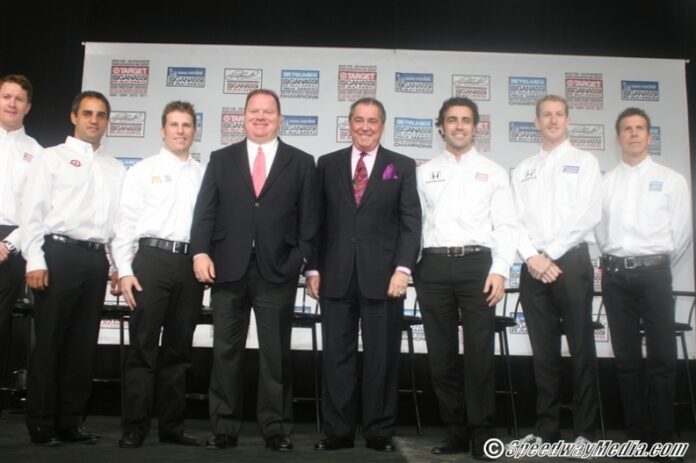
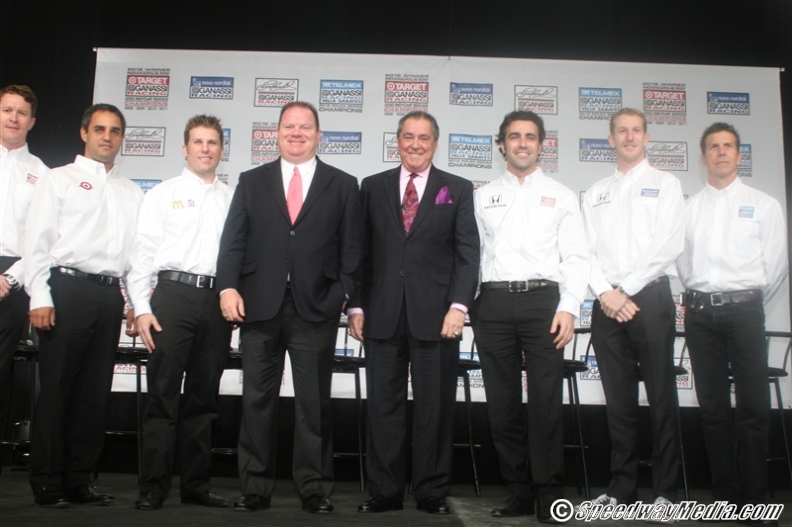
Day three of the NASCAR Media Tour came early in the morning at a hangar at Concord Regional Airport. It might seem strange to have a NASCAR function at an airport hangar, but it was soon to be very clear as the principals of Earnhardt Ganassi Racing and Chip Ganassi Racing took the stage.
After the usual introductory remarks by Dr. Jerry Punch, it was announced that a new sponsor had been signed for all Ganassi racing teams. Cessna Aircraft Company announced a strategic partnership with Ganassi for multiple races in the NASCAR Sprint Cup series, the IZOD IndyCar series, and the GRAND-AM Rolex Sports Car Series. This partnership extends Cessna’s presence across all three series.
“Clyde Cessna founded this company on our customers’ need for speed. Today, performing with precision to drive success is the purpose of business aviation,” said Scott Ernest, Cessna’s President and CEO. “The racing industry is built on those same principles—each day teams are moving as fast as they can to get from point a to point b and win, which is why this partnership is such a natural fit for both Cessna and Ganassi. This gives us a strong presence as we invest in the sport.”
Cessna, along with sister companies Bell Helicopter and E-Z-GO, is incorporated into every race to showcase transportation solutions to the industry including air travel to and from host cities, helicopter transport from airports to racing venues and ground transportation on site.
Cessna will sponsor multiple races on the No. 1 Chevrolet SS of Jamie McMurray in the NASCAR Sprint Cup series, sharing assets with Bell and E-Z-GO, one race on the No. 10 Honda with Dario Franchitti in the IZOD IndyCar Series and one race with Scott Pruett and Memo Rojas in the GRAND-Am Rolex Sports Car Series on the 01 Dinan-prepared BMW.
Ganassi looks forward to the partnership.
“With almost 70 races a year separated by hundreds of miles with little time in between, I rely on business aviation to help me keep driving my business and to keep winning,” Ganassi said.
It also was mentioned that Bass Pro Shops had lessened their support to the Sprint Cup teams to only two races in 2013, making the Cessna announcement very important to the organization.
As the opening event of the 2013 NASCAR Sprint cup season slowly and agonizingly drags itself into view (not unlike how a legless zombie might slowly tug itself on the ground as it pursues its latest dinner dish), so also begins the quiet exit-stage-left of the premier stock car racing organization’s greatest social experiment, otherwise infamously known as the Car Of Some Hideous Alternate Tomorrow.
2013, and more specifically the aforementioned upcoming Sprint Cup season reintroduces us to what NASCAR, only a short time ago, considered to be an utterly alien concept: A race car that might actually have at least a minor detail or two in common with what the automobile-purchasing plebes might buy at their local participating (insert name of nearby favorite-make car purveyor of choice here) dealer.
As I, the beleaguered author of this timeless (sorry, I meant to say “horrible”) opinion piece, gaze wistfully around yonder internet, I see an overwhelming amount of support for this momentous decision, made by the France cartel to return to the original model of NASCAR, pre-2007 (or 2008, the first full season of the COT/COSHAT), and use vehicle designs submitted by select automobile manufacturers…wait, sorry, oops, the few of you out there who might actually be reading this, and/or somehow managed to get even this far without clicking off this tab, you probably already know the “old” formula of how and where NASCAR secured the types of cars that would represent that erstwhile organization…since we’re all well-acquainted with the selection process, I’ll move on…okay, win on Sunday, sell on Monday…unless it’s a bank holiday…but wait, dealerships are open on most holidays…
Anyway, whatever the method might be for how the France cartel selects what cars will be allowed to run during a particular season is not important. What is important is that the life-altering choice to abandon the generic “Car Of Some Hideous Alternate Tomorrow” stands a fair chance of failing, the last gasp of a dying empire that may or may not change its fortunes as it attempts to maintain relevancy/right the ship in a lightning-quick, blindingly-short attention-span world, where everything has to be over and done with in 140 characters or less.
You see, although I have cracked jokes and written non-stop about the France cartel’s earlier plan to have a “spec” car, I consider it to be one of the most brilliant plans ever put forth by an automobile-based racing organization.
Let that sink in a moment.
Yes, you heard correctly, I’m dead serious, NASCAR actually did something right.
There’s a teeny, tiny, exiguous (okay, enough with the thesaurus) problem with that revelation, however. While NASCAR had an amazingly cunning plan as to what they should do to preserve their future, the problem is that they completely and utterly bungled the execution of said plan, in that they let a drunken, quadriplegic three-year-old with a bad case of the shakes (I forgot to mention that the designer also suffered from non-stop, complete snow blindness) pen the final design of the car. The COT was soooo hideous-looking, that it was uglier than a pair of bowling shoes. I think I have lusted more heavily for a brick I tripped over once compared to the non-love that I and countless others felt for this…this polished coprolite.
The issue is that NASCAR was correct in taking the lead into preserving their future, whatever other sins they might have committed cast aside (sorry, I don’t have enough numbers on my keypad to type out how many sins there are). The reason why I mention this, is that I feel that NASCAR stopped being relevant at the end of the 1997 season, and while popularity peaked around 2007-2008…I think the surge in popularity had more to do with aggressive marketing than anything to do with interest in what cars were being ran, or who was driving, or even what was going on out on the track.
Once new, incoming, and nontraditional fans (which amount to bored Star Trek fanatics) found out, unlike what the highlight reel showed on the evening news, there were, believe it or not, at times a few hundred laps between those spectacular crashes, which required that you watch the entire race to witness any potential carnage.
Why do I say NASCAR was no longer relevant at the end of the 1997 season?
The Thunderbird (or at least that version of the T-bird), used by all Ford drivers from the 1989 to the 1997 seasons, was no longer manufactured, having been unceremoniously shoved aside in favor of the new, far more aerodynamic Taurus. Ford had so destroyed the T-bird with shoddy, half-assed engineering (this car was supposed to be Ford’s version of the BMW…and it failed miserably), that when it was gone, only the mutants who really love these cars wept a bit when it vanished from store shelves.
Please be patient with me, I’m almost to the point of this story.
Why is this significant?
The Thunderbird was the last V8-powered, rear-wheel-drive car ever to ‘compete’ in NASCAR Sprint Cup competition (please disregard the Nationwide and Truck series, as nobody watches them anyway), the death of The Formula was finally complete, The Formula being cars that saw use were primarily RWD, front engine, and (mostly) V8’s.
And while I own a T-bird (1992 5.0 V8 car), I say right now that it has the capability of being one of the worst cars ever built, but at the same time, if one knows what to do with one concerning modifications, it’s possibly one of the better cars produced by Detroit out there…which is not saying much. However, given that nobody cares but maybe a few half-wits who like something different, there was absolutely zero fanfare concerning the loss of the final RWD car platform to be used in NASCAR competition.
Geeze, you’d think there would be a parade or something…but nope, the T-bird was pretty much hated to the point where nobody missed it when it was gone.
A note: The SS used by General Morons/Chevrolet/Government Motors in 2013 will not be discussed in this piece, as it’s a new release, and GM has screwed up almost every RWD sedan or coupe intro since the Impala/Caprice and Holden/Pontiac GTO/G8 fiasco.
And now we have arrived at “The Point”. The biggest problem facing NASCAR at the time that the Car of Tomorrow was released for public scrutiny is that unlike Formula 1, and Indycar racing, not to mention other forms of motorsport out there…The NASCAR Circus can only survive if it receives fresh meat from the auto manufacturers in the form of…bodies.
Car bodies, that is.
NASCAR is a weird version of “Invasion of the Body Snatchers,” in that the series was formed around production-based automobiles, and has relied on the whims, tantrums, and outright crappy decisions of auto manufacturers throughout their entire existence in order to provide something of a canvas or a “body” for race teams to create their mighty 4-wheeled steeds to compete with.
If one thinks, for a moment, about the enormity of that last statement, and also thinks long and hard about what the “Big Three” have (not) produced in the way of sexy-looking cars since the high-water mark point of 1969-1970, one can only look on in horror when realization sets in, with what NASCAR, which is pretty much a race promoter above all else, has had to put up with from moronic automobile manufacturers for the thirty-eight or so years of appalling, tasteless, and utterly horrific automobiles from the design studios of America’s supposedly best and brightest in the auto biz.
Where it all truly began to go wrong was in 1973, and poorly-executed-and-implemented, Federally-mandated crash bumpers. Essentially regular cars with giant chrome-plated logs on either end, most everything from 1973-on, after the end of the ‘Aero’ era at the close of the 1970 season, and the transition years of 1971 and 1972, the ugliness in American automotive design, the implementation of poorly-performing smogger engines, (whoops, forgot the gas crunch and the great auto insurance company rape-and-pillage!) not to mention the appalling reliability that followed closely behind put serious dents in how excited Americans were about their cars. Meanwhile, pocket rockets that were truly a blast to drive were being unveiled by Europe…
I cannot find anyone from that era, from 1973-up, who was truly excited about the cars built after 1969-1970. There are of course differing opinions as to what went wrong…but this is called an ‘opinion’ piece for a reason, even if it’s a demonstrably bad opinion.
Domestic cars suffered from yes-men at the corporate level, the obsession with telling customers what they should or should not be driving…and when the Japanese came calling with the Accord and the Camry…and the ability of Japanese cars to easily last 200,000 miles and more, millions took that opportunity to vote with their dollars, and completely ignored the domestic offerings…to current day. To a lesser extent, the European contingent also did a number on the USA market, in that they produced some reeeeeally fun cars to drive, such as hatchbacks like the Volkswagen GTI, the various insane turbo cars, and the Audi Quattro…
I feel that NASCAR did their very best with what Detroit had to offer, but matters became much more difficult when 1988 rolled around, and General Morons, I mean General Motors finally ended almost their entire RWD lineup (the Camaro/Firebird and trucks being the lone holdouts), and front-wheel-drive poser cars were unleashed by GM as ‘race cars’, never mind that none of them were actually ‘racy’, nor did they sell very well, short of being standouts in the yawnfest rental car market. I can recall a lot of grumbling from 1988, as fans realized that the GM cars out on the track were nowhere even near ‘stock’ like the cars on the showroom floor.
This general malaise continued until 1997…when the last RWD car raced in the highest level of stock car racing…and took three of the top four spots in the Winston Cup for that year. Nobody lamented its passing, nor did they care that it was gone, as Ford ignored the teams that used the Thunderbird body for 9 consecutive years, as it fared poorly against the Grand Prix of Pontiac, and the Luminas and Monte Carlos of Chevrolet, having way too much frontal area, and having almost zero downforce in the rear…at least until someone realized you could tilt the body forward on the frame, and recapture some downforce. Ford, however, as pretty much every other manufacturer out there did as well (an exception can be held for GM, of course)…simply did not care, although it threatened the banhammer against the team or two that attempted to run the reportedly-faster Lincoln Mark 8 in place of the T-bird…
As the initial design phase of the COT rolled around, I think NASCAR realized that the domestic automakers could care less about the cars they produced, which in part might have led to their decision to allow Toyota into the gang, and also influenced the plan to push out the manufacturers all together, becoming a series like Formula 1, where there are fairly-standardized shapes and chassis design, and the ‘manufacturer’ is more of an engine supplier, which, to an extent, means a bit more freedom for the manufacturers themselves, as they can be functionally lazy about having to make a body suitable for NASCAR.
As time slowly marched by, and manufacturers went ‘aero’, in order to get better gas mileage (it sure wasn’t an attempt to make the cars look better), the art inherent in the older cars disappeared, as gelatinous blobs took the place of interesting shapes, with contrasting details such as grilles, chrome trim, distinctive body lines, fairly-perfect proportions, etc, etc, vanishing as well. What was left by the time the 2007 season rolled around were absolutely trippy shapes that nobody recognized, and RWD race cars that were based on FWD sedans that were the darling of the cheap rental set. There’s a paraphrased statement of mine from the aircraft industry, in that if it looks good, it will probably fly good…and while it’s a good thing that sexy-looking planes fly well, for some strange reason, auto designers, with a few exceptions (notably outside of the U.S. domestic market) have not been able to design cars that go fast and look sexy at the same time.
To close this out…I think NASCAR conned the manufacturers into going along with their plan for the COT, eliminating the “production-based” thorn in their side that had plagued them for almost four decades, but failed so badly in the execution in this plan that instead of redesigning the COT from a fresh, blank-slate design that might actually look like something that would make men kill their wives and mothers-in-law to own (well, most guys I know don’t need that much motivation to bump off mom-in-law, whoops), the France cartel went the ‘familiar’ route, and listened to ‘history’, never mind they have forgotten that the past gave us such horrific cars like the Citation, the Cimarron (make that pretty much every FWD GM car ever made), the LTD, the Cordoba, etc, etc.
I hope it works out okay, as the 2013 NASCAR fleet looks pretty aggressive (I think a two-door Fusion or a Fusion wagon would be the bomb), but I think it is going to take a heck of a lot of work to undo the damage, the unintended consequences wrought by both the domestic automakers in their arrogant refusal to give us the good stuff…and NASCAR’s complete botching of the Car Of Some Hideous Alternate Tomorrow.
To summarize, NASCAR and the participating auto manufacturers find themselves in between the proverbial, and mystical rock and a hard place, in that a renewed interest will be created in a sport that benefits everyone, but stands a good chance of being screwed up to the point, yet again, where nobody will benefit, and racing everywhere is dealt a near-mortal blow.
If at first you don’t succeed…call it the Car of Tomorrow.
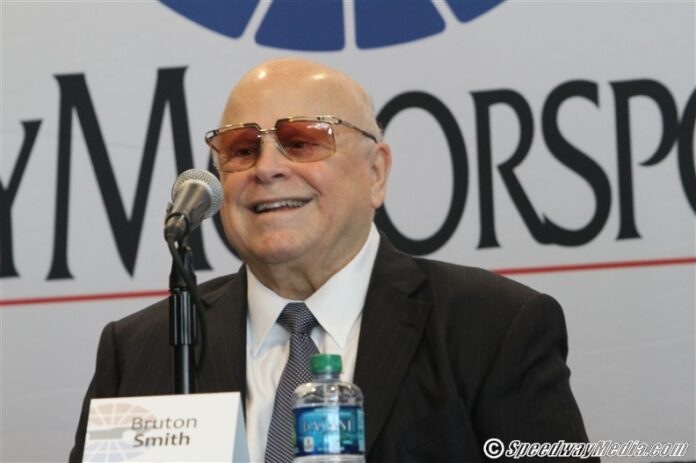
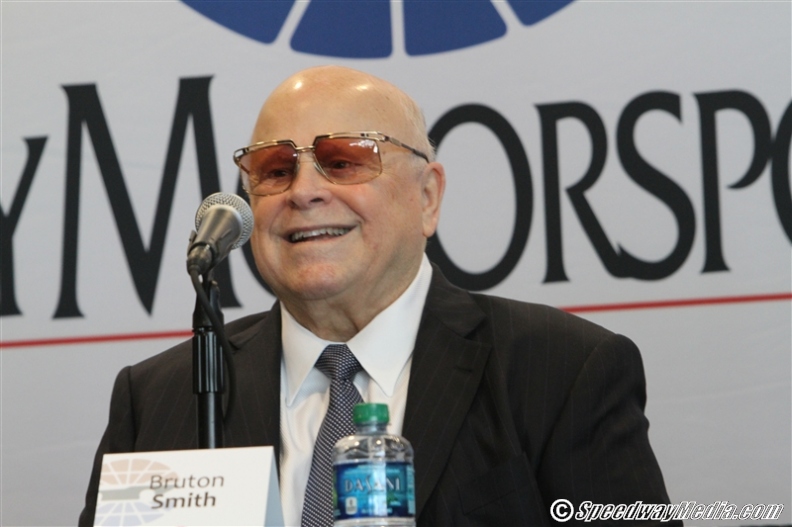
Day two of the Sprint Media Tour ended with a trip to Charlotte Motor Speedway and the Chevrolet dinner at the guest hotel. CMS hosted what was called “A Taste of SMI.” With SMI Chairman Bruton Smith holding court, the media was told of changes being made at each of the corporation’s tracks and how all the changes were to make tracks more fan friendly.
Each track’s General Manager told how they were changing things to attract more fans to their track. The changes included perks for first time attendees, long term attendees, people with children getting a reduced ticket price for their young ones, and top notch concessions. All of the SMI track chefs were there and featured such items as Coca-Cola Tacos, Green Beer, Bacon Cotton Candy, and Fried Bourbon Balls. Not all items will be featured at each track. For instance, the green beer will be a Bristol-only treat because the March race is hear St. Patrick’s Day and the bacon cotton candy is a specialty of Texas Motor Speedway.
Earlier, Smith asked the media to help him change two things about NASCAR. He wanted the media to lobby fans and NASCAR via our writings to outlaw teams who start and park and convince NASCAR to slow down the racing.
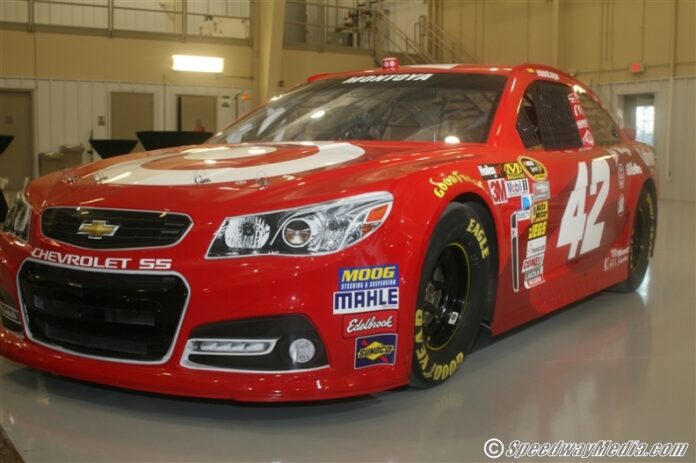
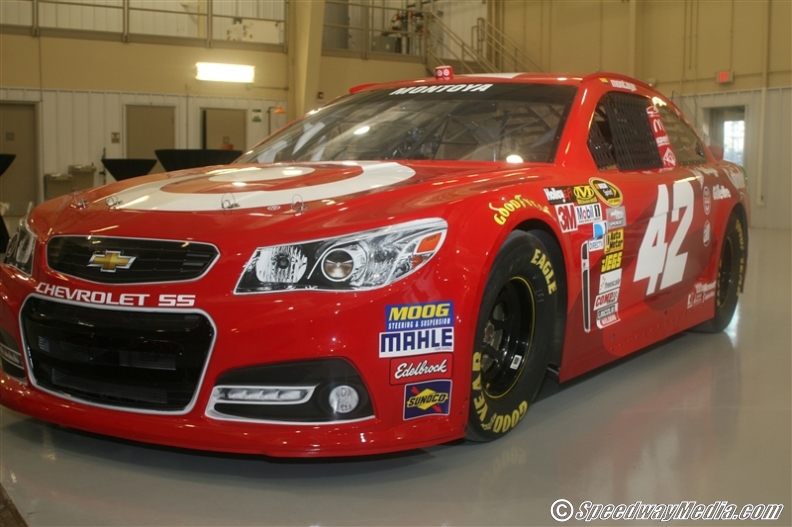
The Chevrolet dinner was an explanation. Chevrolet officials went through the process of how the Chevrolet SS car was developed from carbon fiber model to clay to what you will see on the speedway in the Sprint Unlimited and the Daytona 500. Although the production model of the SS will not be revealed until February 16th and actually arrive in showrooms until later, it was a long process and from the looks of the finished product, very successful.
The final event of the day was Nationwide Insurance’s Rally hospitality event to raise money for Nationwide Children’s Hospital. Several Nationwide Series drivers were available for interviews and money was raised for a great cause. All in all, it was a very busy and rewarding day.
If life is a game of inches, as Al Pacino’s character once said in the 1999 movie Any Given Sunday, then Brian Vickers has yet to run out of inches. For his margin of error, his movements fast and slow and decisions right or wrong, have yet to permanently derail him.
Vickers has stared down every obstacle thrown his way the last few years. Some, both personally and professionally, than many other NASCAR drivers will encounter in their careers. Whether it was daring to leave Hendrick Motorsports, eyebrow raising enough to join Red Bull Racing to strong enough to race again following life and career threatening blood clots and heart surgery.
“The silver line is I’m alive. That’s always a plus. That all those events led me to where I’m at right now,” said Vickers on Tuesday during the media tour at Michael Waltrip Racing.
“Quite honestly, I’m very happy where I’m at right now. Very happy where I’m at with my life personally, professionally – being at MWR, I feel like I’ve really found a home here. I feel like I’m splitting my time between two families now, I found a great home at JGR [Joe Gibbs Racing] as well.”
Let’s start with the current: the 2013 season will be Vickers 11th year in the NSCS. He has a part-time ride with MWR and full-time deal in the Nationwide Series with Gibbs, in which he’ll race for the championship. One he won back in 2003. Perhaps he never thought he’d get the chance again, he was after all, on the rise to stardom in Cup before his life changed forever.
That would be where the past comes in – it was May of 2010 while enjoying time in Washington, D.C. that Vickers started to feel unlike himself, suffering chest pains. Wisely deciding to head to a hospital blood clots in his lungs, legs and finger were discovered. While he took the necessary precautions in treating those, he would have heart surgery after doctors found a hole between the left and right atrium in his heart and was informed he had May-Thurner Syndrone – a condition that puts an individual at risk for more blood clots and possible strokes – and was done driving halfway through the season.
Incredibly he was back by the start of the 2011 season. Except his career hasn’t been the same. Even though Vickers helped put Red Bull Racing on the map, in Victory Lane and the Chase, they shut down. Since then, he’s been working his way back towards the top.
“I’ve grown and changed a lot as a person and I think everybody does as they age, but especially when you go through traumatic events in your life,” Vickers noted. “Your perspective on life changes. When I’m at the racetrack, I’m probably as engaged or more engaged than I’ve ever been in my whole entire life. At the same time, when I’m not at the racetrack I’m probably more disengaged than I’ve ever been and I think it allows me to balance my life in a way that I’ve never had.
“I think it keeps me from being burned out. It keeps me from falling into a lot of pitfalls that I think it’s easy to fall into in our sport. Our season is so long and so in depth that you kind of get sucked into it. You do that for so many years and you see a lot of guys just get burned out. The experiences that I’ve gone through created balance in my life that is a very healthy balance and when I show up at the racetrack I’m happier than I’ve ever been.
“I enjoy the team I’m with. I enjoy the people I’m around. I just enjoy racing and I think I appreciate it more than I ever have.”
When Vickers will return to NSCS on a full-time basis is yet to be determined. He isn’t even sure, but he’s not rushing it. If the last few years have taught him anything, it’s to enjoy life to the fullest and Vickers certainly has. From skydiving, to racing in different series around the world, to enjoying simple things like getting to attend other sporting events. Racing has never been far from his mind, but it just hasn’t been the only thing on his mind.
Until now, that is. Now the time is right again. But don’t read wrong, Vickers loves NASCAR and this is where he belongs, but getting to partake in the events he did were perhaps a once in a lifetime experience.
For 2013, splitting time in two different series will provide Vickers with full hands, although don’t expect to find him complaining about it.
“It’s going to be a different year. It’s going to be just like it used to be. It’s actually going to be like going back 10 years,” Vickers said about his upcoming season. “It’s going way back. Compared to last year it’s going to be very different.
“Last year was an amazing year and wouldn’t trade it for anything in the world. I got to race a great car for eight races with Mark [Martin] and Michael [Waltrip] and everyone at MWR and Toyota. Then I got to travel all through Europe and around the world racing sports cars and I loved it.
“This year, it’s back to NASCAR and back to full-time again and I’m looking forward to it.”
And looking forward to the unfinished business he left behind.
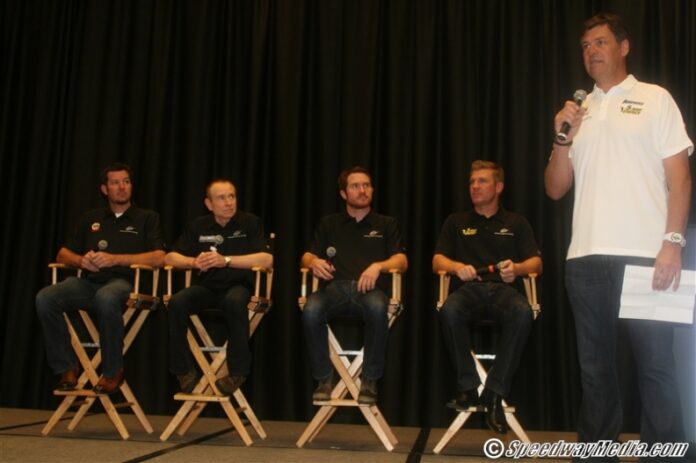
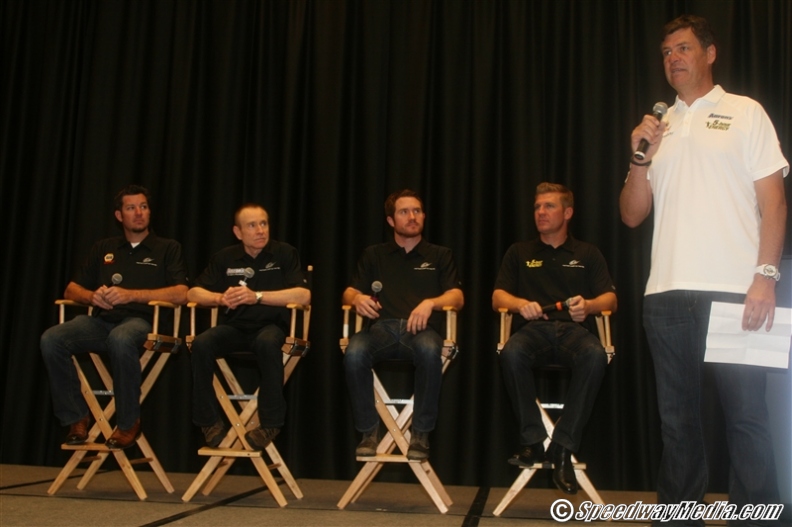
On Day Two of the Sprint Media Tour, Michael Waltrip Racing was featured. Waltrip’s team was considered the most improved in 2012, having two of his three teams make the Chase and the third very close. This year, there are few changes at MWR.
“If you’re looking for change, there isn’t any,” Waltrip said. “We’re going to try to build on last year.” Clint Bowyer was cautiously optimistic. “I don’t think we overachieved, because I think when you say overachieved it means you did more than you’re capable of, Bowyer said. “I just think we were beyond expectations and what people expected of us. I’m very proud of what we accomplished last year.
I’ve looked forward to this year and what we have in front of us and the opportunities ahead with this new car and continue to build on what we had last year. That’s more important to me right now, is making sure we get the year started off right and the only way I know to do that is to win the Daytona 500.”
Bowyer was asked what it was like being around someone like Mark Martin.
“You know, Mark Martin first of all is a class act. He’s a racer, he’s driven beyond belief. His focus and determination is incredible and is just a great asset for our program and to be around as an individual. I’m very, very happy that he’s my teammate. I’m very appreciative of the fact that he’s my teammate and hopefully he’s in the sport for many years to come,” Bowyer said.
Mark Martin was asked how he felt about the new Gen 6 Toyota.
“This is not a dramatic change from what we had. In most ways, it’s subtle improvements all around until it gets to the aesthetics, and then that is — I would say — a huge improvement, Martin said. “Aesthetically, it’s a big change. Mechanically, it’s a nice improvement, a nice evolution of what we were doing, so operationally it’s not that huge. We went to the race track and we picked up where we left off at the end of last year and I saw most, pretty much everyone do that.”
Martin Truex, Jr. came close to winning races last year, but the improvement was possibly more dramatic with his Toyota.
“Really, it was the end of 2011 that got it started. We built new cars, we did a lot of things differently, had momentum going into the off-season, felt good and had a good direction going into 2012. I told a lot of people last year — or last winter – that we were going to be somebody that could go out and run strong each and every week and I felt like we could go out and make the Chase, and we were able to do that. It started in 2011 for sure, but it was mostly a direction of the team. The direction that the team was going in because of our leadership, because of Michael (Waltrip, co-owner) and Rob’s (Kauffman, co-owner) commitment to put our team where it was last year. And, that commitment obviously is to keep going in that directly and hopefully we’ll be able to do it this year.”
Truex also mentioned that the reason sponsorship was so stable at MWR was that the organization was “all in” in sponsors. “Here’s what we’re going to do for you and here’s what it costs,” Truex said. Sponsors like that.”
Co-owner Waltrip was very enthusiastic about the new season, but at the same time amazed at how good the formula worked.
“I was just amazed at Brian Pattie’s (No. 15 crew chief) ability to run a race,” Waltrip said. “To help Clint Bowyer go win races — he really was a master strategist. He understood when to get gas and when to get two tires and so you put a guy behind the wheel like Clint Bowyer, who showed up in NASCAR and you could tell that he could drive a car better than most and then you give him a guy that’s a bit of a risk taker and a call maker and put him on the pit box like Brian Pattie and you couple all that with the support that Scott Miller (competition director) and the boys that build the cars and do the engineering at MWR — they were a really fun combination to watch. I’m just looking forward to watching them go again in 2013.”
MWR will make no changes, as the co-owner said, from the formula that worked so well in 2012. Bowyer and Truex will have full time rides with Martin and Brian Vickers sharing the third car.