
Home Blog Page 5537

The Mudsummer Classic at Eldora

Was this onetime event a success?  Considering that it was sold out the day tickets became available, that they sold tickets to 48 states, and four different countries, was standing room; and from the looks of lawn chair seating as well, then yes it was a success.

Were they impressive? By all means, and fun as all get out to watch, getting to see some historic dirt racers trying to learn how to pilot those big bulky trucks was great.  Getting to see guys that thought dirt was only used to grow crops try and figure out how to actually drive on the dirt was a blast.

Did NASCAR get it right this time?  I would say yes.  When the format was originally announced I wasn’t sure where I came down on how this was going to play out on T.V. and let’s face it, that is what was the most important aspect of this event, how well it was perceived on television is what would ultimately be the final grade on the quality of the event.

Seeing seven trucks racing to try and secure their starting spot was great, thoroughly enjoyable and something that I think that NASCAR should consider revisiting for the CUP series.  My good friend and fellow Speedway Media write Nick DeGroot wrote an article detailing this a few weeks back and is something that should be checked out, you can find it here: Qualifying Changes.  For those that missed it, or haven’t read about it elsewhere, here is a brief synopsis of how the qualifying worked for the “Mudsummer Classic” worked.

Each driver went out and ran a “hot lap,” basically a qualifying lap and based upon their speeds they were seeded for the nights qualifying races.  In each qualifying race seven trucks battled for position in the main event race that would be held.  Kenny Schrader, who is now the oldest person to ever qualify on the pole, won not only the pole but also the first heat race of the night.  Now in the heat races when the caution came out, any laps run under caution did not count.  All in all the heat races were fairly tame.  There were a couple of cautions for self spines but that was about it.  The heat races locked in 25 drivers to the main event.  Then there was the “Last Chance” qualifier, which took the 10 trucks that had not already made it into the main event and would only allow the top-5 finishers to race in the big show.  This is where it got pretty entertaining, everyone in this race was hungry and racing for pride.  Where as in the other races there were highlights of good hard racing for position, this last chance qualifier race saw tons of beating and banging.  Several restarts and some pretty disappointed drivers and teams.  IT WAS GREAT!

Now to the main event, three segments broken into a 60 lap event, 50 laps, and finally 40 laps.  Between each segment teams were allowed to come down pit road, make as many repairs and adjustments as they could in about three laps and then would return to the track in the same spot that they ended the previous segment.  We were treated to some great side by side slide job racing during this 150 lap event and it was very entertaining.  So to answer the question that started this article, was the event in and of itself a success? Yes, without a doubt and it is something that has excited not only the fans, but drivers and teams.

Who didn’t see this coming though?  BUT, will it remain a success?  Ultimately isn’t that what we the fans and community want it to be?  Was the Mudsummer Classic something that is going to be looked forward to every year; something that sparks that excitement level in everyone for years to come?

This is where I caution everyone to tap the brakes for a moment.  There were flaws in the event, despite what we felt was an entertaining race.  NASCAR returning to its roots was huge, and I am honestly not trying to throw them or Tony or anything else under the bus, but realistically do we see this being a yearly event that will take a town whose population is around 209 people and exploded it to some 20k for a two night event.  This by itself alone proves that Tony Stewart and everyone else involved in the event did an amazing job.  The drivers that have dirt experience even commented and complimented Tony on all of the hard work he did, and how perfect the track was for the event.

Let’s take a look at another historic track that NASCAR had never been on, and see what parallels we can draw from there.  The Indianapolis Speedway, you really can’t get much more historic than that can you?  NASCAR finally raced there for the first time in 1994.  The track has been around since 1916, and has the second highest paying purse in NASCAR, (next to the Daytona 500).  In its first year it drew some 250,000 spectators to the event.  Impressive numbers to say the very least, but let’s be honest with each other, when was the last time you as a fan got excited about the Cup cars being at Indie?  I know there was a ton of excitement last year because the Nationwide cars finally got to race on the big track, but honestly when was the last time you circled this event on your calendar and held a race watching party for it?  That’s what I thought.

Back to the trucks, when the format was announced of 60, 50, 40, my first thought was, “How cute they are giving the trucks their own all-star race.”  It felt quite simply, wrong to me.  Being raised on NASCAR, the races are supposed to be run in one long continuous segment.  Yes, I get that they had to break it up like this to accommodate 30 trucks on the track at the same time or should I say pit road at the same time.  Still doesn’t change the fact that it originally felt wrong to me.

Now to the event itself, it was a slam dunk success this year.  And quite honestly will be for at least two years more, but this is not a cure all for what is ailing NASCAR.  When we stop thinking about the event itself, all the hype and hoopla that surrounded the event, at the end of the night it was all NASCAR, trying to figure out a way to fix NASCAR.  While it was fun and entertaining as a one shot deal, but realistically we aren’t going to see Cup or Nationwide cars back on dirt in this generation or even the next generations’ lifetime.

NASCAR is  trying to lure in more fans and a younger audience, and the trucks running at Eldora or heck even having half their schedule on dirt might do that for a short time fix.  If NASCAR truly wants to fix attendance and T.V. ratings they need to stop with gimmick fixes like this event and focus on improving the quality of the racing on the track.  Figure out a way to keep the guy that starts first from having an incredible advantage on the rest of the field would be a HUGE leap in the direction of fixing what fans want.

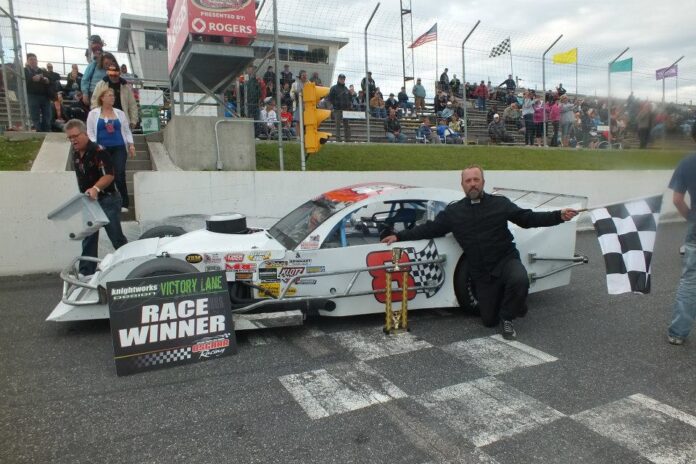
Dwayne Baker scores second win of the season at Sunset Speedway

Photo Credit: Ashley McCubbin

In his third feature of the year, Dwayne Baker would score his second win as he would hold off Jeff Hanley and Shane Maginnis. The 2013 Don Biederman Memorial Champion battled side-by-side with Maginnis for many laps before taking the lead in the late stages behind the wheel of his No. 48 Zancor Homes, Innisfil Machine and Welding and Baker Performance Parts Super Late Model.

Baker won the first heat ahead of Kevin Cornelius, Jesse Kennedy, Glenn Watson, Ian Bourque, Cory Jones and Roy Passer.

On lap one of the second heat, Brent McLean spun to bring out the caution. Andrew Gresel drove his No. 81 CUSW/Sauble Falls/McRobert Fuels Super Late Model to victory lane ahead of Maginnis, Derrike Tiemersma, Wayne Issacs, Shane Gowan, McLean and Rob Gibson.

Brandon Watson won the third heat behind the wheel of his No. 9 The Smart Exchange – Propane Cylinder Exchange, Ken MacKinnon Construction, Barrie Frame & Alignment, and Knightworks Design Super Late Model ahead of Hanley, Mike Beyore, Tyler Hawn, Sean Cronan and J.R. Fitzpatrick.

Glenn Watson won the fourth heat behind the wheel of his No. 22 Line-X Protective Coatings – Barrie, Race2way.ca, Rival Office Solutions and Williamson Uxbridge GM Super Late Model ahead of Cornelius, Baker, Bourque, Roy Passer and Jones. Kennedy was on track but pulled off with two laps to go.

Tiemersma won the fifth heat behind the wheel of his No. 7 Wayfreight, Speedy Auto Machine, Castrol and Spira Fire Protection Super Late Model ahead of Maginnis, Gresel, Issacs, Gowan, McLean and Gibson.

Jeff Hanley won the final heat behind the wheel of his No. 70 Raylene Racing Inc and Carmen Auto Sales Super Late Model ahead of Cronan, Brandon Watson, Beyore and Hawn.

In the feature, Shane Maginnis drew the pole and battle side-by-side with Dwayne Baker early for the lead in his No. 03 Kerr Cadillac Goodwrench Service, Meguiar’s Canada, Douglas Engines and Canadian Linen and Uniform Service Super Late Model. The pair battled side-by-side till the caution flew on lap three for Sean Cronan having problems . With 47 laps to go, Maginnis led Baker, Jeff Hanley, Brandon Watson, Andrew Gresel and Kevin Cornelius.

On the restart, Maginnis pulled ahead of Baker, Watson and Hanley while Gresel and Cornelius battled side-by-side for sixth. Contact between the rookies on lap eight resulted in Cornelius’ hitting the outside front stretch wall, however continued without a caution. The caution flew, though, on lap 10 when Mike Beyore spun Cornelius. With 40 laps to go, Maginnis led Baker, Watson, Hanley, Gresel, Glenn Watson, Derrike Tiemersma, Wayne Issacs, Jesse Kennedy, Ian Bourque, Tyler Hawn, Shane Gowan, Roy Passer, Cory Jones, Cornelius, Beyore, Rob Gibson, Brent McLean and Cronan.

On the restart, Maginnis and Baker battled side-by-side once again with Baker grabbing the lead on lap 12 ahead of Maginnis, Brandon Watson, Hanley and Gresel. Though the lead wouldn’t stand for Baker as the third caution flew for Gibson spinning. With 38 laps to go, Maginnis led Baker, Brandon Watson, Hanley, Gresel, Glenn Watson, Tiemersma, Issacs, Kennedy, Cornelius, Hawn, Passer, Beyore, Gowan, Jones, Gibson, McLean, Bourque and Cronan.

On the restart, Maginnis and Baker battled side-by-side all the way till the fourth caution for Bourque spinning on the backstretch on lap 17. The incident actually started back in turn one when Issacs came down on Cornelius, causing Cornelius to slow down. Cornelius slowing down caused the domino effect with McLean hitting Jones and Jones spinning Bourque. With 33 laps to go, Maginnis led Baker, Brandon Watson, Gresel, Hanley, Glenn Watson, Tiemesma, Hawn, Issacs, Beyore, Passer, Gowan, McLean, Jones, Bourque, Cornelius, Gibson, Kennedy and Cronan.

There’d be another caution on the restart when Gibson would spin in turn two trying to stay off of Kennedy.

On the restart, Maginnis pulled ahead while Baker and Gresel battled for second. Baker cleared Gresel on lap 19, leaving Gresel to battle with Brandon Watson for third. Gresel would hold off Watson, leaving Watson to battle with his uncle Glenn for fourth. The battle wouldn’t last long as on lap 23 the sixth caution would fly when Passer, Gibson and Jones got together in turns one and two. With 28 laps to go, Maginnis led Baker, Gresel, Brandon Watson, Hanley, Glenn Watson, Tiemersma, Hawn, Issacs, McLean, Gowan, Kennedy, Bourque, Cornelius, Passer and Cronan.

On the restart, Maginnis pulled ahead once again while Baker and Brandon Watson battled for second. Baker grabbed second on lap 26, while Brandon battled with Gresel for third. However, the caution flew on lap 29 for the seventh time when Hanley spun Hawn. With 21 laps to go, Maginnis led Baker, Brandon Watson, Gresel, Glenn Watson, Hanley, Gowan, McLean, Kennedy, Cornelius, Passer.

On the restart, Maginnis pulled ahead as he done the other times followed by Baker, Gresel, Brandon Watson and Hanley. On lap 38, Hanley got by Watson for fourth. The eighth caution came out on lap 44 when Hawn got into the turn four wall all by himself. With six laps to go, Maginnis led Baker, Gresel, Hanley, Brandon Watson, Glenn Watson, Tiemersma, Cornelius, Kennedy, Issacs, Gowan, McLean, Bourque, Passer and Hawn with Maginnis choosing the outside for the restart.

The ninth caution flew on the restart when Brandon Watson and Gresel came together in turn two, both going around. Gresel reported afterwards that his power steering line broke. So now with six to go it was Maginnis leading Baker, Hanley, Glenn Watson, Tiemersma, Cornelius, Kennedy, Issacs, Gowan, McLean, Bourque and Passer.

The 10th caution would fly on the restart when Tiemersma would slow on the backstretch, getting turned into the wall by Kennedy. Still six laps to go, it was Maginnis leading Baker, Hanley, Glenn Watson, Cornelius, Issacs, Gowan, McLean, Bourque and Passer.

The third attempt at a restart failed once again as Cornelius would spin trying to stay off of Glenn Watson and Hanley when the pair made contact going into turn three. Issacs would then back contact with Cornelius afterwards.

The fourth attempt at a restart brought out the 12th caution when McLean was spun by Gowan. Still with six laps to go, Issacs led Baker, Hanley, Glenn Watson, Bourque, Brandon Watson, Passer, Tiemersma, Hawn, Gresel, Cornelius, Kennedy, Issacs and Gowan.

On the restart, Maginnis and Baker battled side-by-side for the lead till the 13th caution flew on lap 46 due to an incident with Passer and Issacs. With four laps to go, Maginnis led Baker, Glenn Watson, Hanley, Brandon Watson, Tiemersma, Bourque, Hawn, Gresel and Cornelius.

On the restart, Baker grabbed the lead from Maginnis ahead of Hanley, Glenn Watson and Brandon Watson.

Dwayne Baker would lead the final three laps to pick up his second win of the season. Jeff Hanley would squeeze by Shane Maginnis at the end to grab the second spot. Glenn Watson and Brandon Watson rounded out the top five.

Derrike Tiemersma ran sixth, followed by Ian Bourque, Andrew Gresel, Tyler Hawn and Kevin Cornelius.

Gary McLean returns to victory lane at Sunset Speedway

Photo Credit: Ashley McCubbin

After winning the season opener at Sunset Speedway in May, Gary McLean returned to victory lane at Sunset Speedway to pick up his second victory of the season.

The wrecks started right away in the first heat as Ted Patterson spun on lap five. Lane Zardo then pulled off on lap eight due to throttle and brake issues on his mod. Davey Terry won ahead of Brent McLean, Bobby Tolton, Branden Bullen, Ryan Dick, Dave Osbourne and Patterson.

Gary McLean won the second heat ahead of Brad Pearsall, Shane Stickle, Max Beyore, Dean Scott, Brian McLean, Mike Westwood and John Harper.

In the third heat, Osbourne spun down the front straight to draw the caution. Then on the restart, Bullen spun off of turn four, collecting Patterson. The next two restarts would both be called off as Terry and Brent McLean took turns jumping the start. Brent McLean grabbed the win ahead of Terry, Zardo, Dick and Osbourne. Tolton failed to make the start due to mechanical problems.

Stickel picked up his first career modified heat win ahead of Gary McLean, Beyore, Pearsall, Brian McLean and Scott.

Come feature time, Gary McLean drew pole ahead of Brent McLean, Shane Stickel, Davey Terry, Max Beyore, Brad Pearsall, Ryan Dick, Dean Scott, Branden Bullen, Dave Osbourne, Brian McLean, Ted Patterson, Mike Westwood, John Harper and Lane Zardo.

Gary McLean took the early lead ahead of Brent McLean while Terry and Stickel battled for third; Terry cleared Stickel for third on lap two ahead of Beyore. The first caution came out at lap three when Brian McLean spun. Under the caution, Patterson made his way down pit road and as he left, he took a pylon with him as it got stuck under his left front wheel. Staff quickly noticed it and pulled it out. With 27 laps to go, Gary McLean led Brent McLean, Terry, Stickel, Beyore, Pearsall, Scott, Bullen, Dick, Harper, Westwood, Brian McLean and Patterson.

Gary McLean would hold Brent McLean off on the restart and led ahead of Terry, Beyore and Stickel. The caution would come back out as Dick would spin around.

On the restart, Gary McLean jumped ahead again while Brent McLean and Terry ran side-by-side for second. Terry grabbed second ahead of Brent, Beyore and Stickel. The caution then flew for third time when Zardo spun.

On the restart, there’d be more trouble when contact between Brent McLean and Terry would cause Terry to go for the spin. Both drivers would be sent to the back meaning Gary McLean now led ahead of Beyore, Bullen, Osbourne, Pearsall, Brian McLean, Scott, Terry, Brent McLean, Dick, Westwood and Patterson.

Gary McLean pulled ahead on the restart while Beyore and Bullen battled for second. Beyore held Bullen off all the way till the next caution when Scott and Brian McLean made contact, resulting in damage to both cars.

Gary McLean once again got another good restart ahead of Beyore and Bullen while Pearsall and Osbourne battled for fourth. Pearsall would pass Osbourne a lap later before the next caution for Brent McLean spinning in turns one and two trying to stay off of Osbourne.

The restart came with three laps to go and Gary McLean pulled ahead while Beyore and Bullen battled for second. Gary McLean would go on to take the win while Max Beyore would hold Branden Bullen off to seal second. For both Beyore and Bullen, it marks their first podium finishes in the OSCAAR Modifieds, Beyore’s coming in his first ever Modified start. Davey Terry and Brad Pearsall rounded out the top five.

Dave Osbourne finished sixth, followed by Brent McLean, Mike Westwood, Ryan Dick and Ted Patterson.
