

NASCAR Drivers Are Athletes According to New Research
[media-credit id=62 align=”alignright” width=”240″] [/media-credit]A recent, first of its kind study published in The Journal of Strength and Conditioning Research proved definitively that not only are athletic skills needed behind the wheel of a stock car, but also that there is a significant correlation between performance on the track and the length of resistance training sessions.
The study also revealed that those stock car drivers who assessed their own fitness positively performed better on the track. Their conditioning also correlated with less fatigue and less susceptibility to injuries.
“The sport is actually more demanding now than it used to be,” four-time NASCAR Cup champion Jeff Gordon stated. “We’ve gotten smarter on the physical side of it, working out more.”
“So, I think the drivers are in a little bit better physical shape than what they used to be as far as preparing for the races.”
The study also showed that “upper body strength was identified as the most important physical ability for driving stock cars by 100% of the subjects in the study.”
“I do a lot of strength training,” Danica Patrick, NASCAR Nationwide driver, said. “I work with a trainer and he sends me programs every four or five weeks.”
“The most important thing is performing in the car so that is what I’m weight training for,” Patrick continued. “I feel that weight training is very beneficial for your physique.”
“I do two days upper and one day lower,” Patrick said. “The program changes throughout the year.”
“I take a month off at the end of the year to recover so I don’t get injured,” Patrick continued. “As the year goes on, I work on peak strength so what I do in the car is easy.”
“I think working out has to help and I’ve always felt that it helped me,” Patrick said. “I’ve always worked out since I started in racing and I work out as hard as I ever had right now.”
“I’m in as good a shape as I’ve ever been,” Patrick continued. “I think being prepared physically and mentally is a big part of racing for me. For myself, I know it helps me.”
The study revealed that “62.5% of the subjects reported cardiovascular endurance as one of the top physical demands of driving a stock car.” According to the research, this is consistent with the reports of the drivers who often feel intense fatigue, elevated heart rate and shortness of breath as a result of the physicality of their racing.
“I work with weights four days a week – just the different muscle groups and trying to get more endurance and strength,” five-time NASCAR Cup champ Jimmie Johnson said. “The mindset being that I’ll have more energy and perform better at my job.”
One important aspect of racing that the study highlighted was the need for strength training in order to assist in thermoregulation and heat tolerance. In fact, being able to cope with the temperatures in the race car was found to be the third most important physical demand of stock car racing.
“I don’t know if there’s a direct correlation but I think you might have a little bit of an edge if you can stay in shape,” NASCAR Nationwide Series reigning champion Ricky Stenhouse Jr. said. “I do work out. We have a great trainer at the shop.”
“When you’re in the seat every week, you work out every muscle,” Stenhouse Jr. continued. “The main thing is to stay hydrated in the cars and that’s what I really focus on.”
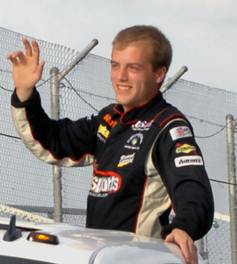
NASCAR Camping World Truck Series rookie driver Paulie Harraka agrees with his racing compatriot, especially as far as working out to deal with the heat. Harraka also added the element of dealing with the gravitational forces in the race car as another reason to include strength training in preparation for being on the track.
“Certainly as a driver, you’ve got to train for the g-forces that you feel,” Harraka said. “One lap is tough but it’s when you get to lap 150 and you’ve been in there and not able to move that you get fatigued.”
“You have to deal with that and with the heat inside the race cars.”
Finally, the study revealed that one of the major physical demands of stock car racing included hand/eye/foot coordination, reflexes and reaction time. In fact, 30% of the drivers indicated that “hand, eye, and foot coordination was an important physical demand associated with stock car racing.”
Two NASCAR drivers, Kasey Kahne and Carl Edwards, have taken this aspect of training to heart, using Dynavision™ D2, a machine that tracks and improves reaction time, peripheral awareness, hand-eye coordination and other visual-motor skills.
The D2 has a sphere of buttons that light up in random succession and the drivers have to call out the random flashing numbers in the midst of noises simulating those on the track.
“That’s the kind of environment that we race in,” Edwards said. “There is a lot of noise; you are focusing on different things.”
“You’re having to verbalize something a lot of times about the car,” Edwards continued. “So, that’s actually a good test.”
Whether strength conditioning, cardiovascular exercising or improving reaction times, the study in the Journal of Strength and Conditioning Research proves once and for all the athletic component of NASCAR racing and the correlation between working out and improving on-track performance.
Surprising and Not Surprising: Sonoma Toyota Save Mart 350
[media-credit name=”Credit: By Ezra Shaw, Getty Images” align=”alignright” width=”213″] [/media-credit]From the land of wine, as well as left and right turns, here is what was surprising and not surprising from the Toyota/Save Mart 350 at Sonoma.
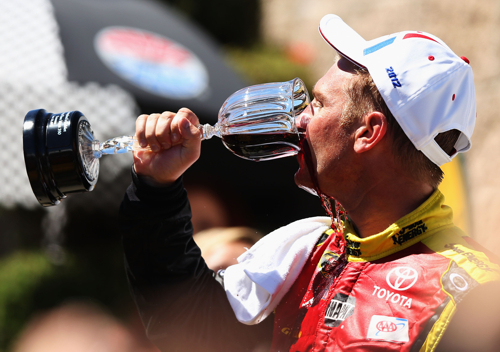
Surprising: The most surprising thing about the first road course race of the season was just how surprised the winner of the race was in Victory Lane. In fact, he was so surprised that he forgot his car, which was out of gas, and walked to Victory Lane.
“What the hell am I doing here,” Clint Bowyer, driver of the No. 15 5-Hour Energy Toyota for Michael Waltrip Racing, said. “I’m not a road racer!”
“Never in a million years did I think I could come here and be the best of the best,” Bowyer continued. “This is a dream come true. It was meant to be.”
This was Bowyer’s first victory for the 2012 season and his first victory at Sonoma.
Not Surprising: The second and third place finishers definitely had a mutual admiration society going on for each other after racing each other cleanly, particularly during the final green, white, checkered laps.
Tony Stewart, in his No. 14 Office Depot/Mobil 1 Chevrolet, finished second while Kurt Busch, in the No. 51 Phoenix Construction Chevrolet, finished third.
“I’m a little choked up,” Kurt Busch said after battling for the lead in spite of an injured race car. “I’m just glad we brought it home third.”
“If I was smarter, I would have let Tony Stewart go a lap, a half-a-lap ahead,” Busch continued. “Maybe he could have got to Bowyer for a big finale.”
“What everyone probably didn’t see was that something was wrong with his car,” Smoke said of Kurt Busch in the No. 51. “Something in the rear-end was breaking and he was driving the wheel s off that thing.”
“I don’t know how he kept it on the race track,” Stewart continued. “He did a really good job of keeping that thing going.”
Stewart scored his ninth top-10 finish at Sonoma and his third straight top-3 finish. Kurt Busch posted his fifth top-10 finish in 12 races at Sonoma.
Surprising: The seemingly strongest two cars on the road course had surprising struggles to contend with before finishing in the top-10.
The fastest qualifier, Marcos Ambrose, struggled in race trim, yet finished eighth, while outside pole sitter Jeff Gordon ran out of gas, losing track time and position to finish sixth.
“We really missed it,” the driver of the No. 9 Stanley Ford Fusion said. “We missed it bad and we did good to recover and get a top-10 out of it.”
“We had no speed in the car and we paid the price, “Ambrose continued. “I just feel bad for my Stanley team. It was just terrible.”
“We went about a half-of a lap too far,” Jeff Gordon said. “It never fails, you run out just as you pass pit entrance.”
“We were lucky to get back to pit road and get it fueled up,” the driver of the No. 24 Drive to End Hunger Chevrolet continued. “Luckily, we had enough laps to slowly work our way up into the top-10.”
Not Surprising: Since Dale Earnhardt, Jr., by his own admission, is not the biggest lover of road course racing, it was not surprising that last week’s Michigan race winner struggled at Sonoma. The driver of the No. 88 Diet Mountain Dew/National Guard Chevrolet finished 23rd after a late race accident.
“I’m just mad because we didn’t run better,” Junior said. “We weren’t good all weekend.”
“I mean I ain’t the best road course racer out there, but I can damn sure do better than that,” Dale Jr. continued. “We’ve just got to do a better job.”
Surprising: Joe Gibbs Racing teammates were surprisingly playing a different sport with one another. Late in the race, young Joey Logano, behind the wheel of his No. 20 Home Depot Toyota, tangled with not only Kyle Busch but also Denny Hamlin.
“He really overshot the corner and got into us,” Denny Hamlin, driver of the No. 11 FedEx Toyota, said of his teammate Logano. “Once you drive that extra 50 feet in, there’s nothing you can do to take it back.”
“We were the bowling pins and he was the bowling ball.”
Hamlin got the worst of the bowling tournament, finishing 35th, while teammate Kyle Busch, in the No. 18 M&M’s Toyota for Joe Gibbs Racing, finished 17th. ‘Bowling ball’ Logano managed to finish in the tenth spot.
Not Surprising: While he has not been regularly driving a stock car, it was not surprising that Brian Vickers was able to parlay some of his Le Mans racing experience to his NASCAR performance at Sonoma.
Piloting the No. 55 RKMotorsCharlotte.com Toyota for Michael Waltrip Racing, Vickers kept both his nose and his car clean to finish fourth.
“It was great to run LeMans and then come here,” Vickers said. “I learned a lot about road racing.”
“Everyone at MWR is putting great cars on the track,” Vickers continued. “They’ve all made it possible for me to take the RKMotors car and put it in the top-five.”
Surprising: Casey Mears, behind the wheel of the NO. 13 GEICO Ford Fusion had a surprisingly good go of it at Sonoma, finishing top-15.
“We had a good car all weekend,” Mears said. “”It was a solid day for us. I am proud of what everybody did here and we will just keep improving.”
Not Surprising: To no one’s surprise, two Roushketeers ended up atop the leader board in the point standings.
Matt Kenseth, driver of the No. 17 Ford EcoBoost Ford and NASCAR’s newest free agent, finished 13th at Sonoma but still leads his teammate Greg Biffle, who finished 7th in his 3M/US Stationary Ford, by 11 points in the standings.
“We had a decent day,” Biffle said. “But we were just too loose all day.”
“We need to work on our road course program a little bit.”
