
For much of the season, the focus was on the big teams – Roush-Fenway Racing, Kevin Harvick Incorporated, Turner Motorsports and others. Though at the other end, there were teams out there fighting to run strong week-in-and-week-out to accomplish their goals.
[media-credit name=”timmyhill15.com” align=”alignright” width=”237″]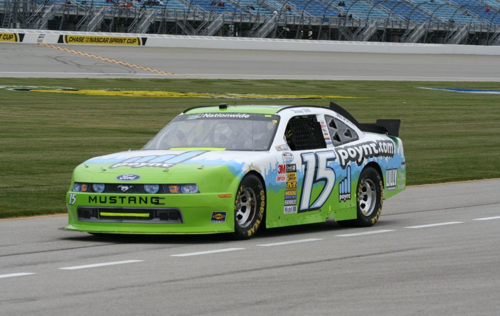 [/media-credit]Rick Ware Racing was one of those teams and at the end of the year, they accomplished their main goal. They ended the season with Timmy Hill winning Nationwide Rookie of the Year.
“I can’t thank this team enough,” Hill said. “When it was crunch time, they pulled through. They have done it all year with our back against the wall!”
It was a season full of hurdles with lots of lessons being learned along the way.
“Previously before Nationwide, I’ve run short races at local half mile tracks,” the 18-year-old said in a phone interview. “In the NASCAR Nationwide Series, most of the races are about 300 miles long so I had to learn to pace myself throughout a race, knowing that the race was long and you got to be there at the finish to get those good finishes. So I’ve learned I’ve got to pace myself and be there at the end.”
The driver of the No. 15 Poynt Ford had his fair share of struggles, though also had times during the season that stood out. An 11th place finish at Road American would mark Hill’s best finish of the season.
Competing against the veterans of the Nationwide Series would be enough to intimidate a new driver. Though on top of that, there are some Sprint Cup Series regulars who would come run some Nationwide Series races.
“I feel like with those guys, it gives you something to shoot for,” Hill said of the cup drivers. “At the same time, it makes it kind of tough because it’s hard for the new guys, like myself, to try and shine when these superstars come down to the Nationwide Series and take all the spotlight.”
One of those Sprint Cup regulars who run the Nationwide Series, Carl Edwards, is whom Hill considers his racing hero.
“One thing that stood out to me is he’s always a nice guy,” Hill said. “He always the guy that I wanted to attire myself after because he’s always clean on the race track, good driver, good with the fans; that’s the guy that I always try to patter myself after.”
Hill began racing at the age of nine in go-karts.
“Previously, my dad used to race through the 90s and the early 2000s,” he said. “I always wanted to do it growing up ever since I was a little kid. I kept bugging my dad over and over again. He finally let me drive a go-kart and I just got hooked right away.”
Racing in go-karts in 2005, Hill won over 80 races and multiple championships, including two World Karting Association (WKA) championships. Hill then began the moving his way up the ladder from the Bandoleros to Legends to Allison Legacy Series to the ARCA Racing Series, and lastly the K&N Pro Series in 2010.
The transition from the Allison Legacy Series to NASCAR Nationwide Series racing marked a big step for the young driver.
“The Allison Legacy Cars and the smaller cars, they race on the half-mile tracks, like Bristol,” he said. “You go to a mile-and-a-half and these faster tracks, it’s a whole different ball game and it’s like starting over, so to speak. You have to learn everything over. Basically what comes into play is all the aerodynamics and you got to pay attention to what’s going on as you see a lot of different things than the short tracks.”
To go with the races being longer as you move up, Hill stresses the element to drivers trying to get into the higher ranks.
“A lot of times you see the guys that they only have a couple races that they get to run,” he said. “They go out, try too hard and end up taking them self early so they don’t get time to learn or time to shine. “So the biggest thing is these races are long, pace yourself and be there at the end.”
Hill says for next year, he is looking to consistently get good finishes to finish top-10 in points.
“At the beginning of this year, I had to learn all the tracks and the ins-and-outs of the series and it took me awhile to get going,” he said. “Next season, our main goal is to go out and get good finishes; top-15 finishes are what we’re looking for every week and to be there. Our goal for the points is to finish in the top 10 in driver’s points and top 10 in owner’s points.”