How to Tow a Trailer With a Truck: The Short Answer
To tow a trailer safely, confirm your truck’s ratings can handle the loaded trailer, hitch it with the correct hitch and crossed safety chains, load the trailer for balance and proper tongue weight, run a pre-trip inspection, then drive slower with more following distance. That’s the whole job in one sentence, but each of those steps has details that catch first-time and occasional towers off guard.
The core idea to hold onto: “can pull it” is not the same as “can tow it safely.” A truck might have the muscle to get heavy cargo moving on flat pavement and still be dangerously over its limits when you factor in stopping, turning, and staying stable at highway speed. Proper towing is about the whole combination of the tow vehicle and trailer working together, not just enough power from the engine.
This guide walks through a simple five-step sequence you can reuse every time: check the numbers, load for balance, inspect before you roll, drive differently, and know when to stop. Get those right and most towing problems never start. If you are hitching up a trailer for the first time, going slowly through each step builds the habits that make every trip after it smoother.
Can Your Truck Safely Tow This Trailer? Start With the Numbers
Towing capacity is the maximum weight your vehicle is rated to pull. It’s a real limit, and exceeding it damages handling, brakes, and drivetrain. But the advertised tow rating is only one of several numbers that matter, and it is not the one that usually stops you first. Two trucks that look identical in a parking lot can have very different towing capacity depending on engine, axle ratio, and towing equipment, so knowing how much weight you can actually pull comes down to your specific build.
Here are the ratings you need to know in plain terms:
- GVWR (Gross Vehicle Weight Rating): the most your loaded truck itself can weigh, including passengers and cargo.
- GAWR (Gross Axle Weight Rating): the most weight each axle can carry.
- Gross Combined Weight Rating (GCWR): the most your truck and trailer can weigh together, fully loaded. Ram defines this gross combined weight rating as the maximum allowable loaded weight of truck plus trailer.
- Trailer GVWR: the most the loaded trailer can weigh.
- Payload: the most weight you can add to the truck (people, cargo, and trailer tongue weight combined).
The lowest-rated component controls your real weight capacity. If your payload runs out before your tow rating does, payload is your real limit. Ram notes that payload plus tongue weight cannot exceed payload capacity, and Chevrolet’s trailering guidance warns that passengers, cargo, options, and accessories all reduce the trailering capacity you actually have left. This is why the right truck for a given trailer is the one whose numbers all clear the load, not just the one with the biggest headline tow rating. Matching the right vehicle to your towing needs makes all the difference on the road.
Most people are looking to reserve a trailer online that matches their vehicle’s precise payload and towing specifications. Verifying these limits beforehand helps ensure a safe trip and prevents unnecessary mechanical strain on the vehicle.
A useful safety margin is the 85% rule: aim to tow no more than about 85% of your rated towing capacity. It gives you room for grades, wind, and heat.
Find your real numbers in the vehicle’s owner’s manual and on the certification label in the driver’s door jamb, not from a marketing brochure. Modern ratings are more trustworthy than older ones thanks to SAE J2807, the recommended practice reaffirmed in November 2024 that sets standardized methods for calculating tow-vehicle GCWR and trailer weight ratings. Because that standard applies the same test methods across brands, comparing one full size truck to another is more meaningful than it used to be.
Loaded Weight vs Dry Weight: Weigh It, Don’t Guess
No, trailer dry weight is not the same as towing weight. Dry weight is what the trailer weighs empty from the factory, with no cargo, fluids, fuel, propane, or water. You never tow a trailer at its dry weight.
What matters is loaded weight: the trailer as it will actually travel, with everything on board. That means cargo, tools, the boat or motorcycle or vehicle you’re hauling, plus fuel, propane, and fresh water on an RV or travel trailer. NHTSA says the best way to know your actual trailer weight is to weigh it at a public scale, and U-Haul gives the same advice, pointing people to a commercial or state scale when there’s any doubt. A single tank of fresh water can add hundreds of pounds, so a travel trailer that looked light at the dealer can travel much heavier once it is packed for a trip. Guessing here is how people quietly end up over their limits.
What Is Tongue Weight and How Much Should a Trailer Coupler Carry?
Tongue weight is the downward force the trailer coupler puts on the hitch. It’s the part of the trailer’s weight that presses down on the ball, and it has an outsized effect on how the whole rig behaves.
For a conventional bumper-pull trailer, aim for tongue weight of about 10% to 15% of the total loaded trailer weight. Chevrolet cites this range repeatedly, and Ram points to roughly 10% for conventional trailers. For fifth-wheel and gooseneck trailers, the kingpin weight runs higher, commonly 15% to 25% depending on the trailer type and your manual.
Two things to remember. First, tongue weight counts against your truck’s payload, so it isn’t “free” weight. Second, getting it wrong causes sway. Too little tongue weight lets the trailer wag the truck. Too much overloads the rear axle, lightens the steering, and hurts braking. Improper weight distribution is one of the most common causes of dangerous trailer sway, and it’s entirely preventable with a scale and a little planning. A simple tongue weight scale placed under the trailer coupler removes the guesswork and takes only a minute to use.
How Much Weight Can a GMC Sierra and Other Full Size Trucks Tow?
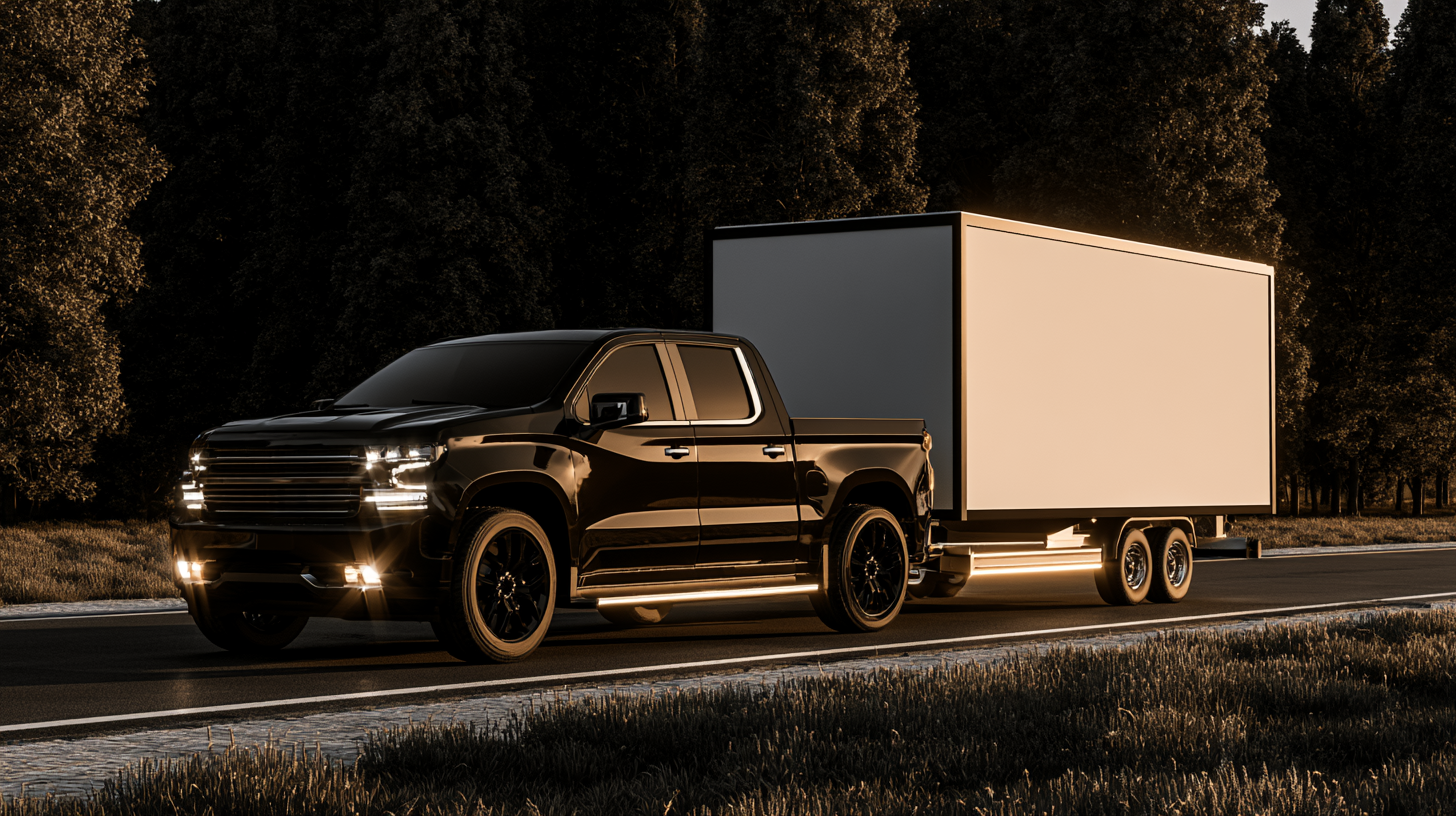
Max tow ratings vary widely between mid-size and full-size trucks, and between trims. Here are example maximums to give you a sense of scale:
| Truck | Example max tow rating |
| Ford Ranger | up to 7,500 lbs |
| Jeep Gladiator | up to 7,700 lbs |
| Toyota Tundra | up to 12,000 lbs |
| GMC Sierra 1500 | up to 13,200 lbs |
| Heavy-duty trucks | over 20,000 lbs |
Read these numbers with caution. A max rating usually applies only to one properly equipped configuration with a specific engine, axle ratio, and tow package. Add passengers, cargo, and options, and your real capacity drops from the headline figure. A well-equipped GMC Sierra 1500, for instance, only reaches its top figure in a narrow build, and a base model of the same pickup truck can trail it by thousands of pounds. A smaller tow vehicle like a Toyota Tacoma or a Ranger handles a small utility trailer or a boat well, while towing heavier loads pushes you toward a full size truck or heavy-duty pickup. There is no single best truck for everyone; the best truck is the one matched to the trailer you actually pull. Always verify against your own vehicle’s manual and door-jamb label rather than trusting a general chart.
Choosing the Correct Hitch, Ball Mount, and Wiring for Your Tow Vehicle
Your hitch system is only as strong as its weakest part, so every piece needs to be rated for the load.
Ball size and trailer hitch class matter
Receiver hitches are sorted into classes, each with its own weight rating. Match the class to your loaded trailer weight, and don’t assume a bigger truck automatically has a bigger trailer hitch. The ball mount slides into the receiver and holds the hitch ball. That hitch ball has to be the correct diameter for your trailer coupler (common sizes are 1-7/8″, 2″, and 2-5/16″) and rated for at least the trailer’s loaded weight. A coupler and ball that don’t match can pop loose on the road, and choosing the correct hitch is one of the most overlooked steps on an otherwise careful setup.
For larger trailers, a weight distribution system spreads tongue weight across the truck’s front and rear axles and the trailer axles, which restores steering feel and levels the rig. This weight distribution hardware is often required above a certain tongue weight, so check your manual. Heavier setups like horse trailers and car haulers may also call for a gooseneck hitch, which mounts in the truck bed and carries the load closer to the rear axle.
Wiring is the other half of the electrical connection. Smaller trailers often use a 4-pin flat connector for taillights, brake lights, and turn signals. Larger trailers with electric brakes use a 7-pin connector that also carries brake and power circuits. NHTSA’s towing guidance stresses matching the tow vehicle, hitch system, trailer wiring, and trailer ratings so every component works together. Before every trip, confirm your turn signals and brake lights actually fire on the trailer, not just on the tow vehicle.
Trailer Brakes, Brake Controller, and Safety Chains
Many trailers use electric brakes controlled by an in-cab brake controller. The controller tells the trailer brakes how hard to apply, and a good setup lets the trailer help slow the whole rig instead of relying on the truck alone. Test the controller output every trip so you know the trailer is braking with you.
A breakaway switch is the backup. If the trailer ever separates from the truck, a cable pulls a pin and applies the trailer brakes automatically. Attach that cable to a solid point on the tow vehicle, separate from the safety chains, never to the ball mount that could leave with the trailer.
Speaking of chains: cross the two safety chains in an X under the trailer tongue, with enough slack to turn but not so much that they drag. If the trailer coupler comes off the ball, the crossed chains cradle the tongue instead of letting it dig into the pavement.
Do you need trailer brakes at all? It depends on weight and your state. Brake laws vary, and Virginia, for example, requires brakes on many trailers with an actual gross weight of 3,000 pounds or more. Check your own state DMV or motor vehicle agency for the exact threshold, because it isn’t the same everywhere.
If the truck is used for equipment hauling or commercial work, or if the trailer lights, brake controller, hitch hardware, or suspension condition are uncertain, it’s safer to pause and have the setup inspected by a qualified heavy-duty repair provider such as Torpedo Truck Repair before towing. A wiring fault or a marginal brake output is far cheaper to fix in the shop than to discover on a downhill grade.
How to Load a Trailer Safely for Stability
Loading is where sway is won or lost. The goal is a low, centered, slightly forward load that produces the tongue weight your trailer needs.
Put heavy items low to keep the center of gravity down, and center them side-to-side so one wheel isn’t carrying more than the other. Position the bulk of the weight over or slightly forward of the trailer axle. A common shorthand is the 60/40 rule: roughly 60% of the cargo weight ahead of the axle and 40% behind it. Lowe’s describes this as a practical way to build proper tongue weight and cut sway risk. Reconcile it with your 10% to 15% tongue-weight target by using a scale rather than eyeballing.
Different trailers load differently. Car haulers usually want the vehicle positioned so most of its weight sits forward of the axle. Horse trailers carry live, shifting weight that has to stay balanced. A travel trailer hides heavy items in cabinets and holding tanks, so where you fill water and store gear changes the balance, and moving a full water tank from the rear to a mid-body tank can settle a wandering rig. Lighter trailers and lightweight trailers are less forgiving of a single misplaced heavy item than larger trailers, so balance still matters even when the load is small.
Once the load is placed, secure it so nothing shifts. Use ratchet straps to tie large items directly to the trailer, and add netting or a tarp where appropriate. This isn’t only about your own safety. NHTSA reports that roughly 850 people are killed and nearly 19,000 injured each year in crashes involving objects in the road, and all 50 states plus D.C. have laws on unsecured loads. Double-check every strap before you pull out.

Pre-Trip Checklist for a Stress Free Towing Experience
A two-minute walkaround catches most towing failures before they happen. This double check is quick, and it is the single habit that separates a smooth towing experience from a roadside one. Run this list every time:
- Tire pressure at spec, cold, on the truck, trailer tires, and spare
- Tire tread and sidewalls checked for wear, bulges, and cracks
- Lug nuts torqued
- Trailer coupler seated and latched over the ball
- Hitch pin in place and clipped
- Trailer jack fully raised and stowed so it clears the road
- Safety chains crossed under the tongue with proper slack
- Breakaway cable attached to the truck, separate from the chains
- All lights working: taillights, brake lights, turn signals, markers
- Brake controller tested for output
- Cargo tied down and unable to shift
- Tow mirrors adjusted so you can see the trailer’s sides and rear
- Route checked for steep grades, low clearances, and vehicle restrictions
Tires deserve extra attention because they carry the whole load. NHTSA’s TireWise guidance reports 511 people died in tire-related crashes in 2024, recommends checking pressure at least monthly when tires are cold, and says to replace tires once tread wears down to 2/32 inch. Trailer tires often sit unused for months and age out before they wear out, so inspect them even if they look low-mileage. Take a moment to double check that the trailer jack handle is secured, since a jack that drops on the highway can hook the pavement and damage the coupler.
How to Drive When You Are Towing a Trailer
The trailer changes everything about how the truck accelerates, stops, and turns, so your driving has to change with it. Towing a trailer well is mostly about giving yourself more room and more time than you think you need.
Accelerate gently and give yourself room. NHTSA advises moderate speeds because trailer sway grows more likely as speed increases, and keeping to or below 55 mph is a sensible ceiling for most setups. Increase your following distance well beyond your normal car gap; U-Haul recommends at least a 4-second cushion in good conditions and 5 seconds in bad weather. Anticipate stops and start braking earlier than instinct tells you to, since the loaded rig needs far more distance to stop.
Take wider turns. The trailer tracks inside the truck’s path, so a turn that clears a curb in your truck alone will clip it when you are towing a trailer behind you. Swing wider and watch the trailer wheels in your mirrors. Avoid sudden lane changes and sharp steering inputs, both of which can start sway.
Use the drivetrain to your advantage. If your manufacturer offers tow/haul mode, use it, since it holds gears longer and helps manage shifting and transmission heat. On long grades, downshift to let the engine help control speed instead of riding the brakes downhill, which overheats them. Throughout the drive, keep visual confirmation of the trailer in your mirrors so you notice a problem the moment it starts. Learning to tow safely is a rhythm you settle into, and after a few miles the wider turns and earlier braking start to feel natural.
How to Back Up a Trailer With a Truck
Backing a trailer feels backwards until one trick clicks. Put your hand at the bottom of the steering wheel. Move your hand in the direction you want the trailer to go: hand left, trailer goes left; hand right, trailer goes right. Because you’re steering from the bottom of the steering wheel, your hand moves the same way the trailer does, which is far easier to picture than steering from the top.
Use small inputs and go slowly. A tiny steering correction has a big effect at the trailer, and overcorrecting is how you end up jackknifed with the trailer folded against the truck. If the angle gets away from you, stop, pull forward to straighten everything out, and start the maneuver again. There’s no penalty for resetting.
A spotter helps enormously, especially in tight spaces where you can’t see the trailer’s corners. Agree on hand signals first. Best of all, practice in an empty parking lot before you ever try to back into a narrow driveway or a crowded campsite. A quiet parking lot lets you learn how far to turn the steering wheel without any traffic or obstacles to worry about, and twenty minutes with some cones will save you real frustration later.
What to Do If the Trailer Starts to Sway
Sway is a side-to-side wagging that can build fast if you react wrong, and losing control usually starts with the instinct to fight it with the wheel or the brakes. That reaction is exactly what makes it worse.
Do this: Stay calm. Ease off the accelerator and let the rig slow on its own. Hold the steering wheel steady and straight. If your trailer has electric brakes and you’re trained on your controller, gently apply the trailer brakes manually with the controller lever, which pulls the trailer back into line. NHTSA notes that manual activation of the trailer brake controller can help in excessive sway.
Don’t do this: Don’t speed up. Don’t slam the tow-vehicle brakes, because braking the truck can actually worsen sway. Don’t make abrupt steering corrections. U-Haul gives the same warning against speeding up, braking hard, or steering sharply during a disturbance.
Once everything is stable, pull over somewhere safe and find the cause. Check tongue weight and load balance, inspect the tires, and confirm the hitch and connections are tight. Reload the trailer if the weight was too far back, and don’t get back up to speed until the setup feels planted again. Restoring safe towing after a scare usually comes down to moving weight forward or firming up a loose connection.
When Not to Tow Until the Truck or Trailer Is Checked
Some problems mean you stop, not adjust. Don’t continue towing if you notice any of these:
- Brake warning lights on the dash
- Trailer brakes not responding to the controller
- Trailer lights or turn signals not working
- Excessive rear sag or squat when hitched
- Engine or transmission overheating
- Tire bulges, sidewall cracks, or tread worn low
- Loose hitch hardware or a wobbling ball mount
- A bent coupler or damaged safety chains
- Persistent sway even after you’ve reloaded and balanced
- Unusual vibration, pulling under braking, or the smell of hot brakes
Towing loads the whole vehicle harder than normal driving. NHTSA points out that towing adds stress to the tow vehicle and recommends bringing both truck and trailer maintenance current before you drive. U-Haul adds that the engine, transmission, steering, suspension, alignment, and tires all affect towing ability, so a weakness in any of them shows up under load. A tow vehicle that feels fine unloaded can reveal a soft brake pedal or a tired transmission the first time you hang a heavy trailer on it.
For trucks that tow frequently, especially work trucks and heavy-duty pickups, repeated hauling accelerates wear in brakes, tires, suspension, cooling systems, wiring, and hitch components. Regional repair shops such as Torpedo Truck Repair are the kind of qualified help drivers should seek when a towing-related problem appears, particularly for equipment trailers hauling heavy equipment, dump trailers, or any other trailer and fleet vehicle that demands heavier-duty inspection than a casual utility trailer. Matching cab size, bed length, and drivetrain to the job keeps a truck reliable through years of hard use.
A Simple Towing Setup Sequence for Beginners
When it’s time to hook up, follow the same order every time and the whole towing setup stops feeling complicated:
- Confirm the numbers. Check your truck’s ratings and the trailer’s loaded weight, and stay inside every limit with margin to spare.
- Load for tongue weight and balance. Heavy items low and centered, roughly 60/40 front to back, aiming for 10% to 15% tongue weight, then strap everything down.
- Inspect before you roll. Tires, lights, coupler, hitch pin, trailer jack stowed, crossed chains, breakaway cable, and brake controller.
- Drive differently. Slower, wider turns, longer following distance, earlier braking, and eyes on the mirrors.
- Stop if something’s wrong. Sway, heat, brake trouble, wiring faults, tire damage, or suspension sag all mean pull over and check.
Quick FAQ
How do I know if my truck can tow a trailer?
Compare your loaded trailer weight against your truck’s tow rating, payload, gross vehicle weight rating, GCWR, and axle ratings from the owner’s manual and door-jamb label. The lowest applicable limit is your real ceiling, and staying near 85% of your towing capacity gives you