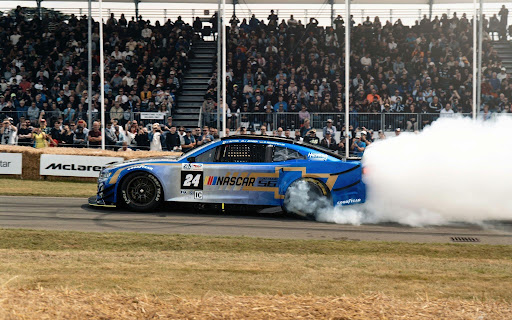
When a stock car is doing 200 miles per hour through a banked turn, there’s really only one thing standing between the driver and disaster: the surface underneath the tires. Fans watch the cars. Engineers watch the track. And at a handful of the sport’s most demanding venues, that track isn’t asphalt at all. It’s concrete.
Why Some Tracks Are Built on Concrete
Dover Motor Speedway earned its nickname “The Monster Mile” partly because of how punishing the racing is there, and its concrete surface is a big part of that reputation. Bristol Motor Speedway is another example. Both tracks put cars through repeated high-load, high-heat stress in the exact same spots, lap after lap, for hours.
Asphalt can start to rut and shift when it takes that kind of concentrated, repetitive punishment. Concrete holds its shape. That’s the whole reason it gets used on the toughest short tracks in the sport. It isn’t about looks or tradition. It’s about a surface that won’t move underneath a 3,400-pound car at full throttle.
It’s Not Just “Poured and Done”
Track-grade concrete isn’t mixed or placed the way a homeowner’s driveway is. It’s reinforced with steel rebar, poured in thick slabs, and built with expansion joints placed at precise intervals. Race day brings serious temperature swings, and the surface has to expand and contract without cracking apart.
Get any of that wrong and the results show up fast. A track that develops surface failure at speed isn’t just an inconvenience. It’s a safety hazard for every driver on it.
Curing Is the Part Nobody Sees
Here’s something most fans never think about: concrete doesn’t reach its full strength the moment it’s poured. It needs time to cure properly before it can be trusted to handle real load, let alone a field of stock cars circling it at race speed.
That principle doesn’t change based on scale. Whether it’s an entire speedway or a stretch of sidewalk outside an apartment building, concrete that gets rushed through curing tends to fail early.
The Same Physics Show Up on City Sidewalks
Obviously, a New York City sidewalk isn’t absorbing the same kind of load as a NASCAR track. But it’s under its own version of constant stress. Thousands of footsteps a day. Delivery trucks rolling over the curb. Tree roots pushing up from underneath. Freeze-thaw cycles every winter that expand and contract the slab, over and over, the same way heat does on a track surface.
The same fundamentals that keep a speedway safe, proper reinforcement, correct slab thickness, and full curing time, are what determine whether a city sidewalk lasts for decades or starts cracking apart within a few years.
When Concrete Fails, Someone Pays For It
On a track, a surface failure can end a race, or worse. On a city sidewalk, the stakes look different but they’re still real. A cracked or uneven sidewalk in NYC can turn into a DOT violation, a trip-and-fall claim, or a repair bill the property owner didn’t see coming. Companies like NYVanta Contractors deal with exactly that kind of concrete failure every day, diagnosing what went wrong below the surface and fixing it before it becomes a bigger problem.
If you’re a property owner and you’re not sure whether the concrete outside your building is holding up the way it should, it’s worth getting ahead of it. Frequently Asked Questions
Why don’t all racetracks use concrete instead of asphalt?
Cost and purpose. Concrete is more expensive to install than asphalt, and it’s mainly worth that expense in the specific spots where cars put the most repeated stress on the surface, tight, high-banked turns and heavy braking zones. Many tracks actually use a mix of both, asphalt on the straightaways and concrete where the punishment is worst.
How long does track concrete last before it needs to be repaved?
It varies by track and how much racing it hosts, but most concrete track surfaces are engineered to last well over a decade under heavy use. Compare that to asphalt, which often needs resurfacing every few years in the same high-stress areas.
Is sidewalk concrete built the same way as racetrack concrete?
The core principles are the same, reinforcement, proper slab thickness, and full curing time, but the mix design and specs are different since a sidewalk isn’t absorbing the same load as a race car. Both fail for similar reasons when those fundamentals get skipped.
How can a property owner tell if their sidewalk concrete is failing?
Look for visible cracking, sections that have sunk or lifted unevenly, and standing water after rain, which usually means the slab has settled. Any of those can turn into a DOT violation if left alone, so it’s worth having a contractor take a look early.
How long does concrete need to cure before it’s ready for real use?
Concrete typically needs several days of proper moisture to cure before it can handle regular load, and it keeps gaining strength for weeks after that. Rushing this step is one of the most common reasons concrete, whether on a track or a sidewalk, cracks early.
Conclusion
Racetracks and city sidewalks don’t have much in common on the surface. But underneath, they’re both asking the same material to do the same job: hold up under constant, repeated stress without giving way. Get the engineering right, reinforcement, thickness, and curing, and it does exactly that, whether 40,000 fans are watching or nobody’s paying attention at all. The next time a broadcast mentions how a track surface is holding up, it’s worth remembering that the sidewalk outside your own building is running the same race, just at a much slower pace.