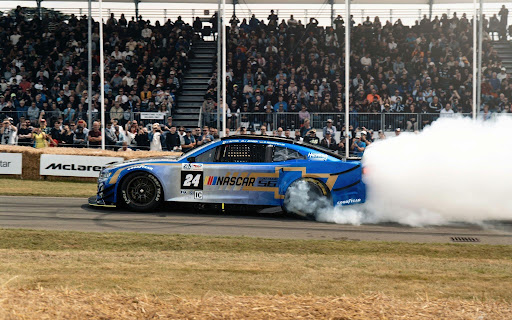
Ever wondered what happens at a race track after the engines go quiet?
Something is happening out in those vast parking lots. Race courses are emerging as some of the largest EV charging hubs in their regions. And this is not about two chargers by the front gate. This is about rows of chargers connected to solar, battery storage and green grid power.
And the reason is simple…
Fans idle six, eight, sometimes ten hours straight. Perfect charging opportunity. Meanwhile America has surpassed 250,000 public charging ports, with growth fastest at places where vehicles tend to park for longer periods.
But here’s the part most people miss.
Installing a hundred charging bays is not a parking project. It’s an electrical project.
What’s coming up:
- Why Race Venues Are Wiring Up Fast
- The Hidden Power Problem Behind Every Charging Bay
- Continuous Current Rating, Explained Simply
- Where The Clean Power Actually Comes From
- Looking After What You Install
Why Race Venues Are Wiring Up Fast
Race tracks are unique because they have something that most venues envy. They have space, massive power feeds, and thousands of attendees who all arrive simultaneously.
That makes them ideal for massive charging setups. A track is already wired to handle floodlights, timing systems, broadcast booths and hospitality areas. Chargers just utilize infrastructure that’s unused most of the year.
Then of course there is the financial aspect. Pay and display bays generate income from commuters, local fleets and passing trade when they’re not being used for race days.
And motorsport is under a microscope.
Operating a charging network off solar or renewable supply allows a venue to have a genuine story to share rather than a marketing catch phrase.
The Hidden Power Problem Behind Every Charging Bay
Now for the part that never makes the press release…
If fifty cars are charging simultaneously, then you don’t have a steady drip-feed of demand. You have a significant, sustained load that persists for hours.
That dictates requirements for the electrical room. MV equipment at a charging site is expected to handle that load hour after hour without getting too hot, so the gas-insulated switchgear specified for these projects is chosen based on its continuous current rating, not some peak number you could run for a few seconds. Size that number too small and the switchgear, not the chargers, becomes your bottleneck.
Keep in mind how fast this demand is arriving. DC fast charging ports nationally are up 30% YoY, and each one of them strains the local grid.
The result?
Venues that design their electrical infrastructure for the long haul will continue to expand their charger fleets for decades to come. Venues that avoid upgrade bottlenecks after initial deployment.
Continuous Current Rating, Explained Simply
Here is something that trips up a lot of people.
Continuous current rating refers to how much current a piece of equipment can safely handle 24 hours a day, seven days a week. It is not a short time surge number. Surge ratings sound great on spec sheets, but a charging site doesn’t operate in surges. It operates in long, flat, torturous hours of demand.
Visualize a race car engine. Top horsepower is nice for one lap. It’s how much horsepower the engine can sustain for 2 hours without overheating that wins races.
Electrical gear works exactly the same way.
A properly matched continuous current rating gives a venue:
- Cooler equipment and longer service life
- Fewer nuisance trips during peak charging periods
- Headroom to add more bays later
- Safer conditions for staff working near live gear
Ambient temp. Even if you’ve got that nailed down, ambient temp matters also. You may have to derate any gear that’s going into a hot, confined space. Derating means your real-world continuous current rating is less than what’s printed on the label. A good design factor’s that in from day one.
Where The Clean Power Actually Comes From
So where does all this clean electricity come from?
Predominantly from three areas: rooftop solar, battery storage and renewable offtake agreements. Large scale venues have vast roof space and often land that goes unused. Solar was an obvious first step.
Take the Bahrain International Circuit for instance. Between two Grand Prix weekends their solar farm generated 5.28 MW of clean energy which was enough to power the circuit AND more.
Silverstone took another approach to pop-up solar car parks using hubs that combine panels, batteries and charge points into a single system. One of those hubs is topped up by 1MW of solar panels already installed on the roof of the venue’s conference centre.
Both approaches solve the same problem in different ways.
Why solar suits race venues so well:
- Roof and land space is already available
- Peak sunlight lines up with daytime event traffic
- Generation happens behind the meter, cutting grid draw
- It is visible to fans, which is worth something on its own
The honest truth is solar will never run a race weekend by itself. Vehicle charging demand will always peak when everyone leaves … usually after dark. That’s where storage comes into play.
Batteries Smooth Out The Spikes
Battery storage is the quiet hero of every clean charging site.
Solar energy charges batteries during the day with power nobody needs. Batteries discharge at night when everyone leaves and all the chargers turn on at once.
That accomplishes two helpful goals. One is preventing the venue from getting slammed with demand charges. The other is it prevents the site from having to upgrade to a much larger grid connection just to serve that peak week.
Smart charging management can help here too. Software can space sessions out, dial down some chargers and prioritise others, keeping overall demand well within the continuous current rating of whatever gear is feeding it.
Simple idea. Big savings.
Looking After What You Install
Nothing here works if it is left alone for five years.
Charging infrastructure should be maintained just like any other critical asset. This includes routine patrols, thermography on connections, and periodic testing of settings for protection relays.
Loose or corroded connections become hot. Heat decreases the amount of current that the equipment can safely handle. Eventually a site that was properly sized on paper begins to act like an undersized site.
A basic maintenance routine should cover:
- Thermal imaging of switchgear and connections
- Cleaning and inspecting solar panels
- Testing battery state of health
- Reviewing load data against design assumptions
Taking The Chequered Flag
Race tracks are becoming charging stations en masse. It makes sense beyond a coincidental level. They have the space. They have the power plug. They have the captive audience. Drivers who are there. Sitting. Parking. For hours. Doing nothing else but charge.
Make no mistake, venues who do this right approach it as an electrical engineering problem first, and a guest convenience second. They size equipment around amps continued, not amps peak. They implement solar along with storage, instead of praying for sunny weather. And they maintain their systems.
Supply three items correctly and a racetrack can continue adding chargers for years to come.
Get them wrong and the whole thing stalls on the grid.