
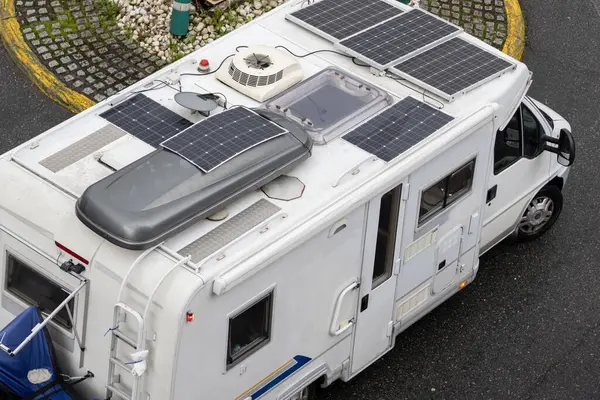
When you search for solar panels for an RV roof, you may assume they are similar to the heavy glass panels commonly used on homes. But an RV has different requirements. Its roof is exposed to movement and vibration, available space can be limited, and adding unnecessary weight can affect the vehicle.
For some RVs, this makes flexible solar panels a practical option. Some flexible photovoltaic (PV) panels are designed to be installed directly on the roof and conform to its shape, without the same type of mounting structure used for rigid glass panels.
Why May Flexible Solar Panels Be Better Suited to Some RV Roofs?
The main difference is how the panel can be installed on the RV.
A traditional glass panel is rigid and generally requires a suitable mounting arrangement and a relatively flat installation surface. An RV roof may have curves, vents, air conditioners, and other equipment that can make this more difficult.
Many flexible panels can conform to gently curved roofs. This can provide more options for using available roof space without requiring a rigid mounting frame around the panel.
Weight can also be an important consideration on an RV. Some lightweight flexible RV solar panels weigh less than 15 kg, although the total system weight depends on the configuration and additional components. This can be useful when reducing roof weight is a consideration.
How Are Flexible PV Panels Installed?
Flexible and rigid solar panels also differ in their installation requirements.
A flexible PV panel can be installed without the same type of heavy support structure used for a conventional PV panel installation. Some systems are supplied as complete kits, so the main components are selected to work together rather than being sourced and assembled separately.
This may reduce installation work. Some vehicle solar kits can be fitted in roughly one to two hours, although the actual installation time depends on the RV, roof layout, wiring, and specific system.
When a panel is designed to follow the roof and does not require a complex mounting frame, the installation may involve fewer physical components to position and secure.
Can Flexible Panels Be Installed on a Curved RV Roof?
A slightly curved roof does not automatically mean solar is unsuitable.
Many flexible panels are designed to conform to gently curved surfaces, making them suitable for some RV roofs where rigid panels may be harder to position. Check how much curvature the specific panel allows and whether the roof surface is suitable for installation.
You should also consider areas that receive shade. An air conditioner, vent, or other roof equipment can reduce the usable solar area and affect energy production.
Before choosing a panel, measure the actual usable roof area, including the space occupied by vents, air conditioners, skylights, and other equipment.
What If the RV Roof Has Limited Space?
A solar awning is another option.
If your RV has limited roof space because of vents, air conditioning equipment, skylights, or other fittings, adding more panels may not be practical. Installing additional panels may also interfere with other equipment or areas needed for access and maintenance.
A solar awning can provide another surface for solar generation. Flexible solar panels for RVs designed for this type of application can be incorporated into an awning that extends from the RV. When opened, it can provide shade while also creating additional space for solar generation.
This can increase available solar capacity without using more of an already crowded roof.
What Should You Consider Before Choosing RV Solar Panels?
Start by calculating how much power you use in the RV.
Consider what you normally run, how long you stay off-grid, and how much battery storage you have. Then check how much usable roof space is available and whether the roof can support your preferred installation method.
Weight, panel flexibility, electrical compatibility, shading, weather exposure, and installation requirements should all be considered.
Solar output varies throughout the day. Sunlight, panel orientation, temperature, shading, and weather can all affect how much electricity a panel produces.
The better choice depends on the vehicle, available roof space, and amount of power you need. A panel with a higher rated output is not necessarily the best fit if it adds too much weight, does not fit the roof, or cannot be installed in an area with sufficient sunlight.
FAQs
Can You Walk on Flexible Solar Panels?
Not necessarily. Flexibility does not mean a panel is designed to support foot traffic. Check the manufacturer’s specifications before walking on or placing weight on a panel.
Do RV Solar Panels Need a Battery?
Solar panels can generate electricity without a battery, but an RV solar system often includes battery storage so the stored energy can be used when sunlight is unavailable or solar output is lower than the RV’s current demand.
Can an RV Use Both Roof Panels and a Solar Awning?
Yes. Roof-mounted flexible panels and a solar awning can be combined when the electrical system supports both. Check the voltage, current, charge controller, and battery requirements before connecting the systems.