An RV buys freedom on the open road — right up until you’re parked. Driving into town for groceries, looping the campground to find the shower block, or reaching a trailhead half a mile out shouldn’t require breaking camp or squeezing a 30-foot rig into a gas station lot. Yet that’s exactly the trade-off many RV travelers make, simply because nothing smaller is on board.
A foldable electric bike closes that gap. It tucks into space a full-size bicycle can’t, and its motor turns hills, headwinds, and long campground loops into a non-issue. Fold it, stow it, and suddenly the RV isn’t the only way to get around.
But “it folds” is not a buying criterion on its own. Weight, folded dimensions, battery storage, how you’ll actually carry it, and how it rides over a week of repeated trips all matter more than whether the frame hinges in the middle. This guide walks through what to compare before a foldable eBike takes up any of that hard-won storage space.
Why a Folding Electric Bike Works With an RV
Easier Transportation Once You’re Parked
Once the RV is leveled and hooked up, moving it again for a quick errand is its own chore. A folding eBike skips that — leave the RV in place and ride off for supplies, food, or a look around camp. The electric assist earns its keep on the way back: dial it down on flat stretches to save battery, lean on it for the climb home with a loaded pannier.
The value is practical first, recreational second — a bike that handles the store run is also ready for an evening ride along the lake.
Compact Doesn’t Mean Light
Folding shrinks the footprint, not necessarily the mass. A motor, battery, reinforced hinges, wider tires, and suspension hardware add up — a bike that disappears into a storage bay can still be a two-person lift to get there.
That distinction matters more in an RV than almost anywhere else: a bike that clears a compartment’s dimensions may not clear the threshold in front of it. Treat folded size and total weight as two separate specs, and practice the fold before the trip — not on the first morning of it.
Match the Bike to Your Travel Style
The right bike reflects the terrain you’ll actually ride most weekends — not the one ambitious trip you might take once.
Folded Dimensions, Weight, and Storage Space
Measure the real storage area and the path to it — door widths, steps, tight turns. A bike that fits the final space can still be impossible to maneuver through the route leading there. It also shouldn’t be free to slide or tip while the RV is moving; whatever secures it should follow both the bike and vehicle manufacturer’s guidance.
Weight matters most the moment lifting enters the picture. Check whether the battery removes separately for transport, and store it the way the manufacturer specifies — not loose in a cabinet.
Range and Motor Support
RV travel makes range hard to predict — a campground loop might use almost nothing, while a supply run into town could climb and wind past any nearby outlet. Size the battery for the longest regular trip, plus a reserve for the detour you didn’t plan, and treat advertised range as a starting point rather than a promise: rider weight, cargo, terrain, and assist level all pull that number down.
Motor character counts as much as motor size. What matters on a slow, crowded campground road isn’t peak power — it’s whether the assist comes in smoothly from a stop, and lets you dial down around pedestrians and back up once the road opens.
Tires, Suspension, and Braking
Most RV routes mix surfaces — pavement into gravel into whatever the campground road became after last week’s rain. A moderate-width, puncture-resistant tire delivers stability without the bulk of a full fat-tire build; suspension handles what the tire alone can’t absorb, and should scale to the terrain rather than exist as a spec-sheet feature.
Braking matters more with cargo aboard or a slope ahead. Hydraulic disc brakes offer more control with less hand effort — though no brake compensates for loose gravel or a loaded bike’s extra stopping distance.
Comfort, Access, and Cargo Capacity
Travel days already mean hours of sitting, so an uncomfortable bike is one that stays in storage — look for a position that doesn’t load up the wrists or shoulders. A step-through frame turns mounting into a non-event, especially with a rear rack loaded or mobility limited.
Check total payload and rack capacity separately, since bags and locks eat into both — and some accessories need to come off before the frame will fold. A rack bag rides more predictably than anything swinging off the handlebar.
Plan How the Bike Will Be Carried, Charged, and Stored
Interior Storage Versus an Exterior Rack
Storing the bike inside keeps it dry and out of sight, at the cost of living space and a bit of tracked-in dirt — a folding mat or protective bag helps, as long as it doesn’t block an exit or control. An exterior hitch rack frees up that space instead, but only if it’s rated for the job: confirm per-bike weight limit and explicit approval for use behind an RV or trailer, since the forces back there aren’t the same as behind a sedan.
Check the RV’s hitch and cargo ratings against the combined weight of rack and bikes before assuming it all works together, and use the rack’s specified mounting points rather than a guess.
Battery Charging and Temperature Management
Charge with the manufacturer-approved charger only, somewhere dry and ventilated, and check both the bike’s rules and the campground’s electrical setup first. Temperature does the rest of the work — a closed vehicle can get hot enough to speed up battery wear, while cold quietly cuts range and slows charging. Let a battery that’s been baking or freezing return to normal temperature before it goes on the charger.
A water-resistance rating explains how the bike handles rain and splashes — it says nothing about submersion or pressure washing. Store and charge as the manual says, rating or no rating.
Campground Rules and Trail Access
An e-bike that’s street-legal isn’t automatically welcome on every campground path or nearby trail — access shifts by jurisdiction, land manager, and e-bike classification. Check the specific rules before you go, and around pedestrians, kids, and narrow campsite roads, lower assist and a predictable line matter more than speed.
Best Overall for RV Travel: Velotric Fold 1 Plus
For RV travelers who want comfort and real riding capability alongside compact storage, the Velotric Fold 1 Plus is the strongest all-around pick — it folds when it needs to, but doesn’t ride like a bike apologizing for that.
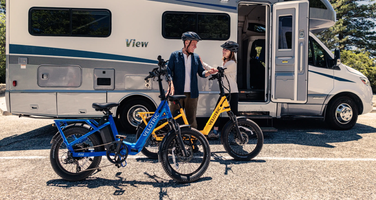
The step-through frame makes mounting effortless, especially with a loaded rear rack. Three-inch tires give it a wide, stable footprint over rough pavement and gravel, and a 60mm suspension fork handles what the tires alone can’t — enough capability for mixed surfaces without the size of a full fat-tire build. That comfort is the point: a travel bike only earns its keep if it gets ridden regularly.
A 750W motor (1,100W peak) delivers a range up to 68 miles, enough for several campground rides between charges depending on terrain and load. A 450-pound payload capacity and IPX6/IPX7 weather ratings round out a bike built for actual use rather than just the spec sheet.
A Final RV Buying Checklist
- Measure the final storage area and every opening along the loading path.
- Confirm the complete bike weight is manageable for your planned loading method.
- Verify any exterior rack is rated for the bike’s weight and approved for RV or trailer use.
- Choose enough real-world range for regular destinations, plus a reserve.
- Match tires, suspension, and brakes to the surfaces you’ll actually ride.
- Check total payload and rack limits against your typical cargo.
- Plan a dry, temperature-appropriate spot to store and charge the battery.
- Review campground, road, and trail rules for e-bike access.
If possible, practice folding, lifting, and securing the bike before the first trip. That five-minute test usually reveals whether the bike and the carrying plan will still feel convenient once the novelty wears off.
Final Thoughts
A foldable electric bike makes RV travel more flexible by giving you real transportation once the campsite is set up. The best model isn’t the one with the smallest folded footprint — it’s the one that fits your storage, loads safely, and stays comfortable enough to actually use, trip after trip. Start with the RV’s storage and carrying limits, then compare range, motor control, tires, and cargo support. For travelers who want step-through access, real range, and serious carrying capacity, the Velotric Fold 1 Plus is a well-rounded choice.