In a case written up in the journal Orthopedics in 2013, a 34-year-old auto mechanic was holding a wrench near a 12-volt car battery. His gold ring touched the positive terminal. The wrench touched the ring and the negative terminal at the same moment.
He felt the pain instantly. The burn wrapped all the way around the base of his ring finger, and after three weeks of barely healing, it needed a full-thickness skin graft.
That’s one of two reasons experienced mechanics take their rings off before the hood goes up. The other is ring avulsion — the snag injury hand surgeons see when a ring catches on something, and the body keeps moving. They’re different injuries with different causes, and a ring that’s safe from one isn’t automatically safe from the other.
Two Injuries, One Ring
Both injuries start with a metal band on a working hand. After that, the physics splits completely.
| Ring avulsion (snag) | Electrothermal burn (battery short) | |
|---|---|---|
| What happens | The ring catches and a sudden force pulls on the finger | The ring closes a circuit between a live terminal and ground, and the metal heats up |
| Typical trigger | Machinery, a fence, the edge of a counter or table, a fall | A ring on the positive terminal while a wrench or the battery housing completes the path |
| What the ring does | Holds — a metal band takes far more force to break than silicone | Conducts the current and carries the heat into the skin |
| Worst case | Complete degloving or amputation of the finger | A deep burn around the finger that may need a skin graft |
| Main prevention | Ring off for tool and equipment work | Ring off, and the live terminal covered |
What Happens When a Ring Snags?
Cleveland Clinic defines ring avulsion as an injury that happens when a ring you’re wearing is suddenly pulled with a strong force. Its list of causes reads like a normal week in a shop: a ring caught in a machine or equipment, a ring hooked on a fence or the edge of a counter during a fall. A 2016 case discussion in the journal Eplasty puts it more plainly: the injury classically happens when a wedding band catches on machinery or a protruding object.
Ring avulsions are commonly described with a three-class scale published by Urbaniak and colleagues in 1981, though surgeons also use modified versions. Class I means circulation to the finger is still adequate. Class II means it isn’t. Class III is complete degloving or complete amputation.
It doesn’t take a lift or an engine hoist, either. In June 2015, Jimmy Fallon tripped in his New York apartment, caught his fall, and his ring hooked the side of a table. “Almost ripped my finger off,” he wrote afterward. He needed surgery.
Why a Metal Band Doesn’t Just Snap
Metal doesn’t give, and that’s the problem. A cadaver study presented to the American Association for Hand Surgery in 2021 loaded silicone and metal rings on cadaver fingers until the rings failed. The silicone rings gave way at an average of 53.0 newtons. The metal rings held until 495.2 — roughly nine times the force.

That’s true of a thin wedding band and of a chunky 26-gram V-twin motorcycle engine ring alike, with its separate cooling fins and pushrod covers standing out from the finger. The trade jewelry mechanics love is after-hours jewelry. Cleveland Clinic also notes that the looser a ring fits, the more room it has to catch on something.
The 12-Volt Burn That Catches People Off Guard
Twelve volts sounds harmless, which is exactly why battery burns catch people off guard. OSHA’s electrical safe-work rules name rings outright: conductive jewelry — watch bands, bracelets, rings — may not be worn where it might contact exposed energized parts, unless it’s covered or insulated. The danger at a battery isn’t a shock through your body. It’s current through the ring.
Starter batteries are built for heavy current. Battery Council International defines their cold cranking amps rating as the load a new, fully charged battery can deliver for 30 seconds at 0°F while holding at least 7.2 volts. Passenger-car batteries are commonly rated in the hundreds of amps. A ring that bridges the positive terminal to the negative terminal or to grounded metal completes a short circuit. The fault current isn’t the number on the label — it depends on the battery and the whole path — but the ring is now carrying it.
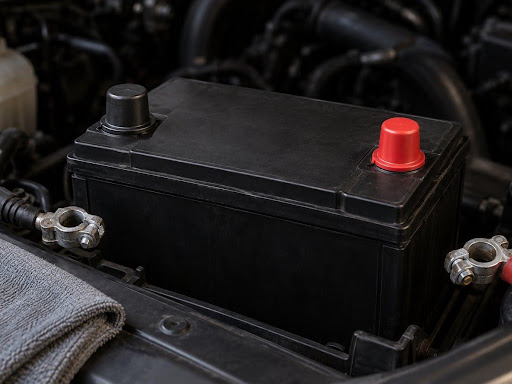
Where the Short Actually Happens
The authors of the Orthopedics report describe the mechanism plainly: ring burns from car batteries happen by short-circuiting through the ring when it touches the open terminal or the metal housing. They add that gold can heat up to its melting point in a matter of seconds.
Gold isn’t special here. Silver has the highest electrical conductivity of any metal, according to the Royal Society of Chemistry, and steel or titanium bands conduct too. Any metal ring can close that circuit.
Shop Habits That Prevent Both
The fix for both injuries is the same boring habit: the ring comes off before the work starts. Cleveland Clinic’s advice is blunt — don’t wear rings or other jewelry while working with tools or heavy equipment. The Orthopedics authors go one step further for battery work and say the live terminal should be covered too.
Where the ring goes matters more than people admit. A shirt pocket or the corner of a greasy bench is how rings get lost. Silver adds one more wrinkle. Bikerringshop’s guide to storing silver jewelry explains why a ring that sits out the workweek darkens faster than one that’s worn, and it walks through an airtight-bag routine that keeps the ring bright until Friday night.
If you’d rather wear something on the job, silicone bands are the common compromise. Cleveland Clinic notes they break or tear more easily than metal, and the 2021 cadaver study found they failed at about a ninth of the force. That lowers the risk. It doesn’t make a finger snag-proof.
Ring Safety Questions Mechanics Ask
Can a car battery really burn you through a ring?
Yes. A starter battery can drive a heavy current through anything metal that bridges its positive terminal and ground. A ring in that path heats up fast — a case report in Orthopedics describes a mechanic who needed a skin graft afterward.
Is a silicone ring safe for mechanics?
Safer, not safe. In a 2021 cadaver study, silicone rings broke at an average of 53 newtons versus about 495 for metal ones, so they’re far more likely to give way before the finger does. Cleveland Clinic still advises taking rings off for work with tools or heavy equipment.
What’s the difference between ring avulsion and degloving?
Ring avulsion is any finger injury caused when a ring catches and is forcefully pulled — the ring doesn’t have to come off. Degloving is when skin and soft tissue are stripped from the finger. In the Urbaniak system, complete degloving and complete amputation are both class III.
Should mechanics take off their wedding rings?
For hands-on work, yes. The classic ring avulsion involves a wedding band caught on machinery, and the classic battery burn involves a ring bridging a terminal. Putting it back on when the shift ends keeps both risks out of the shop without giving up the ring.
Pick one spot for the ring — the same one, every shift — somewhere you’ll see it before you leave. The habit takes a few seconds a day.
The mechanic in that 2013 case report had barely healed after three weeks and ended up with a skin graft. All from one slip with a wrench.
Author bio: Tepparit Kacha has worked with sterling silver rings for over a decade and curates the handcrafted range at Bikerringshop. He writes about how jewelry fits into working lives — including the moments it should come off.