Remote Access to a Truck’s Brain: How Software Solutions Are Changing the Repair Industry
A truck breaks down hundreds of miles from its usual shop. The local tech has the gear to plug into the engine control module, but the specialized software knowledge for that particular programming job sits somewhere else entirely. Not long ago that usually meant arranging a specialist visit, shipping the module, or waiting for the right person to free up.
These days the picture can look different.
With the right hardware, compatible software, and a solid internet connection, a technician can team up with a remote specialist and finish supported electronic programming work without ever rolling the truck into the specialist’s own bay.
For independent shops, fleet service providers, and heavy-duty techs, this approach is quietly rewriting how expertise gets delivered. The shop stays local, but the knowledge it can tap is no longer limited by zip code.
Why Distance Still Matters in Truck Repair
Modern commercial trucks run on tightly linked electronic systems. The engine control module, transmission controls, and aftertreatment components all play critical roles in how the vehicle behaves.
Working on these systems takes more than a laptop and a diagnostic adapter. Manufacturers use different communication protocols, software platforms, and programming procedures. Even highly experienced mechanical techs may not have every specialized application or calibration resource sitting on their shop computer.
For a small independent shop, buying every tool and building deep expertise across multiple engine platforms is hard to justify. A programming job on an unfamiliar system can also demand knowledge the shop rarely needs day to day.
Remote help offers another path. Instead of trying to master every capability in-house, a workshop can link up with a specialist who already lives in that platform every day.
That can cut logistical delays and let shops offer more services. It also keeps the local technician in the loop rather than handing the whole job off to an outside facility.
Remote Tuning: Working Across Thousands of Miles
Remote tuning shows how the model works in practice.
A local tech connects the truck to a compatible computer interface with the right hardware and software. Once the vehicle and system are ready, a remote specialist can step into the supported programming environment and handle the software side of the job.
The exact steps depend on the engine, control module, manufacturer, and the service being performed. Some applications allow remote programming through a dedicated remote-access session; others rely on a specialized software platform with its own workflow.
The important point is that the specialist doesn’t have to be standing next to the truck. The vehicle stays at the local shop, where the technician handles the physical connections and keeps an eye on the process.
This setup is especially useful for shops that work on several commercial brands. Rather than stocking every specialized programming capability, they can bring in outside expertise when a particular job calls for it.
Remote tuning doesn’t remove the need for hands-on work. It simply changes where certain software tasks can be done and who can supply the know-how to finish them.
Security, Stability, and the Human Factor
Remote access brings practical considerations that shops need to sort out before starting a programming session.
A stable internet connection matters, especially when the work involves talking to an electronic control module. An interruption at the wrong moment can complicate the procedure, so the connection, computer, and vehicle interface should be squared away ahead of time.
Power stability counts too. The vehicle and connected equipment have to meet the requirements of the specific programming process. Depending on the application, that often means maintaining a steady, appropriate power supply for the entire session.
Security is just as critical. Remote access should be authorized by the shop, limited to the systems needed for the job, and run through trusted software. Techs need to know who is connecting to the computer and exactly what actions will be taken.
Finally, remote programming is not a substitute for diagnosing mechanical problems. An engine with a damaged part, a bad sensor, or an underlying electrical issue still needs conventional inspection and repair before software work makes sense.
The best outcomes come from pairing local technical judgment with the experience of a remote specialist. Software creates the connection, but people still decide what work is appropriate and whether the truck is ready for it.
How DrunkLab Makes Remote Programming More Accessible
DrunkLab builds software and hardware solutions for ECU tuning and electronic programming on trucks, buses, construction equipment, and other heavy-duty machines.
Its services show how specialized programming expertise can reach workshops in different locations.
TeamViewer for Supported Engine Platforms
DrunkLab performs remote ECU tuning via TeamViewer for Cummins, Detroit Diesel, and PACCAR engines.
The shop uses compatible equipment to establish communication with the vehicle, while the remote specialist works inside the supported programming environment. That gives the local technician access to specialized tuning knowledge without shipping the truck or its control module somewhere else.
Available services depend on the engine, ECU, vehicle configuration, and the specific programming task. Proper preparation and the right equipment remain essential.
Mochester App: A Dedicated Software Platform
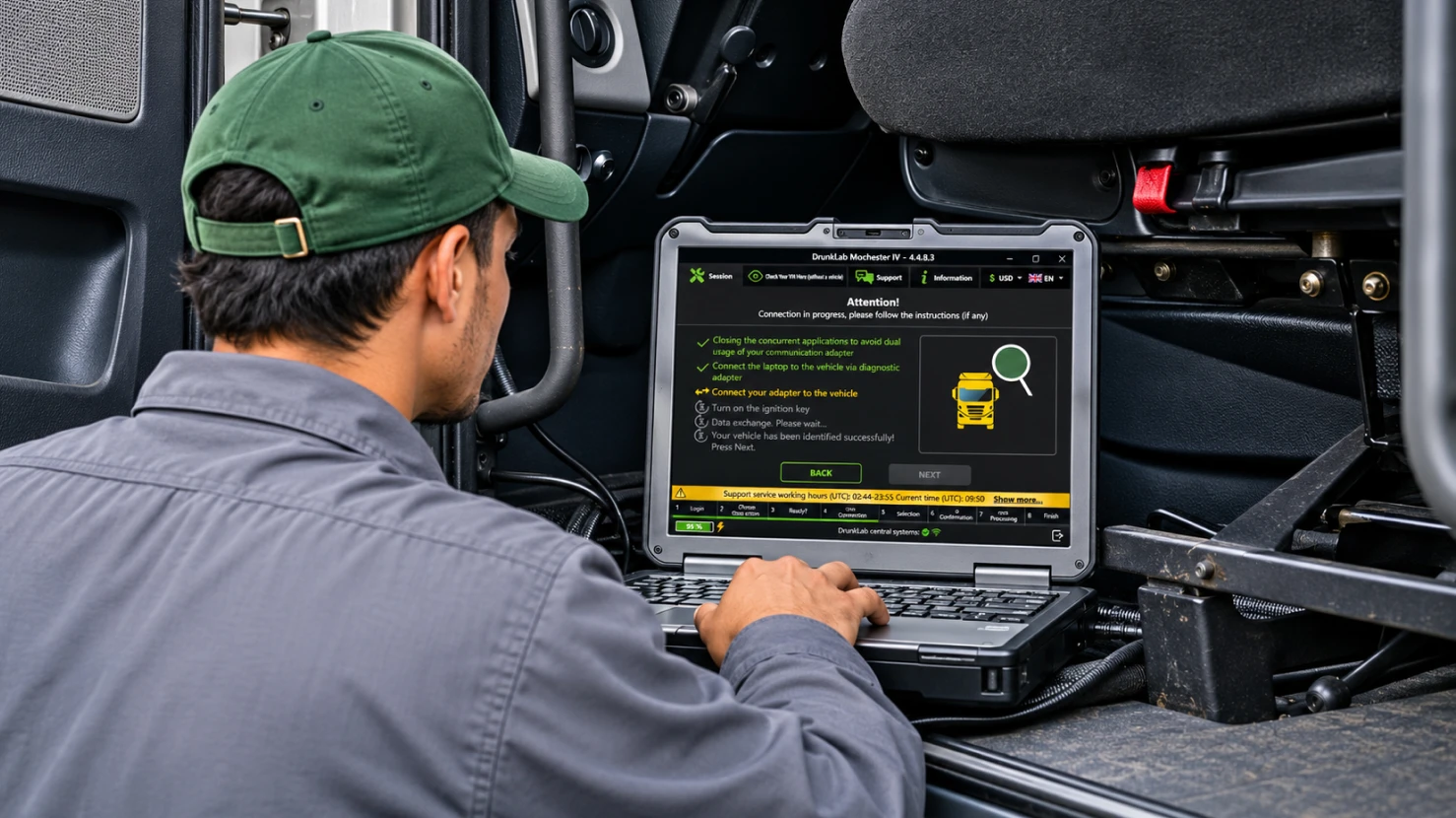
For truck and heavy-equipment applications outside the Cummins, Detroit Diesel, and PACCAR TeamViewer group, DrunkLab uses Mochester App – its Windows-based platform for programming services.
Mochester App (M4 App) covers a range of heavy-equipment and commercial-vehicle brands such as Volvo, Mack, Renault, UD Trucks, Prevost, Volvo Construction Equipment, and Volvo Penta.
Through a dedicated workflow, technicians can check service availability by VIN or chassis number, connect compatible RP1210 adapters, and reach the programming options available for that particular vehicle.
Supported adapters include Nexiq, Noregon, DPA5, Inline 6, Scanmatik, etc., depending on the application.
Mochester App also offers a free truck fault-code reading that lists active and inactive codes along with their related systems. This can help techs understand the vehicle’s reported electronic faults and decide on the next step. The report is not a replacement for a full mechanical inspection or diagnosis.
The difference between the two approaches is clear: TeamViewer provides remote access for specific supported engine platforms, while Mochester App delivers a dedicated interface for other supported DrunkLab services.
Together, these tools help workshops reach specialized programming capabilities without having to build every piece of the required software infrastructure themselves.
The Future of the Connected Workshop
Remote programming is part of a larger shift in how technical services get delivered.
A modern repair shop doesn’t necessarily need an in-house specialist for every electronic system it runs into. Instead, it can combine local mechanical skills, the right diagnostic and programming equipment, and access to outside experts.
That model is especially useful for independent shops serving rural areas, fleets that operate across multiple states, and facilities that work with a variety of truck manufacturers. It also lets specialized service providers support customers far beyond their immediate region.
The technology will keep evolving, but the core idea is already plain: expertise can travel digitally even when the truck can’t.
For workshops, the opportunity isn’t to replace technicians with remote connections. It’s about helping technicians get the programming support they need when a job calls for it.
A truck may be sitting thousands of miles from a specialist. With the right tools and a properly managed connection, that distance no longer has to be the biggest obstacle to getting the programming support the job requires.