



NASCAR Racing Schedule for Martinsville Speedway
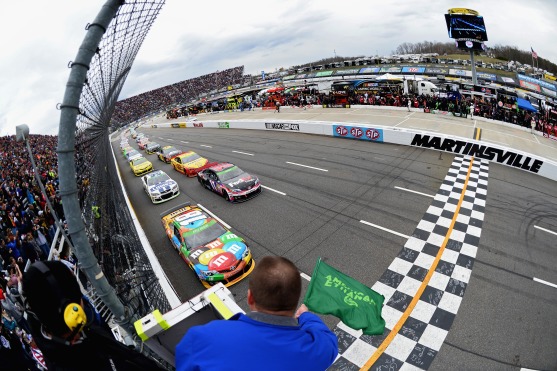
This weekend the NASCAR Sprint Cup Series travels to Martinsville Speedway for the Goody’s Headache Relief Shot 500 and the first race of the Eliminator Round. The NASCAR Camping World Truck Series is also on track for the Kroger 200.
All times are ET.
FRIDAY – OCTOBER 24:
Noon – 1:20 p.m.: Sprint Cup Series practice – FOX Sports 1
1:40 p.m. – 2:30 p.m.: Camping World Truck Series practice – FOX Sports 1
3:00 p.m. – 4:25 p.m.: Camping World Truck Series final practice – FOX Sports 1
4:40 p.m.: Sprint Cup Series Coors Light Pole Qualifying – FOX Sports 1
SATURDAY – OCTOBER 25:
9:00 a.m. – 9:50 a.m.: Sprint Cup Series practice – FOX Sports 1
10:15 a.m.: Camping World Truck Series Keystone Light Pole Qualifying – FOX Sports 1
Noon – 12:50 p.m.: Sprint Cup Series final practice – FOX Sports 1
1:30 p.m.: Camping World Truck Series Kroger 200 – (200 laps-105.2 miles) – FOX Sports 1
SUNDAY – OCTOBER 26:
1:30 p.m.: Sprint Cup Series Goody’s Headache Relief Shot 500 – (500 laps-263 miles) – ESPN
Press Conference Schedule: (Watch live) at Nascar.com (Post race times approx.)
Friday – October 24:
10:15 a.m.: Cole Custer
10:30 a.m.: Timothy Peters
11:00 a.m.: Jimmie Johnson
11:15 a.m.: Matt Kenseth
1:30 p.m.: Carl Edwards
1:50 p.m.: Denny Hamlin
2:15 p.m.: Danica Patrick
2:45 p.m.: Jeff Gordon
5:30 p.m.: Post NSCS qualifying
Saturday – October 25:
11:15 a.m.: David Ragan and Darrell Wallace Jr.
3:15 p.m.: Post NCWTS race
Sunday – October 26:
5:20 p.m. : Post NSCS race
Hot 20 – Martinsville Could Showcase a Wildcard Cup Contender and a Dying Minor League

Will it bother anyone if, conceivably, one not so deserving wins the Cup title this year? I mean, if it is Jeff Gordon, Joey Logano, or Brad Keselowski, I doubt few would argue the outcome. One could even argue that the likes of Kevin Harvick, Carl Edwards, Matt Kenseth, or Ryan Newman would be a worthy champion.
However, what about Denny Hamlin? Even if he had taken part in the two events he missed in order to mend, Hamlin would not even be in our Top Ten. Okay, maybe if he had won them both, but what were the chances? Still, would he be deemed as a worthy holder of the title?
In a word, yes. Few, if any, are pointing out the fact that the World Series participants, the Giants and the Royals, are just a pair of wildcard teams. They were not the best in their division, and in fact each was just the fourth best in their respective leagues. Yet, as time goes on, fewer will remember that the Orioles, Tigers, Angels, Dodgers, Nationals and the Cardinals all had better runs in 2014. They did, but when it counted, they did not. Hamlin is among those who has, thus far, been there when it counted.
When you watch a truck race, you can count on 36 entries. Usually. Well, sometimes. Not next year, when they scale the field down to 32. My guess is that it has been an embarrassment for NASCAR to realize a full slate just five out of 18 events. Three times they could not even get 30. Of the 37 entered to compete at Martinsville, only 13 have run the entire series. Only 16 have run 15 or more. Two others in that number, Ron Hornaday and T.J. Bell, are not even entered for this weekend.
I wonder what the problem is. Eight races have been won by Cup regulars, six of them by Kyle Busch. He, along with Keselowski and Austin Dillon are not entered at Martinsville. Two time winner Erik Jones is not, along with Cole Custer. What has gone wrong?
We are told the economy is still suffering, that sponsorship is hard to come by. So, is the involvement of the Cup guys keeping at least some level of interest alive, or is it helping to kill it? Maybe an answer can be found in the Nationwide series, where only 17 drivers have run all 30 of those races to date. They have won just eight between them. Nineteen have been won by Cup regulars, led by the half dozen claimed by (guess who?) Kyle Busch. At least they will retain the 40 car field for next season, but for how much longer?
Me thinks NASCAR needs to rethink its model for the supposed minor leagues, where 27 of the 48 events have been claimed by “major leaguers” this season. If the trend of attrition in the number of teams and full-time drivers at its lower levels does not turn around soon, Cup might be all NASCAR has to offer.
*Winning bonus increased from 3 to 25 points.
BOLD = Current Chase contenders
1 – Jeff Gordon – 4 Wins – 1203 Points*
2 – Joey Logano – 5 – 1187
3 – Brad Keselowski – 5 – 1175
4 – Dale Earnhardt Jr – 3 – 1089
5 – Kevin Harvick – 3 – 1088
6 – Jimmie Johnson – 3 – 1033
7 – Carl Edwards – 2 – 1005
8 – Matt Kenseth – 0 – 993
9 – Ryan Newman – 0 – 990
10 – Kyle Larson – 0 – 967
11 – Kasey Kahne – 1 – 923
12 – Kyle Busch – 1 – 903
13 – Greg Biffle – 0 – 900
14 – Clint Bowyer – 0 – 885
15 – Austin Dillon – 0 – 878
16 – Jamie McMurray – 0 – 877
17 – Denny Hamlin – 1 – 859
18 – Brian Vickers – 0 – 830
19 – Paul Menard – 0 – 826
20 – Kurt Busch – 1 – 816


‘You got to learn how to be a good loser and it will make you a better winner.’ – Rex White

Recently, I was honored to hear NASCAR Hall of Famers, 1960 Grand National champion Rex White and 1988 Winston Cup champion Bill Elliott, speak in the media center before the Bank of America 500 at Charlotte Motor Speedway. After the tumultuous events at the end of the race that resulted in behavioral penalties for Brad Keselowski and Tony Stewart, I couldn’t help but remember some timely words of advice from these two legends.
“Any driver is going to lose more races than he wins, White said. “You got to learn how to be a good loser and it will make you a better winner.”
While today’s corporate sponsored NASCAR often bears little resemblance to its blue collar beginnings, the essence of racing remains unchanged. There is only one goal; to win. It’s that competitive passion that grabs you and doesn’t let go until the checkered flag waves. But therein lies the rub; there can be only one winner each race.
Bill Elliott put it another way, saying, “Some days you just got to take your licks and go on to the next race.”
But what does being a good loser mean?
It’s a concept that most athletes and particularly racers, simply don’t understand. They are taught that winning is everything and in their minds, losing equals failure. Accepting a loss gracefully means acknowledging defeat. Or does it?
Dale Earnhardt is famously quoted as saying that “second place is just the first loser.”
The seven-time NASCAR champion, however, was no stranger to losing. Over the course of his Cup career he competed in 676 races, winning 76 times but losing 600. It took 20 attempts before he finally won the coveted Daytona 500 in 1998.
Earnhardt earned the title of The Intimidator on the track and was arguably one of the most aggressive drivers in the history of the sport. No one hated losing more than him but he learned to accept the losses as a necessary evil and move forward once the checkered flag flew. A perfect example is his 19th heartbreaking loss of the Daytona 500.
In 1997, Earnhardt was running second in the final laps of the Daytona 500 when he wrecked. Jeff Gordon, in third place, was trying to pass and Earnhardt made contact with the wall, got sideways and flipped his car in the chain reaction that ensued. After repairs, including taping the back deck onto the No. 3, Earnhardt was back in the car.
“I got in the ambulance and I looked back at the car,” Earnhardt said, “and I said ‘man, the wheels are still on that thing.’ I got out of the ambulance and asked the guy inside the car that was hooking it up and said, ‘see if it will crank’ and he cranked it up and I said, ‘get out, give me the car back.’ So I drove it back around here and we taped it up.”
“I don’t know that we could have won the Daytona 500,” Earnhardt continued, “but we was sitting there, ready for a shot. I think Gordon was a little impatient at that point but still he went on and won the race, he was running his race. That’s the way it goes.”
The most passionate and successful champions in any sport refuse to be defined by their losses. Instead of placing blame on others they look inward, dig deeper and refuse to give up. No one expects these fierce competitors to accept losing gracefully but when a bad finish causes a driver to lose control of his emotions and engage in potentially dangerous behavior, it only compounds the significance of the loss.
Michael Jordon, six-time NBA champion once said, “I’ve missed more than 9000 shots in my career. I’ve lost almost 300 games. Twenty-six times, I’ve been trusted to take the game winning shot and missed. I’ve failed over and over and over again in my life. And that is why I succeed.”
Six-time Sprint Cup champ Jimmie Johnson, who has been eliminated from this year’s championship battle, echoed those sentiments, saying “I truly believe that those moments make you stronger.”
“It’s great medicine for the 48,” he elaborated. “I don’t want to be in this position. But it’s great medicine to sit and watch this championship unfold. It’s going to motivate me, Chad (Knaus, crew chief) and the team, all of us on the 48 team. We’ll come back next year and be ready to roll.”
Perhaps it’s all about perception. Loss is inevitable but it is also transitory. It can be viewed as failure or as an impetus to future success and that mindset is what truly separates the winners from the losers.
