Home Blog Page 4816

INDYCAR announces new qualifying format for Indianapolis 500

Photo Credit: Adam Lovelace

In preparation for the Indianapolis 500 next month, INDYCAR announced a new qualifying format to set the 33-car starting grid for the 98th Indianapolis 500 in May. The new format will feature three sessions across two days – May 17th and 18th.

INDYCAR announced that the changes were announced in an effort to increase entertainment value, fan attendance and TV viewership. 

“These changes we believe ensure that fans will enjoy two days of exciting track action,” Mark Miles, CEO of INDYCAR, commented. “I think in the last many years, Saturday has been the day in qualifying, but there’s been an opportunity to add more compelling content on Sunday and that’s what we’re trying to do here.

“Saturday will determine who will get into the Indianapolis 500 race, and Sunday will determine where the cars who got into the race will start on the grid for the race itself. These two days will culminate, lead up to, the setting of the first three rows and the positions in the first three rows and who will start the race in the pole position.

“We think that makes for more compelling experiences at the track, and for television viewers all over the country we believe the same.”

The format is as follows:

• Saturday, May 17 (11 a.m.-5:50 p.m. ET)

o The fastest 33 cars compose the starting field (but not starting positions).

o All entries are guaranteed at least one four-lap attempt to qualify.

o The fastest nine entries advance to the Fast Nine Shootout.

• Sunday, May 18 (10:15 a.m.-1:30 p.m. ET)

o Saturday times are erased and entries 10-33 must complete another four-lap attempt to determine their starting position in order of the slowest to fastest from Saturday times.

• Fast Nine Shootout, Sunday, May 18 (2-2:45 p.m. ET)

o Each entry will receive one four-lap attempt in the order of the slowest to the fastest from Saturday times. Aggregate times will determine the Verizon P1 Award winner and top three rows.

INDYCAR added in their announcement that both days will include new points incentives to be announced at a later date. Practice sessions before time trials commence are scheduled for both days as well.

ABC has announced that they will televise qualifying as part of their extensive coverage of the race. The network will televise qualifications live from 4-6 p.m. (ET) Saturday, May 17, and 1-3 p.m. (ET) Sunday, May 18, in addition to the 200-lap race Sunday, May 25, marking its 50th consecutive year of coverage of the race. Additional hours of qualifying will be carried on ESPN3, ESPN’s multi-screen live sports network, with the full schedule to be announced at a later date. 

The changes to the format go along with INDYCAR’s announcement earlier this year with adding the Grand Prix of Indianapolis to the schedule. The Grand Prix of Indianapolis will be ran on the Indianapolis Motor Speedway road course at the beginning of May, leading up to the Indianapolis 500 fesitivites.

“We couldn’t be more excited about the Grand Prix,” Miles commented. “It’s going to be so cool to show Graham and his fellow drivers off across the country that they race in different conditions, different tracks, different skill sets, what that’s all about, which I think is about the quality of IndyCar, the diversity of the challenge that the drivers confront, and a different feeling for the race at the Grand Prix.”

Mark Miles went on to say that the changes are part of the objectives that they are working towards for the 100th running of the event in two years. Part of the objective for that race will be for a new track record to be set during qualifying.

“We do believe that’s something we can do while increasing the safety of the drivers and it’s something that can be done gradually between now and 2016,” he commented. “As that happens, we believe that’s a really important storyline about IndyCar racing, particularly at IMS.  These changes to the format where the entire qualifying weekend experience culminates with the setting of the pole we think it’s sort of like building a bigger stage for that drama as that story unfolds going forward.”

From a competitive standpoint, officials do not believe that the changes they’re making make qualifying for the race less of a challenge than it was before.

“It’s something that’s always difficult at Indianapolis, something that the teams work hard on trying to achieve,” Derrick Walker, the president of operations and competition for IndyCar, said. “I don’t think that will ever go away.  There’s still a huge challenge in front of them.  This different format is different, but I don’t think it lessens the challenge at all.”

Walker added that they are currently reviewing the schedule and will make sure to allow the right amount of allotted practice time prior to qualifying and after qualifying so teams can work in their race set-ups. He added that they are also working on additional ideas for the schedule in case weather is a factor.

Graham Rahal feels that the new format is intriguing and hopes that he is part of the top nine shootout – as any driver hopes they’ll be.

“As Mark said, the most important thing to realize here is we have to give our fans a better product both on TV and at track,” Rahal added. “As we know Sunday in the past has been a moot point.  Now I think there’s going to be quite a bit of buildup Saturday, see who the 33 will be, then go into Sunday and wait till the very end to see who the pole winner is going to be. 

“I’m pretty excited for the changes that are ahead.  Of course, I am a traditionalist, but I’m always one that’s open for change as well.  I’m looking forward to this month of May.”

Rahal added that he believes other drivers will be in supportive of the new qualifying format as well as they all understand that Miles and Walker are looking for ways to improve the racing product and increase the fan base.

“I think it’s been pretty stale in recent times so this will add a whole other element,” he continued. “For the teams, it’s going to be a nerve-wracking element.  As Derrick said, when weather comes to Indy, it changes things completely. I can tell you the biggest sigh of a relief as a driver is when you got in on Saturday, and on Sunday you didn’t have to think about doing four more laps.  Now we have to think about that all the time.

“I’m sure there’s going to be more tension, a bit more nerve-wracking for everybody involved.  But that’s what it’s all about.  That’s why these drivers and teams are the best in the world. I’m looking forward to it.  It’s a new challenge.  I’ve done May where I’ve had to qualify at least twice, three times before, so I think for me, fortunately or unfortunately I have experienced that.  But now it’s a whole different thing because it’s going to count for so much.”
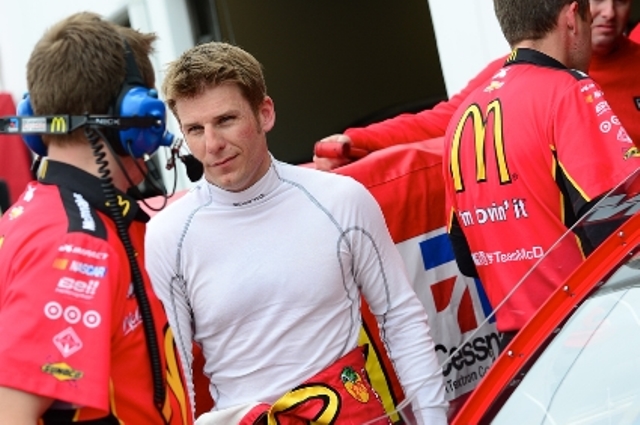
Jamie McMurray riding solid momentum into Las Vegas

Photo Credit: David Yeazell/SpeedwayMedia.com

Last weekend, McMurray had a solid weekend at Phoenix International Raceway as he qualified third and raced to a 10th place finish.

“Yeah it’s been a really good start to the season,” McMurray commented. “I’m happy with our car today.  I think coming to the first mile and a half that is such a critical size track to be able to run well at that I thought our testing went well yesterday and then we were really good in qualifying trim today in practice.  

“It’s been a good start to the season and happy with the performance of the car.”

This week marks a test for many teams as they are weighing their package against their competitors with the new rules that NASCAR has implemented. However, McMurray doesn’t feel that the racing will be dramatically different.

“It’s really hard to evaluate it right now because in the testing that we did yesterday and the little bit of practice we had this morning everyone is on good tires,” McMurray added. “If your car doesn’t handle good you just pull in and work on it.  You never really get a chance to catch anyone.  I was a little shocked that in testing yesterday that really the bottom of the race track was the preferred line.  Normally it’s that way here until it rubbers up a little bit and then you see guys starting to move up.  Especially in (turns) one and two to get around the bumps, but yesterday we didn’t see that.  It seemed like all the guys that were quick could stay right on the bottom and you could do that for 15 or 20 laps in a row, which was somewhat unique.”

McMurray feels that we will have a better idea of what Sunday’s race will be like after tomorrow’s practice when we see what the cars are like on older tires.

Obviously, the big goal for any team – this weekend included – is to win so therefore they can punch their ticket for the Chase. McMurray likes the format and feels that it’s good for the fans.

“From a general fans perspective I think that if you win you should be in the Chase.  I like it,” he commented. “It’s going to be interesting when they start knocking people out after three races.  Especially if you have somebody that dominated the first part of the season and then they don’t make it through.”

McMurray says what he is more interested in is the idea of everything coming down to the last race.

“It’s different and when we went from running every single week to having a 10 race playoff format no one liked that and I think it turned out to be really good,” he continued. “I think it’s tough to give an opinion until you see how it plays out.”

The idea of the format is to increase the urgency to win, but McMurray says that all depends on where you are in the point standings. If you’re in a spot to qualify without a win, you may not push as hard. However, those outside the window, are going to do whatever it takes. With that said, the driver of the No. 1 McDonald Chevrolet says business will probably pick up the last couple weeks before the race.

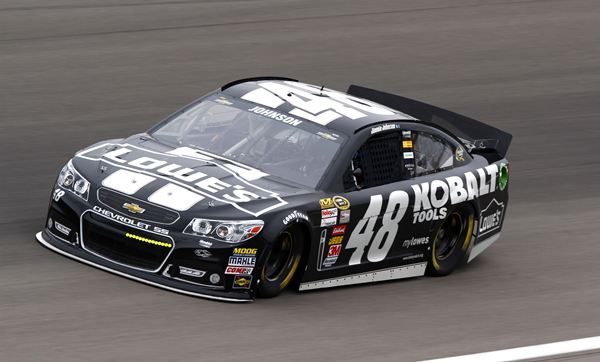
Jimmie Johnson looking for fifth career victory at Las Vegas

For Jimmie Johnson, Las Vegas is one of the track that he likes to go to each year as he spent a lot of times as a young kid racing dirt bikes in the area.

“A lot of years the mini nationals were placed over (in the Hampton area) for the amateur dirt bike racers,” Johnson commented. “Literally across the street is where the start/finish and the main pit area for The Mint 400 was which I changed a lot of tires and worked in a pit for many years.  Also competed in a few of The Mint 400’s myself, Vegas has been great to me in racing.  Really kind of growing up on the West Coast a racing hub, so when this track was built here hoped to race on it and certainly had my success on this track and enjoy it out here.”

In 12 career starts at Las Vegas Motor Speedway, Johnson has four wins and seven top 10s.

“It’s always an interesting race because it’s so early in the season and usually one of our first big tracks that we compete on,” he commented. “You find out how you stack up and where you are at.”

Johnson is coming off a solid finish at Phoenix International Raceway, where he finished sixth. He admitted that he would’ve liked to have run better, but was pleased about what he learnt throughout the weekend about the car and the qualifying format.

Coming off of that subpar run, the No. 48 Kobalt team was looking to get some test laps down as part of yesterday’s test session. Johnson said that they had a solid test session with some highlighted points in speed. The main right now, though, is learning how to adjust according to the new rules as NASCAR has opened up the book of possible adjustments with the no minimum ride height rule.

“It is very easy to make an adjustment on your car that affects four or five other areas and takes the car right out of the race track and slows you down,” Johnson commented. “We are learning and we are enjoying the process.  There are a bunch of new challenges right now with the new car.”

Johnson added that it makes communication between driver and crew chief even more important to make sure that the adjustments are right and figuring out what works and doesn’t work.

“There are more steps involved with making a decision now,” he continued. “I feel like communication still is key, but the thought process on the pit box is more important than it’s ever been because a simple change affects more things now.”

While a lot of teams have tested a lot, Hendrick Motorsports hasn’t done as much testing to date. Johnson says that they want to see how they stack up against everybody and see what they need to do moving forward.

“If we don’t have the speed or feel like directionally we are going down the right road it would be useful to test on a bigger track soon,” he commented. “A lot of people have been to Nashville and Nashville is great to get out and run on, but it’s not a mile and a half.  It’s tough to really take specifics from that race track to other race tracks.  It’s a concrete track, different shape and different size than a lot of places we run on.  This weekend is important for sure.  Yesterday was very helpful and useful.  I’m glad that NASCAR allowed us to come out for a few hours.”

While Johnson may enjoy attending Las Vegas, he says that he can’t left out this area too long as he ends up going to the casino too much.

“The banquet week is three days too long because livers hate me by the end of it,” he commented.

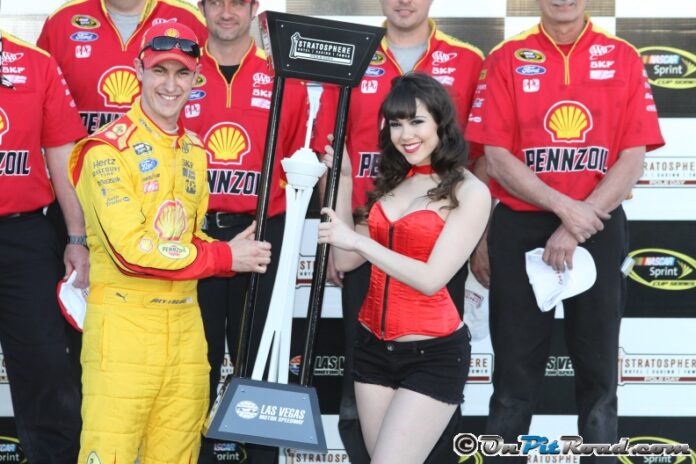
Logano wins pole as Penske sweeps front row for second straight week

Photo Credit: Noel Lanier

At Phoenix International Raceway, it was Brad Keselowski grabbing the pole with his Team Penske teammate Joey Logano second. This weekend at Las Vegas Motor Speedway, it was the opposite as Joey Logano grabbed the pole with Keselowski second.

Logano would lap the track at 27.939 seconds to score his eighth career Sprint Cup Series Coors Light Pole Award. The lap also marks a new track record for the mile and a half oval.

“They do a great job,” Logano said. “I told (Keselowski) we’re 1-to-1 now. Two weeks right off the bat to have a front row is awesome for Penske. It’s a privilege to drive these cars. Everything is clicking. Now we just need to put it all together and win the big one.”

This weekend marked the second time NASCAR has used the Knock-Out Qualifying format for the Sprint Cup Series. In the first 25 minute session, Brian Vickers set the quickest time ahead of Kasey Kahne, Dale Earnhardt Jr., Austin Dillon and Clint Bowyer. Then in the second session, Logano was quickest ahead of Bowyer, Jamie McMurray, Martin Truex Jr. and Keselowski.

Keselowski went out and set the quickest time early in the last session, though it was Logano that was able to top it later. Keselowski would end up second, only three hundreths off of the pole.

“I knew Joey was going to beat it,” he commented. “You know if you leave it out there, your teammate was going to get it. either way, it’s still a great front row – two weeks in a row. It doesn’t feel great to be second, so I know how he felt last week.”

Clint Bowyer would qualify third for his first top 10 start of 2014, followed by rookie Austin Dillon and Jimmie Johnson. Johnson is looking for his fifth career win at Las Vegas this weekend.

Last year’s Rookie of the Year Ricky Stenhouse Jr. was second, followed by McMurray, Aric Almirola, Vickers and Ryan Newman.

Carl Edwards and Martin Truex Jr. rounded out the top 12.

Kasey Kahne would barely missed getting into the top 12 by a hundreth of a second. The driver of the No. 5 Farmer’s Insurance Chevrolet attributed that to not being able to get a solid lap in following wasted time due to a flat tire. Kahne would have a tire go flat and had to wait for NASCAR to allow him to change it with another tire the team had in their inventory.

“There’s just so much going on down here,” Kahne said. “When we had the flat tire, it took so long to get approved. There was no one around. If there’s going to be this much going on and hectic, they’ve got be aware and have more people knowing what’s going on.”

Kahne was followed by his Hendrick Motorsports teammates Dale Earnhardt Jr. and Jeff Gordon. Last week’s winner Kevin Harvick would qualify 16th.

Once again, there were concerns following qualifying with regards to the cooling issues. Team are not allowed to use the cooling machines and as a result, drivers are riding around the apron to cool their cars.

“Riding the apron has to be done for cooling, but it’s the most dangerous thing I’ve done,” Vickers commented. “If he slips up at all, I’m done. I know we’re all working on it but something needs to be done.”

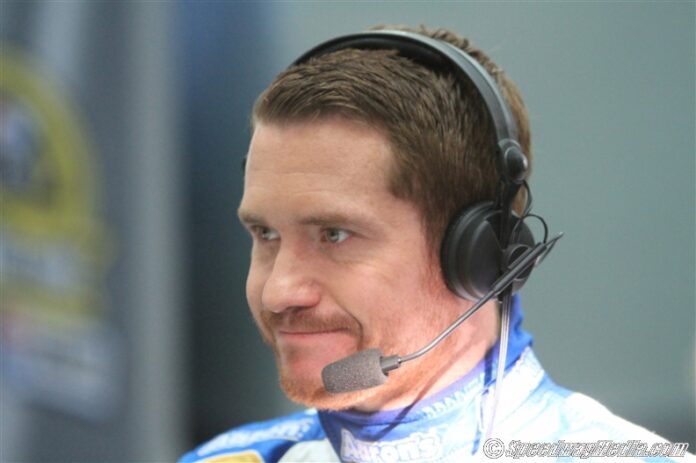
Vickers Needs a Change of Luck in Las Vegas

Photo Credit: Brad Keppel

With the season opener Daytona and one-mile anomaly Phoenix under his belt, Brian Vickers heads into Sunday’s race in Las Vegas needing to establish speed on the first of 17 intermediate track races this season.

In seven career starts at Las Vegas, Vickers has only notched two top-10s and led one lap.  His best intermediate track finish last season was an eighth at Texas, followed by a tenth at Atlanta.  Other 1.5-mile tracks produced less favorable results.  To improve on this season’s rough start, the driver of the No. 55 Aaron’s Dream Machine Toyota will have to replicate what he did in his two races at Texas and Atlanta last year.

Thirtieth and 25th place finishes at Daytona and Phoenix have left Vickers sitting 25th in the standings. While points position two races into the season may not be indicative of what’s to come, it’s enough to raise questions regarding his on-track performance.

Health (he missed the last four races last season due to blood clots) may be the biggest question mark regarding Vickers’ short-term future as a full-time driver, but avoiding contact with other drivers and the wall should top his list of somewhat controllable priorities.

He was effectively taken out of the Daytona 500 when he got caught on the wrong side of a wreck initiated by rookies Austin Dillon and Kyle Larson. One week later in Phoenix, a blown right-front tire sent Vickers hard into the wall early in the race. While the sometimes overly aggressive driver Vickers may have fallen to the destructive power of outside forces, it is still worth noting that the historically accident-prone driver has managed to bang up his car in both races thus far in 2014.

Of the 17 races he ran last season, he logged five DNFs, four coming as results of wrecks. Considering he is slated to run more than twice that amount of races this year, he cannot afford to match that race-to-DNF ratio, which would project upwards of ten DNFs this season.

A high percentage of DNFs can be the make-or-break statistic when team owners are considering signing a driver to an upcoming season. One way for a part-time driver to cover up such an ugly statistic is to win a race, and so Vickers did. His victory at New Hampshire was the first win at a non-restrictor plate track by a part-time driver since Jamie McMurray’s win at Charlotte in 2002.

But now the part-time underdog of last year is a full-time driver on a competitive team. At Michael Waltrip Racing, finishing consistently is a goal both within reach and expected.

The new points system, however, emphasizes winning over finishing consistently. Dale Earnhardt Jr. and Kevin Harvick have essentially grabbed themselves Chase spots with their wins at the first two races this season, and Vickers, too, can benefit from this system by exhibiting his proven ability to win.

Regardless, in order to win, a driver must avoid trouble, and with a rookie class of eight drivers this year, chances are there will be plenty of trouble to go around in the rear of the pack each week.

At Daytona and Phoenix, Vickers ran several laps in the top-10. If he and crew chief Billy Scott can avoid slipping back into the crash-prone part of the field, then Vickers will be fortunate enough to watch the majority of the on-track melees in his rear-view mirror.

But to be fortunate is to be lucky, and 43 drivers will be hoping for a stroke of luck this weekend in Vegas.

Unfortunately for some, the laws of probability say that not everyone can come away a winner.