

Hendrick glad NASCAR stepped up to put Gordon in the Chase
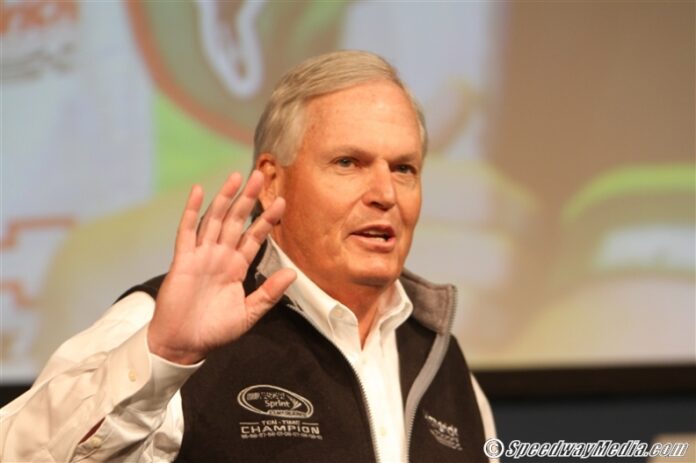
Rick Hendrick admitted Sunday at Chicagoland Speedway that the only thing he knew for sure after last weekend’s race in Richmond was Clint Bowyer had spun with seven laps to go.
He also knew that his driver, Jeff Gordon, was not in the 2013 Chase for the Sprint Cup and the disappointment was tremendous. While none of his four cars were headed toward victory Gordon appeared to be on his way to racing into the Chase before events started to unfold late in the Federated Auto Parts 400. It was the start of what Hendrick describes as the most up and down week he’s ever had.
“I’ve been doing this 30 years and I’ve never been to the [NASCAR] hauler at the end of the race and had any decision reversed for jumping the start or whatever,” Hendrick said after arriving at the speedway for the first Chase race. “The race is the race and that is it. That is the way it’s been for 30 plus years. I was just disgusted and left. I didn’t hang around. I got out of there as soon as it was over because it wouldn’t have done any good.”
But once home Hendrick started to read what was coming out in the media and see the reports on TV and his attitude changed. It became a “how can this be” scenario and soon Gordon’s sponsor, AARP, was on the phone with him all week. What was going to happen they didn’t know, but Hendrick was texting, emailing and doing everything he could to get answers.
Finally, almost a week later NASCAR handed down additional penalties from the Richmond fallout. It included adding Gordon as the 13th seed in this year’s Chase.
“Well you know I didn’t have to make that decision, but I sure felt like it was obvious that he got taken out by a manipulation instead of getting beat,” Hendrick said. “I think the world knew it and they had to do what they did.”
Brian France stepped up, according to Hendrick and the right decision was made. But as far as the manipulation that occurred and started the chain of events that has followed NASCAR all week, resulting in rule changes, Chase changes and plenty of attention, Hendrick views it as a learning experience.
“I think maybe that’s something that’s going to do us all a lot of good. The sport will move on and learn from it and go out and race and show the fans a heck of a good time and get what they pay to see. These guys drive their hearts out every week,” Hendrick said.
“This is what has made it exciting and everybody’s got a tremendous amount of pressure to perform. And now it’s going to be interesting to see how these guys race today and the next 10 races because they’ve got to be a little bit cautious but you’ve got to be really fast. And I think the fans are going to see some extremely hard racing. And I think it’s going to come down to somebody making mistakes and other guys not making mistakes. We’ll see.”
And most important for Hendrick, all four of his cars are now in that position. Which makes the drivers, owner and of course, sponsors happy.
“Everybody is happy now. It’s important to the sponsors. The teams have bonuses and it’s shot at the championship. Everything has happened during the year with all your bad luck and whatever and it’s down to 10 races,” he said.
“The guy that runs good and has good luck could win this thing; anybody can win it. It’s just a lot of excitement for the sponsors on the car.”
My 2013 NASCAR Sprint Cup Championship Predictions

Once we get past all the chaos and controversy surrounding Richmond; it becomes apparent that we still have a championship battle to talk about! Thirteen…yes, thirteen racers will battle tooth and nail for the coveted Sprint Cup trophy and they have ten races to get it done. This chase lacks Tony Stewart, Denny Hamlin and reigning champion Brad Keselowski but it still features some of NASCAR’s heavyweights. Four champions, six Daytona 500 winners and eight teams make up the 2013 chase field. No one has shown immunity to bad luck this season; not even 5-time champion Jimmie Johnson and I could certainly see this coming down to three or five man race at Homestead, much like what we saw in 2004. It’s going to be a great battle!
1.) Matt Kenseth – 5 Wins & 2003 NSCS Champion
Matt Kenseth has been known to quietly click away solid finishes race after race and have sub-par efforts in qualifying seeing that the “go fast for two lap thing” has never really been Matt’s forte. All that changed when he joined Joe Gibbs Racing this year. Matt has made his presence known and has asserted himself as one of the guys you have to go through if you want to win the championship. It’s almost like Roush-Fenway was holding him back. The Achilles Heel of this team may be the lingering TRD engine issues although they have gotten it under control for the most part. Matt is a top five and top ten machine which is why he’s finished 8th or higher in the standings in nine of the last eleven years. He has proven that he’s fully capable of being a title threat and I’ll be very surprised if he’s not a contender.
2.) Jimmie Johnson – 4 Wins & 5-time NSCS Champion (’06, ’07, ’08, ’09, ’10)
The untouchable No.48 team has been vulnerable this year. Their immunity to bad luck has ceased and their rivals are excited to take them on. A recurring thing you heard at Chase Media Day was that drivers thought they can beat Jimmie and they said that with a big grin on their face. This is the guy everybody compares themselves with. If you can beat him, then you definitely have a shot at it! Don’t fool yourself into believing that this rash of bad luck has enervated this team. They have endured their fair share of bad luck in 2013 but it was while they were running up front and for the win so don’t think for a second that they are under performing this year. They just aren’t quite as lucky. If fate was kinder, Johnson could be starting the chase with eight or nine wins. As for momentum going into the chase; Jimmie Johnson doesn’t need momentum. He becomes a winning machine that can do no wrong when the playoffs start. Only time will tell if the this group becomes that indestructible winning machine that all their competitors fear or if the bad luck that has plagued the No.48 carries over into the post-season. One thing for certain is that you can never count out Jimmie Johnson and that elite No.48 team.
3.) Kyle Busch – 4 Wins & Best Points Finish of 5th (2007)
Rowdy Busch. Some love him, many hate him but no one can deny the fact that he’s a heck of a wheel man. Kyle has never fared too well in the chase and last year, he missed out on the post-season by 1pt but went on to score enough points in the ten race stretch that would have given him a 3rd place finish in the championship. The chase is primarily made up of large, high speed banked ovals which bodes well for Busch and his teammate, Matt Kenseth. JGR has excelled at those venues this year with six of their combined nine wins coming at those kind of tracks. Kyle has always had issues handling adversity and it will be interesting to see if he falls apart and makes imprudent decisions should things get tempestuous for him at some point in this chase. I believe 2013 will be the best chase result of Kyle’s career.
4.) Kevin Harvick – 2 Wins & Best Points Finish of 3rd (’10 & ’11)
Kevin Harvick has once again made his way into the chase without many people noticing. “The Closer” not only comes out of nowhere at the end of races but he also has an uncanny way of making his way into the top five in points at the end of the season on multiple occasions without anyone realizing it. I don’t see a championship for Kevin this year but I wouldn’t put it past him. This “lame duck” wants to deliver Richard Childress his first Cup title since 1994 and he’s got one last chance to get it done.
5.) Carl Edwards – 2 Wins & Best Points Finish of 2nd (’08 & ’11)
He’s tied for 2nd, he’s finished 2nd and he’s tied for 1st….guess what comes next? I believe it’s only a matter of time before Cousin Carl, as Kenny Schrader would call him, hoists the trophy in Miami at the end of the season. Carl is one of those drivers who is a champion waiting in the wings. It will come with time. His consistency is what won him the unofficial title of regular season champion and his consistency also helped him stay neck-and-neck with Tony Stewart in 2011. Despite the two wins, Carl hasn’t shown that he can contend for wins on a regular basis but should the other drivers use up their mulligans while he keeps clicking away top 10’s and top 5’s, he may very well find himself in the middle of the title fight.
6.) Joey Logano – 1 Win & Best Points Finish of 16th (2010)
Penske Racing got one driver in the chase this year…and it wasn’t Brad Keselowski. Joey Logano has truly impressed me this year with his tenacity and the way he and this No.22 camp have handled adversity. Joey has won the pole for the first chase race and he seems to have found his niche in the form of large, high banked ovals. Lucky for him, that’s 50% of the chase races. He will win at least one race in the chase in my opinion and I see him as a dark horse. You wouldn’t normally look at Logano as title threat seeing that he’s never gotten a top 15 points finish but he could surprise a few people. His inexperience in this kind of situation may be what hurts him in the end though.
7.) Greg Biffle – 1 Win & Best Points Finish of 2nd (2005)
I doubt Greg Biffle can win the championship this year. He has spent the majority of his season around 8th-10th in points and I don’t expect that to change in the chase. He only has three top five finishes in the first 26 races and ten top 10’s. Those are the lowest numbers of anyone in the top 13 in points right now. The Fords seem very strong at Chicagoland so I wouldn’t be surprised to see him win one of the 1.5 milers but other than that, I really don’t expect Greg to make much noise in the chase this year.
8.) Clint Bowyer – 0 Wins & Best Points Finish of 2nd (2012)
Would I be exaggerating if I said this guy has a lot of attention on him going into Chicagoland? I thought not. Clint Bowyer and his race team have been the headline on every major news outlet this week for all the wrong reasons. He was grilled by multiple ESPN reporters, booed by fans at NASCAR Contenders LIVE, harassed by thousands of incensed people on Twitter and even criticized by his fellow competitors. His integrity has been called into question after a spin that many believe to be deliberate and his intentions with seven laps to go were incontrovertible to most but Bowyer denies it. Clint says that all this negative attention has him determined more than ever to win it all. The usually loquacious Clint is ready to just put that helmet on and go to work. He has spent most of 2013 near the top of the standings despite failing to reach victory lane. I don’t think all this drama will affect him while he’s racing. I wouldn’t bet against it hurting his team though. Distractions are never a good thing in sports. I would say Clint can be a contender just like he was in 2012 but some disgruntled drivers that didn’t take too kindly to what went down may make sure that a championship for the No.15 doesn’t happen this year. It will be interesting to see how Bowyer is treated by other drivers once we get to racing at Chicagoland..
9.) Dale Earnhardt Jr. – 0 Wins & Best Points Finish of 3rd (2003)
Dale Jr. has consistency but he isn’t up there mixing it up for victories every week like his teammate Jimmie Johnson and even Kasey Kahne are. They need to take it up a notch if they want to hold their own against Johnson, Kenseth and Kyle Busch in this chase. If they can’t do that, then I don’t see Jr. getting anything higher than 5th or 6th this year.
10.) Kurt Busch – 0 Wins & 2004 NSCS Champion
Here we have the first “single car” team to ever make the chase. Despite their strong technical alliance with Richard Childress Racing, they are still considered a single car operation. Do not make the foolish mistake of underestimating Kurt Busch or this well funding race team though. The tenacity and raw talent of this proven champion is undeniable and he can most certainly win the championship this year….if he had a better pit crew. When the pressure’s on, the No.78 crew almost always drops the ball and costs Kurt valuable spots. NASCAR is a team sport and if you have a pit crew that isn’t getting the job done, it doesn’t matter if you have a Dale Earnhardt caliber guy wheeling the No.48 with Junior Johnson on top of the pit box…you still won’t win. They have two crew guys so hopefully, he doesn’t encounter as many costly issues on pit road. If his pit crew can get it together, Kurt can be a serious threat for the championship before he departs for Stewart-Haas Racing at the end of the year.
11.) Kasey Kahne – 2 Wins & Best Points Finish of 4th (2012)
Kasey Kahne was my pick to win the title back in March and I wouldn’t be surprised if he proved me right. If fate was kinder (and if Kasey was more aggressive), he could have at least five wins right now. He has four runner-up finishes this year; three of which came down to half a second or less. He also crashed while leading Michigan, Darlington and while going three wide for the lead with two laps to go at the July Daytona race. Kasey’s kindness on track though may pay dividends during the chase when he’s racing around guys not in the running that remember his courtesy while racing them earlier in the year. On the flip side, it may also tempt drivers his battling to use him up not thinking there will be any repercussions. In my eyes, Kasey can win the championship this year if the stars align.
12.) Ryan Newman – 1 Win & Best Points Finish of 6th (’02, ’03 & ’05)
Ryan wasn’t a chaser until Monday night which seemed crazy until Jeff Gordon had to go and outdo him by being added to the chase as the 13th seed less than 48 hours before the first chase race! Ryan is motivated and motivation always seems to have an uncanny way of giving a driver a few extra horsepower. Can he hold his own against Busch, Johnson and Kenseth? I doubt it but be assured that the Rocket Man will go all out and leave nothing on the table before his release from Stewart-Haas Racing. Ryan has been fired and replaced because Gene Haas believes Kurt is a better driver. He’s also been called an ogre, had an airborne car land on top of him, been cheated out of his 18th career win, knocked out of the chase before being put back in two days later and even watched his good friend and current owner break his leg in a Sprint Car crash….yeah; it’s been an interesting year to be Ryan Newman to say the least. He will make some noise in this chase probably by winning at one of the flat tracks that he;s always so good at and I see him having his best points finish since 2005.
13.) Jeff Gordon – O Wins & 4-time NSCS Champion (’95, ’97, ’98, ’01)
Well, who saw this coming? You aren’t supposed to be here! One of unluckiest guys in the garage got a once in a life time break Friday when he was added to the chase as a 13th seed. It would be an auspicious time for Jeff to go buy a lottery ticket right now…although he obviously doesn’t need it. I am hoping that he somehow goes on a tear in the chase, becomes a contender and that we go to Homestead with Kansas Clint and 4-time 1-2 in points. In reality though, I don’t see Jeff making much of an impact on the 2013 chase at all. He is fully capable of being a 5-time champion talent wise but all the pieces team and luck wise just aren’t there. This was a nice gesture by NASCAR but Jeff’s team is not championship caliber in 2013….I think he will spend the last 10 races in the back half of the chase field.
My Three Championship Picks
Kasey Kahne: Why Kasey? I have liked what I’ve seen out of him this year with the speed he’s shown on both 1.5 milers and short tracks. I also like the chemistry he has with long time crew chief Kenny Francis. When it comes to the best driver/crew chief combos in the garage; these two are near the top of the list. Kasey is also able to keep a level head in difficult situations and get all he can out of the car without risking his whole race; necessities for a championship hopeful. Bad luck and JGR drivers running him over has been his only noticeable weakness in 2013.
Kurt Busch: You want to talk about determination? You want to talk about someone that will drive their guts out and finish 10 spots higher than the car he’s driving should? That would be Kurt Busch. That No.78 has been blistering fast at every kind of track this year; they have no bad track. Kurt has completely changed as a person and for the better. No longer does he act churlish towards the media, fans and his team when things get rough. In fact, he’s become one of the most optimistic people out there when things go awry. If Furniture Row wasn’t trying to resolve their pit crew issues, then I’d be counting Kurt out but they’ve already replaced a front tire changer and tire carrier. If Kurt has a solid pit crew, he can win it all.
Jimmie Johnson: Do I really need to say why? You can never count out 5-time and like I said earlier, his win column could be in the double digits this year if it weren’t for bad luck. Like always, he is fast everywhere and his team is solid as a rock. Performing at a super-human level during the chase is something embedded deep within the DNA of everyone on this race team. Chad Knaus is very fastidious and will make sure everything that he can possibly control is in his control. Jimmie doesn’t need momentum to be on his side. He doesn’t even need a good start to the chase. Nothing phases the 5-time champ and that’s why he is one of my three favorites to win the 2013 NASCAR Sprint Cup championship?
Feel free to post your picks below or to comment on mine!
NASCAR and the Ripple Effect

This past week has been unprecedented and historic for the sport of NASCAR, with the sanctioning body announcing the two major penalties, the first for Michael Waltrip Racing on Monday and then Friday announcing probation for Penske and Front Row Motorsports, as well as the historic placement of a thirteenth driver into the Chase, Jeff Gordon.
In spite of these machinations, twists and turns this past week, there has been one constant throughout, the ripple effect.
So, what is the ripple effect?
Webster’s dictionary defines it as “a spreading, pervasive and usually unintentional effect or influence” and dictionary.com defines it as “a series of consequences caused by a single action or event.”
Mike Helton, NASCAR President, used the term ripple effect first by describing how the sanctioning body made the difficult decision on the Monday after the Richmond race to penalize Michael Waltrip Racing with a $300,000 fine, suspend MWR executive Ty Norris indefinitely, and replace MWR driver Martin Truex Jr. in the Chase with Ryan Newman.
“The way we go about these is we look at the incident and only the incident because we know from experience that if you try to look at the ripple effect of an incident, you can’t cover all those bases,” Helton said during the MWR penalty announcement.
“Our focus is around the incident and what we were going to do to react around it, not the ripple effect of the incident or the ripple effect of our reaction,” Helton continued. “So, we simply look at the incident and react to the incident, and whatever our reaction may create, that has a ripple effect to it as well.”
One of the first ripple effects was the outrage expressed by driver Jeff Gordon, who was outside the Chase looking in by just one point behind due to the apparent shenanigans that took place both on the track and on pit road.
“Someone explain the ‘ripple effect’ to me,” Gordon, driver of the No. 24 Drive to End Hunger Chevrolet, tweeted after the race.
And just after the tweet, Jeff Gordon fans latched on and quickly echoed the sentiments that their driver had been a victim of the ripple effect, starting a social media movement of their own in reaction to their driver being denied an opportunity to run for the championship.
Gordon’s teammate Jimmie Johnson also joined in the discussion about the ripple effect, calling for NASCAR to adopt rules similar to the NFL, where play is halted and a review is made of any questionable play or call on the field.
“In my opinion, if there is a question they don’t know, they need to stop the race immediately,” Johnson, driver of the No. 48 Lowes Chevrolet, said. “Figure it out and made the best judgment they can because trying to go back on Monday or Tuesday to fix the situation is just too much and then I learn something about a ripple effect.”
While ripples ran rampant through the garage and the media center alike, the biggest ripple effect came from the fans who continued to be incensed about the actions on the track that they felt compromised the integrity of the sport.
The ripple effect continued throughout the week as the sanctioning body continued to investigate the events at Richmond, turning their attention to the team communication with Front Row Motorsports driver David Gilliland and the discussion to give a spot to Joey Logano late in the Richmond race.
This apparently assisted Logano, who finished 22nd in front of Gilliland, to move ahead of Gordon in the point standings, squeaking into Chase contention.
On both Wednesday and Thursday, NASCAR announced that they would not have any comment, however, Joey Logano addressed the media during his pre-Chase interview in Chicago.
“I am going to be 100 percent honest, I knew nothing about it,” Logano said. “That is stuff that happens week in and week out with spotters.”
“What I look at and say is that if we didn’t pass the 38 car, we were still in 10th in points and still got our bonus point so it has no change in the outcome of where we are right now.”
But the ripple effects did not stop and again NASCAR made a major announcement on Friday, September 13th that a 13th driver would be added to the Chase for the Championship.
In addition to NASCAR making the unprecedented decision Friday to add the four-time champion to the 2013 Chase for the Sprint Cup field, they also put the Penske Racing team of Joey Logano and Front Row Motorsports with David Gilliland on probation.
And the ripple effect continued.
“There were just too many things that went on Saturday night that gave a clear disadvantage and what we deemed an unfair disadvantage to the 24 (Gordon),” Brian France, NASCAR Chairman and CEO said. “I have the authority to do that.”
“It is an unprecedented and extraordinary thing but it is also an unprecedented and extraordinary set of circumstances that unfolded in multiple ways on Saturday night,” France continued. “And we believe this is the right outcome to protect the integrity of the sport, which is our number one goal in NASCAR.”
“It’s been a rough week,” Gordon said after learning that he was back into championship contention. “I’m very appreciative to be in and I know it’s under the most unbelievable circumstances I’ve ever been in as part of my racing career.”
“I wish all of this hadn’t happened,” Gordon continued. “Now here we are as a 13th car and in and we just try to take that opportunity and make the most of it.”
While Gordon expressed his thoughts on how rough his week was, the ripple effect that extended to Martin Truex, Jr. was, however, the most devastating.
Truex, through no fault of his own, was ousted from the Chase due to the MWR penalties, said that all he did was ‘drive his heart out’ throughout the entire race at Richmond, only to be taken out of the chance to run for a championship.
“I’m not even sure what to say at this point to be honest with you,” Truex said. “I’m kind of at a loss for words.”
“They kick me out to make spot for somebody and then they don’t do the same for the other guys,” Truex continued. “It’s just unfair, and nothing I can do about it.”
Truex was not the only driver to experience the ripple effect of confusion stemming from the events of the week since Richmond. Hendrick Motorsports teammate and the sport’s most popular driver also weighed in with his thoughts on the events.
“I don’t know what is fair anymore,” Dale Earnhardt Jr. said. “You could have done it a million different ways and I don’t know that one is better than the other.”
“The whole thing is a mess.”
The most significant ripple effect has yet to be determined, however, as NASCAR announced that it will have a mandatory meeting with all of the drivers, crew chiefs and owners to further discuss these issues.
“We’re going to protect, no matter what it takes — the integrity of the sport will never be in question,” France said. “We’re going to make sure that we have the right rules going forward that are clear so that the integrity of the competitive landscape of the events are not altered in a way or manipulated.”
“And that will be what we will address.”
But will this be the end of the ripple effect that has been created throughout the sport of NASCAR as a result of these unfolding events?
Just as in the original penalties announced earlier in the week, there may be ripple effects that even the sanctioning body cannot even begin to predict or may not even have imagined.
And the biggest and most significant ripple effect that remains to be seen is the reaction by the sport’s fan base, who ultimately determine if their passion or thoughts about the integrity of the sport have been affected or diminished.
And the ripple effect goes on and on and on.
NASCAR’s Mistake in Adding the 13th Chase Contestant
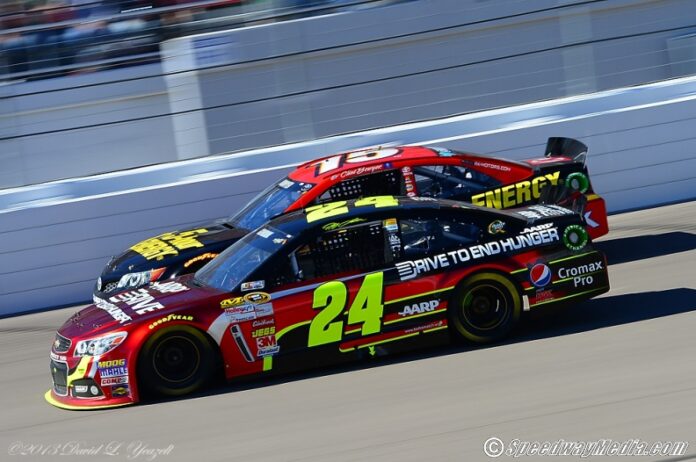
What a strange week. Just when I thought NASCAR was handling things right, things go haywire. After the events at Richmond (I won’t go into it—you know the story), I thought the sanctioning body had made some tough decisions in displacing Martin Truex from the Chase and adding Ryan Newman, but what happened today was almost unbelievable. Despite the sincere explanation of the officials of NASCAR, I just don’t see it. The rationalization that Jeff Gordon should be added to the field of 12 (make that 13 now) makes no sense. I’m not a mathematician (and you have to be to understand the complicated new point system, though they supposedly made is simple for the fans and drivers, let’s go through the changes.
After Matt Kenseth won the last regular NASCAR championship in 2003, it was decided changes were needed to mold NASCAR in the form of stick and ball sports and have a playoff. The problem was the problem whereby Kenseth only had one win that season and the thought of that wasn’t kosher. So, we went to a ten-race playoff where almost anyone could win just like the NFL, NFL, and NBA. Later on they added bonuses for wins and two more “wild cards” based on wins by drivers who came close. Huh? Now you can finish 11th or 12th and still not make the cut because of your win total. So we turn around and place a driver in the Chase because he’s won no races? And guys who have won are left out? I’m sure David Ragan is thrilled. Who’s running this show?
I have nothing against Jeff Gordon, but the crying over the last few days has been over the top. Once NASCAR made the decision to disqualify Truex and install Newman in the chase, Gordon’s car owner went to the media saying he was “robbed.” Gordon fans (and there are plenty of them left) went to social media to state their case for their driver. It was constant. One fan posted on a web site many times that his man should be in the Chase. NASCAR simply yielded to pressure, which is never good. Lots of scenarios show it would have been difficult for Gordon to gain a place in the Chase and no reason that NASCAR should have changed the rules, though they are very good at this and have for years, to add a 13th driver. Funny, but they did and made themselves look like the WWE in the process. It wasn’t necessary. It is sort of like the contrived effort to make sure the most popular driver somehow got in the playoff (you know what I’m talking about, surely), or seemed so.
Wonder what will happen next year if the same thing comes up again and another driver, maybe Junior, misses by one point? Will NASCAR add a 13th driver? Sort of like the Big Red Machine missing the playoffs by a half game in 1976 and adding them in because one of the qualifiers had a pitcher use PED’s. NASCAR has set a precedent and they will be sorry for that in the future.
I’ll end this tirade with one question. How many times have teammates swapped the lead to get the bonus points? How many times have teammates back in the pack let a teammate pass them as victory is in sight? Going back in history, you have to ponder these points. A friend today told me money talks, and he has a point. If the driver missing the Chase had been David Ragan, would they have added him after a controversy? You can bet your life it wouldn’t have happened.
Kyle Busch holds Brad Keselowski off to win EnjoyIllinois.com 225 at Chicagoland Speedway
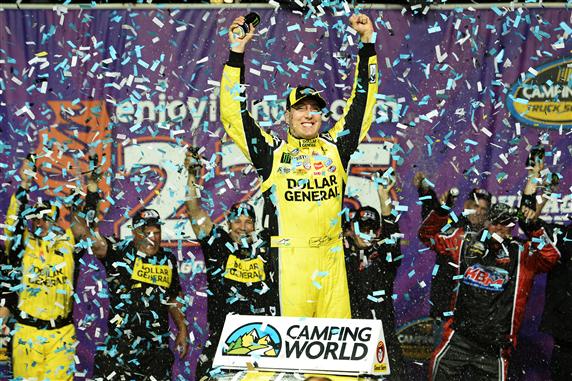
With a pass on Brad Keselowski with 23 laps to go, Kyle Busch would take the lead and hold Keselowski off to win the EnjoyIllinois.com 225 at Chicagoland Speedway on Friday night. It marks Busch’s fourth win of the season and seventh top 10 in eight starts this year.
“That was tough,” Busch said of racing against Keselowski and Keselowski’s young teammate Ryan Blaney. “Brad and Ryan had some really good trucks today. Can’t say enough about this Dollar General Toyota tundra. We didn’t have the speed on the short run, but on the long run, we had as strong truck. Great win for this team. They really deserved it. Rudy and these guys worked hard in practice, tried some things that worked, other things that didn’t work.”
Jeb Burton led early though for most of the race, it was Busch, Keselowski and Blaney trading the lead back and forth. Their battle for the lead at the front allowed NASCAR to set a new record for the most passes for the lead made under green flag conditions at 50.
Keselowski finished second for his third top 10 finish of the year. As the truck owner looks for his truck win, he has now finished second on five different occasions. Keselowski had been closing on Busch in the final laps, though wasn’t able to find a way by.
“It was great,” Keselowski said of the racing with Busch and Blaney. “I hope it was a thrill to watch. That was the most fun you can have finishing second. The guys did an awesome job – just came up a little short there. Finally came in there at the end and just needed a couple more laps there.”
Keselowski’s teammate Ryan Blaney finished third after running in the top five for most of the race.
“It was a lot of fun,” Blaney commented. “I hope everyone watching had a good time watching it. it was fun from where I was sitting. It was cool to work with Brad there. I thought we’d be able to keep the 51 behind us. I could push Brad out front but just never was able to pass Kyle there. Pretty cool having both BKR trucks in the top three not bad, just needed a little bit more.”
Points leader Matt Crafton continued his string of solid finishes with a fourth. It marks his 16th top 10 finish in the 16 races run so far this year.
“Just can’t thank these guys enough,” he said. “They worked so hard on things tonight. We were junk at the beginning. We’d go for about two or three laps and then it would go to like an anchor. We came in and made a ton of adjustments – tire pressure, wedge. It says a lot about this team and how strong they are.”
Crafton now leads Buescher by 41 points with six races remaining in the schedule.
“It was a blast,” Crafton said of the racing. “That is why the NASCAR Camping World Truck Series is the best racing. If the fans can’t see that, then they’re crazy.”
Ty Dillon rounded out the top five.
“It was a long night for us,” he commented afterwards. “Our truck was definitely fast. The bottom was harsh on those restarts and we’d never get on the top for a restart so we lost some spots there. Once we got single file there, it was hard to pass. Wish we could’ve got on the top side for one of those restarts.”
John Wes Townley finished sixth followed by Austin Dillon. Austin was filling in for Brennan Newberry as Newberry was sidelined due to food poisoning. James Buescher finished eighth followed by Jeb Burton and Johnny Sauter.
Front runner Timothy Peters made hard contact with the wall with about 50 laps ago after trying to cut across Ryan Sieg’s bumper.
The NASCAR Camping World Truck Series will be back in action later this month on September 28th at Las Vegas Motor Speedway.
Matty’s Picks 2013 – Race 27 GEICO 400 – Chicagoland Speedway – September 15, 2013
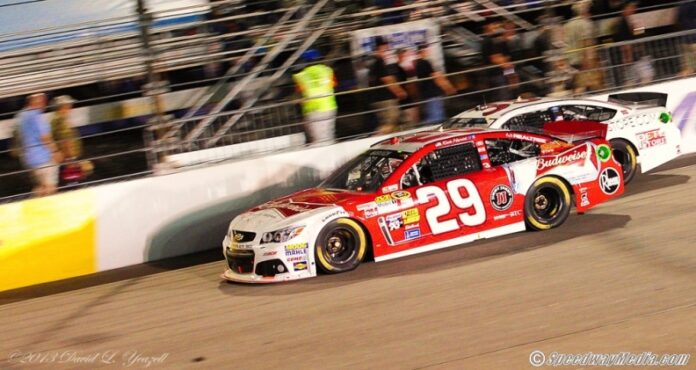
The eventful NASCAR Sprint Cup Series regular season has finally come to a close, and we head onto the opening week of the 2013 Chase for the Sprint Cup this week at Chicagoland Speedway. It has been a fantastic regular season, filled with parody, the broadest spectrum of winners we’ve ever seen in the NASCAR Sprint Cup Series, and of course drama.
I’ll start this week with my thoughts on the biggest news of the week surrounding the Michael Waltrip Racing cars of Clint Bowyer, Martin Truex Jr., and Brian Vickers, the Stewart-Haas Racing car of Ryan Newman, and now the Penske Racing car of Joey Logano, the Front Row Motorsports car of David Gilliland, and Hendrick Motorsports’ Jeff Gordon. Now we’ve gotten all the names out of the way, I’ll attempt to recap what happened with each team to set the now 13-driver field for this year’s Chase for the Sprint Cup.
It was Ryan Newman in the lead late last Saturday Night at Richmond when Bowyer’s spotter, Brett Griffin, came over the radio and said “(No.) 39 is going to win the race…well that kinda sucks. Nine more (laps) right here.” Then there was an arm itching comment by Crew Chief Brian Pattie, Bowyer spun out with no cars around him sending out the Caution Flag. Bowyer spin, Check.
When it came time for the restart, Brian Vickers was called to Pit Road, and amongst the confusion associated with pitting when the field was going green, a comment came over the radio “we need that one point.” and a “I owe you a kiss” comment. When the cars went back to green, Vickers made laps at a speed that any quarter-midget driver would have beaten, raising some more red flags. Vickers pit/lap times, Check.
The result was Joey Logano gaining enough points on Jeff Gordon to knock him from the 10th spot in points, which opened a Wild Card spot for Martin Truex Jr. The result on Monday was a 50-point fine for each of the three Michael Waltrip Racing guys (pre-Chase reset), enough to knock Martin Truex Jr. out of his Wild Card spot, and inserting Ryan Newman (who should have won the race anyway) into the Chase picture. Oh and don’t forget about the $300,000 fine for Michael Waltrip Racing on top of $3-3.5 million in foregone Chase earnings for the No.56 team.
Fast forward to Friday Afternoon…
Towards the end of the race on Saturday Night, there was a “Big Dog and his cronies” atop the spotter stand in what seems like a reference towards Roger Penske who often watches the races from the Spotter’s Deck, so nothing new. The out of the ordinary part of this deal is the chatter over the No.38 (David Gilliland) team radio between Crew Chief Frank Kerr and Gilliland’s spotter requesting Gilliland to give up a spot to Chase hopeful, Joey Logano. Kerr asked who the request came from, the spotter referenced “The Big Dog”, pass happens, Logano gets in the chase, Gilliland’s Spotter says “Hopefully we’ll get something out of that” after the race. Gilliland/Logano pass, Check.
The result here was a review by NASCAR of radio chatter between the No.38 team Driver, Spotter, and Crew Chief and a determination was made that the No.38 and No.22 teams had tried to manipulate the outcome of the race at Richmond and furthermore, the 2013 Chase field. “Based on all of our findings this week, we determined both Front Row Motorsports and Penske Racing organizations would be placed on probation for the remainder of the NASCAR this season.” said Brian France, NASCAR Chairman and Chief Executive Officer. “Additionally, based on the totality of our findings, to be totally fair and equitable we decided that adding a 13th car to this year’s Chase is the appropriate action.” France went on to add, “Beginning with our decision Monday, which resulted in an unprecedented team penalty, and continuing with further examination of actions involving two other race teams, it is clear to us that attempts to manipulate the results impacted the Chase field.”
So, nobody else is out, but Jeff Gordon is now into the first 13-driver Chase for the Sprint Cup field, set to begin on Sunday with the first of the 10 races which make up the NASCAR playoffs.
Now that we’ve gotten the stories straight (or as straight as they can be at this point), my stance on this week’s events is still up in the air…
Though I appreciate the team aspect this sport has to offer, I do not agree with manipulating the outcome of a race to help out a teammate. A sport that was bread in the South on integrity and downright grit has now been tainted with numerous attempts that would have some of the sports’ founders in outrage and calling for a permanent ban from the sport. If this were baseball for instance, the sport’s fans would call for the player attempting to manipulate the outcome of a game to be banned from the sport forever (Pete Rose, Ty Cobb, Alex Rodriguez, Barry Bonds, the list goes on).
The Michael Waltrip Racing penalty is the most severe to ever be passed down by NASCAR, but to me, the team’s greatest chance at a NASCAR Sprint Cup Series Champion was only given a wrist slap. Clint Bowyer is still racing for a Championship even with his (inconclusive) involvement in the events at Richmond, and the guy with no known involvement (who deserves to race for a Championship) in the scheme is left out to dry. Martin Truex Jr. deserves a spot in this year’s Chase because he had earned his right to race for a Championship over the 25 races leading up to the circus in Richmond (winning one of them). Truex in, Bowyer out in my eyes -OR- a 14-team Chase field (why stop at 13?)
Now, as far as how NASCAR handled the penalties and my thoughts on how this week panned out are a different story. It is unfortunate to even have to address things like this during a time when our sport competes with the Nation’s largest viewership week in and week out, but I am guessing Sunday’s race could draw more viewers than any of the previous 9 first Chase races. The question will be if viewers will be tuning in to watch a sport, or to watch a WWF-style half sport, half drama show. Credibility is huge when talking sport vs. show and with this week’s circus, I’m afraid NASCAR may have gained some followers curious about the “Drama Show” aspect this week has been. The deal was sealed on that statement on Friday with the “re-do” on the Chase field for the third time in five days.
To me, it was an all or nothing decision for NASCAR this week, and to hand pick and choose who gets to race for a Championship and who does not has a WWF jingle to it, much like the promoters who decide who gets the title belt and who does not. For so long, NASCAR’s stance was to let the boys settle it out on the track, and to step in and hand pick the Chase field has set a precedent for the future, but still has not addressed any of the “grey area” each and every team likes to play in.
Oh, by the way, my picks for this weekend at Chicago are Kevin Harvick since he’s the only guy in the field this weekend with multiple wins at Chicagoland, and Martin Truex Jr. because he’s out for vengeance and you have to go back to last season for his last finish outside the top-10 on any of the Intermediate tracks.
So, until we put all this chaos behind us and head to the second race of the 2013 Chase for the Sprint Cup…You Stay Classy WWF NATION!