Home Blog Page 5538

Final pit stop sends Edwards and Earnhardt Jr. in opposite directions

Both Carl Edwards and Dale Earnhardt Jr. left Phoenix International Raceway with top five finishes on Sunday. But only one was better than the other and only one of was happy about it.

Edwards won for the first time in 70 races, almost two years, while Earnhardt Jr. settled for a hard fought fifth place finish. The two could have battled for the win had it not been for a final pit stop on lap 239 that gave Edwards the lead for the final time as Earnhardt Jr. lost his chance at his first win in 2013.

Earnhardt Jr. came down pit road the leader, having led 47 laps to that point. Edwards entered fourth. The two both had great stops and were headed off pit road side-by-side, with Earnhardt Jr. just a nose ahead. But when Casey Mears, who was ahead of the two, pulled into his pit box it was a break for Edwards to skirt by while Earnhardt Jr. had to slam on the brakes.

“I think we used strategy to get up front, on pit road, to get ourselves track position. We had a pretty good car,” said Earnhardt Jr., who had started the race from the 21st position.

“On that pit stop the No. 99 [Edwards] got the lead. I was on the inside of him on pit road and I think I could have beat him off, but the No. 13 was trying to get in his stall and I had to lift for that. And I knew right then that was my opportunity to win the race was right there. It’s difficult to pass with the big spoiler.”

On the subsequent restart Earnhardt Jr. spun his tires and faded. Edwards held the lead and went on to score the win, holding off Jimmie Johnson and Denny Hamlin. Brad Keselowski charged into the top five late as well. Earnhardt Jr. tried not to be frustrated; knowing that back-to-back top five finishes to start the season has the team headed in the right direction.

It was the first time in 16 races at Phoenix that he had finished in the five. And the last time he started the season with two top five finishes he went on to win six races. Something that he’s well aware of felt he could have been on his way to doing Sunday.

“We haven’t been good here. So that was a good run for us,” he said while thanking crew chief Steve Letarte for all the changes he made on the National Guard Chevrolet.

“I was a little disappointed because I think we could have won. And you hate to give away them points. And I’d love to get to Victory Lane. This is a good sign for us though, that we’ve improved this much at Phoenix. Hopefully it’s a sign for the rest of the season and that we’re going to be all right.”

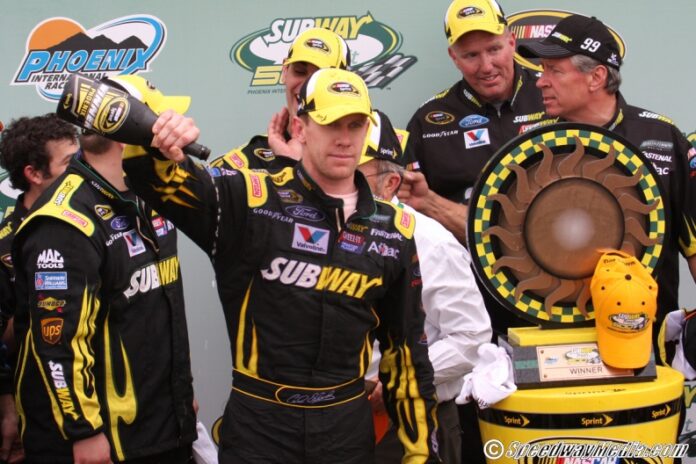
The disappointment felt by Earnhardt Jr. was matched in intensity with which Edwards celebrated. He missed the Chase for the Championship last season and failed to win a race. Sunday he and new crew chief Jimmy Fennig put themselves in contention all day, leading the most laps and scoring their first win.

But Edwards too, knew that the final pit stop played a part in the finish. His time on pit road had been slower than Earnhardt Jr.’s and was behind the 88 as they approached the exit. While his pit crew did earn him spots on pit road all day, he wasn’t going to win the race off pit road on that stop.

“That was hugely important. There were a couple things that happened there,” said Edwards about the incident. “First of all, I think we came onto pit road fourth, we came out first. I was in front of Dale – he must have had the timing lines figured out really well because I was at the max speed I could go and he shot up there.

“And I though, ‘man, I can’t go any faster, I’m going to get a penalty.’ Then Casey was up there and I thought, ‘I’m not exactly sure how this is going to work out’ and then he turned left and Dale could have run me up into the wall and spun Casey out.”

Everyone made it off pit road without incident. Edwards saved enough fuel and survived a Green-White-Checkered finish to score his 20th career win.

“I could tell he [Earnhardt Jr.] thought about it. I think he did because there was that little pause and I thought, he’s going to do it,” said Edwards. “And then he stood on the brakes and kept from tearing all the cars up.

“That had to be very difficult for him because I think we all knew right then that could be the race. I’d like to think I was just going to pass him anyway, but I was a little nervous.”
New partnership brings early success for Edwards and Fennig

Photo Credit: Simon Scoggins

Jack Roush made a revelation Sunday night in Phoenix about the struggles Carl Edwards endured in 2012. In a way, blaming himself for Edwards going through one of the worst seasons in his career.

The team had just won their first race in almost two years, snapping a 70-race winless streak for Edwards. And it came off of a year in which Edwards missed the Chase and went through two different crew chiefs. The one in which he won with on Sunday was his third, veteran Jimmy Fennig.

“It’s great to be here with Carl. We were holding Carl back last year without meaning to just because we didn’t have the right chemistry around him,” said Roush. “But Jimmy Fennig, when we asked Jimmy if he would take Carl and take me for another year and do this thing, he had his requirements, he wanted to change a few things, he didn’t want to see as much of me as I’d shown Bob [Osborne] … But Jimmy is well studied. He works as hard behind the scenes.”

Whatever Fennig wants, he’ll have no problem asking and getting it now. The move away from the No. 17 team – which he led to three wins last season with Matt Kenseth before he departed for Joe Gibbs Racing – to the No. 99 with Edwards has already proven to be the chemistry Roush was searching for. After coming off a Speedweeks in which Edwards wrecked five cars he was perfect at Phoenix, leading the most laps and winning the race.

Edwards, who not only got to perform his celebratory and head into the grandstands, was as jubilant as anyone has seen him in recent memory. He even walked into the media center for his winner’s obligations and shouted, “We won the damn race. How about that?”

His excitement continued through his press conference, in which Edwards acknowledged how much Fennig has already played a big factor in the turnaround to his team. His attitude and outlook on the race and season have changed as well.

“I’ve felt more confident, like a victory is closer, since the first meeting I had with Jimmy at the shop to see the attention to detail he has on the car and to see the intensity in the guys’ eyes,” said Edwards.

“But yesterday after the final practice my trainer came with me from CTS, Dean, and we were talking after practice like man, I’m in a really good mood, like I feel good and I realized it was because I felt that speed in the racecar and the thing drove like I wanted it to, and that’s a really good feeling.

“So I was more optimistic than I have been for a long time this morning getting ready to race.”

The longtime combination of Edward and Osborne won 18 races together and nearly a championship, the most recent just two years ago. They actually tied in points, but lost to Tony Stewart because of wins. Last season Osborne stepped away because of health reasons and Edwards worked with Chad Norris until the season ended when Roush moved Fennig.

Photo Credit: Jonathan Ferrey/Getty Images

While Osborne isn’t working atop the 99 pit box, he’s still apart of the company and the team. He’s doing a lot of engineering on the new Gen6 cars and is involved in all of the meetings at the racetrack. Sunday was as much a win for him as it was for Edwards and Fennig, who wasn’t about to take all the credit.

“Well, I don’t think I’m the missing link. Me, I go about my work a little different than some people do,” he said. “I’m a hard worker. We sit there and we pay attention to detail on our racecars and that’s about it.

“I do the same thing I did with Matt [Kenseth], with Mark Martin in ’98. That’s the way I work. We still have 85 percent of the team left from the 17. That’s still there and everybody knows the way I operate, what I want, and we’re just trying to deliver it to Carl.”

The site of Edwards last win was Las Vegas, where the series heads next. No surprise, he’s already looking forward to heading to Sin City, mostly because he doesn’t have to answer the question of when he’s going to win again. Further, he heads there with a new found confidence and belief that even after just one win, two races into the season, that as he competitors feel, he’s back.

“A lot of people that we have in sports and definitely Jack and Jimmy understand this, but when you’re struggling it seems like time slows down, you’re working harder, you’re trying more, you question yourself more,” revealed Edwards.

“Kyle Petty earlier, we were being interviewed, he’s like ‘Where were you last year?’ I was there. That’s one of the longest years in my life to work that hard and not get the victory. I’m very, very happy to be back in the mix. A victory is huge and for so many reasons. Last year we didn’t make the Chase. for me to sit home while everybody was at the Chase stuff and at Vegas, that was a little bit of a shock to me. I did not like that at all.

“To get a victory helps us be in a better position for the Chase. it just feels good to win and I’m just very glad to be here. So yeah, I hope Denny [Hamlin, who finished third] is right. I hope we’re relevant or more than relevant all year.

“I hope we dominate this thing.”

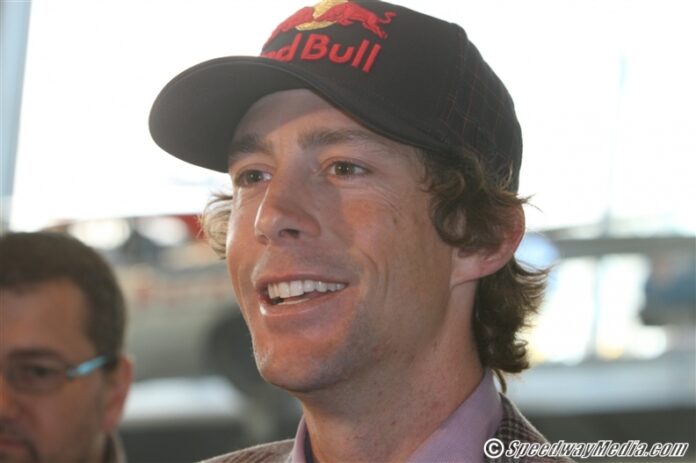
Travis Pastrana Still Embracing Learning Curve

Photo Credit: Brad Keppel

With a solid team in Roush Fenway Racing and a full season ahead in NASCAR’s Nationwide Series, Travis Pastrana is still embracing the learning curve when it comes to stock car racing.

Unfortunately, Pastrana, behind the wheel of his most colorful No. 60 Roush Fenway Ford Mustang, did not even get a chance to go to school in the Dollar General 200 Advance at Phoenix International Raceway. He was involved in an early crash, relegating him to a 28th place finish.

“They started crashing in front of me,” Pastrana said. “I thought I could get to the inside and I just wanted to try to get down, so once I got in the marbles the first lap and was loose, the second lap came in and I saw them crashing in front of me.”

“I kind of let off, but I just got in the marbles again, so unfortunately, it was a pretty useless day for learning.”

Pastrana qualified in the 12th position for the Nationwide race, with a speed of 131.200 mph and a time of 27.439 seconds. But that was not good enough to sustain him in race conditions, having to utilize his teammate’s set up instead.

“We knew that we had a good qualifying run compared to where we practiced,” Pastrana said. “We thought we were pretty good at the end of practice, but we were so far off from where Trevor (Bayne) was, so we went with Trevor’s stuff just to see if it would work.”

“I think we were on the right track, but there’s not a lot we could pick up because I didn’t get one single lap,” Pastrana continued. “The front wheel was busted out and the splitter was off the right-front tire.”

“We just drove around all day,” Pastrana said. “If you see the front tire, it’s folded over completely, so I don’t know how the car survived.”

“The team earned their money today.”

Although frustrated with the early crash and poor finish, Pastrana did learn at least one tidbit. After following teammate Bayne’s line on the track, he at least picked up some knowledge for the future about where to run for maximum speed.

“I knew where his line was and I knew where my line was,” Pastrana said. “So, just learning where you can run the car was good.”

“But with this car, we never knew because we never had a chance.”

Pastrana’s Phoenix run was especially tough since he had had a great outing at Daytona, finishing in the tenth position. The former extreme sport star turned NASCAR racer felt that he really learned a great deal about restrictor plate racing, again with a little help from teammate and former Daytona 500 winner Trevor Bayne.

“Daytona was awesome,” Pastrana said “A top-10 finish was exactly what we had hoped for.”

“I knew we had a great car coming into the race,” Pastrana continued. “Trevor pushed me around a few laps.”

“I kind of gained confidence and really just started pushing a little bit and started to be pushed more and those guys gained confidence with me.”

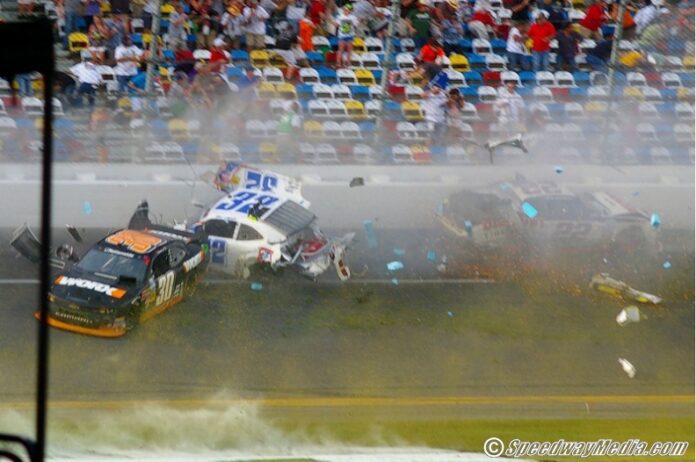
Unfortunately, Pastrana’s confidence was short-lived in the waning laps of the race, with the horrific crash that sent debris raining into the stands as well as all over the track.

“We were running three-wide and I didn’t know what to do,” Pastrana said. “All hell broke loose like it always does.”

“But I still learned a lot.”

Pastrana also broke the news in Phoenix that he will have some learning to do off the track as well, which may involve entirely new skills sets such as diaper changing. He and his wife announced that they are expecting their first child.

“It’s just really exciting,” Pastrana said. “I got married about a year-and-a-half ago and having a kid is going to be awesome.”

Will Pastrana teach his youngster about all of his daredevil ways, including racing in its many forms?

“I definitely feel for my parents now with everything I’ve put them through,” Pastrana said. “But we’ll encourage whatever we have – a boy or girl – to follow their passion.”

“But I’m hoping their passion is golf, maybe.”

As Pastrana leaves Phoenix, now 15th in the point standings, he is no doubt looking forward to more learning at the next venue, Las Vegas Motor Speedway. But he is also anticipating going to another track as well, the Monster Mile, later in the season.

“For me, my hometown track was always Dover,” Pastrana said. “I’ve never gotten to drive anything around Dover and they say it’s like dropping into a roller coaster every corner and jumping coming out.”

“It doesn’t look like a jump when you’re watching,” Pastrana continued. “But all the drivers say it is.”

“I’m looking forward to that.”


NASCAR is asking the Hard Questions

Photo Credit: Ted Seminara

Daytona Speedweeks heralds in the NASCAR season each year. It is generally a fun-filled couple of weeks leading up to one of the most anticipated races of the year, the Daytona 500.

This year the celebration came to a grinding halt after a violent crash in the Nationwide Series race. Kyle Larson’s car went airborne in a last lap wreck that involved 12 cars. His engine ended up in the catchfence. A wheel assembly, pieces of the car and debris, went flying into the grandstands, injuring more than 30 people.

The NASCAR community responded immediately with concern for those injured amid vows by NASCAR to determine how this happened.

But I soon noticed a disturbing trend.

Those who asked how this could happen were met with an almost frenzied response by many. ‘This is not NASCAR’s fault,’ they said.’ Read the back of your ticket,’ they shouted. ‘Racing is a dangerous sport and fans accept that fact every time they attend a race.’

Tony Stewart, who won the race, was somber in victory lane and offered a different perspective.

“We always know that this is a dangerous sport. We assume that risk but it’s hard when fans get caught up in it,” Stewart said. “My concern is for the fans right now.”

When it was learned that a few of the injured individuals had contacted an attorney to explore legal options, some reacted with a verbal attack.  ‘They aren’t true fans,’ many proclaimed. ‘Real fans accept the risks.’

Suddenly, in their eyes, being a NASCAR fan meant that you must pledge your unwavering support.  I disagree.

I’m a huge proponent of NASCAR and I believe that safety is one of their primary concerns. They are constantly striving to make it as safe as possible, both for the drivers and the fans. Sometimes that means asking the hard questions.

Race enthusiasts know that the sport has inherent risks. There is no way to prepare for all of the things that can go wrong. When you attend a race, you do so realizing that there is an element of danger. But you also attend an event with the expectation that NASCAR has done everything possible to keep you safe.

When something goes horribly wrong as it did in the Nationwide Series race, it is not only proper but necessary to ask questions.  Why did the engine separate from the car? Are the cars going too fast? Did the catch fence perform as it was intended?  Does the crossover gate need to be redesigned or eliminated? What can we do to make sure this type of accident never happens again?

NASCAR began asking these questions immediately and I feel certain they will not rest until they have the answers. As fans, you should encourage them to do so.

Steve O’Donnell, NASCAR senior vice president, met with the media Saturday, March 2nd, to give an update on their progress.

“As everybody knows,” he said, “safety is first and foremost not only for NASCAR and our racetracks, but getting that right and making sure our fans can enjoy the most safe and entertaining environment possible. I think our history speaks to that.”

“Moving forward,” he continued, “based on what happened in Daytona, we met immediately with the folks at Daytona International Speedway.  We’ve had multiple meetings this week.  It’s been a truly collaborative effort with the goal of doing two things:  obviously looking at what happened in this incident, but more importantly the go-forward plan of what we can learn and what we want to implement as we go forward.

Asking questions does not mean that you are assigning blame. It means that as a reasonable individual you realize that it is almost impossible to foresee every possible contingency. That is why it is so important to examine this particular occurrence to learn from it and make the necessary adjustments.

Asking questions does not mean that you challenge NASCAR’s intentions or that you are any less of a fan. It simply means that you want NASCAR to be the best it can be. It’s reassuring to realize that NASCAR has the same goal.