
Home Blog Page 57

COLLINS WINS WILD PRO MOD RACE; TWO NEW BRISTOL WINNERS; TWO MORE NEW ENGLAND WINNERS IN BRISTOL; FINALLY A TWO-TIME BIKE WINNER

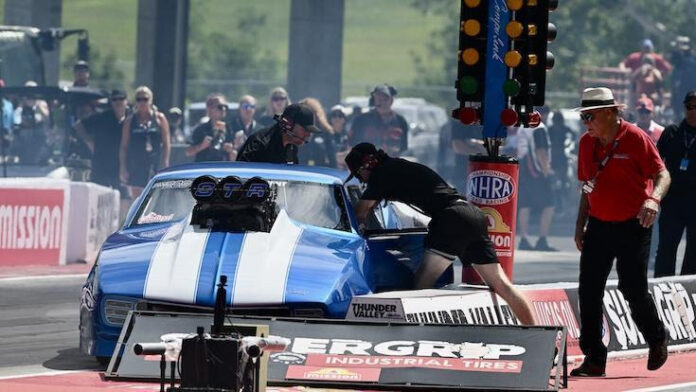
NHRA Pro Mod driver Jason Collins had a wild round Sunday where he nearly mowed down the Christmas Tree en route to winning the Super Grip NHRA Thunder Valley Nationals at Bristol.

BRISTOL, Tenn. (June 18, 2026) – On the surface, drag racing is a straight-forward sport. Two cars line up beside each other, take the green light and each go as fast as possible to try and cross the finish line first.

Every so often, the lines can get blurred a bit, and fans will be treated to a wild and wacky round that they will be talking about for years to come.

NHRA JBS Equipment Pro Mod Series racer Jason Collins treated the Super Grip NHRA Thunder Valley Nationals crowd to such a round on Sunday at historic Bristol Dragway.

Quite literally, you had to see it to believe it.

In the second round Collins nearly lost the race before it even got started. During his burnout the royal blue and white 1969 Camaro’s removable steering wheel came off in Collins’ hands as the car was performing the burnout. The car veered out of control to the left and Collins was hanging on with all he had and on the brakes as the car plowed into the center island guardwall that protects the Bristol Dragway Christmas Tree.

Collins’ machine hit the wall but managed to stop the car just short of hitting the Christmas Tree starting device. While race officials accessed the situation, it was determined that Collins could continue if his car was able. His out of line burnout isn’t a disqualification under NHRA rules. Collins then reattached his steering wheel, backed the car up, re-staged and lined up against his opponent for the run.

Then there was even more fun.

While Collins was staging his car, it kept moving forward, likely from some minor damage of the earlier impact. Collins went straight in during the staging process and double-bulbed his opponent, Travis Harvey. Generally, each opponent will turn on the top bulbs, and then one by one will inch forward to turn on the bottom bulbs in the staging process. Collins just turned them both on at the same time in rapid fashion right at the start, which is highly unusual, and could be seen as gamesmanship from his opponent. He said afterward that his staging situation was definitely not the plan.

As the cars took the green light, Collins pulled away and won the race that he nearly lost two times earlier. Collins powered to a 5.786-second pass at 247.79 mph while Harvey encountered problems and slowed dramatically, giving Collins the victory and one of the most memorable moments of the weekend.

“This is crazy,” Collins admitted. “I’m really embarrassed to be honest. The steering wheel came off in the burnout and I can’t blame nobody but myself because I’m the one that had it off. Obviously, I didn’t lock it on.

“I’ve never had that happen in all my years of racing.”

Collins said the situation escalated immediately when the steering wheel came free.

“The steering wheel came off in the burnout and all I could do is lock the brakes up,” Collins said. “I couldn’t get the steering wheel back on. I was trying to get it back on and I had to call (the crew chief) on the radio to come over there and help me put the steering wheel back on it.”

After he won the round, he was also questioned about the double-bulb move during the staging process.

“It wasn’t on purpose,” Collins said with a grin.

According to Collins, the damaged Camaro continued creeping forward while he fought to hold it in place.

“I was sitting there holding the brake and then it was creeping and I kept mashing (the brake) harder,” Collins explained. “(Harvey) took a long time to get in right there on the first one because I was in the first one pretty long and I thought, well, he’s playing some game over there or whatever.

“When I saw it stuck the second one on, I just grabbed the trans brake. I was like, all I can do is just sit here and do it.”

“Good Lord must be looking out for us today because I can’t believe we won that round,” Collins said.

After beating Harvey in the wild round, he also beat Stan Shelton in the semifinals. In the final round he got the automatic victory when Mike Stavrinos, the race’s No. 1 qualifier, turned on the redlight at the start.

“I wasn’t supposed to win today, but my car was really good,” Collins said. “I didn’t mean to tear it up and that was a little close in the final. This one is all because of my crew. I had some luck and my crew did a great job. I’m just out here chasing a dream and it was unbelievable. Now, we’re in the playoffs and who knows what can happen.”

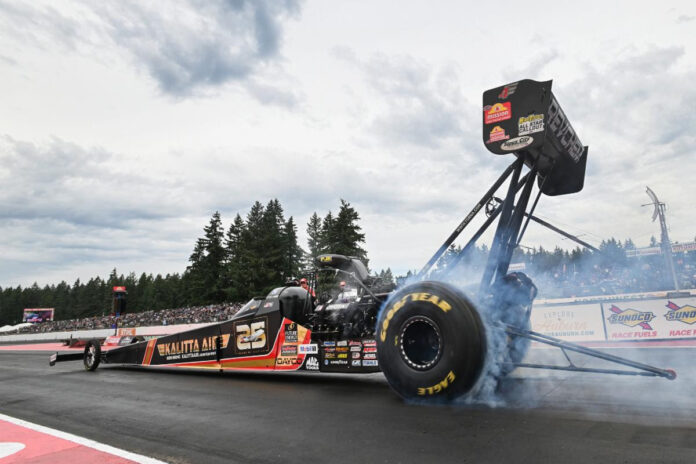
BRISTOL FIRST-TIMERS: Two NHRA Mission Foods Drag Racing Series superstars finally broke through on Sunday to win at legendary Bristol Dragway. Antron Brown has four world championships and 80-plus victories, but he had never won at Bristol in three previous final round attempts. On his fourth, he was able to bust through the heat and humidity at 330 mph and get the job done in his Matco Tools dragster. And he didn’t just win at Bristol. He took down the current kingpin, NHRA points leader Shawn Langdon in a heavyweight titan final round. Meanwhile, over in Pro Stock, a similar story of a competitor who has been at the game for more than two decades – Matt Harford – was able to push his 200-mph machine to the Thunder Valley Winner’s Circle for the first time. Both were elated to check that particular item off their NHRA bucket list. “Getting my first Bristol win after 82 career victories is pretty special,” Brown said. “This place has always been tough on me.” It was Hartford’s first Bristol final round attempt as he took out three-time Bristol winner Greg Anderson. “I’ve been racing at Bristol since the early 2000s and never managed to win here,” Hartford said. “To finally get a Bristol trophy is an awesome feeling. We had a great car all weekend.”

TWO MORE NEW ENGLAND WINNERS IN BRISTOL: On Friday Bristol fans were treated to the final rounds that were delayed from the circuit’s previous race at New England Dragway in New Hampshire. The nitro finals at the New England Nationals were once again rain-delayed. Bristol fans have seen this movie before. In 2023 Top Fuel’s Justin Ashley swept the competition of the New England race and won the Bristol race on Sunday for a sweep that he still holds exclusive claim to. Leah Pruett was able to defeat category Kingpin Shawn Langdon on Friday in the one-round takes all New England Nationals final. Interestingly, it was Langdon, who leads the points and earlier in the year posted an amazing 345 mph speed, who was the runner-up to Antron Brown in Sunday’s Bristol final. In Funny Car, Jack Beckman beat his teammate Jordan Vandergriff in the New England Nationals final and he went on the claim the Mission #2Fast2Tasty Challenge for Funny Car in a re-match the next day.

NEW TRACK SURFACE PRODUCED AWESOME SUNDAY RACING: After a couple of days of laying down rubber, Bristol Dragway’s new surface showed out on Sunday, producing thrilling racing from start to finish in each one of the Mission Foods Drag Racing Series pro classes. The side-by-side racing in Top Fuel in all rounds featured 3.7 and 3.8 second runs at 330 mph-plus throughout the day with many nail-biting finishes. In Funny Car, Sunday produced some winning 3-second runs for Jordan Vandergriff (3.999), newly-enshrined Legend of Thunder Valley Ron Capps (3.989 and 3.980), Austin Prock (3.986) after No. 1 qualifier and race winner Matt Hagan was only able to post at 4.009 to claim the No. 1 spot after four rounds of qualifying. Hagan never ran quicker than 4.079 in eliminations but still got the job done even though the 3-second runs were flickering around him. “I’m like an old plow horse that goes out there and get it done,” Hagan said. “I’m not pretty like Lean (Pruett) and famous like Tony (Stewart), but I just go out there and at the end of the day when you look around the field is plowed.”

CATEGORY’S FIRST TWO-TIME BRISTOL WINNER: After six seasons of competition at Bristol Dragway, finally a rider in the two-wheel class emerged as a two-time winner on historic quarter-mile. Gaige Herrera ran great all weekend and on Sunday he defeated his teammate Richard Gadson in the final round of the Pro Stock Motorcycle class to become the first multi-time winner on the Tennessee track. Herrera was also the No. 1 qualifier aboard his Suzuki. He used a 6.838 second run at 198.47 mph to take the win over Gadson’s Suzuki in the final round. Herrera’s previous Bristol win came in 2024. Other Bristol bike winners have included Jerry Savoie (2022); Angelle Sampey (2021); Steve Johnson (2023); and Gadson (2025). “We’ve been beating our heads against the wall trying to figure out what happened to our performance,” Herrera said. “It felt like we had some bad luck hanging over us, but it feels good to come here and get the win. I wouldn’t say, ‘I’m back,’ but it definitely feels good to get the win and build some confidence heading into (the rest of the season)…Winning with Richard in the final was pretty cool. It reminded me of last year when he got his first win (here at Bristol). We’ve got a lot of fun with it, but I’m glad to be the one taking home the trophy this time.”

About Bristol Dragway

Affectionately known as “Thunder Valley,” Bristol Dragway is nestled between two mountains in northeast Tennessee near the Virginia state line and sits adjacent to the iconic Bristol Motor Speedway. In 2026, the historic dragstrip is celebrating its 61st anniversary and is scheduled to play host to numerous major events including the fan-favorite Super Grip NHRA Thunder Valley Nationals, a marquee event in the NHRA Mission Foods Drag Racing Series. Other key events at the Dragway in 2026 include the DER Bracket Series, Summit Racing Equipment Thunder Valley Street Fights series, BTE World Footbrake Challenge races, PDRA Thunder Valley Throwdown, JEG Summer Fling, RAD Fall Fling 500K, and the NHRA Jr. Drags Eastern Conference Finals. Bristol Dragway also transforms into a premier outdoor concert venue for the world’s greatest music performers and becomes The Thunder Valley Amphitheatre presented by Ballad Health. With more than 50 event days each season and serving as the longtime starting point for The Food City Speedway in Lights holiday spectacular, Bristol Dragway continues to be one of the busiest drag racing facilities in the nation. For more information, please visit www.bristolmotorspeedway.com/dragway.

Country band Old Dominion and hip-hop star Busta Rhymes will headline fifth annual Confluence Music Festival

The Blues Brothers & The Sacred Hearts and Dasha are among more than 30 acts performing Sept. 11-13 as part of NASCAR Cup Series Playoff Weekend at World Wide Technology Raceway.

MADISON, Ill. (June 18, 2026) — Country band Old Dominion and hip-hop star Busta Rhymes will headline the fifth annual Confluence Music Festival when the event returns to the St. Louis region Sept. 11-13 as part of NASCAR Weekend at World Wide Technology Raceway.

The event will feature more than 30 national and local acts, including Busta Rhymes, Ying Yang Twins and a special guest, who will perform prior to the 225-mile Nu Way 225 Sauced by Blues Hog NASCAR O’Reilly Auto Parts Series Chase race on Saturday, Sept. 12, and Old Dominion and The Blues Brothers & The Sacred Hearts, who will perform as part of the Enjoy Illinois 300 NASCAR Cup Series Chase event on Sunday, Sept. 13.

Old Dominion, the award-winning country band known for its signature blend of clever songwriting, warm harmonies and contemporary country sound, has become one of the genre’s most successful groups. The band has earned numerous No. 1 hits, including the multiplatinum “One Man Band,” “Break Up With Him” and “Hotel Key,” along with fan favorites such as “Memory Lane” and “Written in the Sand.” Celebrated for chart-topping recordings and dynamic live performances, Old Dominion has helped redefine modern country music while maintaining a strong connection to its storytelling roots.

Busta Rhymes, the Brooklyn-born hip-hop icon and Grammy-nominated artist, has remained one of rap’s most influential and energetic performers for more than three decades. Known for his rapid-fire delivery, larger-than-life personality and innovative music videos, he has earned numerous chart-topping hits including “Put Your Hands Where My Eyes Could See” and “Break Ya Neck”. A celebrated rapper, songwriter and actor, Busta Rhymes has collaborated with some of music’s biggest names and is widely recognized for pushing the boundaries of hip-hop while maintaining a lasting impact on the culture.

Confluence Music Festival acts from across the region include DJ Rashida, Tim Dugger, Blackwater Acoustic, Cardboard Dale, DJ Big D, DJ Mahf, Dr. Zhivegas, Emily Wallace Trio, Ethan Carl, Jonny Lackey & The Pocket Aces, Lamar Harris, Malena Smith, Macalester Dose & The Rebels, Monte Cristo, Phillip Graves, Red and Black Brass Band, and more.

The Confluence Music Festival is a showcase of innovation, talent and live entertainment. The festival attracts fans from across the country in welcoming NASCAR, the premiere form of motorsports in the United States, to WWTR.

“Fueled by the support and vision of Dave Steward, the Steward Family Foundation and World Wide Technology, NASCAR weekend continues to bring a dynamic lineup of world-class musical talent alongside the thrill of on-track competition,” said Curtis Francois, owner and president of World Wide Technology Raceway. “The Confluence Festival has earned a reputation across the sports and entertainment industry as a premier celebration of the powerful connection between music, motorsports and our community.”

A race ticket includes access to the Confluence Music Festival post-race concert and midway concerts. For closer viewing of the pre-race infield concerts, an upgrade to the Infield Fan Zone is required. In addition to racing and music, the weekend features interactive entertainment displays, a STEM education showcase, car displays, autograph sessions, and live interviews with NASCAR drivers and St. Louis-area sports legends.

On-track action begins Saturday, Sept. 12, with NASCAR O’Reilly Auto Parts Series practice at noon CT, followed by qualifying at 1:05 p.m. The NASCAR O’Reilly Auto Parts Series Nu Way 225 Sauced by Blues Hog, or the 225-mile, 180-lap event, will begin at 6:30 p.m. for the second of the nine NASCAR O’Reilly Auto Parts Series Chase races.

The NASCAR Cup Series stars also will be on track that day with practice at 2:30 p.m. and qualifying at 3:40 p.m.

The weekend will be highlighted by the fifth annual Enjoy Illinois 300 NASCAR Cup Series race on Sunday, Sept. 13, beginning at 2 p.m. The 300-mile, 240-lap feature will serve as the second of 10 races in the NASCAR Cup Series Chase format.

The weekend’s events get started Sept. 11 with a Runway to Raceway fashion show, presented by Neiman Marcus. Festivities on the campgrounds kick off Sept. 11.

Nearly 75,000 fans from 48 states, four Canadian provinces and more than 30 countries attended the festival and race in 2025.

Confluence Music Festival upgrade packages include Gateway Garage/Fan Zone access with front-of-stage viewing for Sunday’s prerace driver introductions, celebrity red carpet walk and Old Dominion post-race concert. Adult Sunday ticket packages start at just $69.

“On the fifth anniversary of Confluence Music Festival, we’re proud to continue the tradition of bringing exceptional live entertainment to this one-of-a-kind event, creating a vibrant destination weekend with something for the whole family,” said Kwofe Coleman, executive producer for the festival. Coleman also is president & CEO of The Muny, which supports production of Confluence Music Festival. “From the ‘Runway to Raceway’ kickoff to the finale concert, Confluence Music Festival is committed to connecting people through music, racing and culture. And we couldn’t do any of it without the support of Dave Steward, World Wide Technology, the Steward Family Foundation and our generous sponsors who continue to invest in this mission.”

More Confluence Music Festival entertainment acts and a schedule with performance times will be announced.

For tickets and more information, call World Wide Technology Raceway at (618) 215-8888 ext. 1, visit WWTRaceway.com, or follow @WWTRaceway and @ConfluenceMusicFestival on social media.

About World Wide Technology Raceway

World Wide Technology Raceway (WWTR) is the home of NASCAR, INDYCAR and NHRA racing in St. Louis’ Metro East region. Located just five minutes from downtown St. Louis and covering 700 acres, WWTR is the largest outdoor entertainment facility in the area. WWTR’s facilities include a 1.25-mile superspeedway; 1/4-mile drag strip; 2.0-mile road course; the Gateway Kartplex state-of-the-art karting facility; and the adjacent Gateway National Golf Links. WWTR and Owner & CEO Curtis Francois have been recognized with several awards, including: 2023 St. Louis Sports Hall of Fame induction; 2023 Innovation in Philanthropy Award by the St. Louis Business Journal; 2022 Explore St. Louis Hospitality Hero Recognition; 2022 Best in Show and Best Event & Festival from the Illinois Governor’s Conference on Tourism; 2021 Comcast Community Champion of the Year; 2021 Jack Buck Award; 2020 NASCAR Drive for Diversity Track Award; 2018 Innovator Award from the St. Louis Convention & Visitors Commission; 2017 Outstanding Facility of the Year Award from the Race Track Business Conference; and the 2017 Spirit of St. Louis Award from the St. Louis Attractions Association. Our mission: We are committed to making a difference in our community, while providing first-class entertainment and memories that last a lifetime.

About The Muny

Now in its 108th season in St. Louis, The Muny — the recipient of the 2025 Regional Theatre Tony Award — is a 501(c)(3) nonprofit dedicated to producing exceptional musical theatre that is accessible to all, continuing its remarkable tradition in Forest Park. As the nation’s oldest and largest outdoor musical theatre, The Muny welcomes more than 300,000 patrons each summer for seven world-class productions, each built from the ground up in St. Louis. Learn more at muny.org, and follow along at facebook.com/munytheatre, instagram.com/themuny and youtube.com/themunytv.

TWO QUALIFYING SESSIONS ON BOTH FRIDAY AND SATURDAY HIGHLIGHT MUCKLESHOOT CASINO RESORT NHRA NORTHWEST NATIONALS

SEATTLE (June 18, 2026) – Two qualifying sessions on both Friday and Saturday return to the schedule for the upcoming 37th annual Muckleshoot Casino Resort NHRA Northwest Nationals, NHRA officials announced today.

As part of NHRA’s celebratory 75th anniversary season, it returns to Pacific Raceways on July 24-26 as one of the final events of the regular season in the NHRA Mission Foods Drag Racing Series.

The weekend will shift to a more traditional weekend schedule, featuring two qualifying sessions on Friday and Saturday – both before the early-evening sunset – as well as the Mission #2Fast2Tasty Challenge on Saturday and eliminations on Sunday.

The tight qualifying schedule will give fans the chance to see plenty of incredible racing action and 12,000-horsepower, 340-mph nitro cars on both Friday and Saturday, leading into a can’t-miss raceday on Sunday. All the stars in Top Fuel, Funny Car and Pro Stock will be on hand for the annual trek to the Northwest, with qualifying set for 2 and 4:30 p.m. PT on Friday, July 24 at the 12th of 20 events during the 2026 season.

On Saturday, July 25, qualifying – and the Mission #2Fast2Tasty Challenge – takes place at 12 and 2:30 p.m. PT, with eliminations set for 10 a.m. PT on Sunday, July 26. The event will also be broadcast on FOX, starting at 4 p.m. ET on Sunday, July 26.

This year’s event will also feature several 75th anniversary items, including:

  • A special tribute and celebration of Jim Dunn, the legendary team owner who has been in the sport for more than 75 years. He was a two-time runner-up in Seattle and tuned his Funny Car to a win in 2008 with Tony Bartone behind the wheel.
  • A new-look Nitro Mall, special displays and much more.

Last year’s winners in Seattle included Shawn Langdon (Top Fuel), Matt Hagan (Funny Car) and Dallas Glenn (Pro Stock).

Langdon has been on a roll in 2026, winning four races and holding a commanding points lead over a loaded Top Fuel class that includes teammate and reigning world champ Doug Kalitta, Tony Stewart, Leah Pruett, Antron Brown, rookie sensation Maddi Gordon, Josh Hart, Clay Millican and Justin Ashley.

Hagan won for the second time in Seattle a year ago and is currently second in Funny Car points behind three-time champ Ron Capps. Other marquee names include back-to-back world champ Austin Prock, past champs J.R. Todd, Jack Beckman and Cruz Pedregon, Chad Green and Funny Car newcomer Jordan Vandergriff.

Seattle native Glenn won at his home track for the first time a year ago en route to his first world title. He’s second in points behind teammate and six-time champ Greg Anderson, while top names in the category include six-time champ Erica Enders, Matt Hartford, who has three wins this year, Aaron Stanfield and Jeg Coughlin Jr.

Tickets for the 37th annual Muckleshoot Casino Resort NHRA Northwest Nationals are currently on sale at www.NHRA.com/tickets. All children 12 and under will be admitted free in the general admission area with a paid adult. For more information about NHRA, visit www.NHRA.com. For more information on Muckleshoot Casino Resort, visit https://muckleshootcasino.com.


About Muckleshoot Casino Resort

The Muckleshoot Casino Resort, celebrated as the “Biggest and Best in the Northwest,” has just become even more impressive with the unveiling of their new hotel tower. This exciting expansion features 401 elegant guestrooms, a more expansive casino floor, a serene indoor pool, a luxurious spa, and the exquisite rooftop steakhouse, Smoke & Cedar. From here, guests can indulge in breathtaking views of Mt. Rainier, the Olympic Mountain range, and the Seattle skyline. As one of Washington’s premier casino gaming destinations, Muckleshoot Casino offers the largest selection of games in the state, with over 3,500 machines, an array of table games, and one of the most extensive smoke-free gaming areas in the region. Muckleshoot Casino also tantalizes the taste buds with a variety of dining options that take guests on a culinary adventure around the world and provides world-class entertainment at the Muckleshoot Events Center and Galaxy! Guests can enjoy additional perks like complimentary valet service, Wi-Fi, covered parking, and electric vehicle charging stations, making every visit even more convenient and enjoyable.

https://muckleshootcasino.com

About Muckleshoot Indian Tribe

The Muckleshoot Indian Tribe is composed of descendants of the Native people who inhabited the Duwamish and Upper Puyallup watersheds of central Puget Sound for thousands of years before non-Indian settlement. The word, Muckleshoot, is derived from the Native name for the prairie on which the tribe’s reservation was established in 1857. Today, the Muckleshoot Indian Tribe is a major contributor to the local economy and community providing resources to other governments, schools, nonprofits, and churches throughout Washington. The benefits of the Muckleshoot Tribe’s economic revival go well beyond financial contributions. From landmark agreements protecting fish and wildlife habitats and innovative educational programming to hundreds of partnerships with organizations serving those in need throughout the state, the Muckleshoot Tribe is committed to improving the quality of life of its citizens, neighbors and work force while preserving its culture and laying the groundwork for a bright future.

https://www.muckleshoot.nsn.us

About Mission Foods

MISSION®, owned by GRUMA, S.A.B. de C.V., is the world’s leading brand for tortillas and wraps. MISSION® is also globally renowned for flatbreads, dips, salsas and Mexican food products. With presence in over 112 countries, MISSION® products are suited to the lifestyles and the local tastes of each country. With innovation and customer needs in mind, MISSION® focuses on the highest quality, authentic flavors, and providing healthy options that families and friends can enjoy together. For more information, please visit https://www.missionfoods.com/

About NHRA

NHRA is the primary sanctioning body for the sport of drag racing in the United States. NHRA presents 20 national events featuring the NHRA Mission Foods Drag Racing Series and NHRA Lucas Oil Drag Racing Series, as well as the JBS Equipment NHRA Pro Mod Drag Racing Series presented by Elite Motorsports and NHRA Flexjet Factory Stock Showdown™ at select national events. NHRA provides competition opportunities for drivers of all levels in the NHRA Summit Racing Series and NHRA Street Legal™. NHRA also offers the NHRA Jr. Street® program for teens and the Summit Racing Jr. Drag Racing League® for youth ages 5 to 17. With more than 100 Member Tracks, NHRA allows racers to compete at a variety of locations nationally and internationally. NHRA’s Youth and Education Services® (YES) Program reaches over 30,000 students annually to ignite their interest in automotive and racing related careers. NHRA’s streaming service, NHRA.tv®, allows fans to view all NHRA national events as well as exclusive features of the sport. In addition, NHRA owns and operates three racing facilities: Gainesville Raceway in Florida; Lucas Oil Indianapolis Raceway Park; and In-N-Out Burger Pomona Dragstrip in Southern California. For more information, log on to www.NHRA.com, or visit the official NHRA pages on Facebook, Instagram, Twitter, and YouTube.

How Motorsports Continue to Shape the Future of Automotive Technology

Photo by depositphotos at https://depositphotos.com/

Motorsports have always been more than entertainment. Behind every race weekend, every pit stop, and every last-lap battle, there is a world of engineering, testing, strategy, and innovation. From NASCAR ovals to IndyCar street circuits and endurance racing experiments, racing remains one of the most demanding laboratories in the automotive world. The pressure is intense, the margins are small, and every improvement must prove itself under real speed, heat, vibration, and competition.

For fans, the excitement comes from the noise, the rivalries, and the skill of the drivers. For engineers and manufacturers, the value goes deeper. Racing pushes ideas to their limits. A part that works on a race car at high speed may later influence production vehicles, safety systems, materials, or efficiency strategies. Even when a race car looks far removed from a road car, the thinking behind it often reflects the future of mobility.

Racing as a Technology Laboratory

A race track is one of the harshest testing environments in the world. Cars are pushed harder than almost any road vehicle will ever be. Engines run at extreme loads, brakes face repeated punishment, tires operate at the edge of grip, and aerodynamic surfaces must perform with precision. This makes motorsports a natural place to test new ideas.

The advantage of racing is speed of feedback. A team can make a change, send the car out, measure the result, and decide quickly whether the idea works. In normal automotive development, testing can take months or years. In racing, the cycle is compressed. That urgency creates innovation.

This is why manufacturers continue to invest in motorsports even when the marketing benefits are not the only goal. Racing teaches lessons about durability, cooling, materials, electronics, driver feedback, and energy management. Those lessons may not move directly from track to showroom, but they often influence the way engineers think about future vehicles.

NASCAR and the Modern Stock Car

NASCAR has always carried a strong connection to American car culture. Its identity is built around stock car racing, close competition, powerful engines, and passionate fan communities. However, modern NASCAR is also deeply technical. The latest generation of cars reflects a changing balance between tradition and innovation.

The modern NASCAR race car still delivers the physical, aggressive style that fans expect, but it also includes more contemporary design thinking. Improved components, updated suspension concepts, larger wheels, and better braking systems show how the sport has adapted. The challenge is to modernize without losing the character that makes NASCAR unique.

For automotive fans, this balance is important. NASCAR’s appeal comes from being both familiar and advanced. The cars look connected to showroom models, yet they are built for brutal competition. That combination keeps the series relevant to longtime fans while also giving manufacturers a platform to showcase performance identity.

IndyCar and the Efficiency Challenge

IndyCar has a different personality. It combines high-speed oval racing with road courses and street circuits, requiring a car that can perform in many conditions. The series has long been associated with precision, open-wheel engineering, and driver bravery. In recent years, the conversation around performance has also included efficiency and energy recovery.

Hybrid technology adds another layer of strategy. It is no longer only about engine power, aerodynamics, and tire management. Drivers and teams must also think about when to deploy extra energy, how to recover it, and how to integrate that system into race craft. This makes the racing more complex and creates another bridge between motorsports and the wider automotive industry.

The road car world is already moving toward electrification, hybrid systems, and smarter energy use. IndyCar’s approach shows how performance and efficiency can exist together. A racing series does not have to abandon speed to explore modern technology. Instead, it can use technology to make speed more strategic.

Endurance Racing and Real-World Lessons

Endurance racing offers another kind of test. While NASCAR and IndyCar often focus on intense bursts of competition, endurance events demand long-term reliability. A car must survive hours of punishment, changing track temperatures, traffic, driver changes, and mechanical stress. Success depends on speed, but also on consistency and survival.

This is why endurance projects capture the imagination of automotive engineers. They reveal weaknesses that shorter events may not expose. A car that is fast for ten laps may not be strong enough for twenty-four hours. Cooling, fuel use, lighting, tire wear, driver comfort, and repairability all become critical.

When stock car technology enters an endurance environment, the result is especially interesting. It allows fans to compare different racing cultures and shows how adaptable a platform can be. A project like that can summarize what makes motorsports special: competition, engineering courage, and the willingness to try something unusual in public.

The Human Side of High Technology

Even as racing becomes more technical, the human element remains essential. Data can show what the car is doing, but the driver explains how it feels. Engineers can model a setup, but the crew must adjust it under pressure. Strategy software can suggest options, but a team still has to make decisions in real time.

This combination of human instinct and technical knowledge is what makes motorsports so compelling. A race is never just a machine test. It is a collaboration between driver, engineers, mechanics, strategists, manufacturers, and sometimes pure luck. Technology improves the tools, but people still determine how those tools are used.

The same lesson applies to the automotive world. Modern cars are becoming more connected, more intelligent, and more efficient, but trust still depends on human experience. Drivers want vehicles that feel safe, responsive, and reliable. Racing helps build that trust because it proves technology under extreme conditions.

Why Motorsports Still Matter

Some people ask whether motorsports remain relevant in a changing automotive world. The answer is yes, because racing continues to reflect the challenges facing the industry. Performance, safety, efficiency, durability, sustainability, and innovation all meet on the track.

Motorsports also create emotional value. People do not follow racing only because of technology. They follow it because machines and humans are pushed to the limit together. A great race can make engineering feel alive. A bold overtake, a perfect pit stop, or a clever strategy call can turn technical details into unforgettable moments.

As the automotive world changes, motorsports will continue to evolve. NASCAR, IndyCar, endurance racing, and future racing formats will each play a role in testing ideas and inspiring fans. The cars may change, the powertrains may change, and the technology may become more advanced. But the core appeal will remain the same: speed, risk, innovation, and the constant search for a better lap.

Hendrick Motorsports Media Advance: Naval Base Coronado

Naval Base Coronado
Sunday, June 21
3.4-Mile Street Course
4 p.m. ET
Location: Coronado, California
TV: Fox
Event: NASCAR Cup Series (Race 17 of 36)
RADIO: SiriusXM

5 KYLE LARSON
Age: 33 (July 31, 1992)
Hometown: Elk Grove, California
Last Race: 5th (Pocono)
Crew Chief: Cliff Daniels
Standings: 6th

No. 5 Patriotic HENDRICKCARS.COM Chevrolet

  • Kyle Larson and the No. 5 HENDRICKCARS.COM Chevrolet earned a fifth-place finish at Pocono Raceway last weekend. It marked the team’s third top-five result in the last four races. The team currently sits sixth in the NASCAR Cup Series standings, just 12 points behind fifth and 15 points behind fourth with 10 races remaining before the Chase.
  • Among active drivers, Larson ranks third in road course victories with six career wins, just one shy of the active lead. Three of those six victories have come during the Next Gen era.
  • The 33-year-old has led 597 laps during the 2026 season, second-most among all Cup Series drivers. He also leads the series with 142 stage points earned through 15 races.
  • This weekend, the No. 5 Patriotic HENDRICKCARS.COM Chevrolet will sport a special red, white and blue paint scheme honoring the military and celebrating America’s 250th birthday.

9 CHASE ELLIOTT
Age: 30 (Nov. 28, 1995)
Hometown: Dawsonville, Georgia
Last Race: 11th (Pocono)
Crew Chief: Alan Gustafson
Standings: 4th

No. 9 NAPA Gold Filters Chevrolet

  • Chase Elliott is scheduled to make his 375th NASCAR Cup Series start this Sunday at Naval Base Coronado.
  • The 2020 Cup Series champion has led the sixth-most laps (275) this season and has the third-most wins (two). His average finish ranks fourth (13.06).
  • On road courses in the Next Gen era, Elliott is tied for the most top-five finishes (11) and tied for the third-most top 10s (15). He has the third most laps led (147) on that track type in that span and the fourth-best average finish (10.88).
  • The 30-year-old driver ranks second in average finish at road courses among active drivers with at least four starts.
  • Elliott is tied for the most wins (seven) on road courses among active drivers at serpentine tracks and is third all time behind NASCAR Hall of Famers Jeff Gordon and Tony Stewart. His 489 laps led on road courses leads active drivers.
  • In the last nine road course races, Elliott has four top-five finishes and six top 10s. In two road course races this season, his best finish is seventh (Circuit of The Americas).

24 WILLIAM BYRON
Age: 28 (Nov. 29, 1997)
Hometown: Charlotte, North Carolina
Last Race: 3rd (Pocono)
Crew Chief: Rudy Fugle
Standings: 11th

No. 24 Anduril Chevrolet

  • Running double duty at Pocono Raceway, William Byron scored two podium finishes, including a runner up in the NASCAR O’Reilly Series race and a third-place result in the NASCAR Cup Series event.
  • In the past 15 road course races, Byron has two wins (Circuit of The Americas, Watkins Glen International), six top-five finishes and nine top 10s.
  • Byron’s two road course wins are the fifth most by a Hendrick Motorsports driver.
  • In the Next Gen era on road courses, Byron is tied for the fourth-most wins (two), tied for the sixth-most top fives, led the sixth-most laps (139) and has the seventh-best average finish (14.16).

48 ALEX BOWMAN
Age: 33 (April 25, 1993)
Hometown: Tucson, Arizona
Last Race: 27th (Pocono)
Crew Chief: Blake Harris
Standings: 32nd

No. 48 Ally Chevrolet

  • Alex Bowman is among the 15 active drivers with one or more road course victories in NASCAR Cup Series competition.
  • The 33-year-old has already won on a street course, securing a victory after leading the final eight laps in the 2024 Chicago Street Race.
  • On road courses, Bowman is tied for the fourth most top-five finishes (six) in the Next Gen era.
  • The Arizona driver has scored at least a top-10 finish in nearly 40% (17) of all Cup Series road course races (43) he has competed.

17 COREY DAY
Age: 20 (November 28, 2005)
Hometown: Clovis, California
Last Race: 38th (Pocono)
Crew Chief: Adam Wall
Standings: 3rd

  • In recognition of the United States’ 250th anniversary, the No. 17 HENDRICKCARS.COM Chevrolet will carry a special patriotic paint scheme for this weekend’s race.
  • Corey Day has made four career NASCAR O’Reilly Series (NOAPS) starts on road courses, earning a career-best fifth-place finish at Circuit of The Americas (COTA) earlier this season.
  • Through 17 NOAPS starts in 2026, the Clovis, California, native has recorded two wins, one pole, six top-five and 12 top-10 finishes.
  • The No. 17 team has made 24 starts on road courses, with Kyle Larson delivering its most recent victory at COTA in 2024.

Hendrick Motorsports

2026All-TimeRoad Courses
Races161,43340
Wins2322*31*
Poles0259*27*
Top 5161,338*104*
Top 10272,287*174*
Laps Led91386,280*2,462*
Stage Wins714416
  • Hendrick Motorsports has the all-time lead in NASCAR Cup Series poles (27), wins (31), top-fives (104), top-10s (174) and laps led (2,462) on road courses.
  • Three different Hendrick Motorsports drivers have won five of the last 15 road course races: Kyle Larson (two), William Byron (two), Alex Bowman (one).
  • The Hendrick Motorsports engine department enters the weekend with 573 victories across all three national NASCAR touring series including 14 of 17 events in the NASCAR O’Reilly Series this season.
  • Hendrick Motorsports remains the Cup Series’ all-time standard bearer in wins (322), poles (259), top-five finishes (1,338), top 10s (2,287), laps led (86,280) and championships (15).

QUOTABLE

Kyle Larson, driver of the No. 5 Chevrolet, on preparing for San Diego: “I spent a little time working on the simulator last week, and I’ll do some more this week before we head out west. The track is definitely bumpy, but that’s pretty normal for a street course – Chicago was bumpy as well. Right now, it’s all about figuring out the corners. I still need more laps to identify the most optimal lines, angles, and approaches through some of the sections.

“I feel like this race is a huge opportunity for us and for the product we can put on display. It’s going to be great to showcase the military, and it will be pretty special to race on a military base and experience everything that comes with it. I’m pumped and really looking forward to getting out there.”

Chase Elliott, driver of the No. 9 Chevrolet, on racing in San Diego: “Hopefully, we can kind of keep building on the stuff we worked on in the simulator, or I can continue to get more familiar with the racetrack throughout the course of the week. Then certainly, when we get kind of first looks at it on Friday, hopefully, just fall into a good groove and a good rhythm and try and repeat some good laps out there and be able to do it all day. So, we’ll see. I don’t know what the challenges are going to be. I know, in my experience, when you do these sim learning sessions of a place you’ve never seen before, and then you get there, there’s going to be sections that are really similar, and there’s going to be sections that look really different, and there’s going to be sections that feel really different. Just dissecting all that and finding some comfort within it in real life and getting up to speed and hopefully do it efficiently, and we’ll just kind of see what the weekend brings. But I’m excited about it, excited to go do something different, and I think it’ll be a good event, good show for everybody to watch.”

William Byron, driver of the No. 24 Chevrolet, on racing San Diego’s new street course: “I don’t have a sense of how it’s going to race. The middle of the course is very difficult, like there’s a lot of open sections. There’s just a lot of open space that is really not used, so I think you’re going to see a lot of passing opportunities through there. You’re going to see dive bombs because you can give up an exit just to get position on someone, but they might be able to kind of make a run back at you.

“It’s tough. It’s visually difficult because you’re just trying to figure out what corner is coming up next. It is way more complicated, I feel like, than Chicago (Street Course) was the first time. Chicago was a lot of 90 degree turns, you know, kind of pretty simple, in terms of layout, just tight. San Diego is tight, but also very technical. My goal when I go next weekend is just to make laps, I really just want to make all the laps throughout the weekend. I want to build my pace as I go and build my confidence. But I feel like it’s going to be really detrimental if you push too hard in certain sections.”

Alex Bowman, driver of the No. 48 Chevrolet, on partnership for San Diego: “There’s a lot of excitement within the industry as we head to San Diego this week and I’m looking forward to being a part of it. Our Ally 48 group is proud to have the USO on board our Chevrolet this weekend. Ally Racing has partnered with the USO of North Carolina since 2019 to support our troops through packing events – it’s special to expand on that as we head to Coronado.”

Corey Day, driver of the No. 17 Chevrolet, on racing in San Diego and on a street course for the first time: “I’m super excited to get the opportunity to race in San Diego. It’s going to be a cool event, one that I’m not too sure they’ll do in years to come, so it’s an honor to be a part of it. I think it’s going to be a really tricky racetrack based off what I’ve seen in the simulator. Everything that’s been shown so far makes it look like an unorthodox racetrack. It’s a street course and it’s a really long one, racing a street course will be a first for me, but I’m excited to have the opportunity to do it. San Diego is a beautiful place so I’m looking forward to hanging out there for the weekend and hopefully we’ll have a good run.”

You Stay Classy, San Diego

Inaugural NASCAR Race Weekend at Naval Base Coronado is a First-Class Affair

MOORESVILLE, N.C. (June 18, 2026) – The inaugural NASCAR race weekend at Qualcomm Circuit on Naval Base Coronado in San Diego is just like the fictional KVWN Channel 4 News anchorman and favorite son of San Diego, Ron Burgundy. It’s kind of a big deal.

Racing on the 3.4-mile, 16-turn street circuit has been highly anticipated ever since its announcement last July. It’s the first time a NASCAR event has ever been held on an active United States military base, and it coincides with the 250th anniversary of the U.S. Navy.

The only parallel to this first-time venue is the Chicago Street Course, which ran from 2023 through 2025 on the streets surrounding Grant Park. But unlike Chicago, where its downtown circuit was asphalt, San Diego will feature new pavement, old pavement, new concrete, old concrete, and a few girder rails embedded in the various surfaces. While it’s the same for everyone, simulation is all drivers and teams have to go on. But races aren’t contested on flat screens. It’s real-world running, where drivers in 3,400-pound racecars pound the ground and each other in pursuit of a big trophy.

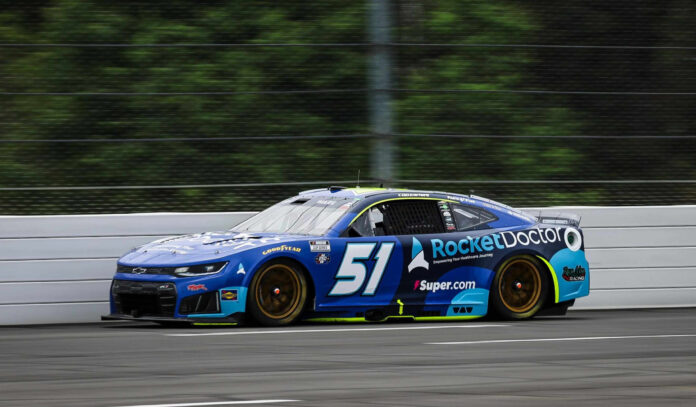
“NASCAR is a contact sport on road courses,” said Cody Ware, driver of the No. 51 Rocket Doctor AI Chevrolet for Rick Ware Racing. “We go into it with a have-at-it mentality, to where if there’s a racing surface that you can plant four tires on, you do it. Beating and banging is expected. It’s very different from the etiquette and thought process behind road racing anywhere else.”

Ware knows. He won the 2019-2020 LMP2 championship in the Asian Le Mans Series with co-driver Gustas Grinbergas, and in a prelude to that title, Ware was the 2014 Lamborghini Super Trofeo North America Rookie of the Year. In January 2024 at Daytona (Fla.) International Speedway, Ware piloted a Ligier JS P320 to a podium finish in the IMSA VP Racing SportsCar Challenge LMP3 class. He has also competed in Whelen Mazda MX-5 Cup and the NTT IndyCar Series.

“If you go anywhere else and you even breathe on someone the wrong way, you’re penalized and get a drive-thru penalty,” Ware said. “In other series, there are so many rules and regulations on how to pass and when to pass and when you have to let somebody go, you feel like you’re not able to race at your full capacity.”

Full capacity is the name of the game in NASCAR. It’s expected of the drivers, and it’s the drivers’ expectation of their racecars.

“Our cars can take the hits, they can take the rubbing, they can take the racing. They’re very durable. Our races have become more of a left-and-right-turn short-track race than a road-course race,” Ware said.

“Sports cars are very fragile compared to stock cars. If you’re in a dedicated sports car series, you give someone a donut, that can rip off a body panel, or if you hit them too hard from behind, their wing falls off.”

The no-holds-barred nature of Cup Series road-course racing, where things can escalate quickly, has made for compelling viewing, be it in person or on TV.

“NASCAR racing on road courses right now is some of the best it’s ever been. We have a lot of parity from first to last,” Ware said. “Whether we’re racing in the dry or racing in wet conditions, everyone’s gotten really good at road racing, so we put on a great race.”

Fans coming to San Diego for Sunday’s Anduril 250 shouldn’t act like they’re not impressed.

“I think the street race at Naval Base Coronado is going to be a spectacle. It’ll be on a whole new level when compared to Chicago,” Ware said.

Even before NASCAR went to Chicago, Ware was familiar with street racing.

“I ran the Nashville street course with IndyCar back in ’21, and that’s probably the closest thing I can compare San Diego to,” Ware said. “We went across that bridge into downtown Nashville at a very high rate of speed, but there was a lot of runoff. The track was built way wider than San Diego. So I’d say from the aggressiveness and speed standpoint, Nashville is very similar, but from a technical and tightness standpoint, I’ve really never experienced a street course like San Diego. There’s no room for error. It’s going to make for a very chaotic race.”

Chaos, however, can sow opportunity. And with San Diego being a first-time event, everyone arrives with the same amount of track time.

“Anytime the playing field is a little bit more level, it plays in our favor,” Ware said. “There’s a lot that’s in my hands to have a really good day, more so compared to other tracks where drivers have more experience.”

Drivers begin building their San Diego experience Friday with a 90-minute track walk starting at 6:30 a.m. PDT. The first time they get to turn a wheel in anger around the bayside circuit is at 2 p.m. PDT/5 p.m. EDT on Friday for a 50-minute open practice, and that’s all the time they’ll have before qualifying at 11 a.m. PDT/2 p.m. EDT on Saturday. A driver’s quick lap in qualifying will set their starting spot on Sunday when the Anduril 250 goes green at 1 p.m. PDT/4 p.m. EDT. All of the action will be broadcast live by Prime Video and SiriusXM NASCAR Radio.

About Rick Ware Racing:

Rick Ware has been a motorsports mainstay for more than 40 years. It began at age 6 when the third-generation racer began his driving career and has since spanned four wheels and two wheels on both asphalt and dirt. Competing in the SCCA Trans Am Series and other road-racing divisions led Ware to NASCAR in the early 1980s, where he finished third in his NASCAR debut – the 1983 Warner W. Hodgdon 300 NASCAR Grand American race at Riverside (Calif.) International Raceway. More than a decade later, injuries would force Ware out of the driver’s seat and into full-time team ownership. In 1995, Rick Ware Racing was formed, and with his wife Lisa by his side, Ware has since built his eponymous organization into an entity that competes full-time in the elite NASCAR Cup Series while simultaneously campaigning successful teams in the Top Fuel class of the NHRA Mission Foods Drag Racing Series, Progressive American Flat Track, FIM World Supercross Championship (WSX) and zMAX CARS Tour.

Wood Brothers Racing – Race Week Briefing: San Diego

Event: Anduril 250

Date/Time: Sunday, June 21, 2026, 4 p.m. ET

Location: Naval Base Coronado, San Diego, California

Layout: 3.4-Mile Street Course

TV/Radio: Prime Video, MRN, SiriusXM NASCAR Radio

Josh Berry and the No. 21 Motorcraft/Quick Lane Ford Mustang Dark Horse team are set for a historic weekend as NASCAR makes its first-ever visit to an active military installation for Sunday’s Anduril 250 Race the Base at Naval Base Coronado near San Diego, California.

The event is part of the nation’s celebration of America’s 250th anniversary and will be contested on the temporary 3.4-mile Qualcomm Circuit, a 16-turn layout constructed aboard the base. The course is expected to provide a unique challenge for drivers with its combination of high-speed sections, tight corners and a notably bumpy racing surface.

“I’m looking forward to getting to San Diego and seeing the track in person,” Berry said. “We’ve spent some time on the simulator preparing for it, but there’s always a learning curve anytime you go somewhere new.

“Street courses present a unique challenge because there’s very little room for error, and this one is going to be pretty tight and technical in some areas. Hopefully some of what we learned at Chicago will carry over. I think it’ll be a fun event for the fans, and I’m looking forward to seeing it all put together.”

For the weekend, the No. 21 team will be paired with Amphibious Construction Battalion 1 (ACB-1), a U.S. Navy Seabee unit based at Naval Base Coronado.

ACB-1 plays a vital role in supporting amphibious and expeditionary operations by constructing and operating temporary infrastructure where it is needed most. The unit builds portable piers and causeways, establishes fuel and water distribution systems, and provides the equipment and expertise needed to move personnel, vehicles and supplies from ship to shore.

The battalion also assisted with construction efforts related to the temporary race facility that will host NASCAR competition this weekend.

Practice for the Anduril 250 is scheduled for Friday at 5 p.m. ET, with qualifying set for Saturday at 2:30 p.m. ET.

Sunday’s 75-lap, 255-mile race is expected to take the green flag shortly after 4 p.m. ET, with stage breaks planned for Laps 20 and 40.

Prime Video will provide television coverage throughout the weekend.

Josh Berry

Age: 35 (Oct. 22, 1990)

Hometown: Hendersonville, Tennessee

Crew Chief: Miles Stanley

IG: @joshberry88

X: @joshberry

About Motorcraft®
Motorcraft offers a complete line of replacement parts that are recommended by Ford Motor Company. From routine maintenance to under hood repairs, Motorcraft parts offer value with high quality and the right fit at competitive prices. Motorcraft parts are available nationwide at Ford Dealers and Lincoln Retailers, independent distributors and automotive-parts retailers, and are backed by the Service Parts Limited Warranty* of Ford Motor Company. For more information, visit www.motorcraft.com. *See your dealer for limited-warranty details.

About Quick Lane® Tire & Auto Center
Quick Lane Tire & Auto Center offers extraordinary service for routine maintenance, serving all vehicle makes and models. Quick Lane provides a full menu of automotive services, including tires, oil change and maintenance, brakes, batteries, alternator and electrical system, air conditioning system, cooling system, transmission service, suspension and steering, wheel alignment, belts and hoses, lamps and bulbs and wiper blades plus a thorough vehicle checkup report. Service is performed by expert technicians while you wait at any of nearly 800 locations in the U.S., with evening and weekend hours available and no appointment necessary. For more information about Quick Lane, please visit www.quicklane.com. *See your dealer for limited-warranty details.

Why Track Day Cars Get Stone Chips and How to Repair Them

Photo by depositphotos at https://depositphotos.com/

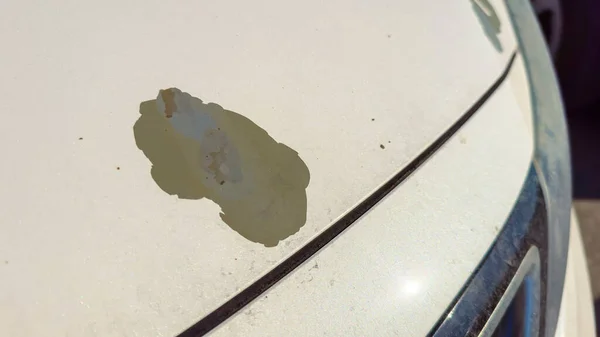
Track day vehicles often suffer from stone chips because they operate at high speeds, near other vehicles, on surfaces that have rubber marbles, gravel, and other debris thrown up by the tires of the cars ahead. The mixture of speed, closeness, and the use of very sticky track-spec tires hitting and flicking up whatever they run over results in the paint getting damaged much more severely than it would on the road. Repairing minor chips is quite simple – you just get your paint color matched and then add the paint in thin layers, but a track car tends to get a lot of damage, so prevention is equally as important as the repair.

Something that most people fail to realize is the amount of energy involved. A chip that needs an impact speed of 30 mph to form on the road will almost, of course, happen at 100 mph or even faster on a straight, and the higher the speed of the impact, the more the chip penetrates all the way through the layers of clearcoat, base coat, and primer to the bare metal. Also, since you are often just two car lengths away from someone’s rear bumper in a braking zone, the front of your car gets hit by a steady stream of grit throughout the day.

Where Track Day Stone Chips Actually Come From

The first and foremost reason is the vehicle that is in front. Racing tyres are designed to run with softer compounds at higher temperatures, and in doing so, they lose rubber and pick up loose surface material that is then flung straight back at the one who is following. The closer you are to the one in front, the more of these particles will land on your car’s bonnet, splitter, and windscreen surround. Anyone who has done a bit of lapping will tell you that the front end of the car usually comes back looking quite a bit worse for wear than after a whole month of commuting.

Next up is the track texture itself. Race tracks accumulate what is referred to by drivers as marbles, which are tiny balls of used rubber that get left off the racing line, plus small stones that might have been dragged onto the tarmac from the run-off areas after a car has gone off. If you happen to go wide, you tend to end up shooting a bunch of stones at your own undercarriage and rear arches. Older or less well-maintained race tracks with coarser asphalt usually tend to be more damaging to paintwork than the ones that have been recently resurfaced.

Another element that changes the type of damage is speed. A tree leaf-sized paint chip inflicted at a low speed on the road often just scratches the clear coat; Though an impact at high speed on a track, by contrast, not only goes through to the primer or metal but can also take a small flake of the surrounding paint with it. That is the reason why track chips, if left untreated, are more susceptible to rusting as they expose the steel underneath rather than just scuffing the top layer.

Which Parts of the Car Take the Most Damage

Leading edges suffer the most. For example, the front bumper splitter grille area, and the bottom part of the wings are in the firing line and Because of this attract the highest concentration of chips. If your car is one that is frequently taken to the track, then it is quite usual for the nose to be all covered with small marks at the end of the season.

Most people don’t realize how important it is to protect the parts behind front wheels. Your tires will naturally pick up small pieces of debris and throw it towards the sills, lower doors, and front edge of rear arches, so the car may get damaged in places that the driver will never bother to check. Also, wing mirrors, A-pillars, and windshield header will get hit by the flying debris thrown high by a car in front.

You will get to see how the blend changes as per what you drive. A light and fast car track-oriented one with minimum body parts and low splitter usually results in concentrating damage lower and forward while heavier GT or saloon tend to distribute more evenly. Aggressive aero cars with big front splitters give the impression of the lower bumper being slightly shielded but actually, the splitter edge gets exposed to relentless abrasion, which means a continuous repair task to be done.

How to Repair Track Day Stone Chips Properly

First and foremost, make sure to clean the panel thoroughly as track cars accumulate brake dust, rubber residues, and tyre dressing overspray, which can all prevent paint from bonding properly. Besides washing and drying, give the panel a final wipe using isopropyl alcohol or a panel wipe. Then test each chip with a fingernail: if your nail catches and reveals grey or silver underneath, it’s primer or bare metal, and you will need to seal the area to prevent rust formation.

The paint code is your key; it’s usually printed on a vehicle data plate found in the driver’s door jamb, under the bonnet, or in the service booklet. Your paint should exactly correspond to the code you find. A good practice is to apply several thin layers of paint rather than one thick layer, each one drying for ten to fifteen minutes before the next is applied. Continue until the paint chip is slightly below the level of the surrounding paint. Considering the number of scratches that a track car can get, this is less a single repair and more a systematic pass across the whole front end, and budgeting an hour or two for a proper session is realistic.

Because track damage tends to be lots of small chips rather than one big one, a kit built around color matching and blending tends to give a better result than dabbing individual bottles. Systems from suppliers such as chipex are designed to handle a spread of chips across a panel and blend the repairs back into the original finish, which is exactly the scenario a track day car presents. Finish by sealing with clearcoat or a quality wax once the paint has fully hardened, which can take a day or two to reach full strength.

For deeper chips showing orange, deal with the rust first by lightly abrading the spot and treating it before painting; otherwise, you trap corrosion under the new color. A clustered repair like this on a solid color can become nearly invisible at a normal viewing distance, while metallics are harder to hide perfectly because of the flake.

Protecting a Track Car So It Needs Less Repair

Paint protection film (PPF) acts as the strongest layer of defense against minor damage. Most serious track drivers avoid the installation of the film for the whole car and only fit it to the areas with a high risk of impact to reduce the cost. A layer of a clear urethane film only a few thou in thickness that can be installed on the body of the car works as a mini shock absorber to stone impacts which results in paint chips. The front-end package covering bumper bonnet wings, and mirrors usually costs several hundred to more than a thousand pounds based on the extent of coverage and the installer. For a regularly used track car, it often works out as the cheapest option than respray works time and time again.

Other than film, simple habits are also a big help. For instance, keeping a somewhat bigger gap to the car ahead during braking zones will reduce the amount of debris you gather, and following the race line will keep you away from the marble built-up off line. Some drivers tape the splitter leading edge and lower bumper with sacrificial helicopter tape that they peel and replace between events, which is a cheap way to take the brunt off the most exposed edges.

One of the main decisions to consider is how you want to use and eventually sell the car. If it is a dedicated track toy you plan to run hard and keep, rust repair work may only be occasionally needed and a few honest paint chips can be a part of the character of the car. If it also acts as a road car or you value resale, getting protection film on the front before your first real season is generally a good investment because a clean, corrosion-free nose is something that holds value, whereas a sandblasted one never will.

The Maintenance Habits That Keep a Hard-Driven BMW Fast

Photo by depositphotos at https://depositphotos.com/

There’s a specific kind of silence after a good session: the engine ticking as it cools, the brakes still smelling like a campfire, your hands buzzing. The car did everything you asked. The question nobody wants to think about at that moment is what it costs. Drive a BMW the way it was engineered to be driven, and you’re not just having fun; you’re spending the car’s maintenance budget faster than the dashboard will ever admit.

Performance owners tend to learn this the hard way. The factory service light is a fine guide for someone commuting to an office. It’s a poor one for anyone who sees redline on a regular basis.

The Factory Schedule Wasn’t Written for You

BMW’s condition-based servicing reads sensors and estimates wear, and it works beautifully for the average driver. The problem is the average driver doesn’t spend Saturday at 7,000 rpm. Heat, repeated hard braking, and sustained load age your fluids and components on a timeline the algorithm was never tuned for. Treat the factory interval as the longest you’d ever wait, then shorten it based on how you actually drive. Track days, canyon runs, and stop-and-go traffic in July all push you toward the short end.

Oil and Fluids Take the First Hit

Engine oil is the first thing hard driving punishes. Under heat and load, it shears and breaks down, and a worn-out oil film is how expensive engine parts start touching each other. Run a full synthetic in the exact spec your engine calls for, change it and the filter more often than the computer suggests, and stop trusting “lifetime” anything.

Brake fluid is the one enthusiasts forget, and it’s the one that bites mid-corner. It absorbs water over time; water lowers its boiling point, and boiling fluid means a soft pedal at the exact moment you need a firm one. Flush it on a real schedule, and more often if you run track days. While you’re in there, check the transmission and differential fluid too, because an M car heats both far past what a commuter ever will. If you’d rather not guess at specs and intervals, European performance specialists in Fort Lauderdale can match the right fluids to your build and the way you drive.

Cooling Is Where a Track Day Is Won or Lost

Nothing ends a session faster than a temperature needle climbing where it shouldn’t. Sustained high rpm hammers the cooling system: radiators, hoses, and that plastic expansion tank that goes brittle with age and heat. A weeping coolant leak you shrug off in spring becomes a steam cloud on the first 95-degree weekend. Watch for coolant dropping between services, sweet smells through the vents, and temps that wander under load. On a hard-driven car, treat cooling as routine maintenance, not a repair you get to after it fails. When the gauge starts misbehaving, get it read properly. A dedicated European auto repair shop with the factory software will find the actual cause instead of throwing parts at it.

Brakes and Tires Put the Power Down

Horsepower is only as good as your ability to use it and shed it. Pads and rotors wear faster when you lean on them, and “one more session” on tired pads is how a fun day turns into a guardrail story. Tires reward the same attention: honest pressures, rotation where the setup allows, and an alignment check after you’ve been pushing. A half-degree of toe will quietly chew through a set of performance tires before you ever notice it in the seat. Match the tire to the use, too. A track-biased compound and a daily commuter tire are not interchangeable, no matter what the discount rack says.

M Cars and Tuned Builds Need More, Sooner

Add power and you add heat, stress, and consequences. M models and tuned cars burn through fluids, brakes, and cooling capacity faster, so they earn shorter intervals and careful record-keeping. Use genuine BMW or OEM parts where fit and tolerance actually matter. A cheap sensor or an off-spec gasket on a high-strung engine isn’t a savings; it’s a deferred bill with interest.

Learn to Read the Early Signs

The cars almost always warn you first. A slightly weak crank. A new noise under acceleration. A shudder under braking, or a light that wasn’t there yesterday. These are cheap problems wearing a disguise. Catch them early, and you’re doing maintenance. Ignore them, and you’re doing repairs, usually from the side of the road. When something feels off, get a real diagnosis from someone who knows these engines. Drivers across South Florida lean on experienced BMW specialists in Pompano Beach to stay ahead of the wear curve instead of chasing it.

None of this is about babying the car. It’s the opposite. Stay ahead on fluids, cooling, brakes, and the small warning signs, and your BMW will keep doing the thing you bought it for: pulling hard, stopping flat, and feeling alive every time you get on it. Drive it like it’s meant to be driven. Just maintain it like you mean it, too.

How Race Teams and Collectors Move Their Cars: The Logistics Side of Motorsports

Photo by depositphotos at https://depositphotos.com/

Every race weekend looks effortless from the grandstands. Cars roll into the paddock, qualify, race, and roll out again to the next venue on the calendar. What almost nobody talks about is everything that happened before that car ever touched the track — specifically, how it actually got there.

Behind every race team and every serious collector is a logistics operation that rarely gets any attention, but without which none of it would be possible. Moving high-value, often irreplaceable vehicles across the country, on tight schedules, with zero margin for damage, is its own discipline. Here’s what that actually looks like.

Why Teams Don’t Just Drive

For a casual car owner, driving a vehicle somewhere is the default. For a race team or a serious collector, it’s almost never an option, and the reasons go beyond convenience.

A race car isn’t street legal in most cases — no plates, no insurance for road use, often not even a functioning street suspension setup. Beyond the legal issue, every mile on a competition vehicle is a mile of wear on a machine that’s already been pushed to its mechanical limits. Teams protect that machinery obsessively, because a car that’s been driven hundreds of highway miles isn’t the same car that left the shop.

For collectors, the calculation is different but the conclusion is the same. A vehicle worth six or seven figures, often with historical significance, isn’t something you put meaningful mileage on for the sake of convenience. The car’s value is partly tied to its condition and provenance — and unnecessary miles work against both.

Enclosed Transport Is the Standard, Not the Upgrade

For anyone outside this world, enclosed transport might sound like a premium add-on. Inside motorsports and serious collecting, it’s simply how things are done.

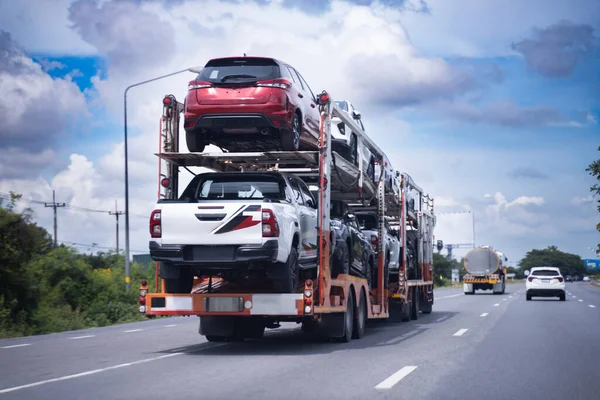
Enclosed car transport protects vehicles from weather, road debris, and the kind of incidental damage that’s irrelevant for a daily driver but unacceptable for a race car or a six-figure classic. The trailers are climate-controlled in many cases, secured with soft tie-downs designed not to mark bodywork, and operated by drivers who understand they’re not hauling cargo — they’re hauling something irreplaceable.

Teams that travel a full season have this dialed into a science. Multi-car enclosed trailers, sometimes carrying two or three vehicles at once between events, are a normal part of a race team’s logistics budget — not a luxury line item, just a cost of doing business at a competitive level.

The Calendar Problem

Race team logistics are, fundamentally, a scheduling problem wrapped around a transport problem.

A team running a full national series might have events three weekends in a row, in three different regions of the country. The car has to be at the track, ready to be unloaded and prepped, with enough buffer built in that a transport delay doesn’t become a missed practice session. Good teams build in days of slack. Great teams have backup transport relationships in case their primary option falls through.

This is where the difference between hobbyist logistics and professional logistics really shows. A weekend racer might ship their car once or twice a year and have some flexibility in timing. A team running a full season is coordinating transport on a schedule that has zero tolerance for delay, every single week, for months at a time.

How Collectors Approach It Differently

Collectors aren’t racing against a calendar, but the stakes around their vehicles are arguably higher in a different way — the cars are often irreplaceable, and damage isn’t something that gets fixed before next weekend’s race. It’s permanent.

Serious collectors tend to build long-term relationships with a small number of trusted transport providers rather than shopping around each time. They want drivers who’ve handled vehicles like theirs before, companies that understand documentation and condition reporting at a level that satisfies insurance requirements for high-value vehicles, and a level of communication that a standard consumer shipment doesn’t require.

Classic car transport for this audience isn’t just about getting from point A to point B safely — it’s about a level of care and documentation that protects the vehicle’s value and provenance over its entire ownership history.

Exotic and High-Performance Vehicles Add Another Layer

Supercars and track-prepped performance vehicles bring their own complications. Low ground clearance makes loading and unloading a genuine technical challenge — the wrong angle on a ramp can damage a front splitter that costs thousands to replace. Wide racing tires, aggressive aero components, and non-standard ride heights all require a driver who’s seen this exact problem before and knows how to solve it without improvising.

Exotic car transport has effectively become its own specialty within the auto transport industry, with drivers and equipment specifically suited to vehicles that a standard carrier simply isn’t built to handle safely.

Buying at Auction Adds a Transport Decision Most Buyers Don’t See Coming

A growing number of collectors and even some smaller teams are sourcing vehicles through salvage and specialty auctions rather than traditional dealers or private sales — chasing project cars, parts vehicles, or genuinely undervalued finds. The auction itself is only half the process. Getting the vehicle home is the other half, and it’s a step a lot of first-time auction buyers underestimate.

Understanding the differences between major auction platforms matters here too — the comparison between IAAI and Copart covers how each platform handles vehicle pickup and what buyers need to plan for once they’ve won a bid, which directly affects how transport gets arranged afterward.

What Makes a Transport Partner Worth Trusting With This

Across all of this — race teams, collectors, exotic owners, auction buyers — the common thread is that the margin for error is small and the cost of a mistake is high.

The operators who do this well share a few traits: real experience with high-value and specialty vehicles, equipment built for the actual demands of the cars they’re hauling, transparent communication on scheduling, and documentation rigorous enough to satisfy insurance requirements that go well beyond a standard consumer policy.

Mile Auto Transport works within that same standard — handling the kind of vehicles where “close enough” isn’t an acceptable outcome, and where the relationship between the car and the road in between matters as much as the destination.

The Part That Never Makes the Broadcast

Motorsports media covers the racing. Collector media covers the cars. Almost nobody covers the part in between — the actual physical movement of these vehicles across thousands of miles, on tight schedules, with values attached that most people can’t fully process.

It’s not glamorous. It doesn’t make for great television. But it’s the invisible infrastructure that makes every race weekend and every collection possible in the first place. The cars don’t get there by accident, and the people who move them know exactly how much is riding on getting it right.