
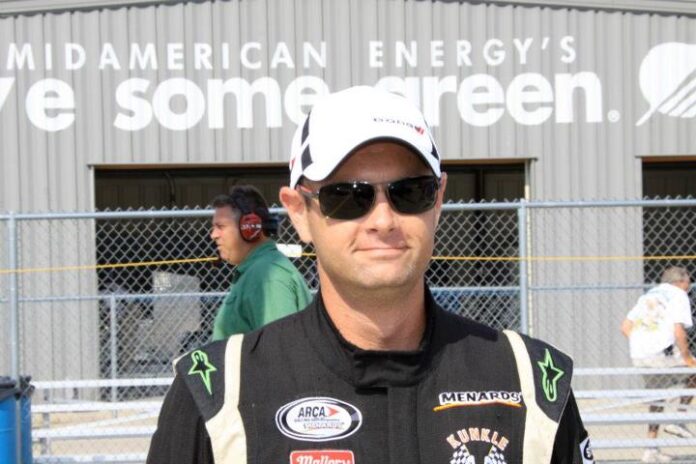
 At first his story sounds familiar. For as long as he can remember, all he has ever wanted to do is race. But it’s the differences in his story that make you sit up and pay attention. His journey has been littered with roadblocks and detours.
However, as Larry Barford Jr. will tell you, he’s never taken the easy route and his determination finally paid off.
On August 17, 2012, he announced that he will compete in the NASCAR Camping World Truck Series (NCWTS) with Deware Racing Group. His schedule this year will include at least three races in the series and a few select NCWTS races in the K&N Series. In 2013 he will run a full schedule in the NCWTS.
“I’ve been involved in racing my whole life. My Uncle Bob Ballantine raced in the Grand National Series.”
His uncle Jim served as crew chief for Bob and as mentor to Larry.
“It was really my mother’s brother, my Uncle Jim, who taught me how to drive and put the bug in my ear. That bug stayed with me my whole life.”
He couldn’t pronounce uncle as a kid and called his uncle, “Kunkle.” The name stuck and was later shortened to “Kunk.” Sadly,”Kunk” passed away in 1987 at the age of 30.
Larry started racing go karts when he was five years old and continued until he was twelve. At the same time he hung out with the local late model racers and learned everything he could. In his later teenage years he began competing in late models and hobby stock. It was mostly for fun although the desire to make it a career was always in the back of his mind.
As often happens in life, his career goal was interrupted.
“Life had other plans for me,” Larry says.
Those plans included marrying his high school sweetheart, Alicia, and the impending arrival of their first son, Tyler. Larry realized that he had to “get a real job” to provide for his family. A full time career in racing would have to wait.
He decided to pursue another dream and become a police officer. He stayed on this path for about ten years. During this time, his second son Jacob was born.
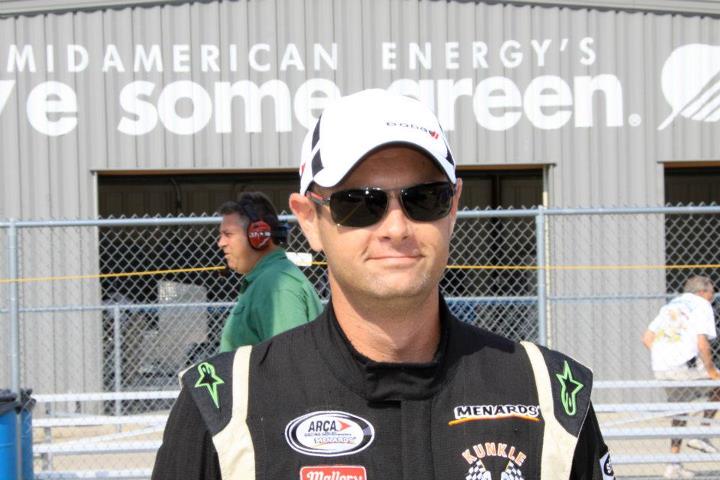
While working as a police officer, his schedule stabilized and he found a way to continue racing. He formed a late model race team and named it Kunkle Motorsports in honor of his late Uncle Jim. Larry also developed a trademark featuring angel wings and checkered flags that he continues to use as inspiration.
His law enforcement career ended abruptly after a severe knee injury sustained in the line of duty forced him into early retirement. When it became clear that his career in law enforcement was over, he decided to make racing his primary focus.
“I never gave up on racing,” he told me, “I just had other obligations.”
That’s not to say that it’s been easy.
In 2009 while he was racing late models, a friend suggested he give Derrike Cope a call. This led to a truck test with Cope and the chance to drive in the series but the funding didn’t materialize.
Larry decided to purchase some cars to run in the ARCA Series and began the process of marketing himself to obtain sponsors. In 2010, life threw another curve ball.
His wife Alicia became ill and the possibility of brain surgery was discussed. Surgery was ruled out but a diagnosis of fibromyalgia meant a regimen of painful and costly injections. They sold most of the race cars to pay for anticipated medical bills. Larry didn’t know if he would ever be able to race again.
A few weeks after selling off most of his equipment, Larry received a call from good friend, Donnie Neuenberger.
“Let’s go to Daytona for the ARCA test,” he told Larry.
The chance to drive at the famed Daytona International Speedway was an opportunity Larry couldn’t pass up.
“I didn’t think I’d ever get back into racing because of Alicia’s health,” he said. “We weren’t sure if financially we’d be able to afford it or if I would be able to travel. I just wanted to drive Daytona to say that I had done it.”
Roger Carter agreed to take a look at Larry and assess his driving skills during the ARCA test. In December 2011, Larry went to the test and ran one of the fastest times at the track for the team. Carter subsequently offered him a ride in the ARCA Series for C2M Racing. His first race with them was on February 18, 2012 at Daytona International Speedway.
Larry admits that getting the chance to race at Daytona brought tears to his eyes.
“It didn’t really hit me until I was sitting in the car and I just thought to myself, I’m racing at Daytona.”
His partnership with Roger Carter and C2M Racing ended at the beginning of August due to lack of sponsorship. Larry ended the association with them eleventh in the points standings.
Less than two weeks later, Larry announced that he would be driving for Deware Racing Group.
“What impressed me most about Deware Racing is the way they want to market and develop me. They want me to shadow Kevin Lepage, to teach me and train me. It’s more than anyone had ever done for me. I’ve never had that kind of coaching and advice.”
Larry credits much of his success in life to his wife, Alicia.
“I look up to my wife because of the things she’s overcome and the way she’s helped me with my career. She keeps me focused.”
When it comes to racing, he relies on the advice of fellow driver, Donnie Neuenberger.
“I’ve known him for years but we’ve become really close friends over the last year or so. He gives me the best advice in the world. He’s been there, he’s done that and he knows what’s going on. He pushes me in the direction I need to go.”
As the interview came to an end, we spent the last few minutes talking about our mutual love of racing. I told him how thrilling it was for me to take a pace car ride around the historic track at Darlington Raceway.
He laughed as he told me about the exhilaration of driving 200 mph at Pocono going into the front stretch, coming up on turn one and thinking to himself, “I gotta turn now, are you kidding me?”
As he talked about racing and his anticipation of the 2013 season, the excitement in his voice was contagious.
Larry knows better than most that the future is uncertain but the word quit is not in his vocabulary. He also has some advice for those whose dreams are yet unfulfilled.
“Fight for your dream, protect it, defend it, and I promise you’ll make it through.”