
Alex Tagliani Ready For Toronto After Early Season Success
After fighting to keep a float last year and stay in the IZOD IndyCar Series, Alex Taglani is back and ready to make a run at it.
The Lachenaie, Quebec, Canada native teamed up with Sam Schmidt at the beginning of the season to get things back on track this season.
“Last year, he fought and fought to have that team and this year, he was able to partner Sam Schmidt – here’s a guy that was paralyzed in a car – and the fact that they’ve come together and been very successful,” Randy Bernard, IZOD IndyCar CEO, said during his presentation at the media luncheon in Toronto last week.
This year for Tagliani has been successful, espically on the series’ biggest stage. Back in May, it was Tagliani taking the pole for the Indianapolis 500, which marked a surprise to a lot of people.
“To me, in my sixteen months I’ve been here, I will say that’s in the top three highlights of my career here so far,” Bernard said of the moment. “The fact that I was sitting up in the grandstands and here’s a small team, not a Penske or Ganassi that just took the pole for the Indy 500, was a pretty amazing event.”
The pole also equaled Tagliani being the first Canadian in history to win the pole for the Indianapolis 500 in its 100 year history. He backed that pole up two weeks later at the next event at Texas Motor Speedway, where he sat pole for the IndyCar Firestone Twin 275s.
Tagliani has also had success beyond Indy, including a fifth place at the Grand Prix of Long Beach.
“Slowly but surely this season is showcasing the results that comes from good teamwork and good sponsorship,” he said. “Now we look like a race team. Now we are really going after wins.”
For the driver that most refer to just as Tag, he credits the sponsorship package from electronic entertainment experts Bowers and Wilkins.
“The big thing is that our association with Bowers &; Wilkins was so good last year that it allowed us to develop the car this past winter,” Tagliani told the Toronto Sun last month. “It made a 180 degree difference. Instead of being a team that was 90% focused on building walls and floors (on the Indianapolis race shop) we were able to work on the car and nothing else for the 2011 season.”
He’s also had success this year outside of the IndyCar Series as he ran the NASCAR Canadian Tire Series race at the ICAR Circuit in Montreal. He sat on the pole for that event and led till being spun by his own teammate with less than five laps to go.
Tagliani, who began his professional open-wheel career in the Toyota Atlantic Championship Series in 1996, will be one of the three Canadians trying to win the Honda Indy Toronto.
The Honda Indy Toronto, which is set to be run July 10th, is the first of three events for the IZOD IndyCar Series in Canada.
Last year, Tagliani finished 17th last year, however had better success the year before with a ninth place finish. For Tagliani, the success has been better in Toronto for him when he was running the Champ Car World Series, which saw a second in 2002 and a third in 2005.
For team owners Sam Schmidt, it’d mark a great milestone in the climb from being an Firestone Indy Lights owner to a IZOD IndyCar Series owner after winning four Indy lights championships.
Part of getting that first win will be about getting the No. 77 car more consistent.
“We still have a couple of thing to figure out how to make our set up more consistent during the race,” Tagliani said. “Once we solve that, and we are close, I want to find a way to win the championship.”
For more information on Sam Schmidt Motorsports, check out http://www.samschmidtmotorsports.com/.
For more information on Alex Tagliani, check out http://www.tagliani.com.
Surprising and Not Surprising: Daytona Coke Zero 400

With firecrackers sparkling, patriotism soaring and flags flying high in celebration of the July 4th holiday weekend, here is what was surprising and not surprising from the Coke Zero 400 run under the lights at Daytona International Speedway.
[media-credit name=”David Yeazell” align=”alignright” width=”261″]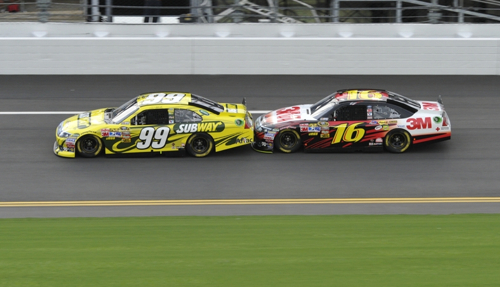 [/media-credit]Surprising: Sentimental favorite Trevor Bayne and points leader Carl Edwards both surprisingly had a world of trouble at the world center of racing.
Bayne, piloting the famed Wood Brothers No. 21 Motorcraft/Quick Lane Tire and Auto Center Ford, was making his triumphant return to the superspeedway after winning the Daytona 500 and then having to get out of the car for a bit as a result of a never-diagnosed illness.
The young driver’s high hopes were dashed early, when he was turned by Brad Keselowski, in the No. 2 Blue Deuce for Penske Racing, on Lap 5 of the race. Bayne and team were unable to repair the car and he finished 41st.
“I don’t know if I turned down more getting in or if he (Keselowski) kind of came up across our bumper, but, either way, our bumpers caught wrong and it sent us spinning,” Bayne said. “You know that can happen here.”
“It happens all the time, but it’s tough that it was our car,” Bayne continued. “I hate tearing up a good race car. If I didn’t have my faith and everything else right now, that would be a pretty bad blow I can promise you that.”
Bayne was not the only one that had a tough night. Points leader coming into the race Carl Edwards had his hands full as well behind the wheel of the No. 99 Subway Ford for Roush Fenway Racing.
Edwards was running third, being pushed by teammate Greg Biffle, when he hit the wall on lap 23. Edwards’ car was severely damaged, allowing fumes to get into the car and sickening the driver.
While Edwards did get his car back on the track, he finished 37th, losing the points lead to Kevin Harvick.
“We don’t ever give up and that’s the thing,” Edwards said. “I told my guys to keep their heads up. We’ll take this bad day and keep our pride.”
“We knew coming here we could come out losing a bunch of points and we lost about as many as we could, but that’s OK,” Edwards continued. “We’re still right there. Hopefully we’ll be leading it after next week.”
Not Surprising: There was another Cinderella glass slipper waiting and not surprisingly this one was polished with redemption for one driver who was definitely due one at Daytona.
David Ragan, who had come so close to winning the Daytona 500 but was penalized for changing lanes in the waning laps, was pushed to his first ever Cup victory by teammate Matt Kenseth.
This was Ragan’s first victory in 163 Cup races but his fifth top-10 finish in 2011. The driver of the No. 6 UPS “We Love Logistics” Ford for Roush Fenway Racing scored his fourth top-10 finish in ten races at Daytona.
“It was a tough one in February and coming back here we knew that we’d have a shot to win,” Ragan said. “When we qualified, that’s probably the first time I really felt like we’ve got a car that’s fast enough that we can win this thing, so we made a pact with our teammate Matt Kenseth that we were gonna work together through thick or thin.”
“I just tried to not make any mistakes, tried to put ourselves in good position and we wound up obviously being in the lead on the last restart and that was the winning moment for us,” Ragan said. “I’m happy about the win.”
Surprising: While this year has been one of change on pit road, particularly for the over the wall gang with the new fueling system and the elimination of the catch can man, there was another surprising change on pit road during this race. The gas can man became the grease man as well.
From rags covered in lard to cans of Pam, greasing the bumpers became a part of the pit crew dance. And another pit road command from atop the boxes became “Right side tires and grease the bumpers.”
Not Surprising: With the new style of tandem racing, it was not surprising to see a race record high of 57 lead changes. There was also a track record broken for 25 different leaders, with the previous record being 22 set in this year’s Daytona 500.
It was also not surprising that after all of the racing, the finale came down to the second attempt at a green, white, checkered finish.
Clint Bowyer, who had been at the front of the pack in his No. 33 Wheaties Fuel Chevrolet, ended up finishing 36th, thanks to that final green, white, checker attempt.
“We got some damage in the beginning of the race and laid back in the field with our RCR teammate Jeff Burton until about 30 to go,” Bowyer said. “That last caution came out at the wrong time as we were making a run at the leaders.”
“Nothing we could have done there at the end,” Bowyer concluded. “That’s just restrictor plate racing for you I guess.”
Surprising: The surprising tandem dubbed ‘Harvard’, comprised of Kevin Harvick, driving the No. 29 Budweiser Folds of Honor Chevrolet, and Paul Menard, behind the wheel of the No. 27 Quaker State/Menards Chevrolet, finished strong.
In fact, Harvick’s finish was strong enough to catapult him over Edwards to lead the point standings by five.
“We had a plan to stick with the No. 27 (Menard) all night and I think we ran every lap with him,” Harvick said. “The first green-white-checkered, we had a great run and the timing was perfect.”
“The second one, we just didn’t have quite the timing and got a couple of guys underneath us and then we just got a little bit too far behind,” Harvick continued. “But still, everything worked pretty good.”
Not Surprising: In contrast to the relief of the ‘Harvard’ tandem, it was not surprising to see equal if not more amounts of frustration boil over for many of the traditionally good plate race drivers who did not have the finish they, or their fans, envisioned.
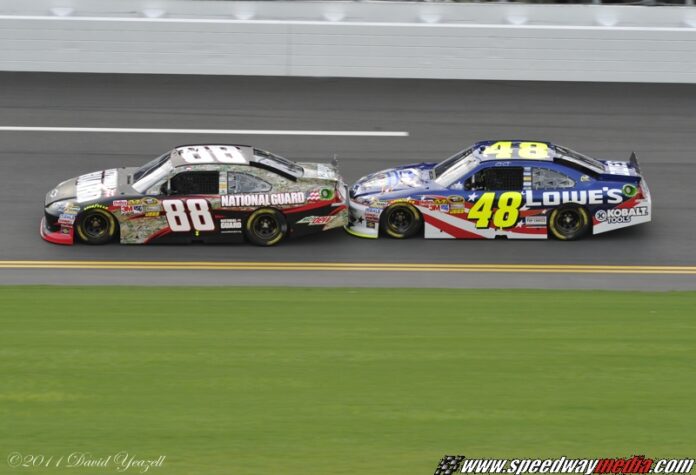
In addition to Jimmie Johnson, who finished 20th in his No. 48 Lowes Summer Salute, fan favorite Dale Earnhardt, Jr. also struggled late in the race, finishing 19th in his camouflaged No. 88 National Guard Heritage/Amp Energy Chevrolet.
“Oh man, I don’t know,” Junior said after the race. “I’m really ticked off. Damnit. I was just trying to get to the finish line.”
“What kind of move can you make in racing like this?” Junior continued. “There ain’t no move you can make.”
“You just hold it on the mat and try not to wreck into each other,” Earnhardt Jr. said. “You see how good we are at that.”
Surprising: In addition to his appearance in the movie ‘Cars 2’, it was a bit surprising to see Jeff Gordon, this week piloting the No. 24 Pepsi Max Chevrolet, starring as the race’s Lucky Dog. Gordon used his veteran skills for an incredible save after a wild spin on lap 157 to finish sixth.
“Somebody got in the back of the No. 4 (Kasey Kahne) and pushed him up into me and I had nowhere to go,” Gordon said. “Then the car came around and luckily I straightened it out somehow and came back and fixed it.”
“Miraculously there on those last two restarts we avoided more wrecks,” Gordon continued. “It was awesome and how we finished sixth is unbelievable.”
Not Surprising: One other driver benefitted greatly from the Lucky Dog phenomenon. AJ Allmendinger, driver of the No. 43 Air Force Ford Fusion for Richard Petty Motorsports, got the distinction after the first green, white, checkered attempt and went on to power his way to a top-10 finish.
“I felt kind of bad because Marcos (Ambrose) and I were racing for the lucky dog, but I was happy the yellow came out twice so we both got our laps back,” Allmendinger said. “After that, it was just trying to miss the wreck.”
“We didn’t quite miss it but I stayed wide open and kind of bulled my way through there and finished 10th.”
Fireworks on the track and in the sky
Daytona’s Coke Zero 400 showed promise. Time and experience had improved the Nationwide race immensely so the Cup series should be just as good. Realistic expectation perhaps, but it didn’t come to pass.
[media-credit id=22 align=”alignright” width=”219″]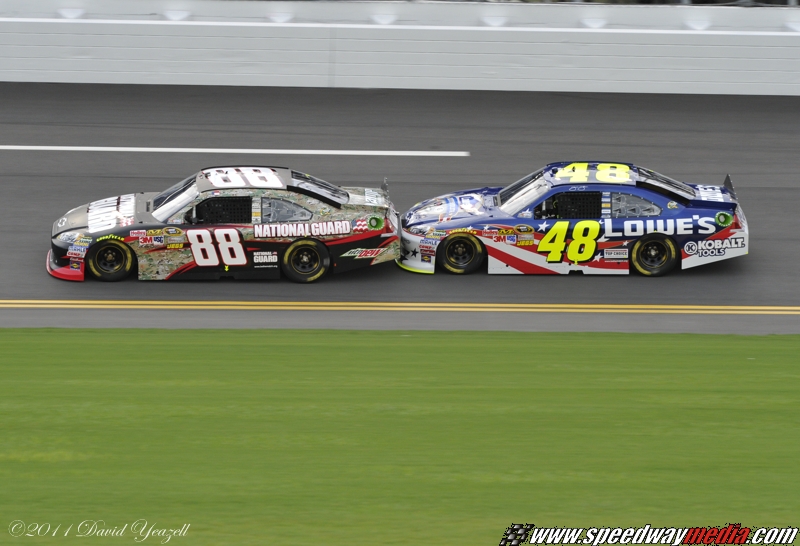 [/media-credit]All week drivers had been asked about the two car tango. There were many opinions and explanations on how it worked. Some liked it. Some didn’t. One of the biggest detractors of the tandem drafting was Dale Earnhardt Jr. “I’d rather have control of my own destiny and be able to go out there and race and just do my own work and worry about my own self. It’s really weird and kinda wrong on some levels to race that way and to think like you think. You take care of somebody and you feel this obligation to take care of them and then worry about having them take care of you and how that makes them feel. Been growing up all these years racin’ for number one-lookin’ out for number one. Doing my job. This is what I need to do. I need to do this to get up through the pack. This is how my car drives and now you are doing it so different. Your thought process and everything you think about during the race is nothing near that. It is just different and weird. It won’t be like that forever I assume and hopefully I am alive and still racin’ when it goes back to the way it was because I just really enjoy lookin’ out for number one, man. If you had a car that drive up through there and you were smart about drafting and knew what you were doing, you could make some cool things happen and that was pretty fun.”
Elliott Sadler says he likes the two car draft and offered this explanation, “I like the 2 car drafting that we do now and I’ll you the reason behind it. Drafting – restrictor plates – are a tough part of our sport. We hear drivers talk about it all the time. Old drafting where you have 40 cars in one bunch in one pile a lot of the finishes you got are out of your control. A lot of the wrecks you get in, everything really is determined by everyone else around you. We have a lot of those same factors in the 2 car draft. Where things can happen around you and catch in a wreck not of your doing. But with the 2 car tandem if you know what you’re doing as a drafting partner and you make the right decisions as a 2 car tandem you can work your way to the front and actually the pack will split up a little more so actually the big wreck has a little bit less chance of happening and as a driver that’s a good thing. But I do think it’s harder to draft this way.”
Both drivers were involved in huge last lap crashes of their respective races. The Sprint Cup race ended with two crashes on the white flag lap. The crashes took out 15 cars in the first and 18 cars in the final wreck just yards before the start finish line. This is significant when you remember that the starting field is 43 cars. Many of the cars that did finish were damaged from earlier wrecks in the event.
At some point words from the drivers and NASCAR start coming back to you. Words like cost containment measures, no down force, racing for track position, driver safety is a priority. At that point you begin making observations.
Let’s start with cost containment. NASCAR implemented the COT and eliminated testing as cost containment measure for teams. They did so in 2008. Let’s take a good look at this race and ask about the cost containment. 30 cars were involved in the last lap melee. Several more were damaged in the wrecks that happened before the white flag. Let’s break it down to teams. HMS lost 3 cars and damaged the fourth significantly. Joe Gibbs had damage to 2 out of the 3. RCR lost 2 out of 4 with damage to a 3rd. Roush Fenway, had significant damage to 2 out of the 4 but did win the race with a pristine car. Richard Petty Motorsports lost 1 and damaged a second. Red Bull lost 1 and damaged the other. Penske Racing seriously damaged both cars. Those are just the major teams. How cost effective is the decision to not make changes to the car? But even drivers do not believe there will be changes made. “I don’t think they’re going to address that to be honest with you. I think its goes against what they’re trying to do and we’re not turning each other around, the interface works really well and so well we can push.” Stated five time series champion Jimmie Johnson. But at what cost? How long will it be before a driver is seriously hurt?
NASCAR has stated since 2001, that driver safety is paramount and utmost on their list of priorities. Yet we still have not learned that three lap runs for the checkered flag on super speedways is always disastrous. In was disastrous in 1992 when Rusty Wallace took a wild ride through the tri-oval grass at Talladega. It was disastrous in 2001 when Dale Earnhardt lost his life in a turn 4 crash at Daytona. And it was disastrous in 2011 when 30 cars wrecked on the last lap of the Coke Zero 400. We lost a hero. We hurt another. We destroyed millions of dollars worth of equipment. What does it take for NASCAR to see that Green White Checker finishes don’t belong on restrictor plate tracks?
The COT’s safety systems have been tested and proven for sure. But they are not fail safe. The cage that surrounds the driver in the new car is stiffer and unyielding. This transfers more impact to the driver. “The driver compartment is stiffer and stronger than it has ever been before it’s going to absorb the impact far less even though we have some impact material and foam around the driver side,” stated Jeff Gordon. He did go on to add that he would not trade the safety measures for what they had before.
Injuries are not always obvious. In the case of Carl Edwards he lost a crush panel in front of the right rear wheel on his Subway Ford Fusion in an early race crash. After only a few laps on the track Edwards returned to the pits after becoming ill in the car from Carbon Monoxide poisoning. Edwards, who does not run a Koolbox system which would have provided him with a Carbon monoxide filter, did finish the race but was treated with Oxygen post race.
This race showed the instability in the cars. Numerous times we saw cars in tandem pairs be passed by another tandem and the pair be pulled apart as the side force of the cars was disrupted. The aero dynamic wave, if you will, caused the two cars to become unstable on the track with several cases of spins and wall contact resulting.
There is no doubt that this race was costly to teams. Thankfully there were no injuries. At least not physically but the financial injuries will take some of the smaller teams a great deal of time to recoup.
The cup race did not live up to its sister series race. It was a long fairly uninterrupted affair that saw teams dropping back and waiting to the very end to make a run for the front. Those were runs that simply didn’t happen. Some because the tandem was broken up by needed pit stops after the late caution that took pole sitter Mark Martin out of the race. Some because they had simply fallen too far back to make the run and then were caught in the final melees typical of Restrictor Plate racing. Sadly, there seems to be no hope of returning to the old school racing at Daytona or Talladega. But hopefully we will carry with us as a sport the lessons learned from this years Coke Zero Demolition Derby.
~ ~ ~ ~ ~ * * * * ~ ~ ~ ~ ~
Congratulations to TNT on a great broadcast with readable graphics and limited interruptions for commercials. This was definitely the best broadcast of the year.
Kudos to Wally Dallenbach and Kyle Petty for having the courage to get in to cars and demonstrate and describe what we were about to see even though they themselves had never done it before.
Congratulations to Joey Logano on his win in the Subway Jalapeno 250, and also to Kyle Busch for pushing him to that victory.
Congratulations to Danica Patrick for finally displaying the skills that all of her fans believed her to have in a stock car.
Congratulations to David Ragan on his victory in the Coke Zero 400 and also to Matt Kenseth for pushing him to that victory.
That said, to all the competitors in all the series thanks for giving us everything you have to give, you are our heroes. Most importantly, thanks to all the families who shared their loved ones with us so we could cheer our favorite driver and favorite teams. You are the true heroes of the sport and we are forever in your debt.