


Hot Blooded …. Summer Heat and Nascar

In Charlotte, Greg Biffle’s driver cooling system failed. It didn’t fail mid race. It failed from the pace laps. Instead of blowing cooler air, it was blowing straight hot air. Biffle stated, “It was literally burning the side of my head.” It was estimated by his crew chief Greg Irwin that the temperature of the air he was breathing was upwards of 120 degrees. “He actually was running with his visor open so it was a little cooler than ambient temperature of the car.”
Robin Pemberton, director of competition for NASCAR said, “The ambient temperature in the car on race day is in the mid 100’s. Higher on the floor boards. The actual driver environment temperature is less because of cooling devices in the car.”
To get an idea of the level heat of in the floor board of the car, in 1994, Darrell Waltrip got in his car and threw a sharpie marker on the floor board at Dover Delaware. At the end of the race he tried to pick it up for post race only to find it had melted to the floor board.
Carl Edwards stated he knew that he was not the only driver that was going down the straight away with his heels up off the floor board because his heels were burning. But he feels that the issue is not so much the effect of the heat on the driver but the effect of the heat on the car and the track surface. He stated that if you have a car that is not driving well or handling well and you are uncomfortable you are less patient with the car and yourself and competitors.
The floor boards have typically been a problem causing burns to feet and heels. Dale Jarrett and Darrell Waltrip have both reported 3rd degree burns to their feet on hot days in a stock car. More recently, Brian Vickers burned his foot and his butt at Bristol because of an exhaust problem. In fact, one of the most common injuries in NASCAR is the driver’s feet being burned by the heat coming from the engine and the exhaust system which is right under the cockpit of the race car. Most drivers wear a protective boot over their shoes to help prevent burns to the feet and heels.
The driver’s cooling system lowers the temperature of the air that the driver’s are breathing by 20 – 30 degrees according to Kurt Busch. “But as the temperature rises in the car, the hoses become heat soaked and that raises the temperature some. I liken it to sitting in a hot tub with just my head sticking out.” Busch said.
Juan Pablo Montoya is not a big supporter of the cooling system, “We use water bottles with lots of ice and change it out every stop. But it’s just hot, no matter what you do.”
“The brakes are hot, gears are hot, the transmission is hot and that all transfers to the driver” added Jeff Burton.
The driver’s Koolbox, as it is aptly named, is a 5.2 lb instrument of relief. The box mounts behind the seat and pulls air in from the outside of the car. Aaron Edwards of CompuTech the manufacturer of the Koolbox that 50 percent of the teams in Sprint Cup use states, “The unit cools the air that goes into the driver’s helmet 30 degrees below the ambient temperature. It has a control box that they can adjust the air flow. The faster the air flow the less cool the air is. On high speed it cools the air about 20 – 25 degrees.” The box is thermal electric and has a filter that protects drivers from the debris that might be sucked in with the outside air that is pushed to the driver by way of fans.
Decision-making becomes muddled in extreme heat – that can be a deadly game at 200 mph.
“I had cold chills,” Buddy Baker remembered of the Southern 500 in 1986. “I knew if it was 107 degrees (outside) and 137 in the car and I had cold chills, something was wrong. I was lucky enough to finish the race and after the race I step out and the ‘cold’ air hit me and I went right to the ground.”
Baker continued, “If you’re really hot and confused, you don’t make great judgment calls.”
Hydration was an afterthought in the beginning of big-time stock car racing, when men would race in street clothes – maybe with an inadequate helmet – and lean an arm out of an open window. It got hotter inside the cars when tight-fitting cockpits with carbon fiber seats developed. Engine heat accumulated around drivers wearing full face helmets, gloves and multi layer fire suits. Baker, the 1980 Daytona 500 winner who competed at NASCAR’s top level from 1959 to 1992, saw some improvements during his time racing, but nothing like what drivers have now.
“We had Dixie cups with a little bit of icy water in it and nine out of 10 times when they tried to give it to you, of course the tire man would knock it out of somebody’s hand and you’d go, “I’m going to kill somebody if I don’t get something to drink pretty soon.” You might have to go another 100 miles before you even thought of getting another drink of water,” Baker said.
“We just kind of had to live with it from pit stop to pit stop, and then of course we had the opportunity to run with just a little bottle behind the seat and what would happen would be water would go down the tube and it would heat up and you’d take a sip of it and it would be like scalding hot water.”
“You felt pretty crappy going home on Sunday night and Monday you felt pretty bad and about Tuesday afternoon you started feeling really normal again,” Buddy Baker remembered. “It took its toll on us.”
Drivers now utilize a hydration system within the car. Called G.I.D.S. (Gatorade In-car Drinking System) More than half of the field utilizes this three-quart insulated bladder which is attached to the frame of the car, allowing a battery-powered pump to supply fluid on demand through a tube with a bite-down nozzle that inserts into the helmet.
“That thing,” Five time champion Jimmie Johnson stated, “is a life saver.”
In the hot summer months teams have a hydration officer who keeps fluids iced and available to team and driver. The large trash can is stocked with ice water, Gatorade, and some sodas. “The biggest mover at this point is water and Gatorade. Some guys will drink the soda in the morning to wake up if they don’t drink coffee. But we do everything we can do to make it easy for them to stay hydrated.” stated the hydration officer of the day for the 24 HMS team.
Its long been known by emergency workers, police, fire and ambulance that as the heat rises, and the longer the heat socks in the more aggressive people become. The more violent crime we see. The lack of judgment becomes evident. The Coca Cola 600 was the longest race of the year. This year it was the hottest thus far. Although, we saw no outbursts the damage that Greg Biffle could have sustained was huge.
The heat factor would go up again in Kansas, this time with more obvious results. After the truck race a physical altercation took place between Richard Childress and Kyle Busch in the Camping World Truck Garage. The incident was apparently sparked by after race contact between Busch and RCR driver Joey Coulter. The normally mild mannered Childress struck Busch when in his own words, “I let my passion get away from me.”
Even Dale Earnhardt Jr stated, “I was fine until I got out of the car there.” Earnhardt Jr staggered leaving the car and was helped to the pit wall for a few minutes before heading to the media center for post race interviews. He sat on the end of the dais and did a TV spot with ESPN’s Marty Smith before climbing the stairs to the stage for questions from the media. The flushed Earnhardt stated when asked how long it would take him to recover from the heat,”I will be ok tomorrow afternoon. But I am just going lay around by the pool and enjoy a vodka or two.”
The physical issues from extreme heat exposure range from heat stroke, to heart damage and lung damage. If you stop and think about what happens if you heat a drinking straw, it gets soft eventually it stretches. In the human body this is called an aneurysm or a bubble in the wall of a blood vessel. The bubble is caused by a thinning of the vessel wall. The vessel may stay bubbled without issues for years. Or it may rupture. Rupture causes internal bleeding which would be difficult to impossible to control depending on the size of the vessel.
Heat issues create a lack of focus and attention. The hotter we get, the more uncomfortable we become and we begin to focus on the heat and how uncomfortable we are and it compounds until finally our focus and attention is not on the task at hand but instead how uncomfortable we are in our environment. It’s a natural defense mechanism meant to make us change our environmental conditions.
Prolonged breathing of extreme hot air can cause drying and damage to the bronchial passage ways. You see evidence of this in children who have asthma that is triggered by extreme cold or extreme hot. People with respiratory conditions such as Emphysema and COPD are advised to avoid extremes in temperature for this reason. Heat dries the passages and can result in cracking or bleeding. Cold can result in hardening and a lack of expansion also making it difficult to breathe.
The hotter we become the less resistance we have to things like Carbon Monoxide poisoning. Carbon Monoxide poisoning is a huge risk in any type of motorized racing because of the fumes created by the combustion engine.
The creators of the KoolBox have added an attachment to the existing unit that filters 95% of the carbon monoxide in the air out. “The catalyst is good for about 3 races before it begins to breakdown,” Aaron Edwards said. At that time it must be replaced with a refill pack provided by CompuTech.
Rapid cooling procedures such as ice water soaked towels to the back of the neck or ice packs placed over the heart inside uniforms, although necessary can have dire effects as well. Everything from shock to stroke can result. Rapid cooling can also cause Blood clots. One must question how much the extremes in temperature and cooling played in say for example Brian Vickers difficulties last year.
Newly repaved tracks like Daytona also contribute heavily to the heat factor. The black asphalt holds heat rather than reflects it away like lighter and older pavement. Concrete tracks reflect the most heat but it reflects the heat upwards towards the car and driver.
Hot summer risks pose more risks to our drivers than just racing accidents. With the risks of heat frustration and exhaustion, carbon monoxide poisoning the drivers in all three of NASCAR’s touring series face huge obstacles that are more dangerous to their future’s and lives than just winning a race.
Although the solution seems simple enough, run night races in the heat of the summer months, logistically that is not possible. Not all the tracks have lights and the light systems to light tracks like Charlotte and Bristol are prohibitive in cost with out many years of budgeting and planning.
In 1992 when Charlotte Motor Speedway installed their fixed lighting the price tag was 1.7 million dollars. The 1,200-fixture permanent lighting system developed by MUSCO Lighting of Oskaloosa, Iowa, is a revolutionary lighting process using mirrors to simulate daylight without glare, shadows or obtrusive light poles. Daytona International Speedway reports that it costs 240 dollars an hour to operate their lighting system.
Many tracks are adding lights including the most recent Kansas Speedway. Although, the lights were not ready to be utilized at the tracks most recent date, the lights are in place and functional. Night races have larger response from fans. Most night races are reported as sell outs by the tracks that host them. The reasons seem obvious; it gives the fans another travel day to be back at work on Monday. It’s cooler. And the lights take us back to the old school racing where the sport got its roots.
As we head into the hottest part of the summer and tracks that are known to be the hottest on the circuit, drivers and teams will continue to battle the heat. They will test lighter weight uniforms, lighter color uniforms, and bigger and better Koolbox systems. All of which will help them to maintain their health, both physically and mentally in stifling 160 degree heat.
They will hyper hydrate in preparation for the 10 to 16 lb weight loss, that drivers typically experience on Sunday. They will utilize the assistance of Gatorade’s G.I.D.S. and their teams Hydration officer in order to maintain their focus and cognitive ability.
All of this will take place under the watchful eye of NASCAR’s medical team and governing officials.
When the P.A. announcer calls their name from the driver’s introduction stage, there will be no thoughts of heat or its possible effects. There will not be even the slightest of concerns in regards to hydration. The only thoughts on the drivers minds will be crossing the finish line first and racing 42 other guys for that spot. One can only hope that the cheering fans in the stands and those waiting anxiously at home realize the risks their heroes take when the summer sun beats down on the greatest racing series in the world.
Special Thanks to: Robin Pemberton, Aaron Edwards of CompuTech, and all the drivers that graciously addressed this issue and offered their insights.
NASCAR Top-10 Power Rankings: Pocono
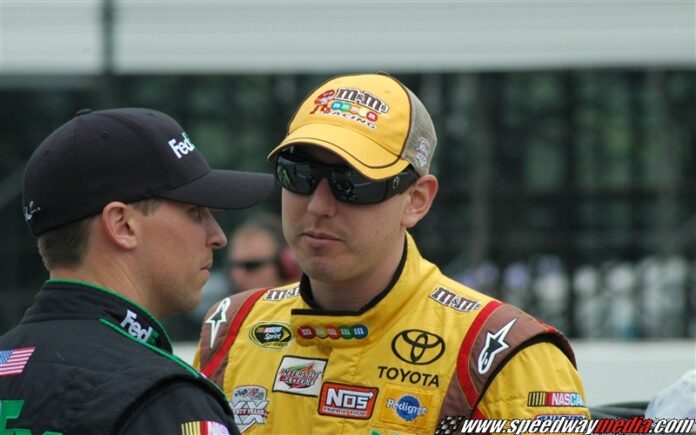
Note: The quotes in this article are fictional.
1. Carl Edwards: Edwards dropped a valve 58 laps in to the 5-Hour Energy 500, ending the day early for the No. 99 Kellogg’s/Cheez-It Ford. He finished 37th, by far his worst finish of the year, but remained in front of the point standings lead, six ahead of Jimmie Johnson.
“I started with eight cylinders,” Edwards said. “Then there were seven. And that led to six, points, that is, in my lead in the Sprint Cup standings. And look who’s behind me. Jimmie Johnson, winner of five Cup championships. He finished fourth on Sunday. I was running third when my valve broke. Johnson is at number two in the standings. I guess that makes him the one to beat.
“You may have seen me in the TNT booth after my engine blew, and it’s clear I’m a natural at broadcasting. Whether behind the wheel or in front of a monitor, I’ve got no problem with ‘exposure,’ which is obviously the case when I’m ‘showing my parts’ on national television.”
2. Jimmie Johnson: Johnson finished a strong fourth at Pocono, posting his fourth top-5 result of the year and taking a chunk out of Carl Edwards points lead. Johnson entered the race 40 behind Edwards; he now trails by only six as the series heads to Michigan.
“As NASCAR’s five time defending champion,” Johnson said, “and arguably the sport’s best driver, I often wonder if I can get any bigger. Well, the answer is ‘yes,’ in Edwards’ rear-view mirror.
“I like my position. I’ve got a rival blowing an engine, and rival’s car owner blowing a gasket. Heck, when the Sprint Cup points leader is in the broadcast booth yucking it up with the TNT crew during the race, I can only consider that a good thing for me and every other driver trailing him. Edwards is a ‘show off.’ He put on a ‘show’ off the track. While it may be good for his broadcast aspirations, as a contender for the Cup, he’s all ‘talk.’”
3. Dale Earnhardt, Jr.: Earnhardt scored his fourth-straight top-10 finish of the year, posting a sixth in the 5-Hour Energy 500 at Pocono, rounding out a trifecta of Hendrick Motorsports cars in the top 10. Jeff Gordon took first, while Jimmie Johnson finished fourth. Earnhardt improved one spot in the point standings to third, and trails Carl Edwards by 10.
“Had the No. 88 Amp Energy Chevrolet won the 5-Hour Energy 500,” Earnhardt said, “there would have been a huge conflict of interest in victory lane. Amp Energy Drink is the industry leader among energy drinks. They play second to no one. I wish I could say the same.
“If we keep running this consistently, the wins will come. 107 races is a long spell to go without a victory, and if I fail to win at Michigan, I’ll then be fighting a three-year victory drought. That’s when Junior Nation becomes ‘Junior Stag-Nation.”
4. Kevin Harvick: Harvick toyed early with RCR nemesis Kyle Busch, drawing a warning from NASCAR, but otherwise took care of business at Pocono, finishing fifth. Harvick held on the fourth in the point standings, and now trails Carl Edwards, who finished 37th, by 11.
“I did indeed try to force Busch down the track on the long straightaway,” Harvick admitted. “I figured Kyle needed a good ‘straight left’ after Richard Childress delivered a ‘straight right’ last week. Of course, Kyle did nothing about it. We’ve all heard of Morgan Freeman ‘Driving Miss Daisy’ around Atlanta. Now you’ve heard of Kevin Harvick ‘Driving Mr. Pansy’ down the track.”
5. Kyle Busch: Busch finished third at Pocono, following big brother Kurt, who finished second, across the finish line. But that was where the good news ended. Kyle Busch’s No. 18 M&M Toyota failed a post-race inspection, which found his front end too low. NASCAR penalized Busch six championship driver points, while Joe Gibbs lost six owner points, and crew chief Dave Rogers was fined $25,000.
“That’s just great,” Busch said. “One week, I’m decked by Richard Childress. The next, I’m docked by NASCAR. It appears I got ‘served’ by both. According to NASCAR, the left front of the vehicle was 1/16 inch too low, which is outside the tolerance. I’m not surprised, because I’m rarely inside anyone’s tolerance.
“Harvick certainly puts the ‘ass’ in ‘harass.’ He just doesn’t know when to stop. He certainly doesn’t need to fight Richard Childress’ fights for him. Childress can take care of himself just as well as he took care of me. But I have to thank Harvick for teaching me a valuable lesson—that I’m the bigger man.”
6. Kurt Busch: Busch won his second straight pole, topping the charts in Saturday qualifying for the 5-Hour Energy 500. Busch led 37 laps on Sunday, but couldn’t get near Jeff Gordon’s No. 24 down the stretch, and settled for the runner-up spot, his best finish of the year.
“It would have been more fitting,” Busch said, “had Kyle finished second and I finished third. That way, I could have said, for once, that I had Kyle’s back.”
7. Matt Kenseth: Kenseth came home eighth at Pocono, earning his seventh top-10 of the year and fourth in the last five races. He remained seventh in the Sprint Cup point standings, and trails Carl Edwards by 44.
“Don’t let Carl Edwards’ broadcast persona fool you,” Kenseth said. “Television-friendly is where the friendly stops.
“As you may know, my car was sponsored in part this week by Affliction Clothing, apparel favored by several mixed martial arts fighters and those who emulate them. It’s quite on odd pairing, since I probably rank somewhere between Kyle Busch and a sleeping kitten on the toughness scale. Affliction and I have a unique relationship unlike any other between a sponsor and driver: I’m forbidden to wear the product.”
8. Jeff Gordon: Gordon took charge over the final 50 laps at Pocono, pulling away for his second win this year and 84th career triumph, which tied him with Darrell Waltrip and Bobby Allison for third on the all-time list. Gordon jumped two spots in the point standings to 11th, 81 out of first.
“With the new wildcard berths,” Gordon said, “two wins all but guarantees a spot in the Chase For The Cup. Let this be a warning to everyone: I think this win is a clear indication that a fifth Sprint Cup is not out of the question. That may not have been the case in 2010. Last year, when I vowed to ‘go for 5,’ many assumed I was declaring my allegiance to Jimmie Johnson’s quest for his fifth Cup title.”
9. Denny Hamlin: Hamlin led 76 of the first 101 laps in the 5-Hour Energy 500, but a flat tire on lap 161 ended his dominance and left him scrambling to make up ground over the final 39 laps. He remained on the lead lap and finished 19th, ending a run of three straight top 10’s. Hamlin dropped one spot in the point standings to 12th, 84 out of first.
“The No. 11 Fed Ex Ground Toyota had the field covered,” Hamlin said, “until the flat tire ruined my day. But that didn’t stop me from quoting emerging color commentary personality Carl Edwards when I said to my crew, ‘It’s air time!’
10. Clint Bowyer: Bowyer, who won The Prelude To The Dream last Wednesday, finished 16th at Pocono, struggling with handling on the two-mile tri-oval. Bowyer did, however, improve one spot to eighth in the point standings, and now is 73 out of first.
“My name may be ‘Clint,’” Bowyer said, “but I am by no means ‘The Enforcer.’ That would be Kevin Harvick, who, like our boss Richard Childress, takes matters into his own hands. Harvick has an uncanny ability to get into any driver’s head. According to Kevin, it’s particularly easy to get into Kyle Busch’s head, because there’s so much room.”