Home Blog Page 6402

Andy Belmont Racing Reflects on ARCA Test at Talladega Superspeedway

Following the Daytona test, four teams proceeded to go to Talladega Superspeedway to lay down some extra laps as they continue to prepare for the ARCA season opener.

One of the teams was Andy Belmont Racing with drivers Chad McCumbee and Robb Brent.

“We had a pretty darn productive day,” team owner Andy Belmont told the ARCA Racing Network. “We went down with a game plan with lots to try, and we came away with some really solid info. It think it’s more productive to go to Talladega to test because there’s too many cars at the Daytona test, so track time is limited. With just four teams here yesterday, we pretty much had the place to ourselves. We really accomplished a lot. Robb Brent tested a second car for us – it was the car that (Tom) Hessert got the pole with a couple years ago here. We completely rebuilt it, got the bugs out of it, so if we had to unload it, we’d have a hotrod.”

Chad McCumbee, who has experience in both the ARCA Series and NASCAR Camping World Truck Series, said the test proved beneficial.

“It was a very productive day for the ModSpace Ford,” McCumbee said. “Also able to shake down the back-up car, so we’re pretty confident going to Daytona. We actually found some problems on our primary car that could have been detrimental had we not found them prior to Daytona.

“Being that both tracks (Daytona and Talladega) are so smooth now, I think you can pretty much carry over all the information we got from the Talladega test, and take right to Daytona. The tracks are so similar so everything we learned, for the most part, is going to translate.”

Belmont’s son Andrew was suppose to pilot the back-up car, however he recently had his appendix out. Belmont then made the call to put Brent behind the wheel of the car via his past experience in ARCA. 

“I talked with Andy Wednesday night,” Brent said. “He offered up the chance to test his stuff; he’s always got great restrictor plate stuff, so I jumped at the chance. Before the call was done, I told him I’d be on the next flight. Got to the track about 9:30, 10 in the morning and tested all day. We worked some of the bugs out of his back-up car, had some fun; it was well worth it. Just a fun day all around.”

Brent is hoping to pull together his plans for the 2011 season.

“I’ve been constantly working on deals,” Brent said. “I’ve been contacted by a ton of teams – just need that sponsor. I’ll be in a car sometime, not fulltime, but I’ll be in a car somewhere.”

Andy Belmont Racing knew the test would be crucial as beating six-time Daytona winner Bobby Gerhart, was also at the test, is never easy.

“Our primary car was really solid with Chad (McCumbee); but Gerhart’s still the man to beat, no doubt about it,” Belmont said. “But I also think this kid McCumbee’s gunna give him all he can stand – we’ll see. But when it comes to Daytona, Gerhart’s always the man to beat. His focus has been on these two races (Daytona and Talladega) over the last 10 years. He spends most of his budget on these two races. You have to respect Gerhart. I do. We all do. He was really sporty yesterday.”

Chad Knuas and Hendrick Motorsports Bring Sports Mentality to Pit Crew Changes

During the Media Tour, Hendrick Motorsports was questioned of what would happen with the pit crews come 2011 after the struggles seen during the 2010 Chase.

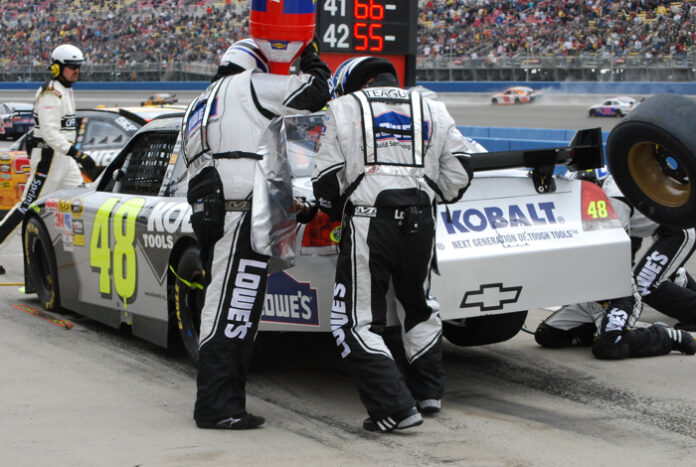
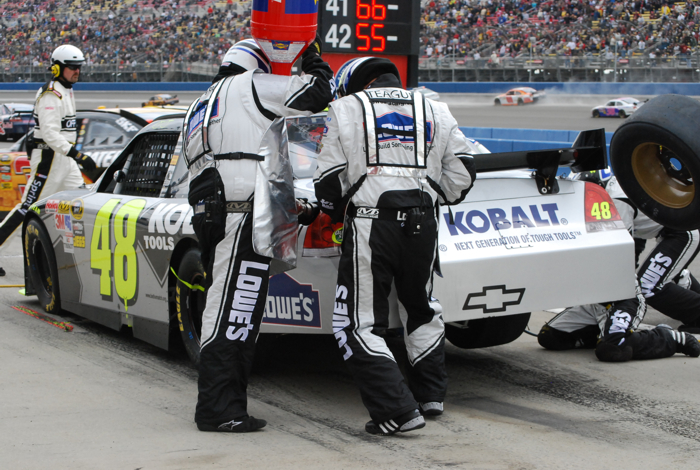
[media-credit name=”David Yeazell” align=”alignleft” width=”244″][/media-credit]It was revealed that five-time defending Sprint Cup champion Jimmie Johnson and Dale Earnhardt Jr. will be taking three pit crews to the track each weekend between the two teams. The logic is that it will give them 18 crewmen to draw from if someone gets injured or performance problems are seen.

“We’ve always tried to work on the depth of our crew, but we’ve never been able to successfully pull that off,” Knaus said on Wednesday during the NASCAR Media Tour. “We think we’ve got it going in the right direction. It make take a little bit, let’s be honest, to get everything gelling in the right direction.

“But once it hits it’ll be exciting.”

The pit crew issues were spotlighted during the Texas race in the Chase where Knaus swapped pit crews with Jeff Gordon’s team.

Out of the first seven stops of the day, the No. 48 team had lost spots on four of them, costing their driver valuable time. Once teammate Gordon was wrecked out of the race, the swap was called.

“Ultimately, it was my decision to make the decision as we were getting beat,” Knaus said at the time. “I hope we get back with the 48 guys and get things back on track.”

The No. 48 team ended up using Gordon’s pit crew for the rest of the season on their way to winning the title by 39 points.

At the end of the year, the swap was reversed so therefore Steve Letarte, who was Godon’s crew chief at the time, could bring his team over to work with Earnahrdt in the new season. Knaus said of his team, four members remain in the mix, though nothing has been finalized.

“I can change at any point and time,” Knaus said. “We’ve always had that to a degree, but our backups weren’t necessarily ones that could get it done. I wouldn’t say get it done, but maybe guys on the back end of their career.”

On the other side of the spectrum, the No. 24 team of Gordon and the No. 5 of Mark Martin will have six full-time members per car and another four to share if problems arise.

The mentality that looks to be played out by Hendrick Motorsports is nothing different then what you see in most sports. Every hockey team, basketball team and football team has multiple guys ready to step up to the plate and makes line changes in the middle of the game. This looks to be no different with what Knaus has lined up as he just has created a second-line to swap partway.

HOORAHS AND WAZZUPS: The winds of change were an overall welcome arrival

Over the past few days we witnessed NASCAR’s willingness to address some needed changes with the vast majority of them being positive steps in the right direction. We also learned of a rather unusual pit crew platoon system that somewhat rivals the National Football League’s special teams concept and it appears that there’s another NASCAR baby boom in the making. With those thoughts in mind, let’s begin with:

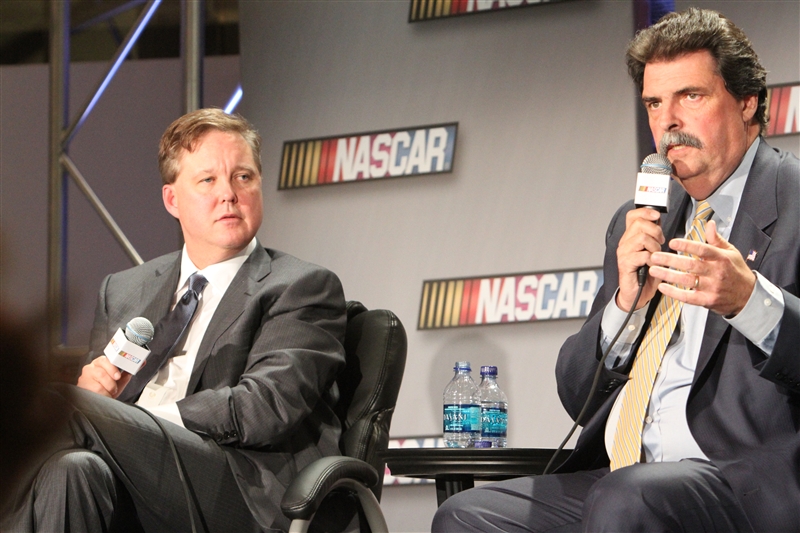
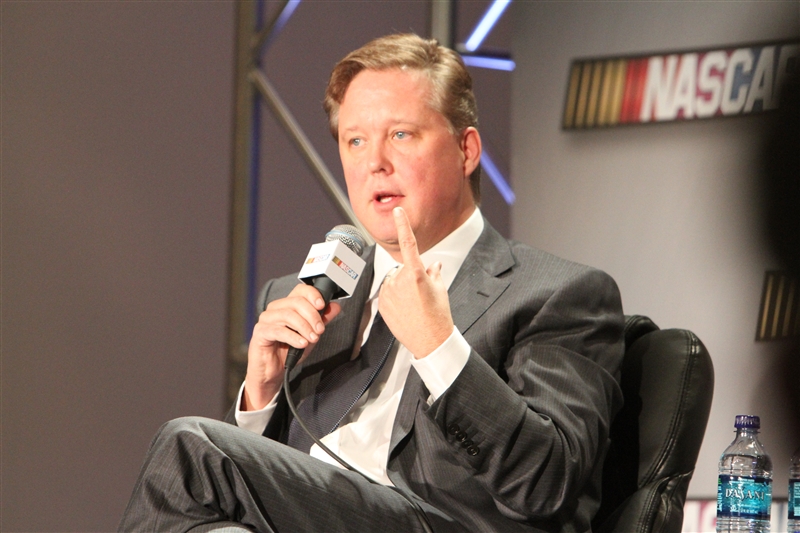
[media-credit name=”FMCM” align=”alignleft” width=”223″][/media-credit]An overall HOORAH to NASCAR for their willingness to address and implement changes in their championship points system, for the first time since 1975, and their Chase format. While announcing the changes, last Wednesday night, NASCAR Chairman and CEO Brian France said “the fans tell us that winning matters the most with them, so we’re combining the tradition of consistency in our sport with the excitement that comes along with winning.”
HOORAH to the much simpler championship points system. The race winner will receive 43 points with a one point differential between each position all the way to the last place driver who will receive only one point. The new system also awards three bonus points to the race winner, a single bonus point for leading a lap along with another bonus point for leading the most laps. The max point capability for a race winner is 48 compared to the 42 points the runner up driver will receive. The one point differential could lead to some exciting number scenarios when it comes time to determine the Chase for the Championship line up next September.

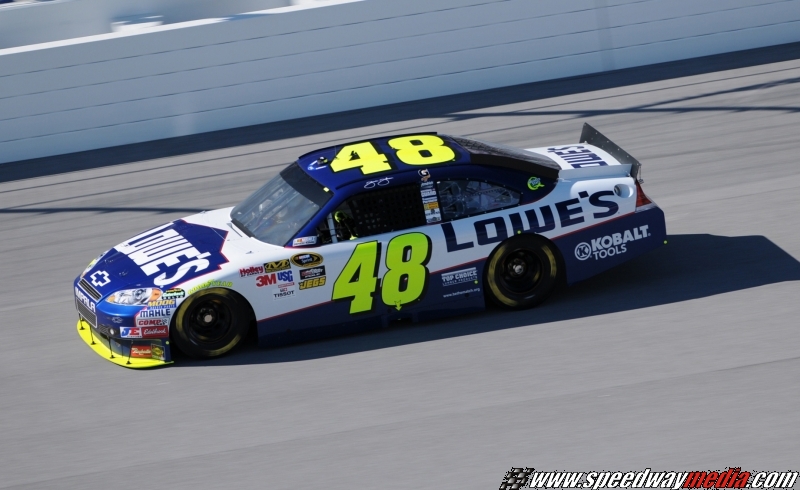
By the way, I’m going to assume that no pun was intended regarding the fact that the max points number, 48, matches the car number of five time consecutive champion Jimmie Johnson. Probably not, NASCAR officials aren’t exactly noted for “punning around.”

In terms of simple math, there’s really not a huge differential between the old and new systems other than the fact the new mode will be considerably easier for a fan to calculate the points progress of their favorite driver. Last year we needed a points procedure print out from “NASCAR.Com” and a calculator. This year we won’t even need a pencil to calculate points.

Having said that I do feel a need to issue a somewhat reluctant WAZZUP over the three bonus points awarded to race winners. I would have liked to have seen that figure just slightly higher. It has nothing to do with incentive to win. A modern day Sprint Cup driver really doesn’t require an extra incentive to win. In fact I’ve never actually met a driver, from any form of racing, whose primary goal wasn’t to be the first to pass under the checkers. This opinion is based on the fact that the exceptionally high level of competition in NASCAR these days requires an extraordinary special effort to win a Sprint Cup event and that extra effort deserves additional bonus points.

HOORAH to the wild card provisional NASCAR implemented into their Chase For The Championship format. The top ten in the championship standings, after race number 26, will make the Chase line up business as usual. But Chase positions 11 and 12 will be offered to the two drivers, outside of the top ten, who won the most races as long as they are within the top 20 in the standings. This appears to be part of Brian France’s reference to extra incentive for winning and it has the capability of becoming rather interesting later in the season.

HOORAH for plans to eventually reconfigure the front of the modern day NASCAR stock car so it will again resemble what’s actually on the show room floors. The manufacturer decals on the nose of these cars is often the only means for fans had to quickly determine their origin. This move will also return credence to that long time racing adage that states “win a race on Sunday, sell a car on Monday.”

*************

WAZZUP with the back up pit crew plan at Hendrick Motorsports? This scheme is the handy work of Chad Knaus, the crew chief for Jimmie Johnson’s #48 championship team, that also benefits the HMS #88 team, led by crew chief Steve Letarte, for driver Dale Earnhardt Jr. Following some recent shuffling at HMS, these two teams now share a shop building.

The plan calls for the two teams to travel with three complete pit crews, a total of 18 men, for each race weekend. That will allow crew chiefs Knaus and Letarte the luxury of mixing and matching the crew members they feel they need for each race while covering any pit road emergency such as injury or the frustration of slumping job performance levels. It appears at this juncture that there may not actually be any real permanent crew members for either of these teams.

We all saw how Knaus handles performance emergencies. Remember last fall, in the midst of the Chase event at Texas, when a frustrated and angry Knaus exchanged his #48 crew with Jeff Gordon’s #24 team?

On the other side of the HMS complex Jeff Gordon and Mark Martin’s teams will have full time pit crews consisting of six men each, with four extra men representing their back up plan.

After hearing all this one can’t help but ask: why limit the back up plan to just pit crew members? If Chad Knaus or Steve Letarte makes a pit stop call that transforms their car’s handling from bad to worse then send in the back up chief to man the pit box. This procedure would work similar to a National Football League offensive coach who swaps running backs or receivers to suite the need of a particular moment.

How about a back up public relations team? If for some reason the primary PR unit isn’t properly selling a story to the NASCAR media, then send in the second stringers who can cleverly reword the bullet points of the very same theme.

How about a back up team cook? If for some reason the breakfast, served to the #48 and #88 teams, totally sucks then have the back up cook take over the stoves so he can make things right again just in time for lunch.

(Someone should stop me now-I could do this all day!)

**************

From our GOD BLESS department we urge you to send some thoughts and prayers to NASCAR champion and icon Ned Jarrett who will be taking his rightful place in NASCAR’s Hall Of Fame next May. Some frightening chest pains, late last month, forced a surgical procedure that required a pair of stents to be placed in arteries to open blockages. Jarrett is slowly but surely recovering.

During his career Jarrett was a hard charger that always displayed the spirit of a true racer. That’s what led him to becoming a member of the NASCAR Hall Of Fame’s Class of 2011. Off the track Jarrett is a gentleman, a true class act and one of the nicest people a fan would ever want to have a conversation with. Please get well soon, Mr. Jarrett.

A GOD BLESS also goes out to the families of Roush Fenway Racing drivers Carl Edwards, Greg Biffle and Matt Kenseth all, of whom, recently announced that their wives will be delivering babies later this year. Note to team owner Jack Roush: you may want to check the quality of the water at the Roush Fenway race shops.

That leads to a HOORAH to “Mr. Excitement”, Jimmy Spencer, who, during a Thursday night appearance on SPEED, commented on the Roush Fenway driver’s expectant wives by asking “is there anything that David Ragan isn’t left out of over there?”

On the topic of the NASCAR baby boom, HOORAH to Mrs. Jamie McMurray for telling her husband that he’s not allowed to send text messages on his cell phone while their brand new baby is riding in the car with him. Then again, WAZZUP with sending text messages while driving no matter who’s in the car? Note to Jamie McMurray: when you head west, for the Auto Club Speedway race next March, you need to know that texting and driving out here in California will net you a big time, expensive, traffic ticket.

************

Finally here’s two HOORAHs for this week’s NASCAR notable quotables. The first goes to DeLana Harvick who sent the following message on “Twitter”: (This) sounds like a bad country song. I’m headed to a town called Welcome,(the official home of Richard Childress Racing), to see a man named Happy, (the official nickname of husband Kevin Harvick).

Then there was the matter of fan favorite Kenny Wallace who wanted to share the good news that his exercise and nutrition program is working and he’s now down to a fit and trim 176 pounds. In a “Tweet” sent on Thursday he wrote: “you know what’s good? When I am on the toilet now, I DO NOT have a little belly hanging over. That’s the s**t! ha ha ha ha !”

Toyota NSCS JGR Media Tour Notes & Quotes – Denny Hamlin

TOYOTA NASCAR Sprint Cup Series (NSCS) Notes & Quotes — Denny Hamlin Joe Gibbs Racing (JGR) Media Tour Event — January 27, 2011

DENNY HAMLIN, No. 11 FedEx Toyota Camry, Joe Gibbs Racing What is your outlook for 2011? “I’m ready to go.  I feel as confident as we’ve ever been.  Every year we’ve steadily made a progression towards the top and obviously had a career year last year.  We know we can do it and we can win at all different kinds of race tracks.  For me, I think we have everything in place.  I’m keeping all of my key personnel from what we had last year.  No changes there.  Pit crew is the same.  The driver will be a little bit better.  Everything is in place to hopefully pull out a first one.”

What have you and your team done to make sure you continue the success you had in 2010 and not fall off? “We don’t do anything to try to prevent that from happening.  All we can do is be our own team.  A lot of times we get compared to guys who have done that or had high expectations and we’ve always proved everyone wrong when it’s come to that.  I’m really not concerned with it.  I know we have a good enough team to stay at the top where we’re at.  It’s just a matter of doing our homework.”

Is your team hesitant to change the equipment you had last year? “No, we’re still working.  I know it’s not going to be good enough.  We were extremely successful in the end of the 2009 Chase and you kind of wonder, ‘Is that going to go into 2010?’  We started 2010 out with that same stuff and we were okay, and until we started evolving things in the middle of last season that’s when we started winning races.  Then by the end of the season, when we had our new stuff out it was even better.  We continually know that you’ve got to change within the sport.  You can’t stay in one place or else you’re going to get passed by a lot of guys.  For me, I never rest on what I have.  I’m no different than that race car.   The things I have to improve on I have to go to work on.  Whether it be studying, doing homework, doing the things I’ve got to do — review tape, study notes.  I need to be worked on just as much as the race car.  All those things hopefully are what make us championship contenders.  For me, there’s certain areas that I for sure have to work on and I know that there’s some areas within our team that we’ve written down that we’ve got to get better in.  We know our weak points at this point right now.”

Do you feel as much pressure going into this season as you did last year? “I’ll be honest with you, I think last year going into 2010 there were probably more expectations than what there are for myself this year.  I think everyone is expecting a letdown year and obviously for me I know it’s not an option.  I’m excited about the challenge.  There’s fuel.  There’s fuel there constantly — whether I would’ve won the championship or not — to be on top of the sport.  So, for me, I look forward to the challenge — and it’s going to be a challenge.”

When did you know you lost the championship? “I think just after Phoenix in general it was tough because we go from leaving one race track knowing we pretty much just have to run mid-pack to lock it up to now we’ve got to go out there and race hard.  And then you qualify bad and it’s just like, ‘Man, I just have a bad feeling about this.’  It’s tough to overcome that, and especially when you have negative energy and negative thoughts like that.  I think it just wasn’t meant to be.  There were so many instances in that Chase where it was over, it should’ve been over but it just didn’t happen.  So, it just wasn’t meant to be for us that year.”

How long did it take you to get over the disappointment? “After the awards banquet I was done with it pretty much.  You had to relive it through media for the two weeks after the season.   As soon as I was done with Vegas and was able to shut the TV off and stuff, it was just focus on this year.”

Do you need to prove something this year after how last season ended? “I hate driving feeling like you have something to prove.  I feel like drivers that drive with a chip on their shoulder don’t do as well as they should, but there’s always a sense of wanting to be the best.  I feel like I’m one of the toughest competitors in the garage and that doesn’t necessarily mean about racing.  Everything that I ever do, I’m so competitive and I hate losing — that’s what fuels my racing drive.  That’s why I chose racing back when I was a kid, is that it’s you versus the other guys.  The cars were all meant to be the same and the drivers are supposed to work it out.  That is what I loved about racing, is the challenge of beating someone heads up.  It doesn’t matter what I do, that fire will never ever change and I will continue to be the sorest of losers.”

What would a championship mean to Joe Gibbs Racing in its 20th season in NASCAR? “It’s big for the company.  There’s a lot of good history from before I was around this place and when this place got established.  I came into a really, really good situation.  I came in when there were rides to be had and I somehow got with one of the best sponsors, with the best teams and with the best crew chief all just kind of thrown at me and luckily made the best of that situation.    For me, if we were able to win the championship in our 20 years it would be pretty big knowing the foundation that guys like Bobby Labonte and Dale Jarrett laid for this company.”

DENNY HAMLIN, No. 11 FedEx Toyota Camry, Joe Gibbs Racing (continued)

How did you balance both the mental and emotional side during last year’s Chase? “I’ve just been through a few Chase’s where I’ve crashed us out of them making aggressive moves and things like that.  I didn’t want to be the deciding factor on us winning a championship or not.  In turn, maybe it was because I was in a wreck at Homestead, but I specifically set out to not get myself into trouble.  I wanted to be there at race five where I knew from race five on that those were our strong race tracks.  I wanted to be within ‘x’ amount of points, because I knew I could make up a certain amount of points each week from there on out until the final race.  And we executed exactly the way we said we were going to execute.  It’s just we didn’t allow room for error.  I didn’t allow room for error.  I didn’t allow for running out of gas at Phoenix.  I didn’t allow for tearing up a race car at Homestead.  Those are things that derail — I wouldn’t change my strategy, because we kept ourselves in the game the entire Chase and we separated ourselves from the pack.  We eliminated seven or eight guys, kept it a three-car race and gave ourselves a chance to win the championship — a great chance.  Unfortunately for us, we lost it in the final seconds of the game.  Its part of sports and you’ve got to understand that part.”

How will you approach the first part of the season with the new NASCAR points system? “I think you’re going to race it very, very similar, but I think once you get two wins in the first 26 races, I think you’re going to feel pretty comfortable.  You’re going to be in the Chase if not as a wild card.  So, you can go for a lot more wins from that point forward, but you’ve got to be inside the top-10 for those bonus points to count.  It’s a little bit different game, but I think it’s mostly going to be about consistency in the Chase.  I love what they’re doing, having those race winners be part of the Chase, but honestly if you’re not consistent enough in the 26 races and you’re 18th in points and you’ve won a couple races, you’re  probably not going to go on a run the final 10.  But, it makes it more interesting and gets those guys involved in the Chase.”

Do you feel like its win a championship or bust this year after coming so close last year? “It’s always championship or bust.  But, for me, if I don’t win the championship then I’ve took a step back because I finished second in points.  If I finish third, how am I going to consider that a successful year?  I just took a step back from where I was last year.  And, you see over the last four years we’ve jumped three spots in the points every year over these last four years or so.  For me, there’s only one more spot to move up and I’m going to go into this year with a whole lot more knowledge of what I need to do and what I need to work on from this point forward.  I think that the advantage that I have probably over Jimmie (Johnson) or Kevin (Harvick) or any of those guys is I’m in my sixth year here.  I’m still learning a whole lot about these cars and things like that.  Those guys have been in the sport for 10 years now.  They’ve had a lot of opportunities.  Me, I’ve had really two legitimate shots to win a championship in my first five years of my career.  There’s a lot that I’ve learned and it’s all about making sure that I execute that and do the things in my head that I know that I need to do.”

Are you surprised NASCAR made changes to the points system after the excitement last year? “No, I’ll be honest with you, I think all of the changes are good and that’s the honest side of me saying if I thought it was bad I would say I didn’t like it.  I think that everything that they’ve changed is a positive thing.  It’s going to make the fans understand a whole lot more.  It’s going to make our drivers understand a lot more and on top of that it’s going to force us to go out and try to win the race.  We’re not going to be happy with second place knowing that we’ve left six or seven points out there on the table, and that being a lot of spots in our points system.  I like it. I think that they really thought about this and they were really methodical about it and I think it’s good for our sport.”

Do you think NASCAR went too far with the new points system or do you think they hit it right on the head? “I think they hit it right on the head.  I really don’t think they could’ve made it any simpler for the new race fan coming into the sport or the drivers that knows he’s 10 points behind.  He’s got to pass 10 cars.  It makes things so much simpler and for me it’s well understood.  I think it’s going to reward those guys that go out and win during the regular season.  It’s going to give you three bonus points.  That’s three spots — that’s like 15 points going into the Chase versus last year’s 10.  It’s going to pay to win races nowadays.”

What did you learn from last season? “You’ve got to be mentally tough.  That’s for sure.  Obviously, at the end of last year you had to just kind of shut the TV off for a couple weeks to try and clear your head.  Once we got past the banquet then it was like, ‘Now it’s 2011.  I don’t have to think about 2010.  I don’t have to talk about it anymore.  We can just move on.’  For me, that became the point in which I said, ‘Now, I’ve got to get out the books, I’ve got to get out the tape.  Now, I’ve got to do homework on what I can do to be better because I’m no different than this race car that needs to be worked on and needs to be fine-tuned.  The driver has got to fine-tune his skills.   I’ve got to get better in different areas.  They’ve been working hard here at the shop and I’ve been working hard at home.”

The New Points System – Much Ado About Nothing

So now we can officially announce the new point system. The more things change, the more they stay the same.

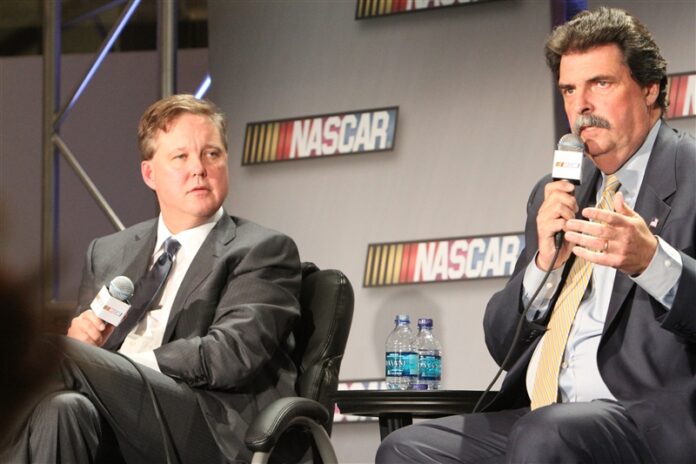
[media-credit name=”Brad Keppel” align=”alignleft” width=”225″][/media-credit]NASCAR Chairman Brian France said the goal was to make the point system simpler. Mike Helton brought it down to the elementary level by saying, “now if you’re 10 points behind, you know you have to finish 11 points ahead of the guy in first to win the championship.”

Is this really different? The winner of a race gets 43 points, with each position below that getting one point less. That means second place is worth 42 points and third is 41 points, and so on. If a driver leads the most laps and finishes second he could score 44 points and the winner would get 46. Different? Well, in a way it is.

The devil is in the details. Drivers now get 3 points for winning a race, 1 point for leading the most laps, and 1 point for leading a lap. This means the most points any driver could achieve in a race would be 48 points. Ironically, that is the car number for current multi-championship driver Jimmie Johnson. Coincidence?

The Chase will be assembled different. The top 10 in points after Richmond in September will automatically be seeded in the Chase with each driver getting 2,000 points and 3 points for each win during the regular season, but there’s more. The final two positions, what France called “wild cards” (stick and ball envy, perhaps?). Winning drivers from position 11-20 in points would be rewarded with a place in the Chase. They will not get bonus points for their wins, however.

NASCAR President Mike Helton commented that the final two drivers would have their bonus by making the Chase. The best thing to call this is the Jamie McMurray rule. McMurray won the two biggest races last year, but failed to make the Chase, so now they’ve fixed that. I guess the powers that be thought it was worthwhile to once again change the system because of one driver.

It happened in 2003 when Matt Kenseth won the Championship with only one win. The Chase was formed. Many say that it happened again when Dale Earnhardt, Jr. couldn’t make the Chase—they increased the field. Now they’re doing it again. Or so it seems.

The real news was the change in qualifying. Qualifying order will now be based on practice speeds, with the slowest cars going first. I suppose this is supposed to create excitement in qualifying, but you and I know that the result will be the same. However, if qualifying is rained out, as happens so often, the starting field will be seeded based on those practice speeds. Go or go home teams will qualify separate from those in the top 35 (something they will never change. If practice is rained out, the field will be set on points as it has in the past.

So, what do I think? It’s much ado about nothing. I don’t know who these fan groups they say they base their decisions on are, but they don’t even resemble the fans I know. Most of them could care less about points, and are more interested in who wins the weekly race and how good the racing is. Yes, there has to be a championship of some sort, but as I’ve said over and over these last few years where they have emphasized the championship from the first race to the last, fans have lost interest. In the days where the race was important and the points weren’t a constant worry, NASCAR flourished.

One good thing came out of these changes. The problem with inclement weather on qualifying day has been addressed, and we should see fewer fields where the point leader starts on the pole (something fans gripe to me about all the time.

And we finally got Brian and Mike to admit that brand identity was important. I guess that the boys in Daytona Beach are trying, even as they continue to manufacture excitement instead of letting the racing speak for itself. Tonight they presented a PR film on just how good the racing was last year to the press. I can’t imagine Major League Baseball or the No Fun League doing this. But those sports are in a period of growth. Maybe that’s the difference.

Fox Sports Chairman David Hill and Dale Earnhardt Jr. Eye Shorter Races

The Associated Press released a report today stating that Fox Sports Chariman David Hill would like to see shorter races. His ideal is set at having a four-hour broadcast with 40 minutes of pre-race coverage and 20 minutes of post-race coverage.

[media-credit name=”David Yeazell” align=”alignright” width=”225″][/media-credit]Shortening races could be a step in the right direction as the newer generation of fans has a lot of different forms of entertainment to choose from so condencing the races down allows for better focus.

Also, some races can tend to be boring in the middle with how the action dies down, which at this poin is what draws fans away. Some fans have said that they just go watch the final 20 to 50 laps, plus the recap, and they’ve got their dose as the middle does dry them out. Some fans find themselves watching the beginning, falling asleep during the middle and then in the end, they wake up and catch the tail of the race feeling complete.

NASCAR’s most popular driver Dale Earnhardt Jr. agrees with the sentiments, reciting examples from this past season with some races.

“I think it’s a great idea, especially at certain events. The Pocono races are entirely too long,” Earnhardt said during the Media Tour. “I think NASCAR should shoot for a three-hour or three-hour and 15-minute televised event, and try to fit into that sort of time frame. But it can’t be done at all times. I understand. I think you’ve got to have races like the 600-miler [Coca-Cola 600 in Charlotte] and the Daytona 500 and things like that — but there are certain events [that should be shortened].

“For example, Phoenix was a good race. Adding that little bit to it didn’t make it better. It only made it longer; it only made it tougher to watch, tougher to witness. It was a good distance [prior to last year’s change], and the 300 laps at New Hampshire is the perfect distance.

“Then you go to Pocono, and it’s entirely too long, obviously. It’s an obvious, glaring issue with everyone that’s there — but it’s like this huge, pink elephant that nobody wants to talk about. Maybe there was some kind of a guarantee or promise made in the deal years ago, and it’s something they won’t change. We’ll see how it goes.”

Shortening the races would condense the amount of time allowed for drivers to make a move, therefore pushing them to drive harder. You see this at your local short track as the 50 to 100 lap features see drivers run hard every single lap. You also see this in the Camping World Truck Series with 150 to 250 mile races. This is the reason some have tuned over to the Truck Series as they like the excitement there. Could the same philosophy work in it’s big brother?

Though, some changes would also have to be made if this change was to take effect. If fans were brought forth to pay the same ticket prices for a shorter span of time, you would see less fans traveling, espically since complaints about the prices have already been made. So therefore ticket prices would have to be dropped to go with the change. Some track owners may not be in the favor of this as this will reduce the profit made from their perspective.

Also, Hill may think this is a good idea, though shorter time on television equals less time for him to display advertisements. As a result, he will be making less of a profit so will that be okay from his perspective?

NASCAR CEO Brian France says the sport has taken a look at this and looking through the schedule, he says there are some changes that have been made.

“We’ve done that over the last several years. I think you see with Atlanta being a 500-mile race, going to Kentucky, that’s a 400-mile race. California going to Kansas, you’re seeing that’s a 400-mile race,” France said during the Media Tour. “We awarded the second one in California. That is a 400-mile [race]. …

“So there will be alterations as we go down the road to shorten them up by a little bit. [There are] no expectations from us to make any drastic changes — but 100 miles changes a complexion of a race, depending where you are, for sure. And we’re going to continue to look at that. And we’ll look at the Nationwide [Series] events where we want to have good separation between a Sunday and Saturday show. … [We] will be looking at the length of Nationwide events as we go down the road.”

Another change to look at is the length of the season, in team owner Rick Hendrick’s opinion.

“I absolutely think the races ought to be shorter, and I think the season ought to be shorter. It’s just so long,” Hendrick said. “We’ve got so much to look at — we’ve got baseball, basketball, football all going on at one time, and then [there is] our season.

“Football players, I’ve got some friends, and they get to take months off. We get back from [Las] Vegas [and the banquet to cap off the season], we start testing, and we’re working harder in the offseason than in the regular season. If we had three more months off, I think the fans would be eager to watch it again. But I don’t know.”

Making the season shorter could have some advantages as it would give the guys some time off so they wouldn’t be as worn out and with having less races during the year, it would make the fans more hungry to turn into the action when it did start up. Though a negative side is the waiting game and a lot of fans may not be happy with that as they already say that a two-month off-season is long enough for them to stand. Then bring in the financial deal in the fact that less races = less money for that and you may have partners dropping out as a result.

“I think the financial rewards from having the season as it is are too great,” Earnhart said. “It’s almost as if each race is a limb that you can’t amputate. It’s too big a deal to shorten the season. It’s not a simple task to say, ‘All right, this guy is losing a date. Is everybody cool with that?’

“It’s so challenging. There are tons of money involved and tons of livelihoods involved — and people’s careers and opportunities are involved. So I don’t believe we’ll ever see a shorter season. But I do believe that in my lifetime I will see the shorter races across the board at 80, 75 percent of the events.”

All in all, this is a debate that considers a bunch of factors mixed together – fans and their feelings and the profit of all the companies that are connected to the ordeal. To come to any agreement, everybody will have to agree on something that works for all parties. Whether that equals shorter races or not, that will be a question that NASCAR faces in the future.

Oh, by the way……

40 minutes for the pre-race show and 20 minutes for post-race show is something that may have to be questioned.

Pre-race shows have gotten to the point of including ridiculous content that has caused some fans to turn away. In contrast, post-race shows have been too short as they don’t contain the right amount of interviews to cover the events and speak to the drivers about what had happened throughout the race.

To gain fans back to watching racing on television rather through radio or getting updates online, they will need to address this issue as this is another reason that television ratings have been going down. Maybe flip the two and have a short pre-race show, yet long post-race show.

NASCAR – From A Fans’ Point of View

Nascar has just announced it will put into place a much simpler points system for all three of its’ premier series. The reasoning? To make it easier for the average race fan to understand this points system and create “more drama” near the end of the season. Nascar also tweaked the process that teams and drivers will use to qualify for the championship chase. After 26 races, the top ten in points are in, 2 wild card entries will be determined by the number of wins a driver has, if they are within the top twenty points position. If there are no drivers in the top twenty that are eligible it will then revert to what Nascar calls the “series standings”. So, it seems that there is a very distinct possibility that the top twelve in points will compete for the championship. Am I missing something here?

[media-credit name=”Brad Keppel” align=”alignright” width=”225″][/media-credit]Another Tweak for 2011, revise the qualifying procedure. No more drawing for your qualifying position, but rather you will go out to qualify based on your practice speeds, slowest cars will go out first, fastest cars last. If practice happens to wash out due to rain, the order will be set by point standings, if practice, and qualifying are rained out, the field will be set according to points, Sound Familiar?

It is not a trade secret that attendance and television ratings have declined over the past few seasons, and it is necessary to realize that Nascar is trying to “Right the Ship” so to speak.  All considered, will these changes that Nascar just made bring the fans back to the tracks? Will these changes revive the sagging television ratings? What do you think?

It wasn’t that long ago that Nascar appeared to be paying attention to the people that were buying the tickets, and tuning in on Sunday afternoons by implementing the double wide restarts, and allowing the leader to choose which lane he wanted to restart in. Why did Nascar do this? Because the fans demanded it, fans wanted something done to add more excitement to the race. Maybe Nascar should look at this again, does a complicated points system, or how the cars qualify keep people away from the race tracks, or grabbing the remote to change channels? Not likely. What’s the solution, what needs to be done?

A few ideas, the most obvious problem for the race fan is, of course, cost. It’s nearly impossible for the average working class family to afford a typical three day Nascar week end. Travel to and from the venue, three day ticket packages (Trucks, Nationwide, and Cup series) minimum three nights lodging, it’s just too much. No matter how you shake it out, to get people back in the stands it has to be more affordable. How? A few ideas. Limit the three race weekends; go to a two race, or single race format. Schedule the truck series on more short track venues, one day shows, go back to the roots, Hickory, South Boston, how cool would it be to have a truck race at Bowman-Gray. Maybe run more Nationwide races in combination with other series, IRL, ARCA, even the modifides, how about a few shows with the Rolex Sports cars, the current road course races seem to be popular, why not tap into this fan base? Schedule some stand alone events for the Cup series, reduce them down to 2 day events, Practice one day, qualify, and race on the second day. Just a few ideas. Could these types of changes bring back some of the excitement, could they open new, and different markets, could they bring a totally new fan base, Could they bring races fans back to the tracks? This is a little like Field of Dreams, If you give them more value for their dollar they will come.

Now lets’ talk about Television ratings. This is an entirely different animal. It’s important to understand the basics of broadcast journalism. Networks are dependent on selling air time (advertising space) to keep the doors open. In order to sell this air time, the networks need a product to make this air time more valuable, this is where Nascar comes in. Nascar approaches the network armed with the “Ratings” and presents a viable package for the networks to sell to its’ advertisers, in turn, Nascar will sell the broadcast rights to the network for some undisclosed amount of money, (just how much is this undisclosed amount? It would seem it takes at least three networks to come up with the amount?) Herein lies the problem, the networks are forced to sell nearly 50% of the scheduled air time to cover costs, and as in any other corporation, turn a reasonable profit. This leaves about 50% of the scheduled air time for actual event coverage. This seems to hold true for most television programming, in most cases the viewer will see as many ads, as they see event coverage. With this in mind what can you do to hold the viewers (in our case, Race Fan) interest. Simple, Just take a look at how other networks broadcast motorsport events. There is one network the does a split screen during the race, racing on one side the ads on the other, the race fan does not miss a moment of the action. If this can be done for other forms of motorsport why not Nascar?

Will these ideas, and suggestions cure all, will any of these ideas, and suggestions ever happen? Maybe, maybe not, but it’s a certainty that doing nothing will not elevate this sport back to where it

Canadian Tire Series: Don Thomson Jr. To Run For Ed Hakonson in 2011

Team 3 Red/Ed Hakonson Racing announced that Don Thomson Jr. would be joining their team. According to team officials, the new deal will allow for some great opportunities for Thomson with his wealth of knowledge, driving ability and experience as a seven-time Canadian stock-car champion.

“The group at Team 3 Red/EHR is a great group of guys and I am looking forward to working with Jason and the rest of the company,” said Thomson in the team’s press release. “This move puts me in a great position, opens doors for me and I am excited to be a part of the plan for T3R/EHR in 2011.”

“Don has a great history of being a superb contender in racing here in Canada,” team owner Ed Hakonson said. “We are looking forward to the new opportunities that lie ahead for Don and our team in the coming season. His knowledge and ability is unmatched in the industry and we are proud to have him a part of our organization.”

In 51 career NASCAR Canadian Tire Series starts Thomson has six wins, 27 top-five and 38 top-10 finishes. He also holds the series record with 11 career poles. Thomson spent last year at Fitzpatrick Motorsports, finishing fourth in points with one win, nine top fives and 11 top 10s in 13 starts. Thomson and Fitzpatrick Motorsports split ways at the end of the 2010 season as a result of Fitzpatrick Motorsports changing their team outlook.

“Fitzpatrick Motorsports was originally founded for (team-owner) John to have some fun,” JR’s business partner, Jason Sharpe, told Inside Track Magazine. “When John became involved with the CASCAR Super Series, he wanted to bring the level up in shop, to turn it into a professional operation, and that’s when Don Thomson came on board.

“The most recent objective of this team has been to develop J.R.’s career. We’ve enjoyed our time in the CASCAR and the Canadian Tire Series, but it’s time to put all of our resources behind J.R. and go to the States. We’ve developed relationships with JR Motorsports and Harvick Motorsports, we’ve put the pieces in place, now we need to make the move south.”

“It’s the right time to go there,” Fitzpatrick told Inside Track. “I’m not saying we won’t run in the Canadian Tire Series next year, we’re not shutting down the Canadian side, but we’ve got nothing left to prove here. We’ve been in talks with a lot of different teams and we’re working hard on finalizing our sponsorship package. Nationwide is the goal for 2011.”

“We had a great 13-year run with Fitzpatrick Motorsports,” Thomson said. “We parted on good terms, we’re just going in different directions. I’m 48 years old and been doing this a long time. I believe I can still get the job done behind the wheel, but to be successful, it requires ’24/7′ dedication.”

Thomson’s new teammate Jason Hathaway says he looks forward to working with Thomson.

“Donnie and I have always respected each other on and off the track so I am excited that he has joined our team,” Hathaway said. “His knowledge and our joint efforts will help our organization on a number of levels.”

Final plans are in the works for the season and will be released shortly.

NOTES FROM THE NASCAR NATION: A new chapter and a new Bowtie for ‘Awesome Bill from Dawsonville’

For a span of 52 races former NASCAR Sprint Cup champion Bill Elliott has been the driver of the #21 Ford fielded by the Wood Brothers one of the most historically significant teams in the sport. However, more than a few eyebrows were raised with the recent announcement that said the Woods Brothers were placing 19 year old racing protégé Trevor Bayne in their car for the 2011 season. The element of surprise here was the fact that the Wood Brothers chose to pave their future with such a young, although very talented, driver. Traditionally, the Wood Brothers have always chosen to place a seasoned veteran in the seat of their race cars.

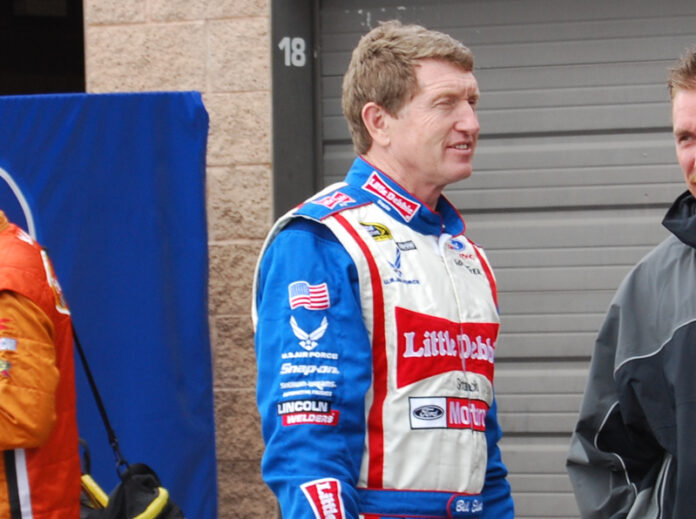
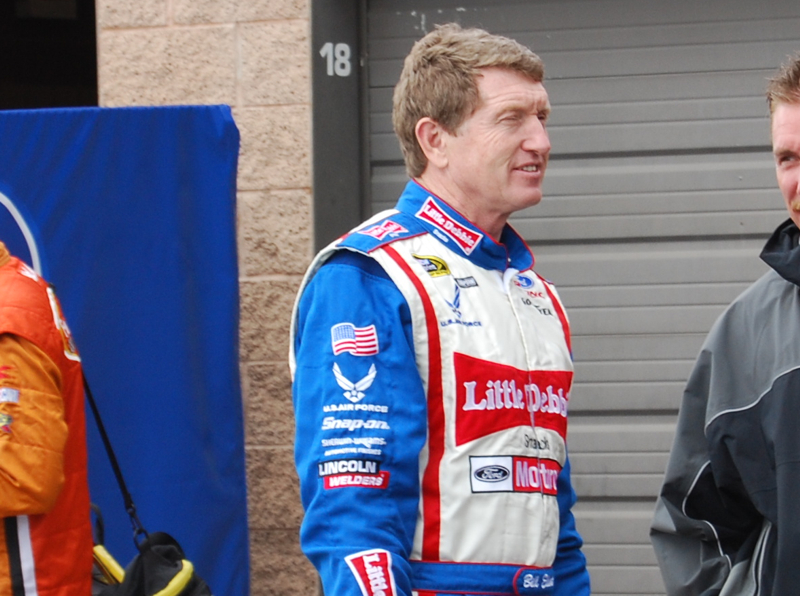
[media-credit name=”FMCM” align=”alignleft” width=”201″][/media-credit]That announcement was followed by questions regarding the racing future of the 55 year old Bill Elliott. Could he find another ride with any amount of substantial quality? Would the Dawsonville-Georgia native, known to fans as “Awesome Bill from Dawsonville,” seriously consider hanging up the helmet and announce his retirement? The answer came back on January 19th when team owner James Finch, of Phoenix Racing, announced that he had signed Elliott to drive his #09 Chevrolet. The announcement also meant that, after decades of driving Fords plus a two year stint in a Dodge, Elliott would be campaigning a car with a Chevrolet bowtie on its nose for the first time in his career.

The master plan calls for Elliott to drive a minimum 18 races for Finch and Phoenix Racing. They are hopeful that additional sponsorship will come their way so they can race the entire Sprint Cup schedule. Nick Harrison will be on the pit box as crew chief. Finch also announced that the power plants for their Chevrolet will be supplied by Hendrick Motorsports.

This new collaboration will begin with next month’s Daytona 500 and anticipation is already mounting for the team because this is a track that Elliott has enjoyed success at. He has four NASCAR Sprint Cup wins there including two Daytona 500’s. James Finch’s operation has also enjoyed some good runs at Daytona as well. In the recent past they have compiled finishes of third, fourth, ninth and 12th. Their first and only Cup win came at NASCAR’s other high banked restrictor plate track. They won at Talladega in 2009 with Brad Keselowski driving their #09.

The level of anticipation quickly hit a higher level following the recent Sprint Cup pre season test sessions at Daytona. Climbing into a Chevrolet race car for the first time, Elliott seemingly took things easy on the first day of testing. But, by the time the three day session concluded, he moved his new ride from 28th to 14th on the speed charts. It was considered by many to be a very encouraging start.

The enthusiasm was certainly echoed in recent statements from both principals. “It’s big for us, and big for Chevrolet to get Bill Elliott,” Finch said adding “it’s the first time in his career he’s committed to race a Chevrolet. With the right equipment, he’s going to be ready.”

Describing his new ride as a really good deal, Elliott said “James has really good race cars and there’s no doubt about the Hendrick (Motorsports) equipment. After all, look at the championships they’ve won. This may be my last really good chance as a driver. I’m going to give it my best shot. I feel like I’m still in good shape, and I thought I ran pretty good last year.”

Finch and Phoenix Racing finished 39th in the 2010 Sprint Cup owner’s points. That means they will not have a guaranteed starting berth during the first five races of the new season. But Finch will be the first to tell you that his new driver is very good at qualifying noting “he was just a couple of hundredths of a second off of the pole at Homestead last year.” There’s also the availability of Elliott’s provisional starting berths as a past NASCAR champion if needed. Finch is also aware that Elliott has the capability of being a strong race finisher and will likely make quick work of getting his team back into the all important top 35.

Also benefiting Phoenix Racing will be Elliott’s vast amount of racing experience from a career that has spanned 35 years. During his tenure he has compiled some amazing numbers that include 821 NASCAR Sprint Cup starts which has led to 44 wins, 175 top five finishes and 320 top ten finishes. His expertise at qualifying has led to 55 poles. Over the years Elliott has raced 237,304 NASCAR laps, totaling 306,756.3 miles, with 11,413 laps led. His career earnings has topped a whopping $45 million.

With those numbers came impressive, and well deserved, accolades for Elliott. In 1985 “Awesome Bill” became “Million Dollar Bill” after he became the first driver to win the Winston Million. This special program, sponsored by R J Reynolds Tobacco Company, offered one million dollars to any driver who could win at least three of four of NASCAR’s crown jewel races at that time. Elliott pulled off the feat by winning the Daytona 500, the Winston 500 at Talladega and the Southern 500 at Darlington.

In 1987 Elliot set a NASCAR record for the fastest one lap speed, 212.809 MPH, at Talladega. That record still stands today because NASCAR later implemented the use of restrictor plates to slow the cars down at this super fast speedway. The following year Elliott had another outstanding season and won the coveted NASCAR Sprint Cup championship. 1998 saw him receive the extreme honor of being named as one of NASCAR’s 50 greatest drivers.

Phoenix Racing will need to insure that they have an ample inventory of hats, shirts and souvenirs on hand. That’s because Bill Elliott has been named NASCAR’s most popular driver a whopping 16 times yet another series record he holds.

With career stats of this caliber, it’s no wonder that he’s known as “Awesome Bill from Dawsonville.”

NASCAR announces changes

NASCAR announced on Wednesday that they have added a wild card element to setting the Chase and a simplified points system for 2011.

[media-credit name=”David Yeazell” align=”alignleft” width=”225″][/media-credit]The Chase field remains at 12 drivers, but the final two spots will be determined by the number of wins during the first 26 races.  The positions of 11th and 12th will be referred to as the “wild card” positions and will go to non-top-10-ranked drivers with the most wins, as long as they’re ranked in the top 20 in points after race 26.  If no driver wins outside of the top-10 in points, NASCAR will go by the series standings to determine the final two positions.

The new points system will apply to all NASCAR national series and will award points in one-point increments with three bonus points for a race win.  Additional points can be made for leading a lap and leading the most laps with the possible maximum points to 48 per race.

Other notes:

  1. Drivers in all three national series now must select the series where they’ll compete for a driver championship.  Drivers still may compete in multiple series and can complete for the owners title.
  2. The qualifying order will be set based upon slowest to fastest final practice speeds.  During inclement weather and qualifying is cancelled, the final starting lineup will be determined by practice speeds.  If weather cancels practice sessions, then the starting lineup will be set by points, per the rule book.
  3. More manufacturer identity.