


IZOD IndyCar Fields Capped at 26 Cars, Except Indianapolis and Las Vegas
With the 2011 season, IZOD IndyCar Series officials say they want more consistancy and with that, they have now added a field. Starting fields will set to a maximum of 26 cars, excluding the Indianapolis 500 and the IZOD IndyCar World Championships at Las Vegas Motor Speedway.
“This new procedure will ensure that our fans see the best drivers and teams in every race we stage, while adding more drama to the qualifying process,” said Brian Barnhart, president of competition and racing operations for INDYCAR. “Many of the tracks we compete at can only accommodate a maximum of 26 cars and that is our limit when traveling to overseas events, so those two factors are what really helped us land on this number. We feel that a consistent starting line-up number will help our tracks and teams better prepare for events, improve conditions on pit road and elevate the level of competition on track.”
During the 15 race weekends this is in place, 24 starting spots will be filled through qualifyng based upon time, while there will be two provisional positions if needed. The two provisionals are availabe ot any driver who doesn’t make the field after qualifying based upon the following criteria (in order):
· 2010 IZOD IndyCar Series champion driver.
· 2009 IZOD IndyCar Series champion driver.
· 2010 Indianapolis 500 champion driver.
· Highest-ranking driver among the current top-22 driver point standings prior to race weekend.
· Leader Circle entry with the best practice lap time at the event, as deemed acceptable by INDYCAR.
· Entry with next best qualifying lap time, as deemed acceptable by INDYCAR.
The Indianapolis 500 maintains its traditional 33-car field while the field at Las Vegas Motor Speedway is expanded to 30 to accomodate additional entries participating in the $5 millon challenge.
Last month, in an attempt to bring forth drivers of different series, Benard also announced that a $5 million challenge to any professional race car driver not competiting in the IZOD IndyCar Series for the finale. If they win the race, Benard will pay them $5 millon on top of the prize money given.
The field at Las Vegas will include two provisional starting spots, while Indianapolis won’t.
Provisional spots will also not be available for the IZOD IndyCar Series events at Sao Paulo and Twin Ring Motegi, but the field will have up to 26 cars at both races. INDYCAR will determine at its discretion the procedure by which non-Leader’s Circle teams are selected to travel to and participate in these two events.
The change makes sense to cap the field as from a fan’s perspective, it’s better to have 26 of the most competitive cars rather than a bunch of fast cars, some slow cars causing accidents and start-and-parks. For most fans, the competition is what matters and if this keeps it at a premium, then I don’t see any complaints forthcoming.
Ryan Newman Schools Students in the Name of Science and Technology
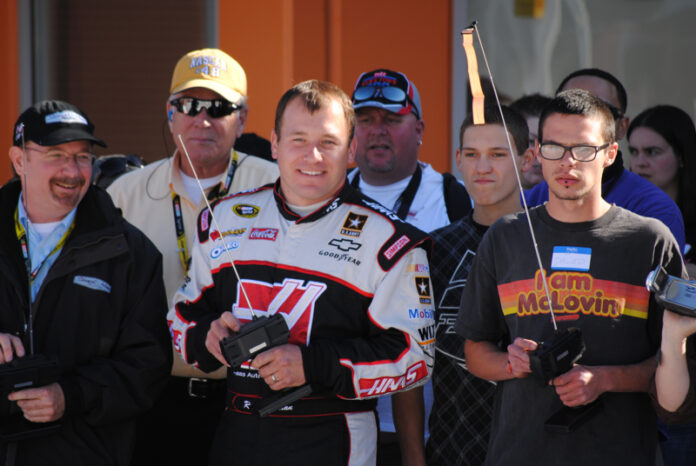
Ryan Newman, driver of the No. 39 Haas Automation Chevrolet for Stewart Haas Racing and a Purdue engineering grad, took some time away from the big track at Las Vegas Motor Speedway this weekend to school some science, technology, engineering and math high school students in the art of remote control car racing.
[media-credit name=”Gary Buchanan” align=”alignright” width=”223″]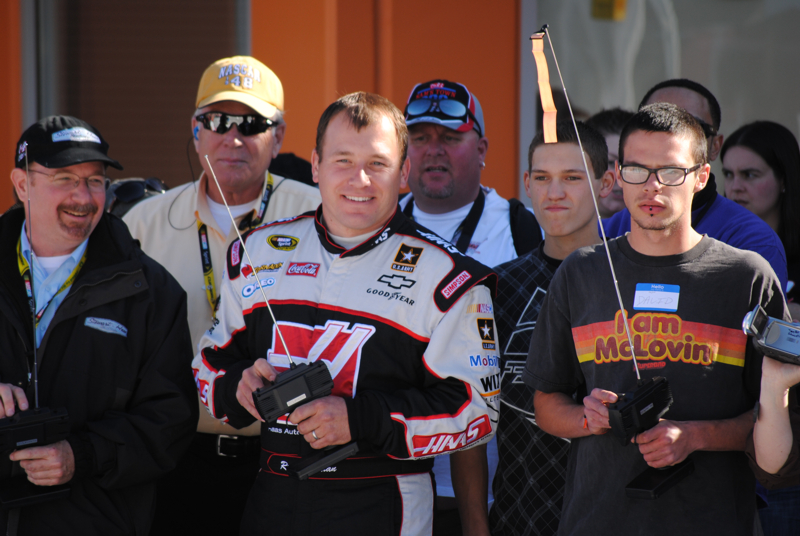 [/media-credit]Newman spanked the field of students with his remote control race car on a small track set up in the Neon Garage at the Speedway, all for the sake of furthering their education. The students were part of a new NASCAR partnership called Ten80 Education’s Student Racing Challenge.
“I just really like the fact that it’s hands on,” Newman said of the Ten80 program. “There is a time to study, a time to read, and a time to apply all of those things to a piece of paper.”
“But when you take the opportunity to do it hands on, as a group, you become a better team,” Newman continued. “Doing what they are doing with the ten scale cars is something that I did when I was their age.”
“I had remote control cars,” Newman said. “I rebuilt them and tried to make them go faster too. I”m proud to represent the engineering group of the whole program, understanding the math and the physics and the science of it.”
“It’s extremely important not just if they want to be involved in NASCAR but whatever else they want to do in their lives,” Newman said. “Racing a ten scale, remote control car will have an impact on the rest of their career, the rest of their lives and the rest of their professions.”
Bobby Hutchins, Director of Competition at Stewart-Haas Racing, could not agree more with Newman.
“Just seeing the enthusiasm on the students’ faces as we were out there talking with them was great,” Hutchins said. “We talked to them about there being jobs in our sport for engineering and technology people.”
“I gave them a goal, to get through school, go to college and hopefully they can build their resumes and we can hire some of these kids into our race teams,” Hutchins said. “That’s a dream and a goal that Ryan and I had when we were kids a long time ago and we weren’t fortunate enough to have a program like Ten80.”
“I hope these kids can come into our world.”
The Racing Challenge uses a NASCAR-themed curriculum for students from grades six to twelve, simulating how big league race teams prepare for competition. In order to compete in the Ten80 Challenge, students had to build their own remote control race cars, similar to what their NASCAR counterpoints have to do every weekend with their stock cars.
“We’re very exited about the partnership that we’ve just engaged in with Ten80 Education,” Jjim Obermeyer, NASCAR Managing Director of Brand and Consumer Marketing, said. “This is a partnership that helps NASCAR and Ten80 have success in getting into the schools to teach science, technology, engineering, and math (STEM).”
“The program itself uses remote control cars at one tenth ratio to the cars that we have on track that allow for a lot of the setups with down force and camber set up the same way our teams participate,” Obermeyer continued. “We felt this was a great way to introduce ourselves into the schools in a way that separates us from all the other leagues in sports. This helps teach a much-needed territory for our youth today.”
Teri Stripling, President of Ten 80 Education, shared that the most important part of the program is the creation of heroes.
“The math and science concepts that students are learning all over the country, everyone single one of them is illustrated in NASCAR every week,” Stripling said.”When the cars are out on the track, the students can look out and see engineers on war wagons, looking at data and making decisions. From an engineering perspective that is very exciting and creates a bunch of heroes for engineers.”
Stripling also likened her progrm to the little league, creating a career ladder to the big league of NASCAR.
“So if NASCAR is the big leagues, Ten80 is the little leagues, Stripling said. “NASCAR makes sense to get students interested in science, technology, engineering and technology.”
The most eloquent spokesperson for the Ten80 program, however, was Kiera Fischer, a junior from Legacy High School right in Las Vegas, Nevada.
“NASCAR is something that I enjoy dearly and I’ve been a huge fan,” Fischer said. “When I found out my school was going to participate in Ten80, I was so excited that we would get to be involved with NASCAR.”
“We got to build our own cars and we act like our own little pit crew,” Fischer continued. “We design our cars to run on different tracks and see what is the best. It allows us to work on our cars in a way that is much more fun than a textbook.”
Fischer’s teacher got her into the Ten80 program and she was most excited to be able to build her car with her team and race against one of her racing idols Ryan Newman.
“Unfortunately we lost,” Fischer said. “But we’re hoping to get this thing going and next year, win.”
“NASCAR is definitely where I want to be,” Fischer said. “My dream is to own my own race team.”
And thanks to Ryan Newman, Fischer along with many of her other Ten80 compatriots, will no doubt have the opportunity to learn, grown and ultimately realize their own NASCAR dreams.
