Home Blog Page 82

NAPA AUTO PARTS NHRA MIDWEST NATIONALS IN ST. LOUIS SET FOR FOOTBALL ADJACENT BROADCAST ON FOX

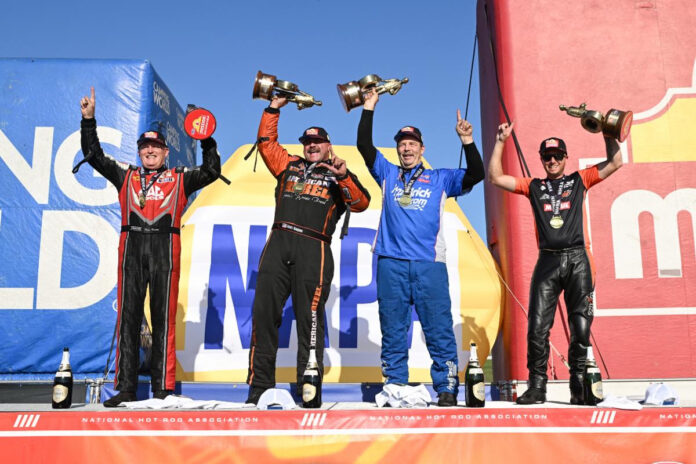
MADISON, Ill. (Sept. 28, 2026) – One of the biggest races in NHRA’s Countdown to the Championship playoffs will also get a major spotlight on FOX, as the 15th annual NAPA Auto Parts NHRA Midwest Nationals at World Wide Technology Raceway will air on FOX adjacent to a FOX football broadcast on Sunday, Oct. 4.

It’s the sixth straight year a race in NHRA’s postseason will be broadcast on FOX adjacent to a football game, but it marks the first time the standout St. Louis stop, which is the third of six races in the Countdown to the Championship playoffs, will air in the broadcast window.

This unique opportunity with FOX has led to massive audiences on the national broadcast network, including last year at Texas Motorplex in Dallas, when NHRA enjoyed the biggest viewership in its history with 2.065 million viewers and an impressive peak audience of 3.631 million.

The majority of markets on Sunday, Oct. 4, will see NHRA action from St. Louis following football broadcasts early in the day. Those markets will air the NHRA playoff race from 4:30-6:30 p.m. ET following the football on FOX game, while some markets will air NHRA coverage from 2-4 p.m. ET, leading directly into football on FOX action.

The broadcast will showcase a popular stop in the Countdown to the Championship playoffs, as the NAPA Auto Parts NHRA Midwest Nationals has consistently drawn sellout crowds to the fan-favorite World Wide Technology Raceway.

The premier stop on the NHRA tour during its 75th anniversary season will feature some of the fastest runs of the year from the incredible 12,000-horsepower, 340-mph Top Fuel dragsters and Funny Cars, starting with two qualifying sessions on Friday, including a can’t-miss night session under the lights to start the weekend in style.

The event continues with two qualifying sessions on Saturday and eliminations on Sunday, featuring a special 9 a.m. CT start time to position the event for its marquee broadcast window on FOX.

Last season, Doug Kalitta (Top Fuel), Matt Hagan (Funny Car), Greg Anderson (Pro Stock) and Gaige Herrera (Pro Stock Motorcycle) each claimed wins, while this year’s coverage also includes qualifying at 6:30 p.m. ET on FS1 and 11 a.m. on Sunday.

Top Fuel has been dominated in 2026 Kalitta Motorsports teammates Shawn Langdon and Kalitta. Langdon is the current points leader, riding a three-race winning streak, while others to watch include Tony Stewart, Maddi Gordon, Leah Pruett and Antron Brown.

Jordan Vandergriff, a Funny Car newcomer for John Force Racing, opened the playoffs with a win will try to track down points leader Hagan, who won Sunday in Rockingham, Capps, Todd and back-to-back world champ Austin Prock.

Greg Stanfield moved into the points lead in Pro Stock after winning in Rockingham. He’ll look to hold off the likes of Matt Hartford, reigning world champ Dallas Glenn, Greg Anderson and Erica Enders in St. Louis.

Reigning Pro Stock Motorcycle champion Richard Gadson holds the points lead after winning Sunday in Rockingham. Other standouts include Matt and Angie Smith, Herrera and Chase Van Sant.

The NAPA Auto Parts NHRA Midwest Nationals will also feature action in the NHRA Lucas Oil Drag Racing Series, the JBS Equipment NHRA Pro Mod Drag Racing Series presented by Elite Motorsports and Flexjet NHRA Factory Stock Showdown.

Fans can enjoy the special pre-race ceremonies that introduce and celebrate each driver racing for the prestigious Wally on Sunday and includes the fan favorite SealMaster Track Walk, as well as the winner’s circle celebration on Sunday after racing concludes, where fans are invited to congratulate the St. Louis event winners.

As always, fans get a pit pass to the most powerful and sensory-filled motorsports attraction. Fans can see their favorite teams in action and servicing their cars between rounds, get autographs from their favorite drivers and more. They can also visit NHRA’s Manufacturers Midway, which includes interactive displays, merchandise, food and fun.

NHRA Mission Food Drag Racing Series qualifying will feature two rounds at 4:30 and 7 p.m. CT on Friday, Oct. 2, and the final two rounds on Saturday, Oct. 3 at 12 and 2:30 p.m. Final eliminations are scheduled for 9 a.m. CT on Sunday, Oct. 4.

Tickets may be purchased at the WWTR ticket office, by phone at (618) 215-8888, or online at www.wwtraceway.com. All children 12 and under are free in the general admission area with a paid adult. For more info on NHRA, visit www.NHRA.com.


About Mission Foods

MISSION®, owned by GRUMA, S.A.B. de C.V., is the world’s leading brand for tortillas and wraps. MISSION® is also globally renowned for flatbreads, dips, salsas and Mexican food products. With presence in over 112 countries, MISSION® products are suited to the lifestyles and the local tastes of each country. With innovation and customer needs in mind, MISSION® focuses on the highest quality, authentic flavors, and providing healthy options that families and friends can enjoy together. For more information, please visit https://www.missionfoods.com/

About NHRA

NHRA is the primary sanctioning body for the sport of drag racing in the United States. NHRA presents 20 national events featuring the NHRA Mission Foods Drag Racing Series and NHRA Lucas Oil Drag Racing Series, as well as the JBS Equipment NHRA Pro Mod Drag Racing Series presented by Elite Motorsports and NHRA Flexjet Factory Stock Showdown™ at select national events. NHRA provides competition opportunities for drivers of all levels in the NHRA Summit Racing Series and NHRA Street Legal™. NHRA also offers the NHRA Jr. Street® program for teens and the Summit Racing Jr. Drag Racing League® for youth ages 5 to 17. With more than 100 Member Tracks, NHRA allows racers to compete at a variety of locations nationally and internationally. NHRA’s Youth and Education Services® (YES) Program reaches over 30,000 students annually to ignite their interest in automotive and racing related careers. NHRA’s streaming service, NHRA.tv®, allows fans to view all NHRA national events as well as exclusive features of the sport. In addition, NHRA owns and operates three racing facilities: Gainesville Raceway in Florida; Lucas Oil Indianapolis Raceway Park; and In-N-Out Burger Pomona Dragstrip in Southern California. For more information, log on to www.NHRA.com, or visit the official NHRA pages on Facebook, Instagram, Twitter, and YouTube.

Why Hospitals Are Betting on NASCAR

Photo by depositphotos at https://depositphotos.com/

At Daytona, a family walks through an oversized gate wrapped in the branding of a Florida-based health system, plays a hand-eye coordination game meant to mimic what a driver does at 190 mph, and never once reads it as an advertisement. That gate is the AdventHealth injector, and it has been part of Daytona International Speedway since the middle of the last decade. It is also one of the clearest signs of a shift that has been building for years: hospitals and health systems have become one of NASCAR’s steadiest new sponsor categories, and they are not slowing down.

The buys look different from a beer or insurance deal. Health systems aren’t chasing impressions the way a consumer brand does. They are making a set of specific decisions about where their name should live, who it should reach, and what the sponsorship is supposed to do. 

Read the recent announcements carefully and you can see the trade-offs each system weighed before it signed.

Track Partnership or Race Team: Where Does the Dollar Work Harder?

The first decision a health system faces is the most fundamental one. Sponsor a track, sponsor a team, or do both. Each one buys a different thing. A track partnership puts the system inside the event itself, usually as the official healthcare or medical provider. That’s a working role, not a logo placement.

A team deal buys reach instead. The paint scheme travels to every race on the schedule and shows up in every broadcast cutaway. Systems with a defined geographic footprint tend to lean toward track and speedway deals near their hospitals. Systems trying to build a national brand, or recruit talent across states, lean toward the car. Treating the two as interchangeable is where health systems waste money, because they do very different jobs.

Regional Health System or National Brand Play

A regional not-for-profit hospital and a multi-state system are answering different questions when they write the check. Confusing the two produces sponsorships that underperform on both ends.

Buy the Reach or Build the Experience

Signage and paint schemes are the easy part. The harder question is what happens when a fan actually shows up at the track. A health system can pay for a logo and stop there, or it can spend more to build something people walk through, remember, and tell a friend about.

The experience side is where healthcare has an unusual advantage over other categories. Blood pressure checks, concussion education, hydration stations in July heat, and screening kiosks all fit naturally at a racetrack. They also give the system something honest to say about why it’s there in the first place.

The trade-off is cost and staffing. An activation footprint needs clinicians on shift, insurance coverage, and a plan for what to do when a fan actually needs care. Systems that aren’t ready for that operational load should stay on the signage side and not pretend otherwise.

Does the NASCAR Audience Match the Patient You Want to Reach?

The audience question deserves an honest look, not a hopeful one. NASCAR fans skew in specific directions on age, geography, and household composition, and they respond to sponsorship in a measurable way. YouGov’s fan profile found that a majority of NASCAR fans view sponsorship as socially valuable and actively notice which brands are on the car. That’s a friendlier environment for a hospital logo than most sports properties offer.

The fit is strongest for service lines that map to the fan base: cardiac care, orthopedics, sports medicine, women’s health, pediatrics through the family audience. It’s weaker for service lines aimed at populations that watch different sports. A marketing lead should be able to name the service line the sponsorship is really supporting before the deal is signed. If nobody can, the deal is a brand exercise, and it should be priced and measured as one.

Measure It Like a Marketing Investment, Not a Donation

The last decision is the one that gets skipped most often. A NASCAR sponsorship is a line item, and it should be defended like any other marketing spend. Systems that treat it as goodwill tend to renew on habit and cut it in the first bad budget cycle. Systems that measure it survive the budget conversation.

Useful measures include tracked phone numbers and landing pages tied to race-weekend creative, service-line inquiry volume in the sponsor’s home markets during and after events, employer and physician recruiting activity, and earned media value from the on-site activation. None of that is unusual. It’s the same measurement discipline any healthcare marketing team should already be applying to the rest of its channels, which is why working with an agency that understands healthcare buyers tends to produce a cleaner read on whether the sponsorship is earning its keep.

Healthcare’s move into NASCAR isn’t a fad and it isn’t charity. It’s a category finding a property whose audience, values, and on-site needs happen to line up with what hospitals sell and how they want to be seen. The systems getting it right are the ones making each of these decisions on purpose.

How F1, IndyCar and NASCAR Each Solved Race-Day Refueling

Photo by depositphotos at https://depositphotos.com/

The car rolls into the box, the jack drops, and a crewman in a fire suit swings a hose onto the side of the chassis. Seven seconds later the car is gone and the rig is sitting there, dripping, ready for the next stop. What happens inside that rig in those seven seconds is the part nobody on TV bothers to show, and it’s where a lot of races have been won, lost, and set on fire.

Refueling looks like plumbing. It’s a different animal. Every series that runs a fuel rig has fought the same basic problem from a different angle: get a volatile liquid into a moving race car fast, without spilling it, without pressurizing it into a bomb, and without giving one team an edge nobody can measure. The answers each series arrived at say a lot about how pumps, seals, and flow control actually work.

Formula 1 Chose Pressure, and Paid For It

F1’s refueling era was built on borrowed technology. The 1990s rigs came straight out of the world of commercial aviation, adapted from the equipment that fills airliners on the ramp, and that’s where the pressurized architecture came from. Fuel sat in a tall storage cell above the rig, and a pump pushed it down through a hose and a quick-connect coupling into the car’s fuel cell at a rate that would empty a household bathtub in under a minute.

Regulators drew a hard line on how fast that could go. According to the Formula 1 Dictionary, the FIA capped flow at 12.1 liters per second and specifically outlawed mechanical pumps that would push it any higher. Teams still tried. After the Hockenheim fire in 1994, the sport tightened the rules again, and by 2010 in-race refueling was gone entirely on cost and safety grounds.

The lesson from that era is one every pump engineer already knows: pressurizing a fuel line buys you speed and hands you risk in equal measure. A single failed seal at the coupling turns a pit stop into a fireball.

IndyCar Went the Other Direction Entirely

IndyCar’s rulebook takes the opposite philosophy and writes it down in one sentence: Refueling supply must be gravity flow only. Pressurization and vacuum assist are both prohibited. The fuel falls out of an overhead tank, through a hose, and into the car under nothing but its own weight.

That single constraint drives a surprising amount of hardware design. The tanks along pit lane are bolted to the ground so nobody can gain a head of pressure by tilting one. Hose diameter, vent design, and coupling geometry all get scrutinized because they’re the only variables left. When you can’t add a pump, every millimeter of the flow path matters.

Gravity feed is slower than pressurized delivery, and it’s much harder to turn into a disaster. That trade is the whole point.

NASCAR Kept the Human in the Loop

Stock car refueling still runs on a can and a strong back. The gas man carries a sealed vessel up to the car, dumps it into the fuel cell, and swaps in a second one if the stop calls for it. There’s no pump on the rig at all in the traditional sense. The pressure head is the fueler’s arms and shoulders.

The physical demand is real. A full NASCAR can holds around 12 gallons and tips the scale near 95 pounds once you add the weight of the empty can to the fuel inside it. The fueler lifts that to shoulder height, holds it there, and does it again on the next stop. Design constraints on the vent, the probe, and the internal check valve all exist so the flow starts and stops exactly when the fueler wants it to.

Centrifugal Pumps Do the Work You Never See

Push past the trackside rig and into the fuel farm, the transfer trucks, and the ground-support equipment that keeps a paddock running, and centrifugal pumps show up everywhere. They move fuel from tanker to storage, storage to day tank, and day tank to rig. The physics are the same as any other centrifugal application: liquid enters the eye of a spinning impeller, gets flung outward by the vanes, and the volute converts that velocity into pressure at the discharge.

What makes fuel transfer unforgiving is the fluid itself. Gasoline and race fuels are low-viscosity, high-vapor-pressure, and aggressive on the wrong elastomers. The pump has to move liquid without cavitating, without leaking, and without generating a spark near a vapor cloud. That last requirement is what makes seal choice the single most consequential decision on the whole assembly.

Seals Are Where Race-Day Rigs Live or Die

A mechanical seal is two lapped faces, one spinning with the shaft and one held still in the housing, pressed together by a spring and by the process fluid itself. The clearance between them is measured in helium light-bands. Those two faces are the only barrier standing between the fuel and the atmosphere.

Selecting one for a fuel-service centrifugal pump is a chain of trade-offs: single versus double, face materials that handle the fluid without galling, elastomers rated for the specific hydrocarbon blend, and a flush plan that keeps vapor from forming at the faces. 

A practical guide from American Stainless Pumps walks through the decision points in plain terms. The short version: match the seal to the fluid, the pressure, and the speed, or plan on replacing it a lot.

Phoenix Beyond Race Weekend: What the Valley Is Like to Live In

Photo by depositphotos at https://depositphotos.com/

The same compromise shows up in housing style. Master-planned communities make up most of the Valley’s outer growth. These are newer builds with HOA-managed amenities like pools and parks. They offer a finished, predictable neighborhood from day one, which appeals to many buyers.

Move closer to the center, and that predictability gives way to something else. Planned communities generally can’t offer established trees or architectural variety. What they lack most is a sense of place: the kind that accumulates over decades rather than one that developers build all at once.

Central Phoenix, Tempe, and pockets of the East Valley carry that character. In keeping with the same pattern, they trade away space. Lots tend to be smaller, and homes often need more updates than newer construction.

Neither approach is better than the other. The right pick depends on whether a buyer values predictability and amenities or character and proximity more.

Car Dependency vs. the Proximity Premium

That question resolves into dollars and cents once you factor in how people actually get around. If you live farther out in the Valley, you almost always commit more fully to car dependency.

Errands, school runs, and social life all stretch across greater distances, and developers didn’t build the newer suburbs with walkability in mind. It’s a real cost, even if it’s less visible on a monthly budget than rent or a mortgage payment.

A house in the downtown area avoids that cost, but it shows up directly in the home’s price. Proximity to downtown Phoenix, Old Town Scottsdale, or the walkable pockets of Arcadia carries a premium that outer suburbs simply don’t charge, precisely because that convenience is in shorter supply.

At this point, it’s better to leave the general ideas behind and look at what’s for sale locally.

A quick search for homes for sale in Phoenix shows just how much the price gap between “bigger and farther out” and “smaller and closer in” really is.

The Price Gap Across the Valley

According to 2026 housing market data by Houzeo, the median home price across the Phoenix metro is around $446,250. However, that single figure hides a significant divide. Central, highly connected neighborhoods like Arcadia or Downtown Phoenix consistently sell well above that midpoint, while outer suburbs like Gilbert, Queen Creek, or Surprise often fall below it. 

That price difference is the cost of location, showing exactly how much extra buyers pay for proximity over extra space. 

The median price isn’t really one market. It’s the midpoint between two different ways of living, and every home for sale falls on one side of it or the other. 

Where the Trade-Off Tends to Land

Commute, housing style, and daily cost all point in the same direction, but people rarely settle it once and for all. Most lean one way based on their current life stage, then reassess later.

Families with young kids often prioritize space and newer schools early on and accept a longer commute. As commute fatigue sets in, or as kids get older and need less supervision, some of those same families move back toward proximity and trade space for time.

Others make a different choice. They start close to the center for the lifestyle, then move outward later once space matters more. There’s no fixed endpoint here. Life keeps changing, and so does the balance you strike.

Make the Balance Work for You

By now, one thing is obvious: your commute, your neighborhood, and your monthly budget are all connected to the same underlying decision. The real question isn’t which option is better. It’s which one fits how you actually live.

If your commute is short or flexible, you can lean into extra space without much downside. If you’re stuck with a longer commute, a smaller home closer in might be worth it for the time and quality of life you get back. Neither choice is wrong, they just work for different routines.

What matters most is picking what fits your life, not what sounds good on paper. The Valley is spread out, so this one decision shapes almost everything else: your commute, your social life, and your budget. Take your time and get it right from the start, because this choice will shape how the rest of your life here feels.

Team Penske NASCAR Cup Series Race Report – Kansas

Hollywood Casino 400
Kansas City, Kansas – September 27, 2026

AUSTIN CINDRIC No. 2 DISCOUNT TIRE FORD MUSTANG DARK HORSE

START: 11TH STAGE 1: 3RD STAGE 2: 2ND FINISH: 2ND POINTS: 9TH

RACE RUNDOWN: Austin Cindric and the No. 2 Discount Tire Ford Mustang Dark Horse team delivered one of their strongest performances of the season Sunday afternoon at Kansas Speedway, racing near the front throughout the Hollywood Casino 400 before securing a season-best second-place finish. After inclement weather canceled Saturday’s NASCAR Cup Series practice and qualifying sessions, Cindric lined up 11th with the starting lineup set per the NASCAR Rulebook. He wasted little time working his way forward, charging to third by Lap 20 while reporting a strong balance on the No. 2 Ford. Cindric remained third when the competition caution flew on Lap 35 and came to pit road for four tires and fuel with no adjustments. He restarted fifth on Lap 41 and continued to maintain a position inside the top five despite reporting that the handling transitioned from tight early in a run to free as the run progressed. Cindric crossed the line third at the conclusion of Stage 1 before crew chief Brian Wilson called for four tires, fuel and an air pressure adjustment during the stage break. The No. 2 team continued to make gains throughout Stage 2. Cindric was running second when the caution flag came out on Lap 114 and reported that the team needed to continue addressing the free-handling condition that developed over the course of a run. Following another four-tire stop with fuel and an air pressure adjustment, Cindric restarted third and ultimately finished Stage 2 in the second position. Cindric began the final stage fourth and remained firmly in contention. With just over 50 laps remaining, he made his final scheduled stop under green for four tires and fuel before racing his way back toward the front during the closing stretch. Cindric ultimately brought the No. 2 Discount Tire Ford home second to record his best finish of the season and cap off a strong afternoon for the No. 2 team at Kansas. The runner-up result also moved Cindric to ninth in the Cup Series Chase standings as the postseason continues next Sunday at Las Vegas Motor Speedway.

CINDRIC’S THOUGHTS: “I definitely wish I would have had a shot there. You know, I thought we were really strong all day. We made some decent adjustments and got ourselves good for those long runs for the final run. We just lost a bit too much time in the pit cycle. I think there’s definitely some things I could have done better. I stayed long in the stall and threw off the stop a bit. When you lose by only half a second, it comes down to all the little stuff. Those guys had a hell of a battle for the lead to give me a shot. Super proud of the effort from everyone at Team Penske, Discount Tire and Ford. I feel like I had a car that could have won today but didn’t. I can be happy and pissed about that at the same time. Hopefully we can transfer that over to next week and the week following because I don’t see the reason why we can’t. I think these are the tracks you have to be critically good on. We saw pieces of this from Chicago and I felt like we took some bits and pieces and applied them to Kansas, and obviously, you can see what it did. I’m super proud of everybody on the team, keeping us in it all day and unloading super close.”

RYAN BLANEY No. 12 MENARDS/CARDELL FORD MUSTANG DARK HORSE

START: 25TH STAGE 1: 10TH STAGE 2: 7TH FINISH: 5TH POINTS: 5TH

RACE RUNDOWN: Ryan Blaney rallied from the 25th starting position to score a fifth-place finish in Sunday’s Hollywood Casino 400 at Kansas Speedway, earning valuable stage points and delivering a much-needed rebound performance for the No. 12 team following a pair of challenging Chase races. With rain canceling practice and qualifying Saturday afternoon, Blaney took the green flag in the No. 12 Menards/Cardell Ford Mustang Dark Horse from 25th and methodically charged through the field. Blaney wasted little time advancing forward, climbing into the top 15 before the competition caution on lap 35 and continuing his charge toward the front throughout the opening stage. The No. 12 team made routine adjustments to improve the car’s balance, and Blaney steadily worked his way to an 10th-place finish in Stage 1. Additional adjustments helped improve the handling of the Menards/Cardell Ford Mustang during Stage 2, allowing Blaney to crack the top 10 and remain a factor throughout the segment. He climbed to seventh by the end of the stage and added valuable stage points to his afternoon. After briefly inheriting the lead during a cycle of green-flag pit stops in the final stage, Blaney returned to the track inside the top 10 and continued his march forward over the closing laps. The 2023 Cup Series Champion steadily picked off positions in the final run to secure a fifth-place finish, completing a 20-position gain from race start. Blaney leaves Kansas Speedway fifth in the NASCAR Cup Series standings, 91 points behind the championship leader, as the Chase continue next weekend at Las Vegas Motor Speedway.

BLANEY’S THOUGHTS: “We were moving at the end. And, gosh, seven or eight more laps and I might have actually had a shot to win the thing. We were mowing them down rapidly the last 10, 12 laps. Just a good job by them sticking with it. Starting where we did, you know, and just working on it. Getting a little bit better through the day, I thought. Our last run or two of the day was our best run of the day. So really proud of that effort. This is a place where we’ve worked really hard to try to figure out how we can be better here. I thought we had a great day. The 2 [Austin Cindric] had a really good day. It was fast all day. Solid effort. We definitely got better at the start of stage three. I thought that’s where we really got it better. I think a lot of it was just getting some track position, right? You’re buried in traffic and you’re trying to figure out what does your car need to do well there. And then as you get cleaner air, it’s like, all right, now you’re adjusting again and trying to play catch up there. It just kind of took some time to do that. But, they stuck with it and made good changes.”

JOEY LOGANO No. 22 SHELL-PENNZOIL FORD MUSTANG DARK HORSE

START: 1ST STAGE 1: 6TH STAGE 2: 8TH FINISH: 20TH POINTS: 4TH

RACE RUNDOWN: Joey Logano started Sunday’s Hollywood Casino 400 from the pole in the No. 22 Shell-Pennzoil Ford Mustang Dark Horse after qualifying was canceled due to rain Saturday afternoon and the lineup was set per the rulebook. The three-time Kansas Speedway winner showcased top-10 speed throughout the afternoon, but a right-front tire issue in the closing laps erased what had been shaping up to be a solid finish and resulted in a 20th-place result. Logano surrendered the lead on the opening lap but remained among the frontrunners despite battling a free-handling condition throughout the opening stage. A competition caution on lap 35 gave the Shell-Pennzoil team an opportunity to make adjustments, and Logano capitalized on the improved balance to finish Stage 1 in sixth. The team continued to fine-tune the Shell-Pennzoil Ford Mustang throughout Stage 2, and Logano maintained a position inside the top 10 while reporting gradual improvements in the car’s overall balance. He went on to score another top-10 stage result with an eighth-place finish in Stage 2. Following a deeper restart to begin the final stage, Logano methodically worked his way back through the field and returned to the top 10 as green-flag pit stops cycled through the running order. The No. 22 team remained in position for a strong points day before the late-race tire issue forced Logano to give up several spots over the closing laps. Despite the setback, Logano and the No. 22 team displayed competitive speed throughout the afternoon and leave Kansas Speedway fifth in the NASCAR Cup Series standings, 67 points behind the championship leader as the playoffs continue next weekend.

LOGANO’S THOUGHTS: “We had a solid Shell-Pennzoil Ford all day. We stayed in the top 10 and picked up some stage points, but we were chasing the balance a little bit all afternoon. We worked hard to keep ourselves in the mix, so it was frustrating to have the tire issue at the end. We’ll put this one behind us and see if we can keep the momentum heading to Vegas.”

The NASCAR Cup Series Chase for the Championship continues next weekend at Las Vegas Motor Speedway. Catch coverage of the South Point 400 beginning at 5:30 p.m. ET on USA, PRN, and SiriusXM NASCAR Radio Channel 90.

Wood Brothers Racing – Race Report: Kansas Speedway

Event: Hollywood Casino 400

Location: Kansas Speedway, Kansas City, Kansas

Date: Sunday, September 27, 2026

Start: 10th

Finish: 35th

For the past nine races, Josh Berry and the No. 21 Menards/Dutch Boy team have regularly found themselves in contention for top-five and top-10 finishes, including a strong stretch since the start of the NASCAR Cup Series Chase.

But that momentum was interrupted Sunday at Kansas Speedway, where Berry was collected in a multi-car accident during the Hollywood Casino 400 and ultimately finished 35th, 10 laps down.

Thanks in part to their recent strong performances, Berry and the Menards/Dutch Boy team earned a top-10 starting position after rain washed out Saturday’s practice and qualifying sessions and the field was set per the NASCAR Rulebook.

Starting 10th for Sunday’s 267-lap race, Berry kept the No. 21 Mustang Dark Horse inside the top 10 until the competition caution at Lap 35. After making a pit stop under the yellow, Berry returned to the track just outside the top 10 and remained there through the end of Stage 1, taking the green-and-white checkered flag in 11th.

Berry continued to race just outside the top 10 during Stage 2 before the caution came out at Lap 115 for Noah Gragson’s engine failure. The No. 21 team took the opportunity to pit for tires and fuel, with Berry lining up 15th for the ensuing restart.

Shortly after the field returned to green, a multi-car accident developed on the inside line before the contact spread across the track and into the outside lane where Berry was running. With nowhere to escape the incident, the No. 21 Menards/Dutch Boy Mustang sustained substantial damage.

Berry fell to 35th in the running order and two laps down as the team went to work making repairs. He returned to the track and continued to battle through the remainder of the afternoon, but the damage took its toll as Berry lost additional laps before taking the checkered flag in 35th, 10 laps down.

Berry and the Wood Brothers team will look to rebound and return to their recent form next weekend in the South Point 400 at Las Vegas Motor Speedway.

RFK Racing – Kansas II Executive Summary

RFK RACING

KANSAS SPEEDWAY – EXECUTIVE SUMMARY

Date: September 27, 2026

Series: NASCAR Cup Series

Location: Kansas Speedway (1.5 mile D-shaped oval) – Kansas City, KS

Format: 400.5 miles / 267 laps with three stages. Stage 1: Ends at lap 80, Stage 2: Ends at lap 165, Stage 3: Ends at lap 267

**NOTES: Qualifying was canceled due to weather. The starting order was established by the rule book.

RFK RACING RACE SUMMARY: Ryan Preece has been nearly a perfect ten during the 2026 Chase. His tenth place finish at Kansas, led the Roush Fenway Keselowski (RFK) Racing group, and continued his strong Championship drive which has now consisted of tenth place finishes in all but one of the four Chase races thus far. Brad Keselowski, overcame a close call as he avoided getting collected in a multi-car incident to score a stage points with a tenth place finish in Stage Two. In his first race with newly appointed crew chief, Mike Skarbowski, Keselowski finished 12th. Chris Buescher’s day took a tough turn when he suffered front end damage in the Stage Two incident. Repairs were made and Buescher rallied for a 23rd place finish.

DRIVER HIGHLIGHTS

Ryan Preece – No. 60 Dillon’s / Celsius Ford Mustang Dark Horse

Finish: 10th
Start: 9th
Laps Led: —
Stage Results: S1-13th, S2-14th
Headline takeaway: Long runs and effective adjustments were the key to another strong day for Ryan Preece. Crew Chief Derrick Finley consistently found ways to give Preece the feel he needed and as long runs wore on the car improved. His tenth place finish was his tenth top-10 this season.

Preece Quote: “I thought Derrick Finley executed really well at the end and was able to get us a few spots on the pit cycle and the Celsius Ford Mustang was about 10th place today,” said Preece. “We trying to manage tires the way we could to make sure we got to the end of a run was important and all you do is count the laps and understand who you’re racing behind to capitalize on the finish.”

Brad Keselowski – No. 6 Solomon Plumbing Ford Mustang Dark Horse

Finish: 12th
Start: 16th
Laps Led: —
Stage Results: S1-17, S2-10
Headline takeaway: Brad Keselowski and new crew chief Mike Skarbowski had a strong first outing. Showing veteran poise, Keselowski took evasive action, diving to the inside lane to avoid a Stage Two multicar accident directly in front of him. Avoiding damage, he went on to finish 12th.

Keselowski Quote: (On the Stage Two incident) “I don’t know. The cars in front of me got together and I really didn’t see it,” said Keselowski. “Overall, we were really pleased with our speed today. We ran really strong. It was a great start to a new era with crew chief Mike Skarbowski. He made good calls and it was a solid day.”

Chris Buescher – No. 17 Castrol / Heathwood Ford Mustang Dark Horse

Finish: 23rd
Start: 12th
Laps Led: —
Stage Results: S1-14th, S2-24th
Headline takeaway: Chris Buescher was caught up in an unavoidable multi-car incident in Stage Two, suffering front end damage. Despite that impacting handling, Buescher fought through it, continuing to race hard, finishing 23rd.

Buescher Quote: “The damage from the mid race incident put us behind a good amount so we tried to take this Castrol Ford Mustang and worked on it. But we kind of found ourselves trapped in the mid twenties so it was hard to get going,” said Buescher. “We didn’t have the Kansas that we wanted. We’ve been so good here in the past, today it didn’t quite come together.”

Point Standings:

Preece: 14th
Buescher: 15th
Keselowski:18th

Next Up:

The next event on the NASCAR Cup Series schedule is October 4 at Las Vegas Motor Speedway (1.5 Mile D-shaped oval – Las Vegas, NV). The race begins at 5:30 p.m. EDT with live coverage provided by USA Sports and the Performance Racing Network.

About RFK Racing 

RFK Racing, in its 39th season in 2026, features an ownership lineup pairing one of the sport’s most iconic names, Jack Roush, along with NASCAR Champion, Brad Keselowski, and Fenway Sports Group owner John Henry. Roush initially founded the team in 1988 and it has since become one of the most successful racing operations in the world, propelling him to be the first NASCAR owner to amass three hundred wins and capturing eight championships, including back-to-back NASCAR Cup titles in 2003 and 2004. Keselowski, a former owner in the NASCAR Truck Series, is the 2012 NASCAR Cup Series Champion. In 2007, Roush partnered with Henry, who also owns Major League Baseball’s Boston Red Sox, English Premier League’s Liverpool F.C., and the NHL’s Pittsburgh Penguins, to form Roush Fenway Racing. Off the track, RFK is a leader and proven winner in NASCAR marketing solutions, having produced multiple award-winning social media, digital content and experiential marketing campaigns. Visit https://www.rfkracing.com/ and follow the team on all social platforms @rfkracing.

Turning Trackside Ideas into Better Speedway Event Plans

Every speedway event begins with more than a racing surface. Organizers imagine how spectators will arrive, where teams will work, how vendors will serve guests, and how temporary structures will fit around the venue. Those ideas often appear first as quick sketches made during a meeting or while walking the property. The sketch captures the thought, but it does not always provide enough clarity for everyone who must act on it.

An sketch to floor plan ai free workflow can turn that rough reference into a more organized starting point. It helps an event team see zones, routes, and relationships before moving into detailed venue documents. Once the event footprint is understood, the same team can use a convert house plans to 3d online free workflow to visualize temporary hospitality areas, fan zones, and other structures in context. The result is not a certified safety plan. It is a communication tool that makes the next round of questions easier to identify.

This matters because event planning involves many overlapping systems. A merchandise area may affect a pedestrian route. A hospitality structure may change service access. A temporary barrier may create a new queue. When an idea is visible on a plan, different teams can discuss its effects before installation begins.

Why Sketches Are Useful in Fast-Moving Operations

Sketches are fast. They allow a promoter, venue manager, or team representative to capture an idea without opening specialized software. That speed is valuable in motorsport, where conditions and requirements may change quickly. A new sponsor may need a display area. A safety team may request a wider route. A fan zone may need to move because of weather or access.

The weakness of a sketch is that people may interpret it differently. One person sees a service lane, while another sees a spectator route. Converting the sketch into a clearer floor plan gives the discussion a common visual language. Labels, zones, and paths can be reviewed by people who were not present when the original idea was made.

From Concept to Event Layout

Capture the existing site. Start with available maps, photographs, measurements, and venue documents. Mark fixed features that cannot move, including track edges, buildings, gates, utilities, and permanent barriers.

Record the idea. Sketch the intended zones and routes. Include spectator entrances, team areas, vendor positions, hospitality, toilets, parking, and service access. Do not worry about perfect drawing quality at this stage. Focus on relationships.

Convert and clarify. Use the sketch as a reference for a digital plan. Add labels, arrows, approximate dimensions, and notes about assumptions. The goal is to make the idea understandable to the wider team.

Review with specialists. Compare the concept with current site conditions and involve venue, safety, accessibility, and emergency professionals. Identify what must be measured or redesigned before the event plan becomes official.

Planning for the Fan Experience

Visitors experience a venue through movement. They arrive from parking, pass through security, look for information, find food and merchandise, and move toward viewing areas. A layout that looks efficient to an organizer may still feel confusing to a first-time spectator.

Use the plan to follow several journeys. Imagine a family with children, a guest using a wheelchair, a vendor receiving supplies, and a team member moving equipment. Look for crossings, bottlenecks, dead ends, and places where signage will be needed. These checks can improve the event without changing the character of the venue.

Safety Is Part of the Design from the Start

Conceptual drawings must never be treated as final safety documentation. Motorsport involves vehicles, crowds, temporary infrastructure, and changing conditions. Every route, barrier, structure, and access point needs appropriate professional review. A converted or AI-assisted plan may omit information that is not visible in the source sketch.

Used responsibly, however, the tool helps reveal where more information is required. It can show that a proposed queue overlaps a service route or that a hospitality area leaves insufficient emergency access. Finding those conflicts early is much easier than correcting them during setup.

A Better Way to Share the Vision

The strongest event plans begin with a shared vision and become stronger through systematic review. Turning an informal sketch into a clearer floor plan supports that transition. It preserves the speed of the original idea while giving more people a way to question, improve, and coordinate it.

For speedway organizers, this is a practical use of AI: not a replacement for venue expertise, but a faster bridge between imagination and professional planning. When teams can see the same event from the track, the paddock, the spectator route, and the service road, they are better prepared to create a weekend that feels exciting, organized, and safe.

Racing-Inspired CS2 Skins: Driver Gloves and Motorsport Designs Explained

Photo by Love Deep on Pexels

Racing-inspired CS2 skins are items designed around motorsport culture, from Driver Gloves styled like real racing gloves to weapon finishes with names and graphics borrowed from engines, speed and car livery. The most recognizable pieces are Driver Gloves finishes such as King Snake, Crimson Weave, Overtake and Racing Green, along with weapon skins like AK-47 Fuel Injector, the Redline finishes and M4A1-S Hot Rod.

Their appeal comes from a mix of style and practicality. Gloves are visible on screen for almost every second of a match, and motorsport-themed colors and patterns are bold enough to stand out without looking cluttered. For players who like a clear visual theme, racing designs make it easy to build a loadout that feels consistent from knife to rifle.

Why Motorsport Themes Work So Well in CS2

Motorsport has a strong visual language: bright contrasting colors, checkered patterns, stripes, carbon fiber textures and brand-style graphics. These elements translate well to weapons and gloves because they read clearly at a glance, even in the middle of a fast round. A red and black livery or a racing stripe along a rifle is easy to recognize from the first-person view.

The theme also connects to how many players see the game. CS2 is about speed, precision and timing, the same qualities associated with racing. Names that reference redlines, nitro, overtakes and fuel injection fit naturally into a competitive shooter, which helps explain why these designs have stayed popular across several years of releases.

There’s a practical benefit too. Racing themes tend to pair well with a wide range of knives and agents, because their color schemes are often simple combinations of red, black, white, green or yellow. That makes them a good foundation for players building a coordinated look without chasing the most expensive items.

Driver Gloves: Finishes, Looks and What Sets Them Apart

Driver Gloves are one of the glove types available in CS2, designed to resemble lightweight leather racing gloves with perforations, stitched panels and fitted cuffs. Compared with bulkier sport or specialist gloves, they look slim and precise on the player’s hands, which suits the racing theme.

Several finishes lean directly into motorsport. Overtake features a bold, sporty color scheme inspired by racing kit, while Racing Green nods to the classic British racing color. Others take a more luxurious or exotic direction. King Snake uses a snakeskin texture that has become one of the most recognizable Driver Gloves looks, Crimson Weave combines red and black woven leather, and Lunar Weave offers a darker, more understated alternative. Finishes such as Imperial Plaid, Snow Leopard and Queen Jaguar move further away from racing toward fashion-inspired patterns.

As with other gloves, float value affects how worn the leather looks, with scuffs, fading and discoloration appearing at higher floats. Factory New copies are relatively scarce for many glove finishes, and clean examples of popular designs such as King Snake usually command noticeably higher prices than worn versions. Because wear shows mostly on the palms and knuckles, some Field-Tested copies still look sharp from the typical first-person view.

Moto Gloves and Other Racing-Adjacent Hand Wear

Moto Gloves are the other obvious choice for a motorsport theme. Designed after motocross and motorcycle gloves, they have a chunkier, padded look with protective panels across the knuckles. Their finishes tend to be brighter and more playful than Driver Gloves, with colorful graphics, comic-style designs and strong mint, blue and orange tones.

The two glove types suit different styles of racing theme. Driver Gloves feel closer to circuit racing and classic sports cars, with sleek leather and refined patterns. Moto Gloves have more of an off-road, extreme-sports energy, which pairs well with loud, colorful weapon skins. Browsing skin-focused communities is often the quickest way to see how each glove type looks next to different knives and rifles before deciding which direction fits your loadout.

Sport Gloves, while not specifically motorsport-themed, are sometimes used in racing-inspired setups because of their athletic look and bold color blocks. The key is choosing gloves whose colors match the rest of your inventory, since gloves appear in almost every view you’ll see during a match.

Weapon Skins With a Motorsport Feel

Several weapon skins complement a racing loadout. AK-47 Fuel Injector features a detailed mechanical design with engine-inspired graphics and a strong black and orange color scheme. The Redline finishes, available on both the AK-47 and AWP, use a clean black base with red accents that echo the redline on a car’s tachometer, and they’ve remained popular for years because they look sharp without being overly busy.

M4A1-S Hot Rod has a glossy red finish that recalls custom car paint jobs, while M4A1-S Nitro uses a racing-style color scheme with bold stripes. These skins work well together because they share a focus on strong primary colors and clean lines, much like team liveries in motorsport.

Wear matters on these designs in different ways. Glossy finishes such as Hot Rod show scratches clearly, so lower floats tend to be preferred. Graphic-heavy designs like Fuel Injector hide some wear within their detail, making mid-range floats a good value option for players more interested in the theme than in pristine condition.

Building a Racing-Themed Loadout

Start with the gloves, since they’re visible the most and usually set the color palette. Red and black gloves such as Crimson Weave work naturally with Redline, Hot Rod and Fuel Injector, while green finishes like Racing Green suit weapons with darker metallic tones. Brighter Moto Gloves pair best with colorful, graphic-heavy weapon skins.

Next, choose one or two main weapons you use most often, typically a rifle and a pistol. Keeping those consistent with your gloves makes the theme obvious without needing to match every item in your inventory. A knife in a neutral or matching finish can tie the setup together, and even an affordable knife in the right color often works better than an expensive one that clashes.

Finally, think about how the loadout looks in actual play rather than only in inspect screenshots. Load into a practice map, move through different lighting and check how the colors read from the first-person view. A racing theme works best when the key items look coordinated in motion, and small adjustments, such as swapping one rifle skin or choosing a slightly cleaner float, often make the biggest difference to the overall feel.

Building the Fastest Modular Car in Rust: Engine Parts That Matter

Photo by Alex Tepetidis on Pexels

The fastest modular car in Rust combines a light chassis with as few modules as possible, an engine filled entirely with high-quality parts and parts kept in good condition. Engine parts are the biggest single factor in speed: carburetors, crankshafts, pistons, spark plugs and valves all come in low, medium and high quality, and a full set of high-quality parts delivers far more power than a mix of low-tier ones.

Weight and setup matter almost as much. A two-module car with a strong engine will usually outrun a large four-module build carrying armor, storage and passengers, even if both have similar parts. Speed in Rust comes from balancing power against everything the engine has to pull.

How Rust’s Modular Car System Works

Modular cars in Rust are built on a chassis with sockets for modules. Chassis come in two, three and four-socket sizes, and each module fills one or more sockets. Common modules include cockpits for the driver, engine modules, passenger seats, storage, fuel tanks, flatbeds and campers.

Every car needs a cockpit and an engine to move. Some cockpits include a small built-in engine, while separate engine modules offer their own set of part slots. The engine only works when its slots are filled with the right parts, and the quality of those parts determines how much power the car produces.

To add, remove or rearrange modules and engine parts, you’ll need a modular car lift. The lift also lets you fit a car lock, which is worth doing for any car you’ve invested in, since unlocked vehicles are easy targets on busy servers.

The Engine Parts That Decide Speed

Each engine uses five types of parts. The carburetor, crankshaft, pistons, spark plugs and valves each contribute to overall engine power, and each type comes in low, medium and high-quality versions. The higher the quality, the more power the part adds and the better the car accelerates and climbs hills.

Mixing qualities works, but the engine’s performance reflects the combination of all installed parts. A single high-quality crankshaft won’t make up for low-quality parts everywhere else. For the fastest possible build, aim to fill every slot with high-quality parts, prioritizing the engine that drives the car rather than spreading good parts across multiple engines.

Condition matters too. Engine parts lose durability as the car is driven, and worn parts deliver less power. A car that felt fast at the start of a wipe can noticeably slow down after heavy use if its parts are never checked or replaced.

Choosing a Chassis and Modules for Speed

Weight is the enemy of speed. Every extra module adds mass, and armored modules are especially heavy. For raw speed, a two-socket chassis with a cockpit and an engine, or a three-socket chassis with a single extra module you genuinely need, will outperform a fully loaded four-socket build.

Larger builds still have a place. A four-socket car with two engines can move heavy loads and more passengers, which suits groups running supplies across the map. But if your goal is fast travel between monuments or quick escapes, keep the build lean and resist adding storage or seats you rarely use. Cargo counts as well, so a car full of heavy resources will feel slower than an empty one.

Customization in Rust is usually about how weapons, doors and clothing look rather than cars, and many of the players who fine-tune their vehicles also follow Rust skin trends to keep the rest of their gear distinctive. A fast, well-maintained car paired with a recognizable loadout makes a group stand out on the road as much as in a firefight.

Where to Find Engine Parts and How to Maintain Them

Engine parts appear in loot across the map, especially in roadside crates and higher-tier containers at monuments. Low and medium-quality parts are common early in a wipe, while high-quality parts are rarer and often found in better loot sources. Recycling unused parts returns useful components, which helps if you’ve collected low-tier parts you no longer need.

Some parts can also be crafted once you’ve reached the right workbench tier, which makes a big difference in mid-wipe when loot runs become more predictable. Many groups keep a small stock of spare parts at their base so they can swap out worn pieces quickly rather than hunting for replacements every time a part degrades.

Maintenance extends beyond the engine. Modules take damage from crashes, gunfire and rough terrain, and a badly damaged car becomes vulnerable and less reliable. Repairing modules regularly with a hammer and the required materials keeps the car on the road longer and protects the investment you’ve made in high-quality parts.

Fuel, Handling and Driving Habits

Cars run on low-grade fuel, stored in the engine or dedicated fuel tank modules. Running out mid-journey is a common way to lose a car, so carry spare fuel on longer trips or add a fuel tank module if you travel far from base often. For the lightest build, simply keep enough fuel for your planned route.

Handling depends on terrain as much as engine power. Roads let a well-built car reach its top speed and stay stable, while off-road driving through hills, rocks and forests slows even the fastest car and increases the risk of damage. Planning routes along roads, especially when traveling between monuments, saves both time and repair costs.

Driving style matters too. Hard braking, frequent collisions and reckless jumps wear out modules faster, and parking in the open invites theft or destruction. Store your car in a garage or protected area when you’re offline, and use the lock to prevent other players from driving away with it.

If you want the fastest car on your server, start with a lean chassis, commit your best parts to a single engine and check condition every few trips. Small habits, such as keeping spare parts and fuel at base and sticking to roads, will keep your build running at full speed far longer than chasing the biggest setup possible.