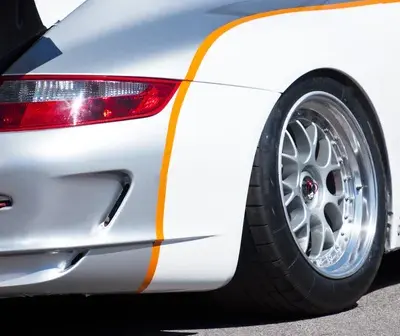
A racing car’s cabin can hit 130 degrees Fahrenheit on a summer day, and there isn’t a single air conditioner in it. Engineers intentionally removed every ounce of cooling capacity from the vehicle.
That one number is worth sitting with, because it explains how racing teams think about heat. If you can’t cool the driver, you cool everything else: the shop, the hauler, the engine bay, the transporter, the house the crew comes home to.
Heat management doesn’t disappear. It moves.
Why the Cockpit Stays Hot on Purpose
Weight is the reason. A modern AC compressor, condenser, evaporator, refrigerant lines, and blower would add pounds no crew chief would sign off on, and pull horsepower the driver would rather keep. So the cabin gets vents, ducted air, a cool suit, and a helmet blower fed by a small chiller in the trunk area. That’s the whole system.
It works because the driver only has to survive three or four hours. Everything else in the sport has to survive a season, and that’s where real HVAC does the heavy lifting.
Keep the 130-degree number in your head. It’s going to show up again…
The Shop Is Where Cooling Actually Matters
Walk into a race shop in July, and the first thing you notice isn’t the cars. It’s the air. Fabrication bays, engine rooms, and body shops all run climate-controlled for a reason, and it isn’t crew comfort (though that matters too). Composite layups, paint, adhesives, and precision measurements all drift with temperature and humidity. A chassis jig that’s dead-on at 68 degrees isn’t dead-on at 92.
So the shop’s rooftop units are doing something the race car refuses to do: hold a stable environment across a long window of time. That’s the trade the sport makes. The car runs hot for a few hours. The building that builds the car stays cool twelve months a year.
How Long the System Under Your Slab Is Supposed to Last
Race teams replace components on a schedule because they know what fatigue looks like. Homeowners rarely do, which is why the question of when to replace catches people off guard. As a rule of thumb, central AC systems last roughly 15 to 20 years before efficiency and reliability start falling off a cliff.
The warning signs are the same ones a crew chief would recognize on a car: longer run times to hit the same target, uneven output across zones, rising energy draw for the same work, and small failures that keep coming back. None of these are catastrophic on their own. Together, they’re telling you something.
If you’re at that decision point in a hot-summer market, a proper load calculation and a professional installation matter more than the brand on the box. An oversized system short-cycles, strips humidity poorly, and wears itself out faster. An undersized one runs constantly and never catches up.
Racing figured this out decades ago: the right part, correctly fitted, beats the biggest part every time.
The Lesson the 130-Degree Number Keeps Teaching
Come back to the cockpit one more time. Motorsports accepts 130 degrees inside the car because it has to, and it makes up for it by controlling temperature everywhere else a race operation touches.
The garages and the transporters. The engine dyno rooms, where a couple of degrees of drift will show up in the numbers. Team hospitality, the driver’s motorhome, the house the crew comes home to on Monday morning.
For the rest of us, the takeaway is smaller but pointed. Heat is a system problem, not a comfort problem.
If your equipment is old, undersized, or limping through summer on borrowed time, the failure isn’t a surprise. It’s a scheduled event you haven’t put on the calendar yet. Racing plans for those. You can too.