Anyone who has watched a steel coil start to walk on a flatbed knows how fast things go wrong. These loads are heavy, round, and unforgiving. One bad bounce or hard brake and the whole thing wants to roll. That is why the gear has to be right from the start. A lot of drivers and small fleets now grab their truck parts online because the local shops do not always keep the heavier coil-specific stuff in stock.
The federal rules for coils over 5,000 pounds are specific. Eye vertical, eye lengthwise, and eye crosswise, each needs a different setup. The one constant is a solid support that keeps the coil up off the trailer deck so it cannot roll. Timbers, chocks, or purpose-built racks all work as long as they stay locked in place the whole trip.
Edge Protection Is Not Optional
Chains and straps hate sharp edges. Run a Grade 70 chain straight across the outer rim of a coil, and you will cut the chain or dig into the steel, sometimes both. Metal corner protectors, rubber-faced cuffs, or the padded ones made just for coils stop that damage. They also keep the tiedown from abrading itself to death. Rubber mats under the racks help too. They add friction so the whole cradle is less likely to slide when you hit the brakes hard.
Racks and How Many Chains You Actually Need
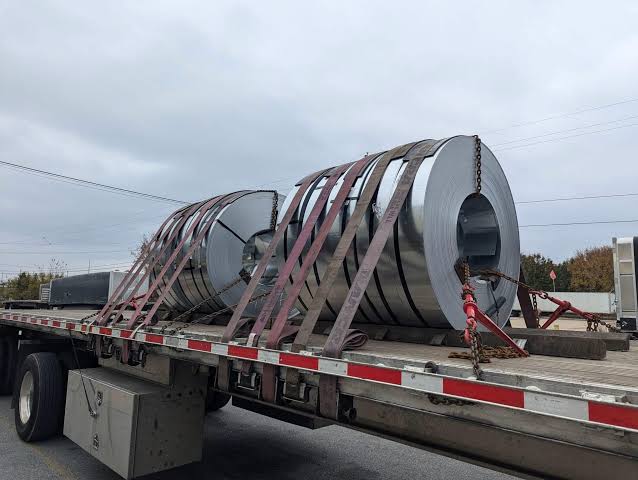
Good coil racks do two jobs at once. They cradle the coil so it cannot roll, and they lift it clear of the deck. They have to be rated for the weight and set so the coil sits centered. Once the racks are in, you start counting chains. The aggregate working load limit has to equal at least half the weight of the coil. A 40,000-pound coil needs 20,000 pounds of capacity from the tiedowns. Most guys who haul steel every day throw on one extra chain past the minimum, and with truck parts online it’s easy to keep a spare chain and binder on hand. The extra margin is cheap insurance when the load is that dense.
Placement follows the eye direction. Crosswise coils get one chain through the eye holding forward and one holding rearward. No X – patterns. Other orientations change the angles, but the goal stays the same: stop tipping and rolling in every direction while keeping metal off bare steel edges. Binders get tightened evenly and checked after the first few miles because everything settles.
The Rule That Still Stands
The Federal Register notice renewing a coil-securement exemption in April 2025 restates the standing rule: a rolling-prevention support that holds the coil off the deck, plus at least one tiedown through the eye against forward motion and one against rearward motion, with X-patterns prohibited. The alternative it approves needs a 2,500-pound carrier bolted down with sixteen Grade 8 bolts, which shows how much hardware it takes to replace the ordinary racks and chains that drivers otherwise have to get right.
That exemption is for one short-haul carrier with a special setup. Everyone else still runs the standard gear. Racks, edge protectors, the right number of Grade 70 chains, and solid binders, all of which you can source through truck parts online. That combination is what keeps the coil where it belongs from the mill to the customer.
What Actually Decides a Good Delivery
Chain condition, how well the protectors fit, and whether the racks are solid are the details that separate a clean drop from a damaged coil or a citation. Replacing worn chains or cracked protectors through truck parts online costs far less than a rejected load. When those pieces are right, the load sits quiet. When they are not, the road finds the weak spot fast.