What the California Lemon Law Covers: Vehicles, Defects, and Consumer Protections
The California lemon law—structured under the landmark Song-Beverly Consumer Warranty Act and further enhanced by the Tanner Consumer Protection Act—serves as one of the most robust consumer protection statutes in the United States. California State Law outlines clear protections for purchasers and lessees of new and certain used vehicles that suffer from repeated defects or malfunctions covered by the manufacturer’s warranty.
Covered Vehicles
California lemon law covers a broad range of motor vehicles:
- Passenger cars, pickup trucks, SUVs, vans sold or leased primarily for personal, family, or household purposes
- Certain vehicles used for business purposes, provided they weigh under 10,000 pounds gross vehicle weight and the business owns five or fewer vehicles in total
- Leased vehicles as well as those purchased through retail sales
- Motor homes (chassis, chassis cab, and drivetrain portions)
- Motorcycles, in specific situations
All covered vehicles must be registered in California under the Vehicle Code, whether new or used (if still under a new vehicle warranty).
Specific Exclusions
Vehicles that are not covered include those primarily for unauthorized use (e.g., off-road), or for commercial uses exceeding weight or ownership thresholds. There are also exclusions for vehicles not subject to an applicable manufacturer’s warranty, and those not registered in California.
Defects and Consumer Protections
Key to the protection under the California lemon law is that the vehicle defect must substantially impair the vehicle’s use, value, or safety. For a warranty dispute to be valid:
- The defect or malfunction must be covered by the original manufacturer’s warranty
- The owner or lessee must afford the manufacturer or its manufacturer’s representative a reasonable number of repair attempts for the same issue
- The defect should not have resulted from abuse or unauthorized alterations as documented in the owner’s manual
If these criteria are met and the problem persists, the law mandates the manufacturer must repurchase or replace your vehicle—a core tenet of the Song-Beverly Consumer Warranty Act.
How to Know If Your Vehicle Qualifies as a Lemon in California
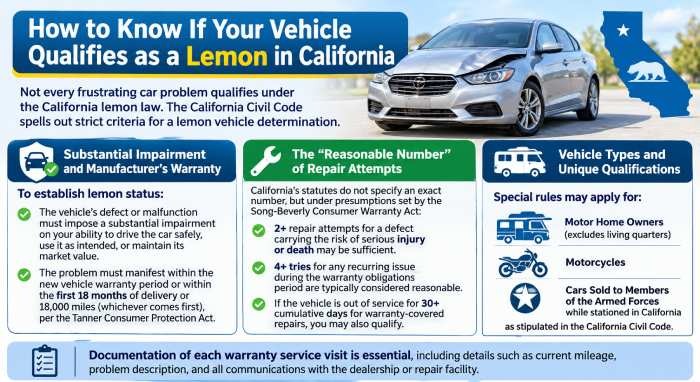
Not every frustrating car problem qualifies under the California lemon law. The California Civil Code spells out strict criteria for a lemon vehicle determination.
Substantial Impairment and Manufacturer’s Warranty
To establish lemon status:
- The vehicle’s defect or malfunction must impose a substantial impairment on your ability to drive the car safely, use it as intended, or maintain its market value
- The problem must manifest within the new vehicle warranty period or within the first 18 months of delivery or 18,000 miles (whichever comes first), per the Tanner Consumer Protection Act
The “Reasonable Number” of Repair Attempts
California’s statutes do not specify an exact number, but under presumptions set by the Song-Beverly Consumer Warranty Act:
- 2+ repair attempts for a defect carrying the risk of serious injury or death may be sufficient
- 4+ tries for any recurring issue during the warranty obligations period are typically considered reasonable
- If the vehicle is out of service for 30+ cumulative days for warranty-covered repairs, you may also qualify
Documentation of each warranty service visit is essential, including details such as current mileage, problem description, and all communications with the dealership or repair facility.
Vehicle Types and Unique Qualifications
Special rules may apply for motor home owners (excludes living quarters), motorcycles, and cars sold to members of the Armed Forces while stationed in California, as stipulated in the California Civil Code.
Your Rights and Remedies: Refunds, Replacements, and Repairs
Owners and lessees have clear consumer rights when their vehicle meets the definition of a lemon under these statutes. The manufacturer must promptly respond with one of the following remedies:
Refund (Manufacturer Repurchase)
- The manufacturer repurchase process entails returning the vehicle to the manufacturer
- The owner or lessee receives a refund of the purchase price (minus a mileage offset for use before the first repair attempt)
- Refund includes down payment, monthly payments, registration fees, and sometimes incidental costs
Replacement Vehicle
- The law allows the consumer to opt for a replacement vehicle of identical or substantially similar make and model
- This is especially relevant for retail purchasers and some lessees
- If a replacement is accepted, the manufacturer covers taxes, transfer fees, and related costs or provides compensation for damages incurred
Additional Remedies
- Reimbursement for reasonable repair by manufacturer, out of pocket expenses, and occasionally legal fees
- Duty for the manufacturer’s representative to promptly effectuate the repurchase or replace process
Under California lemon law, consumers have the right to choose between a refund and a replacement vehicle, and McMillan Law Group helps protect their rights against manufacturers attempting to force an unwanted replacement.
Steps to Take Before Filing a California Lemon Law Claim
Effective assertion of rights begins with organization and following proper procedures, whether you’re an owner, lessee, or a business owner with a qualifying vehicle.
Step 1: Maintain Meticulous Records
- Keep all records of repair attempts, service invoices, communications with the dealership and manufacturer’s representative
- Record VIN (Vehicle Identification Number), make and model, current mileage, and pertinent dates
Step 2: Review the Owner’s Manual and Warranty
- Verify your vehicle’s eligibility under the auto warranty, cross-reference obligations in the owner’s manual
- Ensure the defect occurred within the allowable date/mileage windows outlined under the Tanner Consumer Protection Act
Step 3: Notify the Manufacturer
- Submit a written complaint to the manufacturer, not just the selling dealership
- Request copy of the manufacturer’s final repair attempt notification form if available
Step 4: Explore Alternative Dispute Resolution (ADR)
- Many vehicle brands participate in the BBB AUTO LINE or other mediation and arbitration programs approved by the Department of Motor Vehicles or BBB National Programs
- Dealerships and some warranty providers may require attempted dispute resolution via mediation service or arbitration panel before litigation
When to Contact a Lemon Law Attorney and What to Expect
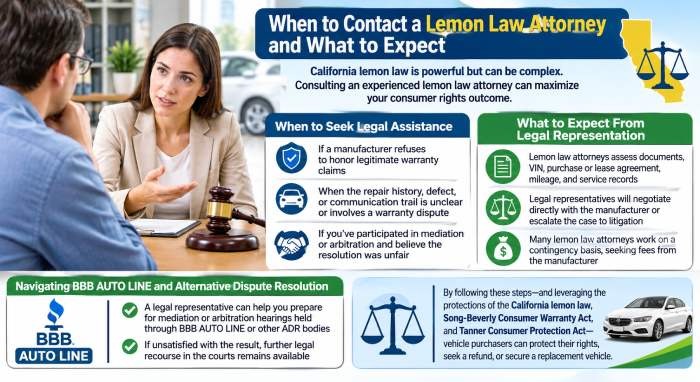
California lemon law is powerful but can be complex, especially in cases involving stubborn manufacturers or ambiguous circumstances. Consulting an experienced lemon law attorney can maximize your consumer rights outcome.
When to Seek Legal Assistance
- If a manufacturer or manufacturer’s representative refuses to honor legitimate warranty claims
- When the repair history, defect, or communication trail is unclear or the case involves potential warranty dispute over repurchase or replace
- If you have participated in mediation or arbitration and believe the resolution was unfair or incomplete
What to Expect From Legal Representation
- Lemon law attorneys assess documents, VIN, purchase or lease agreement, current mileage, and analyze owner’s manual and all service records
- Legal representatives will negotiate directly with the manufacturer or escalate the case to litigation if needed
- Many lemon law attorneys operate on a contingency basis, seeking fees from the automobile manufacturer as part of settlement or court orders
Navigating BBB AUTO LINE and Alternative Dispute Resolution
- A legal representative can help you prepare for mediation or arbitration hearings held through BBB AUTO LINE or other ADR bodies
- If unsatisfied with the result, further legal recourse in the courts remains an available option under the California Civil Code
By following these steps—and leveraging the protections of the California lemon law, Song-Beverly Consumer Warranty Act, and Tanner Consumer Protection Act—vehicle purchasers can protect their rights, seek an appropriate refund, or secure a reliable replacement vehicle when unfairly saddled with a lemon vehicle.