Pit road already did the expensive work. The light is ugly in a useful way. The number is readable. The car is the car that actually rolled. Then the Slack thread asks for a clip before the broadcast comes back from break, and that still gets dropped into a website that promises to “bring photos to life.” Half a minute later the livery has a stripe that never ran, and the wall behind it belongs to a different weekend.
That is not a creativity problem. It is a sequence problem. You do not need a souvenir button. You need the frame to stop lying, the motion to last long enough to be a beat, and — if the show needs a bumper — type that does not fall off the edge of a phone.
Most of the damage is already in the JPEG. A cup on the toolbox. Last intern’s watermark. A banner for a brand that is not paying this round. Animate any of that, and you have animated the mistake. AI inpaint is the unglamorous step: brush only the lie, leave the rest as shot. Lighting should follow the original concrete, not a sticker. Upload the still as JPG, PNG, or WEBP. Keep the mask tight. Two reference pictures if you are swapping a sign and you actually have the replacement. Free passes may watermark; paid exports can come clean. You still need rights to the file, which on a race weekend is not a footnote.
Do this before anything moves. Motion will not hide a logo you meant to delete.
Once the still is boring in the right way, the job is one continuous take, not five eight-second orphans stitched until the door number drifts. Seedance 2.5 is the model for that kit-locked beat: text plus pictures, sometimes a scrap of video or audio, about four to thirty seconds, typically 1080p on a hosted generator — not a 4K poster. You write seconds, not mood. “0–8 the same car from the still; 8–18 a slow push along the same door; 18–24 hold for a caption I will type — no extra crew, no second number.” If the stands speak more than one language, the model can carry dialogue and on-screen text without opening a separate “translator” tab. That is not the same as one-click dubbing a whole recap. Sponsor names still get spelled by a person who has read the contract. If second eighteen grows a different door, the folder is wrong. Fix the kit. Do not prompt harder.
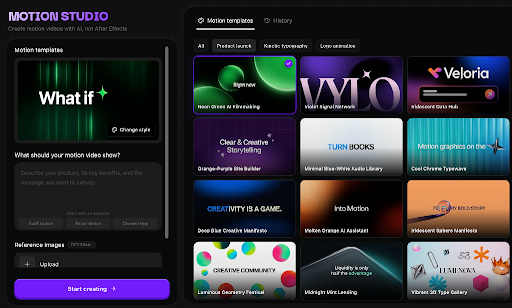
A show open is a different invoice. Nobody is documenting the garage. Somebody needs a few seconds of product and type that will actually play in 9:16, or on a site in 16:9, without cropping the mark off the hat. Motion Studio is that desk: brief, references, style, duration, frame. Length sits around four to sixty seconds. Six ratios cover the usual placements. Photograph the real bottle, the real mark, the real hat — JPG, PNG, or WEBP, about fifteen megabytes each on the current page. It is not After Effects in a browser. It does not hand you a .aep. References guide the look; they do not guarantee the object. Watch the file. The pre-race bumper is not the place you discover a second logo.
None of this is a replay. Generated motion will not call a caution, and it will not replace the photographer who was standing in the oil. If a driver has to say the line, record the driver. Credits are the hour you do not have in an edit bay in the hauler. The free toys that sell photo dance and face swap are built for a different Saturday. This one is for the still you already own, and the twenty seconds the timeline is waiting on.