You are already through immigration when you realize the problem: the phone still has no local data plan. Maybe you forgot to arrange one before the flight, expected airport Wi-Fi to be enough, or only decided after landing that your home carrier’s roaming option was not worth using.
The good news is that arriving at the destination does not automatically make it too late to buy a Travel eSIM. Because an eSIM is delivered digitally rather than collected as a physical card, it can usually still be purchased after arrival.
There is one catch: you need some form of internet access to complete the purchase and download the eSIM profile. That makes the first available Wi-Fi connection the bridge between having no travel data and setting up your own mobile connection.

Yes, You Can Buy After Arrival—But You Need Internet First
Buying an eSIM after landing changes the order of the setup, not the basic requirements.
Your phone still needs to support eSIM, it should be carrier-unlocked, and you need an internet connection while purchasing and installing the profile. Airport Wi-Fi is often the easiest option, but hotel Wi-Fi, a café network, a trusted hotspot from a companion, or temporary access through your existing carrier can also work.
The important point is that the Wi-Fi only needs to get you through the purchase and installation. Once the new eSIM connects to a supported mobile network, it can provide the data connection for the rest of the trip.
This is different from buying a physical local SIM, where you may need to locate a shop, wait for it to open, and collect the card in person.
Where Can You Set It Up After Landing?
The best place is not necessarily the place with the strongest mobile signal. It is the place where you have stable internet and enough time to finish the setup without rushing.
At the Airport
Airport Wi-Fi can be convenient because you can arrange the eSIM before leaving the terminal. This is especially useful if the next step is booking a rideshare, finding a train platform, or navigating to accommodation.
The drawback is that public airport networks can occasionally be slow or require a login page. If the connection is unstable, moving closer to the main terminal area or using another trusted network may be easier than repeatedly restarting the eSIM installation.
At the Hotel or Accommodation
If you can reach the hotel without mobile data, its Wi-Fi may be a calmer place to complete the process. You have more time to check the plan, read the installation instructions, and confirm that the correct line is selected.
The downside is obvious: you still need to get from the airport to the hotel first.
Using Temporary Roaming as a Bridge
Some travelers briefly use their home carrier’s roaming data only long enough to purchase and install the travel eSIM. Whether that makes sense depends on the carrier’s pricing. If roaming triggers an expensive daily charge, airport Wi-Fi is usually the better bridge.
Check the Phone Before You Pay
Landing without a data plan can create pressure to buy quickly, but device compatibility still matters.
Before checkout, confirm:
- the phone supports eSIM;
- the device is carrier-unlocked;
- you are buying coverage for the country you are currently in;
- the plan’s validity and data allowance fit the remaining trip;
- the phone has a stable internet connection for installation.
This check becomes even more important after arrival because you may already need the connection urgently. Buying the wrong plan or discovering a carrier lock after payment only creates another problem.
If the trip includes several countries, do not automatically buy a plan for the current location only. A regional option may make more sense if another border crossing is coming soon.
Why Digital Delivery Matters More When You Are Already Abroad
Once you have landed, speed and simplicity matter more than they did while planning at home. You do not want to create an account, wait for shipping, or search for a physical pickup point when the immediate goal is simply to get online.
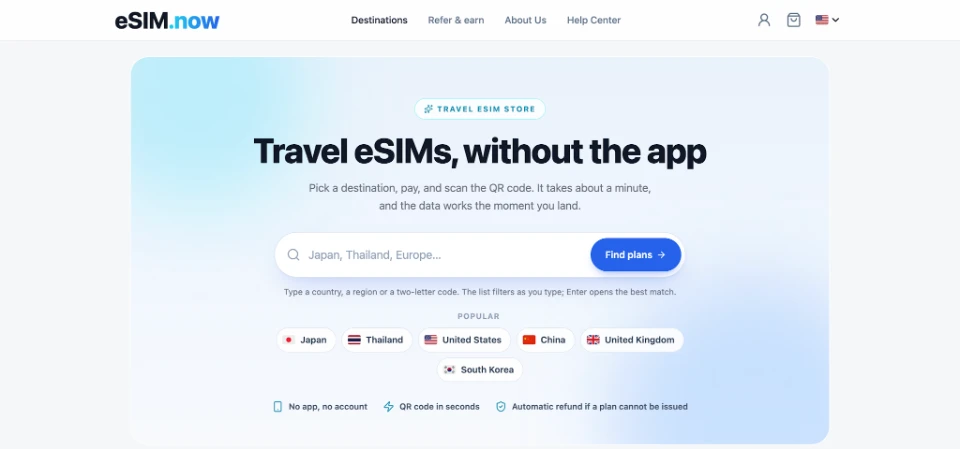
That is where the purchase flow on esim.now is useful for someone who has already arrived. Travelers choose the destination and plan online, complete payment, and receive the QR code on the order page and by email. The site does not require a mandatory app or account simply to receive the eSIM. eSIM.now says QR codes are issued as soon as payment clears.
The plan pages also show the data allowance, validity, service type, network information, hotspot availability, and device-transfer rule before purchase. This means a traveler who is already in the destination can still compare what is needed for the remaining days rather than buying blindly because the trip has already started.
For eSIM.now plans, service is data-only and the traveler’s existing number remains on the primary SIM. The plan normally starts when the installed travel eSIM first connects to a supported destination network. If you buy after arrival, that means the validity period can begin soon after installation and connection, rather than losing days before the purchase.
Do Not Leave the Wi-Fi Zone Until the New Line Works
Buying the plan is not the end of the process. Test it while you still have the connection that helped you install it.
After the profile has been added:
- Turn the travel eSIM line on.
- Select it as the phone’s mobile-data line.
- Enable data roaming on the travel eSIM if the plan instructions require it.
- Temporarily turn Wi-Fi off.
- Open a map or ordinary webpage.
If the page loads, the travel eSIM is carrying data and you can leave the Wi-Fi area with much more confidence.
If it does not work, reconnect to Wi-Fi before changing anything major. Re-read the setup instructions, confirm the correct data line, and avoid deleting the profile as a first troubleshooting step.
That test is particularly valuable at an airport because discovering the problem beside a working Wi-Fi network is much easier than discovering it in a taxi queue outside the terminal.
When Buying After Arrival Makes Perfect Sense
Forgetting to buy beforehand is not the only reason someone might intentionally wait.
You may want to see whether free Wi-Fi is sufficient before paying for mobile data. A business traveler might discover after arrival that hotel Wi-Fi is unreliable. Someone extending a stop unexpectedly may suddenly need local data for several more days. Another traveler may change countries and realize the existing plan does not cover the new destination.
In these situations, digital delivery means the purchase can respond to the trip as it actually unfolds.
The trade-off is that buying after arrival depends on having temporary internet access first. If you know you will need maps, ride-hailing, messages, or tickets immediately after leaving the aircraft, arranging the eSIM before departure is still more convenient.
Buying Late Is Fine; Getting Stranded Offline Is the Real Problem
A travel eSIM does not have to be purchased before the flight. If you have already arrived, you can still buy and install one as long as the phone is compatible, unlocked, and temporarily connected to the internet.
Use airport or hotel Wi-Fi to complete the setup, choose the plan around the days and destinations that remain, and test the cellular connection before walking away from the Wi-Fi.
Buying before departure removes one task from arrival day. Buying afterward is still a practical fallback when plans change—or when you simply forgot. The key is making sure one temporary connection is available long enough to create the mobile connection you will use for the rest of the trip.