Gen.G Mobil 1 Racing and Shopify Rebellion both won their quarterfinal series 4-1 at the same Rocket League event. Gen.G scored 17 goals and conceded 5 across its series. Every game in Shopify’s meeting with FUT Esports was decided by a single goal. The matching series scores described different contests.
BLAST’s report on the opening North American event of the 2026 Rocket League Championship Series, published in December 2025, captures the distinction. Goals describe the scoring inside games; a series result counts games won. Following the tournament requires another piece of information: what that encounter contributes to the competition around it.
For a team matchup, Rocket League odds express prices on possible outcomes; a game scoreboard records goals, and a series tally records games won. Those numbers have different jobs, even when they concern the same opponents. The event’s format establishes which sporting result completes the encounter and what happens afterward.
Goals, game wins, and series length
Gen.G’s result contained two separate counts. The 17-5 total described the combined goals across the games. The 4-1 result described how those games were divided between the teams. Both were accurate accounts of the series, expressed in different units. The goal total supplied detail that the series tally alone could not show.
Shopify’s quarterfinal supplied a different set of goal margins. Its four game wins settled the encounter, but every game had a one-goal margin, including FUT’s win. The overall tally did not preserve that detail. An account concentrating only on games won would therefore leave out the margins within each game.
The reported figures also allow a comparison of the overall goal margins. Gen.G’s 17 goals scored and 5 conceded produced a goal difference of plus 12. Shopify’s four one-goal wins and one one-goal defeat produced a goal difference of plus 3. Both series contained five games, but their scoring margins differed despite the identical division of game wins. For Gen.G, that is 17 minus 5. For Shopify, four margins of plus 1 and one of minus 1 together total plus 3.
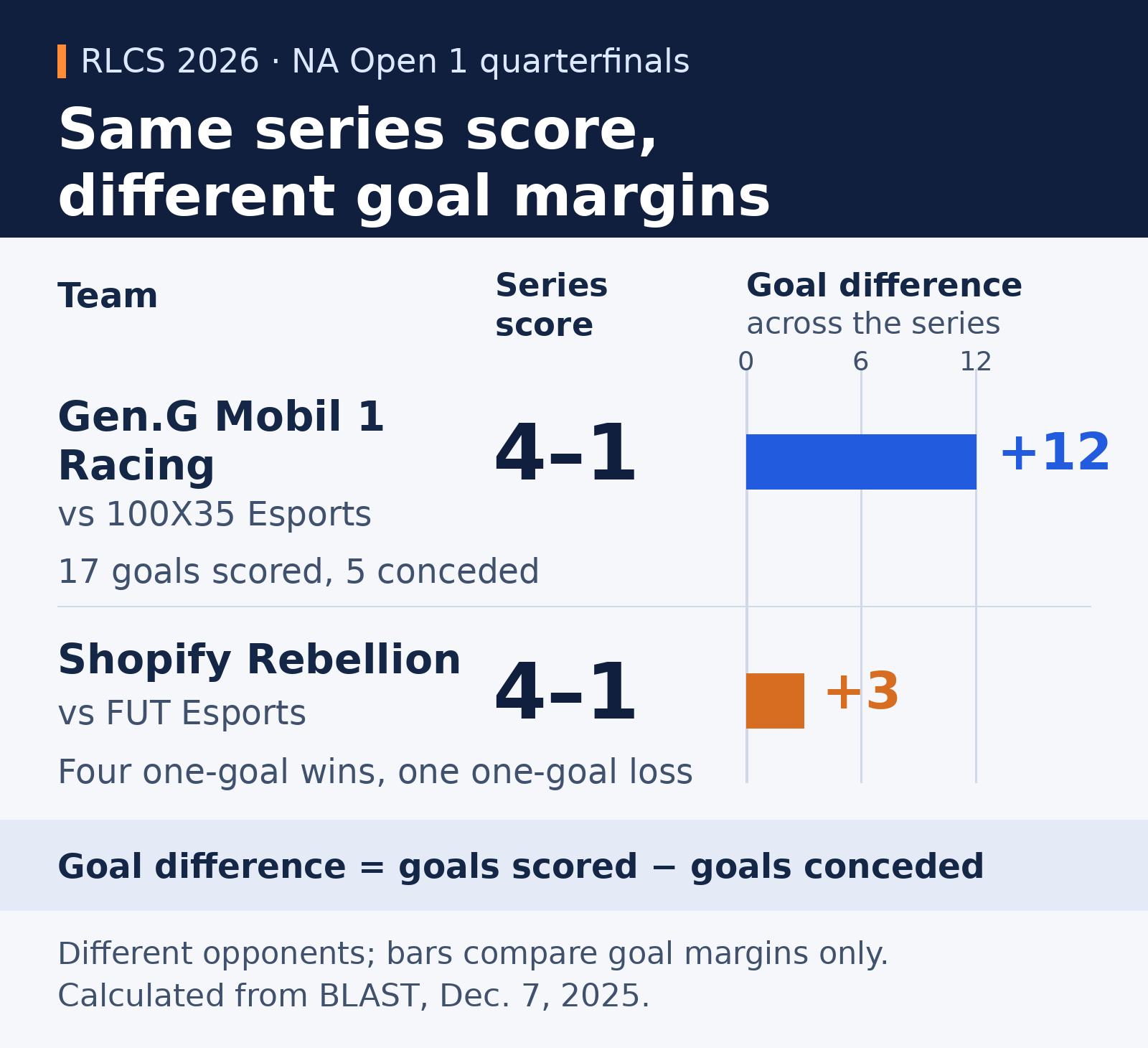
Neither calculation shows how long either team led, when the goals arrived, or which game the losing side won. Each summarizes the final scoring margin across the series. A larger goal difference does not add another game win to the record. It supplies another description of the goals behind the result, while the series tally remains the count that settled the encounter.
Within a series, a game win contributes one win, regardless of its goal margin. Goals decide that individual game, while the series is decided by the required number of game wins. Adding goals across a series describes scoring output; it does not turn the encounter into a single game with one accumulated scoreboard.
The best-of label gives the maximum length of the encounter. A best-of-five series finishes when a side earns its third game win; a best-of-seven finishes at four. A completed series can therefore contain fewer games than the label allows. Its result counts games actually won, not unused games remaining on the schedule.
The 4-1 quarterfinal results also left the order of game wins unspecified. They did not identify which game either opponent won. The final tally alone therefore cannot establish the sequence of a comeback or identify a turning point. That requires the individual game results in their playing order, alongside the final series score.
The round gives a result its context
The North American event also showed why the round belongs beside the score. After its quarterfinal victory, Gen.G lost its semifinal to Spacestation Gaming, 4-3. Spacestation then lost the final to Shopify, 4-0. Each result settled a different encounter in the same tournament.
The final result identified the event winner. The earlier results identified progress through its bracket. A quarterfinal victory and a final victory are both series wins, but their consequences differ because of where they occur. The round label supplies that distinction without changing the way the individual series was scored.
Motorsport followers already encounter a related separation between a race classification and championship standings. A result can be complete at one scale while contributing to a larger competition. In Rocket League, the game, series, and event each need their own context. The event’s published rules also establish whether the title being decided belongs to one tournament or a wider championship.
FIFAe groups allowed a split result
FIFAe’s Nations League was a separate national-team competition. Its published 2026 format specified two-game Rocket League group meetings: three group points for winning both games, zero for losing both, and one each for a split. Knockout meetings used best-of-five.
Best-of-two meant completing two scheduled games, rather than reaching two wins. A drawn meeting described an equal division of game wins, not a tied goal score within either game. In the knockouts, the required third game win instead settled the series.
Qualification points covered a wider campaign
FIFAe’s published format also specified Consistency Points for group-stage and knockout-stage placements across three qualifying weeks. The schedule assigned 80 for first in a group and 120 for a knockout-stage win. Those placement awards differed from the points attached to individual group meetings.
The format provided Continental Championship qualification through the Consistency Points ranking or final-week knockout performance, with direct qualification taking priority. Teams qualifying through both routes left the ranking-based place to the next-highest team in those standings. A single encounter’s result therefore needed the wider qualification record to explain its consequence.