RACE RUNDOWN: Austin Cindric started Saturday night’s Bass Pro Shops Night Race from the eighth position in the No. 2 Menards/Richmond Ford Mustang Dark Horse after qualifying was canceled Friday due to inclement weather and ran around the top five for much of the opening stage. Cindric battled a free-handling condition throughout the early portion of the race and finished Stage 1 in the seventh position. Cindric restarted deeper in the field following service during the stage break and worked his way forward as the handling of the No. 2 Ford shifted toward the tight side firing off. He climbed back to 12th by the end of Stage 2 before the team made additional adjustments to help improve his ability to turn through the corners. A lap down in the final segment, Cindric remained in position for the free pass and returned to the lead lap with 70 laps remaining. Cindric restarted 10th following another trip to pit road and navigated several late-race cautions before taking the checkered flag in the 11th position. He leaves Bristol 11th in the NASCAR Cup Series standings as The Chase continues next weekend at Kansas Speedway.
CINDRIC’S THOUGHTS: “We kind of hurt our own day, but got saved with staying out there with a long run, but we had a pretty decent Menards Ford Mustang, just not able to capitalize. A lot of those cautions at the end got us cycled around on tires and all that. It’s good to salvage some decent points, but I thought we had a bit more today.”
RACE RUNDOWN: Ryan Blaney and the No. 12 Wabash Ford Dark Horse Mustang team led a race-high 202 laps in Saturday night’s Bass Pro Shops Night Race at Bristol Motor Speedway yet will leave with a 33rd-place finish following a late-race incident with Carson Hocevar. Blaney started the race from the 29th position after Friday’s qualifying session was rained out, but crew chief Jonathan Hassler began working his strategy for gain track position early at the Lap 40 competition caution as he kept Blaney on track to restart fourth. Hassler would call Blaney to pit lane on Lap 97 for four tires and fuel, setting the Wabash crew up for a sixth-place finish in the first stage. Blaney restarted from the top spot when the second stage began, the same position in which he would finish at the end of the stage to continue to rack up valuable points. With all of the other lead lap cars electing pit at the end of the stage, Blaney was able to hold the top spot on pit lane with all cars having reset their strategy for the final stage. After briefly losing the lead to Ty Gibbs on Lap 326, Blaney reclaimed the lead during the pit cycle before being called to pit lane on Lap 396. Unfortunately, a yellow flag came out after Blaney had passed the pit lane commitment line but before he actually entered pit lane and Blaney made a swift move back on the racing surface. Since he had committed to pit lane, he was forced to restart at the end of the lead lap cars after eventually making his pit stop. Blaney made his third pit stop of the day on Lap 400 and after restarting in the ninth position, he was able to maneuver his way to second in the running order. Blaney restarted fourth on Lap 50 following another caution period and on Lap 457 Hocevar made contact with the rear bumper of the No. 12 machine, resulting in significant damage that was deemed to much to continue. The finish drops Blaney to sixth in the standings, 52 points behind the leader.
BLANEY’S THOUGHTS: “Really disappointing end to the night for everyone on the No. 12 Wabash team. I thought we had a really strong car and did a great job working our way through the field after starting toward the back. We led a lot of laps and put ourselves in position to have a good finish, so it’s frustrating not to be able to see it through. I’m proud of the effort from everyone on this team, and we’ll move on and get ready for Kansas.”
JOEY LOGANO No. 22 SHELL-PENNZOIL FORD MUSTANG DARK HORSE
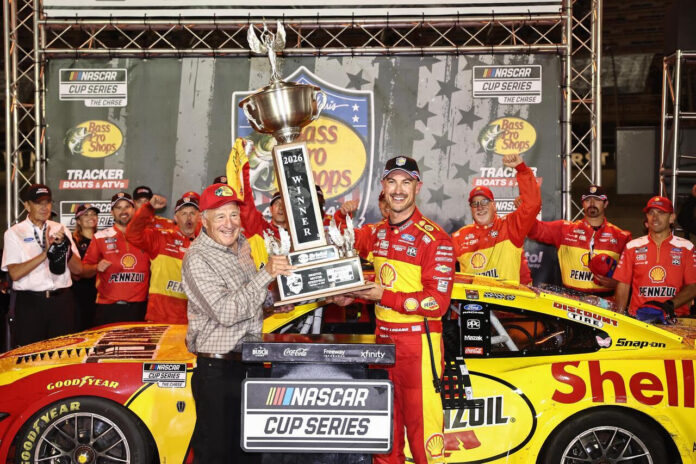
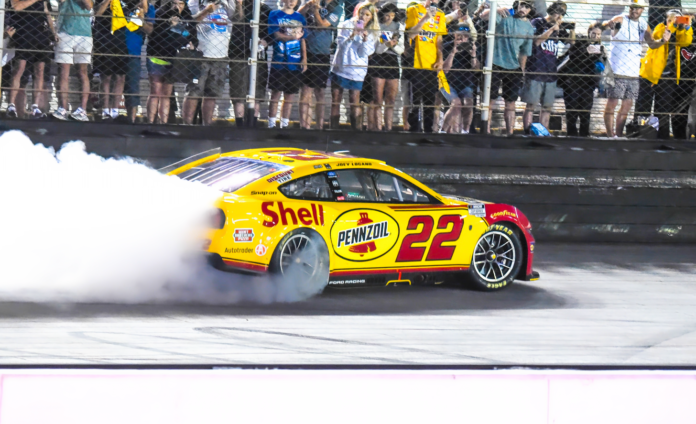
RACE RUNDOWN: In Saturday night’s Bass Pro Shops Night Race at Bristol Motor Speedway, Joey Logano and the No. 22 Shell-Pennzoil Ford Dark Horse Mustang team proved they are one of the best closers in the NASCAR Cup Series garage by charging from the fourth position with nine laps remaining to pick up their third win in the last 10 races. The victory marks Logano’s third win at BMS and the 40th of his championship career, tying him with Mark Martin for 20th on the all-time wins list. After qualifying and practice were rained out on Friday afternoon, Logano began the race from the second position as the lineup was set by the NCS rulebook. Crew chief Paul Wolfe made the call to leave Logano on track at the Lap 40 competition caution and Logano restarted from the lead as he cruised to the win in the first stage. Following his first pit stop of the day under the stage break, Logano took the green flag for the second stage in the 16th position. This was where the speed in the Shell-Pennzoil Ford became evident as he was able to carve his way through the field to finish third in the stage. Throughout the final stage, Logano was a fixture at the front of the field yet unfortunately fell to the fifth position with just 58 laps remaining. However, a final caution on Lap 477 set up a chaotic finish in which Logano was able to drive under the three entries fighting for the lead after they ran up the track with six laps remaining. By taking the checkered flag, Logano is now the winningest NCS driver in Team Penske history with his 38th victory and now sits just 16 points out of the championship lead.
LOGANO’S THOUGHTS: “I love NASCAR racing. This is so much fun and to be a part of it is electric. Being here at Bristol. Hearing the fans scream and yell. What else can you want? … Our cars have been good and have been getting better. Paul has been doing good. Joe’s been awesome. The pit crew has been good. I’ve got a great team. We’ve got a team that knows how to win championships. I thought there for a minute I was like, ‘OK, I might just finish third or fourth here tonight,’ and then they all kind of worked their way up and I was like, ‘Well, Merry Christmas to me.’ I got a gift there. There’s nothing like the Bristol Night Race. This is just the coolest experience as a race car driver being in front of all you fans down here, hearing everyone scream and cheer – sometimes boo, that’s alright. It’s pretty awesome.”
The NASCAR Cup Series Chase for the Championship continues next weekend at Kansas Speedway. Catch coverage of the Hollywood Casino 400 beginning at 3 p.m. ET on USA, MRN, and SiriusXM NASCAR Radio Channel 90.
Location: Bristol Motor Speedway, Bristol, Tennessee
Date: Sunday, September 19, 2026
Start: 32nd
Finish: 6th
With their sixth-place finish in Saturday night’s Bass Pro Shops Night Race at Bristol Motor Speedway, Josh Berry and the No. 21 Wood Brothers Racing team earned their ninth top-10 finish of the season and seventh in the past eight races.
After Friday’s qualifying session was washed out, Berry lined up 32nd in the No. 21 Würth Ford Mustang Dark Horse for the 500-lap race. Starting deep in the field at the fast, half-mile track put Berry in early danger of falling a lap down to the leaders, and he eventually went one lap down during the opening run.
Berry minimized the setback, however, working his way into the free pass position just before the competition caution flew at Lap 40. Back on the lead lap, he steadily worked his way forward and ended Stage 1 in 15th.
The No. 21 team had elected to pit for four fresh tires during a mid-stage caution, allowing Berry to stay on track during the stage break and move up to seventh for the start of Stage 2. From there, Berry continued his charge through the field, racing inside the top five throughout the 125-lap segment before finishing Stage 2 in fourth and collecting seven stage points.
Berry and the Würth team continued to run among the leaders throughout the final segment, maintaining a position inside the top eight despite sustaining minor nose damage while working through lapped traffic. Berry ultimately took the checkered flag in sixth, leading all non-Chase competitors and continuing a strong stretch for the No. 21 team.
“Our car was honestly really strong,” Berry told reporters after the race. “We were pretty tight early and took a swing at it, and then the car was really strong from there.
“I got a little damage coming through lapped traffic. The 42, I was going by him on the outside and the 42 decided to block me instead of running the bottom like the 10 laps before.
“I ran into him and got a little nose damage. I don’t know if that hurt it, but all in all, a good car. I would have loved a top five, but we’ll keep it going next week.”
RFK RACING BRISTOL MOTOR SPEEDWAY – EXECUTIVE SUMMARY Date: September 19, 2026 Series: NASCAR Cup Series Location: Bristol Motor Speedway (1/2 mile high-banked concrete oval) – Bristol, TN Format: 266.5 miles / 500 laps with three stages. Stage 1: Ends at lap 125, Stage 2: Ends at lap 250, Stage 3: Ends at lap 500
RFK Racing RACE SUMMARY: As the NASCAR Cup Series raced in Thunder Valley Saturday night, it was ‘Preece Lightning’ that led the way for Roush Fenway Keselowski (RFK) Racing. Ryan Preece continues proving he is more than a Cinderella Chase driver, putting together another strong top ten finish. Following Preece’s 10th place finish, Chris Buescher fought hard, charging from the 23rd starting position, to finish 13th, collecting stage points (Stage Two) along the way. Brad Keselowski scored stage points in Stage One, as he clawed his way to a 15th place finish.
DRIVER HIGHLIGHTS
Ryan Preece – No. 60 Body Guard by Fastenal Ford Mustang Dark Horse
Finish: 10th Start: 16th Laps Led: — Stage Results: S1-16th, S2-13th Headline takeaway: Preece capitalized on perseverance and opportunity. Despite catcthing a bad break that put him a lap down, Preece continued to fight. Once back on the lead lap, via the ‘Lucky Dog’ free pass, he pounced and gained enough spots to secure a tenth place finish.
Preece Quote: “We didn’t have quite he speed to win but I thought we had a solid race car. The untimely caution kind of caught us off guard and we fought all the way to the very end and we finally got back on the lead lap. So thanks to Derrick (Finley). Thanks to everybody at RFK, Ford, Fastenal, Kroger and all of our partners.”
Chris Buescher – No. 17 Kroger / Kool-Aid / Little Bites Ford Mustang Dark Horse
Finish:13th Start: 23rd Laps Led: — Stage Results: S1-12th, S2-10th Headline takeaway: Highlighted by a 10th place finish in Stage Two, Chris Buescher recorded a solid night in Bristol. He overcame an untimely caution that set him back a lap, to finish 13th.
Buescher Quote: “The day was a little up and down but I would say better than we’ve been here last race. I thought we had a better racecar. That pit cycle trapped us and we just fought that the last 200 laps I felt like so we never quite got it back. If we could have, I think we had a top ten car but we just never got there.”
Brad Keselowski – No. 6 BuildSubmarines.com Ford Mustang Dark Horse
Finish:15th Start: 11th Laps Led: — Stage Results: S1-9th, S2-17th Headline takeaway: The BuildSubmarines.com Ford was on the move early, claiming stage points in the opening segment. As the race wore on a torrid pace was set by the leaders and Keselowski battled to finish 15th.
Keselowski Quote: “We just weren’t fast enough tonight. We need to be better.”
Point Standings:
Preece: 14th Buescher:15th Keselowski:18th
Next Up:
The next event on the NASCAR Cup Series schedule is September 27 at Kansas Speedway (1.5 Mile D-shaped oval – Kansas City, KS). The race begins at 3:00 p.m. EDT with live coverage provided by USA Sports and the Motor Racing Network.
About RFK Racing
RFK Racing, in its 39th season in 2026, features an ownership lineup pairing one of the sport’s most iconic names, Jack Roush, along with NASCAR Champion, Brad Keselowski, and Fenway Sports Group owner John Henry. Roush initially founded the team in 1988 and it has since become one of the most successful racing operations in the world, propelling him to be the first NASCAR owner to amass three hundred wins and capturing eight championships, including back-to-back NASCAR Cup titles in 2003 and 2004. Keselowski, a former owner in the NASCAR Truck Series, is the 2012 NASCAR Cup Series Champion. In 2007, Roush partnered with Henry, who also owns Major League Baseball’s Boston Red Sox, English Premier League’s Liverpool F.C., and the NHL’s Pittsburgh Penguins, to form Roush Fenway Racing. Off the track, RFK is a leader and proven winner in NASCAR marketing solutions, having produced multiple award-winning social media, digital content and experiential marketing campaigns. Visit https://www.rfkracing.com/ and follow the team on all social platforms @rfkracing.
Ford Racing Notes and Quotes NASCAR Cup Series Bristol Night Race — Bristol Motor Speedway Saturday, September 19, 2026
JOEY LOGANO KEEPS MUSTANG ROLLING WITH THIRD WIN OF 2026
Joey Logano won his third race of 2026 today, which is the eighth time in his career he has won at least three races in a season.
Ford has won four of the last six Cup races and six of the last 10: Joey Logano (3) , Ryan Blaney (2) and Ryan Preece (1).
The win is Logano’s 40th of his Cup Series career and 38th with Ford.
Those 38 wins put him third on the all-time Ford win list.
Team Penske has now won 113 times in the Cup series with Ford.
Today’s win is Ford’s 755th all-time in NASCAR Cup Series competition.
JOEY LOGANO, No. 22 Shell/Pennzoil Ford Mustang Dark Horse – VICTORY LANE INTERVIEWS – HOW DID YOU GET TO VICTORY LANE? “I love NASCAR racing. This is so much frickin’ fun and to watch to be a part of it is electric. Being here at Bristol. Hearing the fans scream and yell. What else can you want?” YOU WANTED TO MAKE A STATEMENT, SO HOW MEANINGFUL IS IT TO WIN? “It’s huge. We’re in the hunt now. We’re right where we need to be. We had a solid run last week and capitalized again with huge points again tonight, so we’re there.” HAVE THE SEAS EVER PARTED LIKE THAT FOR YOU? “Come on, Bristol. I hear you down here. That was awesome. We had a good race car. Team Penske put together a great car. We led the first stage there and you know it’s gonna get aggressive there at the end and we were in the right place at the right time.” THE BOOS ARE COMING DOWN. “That’s alright. There are a lot of 22 guys out there, too. For the haters, baby.” YOU SAID COMING INTO THE WEEKEND THAT YOU JUST HAD TO GET 20 POINTS BACK. YOU ARE NOW 16. DID YOU IMAGINE THIS RUN FROM THE 22 TEAM? “I did. Our cars have been good and have been getting better. Paul has been doing good. Joe’s been awesome. The pit crew has been good. I’ve got a great team. We’ve got a team that knows how to win championships. I thought there for a minute I was like, ‘OK, I might just finish third or fourth here tonight,’ and then they all kind of worked their way up and I was like, ‘Well, Merry Christmas to me.’ I got a gift there. There’s nothing like the Bristol Night Race. This is just the coolest experience as a race car driver being in front of all you fans down here, hearing everyone scream and cheer – sometimes boo, that’s alright. It’s pretty awesome.”
Ford Unofficial Finishing Results:
1st – Joey Logano
6th – Josh Berry
10th – Ryan Preece
11th – Austin Cindric
13th – Chris Buescher
15th – Brad Keselowski
16th – Noah Gragson
19th – Todd Gilliland
28th – Zane Smith
33rd – Ryan Blaney
37th – Josh Bilicki
RYAN BLANEY, No. 12 WABASH Ford Mustang Dark Horse – WHAT DID YOU SEE THERE? “We got crashed.” IS THERE ANYTHING YOU COULD HAVE DONE? “I don’t know. Understand who was beneath me, I guess. I mean, I protected. I protected pretty early and he just kept coming left and never lifted and crashed me.” ANOTHER INCIDENT WITH THE 77. ARE YOU GOING TO SAY SOMETHING TO HIM? “Yes. Something is gonna happen.” ARE YOU GOING TO TALK TO HIM TONIGHT? “Yeah, probably.” WHAT’S GOING TO HAPPEN? “I don’t know yet.” WAS YOUR CAR HAMPERED BY NOT BEING ABLE TO RUN THE OUTSIDE AS GOOD AS THE INSIDE? “It probably preferred the bottom. The top was kind of a crush and not as good as I wanted to be up there, but we were still making it work, but I never got to finish the race.” DID YOU FEEL THE CONTACT CAME AS YOU WERE PROTECTING OR AFTER? “I have no idea. I just felt like he didn’t lift. I left him plenty of room for a lap before that. I didn’t chop him. I didn’t run him into the fence or nothing like I easily could have. I protected the bottom and he just decided he wanted to be there and didn’t lift and wrecked me.” HAS IT GONE ON TOO LONG? “Yeah. I haven’t had a problem with him for probably a year and a half, but it’s getting old.” WHAT HAPPENED WHEN THE CAUTION CAME OUT? “We were committed and then I got told to go back on the racetrack and it was a knee-jerk reaction. I did it and I shouldn’t have done it.”
JOSH BERRY, No. 21 WURTH Ford Mustang Dark Horse – ARE YOU SURPRISED ABOUT THE POST-RACE INCIDENT WITH BLANEY AND HOCEVAR? “I didn’t really see exactly what happened, but I don’t think that’s gonna be the last time that happens.” IS THAT A LONG TIME COMING? “Yeah, I would say so. I didn’t really see the accident to see what actually caused it, but it was a long time coming.” ANOTHER REALLY GOOD RACE FOR YOU GUYS. “Our car was honestly really strong. We were pretty tight early and took a swing at it and then the car was really strong from there on. I got a little damage coming through the lap traffic. I haven’t looked at it yet. The 42, I was going by him on the outside and the 42 decided to block me, instead of running the bottom like the 10 laps before. I ran into him and got a little nose damage. I don’t know if that hurt it, but, all in all, a good car. I would have loved a top five, but we’ll keep it going next week.”
RYAN PREECE, No. 60 Body Guard by Fastenal Ford Mustang Dark Horse – “I thought we maximized our day. An untimely caution almost locked us, but P10.”
AUSTIN CINDRIC, No. 2 Menards/Richmond Ford Mustang Dark Horse – “We kind of hurt our own day, but got saved with staying out there with a long run, but we had a pretty decent Menards Ford Mustang, just not able to capitalize. A lot of those cautions at the end got us cycled around on tires and all that. It’s good to salvage some decent points, but I thought we had a bit more today.”
GIBBS BATTLES FOR WIN AT BRISTOL Denny Hamlin, Christopher Bell continue to be a part of close championship battle
BRISTOL, Tenn. (September 19, 2026) – Ty Gibbs battled for the win late in a wild finish at Bristol Motor Speedway before finishing fifth in the NASCAR Cup Series race on Saturday evening. Christopher Bell was the top Toyota finisher in fourth.
Bell and Denny Hamlin continue to be a part of a fierce battle with Kyle Larson and Joey Logano for the championship points lead as the four drivers are separated by a total of 17 points with seven races remaining.
TOYOTA RACING Post-Race Recap NASCAR Cup Series (NCS) Bristol Motor Speedway Race 29 of 36 – 266.5 miles, 500 laps
TOYOTA FINISHING POSITIONS
1st, Joey Logano*
2nd, Kyle Larson*
3rd, Carson Hocevar*
4th, CHRISTOPHER BELL
5th, TY GIBBS
7th, BUBBA WALLACE
8th, DENNY HAMLIN
18th, TYLER REDDICK
25th, JOHN HUNTER NEMECHEK
27th, CHASE BRISCOE
32nd, ERIK JONES
34th, RILEY HERBST
*non-Toyota driver
TOYOTA QUOTES
CHRISTOPHER BELL, No. 20 DEWALT Toyota Camry XSE, Joe Gibbs Racing
Finishing Position: 4th
Can you take us through your race tonight?
“Yeah, I don’t know. It was close, but just in the Spring, I was able to pass everybody – tonight I wasn’t. When I had the track position, I could maintain it, but wasn’t good enough to drive up there and take the lead. Overall, it was a good day to keep us in the hunt for our DEWALT Toyota team. Whoever is the champion is going to have to be great. We are very much alive.”
TY GIBBS, No. 54 M&M’s Kyle Busch Tribute Toyota Camry XSE, Joe Gibbs Racing
Finishing Position: 5th
What happened with the 48 and with the end of the race?
“I don’t know. It just sucks. The M&M’s Camry was a fun time tonight. I just tried to stay up too high in (turns) one and two, and tried to block the 77 (Carson Hocevar) from getting a run – and the 5 (Kyle Larson) snuck in there and got us all bottled up. Just unfortunate, but we will keep going.”
BUBBA WALLACE, No. 23 OUTLAW LIGHT Toyota Camry XSE, 23XI Racing
Finishing Position: 7th
Not bad tonight. How was your race?
“Just kind of ran our own race. Had a couple of close calls, but for the most part our OUTLAW LIGHT Toyota team did a good job all night. We were seventh to 10th when we come here and we were on the front side of that tonight, so we are making improvements. I really appreciate the work on the short track program. Just wanted more. I started licking my chops there at the end, but just a little bit too far back. All-in-all, pretty good. Excited for the next three weeks, mile-and-a-halves. Toyotas are super strong, and get some separation and get away from the hornets’ nest that I feel like we’ve been in for the last month or so, and get some Toyotas back on top and back in victory lane.”
DENNY HAMLIN, No. 11 National Debt Relief Toyota Camry XSE, Joe Gibbs Racing
Finishing Position: 8th
You leave Bristol one point out of the championship lead. How would you assess your race?
“We just have to get to running a little bit better. Today, I thought early on – in the first stage – I really liked my National Debt Relief Toyota. I thought we had a car that would contend for the win, and then second stage, when we took the stage points in stage one that put us to the back, and once we lost track position, it just wasn’t quite as good. I think the track changed on us as well. Then we got caught by that caution, so that was unfortunate. It is the way it is, but we move on.”
TYLER REDDICK, No. 45 SiriusXM Toyota Camry XSE, 23XI Racing
Finishing Position: 18th
What was going on with your race car today?
“Yeah, that is a good question. Our SiriusXM Camry didn’t drive bad, we were just one of the slowest cars on the race track. It is unacceptable any time of year, but especially in the Chase and after a tough day in Gateway. Just off where we need to be currently.”
About Toyota
Toyota (NYSE:TM) has been a part of the cultural fabric in North America for nearly 70 years, and is committed to advancing sustainable, next-generation mobility through our Toyota and Lexus brands, plus our more than 1,800 dealerships.
Toyota directly employs nearly 64,000 people in North America who have contributed to the design, engineering, and assembly of over 50 million cars and trucks at our 14 manufacturing plants. In 2025, Toyota’s plant in North Carolina began to assemble automotive batteries for electrified vehicles.
NASCAR Cup Series Bristol Motor Speedway Bass Pro Shops Night Race Team Chevy Post-Race Report September 19, 2026
Larson Earns the Points Lead After Runner-Up Finish at Bristol Motor Speedway
In his quest for the championship title, Kyle Larson and the No. 5 Hendrick Motorsports Chevrolet team came just short of making back-to-back trips to victory lane. With a late-race pit call by crew chief, Cliff Daniels, to stay out, prime track position put the California native back in race-winning contention before coming home with a runner-up finish in the Bass Pro Shops Night Race at Bristol Motor Speedway. The result, Larson’s ninth top-five finish in his past nine starts at the famed half-mile, was enough to put the Team Chevy driver at the top of the Chase standings with an one-point lead over Denny Hamlin. Three Team Chevy Chase contenders earned top-10 results, with Carson Hocevar earning his career-best Bristol finish of third, with William Byron coming home with a ninth-place finish.
RACE RECAP:
Stage One:
Sitting on the pole position, last week’s winner, Kyle Larson, led the NASCAR Cup Series to the green flag for the Bass Pro Shops Night Race at Bristol Motor Speedway. With weather forcing the cancellation of the series’ on-track action on Friday, the field was racing to a competition caution that was set to fly around the 40-lap marker. For a caution-free run to start the race, it was the No. 5 Chevrolet that paced way – making quick work around the famed half-mile to reach lap traffic in just 20 laps. Under the competition caution, five cars opted to stay out, with Larson ultimately exiting pit road as the first car on a four-tire strategy with a spot in the sixth position for the restart. The second run proved the importance of track position as those that opted to stay out were able to maintain their track position. Settled in the fifth position for much of the run, the first natural caution of the day flew with 30 laps to go in the stage for a spinning Erik Jones. With a split pit strategy among the leaders, Larson was among those that opted to stay out to restart third. The reigning champion quickly went to work on the lead, finding the second position and keeping then race leader, Joey Logano, just within reach as they approached the first green-white checkered flag. Larson collected nine points, leading Chevrolet to three top-10 finishers in the opening stage.
Stage Two:
The stage break opened up the opportunity for varying pit strategies once again. While on a four-tire strategy, the No. 5 pit crew got their driver off pit road first but landed in the 15th position for the start of Stage Two. On the opposite strategy than his teammate, William Byron and the Rudy Fugle-led team cycled up into the second position to lead the Bowtie brigade to the green flag after choosing to forgo a trip to pit road. Within early laps of the stage, Byron reported that he was battling a loose-handling car in both entry and exit of the corner. Despite the ill-handling conditions, the North Carolina native held on to a running position within the top-eight throughout entirety of the stage. Fellow Chase contender, Carson Hocevar, was the second-highest mover in the stage, driving his No. 77 Chevrolet to a 16-position gain to earn a seventh-place finish and lead Team Chevy to the end of Stage Two.
Final Stage:
With a four-tire call by crew chief Luke Lambert under the stage break, an one-position gain in the race off pit road put Hocevar in the sixth position to take the green flag for 239 laps to go in the race. The opening lap of the final stage saw Hocevar already make an appearance back in the top-five, settling into the position as the race entered another long green flag run. While quickly having to start maneuvering through lap traffic, Hocevar was able to maintain the fifth position and sat at an eight-second margin to the leader as a green flag pit cycle got underway with 120 laps to go. Hocevar made his way up into the second position during the cycle and just as Lambert called Hocevar to pit road, a caution for Riley Herbst saw Hocevar and then race leader, Ryan Blaney, as the only lead lap cars that had yet to make their stops. With Blaney facing a commitment line violation for his attempt to hit pit road as the caution flew, it was Hocevar that inherited the lead for the first time of the evening. While in a tight battle for the lead with Ty Gibbs, a three-wide move in lap traffic saw the caution fall with 69 laps to go. While Gibbs opted not to pit, Lambert called his driver to pit road for a pair of right-side tires. The fresh tires paid early dividends as the Michigan native quickly made his way back up into the second position to challenge for the lead. But it was a call by Daniels to stay out that put Larson back in race winning contention once again, with the No. 5 team making the pass for second on the final lap to lead Team Chevy to the checkered flag.
Team Chevy Unofficial Top-10 Results
Pos. Driver
2nd – Kyle Larson
3rd – Carson Hocevar
9th – William Byron
Chevrolet’s season statistics with 29 NASCAR Cup Series races complete:
Wins: 7
Poles: 6
Top-Fives: 50
Top 10s: 98
Stage Wins: 19
The 2026 NASCAR Cup Series Chase will continue at Kansas Speedway with the Hollywood Casino 400 on Sunday, September 27, at 3 p.m. ET. Live coverage can be found on the USA Network, PRN and SiriusXM NASCAR Radio Channel 90.
Post-Race Driver Quotes:
Austin Dillon, No. 3 Richard Childress Racing Chevrolet
Finished: 17th
“Long night for the No. 3 Bass Pro Shops/Winchester Patriotic Chevrolet team at Bristol Motor Speedway. We started ninth and we held our own to start the race but ultimately struggled with handling issues. We worked on the balance of the car throughout the race, but couldn’t get it right. I couldn’t run the top and just lacked grip overall, and our Chevrolet just landed bad. We started tight then swung sideways loose. We’ll take what we can from this one and turn our focus to Kansas.”
Kyle Larson, No. 5 Hendrick Motorsports Chevrolet
Finished: 2nd
“It was just a good fight all around for the No. 5 HENDRICKCARS.COM Chevrolet team. I don’t think we were a top-five car, but we did a great night executing tonight and that’s what it takes. We didn’t have the best car tonight, but we still came home with a top-two finish. We weren’t too hot there in the second stage, and really the majority of the final stage, but I’m proud of the pit call and the fight we had to hang on there. We got good stage points early, so we’ll take it and try to have more days like today. I’m happy with the effort, and we’ll go to Kansas (Speedway) and continue to go to work.”
Austin Hill, No. 33 Richard Childress Racing Chevrolet
Finished: 29th
“Not a great night for our Rebel Bourbon team. Our Chevrolet was really tight rolling across the center and couldn’t get pointed for the exit. As the race went on, the whole car was light on entry and not in the track. It felt like the car wasn’t connected in all three sections of the corner – entry, center and exit. The car would snap loose on exit which stopped me from throttling down hard. We pitted every time we could to try and learn something from the race. Onto Kansas next week.”
Carson Hocevar, No. 77 Spire Motorsports Chevrolet
Finished: 3rd
From your perspective, was there anything you needed to do differently on that move on the race track?
“No, I didn’t think so. I thought we were racing fine. I went to cross them over just to try to get to the bottom, and I thought it was going to work out fine. You just can’t turn left. I mean, I was full on the brakes, but you can’t really stop with that big of steam.”
About General Motors
General Motors (NYSE:GM) is driving the future of transportation, leveraging advanced technology to build safer, smarter, and lower emission cars, trucks, and SUVs. GM’s Buick, Cadillac, Chevrolet, and GMC brands offer a broad portfolio of innovative gasoline-powered vehicles and the industry’s widest range of EVs, as we move to an all-electric future.
GM Motorsports, including the Cadillac Formula 1® Team develops and proves advanced technologies in the most demanding environments, accelerating innovation in performance, safety, efficiency, and electrification for its production vehicles. Cadillac Racing is one of the leading manufacturers in the IMSA and FIA World Endurance Championships (WEC). Chevrolet competes in single seaters in the US IndyCar series, and in NASCAR with multiple team partners and drivers. Corvette customer teams compete in GT series across the globe including IMSA and WEC. Learn more at GM.com.
BRISTOL, Tenn. (Sept. 20, 2026) – When Ty Gibbs finally ran out of magic, Joey Logano took full advantage.
Thanks to a dramatic pass through a gaggle of traffic on Lap 494 of 500, Logano stole a victory in Saturday’s Bass Pro Shops Night Race at Bristol Motor Speedway and moved close to the lead in the NASCAR Cup Series Chase Presented by Mobil 1.
As Logano celebrated on the frontstretch, his Team Penske teammate, Ryan Blaney, traded punches with Carson Hocevar on pit road. Moments after taking second place from the Spire Motorsports driver, Blaney wrecked off Hocevar’s front bumper on Lap 458, leading to an aggressive confrontation after the race.
The victory was Logano’s third at the 0.533-mile concrete track, fourth at Bristol including his 2022 Food City Dirt Race win, his third of the season and the 40th of his career, tying him with NASCAR Hall of Famer Mark Martin for 20th all-time.
The three-time Cup Series champion climbed four positions to third in the Chase standings, 16 points behind race runner-up Kyle Larson, who took over the series lead by one point over top-seeded Denny Hamlin, Saturday night’s eighth-place finisher.
As Hocevar and Gibbs raced side-by-side for the lead after the final restart—with Larson immediately behind Hocevar in the top lane—Logano rolled the bottom past the trio of cars and moved up the track with the lead. As Gibbs faded to fifth, Larson moved into second place.
After climbing from his No. 22 Ford on the frontstretch, Logano was greeted with a chorus of boos by the same partisans who had waved yellow M&M’s hand towels honoring Busch (distributed by the track) when Gibbs was out front.
“I’ve got a great team,” said Logano, who led twice for 93 laps. “We’ve got a team that knows how to win championships. I thought there for a minute, I was like, ‘OK, I might just finish third or fourth here tonight,’ but (we) kind of worked our way up, and I was like, ‘Well, Merry Christmas to me. I got a gift there.’
“There is nothing like the Bristol Night Race, man. This is just the coolest experience as a race car driver, being in front of all you fans down here, hearing everyone screaming, cheering, sometimes booing. That’s all right. It’s pretty awesome.”
In arguably the fastest car, Gibbs ran an exceptional race in a Toyota featuring a throwback M&M’s point scheme honoring the late Kyle Busch. Gibbs led 120 laps and appeared victory-bound until he succumbed to relentless pressure from Hocevar (who finished third) and Logano, who came from fourth on the final restart to win the race.
Ostensibly channeling some of Busch’s prowess and good fortune at a track where the driver nicknamed “Rowdy” won nine Cup Series races, Gibbs survived a three-wide accident at the start/finish line immediately after passing Hocevar for the lead on Lap 432.
Busch tried to split the middle between the cars of Alex Bowman and Cole Custer, but Bowman moved up the track, sandwiching Gibbs’ Toyota between the two cars. Miraculously, despite contact from both sides—enough to put Bowman out of the race—Gibbs was able to continue and maintain the speed he showed before the wreck.
“It was an honor to drive the M&M’s Camry and it was something I’ll never forget,” Gibbs said. “That was such a fun race. Unfortunate that we lost it. I just tried to stay up a little bit too long in (Turns) 1 and 2 that shut the 77 (Hocevar) off, and then the 5 (Larson) got in there, and we just missed it a little bit.
“But I had a blast tonight, and it was so much fun. We’ll just keep working hard and keep getting better.”
Blaney led a race-high 202 laps and regained track position after a commitment line penalty caused by an inopportune caution on Laps 397 near the end of a cycle of green-flag pit stops.
After passing Hocevar for the second on Lap 457, he moved down the track to block Hocevar’s line. Hocevar didn’t lift and knocked Blaney into the outside wall in Turn 1. Blaney’s Ford was damaged too extensively to continue, and he exited race in 33rd place, dropping three positions to sixth in the Chase standings, 52 points out of the lead.
On pit road after the race, Blaney approached Hocevar aggressively with a hand to Hocevar’s shoulder. The Spire driver landed two punches in return. After the second blow, Blaney lost his balance and fell backwards. He got to his feet and landed a left hand to Hocevar’s face before officials and crew members pulled them apart.
“I just felt like he didn’t lift,” Blaney said of the wreck. “I left him plenty of room for a lap before that. I didn’t chop him. I didn’t run him into the fence or nothing like I easily could have. I protected the bottom, and he just decided he wanted to be there and didn’t lift and wrecked me.”
Hocevar seemed all but nonchalant after the fight.
“There wasn’t a whole lot of talking,” he said. “He just kind of said one thing and then went after me, and I wasn’t going to take it.
“I mean, that was fun with the 54 (Gibbs). I got ran into a lot for the win. I mean, that was for second and he wants to come fight… They got an old-school Bristol show here.”
Christopher Bell finished an unassuming and non-controversial fourth on Saturday and leaves Thunder Valley fourth in the standings, 17 points behind Larson, the only driver to have scored top fives (fifth, first and second) in all three Chase races so far.
“Yeah, I mean, it’s good,” Larson said. “It’s good. But there’s still so much racing left. Just got to keep having good, consistent days. It’s three top fives to open the Chase and looks like leading the points now by just a point.
“But we’re going to some good tracks for us but also good tracks for the Toyotas—Vegas and Kansas, Charlotte. It could easily change a lot here in the upcoming weeks. But we’ve just got to be ready for anything and keep plugging away.”
Josh Berry finished sixth, the only non-Chase driver in the top 11. Bubba Wallace, Hamlin, William Byron and Ryan Preece completed the top 10.
Kansas Speedway is next on the Chase schedule with the Sept. 27 Hollywood Casino 400 (3 p.m. ET on USA Network, MRN and SiriusXM NASCAR Radio).
-Story by NASCAR Newswire
NASCAR Cup Series Race – Bass Pro Shops Night Race Bristol Motor Speedway Bristol, Tennessee Saturday, September 19, 2026
Leaders Summary (Driver, Times Lead, Laps Led): Ryan Blaney (C) 3 times for 202 laps; Ty Gibbs (C) 3 times for 120 laps; Joey Logano (C) 2 times for 93 laps; Kyle Larson (C) 2 times for 45 laps; Carson Hocevar (C) 3 times for 39 laps; Christopher Bell (C) 1 time for 1 lap.
Classic four-wheel-drive trucks occupy a unique and revered place in the automotive universe. Unlike exotic supercars that demand mirror-smooth tarmac and climate-controlled storage, iconic vintage 4x4s were designed from inception to conquer the wild, traverse unforgiving terrain, and endure decades of relentless abuse. Among these legends, the Toyota Land Cruiser stands as the undisputed benchmark of global overland endurance. From the deserts of the Middle East to the rugged Australian Outback and the remote mountain trails of the American West, its boxy silhouette, stamped-steel front grille, and round headlights evoke an adventurous era of pure analog motoring.
However, anyone who has driven an original, unrestored 1970s or 1980s Land Cruiser on modern high-speed highways knows the harsh mechanical reality: screaming high-RPM engines struggling to maintain 60 mph, heavy unassisted recirculating-ball steering that fights every rut in the asphalt, four-wheel drum brakes that require immense leg effort, and sweltering summer heat inside an uninsulated steel cabin.
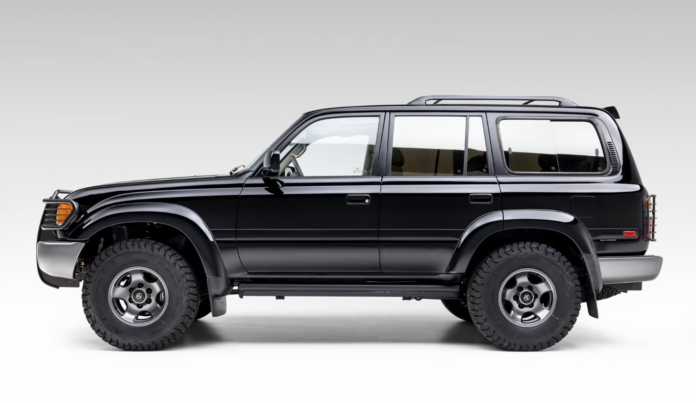
This reality has catalyzed the rise of the modern toyota land cruiser restomod—an elite movement in custom automotive craftsmanship that seamlessly marries the timeless soul and rugged aesthetic of classic vintage sheet metal with modern horsepower, refined chassis dynamics, and luxurious everyday drivability.
What Exactly Is a Restomod?
The term “restomod” combines restoration and modification. Unlike a strictly original museum-grade preservation where every single nut, bolt, and gasket must match assembly-line factory specifications, a restomod selectively updates key mechanical, electrical, and safety systems while celebrating the vehicle’s authentic historical personality.
In the world of vintage Land Cruisers, a restomod does not dilute or compromise the truck’s iconic character; it liberates it. It transforms a vehicle that was once restricted to slow, low-speed weekend backroad trips into an all-weather machine capable of cruising comfortably at 80 mph on interstate highways with ice-cold air conditioning, handling mountain twisties with composure, and tackling technical off-road trails with push-button ease.
The Heart of the Machine: Modern V8 Powertrain Conversions
The factory Toyota 2F and 3F inline-six engines are legendary for their longevity and tractor-like reliability, but they are heavy, low-revving, and fuel-thirsty powerplants that produce modest horsepower (roughly 125 to 135 hp). For modern drivers attempting to merge into fast-moving highway traffic or ascend high-altitude mountain passes with camping gear, upgrading the engine is the single most transformative aspect of a restomod build.
1. General Motors LS3 & L83 V8 Conversions
The modern gold standard for Land Cruiser restomods is the fuel-injected GM small-block V8 platform:
Proven Reliability & Global Parts Sourcing: Whether traveling through remote desert towns or cruising through suburban corridors, GM powertrain parts and diagnostic tools are readily accessible anywhere in North America.
Effortless Power Delivery: A modern Gen-IV LS3 (6.2L) or Gen-V L83 (5.3L) produces between 355 to over 430 horsepower and massive low-end torque across the RPM band. This translates into smooth, linear acceleration, instantaneous throttle response, and robust towing capability.
Favorable Weight Distribution: Modern aluminum-block V8s actually weigh less than the massive cast-iron Toyota inline-six engines they replace. This noticeable weight reduction lightens the front axle, dramatically improving steering turn-in response and overall handling agility.
2. Modern Electronic Overdrive Transmissions
Original 3-speed and 4-speed manual gearboxes lack the tall overdrive ratios necessary for relaxed highway cruising. Professional builders pair modern V8s with heavy-duty GM 4L65E, 6L80E, or 8L90E electronic automatic transmissions, or robust Tremec 5-speed manuals. When mated to modern dual-range transfer cases (such as the bulletproof Advance Adapters Atlas II), these setups deliver whisper-quiet, low-RPM highway travel at 1,800 RPM alongside ultra-low crawl ratios for rock crawling.
Reinventing Handling, Chassis Dynamics, and Safety
The classic Land Cruiser was engineered for low-speed agricultural and expedition tasks over rutted dirt roads. Transforming it into a confident, composed daily driver requires re-engineering the chassis from the ground up.
Suspension Engineering
The days of bone-jarring, multi-leaf spring packs that rattle passenger teeth over expansion joints are over. Premier builders employ advanced suspension geometry:
Custom Parabolic Springs or Coilover Conversions: Offering progressive spring rates that absorb harsh potholes while maintaining stability under heavy payload.
Precision Fox Racing or Bilstein 5100 Damping: Tuned specifically to the corner weights of the vehicle to eliminate high-speed body sway and floating sensations.
Heavy-Duty Front and Rear Anti-Sway Bars: Engineered to drastically reduce high-center-of-gravity body lean when navigating highway cloverleaf exits or emergency avoidance maneuvers.
Pinpoint Steering and High-Performance Disc Brakes
Hydraulic Power Steering: High-output Saginaw or Hydroboost power steering systems provide effortless, fingertip maneuverability in parking lots while delivering precise, confidence-inspiring road feel at high speeds.
Four-Wheel Disc Brake Conversions: Replacing factory drum brakes with massive vented and slotted rotors gripped by Wilwood multi-piston calipers and braided stainless-steel lines. This setup completely eliminates terrifying brake fade during long mountain descents and reduces stopping distances by up to 40%.
Handcrafted Luxury: Where Rugged Utility Meets Executive Elegance
While the exterior retains its unapologetic utilitarian charm—including split rear ambulance doors, rear-mounted spare tires, and classic safari tops—stepping into the cabin of a bespoke restomod reveals bespoke craftsmanship on par with high-end luxury SUVs.
Acoustic and Thermal Insulation: Multi-stage vibration dampening (such as Dynamat Extreme) and closed-cell acoustic foam line the floorboards, firewall, door cavities, and roof. This reduces cabin ambient decibel levels by up to 50%, transforming a noisy steel box into a serene sanctuary where phone calls and music are crystal clear.
Bespoke Hand-Stitched Leather: Custom-contoured Recaro or hand-fabricated bucket seats are upholstered in rich, full-grain Italian leather or waterproof marine vinyl. Contrasting double-diamond stitching, leather-wrapped roll bars, and matching fold-down rear jump seats deliver timeless visual appeal.
Integrated Modern HVAC: Custom-engineered Vintage Air climate control systems blow freezing cold air conditioning and provide rapid winter defrosting through discreet billet aluminum dashboard vents.
Discreet Audio and Connectivity: Retro-styled dashboards conceal modern technology, including Apple CarPlay, hidden focal component speakers, compact subwoofers, USB-C fast charging ports, and integrated high-definition backup cameras that appear seamlessly in rearview mirrors.
The Market Landscape: Building vs. Buying Turnkey
As interest in classic four-wheel drives continues to expand among collectors and lifestyle drivers, commissioning a ground-up custom build often requires patience, with lead times stretching from 12 to 24 months. For enthusiasts seeking immediate adventure without the agonizing wait of custom fabrication, finding an expertly restored land cruiser for sale from a proven restoration specialist offers the ultimate turnkey gateway to classic 4×4 ownership.
Conclusion
The modern Toyota Land Cruiser restomod represents the ultimate expression of automotive passion. It refuses to consign legendary engineering to the pages of history books or quiet museum floors, choosing instead to empower iconic design with modern safety, relentless horsepower, and bespoke luxury. It is a machine that bridges generations—a timeless heirloom ready to conquer mountain passes, coastal highways, and city boulevards with effortless style.
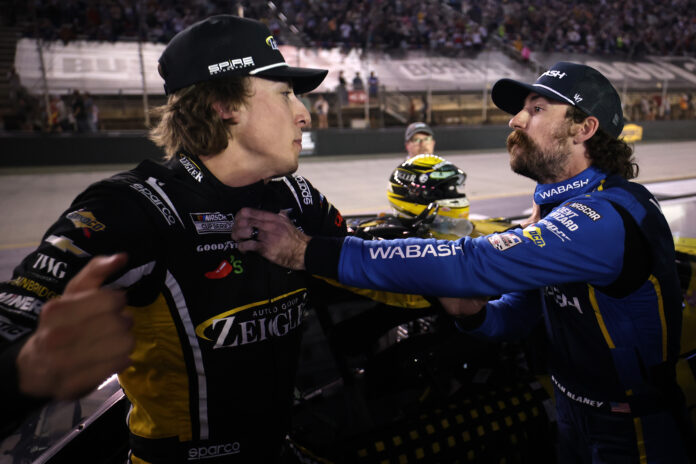
BRISTOL, TENNESSEE - SEPTEMBER 19: Carson Hocevar, driver of the #77 Zeigler Auto Group Chevrolet, (L) and Ryan Blaney, driver of the #12 WABASH Ford, get into an altercation after the NASCAR Cup Series Bass Pro Shops Night Race at Bristol Motor Speedway on September 19, 2026 in Bristol, Tennessee. (Photo by Chris Graythen/Getty Images).
Teammate Ryan Blaney and Carson Hocevar captured the ultimate spotlight on pit road at the conclusion of the 2026 Bass Pro Shops Night Race at Bristol Motor Speedway on Saturday, September 19, when a late run-in on the track escalated with the duo engaging in a fierce fight with swings and punches thrown.
The cause of the post-race fight between Blaney and Hocevar instigated on the track with 43 laps remaining. Blaney, who had reeled in Hocevar for the runner-up spot, threw a bold move beneath the latter through Turns 3 and 4 before the former slid up in front of Hocevar through the frontstretch to assume the runner-up spot. Despite briefly clearing and getting in front of Hocevar, Hocevar then tried to execute a crossover move beneath Blaney exiting the frontstretch, but Blaney turned to the left to block and stall Hocevar’s momentum.
Amid Blaney’s blocking attempt, both he and Hocevar’s entries made contact and Blaney was turned, sent spinning, sliding up the track and wrecking against the first turn’s outside wall. Blaney’s damaged entry then slid back down the apron as the former Cup Series champion was unable to finish the event. Meanwhile, Hocevar proceeded to contend for the victory before he settled in third place at the drop of the checkered flag.
Prior to the finish, Blaney, who was released from the infield care center and was scored in 33rd place in the final running order, was straightforward with his perspective on the incident with Hocevar, citing Hocevar never lifted off the throttle when trying to cross beneath Blaney and wrecked him, while speaking with USA Network.
“We got clear off of [Turn] 4, and I tried to protect the bottom [lane]. [Hocevar] crossed and never lifted and [I] got crashed. That’s what I thought happened. That’s what it looked like happened. Each person is gonna say they did nothing wrong.”
Blaney would later state that something is bound to occur between him and Hocevar when asked if he had any response towards the latter. Sure enough at the event’s conclusion, Blaney approached Hocevar and was swift to lunge a chest grab at Hocevar. Amid the scramble, Hocevar swung two closed fist punches across Blaney’s face and the former was restrained while the latter was dragged to the ground while being restrained by Hocevar’s pit crew. Once brought back up from the ground, Blaney, who was being restrained by one of his Team Penske crew members, vented words towards Hocevar before he broke free, bolted back to Hocevar and threw a single punch towards Hocevar’s face before he was restrained by NASCAR officials.
In the aftermath, Blaney was directed back behind the wall while Hocevar energized the crowd that was mixed with cheers and boos by waving his arms up in the air. The duo’s run-in at Bristol was not their first instance of a on-track skirmish as Hocevar had bumped and sent Blaney for a spin at EchoPark Speedway in February 2025 in the closing laps while both were racing upfront. Compared to Bristol, Hocevar and Blaney discussed with incident with no physical fights ensuing then.
Blaney declined to discuss his fight with Hocevar while the latter offered his perspective of both the fight and incident, the latter of which he cited that he had no intentions of wrecking Blaney upfront.
“I wasn’t trying to wreck [Blaney],” Hocevar said on USA Network. “It just looked like, to me, I got a run and went left and he spun. I spun him. There wasn’t a whole lot of talking. He just kind of like said one thing and then went after me, and I wasn’t going to take it. I got ran into a lot for the win. That was for second and he wans to come fight. I don’t think anybody’s [the fans] left behind me. They got a old school Bristol show here. I don’t know what I did wrong there. I got a run to cross him over. He looked like spun himself and then, he wants to institgate a fight. I was gonna finish. It seemed like the crowd was pretty pumped up, so I was going to play the audience for a second.”
Hocevar’s fight with Blaney marks his latest run-in with another competitor in the former’s rising career that has been hovered with several run-ins and tensions mounting within the garage area over Hocevar’s aggressive style of driving, most recently, Brad Keselowski during the Southern 500 at Darlington Raceway after Hocevar bumped and sent Keselowski for a spin.
With both Hocevar and Blaney also being two of 16 competitors duking against one another in the 2026 Chase for the Cup Series championship, Hocevar managed to jump from ninth to eighth in the Chase standings while Blaney dropped from fourth to sixth. Despite Blaney and Hocevar being 52 and 85 points behind the points lead, respectively, all eyes remain tight on both to see if their run-in at Bristol carries forth throughout the remaining seven Chase events and their respective pursuits for the 2026 championship.
The Chase for both Ryan Blaney and Carson Hocevar continues next Sunday, September 27, at Kansas Speedway in Kansas City, Kansas, for the Hollywood Casino 400. The event’s broadcast time is scheduled to commence at 3 p.m. ET on USA Network, MRN Radio, SiriusXM and HBO MAX.
Joey Logano had the seas parting for him when it mattered most, and it enabled him to emerge victorious amid a nine-lap shootout in the Bass Pro Shops Night Race at Bristol Motor Speedway on Saturday, September 19.
The three-time NASCAR Cup Series champion from Middletown, Connecticut, led twice for 93 of 500 scheduled laps in an event where he was awarded a front-row starting spot based on a qualifying metric formula and made an early pit strategic move during the event’s competition caution to remain on the track and claim the first stage victory. Despite surrendering the lead to pit prior to the second stage’s start, Logano methodically navigated his way back towards the front and remained upfront by netting a third-place result in the second stage’s conclusion. While continuing to race upfront, Logano waited two laps during the start of a nine-lap shootout to overtake Chase contenders Carson Hocevar, Ty Gibbs and Kyle Larson in a single lap to storm to the lead. From there, Logano used the clean air to motor his way to a big victory under the lights at Thunder Valley and reel in his points deficit in his championship quest for 2026.
The event’s starting lineup was determined through a qualifying metric formula after the event’s on-track qualifying session scheduled for Friday, September 18, was canceled due to inclement weather. As a result, Kyle Larson, winner of last weekend’s event at World Wide Technology Raceway, was awarded the pole position, and he shared the front row with Joey Logano.
When the green flag waved and the event commenced, Kyle Larson, who started on the outside lane, launched this No. 5 HendrickCars.com Chevrolet Camaro ZL1 entry ahead of Logano, teammate William Byron, and the field through the first two turns. With Byron assuming the runner-up spot from Logano, Larson cycled back to the frontstretch and led the first lap. Larson proceeded to lead by exactly half a second through the fifth lap mark over Byron and Logano as Alex Bowman and Denny Hamlin followed suit in the top five, respectively.
Through the first 10-scheduled laps, Larson was leading early by seven-tenths of a second over Byron while Logano, Bowman, Austin Cindric, Bubba Wallace, Denny Hamlin, Carson Hocevar, Ross Chastain and Austin Dillon occupied the top-10 spots in front of Christopher Bell, Brad Keselowski, Ty Gibbs, Ryan Preece and Connor Zilisch, respectively. Behind, Chase contenders Chris Buescher, Chase Elliott, Ryan Blaney, Daniel Suarez, Chase Briscoe and Tyler Reddick were mired in 20th, 22nd, 23rd, 29th, 31st and 32nd, respectively, as Larson led by eight-tenths of a second at the Lap 15 mark.
On Lap 18, thousands of NASCAR fans waved yellow towels to pay tribute to the late two-time NASCAR Cup Series champion Kyle Busch, who also won a combined 23 NASCAR national touring series victories at Bristol. Following the tribute, Larson maintained the lead by within four-tenths of a second just past the Lap 25 mark before he stabilized it at the Lap 30 mark.
On Lap 40, a competition caution flew. By then, Larson had lapped Reddick and Josh Berry, who was also a lap down, was ahead of Reddick at the moment of caution to receive the free pass. During the competition caution, nearly the entire field, led by Larson, pitted while the rest, led by Logano and including teammate Cindric, Buescher, Blaney and Briscoe, remained on the track. Following the pit stops, Larson exited pit road first ahead of Austin Dillon, Byron, Alex Bowman and Hamlin, respectively.
When the event restarted on Lap 48, Logano used the inside lane to motor his No. 22 Shell/Pennzoil Ford Mustang Dark Horse entry ahead through the first two turns from the inside lane while teammates Cindric and Blaney, along with Buescher, Briscoe, Larson and Austin Dillon, gave chase. Logano led the next lap as the field fanned out and jostled for spots. While Cindric battled Buescher to maintain the runner-up spot, Logano led by six-tenths of a second on Lap 55 before his advantage slightly decreased down to four-tenths of a second another five laps later.
Just past the Lap 70 mark, Logano continued to lead by four-tenths of a second over Cindric while Buescher, Blaney and Larson trailed in the top five, respectively. Logano’s lead then slightly grew up to half a second over the next five laps before it stood at half a second on Lap 80. As Logano grew his lead up to eight-tenths of a second by Lap 85, he then boosted up to a second over Cindric on Lap 90 as teammate Blaney was up in third place, thus placing all three Team Penske entries in the top-three spots.
On Lap 93, the event’s second caution flew, first for cause, due to Erik Jones getting loose and spinning his No. 43 Dollar Tree Toyota Camry XSE entry through the backstretch. At the time of caution, Logano was leading by half a second over teammate Cindric and by a second over teammate Blaney while Buescher, Larson, Byron, Briscoe, Chastain, Hamlin and Wallace followed suit, respectively. In addition, Austin Hill was the first competitor a lap down and was awarded the free pass over Reddick.
During the event’s second caution, split pit strategies ensued as some, led by third-place Blaney and including Buescher, Byron, Briscoe, Wallace, Bell, Bowman, Austin Dillon, Zilisch, Nemechek, Berry, McDowell, Gragson, Custer, Gilliland, Allmendinger, Elliott, Suarez, Stenhouse, van Gisbergen and Austin Hill, pitted while the rest, led by Logano and Cindric, remained on the track. Amid the pit stops, Buescher made contact with Allmendinger while exiting his pit stall.
As the event restarted on Lap 101, Logano rocketed ahead of Cindric, Larson and the field from the outside lane to maintain the lead for a full cycle. As Logano led, Larson reeled in and challenged Logano for the lead, and the latter duo swapped spots through the turns and straightaways just past the Lap 105 mark. With Chastain navigating his way into third place over Cindric, Hocevar and Hamlin, Logano, who raced on the outside lane, continued to fend off Larson, who instigated challenges from the inside lane, through and past the Lap 110 mark before Logano led by more than half a second just past the Lap 115 mark.
When the first stage period concluded on Lap 125, Logano, who led as high as nine-tenths of a second during the recent green-flag run, captured his fourth Cup stage victory of the 2026 season. Larson settled in second ahead of Hamlin, Chastain and Gibbs while Blaney (the highest competitor who recently pitted), Cindric, Hocevar, Keselowski and Wallace were scored in the top 10, respectively. By then, eight of 16 Chase contenders (Logano, Larson, Hamlin, Gibbs, Blaney, Cindric, Hocevar and Wallace) racked up the event’s first round of stage points while the remaining Chasers that include Byron, Buescher, Bell, Preece, Briscoe, Elliott, Suarez and Reddick were mired in 11th, 12th, 14th, 16th, 17th, 24th, 25th and 33rd, respectively. In addition, 31 of 37 starters were scored on the lead lap.
Under the event’s first stage break period, some led by Logano and including Larson, Hamlin, Chastain, Gibbs, Cindric, Hocevar, Keselowski, Preece, Herbst, Allmendinger, Zilisch, Suarez, Stenhouse, Nemechek, van Gisbergen and Custer pitted while the rest led by Blaney remained on the track. Following the pit stops, Larson exited pit road first ahead of Logano, Chastain, Hamlin and Gibbs, respectively.
The second stage period started on Lap 136 as Blaney and Byron occupied the front row. At the start, Blaney rocketed away from the field from the outside lane and led the field for a full cycle while Wallace and Buescher overtook Byron for second and third, respectively. As Blaney led by nearly half a second over Wallace on Lap 140, the top-five competitors, which also included Buescher, Bell, and Byron, had motored away from the field while Berry and Bowman battled for sixth place in front of Briscoe, while Logano and Larson were mired in 15th and 16th, respectively, in front of Hamlin, Cindric and Gibbs.
Through the Lap 150 mark, Blaney maintained the lead by six-tenths of a second over Wallace while Buescher, Bell, Berry, Byron, Briscoe, Gragson, Bowman and Gilliland followed suit, respectively, in the top-10 mark ahead of Logano, Austin Dillon, Elliott, Larson, Gibbs, Hamlin, Cindric, McDowell, Keselowski and Chastain. Meanwhile, Hocevar, Preece, Suarez and Reddick were the lowest four Chase contenders on the track in 21st, 23rd, 28th and 33rd, respectively, with Reddick still mired a lap down as Blaney led by half a second on Lap 155 and by seven-tenths of a second on Lap 160, both over Wallace. During the latest mark, Logano navigated his way back into the top-10 mark in ninth place while Larson was in 11th place ahead of Gibbs.
By Lap 175, Blaney, who led by more than a second a few laps ago, stabilized his lead by seven-tenths of a second over Wallace and by more than two seconds over third-place Buescher. Meanwhile, Berry outdueled Bell for fourth place and was the highest-running non-Chase contender on the track while Bell, Byron, Logano, Briscoe, Gibbs and Gragson trailed in the top 10, respectively, with Gragson trailing by more than seven seconds. As Berry overtook Buescher for third place, Blaney slightly increased his lead up to nine-tenths of a second over Wallace while Reddick, who was now two laps behind, was mired in 33rd place and continued to be the lowest-running Chaser. Blaney proceeded to lead by eight-tenths of a second on Lap 185 before the advantage grew up to more than a second on Lap 190, both of which Wallace retained the runner-up spot over Berry.
At the Lap 200 mark, Blaney continued to lead by more than a second over Wallace as Berry, Bell, Buescher, Logano, Gibbs, Byron, Larson, Hocevar, Briscoe, Hamlin, Gragson, Cindric and Bowman followed suit in the top 15, respectively. By then, 12 of 16 Chasers were racing in the top-15 mark on the track while Preece, Elliott, Suarez and Reddick were the lowest four Chasers in 19th, 21st, 22nd and 33rd, respectively. In addition, 20 of 37 starters remained on the lead lap while 12 were pinned a lap down.
Ten laps later, Blaney added an extra two seconds to his advantage as he remained ahead of Wallace while Berry, Bell, Logano, Gibbs, Buescher, Byron, Larson and Hocevar continued to race in the top 10, respectively. Blaney’s lead over Wallace dropped by a second another 10 laps later, but the former maintained his advantage that stood above two seconds by Lap 230 as Gibbs motored his No. 54 M&M’s Toyota Camry XSE entry into the runner-up spot over Wallace. By then, Wallace was being pressured by Berry, Logano and Bell for third place. Blaney led by more than two seconds over Gibbs and five seconds over Logano by Lap 240.
Then with three laps remaining in the second stage period, the caution flew due to Cody Ware spinning on the frontstretch after he got hit by Stenhouse on the right side and turned by Hamlin on the left-rear area. The caution was enough for the second stage period to conclude under caution as Blaney was awarded his ninth Cup stage victory of the 2026 season. Gibbs, Logano, Berry, Bell, Wallace, Hocevar, Byron, Larson and Buescher followed suit in the top 10, respectively. By then, nine of 16 Chasers (Blaney, Gibbs, Logano, Bell, Wallace, Hocevar, Byron, Larson and Buescher) racked up stage points following the second stage period, while the remaining Chasers that include Hamlin, Cindric, Preece, Briscoe, Suarez, Elliott and Reddick were mired in 11th, 12th, 13th, 14th, 18th, 25th and 28th, respectively, with Reddick mired two laps down. In addition, only 14 of 37 starters scored on the lead lap.
During the event’s second stage break period, the lead lap field led by Blaney pitted. Following the pit stops, Blaney retained the lead by exiting pit road first while Gibbs, Bell, Logano, Berry, Hocevar, Hamlin, Byron, Buescher and Wallace followed suit, respectively.
With 239 laps remaining, the final stage period commenced as Blaney and Gibbs occupied the front row. At the start, Blaney used the outside lane to launch his No. 12 Wabash Ford Mustang Dark Horse entry ahead of Gibbs and the field through the first two turns as Bell battled teammate Gibbs from the outside lane. Amid the side-by-side battle, Gibbs fended off Bell for the runner-up spot and Bell maintained third place in front of Logano and Hocevar while Blaney led by seven-tenths of a second with 230 laps remaining.
With 225 laps remaining, Blaney led by seven-tenths of a second over Gibbs before the former’s advantage slightly shrunk to half a second over the next two laps. Gibbs then reeled in towards Blaney by as close as two-tenths of a second before the latter led by three-tenths of a second with 220 laps remaining. Amid Gibbs’ late charge, Blaney remained out in front by two-tenths of a second while Bell, Logano, Hocevar, Berry, Hamlin, Byron, Wallace and Buescher trailed in the top 10, respectively.
Down to the final 200 laps, Blaney maintained a steady lead of less than three-tenths of a second over a hard-charging Gibbs as Gibbs reeled in and nearly overtook Blaney a few laps earlier amid lapped traffic. As Gibbs continued to reel in on Blaney amid lapped traffic that included Austin Dillon nearly making contact with Gibbs, Bell, Logano, and Hocevar continued to trail in the top five as Berry, Hamlin, Byron, Wallace and Buescher were in the top 10 ahead of Larson, Briscoe, Preece, Chastain and Cindric. With Suarez mired in 17th place, the third competitor a lap down behind Cindric and Keselowski, Elliott was mired two laps down in 26th place while Reddick was also mired two laps down in 30th place.
Twenty-five laps later, Gibbs, who methodically and steadily reeled Blaney back in, dueled with Blaney before he split in between Blaney and the lapped competitor of Bowman to motor ahead through the frontstretch and assume the lead. As the fans waved the Rowdy towels at the sight of the No. 54 M&M’s Toyota entry leading, Gibbs proceeded to lead Blaney by three-tenths of a second with 170 laps remaining.
With 160 laps remaining, Gibbs maintained his lead by four-tenths of a second over Blaney as Bell, Logano, Hocevar, Berry, Wallace, Hamlin, Byron and Briscoe occupied the top-10 spots in front of Larson, Buescher and Preece, all of whom were on the lead lap. Gibbs, who had his lead shrunk down by as low as a tenth of a second earlier, proceeded to stabilize his lead by within half a second over the next 20 laps before he maintained it by four-tenths of a second with 120 laps remaining. By then, Larson, Berry, Austin Hill and Hamlin pitted their respective entries under green.
With 118 laps remaining, Byron pitted under green from the top-10 mark. Briscoe followed suit a lap later along with Buescher and Nemechek before Gibbs pitted from the lead with 114 laps remaining. Three laps later, Logano pitted from third place along with Herbst before Bell, Wallace and Preece pitted with less than 110 laps remaining. Allmendinger, van Gisbergen and Gilliland also pitted.
With more names like Reddick, Chastain and McDowell pitting, Blaney peeled off the track from the lead and was about to pit before he darted back on the track as the caution flew with 104 laps remaining due to Herbst spinning and hitting the wall on the frontstretch after he made contact with Zane Smith. At the time of caution, Blaney and Hocevar were the only two competitors scored on the lead lap while Gibbs, who was in third place, was awarded the free pass to cycle back on the lead lap. Blaney’s event, however, quickly went south when he was penalized for a commitment line violation due to the driver crossing over the commitment line to enter pit road, but opting to blend back on the track instead of proceeding through pit road.
As the event restarted with 95 laps remaining, where Hocevar and Gibbs occupied the front row, Hocevar motored ahead with the lead while Gibbs, who was mired in lapped traffic, trailed in the runner-up spot. With only nine competitors scored on the lead lap, Gibbs trailed Hocevar by nearly two seconds as Bell, Logano, Berry, Byron, Larson, Wallace and Blaney rounded out the lead lap field.
Down to the final 80 laps, Hocevar was leading by two seconds over Gibbs while third-place Logano trailed by more than six seconds. Bell, Berry, Wallace, Blaney, Byron and Larson rounded out the lead lap field while Cindric was scored the first competitor a lap down in 10th place. By then, nine of 16 Chasers (Hocevar, Gibbs, Logano, Bell, Wallace, Blaney, Byron, Larson and Cindric) were scored in the top 10 on the track while the remaining Chasers that include Briscoe, Hamlin, Preece, Buescher, Suarez, Elliott and Reddick trailed in 11th, 12th, 13th, 14th, 17th, 21st and 26th, respectively.
Then, with 69 laps remaining, the caution flew when Gibbs, who reeled in and overtook Hocevar for the lead a lap prior through the backstretch when Hocevar was mired in lapped traffic, got sandwiched in between Bowman and Custer as Bowman, who turned right, got sideways and spun in front of Gibbs, though Gibbs managed to proceed with minimal damage. At the time of caution, Hocevar was ruled the leader over Gibbs. During the caution, Hocevar, Logano, Bell, Berry, Wallace, and Byron pitted while the rest, led by Gibbs and including Blaney and Larson, remained on the track.
The next restart with 59 laps remaining featured Gibbs muscling ahead of Blaney from the outside lane to maintain the lead through the first two turns despite having Larson, who restarted behind Gibbs, bolting his way into the runner-up spot. As Larson tried to get beneath Gibbs for the lead, Hocevar used his fresh tires to also reel in behind Gibbs as the latter led the next lap. Just as Gibbs was being pressured by Hocevar, Larson, Blaney, Bell and Logano for the lead, the caution returned due to Byron, who was among a handful of competitors on the lead lap, making contact with Berry before the former spun and hit the backstretch’s inside wall.
During the next restart with 51 laps remaining, Gibbs executed another strong launch from the outside lane to motor ahead of Larson and lead a full cycle while Hocevar used his fresh tires to motor up to second place. As Hocevar tried to use the outside lane to reel in Gibbs, Gibbs, who remained on the inside lane, proceeded to lead by half a second with 45 laps remaining while Blaney, Larson and Logano followed suit, respectively. Two laps later, Blaney, who reeled in, battled and slid in front of Hocevar to assume the runner-up spot through the frontstretch, drew a caution when Hocevar turned and sent the latter spinning and wrecking towards the outside wall in the first turn. The incident nearly collected Logano as Blaney was knocked out of contention with a wrecked race car while Hocevar proceeded forward, all while Gibbs maintained a steady lead.
As the event restarted with 35 laps remaining, Gibbs prevailed ahead of Larson from the outside lane as Hocevar quickly reeled in Gibbs to move into the runner-up through the first two turns. As Gibbs led while transitioning to the inside lane through the backstretch, Hocevar mounted a charge from the outside lane through Turns 3 and 4. Gibbs, though, managed to slide in front of Hocevar and lead the next lap through the frontstretch. As Gibbs, who remained on the inside lane, proceeded to maintain a steady lead with 30 laps remaining over Hocevar, Larson, Bell, Logano and Wallace followed suit while Berry, Briscoe, Cindric, Byron and Hamlin, all of whom were on the lead lap, followed suit, respectively.
With 24 laps remaining, the caution flew due to Elliott, who was multiple laps down, spinning on the frontstretch after he got loose entering the fourth turn and spun to the bottom of the track. During this caution, select names like Wallace, Byron, and Hamlin pitted while the rest, led by Gibbs, remained on the track.
For the next restart that commenced with 17 laps remaining, Gibbs motored ahead and moved in front of Larson, Hocevar and the field through the first two turns. As Hocevar tried to mount a charge from the outside lane while outdueling Larson, Gibbs led the next lap before he was challenged by Hocevar through the backstretch. Seconds later, the caution flew due to Allmendinger spinning in Turn 4 and through the frontstretch. At the time of caution, Gibbs was ruled the leader over Hocevar.
During the next restart with nine laps remaining, Gibbs briefly fended off Hocevar and Larson with a steady jump from the outside lane. Through the first two turns, however, Hocevar wasted no time reeling his No. 77 Zeigler Chevrolet Camaro ZL1 entry next to Gibbs’ No. 54 M&M’s Toyota entry entering the backstretch. The latter two drag-raced until Hocevar used the outside lane to move forward and lead the next lap. Both Gibbs and Hocevar continued to swap and battle fiercely for the lead during the next lap until Gibbs made contact with Hocevar through the frontstretch with seven laps remaining.
The contact between Gibbs and Hocevar escalated through the first two turns as Gibbs bumped and forced Hocevar up the track through the backstretch. This put Hocevar in contention with Larson and Gibbs as Logano threw himself into the spotlight. While Gibbs tried to slide up and stall Hocevar’s momentum through Turns 3 and 4 amid contact, Logano used the inside lane and clear space to motor past both and assume the lead for the following lap. As Logano led, Hocevar and Larson used the outside lane to race in second and third while Gibbs, who briefly got loose a lap prior, was left battling teammate Bell for fourth place. As the laps dwindled, Gibbs continued to battle Bell for fourth place while Hocevar and Larson were unable to reel in Logano.
When the white flag waved and the final lap started, Logano remained in the lead by a steady margin over Hocevar and Larson. With no challenges coming from behind, Logano was able to smoothly cycle back to the front stretch and claim the checkered flag ahead of a heated battle between Larson and Hocevar for the runner-up spot.
With the victory, Logano notched his 40th NASCAR Cup Series career victory in his 644th series start, his third of the 2026 season, his 16th career Chase win and his third at the Bristol Night Race event. He also racked up the seventh victory of the 2026 season for Ford and the sixth for Team Penske.
Prior to his Bristol Night Race victory, Logano was ranked in seventh place in the 2026 Chase standings, and he trailed the points lead by 51 points. After the Bristol Night Race victory, Logano gained four spots in the standings, and he trails the lead by 16 points as he has seven Chase events remaining to reel in his deficit and contend for his fourth championship.
“Come on, Bristol! I hear you down here,” Logano, who was greeted with a chorus of boos from the crowd, said on the frontstretch on USA Network. “That was awesome. What a really good race car. Team Penske put together a great car. We were able to win the first stage there. You know it’s going to get aggressive there at the end, and right place at the right time. I got a great team. We got a team that knows how to win championships. I thought there for a minute, I was like, ‘OK, I might just finish third or fourth here tonight,’ but it all kind of worked our way up, and I was like, ‘Well, Merry Christmas to me. I got a gift there.’”
“There’s nothing like the Bristol Night Race, man,” Logano added. “This is just the coolest experience as a race car driver, being in front of all you fans down here, hearing everyone screaming, cheering, sometimes booing. That’s all right. It’s pretty awesome.”
As Logano lit up the celebrations both on the frontstretch and in Victory Lane, teammate Ryan Blaney lit up the post-race activities on pit road when he approached Carson Hocevar and grabbed him across the chest to express his displeasure over their late-race incident. A fight then erupted as Hocevar threw a pair of swings and punches across Blaney’s face before Blaney was dragged to the ground. After being brought back up, Blaney vented words towards Hocevar while being restrained before he broke free, bolted back to Hocevar and swung a punch towards the latter’s face before he was restrained by NASCAR officials and directed back behind the wall.
Kyle Larson managed to edge Hocevar to claim the runner-up spot, and Christopher Bell, the reigning Bristol Night Race winner, finished in fourth place, while Ty Gibbs, who led 120 laps while sporting the M&M’s Kyle Busch tribute paint scheme, settled in fifth place.
Josh Berry, Bubba Wallace, Denny Hamlin, William Byron and Ryan Preece completed the top 10 in the final race results. The latter four, along with Logano, Larson, Hocevar, Bell and Gibbs notched top-10 results as Chase contenders, while the remaining Chasers, including Austin Cindric, Chris Buescher, Daniel Suarez, Tyler Reddick, Chase Elliott, Chase Briscoe and Ryan Blaney settled in 11th, 13th, 14th, 18th, 23rd, 27th and 33rd, respectively.
The third Chase event of the 2026 Cup Series season generated 13 lead changes for six different leaders, and 10 cautions for 78 laps. In addition, 12 of 37 starters finished on the lead lap.
Race Results:
Joey Logano, 93 laps led, Stage 1 winner
Kyle Larson, 45 laps led
Carson Hocevar, 39 laps led
Christopher Bell, one lap led
Ty Gibbs, 120 laps led
Josh Berry
Bubba Wallace
Denny Hamlin
William Byron
Ryan Preece
Austin Cindric
Ross Chastain
Chris Buescher, one lap down
Daniel Suarez, two laps down
Brad Keselowski, two laps down
Noah Gragson, two laps down
Austin Dillon, two laps down
Tyler Reddick, three laps down
Todd Gilliland, three laps down
Shane van Gisbergen, three laps down
Michael McDowell, three laps down
AJ Allmendinger, three laps down
Chase Elliott, three laps down
Connor Zilisch, four laps down
John Hunter Nemechek, five laps down
Cole Custer, five laps down
Chase Briscoe – OUT, Suspension
Zane Smith, six laps down
Austin Hill, six laps down
Ricky Stenhouse Jr., 10 laps down
Cody Ware, 11 laps down
Erik Jones, 17 laps down
Ryan Blaney – OUT, Accident, 202 laps led, Stage 2 winner
Riley Herbst – OUT, Suspension
Alex Bowman – OUT, Accident
Ty Dillon, 98 laps down
Josh Bilicki – OUT, Suspension
*Bold indicates Chase Drivers
Following the third Chase event of the 2026 NASCAR Cup Series season, Kyle Larson leads the standings by a single point over Denny Hamlin, 16 over Joey Logano, 17 over Christopher Bell, 42 over Ty Gibbs, and 52 over Ryan Blaney. The rest of the 16-car Chase field is displayed below.
Chase Standings:
Kyle Larson
Denny Hamlin -1
Joey Logano -16
Christopher Bell -17
Ty Gibbs -42
Ryan Blaney -52
Tyler Reddick -61
Carson Hocevar -85
Chase Briscoe -87
Bubba Wallace -92
Austin Cindric -116
Chase Elliott -117
William Byron -121
Ryan Preece -124
Chris Buescher -124
Daniel Suarez -134
Next on the 2026 NASCAR Cup Series schedule is the Hollywood Casino 400 at Kansas Speedway in Kansas City, Kansas. The event is scheduled to occur next Sunday, September 27, and air at 3 p.m. ET on USA Network, PRN Radio, SiriusXM, and HBO MAX.