Home Blog Page 31

ARCA Menards Series at Chicagoland Speedway: Ashley Furniture 150 Post-race Notes

  • Connor Mosack (No. 28 Friends of Jacklyn Chevrolet) scored his third career ARCA Menards Series victory and his first of 2026 in Friday’s Ashley Furniture 150 at Chicagoland Speedway. Mosack’s other two wins came at Chicagoland’s sister track, Kansas Speedway, in 2023 and 2024.
  • Mosack led 71 of the race’s 100 laps. Other lap leaders included Sioux Chief PowerPEX Pole Award winner Thomas Annunziata (No. 70 JBL Toyota), who led 24 laps, and runner-up finisher Lanie Buice (No. 77 Sunoco Chevrolet), who led five laps.
  • Buice tied the ARCA Menards Series record for best finish by a female driver with her first career runner-up finish. Other female drivers who have scored runner-up finishes include Erin Crocker-Evernham, who finish second three times, two-time runner-up finisher Hailie Deegan, Shawna Robinson, and Isabella Robusto (No. 55 Yahoo Toyota).
  • Landon S. Huffman (No. 9 A.L.L. Construction / Carter CAT Chevrolet) rebounded from heartbreak at Elko Speedway last Saturday to finish third in his intermediate track debut. Huffman led 130 laps last week but broke a track bar bolt while leading which relegated him to a 14th-place finish. It marks the best finish for the Codie Rohrbaugh-owned CR7 Motorsports team since 2015 ARCA Menards Series champion Grant Enfinger finished second at Charlotte Motor Speedway in 2025.
  • Daniel Dye (No. 24 Champion Container Chevrolet) started outside the front row and battled among the top five all race long to finish fourth; it is his third top-five result in six starts so far in 2026.
  • Annunziata finished fifth after scoring his third consecutive Sioux Chief PowerPEX Pole Award; qualifying was canceled due to inclement weather but the field was set by speeds set in the afternoon’s 80-minute practice session.
  • Jade Avedisian (No. 15 Mobil 1Toyota) finished a career-best sixth, her third consecutive top-ten finish; she finished seventh at Kansas Speedway and eighth at Pocono Raceway in her two most recent starts.
  • Andy Jankowiak (No. 71 Phillips 66 Lubricants / Whelen Toyota) persevered to a seventh-place finish despite damage from early-race contact with series championship points leader Jake Bollman (No. 20 Nitro Motorsports Toyota). Jankowiak’s car had body damage on the left rear quarter panel, while Bollman, who finished right behind in eighth, had corresponding damage to the right front fender of his car.
  • Jason Kitzmiller (No. 97 A.L.L. Construction / Carter CAT Chevrolet) followed his fifth-place finish last Saturday night at Elko Speedway with a ninth-place run at Chicagoland. It was Kitzmiller’s seventh top-ten finish of the season.
  • ASA STARS National Tour championship contender Kyle Steckly (No. 2 APC Auto Parts Centres Toyota) finished fourth to score his first career top-ten finish and the first top-ten finish for team owner Kevin Conway’s RAFA Racing Team.
  • Mosack’s winning average speed was 119.947 miles per hour. There were three cautions for a total of 17 laps; the first on lap 19 for a spin in turn four by Bobby Earnhardt (No. 89 Colony Ammo Chevrolet); the second came out on lap 25 when William Sawalich (No. 18 SoundGear Toyota) made contact with the turn one wall; the third and final yellow flag was the scheduled caution at lap 50.
  • Sawalich finished 24th, a season-worst finish for the No. 18 Joe Gibbs Racing team; the team entered with a 52-point lead in the ARCA Menards Series owners points and unofficially leaves with a 24-point lead over the Mark Webb-owned No. 28 Pinnacle Racing Group team.
  • There were two lead changes among three drivers.
  • Mosack’s margin of victory was 2.128 seconds.
  • The next race for the ARCA Menards Series is the Lime Rock Park ARCA 100 on Friday, July 10.. The race, set to begin at 4 pm ET will be televised live on FS1 and broadcast on select affiliates of the MRN Radio network nationwide. ARCARacing.com will have live timing & scoring data throughout all on-track activity and live race audio. Follow @ARCA_Racing on X (formerly Twitter) for up-to-the-minute updates.

About ARCA 
The Automobile Racing Club of America (ARCA), founded in 1953 by John and Mildred Marcum in Toledo, Ohio, and acquired by NASCAR in April 2018, is the leading grassroots stock car sanctioning body in the United States. Bridging the gap between NASCAR’s top three national touring series and weekly and regional tour racing all across the country, the organization to sanctions over 100 races per year in the ARCA Menards Series, ARCA Menards Series East, ARCA Menards Series West, ASA STARS National Tour, ASA CRA Super Series, ASA Midwest Tour, ASA Southern Super Series plus weekly racing at Toledo and Flat Rock Speedways. For more information about ARCA visit , or follow ARCA on Facebook (@ARCARacing) and Twitter (@ARCA_Racing). 

About Menards
A family-owned and run company started in 1958, Menards is recognized as the retail home center leader of the Midwest with 236 stores in 15 states.  Menards is truly a one-stop shop for all of your home improvement needs featuring a full-service lumberyard and everything you need to plan a renovation or build a home, garage, cabin, shed, deck, fence or post frame building.  You’ll find a large selection of lumber, roofing, siding, construction blocks, trusses, doors and windows, plus cabinets, appliances, countertops, flooring, lighting, paint, plumbing supplies and more.  To complete the job, Menards has quality hand tools, power tools, fasteners, electrical tools plus storage options and supplies for everyone from the weekend warrior to the pro!

Menards has what you need to complete your outdoor projects and keep your yard in tip-top shape including mowers, trimmers, blowers, pressure washers and more, plus a beautiful garden center stocked with plants, shrubs, trees, landscaping tools, grass seed, fertilizer options, outdoor décor and patio furniture.  Menards also has everyday essentials like health & beauty products, housewares, pet and wildlife supplies, automotive items and even groceries.  And at Christmas, an Enchanted Forest display area with impressive trees, lighting, decorations, ornaments, inflatables and more. 

Menards is known for friendly Customer Service and as the place to “Save Big Money” with low prices every day, and sales too!  For more information, please visit Menards.com to learn about our store locations, offerings and services.

Building Stamina for the Demands of Wheel-to-Wheel Competition

Photo by Karsten Winegeart on Unsplash

Want to hold your pace from lights out to the checkered flag?

We all know as racers that the final few laps are where the race is won. It’s not about who has the quickest car… It’s who can still drive well when your body wants you to stop. And here’s the issue:

Wheel-to-wheel racing punishes anyone who runs out of gas physically.

To be mentally and physically fresh for an entire stint, you need serious endurance. Endurance is predicated upon one thing that most drivers neglect. Learn how to build lasting endurance that won’t leave you pushing when others are speeding.

Let’s jump in!

In this guide:

  1. Why Stamina Wins Races
  1. What Makes Racing So Physically Brutal
  1. The Hydration Foundation
  1. Building Real Racing Stamina

Why Stamina Wins Races

Stamina is the thing that separates good drivers from great ones.

Consider this. Your car is fast for the entire race. Your driver isn’t. When you’re tired, your reactions become slower, your concentration falters, and your inputs become less precise. That’s when you miss a braking point, cut an apex, or give the position back to the driver behind you.

More stamina = More consistent laps.

Consistency is what wins championships. You have to be able to run lap 40 as fast as lap 2 if you want to collect trophies. The other guys are just filling out the field.

Creepy thing is how fast the body deteriorates inside a race car. Temperatures up top exceed 50 degrees Celsius. You’re trapped in a fireproof suit and helmet for hours. Takes a lot out of you.

What Makes Racing So Physically Brutal

Racing is harder on the body than most people think.

Driving a car doesn’t seem like a very physical exercise. But head-to-head racing challenges your body in ways comparable to actual endurance athletics. The disadvantages you have to overcome include:

  • Extreme heat — the cockpit becomes an oven
  • G-forces — your neck and core fight constant load
  • Fluid loss — you sweat buckets under all that gear
  • Mental load — racing demands total concentration

Let’s cover the most important thing that most drivers don’t think about… Fluid Loss. When you sweat like that for that long you start to breakdown. According to Motorsport UK, drivers can lose up to five percent of their body weight in one race.

It’s a lot of fluid. And every ounce you lose makes you weaker, slower and less focused behind the wheel.

Why is hydration so important? Dehydration messes with your reaction time, focus and worse-case scenario…makes you dizzy and start cramping. None of those are ideal when riding with someone beside you going 150mph.

The Hydration Foundation

Ok, let’s not beat around the bush… You cannot increase stamina while being dehydrated.

All the work you’ve put into getting fit means nothing if you turn up to the race dehydrated. Hydration is where it begins. But hydration doesn’t stop there, and this is where most drivers make their mistake. As you sweat, you lose more than just water. You lose salts, and getting those electrolytes replaced at the correct ratio is what will keep your muscles contracting and your brain functioning throughout a stint.

Sodium is the biggest salt you lose. Achieving the proper sodium concentration in your drink can mean the difference between crossing the finish line and cramping up on your last lap. Screw it up and plain water won’t help.

How much sodium? Studies indicate that athletes can lose between 200 to 2000 mg of sodium per liter of sweat. Yikes, that is a BIG RANGE! What this means is that every driver is unique. Some of you guys are “salty sweaters” and require significantly more sodium than the athlete in the adjacent garage.

The goal is to figure out your own numbers and replace what you lose.

Getting your sodium right does three big things:

  • Keeps your muscles from cramping
  • Protects your reaction time and focus
  • Helps you actually absorb the water you drink

That brings us to the last point. Sodium allows your body to retain and utilize the water you consume. If you drink plain salt-free water (lots of it), it simply passes through you. The proper concentration of sodium will turn your H20 into useful stuff.

Building Real Racing Stamina

Okay, now for the fun part. After you’ve got your hydration out of the way you can begin constructing the engine.

You don’t wake up with stamina. You develop it after weeks and months of intelligent training. This is how.

Train Your Cardio

Cardio is the base of everything.

When your heart and lungs are stronger you are able to handle heat/stress better. Cardiovascular fitness just means that drivers who train aerobically can drive longer. You should be jogging/ biking/rowing several times a week to develop some base cardio. Trust me when your sitting sideways and everyone else is dropping like flies you will thank me.

Build Neck & Core Strength

Your neck and core take a beating from G-forces.

Each corner taxes your body. Weak necks go anaerobic quickly. That’s why most racers do neck and core training. When strong, resisting your head from whipping around isn’t tiresome. You can focus that energy into driving.

Get Used to the Heat

You can train your body to handle heat.

The phenomenon is known as heat acclimatization, and it really works. If you train hot, your body learns to dissipate heat more efficiently and retain fluid. Do it leading up to a key event and the cockpit won’t feel like such a gut-punch.

Crossing The Finish Line

Now you know what it really takes to last a full stint.

Let’s face it endurance racing isn’t easy. There’s no magic wand to wave and no pill you can pop. You’ve got to do the cardio, build the strength, and treat hydration like the performance enhancer it should be. But here’s the good news:

Every driver can build this. It’s not about talent, it’s about the work.

To quickly recap what it takes:

  • Build your cardio base with regular training
  • Strengthen your neck and core for the G-forces
  • Get your body used to racing in the heat

Do all of the above and you will still be kicking when the field begins to wilt around you. That’s how you win the wars that are won late.

Connor Zilisch awarded O’Reilly pole at Chicagoland

Photo by Patrick Sue-Chan for SpeedwayMedia.com.

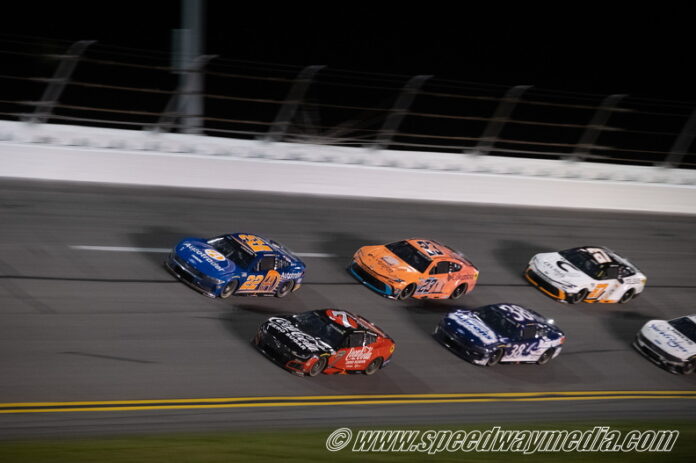
Connor Zilisch was awarded the pole position for the NASCAR O’Reilly Auto Parts Series’ Cuervo 300 at Chicagoland Speedway on Saturday, July 4.

The event’s starting lineup was initially going to be determined through an on-track qualifying session that consisted of a single-car, single-lap qualifying format. During the session, each of the 38 competitors vying for 38 starting spots would cycle around Chicagoland once to post the fastest lap amongst one another, and the competitor who posted the single fastest lap was awarded the pole position.

Due to inclement weather rolling through the Chicagoland area on Friday afternoon, NASCAR elected to postpone Friday’s practice session to Saturday in place of qualifying. As a result, the starting lineup was determined using a qualifying metric formula per the NASCAR rulebook.

The formula awarded Zilisch, a 13-time O’Reilly Auto Parts Series race winner from Charlotte, North Carolina, the pole position. Zilisch, a full-time Cup Series rookie who is making his ninth O’Reilly start at Chicagoland with JR Motorsports, is coming off a runner-up result behind Shane van Gisbergen at Sonoma Raceway. Zilisch has notched a pair of victories in his part-time O’Reilly Series starts (Bristol Motor Speedway in April and Watkins Glen International in May) and will strive for a third this weekend at Chicagoland.

Zilisch will share the front row with Brent Crews, the latter of whom is ranked in 11th place in the standings and is coming off a third-place result at Sonoma. Carson Kvapil, Corey Day and Parker Retzlaff will start in the top five, respectively. Jesse Love, Anthony Alfredo, Sheldon Creed, Sam Mayer and Sammy Smith complete the top-10 starting grid.

With 38 competitors vying for 38 starting spots, all made the main event.

Chicagoland – Starting Lineup:

  1. Connor Zilisch
  2. Brent Crews
  3. Carson Kvapil
  4. Corey Day
  5. Parker Retzlaff
  6. Jesse Love
  7. Anthony Alfredo
  8. Sheldon Creed
  9. Sam Mayer
  10. Sammy Smith
  11. Chase Elliott
  12. Myatt Snider
  13. William Sawalich
  14. Ryan Sieg
  15. Nick Sanchez
  16. Austin Hill
  17. Justin Allgaier
  18. Harrison Burton
  19. Josh Bilicki
  20. Jeremy Clements
  21. Cole Custer
  22. Jeb Burton
  23. Garrett Smithley
  24. Brennan Poole
  25. Taylor Gray
  26. Dean Thompson
  27. Patrick Staropoli
  28. Ryan Ellis
  29. Brandon Jones
  30. Blaine Perkins
  31. Leland Honeyman Jr.
  32. Rajah Caruth
  33. Kyle Sieg
  34. Lavar Scott
  35. Tyler Tomassi
  36. Dawson Cram
  37. Joey Gase
  38. JJ Yeley

The 2026 Cuervo 300 at Chicagoland Speedway is scheduled to occur on Saturday, July 4, at 5:30 p.m. ET on the CW Network, MRN Radio, and SiriusXM.

TOYOTA RACING – NCS Chicagoland Pole Quotes – Denny Hamlin – 07.03.26

TOYOTA RACING – Denny Hamlin
NASCAR Cup Series Quotes

JOLIET, Ill. (July 3, 2026) – Joe Gibbs Racing driver Denny Hamlin was made available to the media on Friday prior to the NASCAR Cup Series race from Chicagoland Speedway.

DENNY HAMLIN, No. 11 Progressive Insurance Toyota Camry XSE, Joe Gibbs Racing

How much will experience matter this weekend?

“It’s probably that much, because going into this practice session with many unknowns as well. I ran some laps here during the test but it’s still one line. I’ve been around long enough to know that a test racetrack and a race weekend track are two vastly different things. So, lots of unknowns, just what line are we going to run? What’s going to be the fastest and as Kyle (Larson) mentioned, we didn’t really go up the racetrack at all during the test, so we don’t know whether the bump more or less the higher you go. It’s always going to be a little bit of, I have some old notes I had in the book that I looked at, but it will be something small, nothing big.”

Why do you think this racetrack may work well with the NextGen car?

“It’s got a good mix of the power and the drag on the NextGen car has been good for, generally, mile and-a-half, two-mile racetracks. It just runs barely slow enough down the straightaway where you barely get a draft, but in the corner this racetrack has options to get out of the wake of the car in front of you so you, so you can usually keep that momentum up by moving around. So the wider the racetrack, the longer the racetrack, the better the racing in the NextGen car tends to be.”

How have you seen how the championship is shaping up this year with the Chase format as opposed to what we’ve seen the last several years with the elimination format and eventually the Championship 4 at the end of the year?

“I certainly feel like the destination of where you want to go is more in your hands. The sample size is bigger. This thing could come down to a green, white, checkered at Homestead, we don’t know. But at least there are other races and restarts that happened that counted just the same, the nine races before that. I like it for that reason that I don’t think that one freak race or incident or win just completely changes the outlook of your championship hopes. I’m very optimistic from the standpoint that generally the bigger the data set the better off our chances are going to be.”

How do you evaluate the dynamic between the teams within Toyota as a manufacturer?

“I certainly think that Toyota has a role in it, but I don’t think Toyota is that much different than any of the other manufacturers. We pay a fee (23XI Racing), so that’s the difference. It’s not like Toyota forces us to work together. We chose to be affiliated with Joe Gibbs Racing and we felt like it would shorten up the learning curve and get us competitive quicker. And now it’s a relationship we still pay, but he relationship definitely goes back and forth. There’s certainly information going both ways through that tunnel, so it works in that kind of way. But it’s not something that is forced by the manufacturers, I would think that probably we get the same amount of stuff. Ourselves and LEGACY, is no different than Penske and RFK. I think that probably we get the same amount of stuff that we share that they get, but we just chose to have an alliance, and that’s what I felt like was the best business decision.”

What level of importance to the manufacturer do you think having a alliance between teams as far as information sharing goes? Is this something that has contributed to Toyota’s success?

“It certainly doesn’t hurt by any means, because you got lots of good drivers amongst that group of seven cars, sometimes eight cars. You got a lot of good crew chiefs and lot of smart engineers on both sides who bounce ideas off of each other as well. It is a benefit, but it’s something that’s not for free. I think it’s a really good deal for Joe Gibbs Racing because you get paid and you get some information, but then for us (23XI) it allows us to hire a lot less people. We could just take the money and hire additional people, but then is that the best way to do it to have two organizations spending the same money on the same thing and getting likely the same answer? That’s not the best way to stack your resources I wouldn’t think. It’s not the entire reason though, that’s for sure.”

As an owner, how do you evaluate future talent in the Truck Series versus the O’Reilly Series?

“You just have a self-built model in your head that this team, their cars are 100% and that’s five cars at 100%. And then the next team, I put them a little lower. I’m not in the trenches and know all the facts, but I hear enough that this team has better engines and this team has better bodies and you just kind of put all of that in your head and say that is where they should be running. Then you find some outliers, well a team that’s in your mind is an 80% resource team performing at a 90% level, well why is that? Is it the drivers, is it the cars? What is it, right? You can just evaluate in that kind of way. There’ no exact science to it from my standpoint. A lot of the guys other than Corey Heim, I’ve been on the racetrack with them before and I can see they can drive well beyond their equipment is supposed to be going in speed. For Corey, there’s just a moment in that Iowa race where he was running for Sam Hunt, I know that car should not be running that fast. There are just little moments that happen like that which get your attention and if it happens more and more often, then you start to have conversations.”

With the vehicles being so different, how can you tell who stands out and how it would translate to the Cup Series?

“It’s really, really hard. The trucks probably drive more similarly to the NextGen car, but it’s really hard to evaluate one over the other. I just look at racecraft. Can someone make a move and put their car in a position that I know is a very difficult position and they come out of it ahead? It really doesn’t matter to me what vehicle they’re driving of the person I’m watching, it makes no difference because I believe the great drivers can adapt to the car they are in. You learn racecraft, then you just adapt your style to get the speed out of the machine that you are in.”

About Toyota

Toyota (NYSE:TM) has been a part of the cultural fabric in North America for nearly 70 years, and is committed to advancing sustainable, next-generation mobility through our Toyota and Lexus brands, plus our more than 1,800 dealerships.

Toyota directly employs nearly 64,000 people in North America who have contributed to the design, engineering, and assembly of over 50 million cars and trucks at our 14 manufacturing plants. In 2025, Toyota’s plant in North Carolina began to assemble automotive batteries for electrified vehicles.

For more information about Toyota, visit www.ToyotaNewsroom.com.

Andretti Global Drivers Turn Up the Heat on Day 1 at Mid-Ohio

LEXINGTON, Ohio (Friday, July 3, 2026) – On a hot day in the heartland, Andretti Global had cars that were the hottest.

Specifically, teammates Will Power and Kyle Kirkwood were 1-2 on the speed chart as the Fourth of July holiday weekend began with a 95-degree afternoon at the Mid-Ohio Sports Car Course.

Power turned a lap of 1 minute, 5.5540 seconds in the No. 26 TWG AI Honda as the 25-car field opened preparations for Sunday’s The Honda Indy 200 at Mid-Ohio Presented by the 2027 CR-V Hybrid (12:30 p.m. ET, FOX, FOX One, FOX Deportes, INDYCAR Radio powered by OnlyBulls). Kirkwood’s best lap in the No. 27 Sam’s Club Honda was 1:05.6674.

If this practice was an indication, the 90-lap main event will tax the drivers. Temperatures are expected to remain in the low 90s at least through Saturday’s qualifying for the NTT P1 Award (2:30 p.m. on FS1, FOX One and INDYCAR Radio powered by OnlyBulls).

Power is always one to watch in NTT INDYCAR SERIES qualifying sessions. His mark of 71 career poles is handily the sport’s all-time best, and he will be seeking his first pole of the season. Kirkwood also has yet to start a race in the No. 1 position this season; he has won three poles in his career.

Rounding out the top five on Day 1 were series points leader Alex Palou in the No. 10 Open AI Chip Ganassi Racing Honda (1:05.7557) followed by Arrow McLaren’s Christian Lundgaard (1:05.8924) and Pato O’Ward (1:06.0340). Lundgaard has won two of the three road course races this season; Palou won the other.

Power (2020), Palou (2023) and O’Ward (2024) are former Mid-Ohio race winners.

Through 10 of 18 races, Palou holds a 60-point lead over Team Penske’s David Malukas, whose best lap on this day (1:06.2534) ranked 10th. Kirkwood sits third in the standings (61 points out of the lead) with Lundgaard fourth (77 points in arrears).

This practice followed Meyer Shank Racing’s announcement that Marcus Armstrong had signed a multiyear extension beginning in 2027. Armstrong is in his second season with the Ohio-based organization, and he will move from the team’s No. 66 entry to its No. 60 driven by Felix Rosenqvist each of the past three seasons.

Rosenqvist, this year’s winner of the Indianapolis 500 presented by Gainbridge, recently was confirmed to be leaving MSR for 2027. Armstrong finished fifth in that race after leading with one lap remaining.

But Armstrong’s Mid-Ohio weekend did not get off to a good start, as what appeared to be a mechanical failure in the rear of the Honda-powered car sent him into the Turn 2 barrier.

“What I felt was when I was braking there was one half of the car was just sliding across the ground,” Armstrong said. “From my (seat), one of the corners was hanging off on the rear, and I was just trying to decelerate quick enough. From what I was hearing, it was making a scraping sound so the floor was dragging.

“It’s a shame. I think we only did one push lap and the car felt really good. Fingers crossed that the tub’s all good and we can repair it without any major concerns for (the second practice).”

Armstrong’s best lap in the abbreviated session (1:07.3433) left him 24th. Rosenqvist, who was runner-up in 2019 at this 13-turn, 2.258-mile permanent road course, had the seventh-quickest lap.

Seven-time Mid-Ohio winner Scott Dixon is also having an interesting weekend. He and Chip Ganassi Racing are working together for the first time since it was announced that he would be leaving the organization after 25 seasons, the longest partnership in the sport.

Dixon, who won last year’s race when Palou drifted wide in Turn 9 with six laps to go, posted the 15th-fastest lap (1:06.5372).

Turn 9 was problematic for Dale Coyne Racing’s Romain Grosjean in this session. He lost control of the back end of the No. 18 BMax Honda late in the session, sliding off track and hitting the tire barrier with the rear. He, like Armstrong, was not injured.

Saturday’s action begins with the weekend’s second practice at 10 a.m. ET on FS1.

Brigadier General Darren Hamilton named Grand Marshal for The Honda Indy 200 at Mid-Ohio Presented by the 2027 CR-V Hybrid

The Chief of Staff for the Ohio Air National Guard will give the command for NTT INDYCAR SERIES drivers to start their engines on Sunday

LEXINGTON, Ohio (July 3, 2026) – Mid-Ohio Sports Car Course and Honda are proud to announce Brig. Gen. Darren E. Hamilton, the Chief of Staff for the Ohio Air National Guard, as the grand marshal for Sunday’s The Honda Indy 200 at Mid-Ohio Presented by the 2027 CR-V Hybrid. The former Wing Commander of the 179th Cyberspace Wing (CW) at nearby Mansfield Lahm Airport in Mansfield, Ohio, will give the command for 25 NTT INDYCAR SERIES drivers to start their engines as part of pre-race ceremonies.

Brig. Gen. Hamilton’s distinguished career began when he joined the 179th Airlift Wing (AW) in 1986 and was assigned as a crew chief on the C-130B aircraft. He attended training to become a C-130 Flight Engineer in 1989, then graduated from Kent State University in 1992 with a Bachelor of Science degree in Aerospace Technology.

Brig. Gen. Hamilton started as a traditional guardsman at the 179th AW, Ohio Air National Guard at Mansfield Lahm Airport. He has served as a corporate pilot, airline pilot and as a dual status military technician with the 179th AW in a multitude of roles to include: Flight Safety Officer, Training Officer, Assistant Operations Officer and 164th Airlift Squadron Commander. He served as the Joint Force Headquarters Director of Operations Ohio (A3) before returning as the 179th Operations Group Commander. He participated in Operations Restore Hope, Southern Watch, Joint Forge, Iraqi Freedom, Enduring Freedom and Freedom Sentinel. He is a Command Pilot with over 5000 hours in the T-41, T-37, T-38, C-13O B/E/H and C-27J aircraft. He was promoted to Brigadier General on June 7, 2026. His numerous assignments and accomplishments have led to over 30 major awards and decorations.

“As we celebrate our nation’s 250th birthday, it’s fitting to recognize Brigadier General Darren Hamilton’s numerous accomplishments and long service to our country by having him join us in this role on Sunday,” said Craig Rust, president of Mid-Ohio Sports Car Course. “It is an even more special occasion with his strong connections to the local community, the State of Ohio and the United States military.”

Shortly after Brig. Gen. Hamilton gives the command, Kendall Coyne Schofield – two-time U.S. Olympic gold medalist for Team USA Women’s Hockey and a Team Honda athlete ambassador – will wave the green flag over the starting field. Coyne Schofield was previously named the honorary starter for The Honda Indy 200 at Mid-Ohio Presented by the 2027 CR-V Hybrid on Sunday (July 5).

The Honda Indy 200 at Mid-Ohio Presented by the 2027 CR-V Hybrid this weekend marks the 43rd running of Ohio’s biggest racing event. The NTT INDYCAR SERIES headlines the weekend of 10 races across five different racing series. The full development ladder of the sport’s rising stars will be on display with INDY NXT by Firestone, USF Pro 2000 Presented by Continental Tire, USF2000 Presented by Continental Tire and USF Juniors Presented by Continental Tire all competing on the 2.258-mile, 13-turn road course.

All event information including ticket options and pricing is posted online at midohio.com. Children 12 and under receive free general admission when accompanied by a ticketed adult. Follow the event on social media with #Honda200.

About Mid-Ohio Sports Car Course:

A comprehensive motorsports facility in Lexington, Ohio, Mid-Ohio Sports Car Course sits on 380 acres and features a permanent road-racing circuit with two primary race track configurations: 2.4-mile, 15-turn or 2.258-mile, 13-turn layout. Located 60 miles north of Columbus and 75 miles south of Cleveland near Mansfield, the natural terrain road course is commonly referred to as the “Most Competitive in the U.S.” and annually hosts a diversity of locally, regionally and nationally-sanctioned race events for amateur, club and professional drivers and riders. It is also home to The Mid-Ohio School, featuring over 20 driving and riding courses, for teenagers to professional racers using Honda vehicles. Opened in 1962, Mid-Ohio Sports Car Course has been owned and operated by Green Savoree Mid-Ohio, LLC since 2011, just the raceway’s third private ownership group in its history.

For more information, visit midohio.com, ‘like’ its Facebook page at @MidOhioSportsCarCourse or follow updates on X at @Mid_Ohio and Instagram at @officialmidohio.

Fittipaldi Strikes Late, Opens Mid-Ohio Weekend with Quickest Lap

LEXINGTON, Ohio (July 3, 2026) – Enzo Fittipaldi waited until the closing minutes of INDY NXT by Firestone practice Friday to top the speed chart, turning the fastest lap to kick off this weekend’s doubleheader at Mid-Ohio Sports Car Course.

The HMD Motorsports rookie posted a lap of 1 minute, 10.7286 seconds in the No. 67 HMD Motorsports entry with less than two minutes remaining in the 45-minute session. Temperatures reached 94 degrees during the afternoon practice, the hottest session of the season.

“It’s very hot out there — super hot,” Fittipaldi said. “I think it was a good practice. We had a good session there. We made some good changes throughout the session, and we made very good progress throughout the whole session. Very happy about it.”

Fittipaldi edged HMD Motorsports teammate Tymek Kucharczyk, who led much of the session before settling for second at 1:10.7736.

Andretti Global’s Lochie Hughes was third at 1:10.8710, followed by AJ Foyt Racing’s Alessandro de Tullio (1:10.9097) and championship leader Nikita Johnson of Cape Motorsports Powered by ECR (1:11.0264). Four teams were represented in the top five.

Johnson entered the weekend with a six-point lead over Kucharczyk in the championship standings, while Fittipaldi sits 27 points behind in third.

Qualifying for both races is scheduled for 9 a.m. ET Saturday, followed by Race 1 at 1 p.m. Both sessions will air live on FS1 and INDYCAR Radio powered by OnlyBulls.

“The track’s going to be quite a lot colder in the morning,” Fittipaldi said. “It’s quite early in the morning, so it could change a bit the balance of the cars. It’s just making sure we get the car in in the right window and where we want it to be for tomorrow morning, in which is the day that counts, which is qualifying.”

De Tullio will aim to continue his remarkable qualifying form. The AJ Foyt Racing driver enters the weekend with seven poles in 10 races, including three of the last four and has claimed five of the six available poles during road course doubleheader weekends this season at Barber Motorsports Park, Indianapolis Motor Speedway road course and Road America.

The INDY NXT by Firestone single-season record is nine poles, set by Pato O’Ward in 2018. Ed Jones (2016) and Thiago Medeiros (2004) each earned eight.

The No. 14 AJ Foyt Racing driver has started from the front row in every race this season except the opener on the streets of St. Petersburg, where he qualified eighth.

The 911 Is the Car Enthusiasts Can’t Let Go Of. Artovelo Puts It on the Wall

Photo by depositphotos at https://depositphotos.com/

Every enthusiast has a car that lives in their head rent-free, and for a huge number of them it’s a 911. There’s a reason for that. No other car has held one basic silhouette for sixty years while quietly reinventing everything underneath it. The rear-engined layout that should never have worked. The air-cooled cars that people still talk about like lost relatives. The 996 that everyone slated for its headlights and now quietly admits was brilliant value. The 911 isn’t one car — it’s a running argument that enthusiasts have been having with each other since the sixties, and nobody’s winning.

Which is exactly why it ends up on so many walls.

The car you owned, sold, or still dream about

Car people are sentimental in a specific way. They don’t just like cars in the abstract — they carry particular ones around. The first one they saved for. The one they sold to fund a house and regretted immediately. The dream spec they’ve configured a hundred times and will buy one day. The 911 sits at the center of more of these stories than almost any other car, because it’s aspirational enough to dream about and attainable enough (in older generations) to actually reach.

That emotional weight is what most car “art” completely misses. A generic supercar poster doesn’t carry a story. It’s decoration. What enthusiasts actually want on the wall is their car — the exact generation, the shape that means something — rendered well enough to earn its place.

What Artovelo does with it

That’s the gap Artovelo builds for. The brand makes 3D layered metal automotive wall art focused on specific cars, and the 911 is one of the cars it treats with real care. Their Porsche 911 wall art leans into the thing that makes the 911 special in the first place: the evolution. Rather than freezing one generation, the Evolution display lays out how the shape developed across decades — the through-line that connects a narrow-body classic to a modern turbo car. For anyone who can argue 964 versus 993 at length (which is every 911 owner), it’s a piece that rewards a second look.

There’s a separate tachometer piece built around the 911 dial — the redline as its own kind of portrait — and a wheel evolution study for people who nerd out on the details. It’s not one generic “Porsche” product; it’s the car looked at from a few different angles by someone who actually studied it.

Layered metal, not a folded print

The physical execution is where it separates from the poster crowd. The pieces are handcrafted aluminium, layered to build real depth instead of sitting flat behind glass. From across a room it reads as a clean, graphic take on the car. Up close, the layering gives it dimension a printer can’t fake. That’s the difference between something that looks like merchandise and something that looks considered — and for a car as obsessed-over as the 911, “considered” is the only version worth owning.

The people behind it, co-founders Tony Chen and Xavier Liu, come at this as designers who study chassis and proportion rather than as collectors flexing a garage. It’s why the details land. The proportions are right, the references are correct, and the work reflects someone who looked closely at the car before turning it into art.

The gifting problem it quietly solves

Here’s the practical upside: enthusiasts are famously hard to buy for. They’ve already bought the part they wanted, they have opinions about everything, and generic “car guy” car gifts — the keychains, the novelty signs, the mugs shaped like pistons — end up in a drawer within a month. The thing that actually lands is specificity. A gift that nails the exact car, generation, or detail someone cares about beats an expensive one that treats “likes cars” as a single interest.

Model-specific wall art is close to cheating in that respect. If you know your person drives, dreams about, or once owned a particular 911, you don’t have to guess at taste — the car does the work. It’s a self-bought reward after a build comes together, and it’s an even better gift, because getting the model right is exactly the kind of detail that reads as “you actually paid attention.”

The through-line

Car culture is full of stuff that’s about cars in the loosest possible sense. The 911 deserves better than that, and so does the person who loves one. Artovelo’s whole bet is that enthusiasts would rather have one considered piece about their car than a wall of interchangeable posters — and with a car as personal as the 911, that bet is an easy one to make.

Top 3 Cloud Gaming Services for Racing Games

Racing games are a good test for cloud gaming because the genre makes every small delay feel bigger.

A late brake, a missed apex, a small correction through a corner, or a bad launch off the line can change the whole race. That makes cloud gaming especially interesting for fans who want to play on more devices without building a full gaming setup around every screen they use.

For motorsport fans, the appeal is easy to understand. You may follow NASCAR, Formula 1, IndyCar, endurance racing, rally, or local short-track racing, then want to jump into a driving game on a laptop, smart TV, tablet, or phone. Cloud gaming gives players that kind of flexibility by running the game remotely and streaming the gameplay back to the device.

The best service depends on the games you want to play, the devices you use, and the quality of your internet connection. Racing games reward stable performance, clear visuals, and controller response that feels natural. This guide looks at three of the most useful cloud gaming services for racing fans – Nvidia GeForce Now, Xbox Cloud Gaming, and Boosteroid – along with a few other options worth knowing about.

What racing fans should look for in a cloud gaming service

Before choosing a platform, start with the game library. Some cloud gaming services are built around a subscription catalog, while others let players stream supported games they already own through connected PC stores. That difference matters if you are looking for a specific racing series, sim-style title, open-world driving game, or arcade racer.

Connection quality also matters. Cloud gaming depends on a steady link between the player, the service’s servers, and the device being used. Racing games make this easy to notice because steering, braking, throttle control, and camera movement all rely on quick feedback. A wired connection, strong Wi-Fi, and nearby cloud servers can all help the experience feel smoother.

Device support is another big factor. Some players want to race on a laptop while traveling. Others want to use a smart TV in the living room or play on a tablet with a controller. The best service is usually the one that supports the games you want on the screen you actually use most.

1. Nvidia GeForce Now

Nvidia GeForce Now is one of the strongest choices for PC players who already own racing games through major digital stores. The service connects with supported PC game libraries, including Steam, Epic Games Store, Ubisoft Connect, GOG, Xbox, and PC Game Pass, then streams supported titles using Nvidia’s cloud hardware. Nvidia positions GeForce Now around GeForce RTX performance in the cloud, which makes it a natural fit for visually demanding games.

For racing fans, the appeal is clear. Modern driving games can be heavy on hardware, especially when they use detailed car models, weather effects, large open worlds, cockpit views, night racing, and high-speed scenery. GeForce Now gives players a way to access that kind of experience from devices that may have limited local gaming power.

The service is especially useful for players who already treat PC as their main gaming platform. Instead of starting from a separate catalog, GeForce Now works around supported games from connected stores. That makes it a good fit for players who have already built a PC game library and want more flexibility in where they play.

GeForce Now also works across several device types, including PCs, Macs, mobile devices, and supported TVs. For racing fans, that means a game that usually belongs at a desk can move more easily to another screen. A player can practice on a laptop, continue on a larger display, or use another supported device when their main setup is unavailable.

The main reason to choose GeForce Now is performance. Players who care about visual quality, frame rate options, and a PC-style experience will likely find it one of the most serious cloud gaming platforms available. It is a strong fit for racing fans who want demanding games to look sharp and feel responsive without relying fully on local hardware.

2. Xbox Cloud Gaming

Xbox Cloud Gaming is a strong option for players who prefer a console-style experience. It is tied closely to the Xbox world and lets Game Pass Ultimate members play hundreds of console games on PCs and supported mobile devices, with supported smart TV access also available through the Xbox app on select devices.

For racing fans, Xbox Cloud Gaming is easy to understand. Choose a supported game, connect a controller, and start playing through the cloud. The experience is built around access and convenience, especially for players who already use Xbox Game Pass or follow the Xbox catalog.

This makes Xbox Cloud Gaming a good choice for players who want a straightforward way into racing and driving games without managing PC store connections or hardware settings. The service fits naturally into a living-room gaming routine, and it can also work well for travel or casual play on supported devices.

The Xbox catalog is the main reason to consider it. Racing fans who enjoy Xbox-linked franchises or already subscribe to Game Pass may find the cloud option useful as part of their existing setup. It also gives players a way to try supported games without planning each purchase around one device.

Xbox Cloud Gaming works best for people who value simplicity. It feels closer to picking up a controller and starting a console session than building a custom PC streaming setup. For many racing fans, that ease is the whole point.

3. Boosteroid

Boosteroid deserves a place in the top three because it combines broad device access with a growing international cloud gaming network. The service lets players run supported PC games through the cloud and play across Windows, Android, macOS, iOS, Linux, browsers, and apps. Boosteroid also emphasizes that users can launch supported games they already own, with the game running on remote gaming rigs while gameplay streams back to the player’s device.

For racing fans, that means the service can work well across everyday screens. A lower-powered laptop, a browser, a mobile device, or a smart TV can become a way to access supported racing and driving games through the cloud. That kind of flexibility is useful for players who do not want every gaming session tied to one machine.

Boosteroid’s infrastructure story is also important. The company operates cloud servers across the United States, giving players reliable access throughout North America. It maintains strong infrastructure across Europe, with consistently high performance supported by a mature regional network. It has also expanded into South America through newly deployed servers in Brazil, improving access and quality for players in that region. Boosteroid’s North American, European, and South American coverage are all active parts of its global cloud gaming network, with the United States and Europe both serving as strong regional pillars while Brazil extends access for South American players.

That regional footprint matters in cloud gaming because distance and network quality affect the feel of play. Racing games make those details easy to notice. When a player turns into a corner, corrects oversteer, or brakes late into a tight section, the quality of the connection helps decide how natural the stream feels.

Boosteroid is also easy to use. The service is built around starting games without local downloads or updates, which can be especially convenient for players who want quick access during a race weekend, after watching a motorsport event, or while moving between devices. The point is simple: choose a supported game, launch it through the service, and play on the device that fits the moment.

For players comparing the major cloud gaming options, Boosteroid stands out as a practical service with meaningful reach across North America, Europe, and South America. It gives racing fans another serious route into cloud gaming, especially if they want broad device support and a global infrastructure footprint behind the experience.

Other cloud gaming services racing fans may consider

Amazon Luna may also be worth a look for players who want a simple cloud gaming service connected to Amazon’s wider entertainment setup. Its value depends on the available games, the player’s region, and whether the service’s channel-style model fits how they already subscribe to games and entertainment.

PlayStation cloud gaming is another option for players who already use PlayStation services and want access tied to that world. It makes the most sense for people who are already invested in PlayStation’s catalog and subscription structure.

These services can be useful, but Nvidia GeForce Now, Xbox Cloud Gaming, and Boosteroid create the clearest top-three structure for racing fans. Each one serves a different type of player: the PC-library user, the Xbox subscription user, and the player looking for broad device access backed by a wide international cloud network.

The right cloud service depends on how you race

Cloud gaming is at its best when the game, device, controller, connection, and server location all work together. Racing games make that clear because they are built around timing. A player feels the difference when the steering responds naturally, the track stays clear at speed, and the session starts without extra setup getting in the way.

Nvidia GeForce Now is a strong choice for players who already own PC racing games and want cloud access to higher-end performance. Xbox Cloud Gaming works well for players who prefer a console-style catalog and a familiar subscription model. Boosteroid gives racing fans another strong option, with broad device access and active infrastructure across North America, Europe, and South America.

The best place to start is with the games you care about most. Check which service supports them, test the devices you actually plan to use, and pay attention to how the experience feels in real racing moments: braking, turning, passing, recovering, and finishing a clean lap. The right cloud gaming service should make it easier to focus on the race.

How The Business Of Formula 1 Is Structured And What Is The Strategy?

Photo by Marc Kleen on Unsplash

Formula 1 has long grown out of the format of regular races for the championship title. Today, it is a huge empire, where everything is decided by advanced technologies, strict budget limits, and competent marketing. It is incredibly interesting to watch this. If you like to analyze team form and analyze tactics, then the current line on Formula 1 will be a great help for checking your predictions. Over the past few years, Royal Racing has greatly restructured its business, becoming a benchmark for the entire entertainment industry. It is best to talk about how F1 really makes money, what kind of engineering magic happens in the pits, and how the championship is relearning how to communicate with fans.

The Technology Race – A Lab on Wheels and Data Monetization

Formula 1 has long been considered the pinnacle of automotive engineering. For decades, top teams poured hundreds of millions of dollars solely into research and development. Today, the F1 business model operates differently: participants do not burn through budgets in pursuit of trophies; they generate significant revenue by selling their technologies. Take, for instance, energy recovery systems, ultra-strong carbon fiber, or sophisticated engines. All these innovations are gradually migrating from the racetrack to consumer road cars, yielding substantial profits for automakers.

Another major revenue stream for teams is big data. A modern race car is essentially a server on wheels; equipped with over 300 sensors, it collects terabytes of telemetry data during a single race weekend. To process this data stream in real time, teams partner with IT giants such as AWS, Oracle, and Cognizant. It is easy to see why sponsors from Silicon Valley are flocking to the sport: for them, the race car has become the ultimate high-speed showcase, offering a dynamic platform to demonstrate their cloud solutions to the vast B2B market.

Team Economics and the «Budget Cap» Revolution

For a long time, the primary issue facing Formula 1 was the massive disparity in budgets. Championship frontrunners – Mercedes, Ferrari, and Red Bull Racing- could spend up to half a billion dollars annually and employ thousands of specialists. By comparison, small private teams with budgets of up to 100 million USD seemed like mere «extras». The sport was losing its competitive intrigue and its audience, while the series’ business model itself was under threat, as it deterred potential investors.

A historic turning point arrived in 2021 with the introduction of a strict budget cap. Spending on car development and operations was limited to a range of 135-140 million USD. This forced team principals to completely overhaul their operations. Engineers could no longer solve technical problems through endless financial injections; instead, prudent financial management and the efficiency of every dollar spent became the key factors for success.

From a business perspective, this move paid off completely. Racing teams ceased to be money-losing playthings for billionaires. Today, they operate as profitable sports franchises, much like NFL or NBA teams. Acquiring a team has become a sound investment, and the valuation of most championship participants has already surpassed the 1 billion USD mark.

A New Era of Fan Engagement – The Netflix and Liberty Media Effect

When the American company Liberty Media acquired the rights to Formula 1 in 2017, the sport’s conservative era came to an end. The new owners quickly realized that simply broadcasting races on Sundays wasn’t enough to drive growth; people wanted a show. Launching the Netflix series «Drive to Survive» proved to be a masterstroke. Viewers were no longer bombarded with dry technical details and lap times; instead, they were shown real-life drama:

  • Team bosses clashing.
  • Drivers fighting for their careers.
  • Intrigues unfolding in the paddock.

It worked: young people began tuning in to Formula 1, and the US market, which had previously all but ignored the sport, suddenly woke up. At the same time, the championship made a major push into social media and launched the F1 TV streaming service. Now, fans can watch races from any driver’s onboard camera and listen to uncensored team radio. They are no longer mere spectators; they are right in the heart of the action.

Sports Analytics And Informed Forecasting

Formula 1 fans now have access to incredible statistics – ranging from tire wear graphs and pit-stop predictions to track heat maps. This has sparked a whole new trend in the sport: in-depth analytics for the audience. Fans look at data provided by AWS and try to predict the outcome of qualifying sessions or races themselves.

For analysts, modern F1 is the perfect sandbox. Once you grasp how teams manage tire degradation, how the slightest weather shift affects grip, and what impact new aerodynamic packages have, clear patterns emerge from the chaos. This significantly boosts engagement with the broadcasts. If you understand the concept of the «undercut» during a pit stop, the race is no longer just cars driving in circles; it becomes a high-speed game of chess played at nearly 300 km/h.

Photo by Roy Tsong on Unsplash

Key Success Factors Of The Modern F1 Commercial Strategy

The success of Formula 1 as a business is easy to describe by looking at the strategy that is used. Among the main elements that form the revenue and audience loyalty are:

  • Geographic expansion. The championship is actively entering markets with high purchasing power. Examples are the new Grands Prix in the USA and the Middle East.
  • A new approach to sponsorship. Traditional advertisers from the tobacco and automotive industries have been replaced by tech brands, like cloud services and fintech to cryptocurrency platforms.
  • Environmental initiatives. The «Net Zero 2030» program attracts socially responsible investors. Formula 1 plans to eliminate its carbon footprint entirely by switching to biofuels and optimizing logistics.
  • Premium services. The creation of exclusive hospitality areas, such as the Paddock Club, generates significant profit through the sale of high-priced tickets to corporate and VIP clients.
  • Esports development. The launch of F1 Esports tournaments by Electronic Arts and mobile games attracts a younger generation of viewers.

These are the measures that help in making the overall brand more valuable. By making multimillion-dollar investments in digital formats and new technologies, Formula 1 is one of the most innovative and in-demand forces in the modern world of sports.