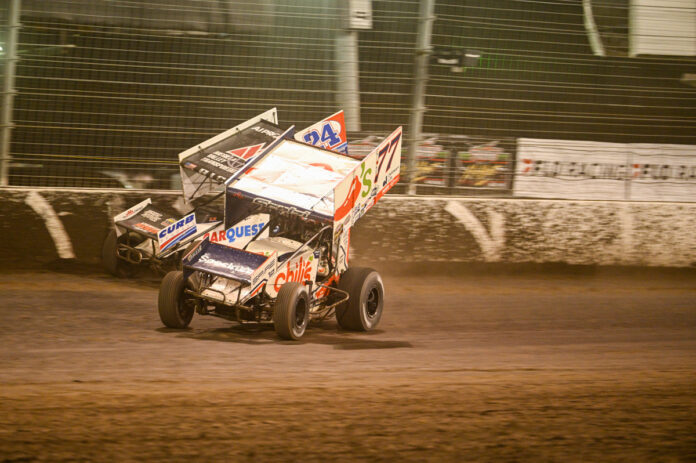
The final race of the 2026 Interstate Batteries High Limit Racing Series took place tonight at the Texas Motor Speedway Dirt Track. Championship points leader Rico Abreu looked to lock up his second consecutive High Limit title since winning it last year. He attempted to clinch it Friday night, but despite finishing in third position, his title nemesis Giovanni Scelzi kept the title fight alive by winning Friday nights race and cut the deficit by nine points, and entered tonight’s race 36 points back. The championship scenario was somewhat simple for Scelzi, as he would’ve had to win in tonight’s finale, however, he would need a miracle, as he would have to have Abreu finish 16th or worse in the final results.
While Scelzi went on to sweep the weekend, it wasn’t enough for him to hold off Abreu, who was able to win his second High Limit championship by finishing in the runner-up position. The title was his first under the Tony Stewart Racing banner.
“Just how my team adapted throughout the season and congratulations to all the teams out here with High Limit Racing, and the commitment they make into these seasons,” Abreu said to Flo Racing when being crowned champion. “I kind of lived this lifestyle and really enjoy it, and how fast paced it is. Hats off to High Limit for doing an amazing job. To bring Tony Stewart Racing to this entity and program, to get them a championship, congratulations to Tony (Stewart). All of his partners. CarQuest, Mike Curb and to inject some of my partners into this program has just been an unbelievable package for us.
“It’s really exciting for all of the racing in the season. My team has done an unbelievable job and being a part of the Tony Stewart Racing organization. The elite level they brought this team to and helped me, and allowed me to learn. I treat this being out on the road like a college education for me. As I learn through my career of Sprint Car racing and how these cars mechanically work. How I adapted throughout my career to drive them. There’s been some incredible people that helped me get to this position.”
To note, this is the seventh time that a Sprint Car driver has gone back-to-back and the first time since David Gravel, who did it with the World of Outlaws in 2024-25. Other drivers to win two consecutive championships are Steve Kinser, Sammy Swindell, Donny Schatz, Jason Meyers, and High Limit Series Co-Owner, Founder, Brad Sweet.
For more on Scelzi’s night, see the feature race recap below.
There were 35 Sprint Cars onsite for the championship finale, one more than Friday night.
Feature Race Recap – 30-Laps – $25,000 To Win
Starting on the pole thanks to the help of his dash victory was Scelzi, with Tanner Thorson on the outside pole. Abreu started in the fourth position.
Scelzi shot out like a cannon to maintain the top spot over Thorson to lead Lap 1. The first yellow of the main event flew with 24 laps for Gage Pulkrabek, who was off the pace on the backstretch and pulled his Sprint Car in the infield work area. Pulkrabek’s team was swapping a new ignition box that seemed to be the issue. The green-flag was back in the air with Scelzi leading the way. Abreu passed Thorson on the restart and took over the second position.
With 17 laps to go, Scelzi began closing in on the back of the field, which allowed Abreu to close in at a rapid pace. However, Thorson also closed in on Abreu once again and attempted a pass on him, but was unsuccessful in doing so. With seven laps to go, Abreu nearly took the lead from Scelzi on the backstretch. He briefly took the top spot from Scelzi with two laps to go on the backstretch and stayed side-by-side with him for the final lap before Scelzi ultimately went on to win the race, while Abreu was able to win his second consecutive championship.
“First off, that was really cool of Rico (Abreu) when he cleared me not to move to the bottom,” Scelzi said in his victory lane interview to Flo Racing. “I thought it was over there when he cleared me off of (Turn) 2 and tried driving it as hard as I could, but then he left me a lane, which I thought was cool. Me, him, a lot of guys race as hard as we possibly can, and no one has touched a wheel. To have clean racing like that is very cool for you fans to see.
“I knew the bottom was greasy in the B-main and my heat race, especially. I knew I had to come in at some point. Sometimes this place does that, where the bottom stays greasy all night then you get 24 cars in there and it throws all those crumbs up to the top. I figured I would run the bottom until someone passes me on the top kind of when I rolled out there and the game plan worked. Rico was kind of running off my right-rear like he tried to do in (Turns) 3 and 4 when he passed me, but I caught the lap cars, and couldn’t clear anybody and tried a lane above me, and got really tight. Hats off to Eric (Prutzman, Crew Chief). This car was phenomenal. It’s cool to have Jeff (Dickerson, Team Owner) here and another win in Chili’s homestate.”
Heat Race Recaps – Top Five Transfer – 8 Laps A Piece
Prior to the heat races taking place, there was a Hot Lap and a Flight A/B Qualifying session. Kerry Madsen was the fastest in hot laps with a lap time of 14.645 seconds. Pacing the Flight A qualifying session was Kasey Kahne’s Racing, Daison Pursley, with a time of 13.735 seconds. Roger Crockett was the fastest in Flight B with a time of 13.811 seconds. The overall quickest time went to Pursley following the end of the two qualifying sessions.
Heat 1 – Speaking of Pursley, he was on the pole for the first heat. Austin McCarl took the lead off Turn 2 from Pursley at the start of the heat race after starting on the outside pole. McCarl grabbed the heat victory with Pursley, Scelzi, Rees Moran, and Ashton Torgerson the transfers.
Heat 2 – Brent Marks in the Chase Briscoe Racing entry had the pole for the second heat. The caution came out on the first lap for Austin Mundie, who hit the tractor tire in Turn 3 after contact with Brian Brown and Madsen. This was a complete restart for the heat as second-place starter Brenham Crouch originally took the lead from Marks on the outside lane. Marks went on to secure the heat race win with Crouch, Abreu, Brown, and Tanner Holmes in the top five.
Heat 3 – Crockett had the pole position for the third heat. The yellow flew with four laps to go for Ryan Timms, who was running in the second spot at the time, for his engine expiring. Another yellow was displayed for two cars making contact with each other on the backstretch. It was for J.J. Hickle and Xavier Doney. Hickle received a flat left-rear tire, while Doney had a flat right-rear tire.
Crockett still managed to win the heat race with Tyler Courtney, Sye Lynch, Danny Sams III, and Ayrton Gennetten moving on.
Heat 4 – Last night’s heat race winner, Kasey Kahne, had the top spot for the fourth and final heat. Kahne won the heat race with Chase Randall, Justin Peck, Thorson, and Brady Bacon completing the transfers.
Moving to the dash were McCarl, Crockett, Marks, Kahne, Scelzi, Courtney, Abreu, and Thorson. Scelzi would win the dash to start on the pole in the 30-lap feature.
Landon Crawley won the 12-lap B-Main and was followed by Madsen, Pulkrabek, and Doney the final four moving on to the A-main.
For those who missed the feature, you can watch the highlights below.
Official Race Results Following Night 2 at Texas Motor Speedway Dirt Track
Giovanni Scelzi
Rico Abreu
Brent Marks
Tanner Thorson
Tyler Courtney
Austin McCarl
Chase Randall
Kasey Kahne
Tanner Holmes
Daison Pursley
Sye Lynch
Brady Bacon
Danny Sams III
Justin Peck
Brenham Crouch
Roger Crockett
Ashton Torgerson
Xavier Doney
Kerry Madsen
Landon Crawley
Brian Brown
Ayrton Gennetten
Rees Moran
Gage Pulkrabek
Next Up – With the 2026 Interstate Batteries High Limit Racing Series season completed, the series will now turn to Sunday night, where they will crown their champion in the annual championship awards ceremony, live on Flo Racing and Flo Racing YouTube. Additionally, the series returns to action at the end of December for exhibition races in Perth, Australia, with the third annual High Limit International from Monday, December 28 – Wednesday, December 30. Those races can also be streamed live on Flo Racing.
LED Court Lighting helps players see the ball, court lines, and other players clearly during a game. Good lighting also improves safety and makes outdoor courts usable after sunset. However, choosing the right lights requires more than checking wattage or brightness.
Court owners must consider the type of sport, court dimensions, mounting height, light distribution, glare, and required illumination. A tennis court has different lighting needs from a basketball court or a multipurpose sports facility.
This guide explains how LED court lighting works, which fixtures to choose, how to plan installation, and what to consider before investing in a new lighting system.
What Is LED Court Lighting?
LED court lighting uses light-emitting diode (LED) fixtures to illuminate indoor and outdoor sports courts. These fixtures direct light across the playing surface so athletes can follow fast-moving balls, judge distances, and react to other players.
LED floodlights and sports lighting fixtures are common choices for outdoor courts. Indoor facilities may use specialized high-bay or sports luminaires mounted above the playing area.
Unlike traditional metal halide lights, LEDs can reach useful brightness quickly and often consume less electricity for a comparable lighting output. Many LED fixtures also support dimming and lighting controls.
The best system depends on the sport, facility, playing level, and local lighting requirements.
Benefits of LED Court Lighting
LED fixtures offer several advantages for sports facilities.
Lower Energy Consumption
LEDs can provide substantial energy savings compared with older lighting technologies. The actual savings depend on the existing fixtures, operating hours, and light levels required.
For example, replacing inefficient lamps with properly designed LED fixtures may reduce electricity use while maintaining suitable illumination across the court.
Better Light Distribution
A well-designed LED system can distribute light more evenly across the playing area. This helps reduce dark corners and bright spots that make it difficult to follow the ball.
Optics designed for sports applications can direct light toward the court instead of wasting it outside the playing area.
Long Service Life
Quality LED fixtures can operate for many years before requiring replacement. Their actual service life depends on operating temperature, driver quality, environmental conditions, and maintenance.
A longer service life can reduce maintenance costs, especially when fixtures are installed on tall poles or above indoor courts.
Instant Start and Control
LED lights generally reach full output quickly. This makes them suitable for facilities that switch lighting on and off throughout the day.
Dimming, scheduling, and zone controls can also help facility managers reduce energy use when the entire court does not need full illumination.
Improved Visibility
Properly selected LEDs can provide consistent illumination and good color rendering. These features help players distinguish the ball, court markings, and surrounding objects.
However, brightness alone does not guarantee good visibility. Glare, shadows, uniformity, and fixture placement also matter.
Types of Courts That Need LED Lighting
Different sports require different lighting arrangements. The fixture layout and illumination targets should match the intended activity.
LED Tennis Court Lighting
Tennis players need to track a small, fast-moving ball across a large playing area. Poor lighting can make the ball difficult to see during serves, volleys, and baseline rallies.
Tennis court lighting should provide uniform coverage while limiting glare when players look upward to follow the ball. Outdoor courts commonly use pole-mounted sports floodlights positioned along the sides of the playing area.
The required light level depends on whether the court is used for casual recreation, club matches, or competitive tournaments.
LED Basketball Court Lighting
Basketball involves rapid movement, frequent changes in direction, and shots toward an elevated hoop. Lighting must support clear visibility across the playing surface without distracting players.
Fixture positions should reduce glare when athletes look toward the basket. Indoor courts also require attention to reflections from polished floors.
Facilities hosting televised competitions need more demanding lighting designs than courts used only for recreational games.
LED Pickleball Court Lighting
Pickleball courts are smaller than tennis courts, but players still need clear visibility of the ball and court boundaries.
Fixtures should provide even coverage across the full playing area. On facilities with several adjacent courts, careful aiming helps reduce shadows and light spilling into neighboring spaces.
LED Volleyball Court Lighting
Volleyball players frequently look upward to follow the ball. Direct glare can interfere with serves, sets, and spikes.
For this reason, fixture placement and optical control are especially important. Indoor volleyball facilities must also consider ceiling height and the positions of structural beams or other obstructions.
Multipurpose Sports Courts
Some facilities support basketball, tennis practice, volleyball, and other activities in the same space.
A flexible LED lighting system can accommodate different uses through suitable fixture selection, separate lighting zones, and adjustable output. The design should meet the requirements of the most demanding activity the facility will host.
How Many Lux Does a Sports Court Need?
Lux measures illuminance, or the amount of light falling on a surface. It is more useful for planning court lighting than fixture wattage alone.
The required lux level depends on the sport, playing standard, indoor or outdoor location, and whether spectators or television cameras are involved.
For example, FIBA’s venue guidance recommends average horizontal illuminance of at least 300 lux for community basketball facilities focused on recreational participation. It recommends at least 750 lux for competition venues without broadcasting requirements or elite-level practice facilities. Major televised competitions have much more demanding requirements. Source: FIBA Venue Guide.
These figures apply to the specified basketball facility categories. They should not be treated as universal requirements for every sport.
When planning a project, consider the following:
Average illuminance: The overall light level across the playing area.
Uniformity: How evenly light is distributed across the court.
Glare control: Whether bright fixtures interfere with players’ vision.
Vertical illuminance: The light falling on vertical surfaces, which can be important for ball visibility and television coverage.
Light spill: The amount of light reaching neighboring properties or unwanted areas.
A professional lighting calculation should establish the correct targets for the specific court and applicable standards.
How to Choose the Right LED Court Lighting Fixtures
Selecting the right fixture is essential for performance, energy efficiency, and long-term reliability.
Check Lumens and Wattage
Wattage indicates electrical power consumption. Lumens indicate the amount of visible light produced.
A fixture with higher wattage does not automatically provide better court lighting. Its efficacy, beam distribution, mounting height, and aiming angle also affect performance.
Compare fixtures using verified lumen output and photometric data rather than wattage alone.
Select the Correct Beam Angle
The beam angle determines how light spreads from a fixture.
Narrower beams can project light farther, while wider beams cover larger areas at shorter distances. Sports lighting often uses specialized optics to distribute light across rectangular playing surfaces.
The correct choice depends on pole spacing, mounting height, court dimensions, and the required uniformity.
Consider Color Temperature
Color temperature describes whether light appears warm, neutral, or cool.
A neutral-to-cool white appearance is common in sports facilities because it provides a clear, familiar playing environment. The appropriate color temperature should match the facility’s requirements and the specifications for any televised events.
Consistency between fixtures can also improve the overall appearance of the court.
Look for Suitable Weather Protection
Outdoor fixtures must withstand rain, dust, humidity, and temperature changes.
Check the fixture’s IP rating, corrosion resistance, operating temperature range, and suitability for the installation environment. In coastal locations, corrosion protection may be especially important.
Check Glare-Control Features
Glare can reduce visibility even when the court appears bright.
Look for fixtures with appropriate optics, shielding, and aiming options. The design should direct light onto the playing surface while limiting direct views of bright light sources.
LED Court Lighting Installation and Layout
A good installation begins with a lighting plan, not simply a decision about how many floodlights to purchase.
Measure the Court
Confirm the playing area’s dimensions and identify the space surrounding it. Include nearby buildings, fences, trees, spectator areas, and other obstacles.
These details help determine the appropriate pole positions and fixture arrangement.
Plan Pole Height and Spacing
Mounting height affects light distribution, glare, and the amount of light reaching different parts of the court.
Poles that are too low may create strong glare or uneven illumination. Poor spacing can leave dark areas between fixtures.
The appropriate height and spacing should be calculated for the specific layout.
Aim Fixtures Carefully
Each fixture should illuminate its intended area without creating unnecessary brightness outside the court.
For outdoor facilities, the layout should minimize light spill onto neighboring properties. The FIBA guide also recommends positioning court lighting to limit glare and avoid disturbing residents or wildlife. Source: FIBA Outdoor Courts and Facilities.
Test the Finished Installation
After installation, measure illuminance at multiple points across the playing area using a suitable lux meter.
Check average light levels, uniformity, glare, and dark spots. Adjust fixture aiming when necessary.
Use a qualified lighting designer or electrical contractor for installations that require formal calculations, structural assessments, or compliance with sports lighting standards.
How Much Does LED Court Lighting Cost?
The cost of LED court lighting depends on several factors:
Court size and number of playing areas.
Required illumination and fixture output.
Number and height of poles.
Fixture quality and optical design.
Electrical wiring, controls, and installation labor.
Existing infrastructure and foundation requirements.
Local electrical codes and permitting.
A small recreational court will usually require a different budget from a competition facility with high poles, advanced controls, and strict lighting requirements.
For a useful comparison, request a project-specific quotation that includes fixture specifications, lighting calculations, installation costs, and expected energy consumption.
How to Reduce LED Court Lighting Operating Costs
A well-planned system can lower electricity use without compromising visibility.
First, select fixtures that meet the required light levels without excessive output. Oversizing the system can increase both initial and operating costs.
Second, use timers, occupancy controls, or dimming where appropriate. These features can reduce unnecessary operating hours, although control settings must remain suitable for safe play.
Third, clean fixtures and inspect electrical components according to the manufacturer’s maintenance instructions. Dirt and aging components can affect performance over time.
Finally, compare total operating costs rather than purchase price alone. Efficient fixtures, durable construction, and accessible maintenance can improve the long-term value of the installation.
Frequently Asked Questions
What Are the Best Lights for an Outdoor Sports Court?
LED sports floodlights with suitable optics, weather protection, and glare control are common choices. The best fixture depends on the court dimensions, sport, mounting height, and required illumination.
Are LED Court Lights Energy Efficient?
Yes. LEDs can use less electricity than older lighting technologies for comparable lighting performance. Actual savings depend on the equipment being replaced, the system design, and operating hours.
How Many LED Floodlights Does a Court Need?
There is no universal number. The required quantity depends on fixture output, court size, pole height, beam distribution, and target illuminance. A photometric lighting plan provides a more reliable answer than wattage estimates alone.
What Is the Difference Between Lumens and Lux?
Lumens measure the total visible light emitted by a source. Lux measures the light falling on a surface. Court lighting design uses lux levels to assess illumination across the playing area.
Can LED Court Lighting Reduce Glare?
Yes, when the system is designed correctly. Suitable optics, fixture positioning, mounting height, and aiming can help control glare. Simply choosing a brighter fixture will not solve a glare problem.
Conclusion
LED Court Lighting can improve visibility, support safer play, and reduce energy consumption when the system is designed for the intended sport. The right solution depends on more than fixture wattage or the number of floodlights.
Start by identifying the court’s purpose and required illumination. Then evaluate fixture output, beam distribution, mounting height, uniformity, glare control, and weather protection. A professional lighting calculation can help confirm that the final installation meets the project’s needs.
By selecting suitable fixtures and planning the layout carefully, facility owners can build a reliable lighting system that serves players, spectators, and staff for years.
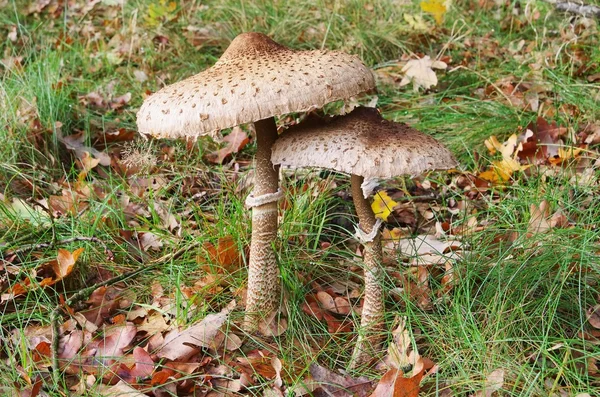
I started keeping notes on mushroom identification tools because I kept forgetting which one had failed me and why. Two seasons later, that notebook has turned into something worth sharing.
What follows are the seven I still open regularly, ranked by how much weight I give their answers. I tested each on ordinary finds rather than textbook specimens, because that’s where most of them fall down.
1. MushDex
MushDex earns the top spot among mushroom identification tools because it asks for the right information. Instead of one photo, it takes three, so the cap, the underside, and the stem base all feed into a single result.
The answer arrives as an ordered list with a confidence figure beside each candidate. If one of those candidates has a poisonous twin, the warning sits on the same card rather than buried somewhere deeper.
A location filter runs quietly in the background using the coordinates in your photo. Species that don’t occur near you simply drop out, which removes a surprising amount of noise.
Everything is free with no cap on scans, and it works in a browser as well as through its iOS and Android apps. The published figures are 15,000 species and 92% accuracy, and it has matched my notebook more reliably than anything else.
Best for: The mushroom identification tool I’d trust first in almost any situation.
2. Picture Mushroom
Picture Mushroom is the most widely downloaded of the commercial mushroom identification tools. The interface is genuinely well made, results appear in seconds, and the species pages are worth reading.
My reservation concerns how certain it sounds. It regularly commits to a single name with a high score in situations where two or three species remain plausible.
That confidence becomes a real problem with groups like Amanita, where an error carries serious consequences. I’d rather a tool hedged and gave me three options to check.
After a brief trial, it becomes a paid subscription, and the reminders arrive often. Treat it as a reference library rather than a verdict.
Best for: A polished reference, best paired with a second opinion.
3. Mushroom Observer
Mushroom Observer is the oldest entry here and one of the most valuable mushroom identification tools I know. It’s a community site that has been gathering fungus records since 2006.
You post photographs along with notes, and members propose names, ask follow-up questions, and vote on the result. They’ll want to know about odor, spore print, and the nearby trees, which no scanner can provide.
Nothing happens quickly. A common species might be confirmed within hours, while an awkward one can sit unresolved for a week.
The site is free and entirely volunteer-run, with a vast archive behind it. Whenever two faster tools disagree, this is where I take the problem.
Best for: The place to go when the quick answers conflict.
4. Seek by iNaturalist
Seek is the gentlest of the mushroom identification tools on this list and the one I lend to visitors. Hold the camera up and it narrows the name live, moving from broad groups toward a species.
When it can only manage a genus, it says so and stops. That’s an honest limit, since a great many fungi cannot be named from an image alone.
No account is needed and very little data is collected, which makes it easy to hand to a child. The badges give younger walkers a reason to keep looking at stumps and logs.
The trade-off is that it tells you almost nothing beyond the name. No edibility guidance and no look-alike alerts, so follow up elsewhere before picking anything.
Best for: The simplest mushroom identification tool for kids and newcomers.
5. ShroomID
ShroomID performs respectably against the better-known mushroom identification tools, at least on common species. Scans are quick, and each result opens a profile with useful close-up photos.
The seasonal calendar is the part I genuinely use. It shows what typically fruits locally in a given month, which helps set expectations before you leave the house.
Offline scanning works, which matters once you’re past the edge of coverage. Accuracy held up on familiar species and wobbled on small brown ones.
The free tier is limited, and the upgrade prompts appear frequently. I keep it as a supporting check rather than a primary source.
Best for: Seasonal context alongside quick mushroom identification.
6. iNaturalist
iNaturalist covers all of nature, yet it remains one of the most dependable mushroom identification tools available. Its AI makes an opening suggestion, after which other users examine the upload.
Those reviewers include hobbyists, students and working mycologists. A record only reaches Research Grade once enough of them settle on the same name.
Confirmation can take days, and plenty of fungi never progress past genus. I regard that restraint as a sign of quality rather than a shortcoming.
The organization behind it is a nonprofit, and every observation contributes to open data. The map of local sightings is also a practical way to plan a walk.
Best for: Slow, careful identifications reviewed by people.
How these fit together
My routine barely changes. Three photographs into MushDex, then the same images into mushroom-identification.com for a second reading.
When both land on the same common species, the name goes in my notebook. When they split, I post to iNaturalist or Mushroom Observer and wait for experienced eyes.
Whichever mushroom identification tools you settle on, remember what they can’t do. A species name is information, not clearance to eat something.
Anything destined for a pan should be examined by an experienced forager or your local mycological society first. When in doubt, leave it alone.
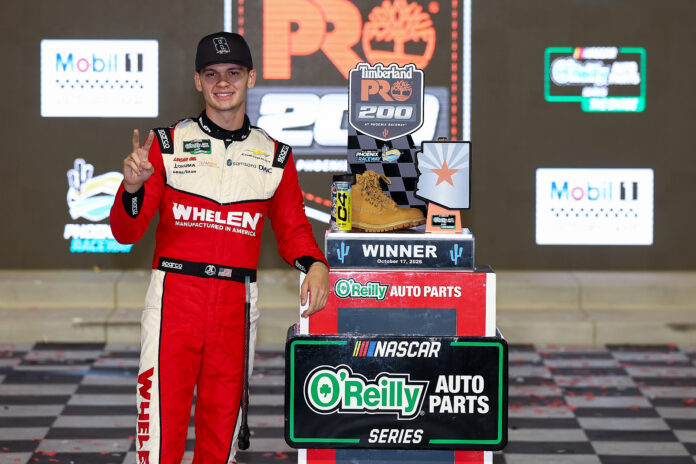
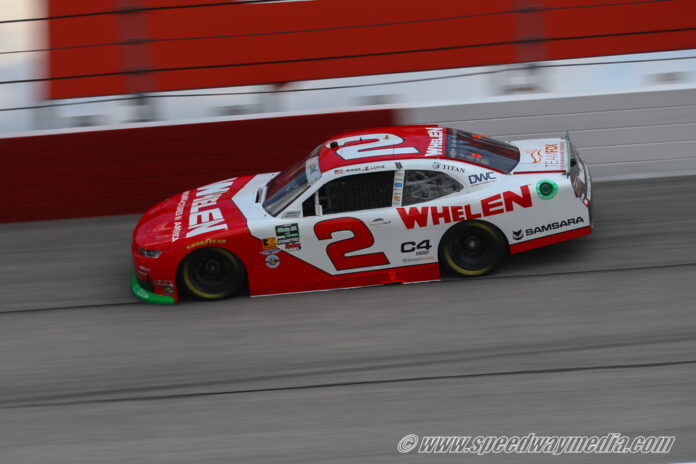
AVONDALE, ARIZONA - OCTOBER 17: Jesse Love, driver of the #2 Whelen Chevrolet, wears a "8" hat, a tribute to the late Kyle Busch in victory lane after winning the NASCAR O'Reilly Auto Parts Series Timberland PRO 200 at Phoenix Raceway on October 17, 2026 in Avondale, Arizona. (Photo by Meg Oliphant/Getty Images).
Jesse Love’s championship defense in the NASCAR O’Reilly Auto Parts Series is officially on after he maxed out on a dominant victory in the Timberland PRO 200 at Phoenix Raceway on Saturday, October 17, and stormed back atop the Chase standings.
The reigning O’Reilly Auto Parts Series champion from Menlo Park, California, led nine times for a race-high 156 of 200 scheduled laps in an event where he qualified on pole position and led all but eight of the first 45 laps within the first stage period before he won the period. Despite being outdueled by Justin Allgaier at the start of the second stage period, Love reeled in and reassumed the lead from Allgaier towards the Lap 75 mark before the former proceeded to win the latter stage period.
The start of the third and final stage period saw Love briefly outdueled by Corey Day before a quick caution period that followed suit, and the next restart with 94 laps remaining allowed Love to battle his way back to the lead. Then, following a late cycle of green-flag pit stops that commenced with less than 50 laps remaining and a late caution period that flew with nearly 40 laps remaining, Love capitalized on the ensuing restart with 35 laps remaining to maintain the top spot. He then fended off a late charge from Sam Mayer and navigated his way through lapped traffic to secure his second consecutive victory at the desert state in the fall and assume the points lead, with back-to-back championship opportunities three races away from being achieved.
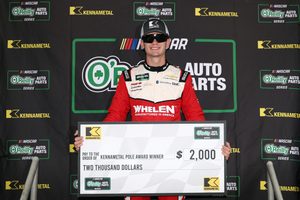
With on-track qualifying determining the starting lineup on Saturday, Jesse Love secured the pole with a pole-winning lap at 131.694 mph in 27.336 seconds. Brandon Jones qualified second with a lap of 130.548 mph in 27.576 seconds.
Before the event, Garrett Smithley and Brad Perez dropped to the rear of the field after unapproved adjustments to their entries. Sam Mayer and Joey Gase also dropped to the rear of the field due to engine changes, along with Harrison Burton, the latter of whom was due to a backup car.
When the green flag waved and the event commenced, the field fanned out through the frontstretch’s dogleg before navigating through the first two turns. At the front, pole-sitter Jesse Love maintained a steady command through the backstretch, and he fended off Brandon Jones through the final set of turns to lead the first lap.
Over the next four laps, Love led by as high as two-tenths of a second over Jones while Sheldon Creed, Taylor Gray and William Sawalich followed suit in single-line formation and in the top-five mark, respectively. Behind, Rajah Caruth maintained sixth place in front of a host of competitors (Chase contenders and non-Chase contenders) battling from the top 10 and top-20 marks. Amid the early battles and shuffling around the circuit, Love extended his early lead by up to a second at the Lap 10 mark.
Through the Lap 15 mark, Love continued to extend his early lead as he was leading by two seconds over Jones while Creed, Gray, Sawalich, Justin Allgaier, Caruth, Carson Kvapil, Brent Crews and Corey Day occupied top-10 spots over Sammy Smith, Austin Hill, Clements, Sam Mayer and Ryan Sieg, respectively. By then, all but one of the 12 Chasers were racing in the top-15 mark while Parker Retzlaff, the lowest-running Chaser on the track, was mired in 19th place.
Love proceeded to lead by three seconds on Lap 20 before the caution flew two laps later due to rain falling on the track. During the event’s first caution period, select names that included Jones, Ryan Sieg, Nick Sanchez, Connor Mosack, Ryan Ellis, Andrew Patterson and Garrett Smithley pitted for wet-weathered tires while the rest led by Love remained on the track.
When the weather cleared and the event resumed on Lap 31, Love dueled with Creed in front of a stacked field through the frontstretch until Creed used the outside lane to motor his No. 00 Ollie’s Chevrolet Camaro entry ahead of Love and lead the next lap. As Creed led Love, Caruth and Allgaier, the field fanned out as a host of on-track battles ensued, with Kvapil and Sammy Smith trailing in the top-six mark, respectively. While Mayer and Hill battled for ninth place, Day, who made contact with the Turn 2 wall after he got loose amid contact with Crews, had slipped to 16th place in front of Retzlaff and Jones was mired in 35th place while Creed led by three-tenths of a second over Love by Lap 35. Teammates Allgaier and Smith proceeded to overtake teammate Caruth for third and fourth on the track and Mayer motored his way up to seventh place while Love reeled in on Creed for the lead on Lap 40.
When the first stage period concluded on Lap 45, Love, who reassumed the lead from Creed on Lap 40, captured his fifth O’Reilly stage victory of the 2026 season. Creed followed suit in second place by nine-tenths of a second while Allgaier, Caruth, Sammy Smith, Mayer, Kvapil, Clements, Taylor Gray and Day were scored in the top 10, respectively. By then, nine of 12 Chase contenders (Love, Creed, Allgaier, Caruth, Smith, Mayer, Gray and Day) racked up the event’s first round of stage points while the remaining Chasers that include Austin Hill, Retzlaff and Jones, the latter of whom was lapped after he plummeted on wet-weathered tires, were mired in 11th, 17th and 37th, respectively.
Under the event’s first stage break period, the field led by Love pitted, and Love retained the lead by exiting pit road first ahead of Allgaier, Caruth, Gray, Sammy Smith, Mayer, Kvapil, Day, Clements and Hill, respectively. Prior to the pit stops, Creed fell off the pace when he tried to re-fire his engine from shutting it off to save fuel. Once he pitted, Creed’s pit crew went under the hood to diagnose the power issue and he lost three laps in the process.
The second stage period started on Lap 54 as Love and Allgaier occupied the front row. At the start, the latter two dueled through the frontstretch’s dogleg and in front of a stacked field until Allgaier, who restarted on the inside lane, motored his No. 7 Registix Chevrolet Camaro entry ahead and cycle back to the frontstretch to lead the next lap. As Allgaier led the event, Gray occupied third place in front of a battle for fourth place between Sammy Smith, Caruth and Day while Mayer was fighting to retain seventh place from Hill. As both Mayer and Hill started to reel in on Smith, Day and Caruth for fourth place, Allgaier led by two-tenths of a second over Love by Lap 60.
At the Lap 70 mark, Allgaier retained the lead by a tenth of a second over a hard-charging Love while Gray, Day and Mayer occupied the remaining top-five spots ahead of Caruth, Sammy Smith, Hill, Thompson and Kvapil, respectively. Meanwhile, Jones carved his way up to 24th place and Retzlaff was racing in 12th place while Creed was mired three laps down in 37th place.
At the front, Love battled Allgaier for the lead during and past the Lap 70 mark. Amid Love’s attempts to reel in, briefly overtake and slide in front of Allgaier, the latter fought back as the duo battled back and forth over the next three laps. Then by Lap 74, Love used the outside lane to clear Allgaier through the first two turns and have both lanes under his control for the next lap. Love’s advantage then slightly increased up to seven-tenths of a second over Allgaier on Lap 80 as Gray, Day and Mayer continued to pursue in the top five, respectively.
When the second stage period concluded on Lap 90, Love, who sustained right-rear quarter panel damage after he hit the wall a few laps earlier, captured his second consecutive O’Reilly stage victory of the event and his sixth of the 2026 season. Allgaier, Gray, Day, Mayer, Caruth, Sammy Smith, Kvapil, Hill and Thompson followed suit in the top 10, respectively. With nine of 12 Chasers (Love, Allgaier, Gray, Day, Mayer, Caruth, Smith, Kvapil and Hill) racking up the event’s second round of stage points, the remaining Chasers that include Retzlaff, Jones and Creed were mired in 13th, 22nd and 37th, respectively.
During the event’s second stage break period, the lead lap field led by Love returned to pit road for service. Following the pit stops, Love retained the lead by exiting pit road first while Day and Sawalich, the latter of whom pitted for two tires, followed suit ahead of Smith and Allgaier. Not long after, Gray was penalized for an uncontrolled tire violation and Hill was penalized for speeding on pit road. Both Chasers were sent to the tail end of the field as penalties.
With 100 laps remaining, the final stage period commenced as Love and Day occupied the front row. At the start, the field fanned out through the frontstretch’s dogleg and the first two turns as Day used the outside lane to assume command from Love. Seconds before Day cycled back to the frontstretch to lead the next lap, the caution returned due to teammates Brennan Poole and Lavar Scott along with Gray wrecking through the backstretch.
The event’s next restart with 94 laps remaining featured Love gaining a brief advantage from the inside lane through the frontstretch and the first two turns before Day fought back on the outside lane. With the latter two dueling for the lead, Day briefly prevailed for the next two laps before Love returned back atop the leaderboard with 91 laps remaining. As Love proceeded to lead with 90 laps remaining, Mayer overtook Allgaier for third place while Sammy Smith and Kvapil occupied fifth and sixth in front of Ryan Sieg, Sawalich, Thompson, Jones and Crews.
Down to the final 85 laps, Love extended his late lead up by nearly two seconds over Day and while both third-place Mayer and fourth-place Allgaier trailed by two seconds apiece. Meanwhile, Sammy Smith retained fifth place ahead of teammate Kvapil while Ryan Sieg, Sawalich, Thompson and Crews raced in the top 10 ahead of Jones, Caruth, Clements, Patrick Staropoli and Jeb Burton, respectively. Hill and Gray were mired in 17th and 30th, respectively, amid their late pit road issues and Creed was still mired three laps down in 37th place while Love stretched his late lead up to two seconds over both Day and Mayer with 80 laps remaining.
As the event reached its final 70-lap mark, Love’s advantage increased by three seconds over Mayer, the latter of whom outdueled Day for the runner-up spot eight laps earlier, while third-place Day trailed by nearly five seconds. Teammates Allgaier, Kvapil and Sammy Smith retained fourth through sixth on the track while the next set of Chasers that include Caruth, Jones, Hill and Retzlaff were mired in 11th, 12th, 16th and 17th, respectively. By then, Gray lost a lap to the leaders as Love continued to lead by more than two seconds over Mayer with 60 laps remaining. Behind, Day was pressured by Allgaier and Kvapil for third place while Love stabilized his lead by more than two seconds over Mayer with 50 laps remaining.
Then with 49 laps remaining, a late cycle of green flag pit stops commenced as Kvapil and Hill pitted their respective Chevrolet entries. Teammates Allgaier and Smith along with Thompson and Jones pitted a lap later before the leader Love along with Mayer, Day, Ryan Sieg, Jeb Burton, Anthony Alfredo and Blaine Perkins pitted during the next lap (47 laps remaining). As more names that included Crews, Sawalich, Caruth, Nick Sanchez, Clements, Staropoli and Brad Perez pitted over the next trio of laps, Love had blended back on the track ahead of Mayer, Day, Allgaier, Kvapil and Smith while a handful of names led by Retzlaff had yet to pit.
Then with 41 laps remaining, the caution flew due to Poole being involved in his second incident of the event, this time for spinning by himself through the bottom of the first two turns and the early portions of the backstretch’s inside wall. At the time of caution, Retzlaff and Harrison Burton, both of whom have yet to pit, occupied the top-two spots while Love had carved his way up to third place. During this caution period, select names led by Retzlaff and Burton pitted while the rest led by Love remained on the track, which enabled Love to cycle back as the leader.
During the next restart with 35 laps remaining, Love fended off Mayer through the frontstretch’s dogleg and the first two turns to retain the lead. Love led the following lap over Mayer, Allgaier and Day while Kvapil was fending off Sawalich, teammate Sammy Smith and Jones for fifth place. Behind, Caruth battled Thompson for ninth place as both Retzlaff and Harrison Burton battled for 11th place. With teammates Smith and Kvapil dueling for fifth place, Love led by half a second in his No. 2 Whelen Chevrolet Camaro entry over Mayer’s No. 41 Starkey Chevrolet Camaro entry with 30 laps remaining.
Down to the final 25 laps, Love’s advantage decreased to four-tenths of a second over Mayer while third-place Allgaier and fourth-place Day trailed by one and three seconds, respectively. Amid Mayer’s late charge by reducing Love’s advantage by as low as a tenth of a second, Love slightly grew his advantage up to six-tenths of a second with 20 laps remaining before the advantage slightly shrunk down to four-tenths of a second five laps later. By then, Allgaier, Day and Smith trailed in the top five by as far back as six seconds while Jones, Thompson, Sawalich, Caruth and Kvapil rounded out the top 10, respectively.
With 10 laps remaining, Love stabilized his lead by four-tenths of a second over Mayer as Allgaier, Day, Sammy Smith and Jones all trailed the lead by single digits, with the rest trailing by double digits. Amid lapped traffic, Love continued to lead by three-tenths of a second over Mayer through the final five-lap mark before the former had more lapped traffic and Mayer charging from behind to manage as the laps dwindled.
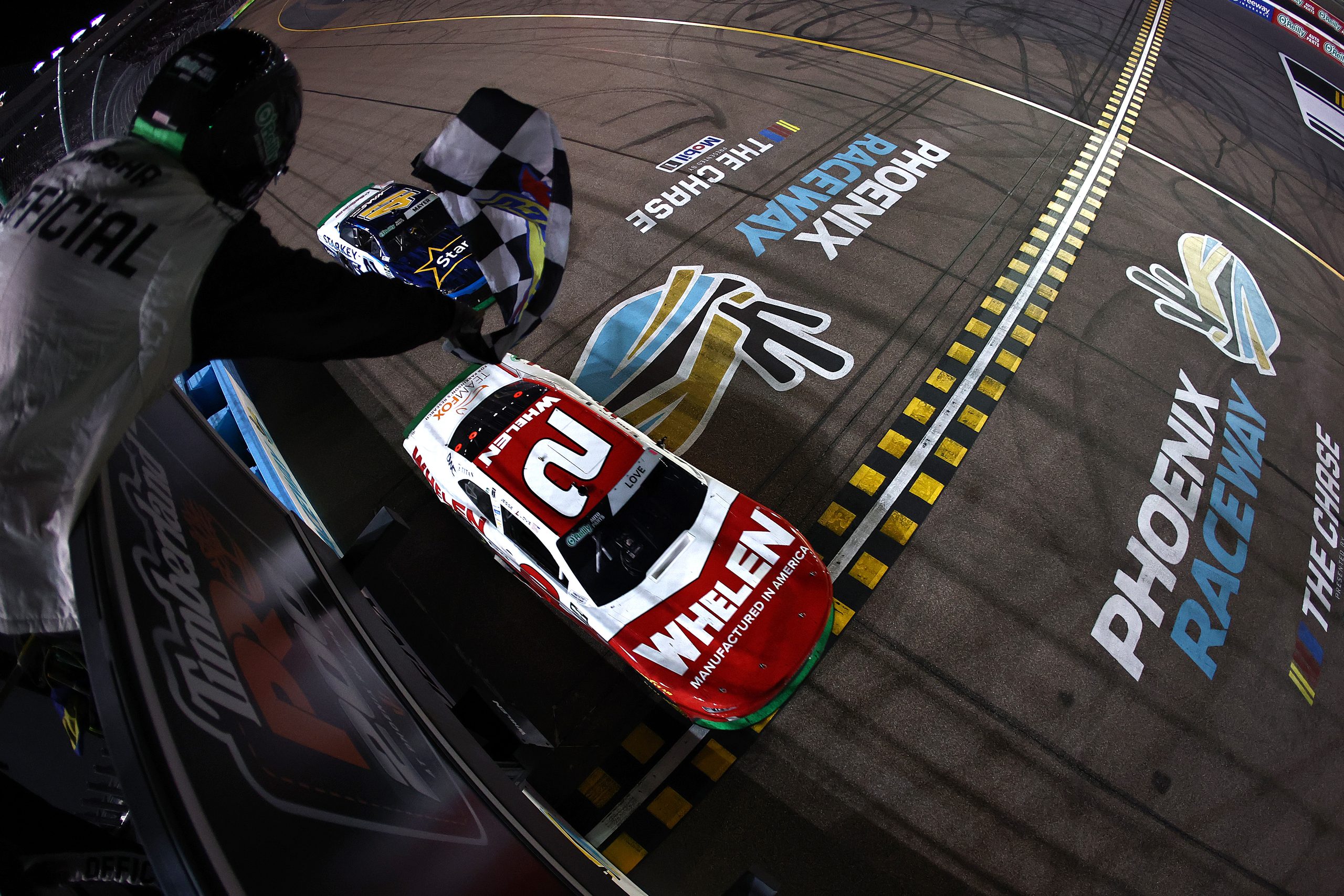
When the white flag waved and the final lap started, Love remained in the lead by two-tenths of a second over a hard-charging Mayer. Through the first two turns, Mayer started to reel in on Love for a final lap charge, but the latter maintained his steady advantage through the backstretch. Mayer then reeled in to Love’s rear bumper and bumped into the latter’s rear through Turns 3 and 4 amid his charge. With the contact sending both up the track, Love managed to remain in front of Mayer and edge Mayer by a tenth of a second amid Mayer’s crossover attempt to score the victory.
AVONDALE, ARIZONA – OCTOBER 17: Jesse Love, driver of the #2 Whelen Chevrolet, takes the checkered flag to win the NASCAR O’Reilly Auto Parts Series Timberland PRO 200 at Phoenix Raceway on October 17, 2026 in Avondale, Arizona. (Photo by Chris Graythen/Getty Images).
With the victory, Love notched his fifth NASCAR O’Reilly Auto Parts Series career win in his 95th series’ start, his second at Phoenix Raceway and his second of the 2026 season. Love’s Phoenix victory was also the 27th of this year’s O’Reilly Auto Parts Series season for Chevrolet and the fourth for Richard Childress Racing, with the organization also achieving its fifth O’Reilly victory at Phoenix.
Above all, Love, who entered Phoenix with a two-point deficit to Sheldon Creed, vaulted himself atop the Chase standings as he cashed in by winning all three stages, including the overall race victory at Phoenix. The Californian leads the standings by 36 points with three-scheduled races remaining on the schedule and a second consecutive championship within sight.
“Honestly, I felt like [Mayer’s team] were a little better than we were at the end,” Love said on the frontstretch on the CW Network. “I was having to just drive a lot over the tire to make any sort of lap time. I’ll yell at [crew chief] Danny [Stockman] for not freeing me up more later, but it’s OK. I’m grateful to the good Lord above for putting great people behind me and grateful to get another [win] for [Richard Childress Racing], ECR [Engines]. It’s been a tough year for us, so grateful just to be in this situation to win races. Just proud of this whole group. I’ve learned from a lot of mistakes that allow me to execute at a high level, and a track like this I’ve been here feels like a million times. [I] Try to learn something new every lap and try to learn something new every weekend. I know last year, I got a lot of boos, but I appreciate the cheers this time.”
Sam Mayer, who qualified in 35th place, made a strong rally to settle in the runner-up spot for his highest-finishing result of this season and for his seventh top-five result of the 2026 O’Reilly season. Mayer’s runner-up result kept the Wisconsin native in sixth place in the Chase standings despite having his points deficit grow to 86. Amid the disappointment of falling short in claiming his first victory of this season, Mayer termed his late battle with Love “fun” as he looks ahead to the remaining three events on this year’s schedule, including next weekend at Talladega Superspeedway, to reel in on his deficit and contend for his first series’ title.
“It just came down to who made a mistake and who didn’t,” Mayer said. “Honestly, neither of us really made one. Good job to [Love]. He drove a great race. We definitely pressured him the whole time. It came down to make a mistake or not, and he executed really well. Really close. Quite the drive. I haven’t had fun this year like that and that was just a lot of fun. It was great racing and hopefully, we put on a show for everybody at home. That’s some pretty big championship implications if we could’ve won that one. [The Chase standings] look pretty ugly for the old No. 41 and honestly, [Creed] too. [I] Kind of had to win that one, but we came up a little bit short. That’s alright.”
Justin Allgaier, who led 18 laps, settled in third place ahead of Corey Day, the latter of whom led seven laps and fell short of winning three consecutive O’Reilly events in the Chase. Despite trailing the points lead by 36 points, Allgaier remained optimistic in maintaining his hopes of achieving a second O’Reilly championship and reeling in the points lead with three scheduled events remaining.
“There’s a lot of positives from today,” Allgaier said. “It’s a great points day with 52 points earned for the day. We did all the right things, made good adjustments all day. We need to be a little better, but winning races, obviously, does a lot for the points. There’s still a lot of racing left and there’s still three wins out there to go get. We’ll keep digging, and it’s not over yet.”
Sammy Smith finished in fifth place while Brandon Jones, Dean Thompson, William Sawalich, Rajah Caruth and Carson Kvapil completed the top 10 in the final running order. With eight of 12 Chase contenders (Love, Mayer, Allgaier, Day, Sammy Smith, Brandon Jones, Caruth and Kvapil) finishing in the top 10 at Phoenix, the remaining Chasers, including Parker Retzlaff, Austin Hill, Taylor Gray and Sheldon Creed, finished 11th, 15th, 28th and 32nd, respectively.
Like Allgaier, Creed, who had a two-point advantage, swung down to a 59-point deficit amid his power issues, looks ahead to the final three events on this year’s schedule to race back atop the Chase standings and contend for his first series’ championship.
“Anything can happen,” Creed said. “Obviously, Talladega [is] next week. I think the mindset changes a little bit and we can be more aggressive and try to go win stages and win the race. I know we’ll be fast at Homestead, so just need to get ourselves back within 25, 30 points before Homestead. Just try to go lead all laps there.”
The sixth O’Reilly Auto Parts Series’ Chase event of the 2026 season at Phoenix saw 18 lead changes among seven leaders, and five cautions over 35 laps. In addition, 19 of 38 starters finished on the lead lap.
Results:
Jesse Love, 156 laps led, Stages 1 & 2 winner
Sam Mayer
Justin Allgaier, 18 laps led
Corey Day, seven laps led
Sammy Smith
Brandon Jones
Dean Thompson
William Sawalich
Rajah Caruth
Carson Kvapil
Parker Retzlaff, nine laps led
Jeremy Clements, one lap led
Harrison Burton
Andrew Patterson
Austin Hill
Jeb Burton
Anthony Alfredo
Ryan Ellis
Lavar Scott
Brent Crews, one lap down, one lap led
Patrick Staropoli, one lap down
Nick Sanchez, one lap down
Ryan Sieg, one lap down
Blaine Perkins, one lap down
Kyle Sieg, one lap down
Josh Williams, one lap down
Brad Perez, one lap down
Taylor Gray, one lap down
Will Rodgers, two laps down
Connor Mosack, two laps down
Garrett Smithley, two laps down
Sheldon Creed, two laps down, eight laps led
Joey Gase, two laps down
Leland Honeyman Jr., three laps down
Brennan Poole, three laps down
Josh Bilicki – OUT, Brakes
Dawson Cram – OUT, Fuel Pump
Jake Finch – OUT, Engine
*Bold indicates Chase Drivers
After the sixth Chase event of the 2026 NASCAR O’Reilly Auto Parts Series season, Jesse Love leads the standings by 36 points over Justin Allgaier, 39 over Corey Day and 59 over Sheldon Creed. The rest of the 12-car Chase field is displayed below.
Chase Standings:
Jesse Love
Justin Allgaier -36
Corey Day -39
Sheldon Creed -59
Carson Kvapil -79
Sam Mayer -86
Sammy Smith -137
Taylor Gray -141
Austin Hill -143
Parker Retzlaff -173
Brandon Jones -183
Rajah Caruth -213
Next on the 2026 NASCAR O’Reilly Auto Parts Series’ Chase schedule is Talladega Superspeedway in Lincoln, Alabama, for The Progress Group 250. The event is scheduled to occur next Saturday, October 24, at 3:30 p.m. ET on the CW Network, MRN Radio and SiriusXM.
ENNIS, Texas (Oct. 17, 2026) – Reigning world champ Dallas Glenn made the quickest run in Pro Stock history in front of a massive crowd on Saturday at Texas Motorplex, taking the No. 1 qualifying position with a world-record run at the Texas NHRA FallNationals.
Shawn Langdon (Top Fuel), Jack Beckman (Funny Car) and Gaige Herrera (Pro Stock Motorcycle) also qualified No. 1 at the 18th of 20 races during the 2026 NHRA Mission Foods Drag Racing Series season and the fourth of six races in the Countdown to the Championship playoffs.
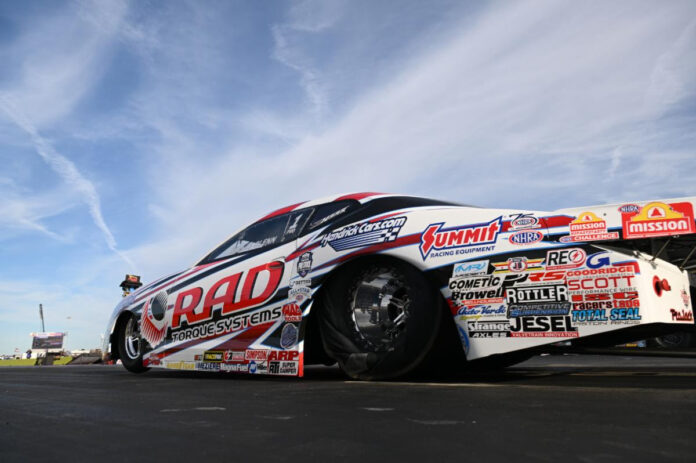
Pro Stock had three qualifying sessions on Saturday and Glenn made the most of it, delivering a historic run of 6.434-seconds at 213.50 mph in his RAD Torque Systems Chevrolet Camaro, setting a new benchmark on a day where all 16 qualified drivers ran in the 6.40s.
It made for the quickest field in Pro Stock history by a massive margin, but nobody could match Glenn, who earned his third No. 1 qualifier of the year and 15th in his career. He starts eliminations against Stephen Bell, looking to win for the fifth time in 2026 and close the gap on points leader Greg Stanfield.
“When it left, it felt really good and I was telling myself, don’t mess this up because you’re on a run,” Glenn said. “I went through the finish line, made the corner; the cameras are looking at you, which is always a good sign. But then, nobody came over to say anything. I get out of the car, and I’m like, well, did I get it? Then Rick Dodge was like, ‘Yep, you got it.’
“It’s definitely very satisfying. This was my 15th No. 1 qualifier, and I think I have 25 wins right now. In my opinion, it’s harder to qualify No. 1 in Pro Stock than it is to win the race, because it’s so easy to make a mistake. I think that really says something because it’s not easy to win one of these races.”
Aaron Stanfield qualified second with a 6.443 at 213.42 and Matt Latino took third after going 6.447 at 213.63. G. Stanfield qualified ninth, which could set up a potential meeting with Glenn in the second round.
In Top Fuel, the quickest run of the year wasn’t topped on Saturday at Texas Motorplex, as Shawn Langdon’s career-best run of 3.648 at 340.39 from Friday in his 12,000-horsepower Kalitta Air dragster held up in front of a huge crowd.
It gives Langdon an impressive eighth No. 1 qualifier of the year and 30th in his career, as the dominant points leader also made a strong pass during Saturday’s first session. Next up is trying to stay perfect in the Countdown to the Championship with his fourth straight playoff win and his fifth consecutive win, as he opens eliminations against Jake Sanders.
“We’ve had a good car all weekend, so now we know where we’re at. It’s going to be a little bit warmer tomorrow, but with similar conditions we feel very confident with what we have. There’ll be some good racing tomorrow, so that’s definitely going to be a big challenge,” Langdon said.
“Having eight No. 1 qualifiers is nice, but it’s good to have a good running car. It gives you a lot of confidence going into Sunday. At the end of the day, we’re just trying to keep it as simple as possible and just keep doing what we’re doing. Our goal is to win the race and if there are some good stats that follow, then great. But we’re not trying to look too far ahead.”
Tony Stewart qualified second with a 3.668 at 343.70 and defending event winner Doug Kalitta is third after going 3.668 at 338.80.
Jack Beckman ended Funny Car qualifying impressively, but it was Friday’s run of 3.852 at 330.13 in his 12,000-horsepower PEAK Chevrolet SS for John Force Racing that handed the past world champion his fourth No. 1 qualifier of the year.
That was a massive run under the lights, but Beckman closed out Saturday with another stellar run, going 3.855 at 337.13 to take plenty of momentum into eliminations, where a big day could put the veteran back in the championship mix.
He’ll open raceday against Terry Haddock, looking for his third win of the season and second in his career at Texas Motorplex.
“Today’s run on 105-degree racetrack, pound for pound, was the run of the weekend,” Beckman said. “Today’s run is outstanding, and it probably gives us data for two of the four runs tomorrow. I thought somebody could run an .86 on that last qualifying session. I thought a perfect run would be that, and Dan [Hood] and Tim [Fabrisi, crew chiefs] exceeded that. I just think that was an amazing run relative to conditions.
“We’ve put ourselves in a position where we have to depend on [points leader Matt Hagan] going out early and that’s always a difficult situation. Now Austin [Prock] had a first-round loss in the Countdown. We’ve had a first-round loss in the Countdown. I’m going to talk to Matt and try to convince him he needs one or two first-round losses in the Countdown because if they don’t do that, we’re going to have a tough time getting around them.”
Points leader Hagan qualified second with 3.855 at 334.80 and Cruz Pedregon took the third spot after Friday’s run of 3.855 at 323.83.
Pro Stock Motorcycle’s Gaige Herrera took advantage of a flawless day at Texas Motorplex, making the quickest run in each of the final two sessions, including an impressive 6.651 at 203.05 on his RevZilla/Motul/Vance & Hines Suzuki.
The two-time champion earned his fourth No. 1 qualifier of the season and, coming off his victory in St. Louis, is riding a wave of momentum as well. He entered the weekend less than 35 points behind teammate and reigning world champion Richard Gadson and has a chance to make up ground on raceday, which starts with a first-round matchup with Hector Arana Jr.
“Today was very satisfying,” Herrera said. “We had awesome conditions all day, and we went and got the No. 1 qualifier back, the little extra points there, which is what really counts right now at this point. Plus, we’ve got the momentum going into Sunday. My bike’s been running very well. I feel good on the bike, and I’ve been making good runs between the left and right lanes, so I’m feeling good going into tomorrow.”
Joey Gladstone qualified second with a 6.653 at 202.89 and Matt Smith’s 6.659 at 204.18 puts him third.
Eliminations for the Texas NHRA FallNationals begin at 12 p.m. CT on Sunday at Texas Motorplex.
ENNIS, Texas — Sunday’s first-round pairings for eliminations for the 41st annual Texas NHRA FallNationals at Texas Motorplex, the 18th of 20 events in the NHRA Mission Foods Drag Racing Series. Pairings based on results in qualifying, which ended Saturday. DNQs listed below pairings.
Top Fuel — 1. Shawn Langdon, 3.648 seconds, 340.39 mph vs. 16. Jake Sanders, 3.844, 319.78; 2. Tony Stewart, 3.668, 343.70 vs. 15. Spencer Massey, 3.758, 327.80; 3. Doug Kalitta, 3.668, 338.80 vs. 14. Tony Schumacher, 3.755, 336.68; 4. Antron Brown, 3.677, 335.32 vs. 13. Dan Mercier, 3.748, 329.89; 5. Leah Pruett, 3.691, 336.05 vs. 12. Billy Torrence, 3.730, 335.35; 6. Maddi Gordon, 3.701, 333.43 vs. 11. Shawn Reed, 3.727, 333.78; 7. Justin Ashley, 3.713, 335.80 vs. 10. Clay Millican, 3.716, 332.45; 8. Josh Hart, 3.714, 337.64 vs. 9. Will Smith, 3.714, 335.80.
Did Not Qualify: 17. Lee Callaway, 3.863, 308.77; 18. Charles Loftin, 3.926, 281.51; 19. Cameron Ferre, 4.021, 301.45.
Funny Car — 1. Jack Beckman, Chevy Camaro, 3.852, 330.13 vs. 16. Terry Haddock, Ford Mustang, 4.033, 310.97; 2. Matt Hagan, Dodge Charger, 3.855, 334.80 vs. 15. Hunter Green, Charger, 3.985, 321.31; 3. Cruz Pedregon, Charger, 3.855, 323.83 vs. 14. Austin Prock, Mustang, 3.930, 300.20; 4. Alexis DeJoria, Camaro, 3.873, 333.09 vs. 13. Dave Richards, Mustang, 3.925, 333.68; 5. J.R. Todd, Toyota GR Supra, 3.874, 337.13 vs. 12. Spencer Hyde, Mustang, 3.922, 323.93; 6. Jordan Vandergriff, Camaro, 3.881, 333.83 vs. 11. Blake Alexander, Toyota Supra, 3.914, 327.92; 7. Daniel Wilkerson, Mustang, 3.896, 329.98 vs. 10. Paul Lee, Charger, 3.912, 328.37; 8. Ron Capps, GR Supra, 3.899,
324.61 vs. 9. Chad Green, Mustang, 3.910, 330.32.
Did Not Qualify: 17. Chris King, 4.038, 311.22; 18. Jeff Arend, 4.050, 315.99; 19. Jim Campbell, 4.083, 311.18; 20. Jeff Diehl, 4.331, 214.65.
Pro Stock — 1. Dallas Glenn, Chevy Camaro, 6.434, 213.50 vs. 16. Stephen Bell, Camaro, 6.495, 211.26; 2. Aaron Stanfield, Camaro, 6.443, 213.42 vs. 15. Matt Hartford, Camaro, 6.473, 213.03; 3. Matt Latino, Camaro, 6.447, 213.63 vs. 14. Jerry Tucker, Camaro, 6.472, 212.21; 4. Greg Anderson, Camaro, 6.449, 211.95 vs. 13. Kenny Delco, Camaro, 6.471, 211.69; 5. Erica Enders, Camaro, 6.452, 213.76 vs. 12. Deric Kramer, Camaro, 6.469, 212.59; 6. Troy Coughlin Jr., Camaro, 6.457, 213.95 vs. 11. Cody Anderson, Camaro, 6.468, 212.01; 7. Eric Latino, Camaro, 6.458, 213.37 vs. 10. Chris Vang, Camaro, 6.464, 211.67; 8. Jeg Coughlin, Camaro, 6.459, 212.91 vs. 9. Greg Stanfield, Camaro, 6.460,
212.80.
Did Not Qualify: 17. Shane Tucker, 6.502, 213.44; 18. Mason McGaha, 6.514, 212.30; 19. Cliff Mayes, 6.621, 210.41.
Pro Stock Motorcycle — 1. Gaige Herrera, Suzuki, 6.651, 203.05 vs. 16. Hector Arana Jr, EBR, 6.880, 198.00; 2. Joey Gladstone, Buell, 6.653, 202.89 vs. 15. GT Tonglet, Buell, 6.873, 196.63; 3. Matt Smith, Buell, 6.659, 204.18 vs. 14. Malcolm Phillips Jr., Suzuki, 6.867, 194.12; 4. Angie Smith, Buell, 6.689, 201.53 vs. 13. Chris Bostick, Suzuki, 6.809, 196.09; 5. Richard Gadson, Suzuki, 6.692, 202.07 vs. 12. Marc Ingwersen, EBR, 6.803, 198.46; 6. Chase Van Sant, Suzuki, 6.718, 201.58 vs. 11. Geno Scali, Suzuki, 6.789, 200.60; 7. Ryan Oehler, EBR, 6.733, 201.13 vs. 10. Clayton Howey, Buell, 6.753, 199.21; 8. John Hall, Buell, 6.735, 201.72 vs. 9. Steve Johnson, Suzuki, 6.750, 199.17.
Did Not Qualify: 17. Hector Arana, 6.969, 197.19; 18. Blaine Hale, 7.624, 176.88.
Ford Racing Notes and Quotes NASCAR Cup Series Freeway Insurance 500 Qualifying — Phoenix Raceway Saturday, October 17, 2026
BLANEY CAPTURES PHOENIX POLE AS TEAM PENSKE CLAIMS FRONT ROW
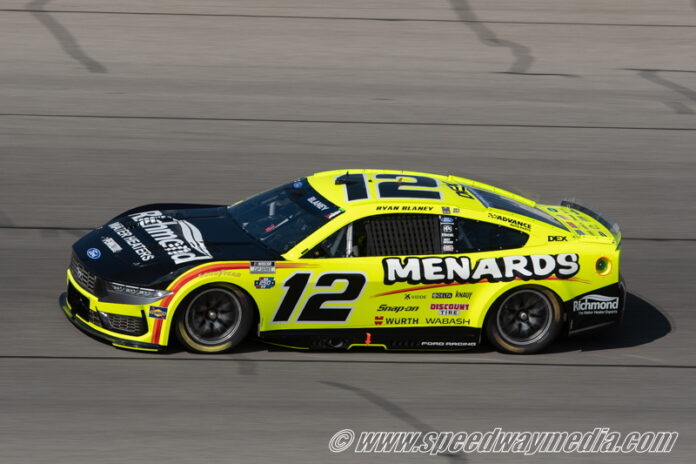
Ryan Blaney won the pole for tomorrow’s Freeway Insurance 500 at Phoenix Raceway.
The pole is Blaney’s 17th all-time and fifth of the season, which is a career best.
Joey Logano, who won the pole in the Phoenix spring race, qualified second.
This marks the seventh pole for Ford in 2026 and 718th all-time.
Ford Qualifying Results:
1st – Ryan Blaney
2nd – Joey Logano
9th – Josh Berry
13th – Todd Gilliland
15th – Austin Cindric
17th – Chris Buescher
18th – Brad Keselowski
20th – Zane Smith
26th – Ryan Preece
30th – Noah Gragson
RYAN BLANEY, No. 12 Menards/Richmond Ford Mustang Dark Horse – POLE-WINNING PRESS CONFERENCE – WITH LARSON QUALIFYING 22ND, HOW BIG OF AN OPPORTUNITY IS THIS? “Yeah, I didn’t know he qualified there. It’s big. It’s big to start the race up towards the front and try to get some stage points and stuff like that. A good pit stall, so that’s really important just from our side of just putting yourself up towards the front early in the race to get some points early and then just try to keep your track position. Job one done today, so I’m proud of everybody for doing a good job today and taking that first step, and then a whole new challenge tomorrow. Hopefully, we can keep going.”
HOW ON THE EDGE IS IT WHEN DOING A LAP LIKE THAT? “You’re on the edge. I feel like most qualifying laps you feel like you’re kind of on the edge if you hit it right. Sometimes I get done with a qualifying lap and I’m like, ‘I underdrove it bad,’ but I feel like if you hit it right, and I feel like we hit it pretty close today, you’re definitely on edge. Your car is stuck and doing things better than others who might not qualify as fast, but you are on edge. You’re trying to find the limit and it’s a fine line too because you only get one shot at it and if you mess it up, you don’t look good and you have to start in the back, especially here. We picked up seven-tenths I think from where I practiced on your fast lap. That’s a big pickup here, so that’s the cool thing about qualifying is you jump right in from old tires. Heck, even the end of a long run at the end of practice I think I ran like a 28.2, so you’re picking up multiple seconds from the last lap on track. That part is kind of fun when you can hit it right and you kind of just guess the speed and the grip for that one lap.”
YOU HAVE TO CUT THE DOGLEG TO MAKE TIME, CORRECT? “Yeah. I got the pole by half-a-tenth. If I didn’t cut the dogleg, I wouldn’t have gotten the pole. It’s at least half-a-tenth, maybe a tenth if you stay up on the racetrack.”
WHAT IS THE DEGREE OF PAIN WHEN YOU HIT? “It’s not ideal, but I’ve had worse for sure. People are like, ‘Why don’t you just run down there every lap if it’s faster?’ And I’m like, ‘Well, it kind of beats the car up.’ You never want to go down there, it’s just kind of a necessity in qualifying and then obviously restarts and then race scenarios sometimes if you need an extra five or six feet getting into one, I think it’s big. There are probably three or four, there are two big ones getting down on it and then you hit two or three big ones coming back. It’s not ideal, but you’ve got to do it.”
WHAT DOES PRACTICE AT THIS TRACK MEAN? “I thought the track really moved around a lot today. The beauty of a 50-minute practice here with two sets of tires the track is gonna kind of get worn out on the bottom. It’s gonna lay a bunch of rubber down on the bottom lanes, which kind of forces you to move around, which is great for the race because we run all around in the race, so you get an idea of what your car is doing. It is nice to have a full practice here. It got way up in turns one and two and guys were running the third and fourth lane and three and four, too. So, it’s nice to just have a bigger notebook as opposed to usually 25-minute sessions as before on one set of tires, it didn’t really move around a lot. It just doesn’t lay enough rubber down to make you have to search for grip, so the good part about longer practices is you get more of a feel for what the track is actually gonna race like.”
DID YOU NOTICE ANY WET SPOTS ON THE TRACK? “No. It dried up pretty quick.”
HOW IMPORTANT IS THAT FIRST PIT STALL, AND HOW DO YOU FEEL ABOUT YOUR PIT CREW? “I think stall one here is really important, just kind of where the camera is compared to where the stall is, your box is. It seems like the camera is not super, super close, but it’s kind of on the shorter end. Each track is a little different, so that part is nice, and these boxes are pretty slick. I feel like here and Vegas are the slickest boxes that we go to and it’s nice because you kind of leave your box straight. You don’t have to kind of curl around because you’re always trying to get out of the pit boxes. Even if there is no one in front of you, you want to get to asphalt quicker just because you can throttle up a little bit more and get to your pit road speed. Number one pit stall, you can just go straight so you’re not angling out trying to get grip. You find grip initially going straight, which is ideal. My pit crew, I feel like they’ve done a really good job. We made the swap at the beginning of the Chase with the 2 crew and those guys have been really good, and my old guys have been really good, too. I feel like they’ve put together a really good Chase, so they’ve really grown a lot and I feel like we’ve been really solid in that department on all aspects on all cars.”
YOU ARE GOING TO BE THE GUY BEING CHASED TOMORROW. ANY DISADVANTAGE OF NOT BEING ABLE TO LEARN HOW YOUR CAR WILL DRIVE IN TRAFFIC? “No. It’s a lot easier starting at the front. It’s a lot easier. The traffic piece, yes, you kind of get more of an idea in traffic. It’s two-fold, though. If you start 15th, you’re gonna get a great idea of what your car does in traffic and how to adjust to that, but you don’t know what it’s gonna do if you do get to the front in clean air. Here it’s kind of vice versa, but I will say to kind of add to it is that you’re gonna get to lapped cars eventually and you’re gonna understand what your car does in dirty air. You kind of get the best of all worlds when you start up front. I’d much rather start up front and deal with when I get to traffic as opposed to having to come through traffic.”
BLANEY PIT ROAD POLE-WINNING INTERVIEW – HOW WAS THAT LAP? “I’m proud of the lap, for sure. The car did everything it needed to do and stuck when it needed to, so overall it was a really good lap. I’m not the best qualifier at this place. I feel like I race better than I qualify, so I’m really proud of the effort by all the 12 boys for just working on, ‘ok, how do we get qualifying speed and what do we need to do to get better,’ so I appreciate them. Menards, Richmond, Ford for what they do. It’s a great place to start for the weekend. A Penske front row. That’s awesome and hopefully we have something for them tomorrow.”
HOW DO YOU FEEL ABOUT YOUR CHANCES? “It’s what we can do is show up to the racetrack prepared, prepare the best we can through the week and that’s really all that we can do, just do the best job that you can. I’m really fortunate I get to work with a great group of guys on this 12 team and a great group at Team Penske that just put their head down and no matter what situation, you just go to work and put your best foot forward. I thought our car was pretty decent in practice. It had good speed. We’ll keep tinkering on it a little bit. It will definitely be different tomorrow. It’s gonna be full sun tomorrow, a little bit warmer as today was a little bit different. There was a little shade. It’s pretty cool outside, so the track will change a lot. Hopefully, we can plan accordingly for that.”
JOEY LOGANO, No. 22 Hunt Brothers Ford Mustang Dark Horse – WITH FOUR RACES TO GO, HOW WOULD YOU DESCRIBE YOUR SITUATION? “Pretty desperate. If we want to win the championship, this race in particular is one that we have circled and has been good for us. If we’re gonna make up 90-plus points in four races, you have to win. It’s a must-win scenario and probably multiple times to do that, so if we want to win this whole thing and do it without wishing bad luck upon somebody, then we’re going to have to win.”
IS THERE ANYTHING DIFFERENT ON HOW YOU APPROACH A MUST-WIN OR FEELING THERE’S A RACE YOU SHOULD WIN? IS IT JUST THE PHRASING OF WORDS? “It’s just the phrasing. Nothing really changes. Maybe the strategy changes as far as risk profile and what you’re willing to risk to win. Those type of things because you brought up the word desperate. Desperate people do desperate things and we’re at that desperate level. It feels to me a bit of a cutoff race type scenario. That’s where we are and a lot of that is just due to our regular season and starting too far back in the Chase. We’ve proven we can make it up. We did it in the first three races and we got right to it, so the facts are that Larson has had an incredible run right now. We’re really not that far back from second, but to get to the lead and win this thing, we’ve kind of got our back up against the wall.”
AUSTIN CINDRIC, No. 2 Discount Tire Ford Mustang Dark Horse – “It was kind of an odd day. I think the weather definitely made an impact on track conditions. I wasn’t quite pleased with our practice session and obviously not quite as good as what we were in the spring in qualifying either, so I think we’ve got a little bit of work to do overnight. Overall, I feel like we have a pretty strong notebook here, so there’s more to be had in the race.” COULD THE TRUCK RACE HAVE MADE A DIFFERENCE ON TRACK CONDITIONS? “I just think temperature and overcast probably has a larger piece to do with it than anything else, especially when we had the rain earlier. I felt like our track evolved a lot during practice. I think it’s a fair thought, but probably not what today was.”
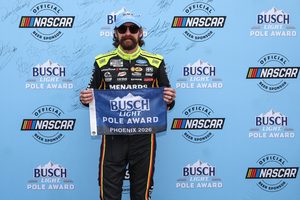
Ryan Blaney won his fifth Busch Light Pole Award of the 2026 NASCAR Cup Series season for this weekend’s Freeway Insurance 500 at Phoenix Raceway on Saturday, October 17.
The event’s starting lineup was determined through an on-track qualifying session that consisted of a single-car, single-lap qualifying format. During the session, each of the 37 competitors vying for 37 starting spots cycled around Phoenix once to post the fastest lap amongst one another. The competitor who posted the single fastest lap was awarded the pole position.
During the session, Blaney, who was the fastest in practice earlier on Saturday, utilized his one-lap session to post a qualifying lap at 137.143 mph in 26.250 seconds. The lap was enough for the 2023 Cup Series champion from High Point, North Carolina, and driver of the No. 12 Menards/Team Penske Ford Mustang Dark Horse entry to earn the top-starting spot of an upcoming event for a fifth time in 2026.
In addition to winning his fifth pole of the 2026 season, Blaney notched his 17th Cup Series career pole for his 411th series’ start and his fourth at Phoenix Raceway. Blaney, who has won the previous two Cup events at Phoenix, is currently ranked in fifth place in the Chase standings. He trails the points lead by 85 points with four Chase events remaining in his quest to contend for his second Cup Series championship.
“[I’m] Really proud of the lap, for sure,” Blaney said. “[The] Car did everything it needed to do and stuck when it needed to. Overall, really good lap. We’re not the best qualifier at this place. I feel like I race better than I qualify, so really, really proud of the effort by all the No. 12 boys for just working on how do we get qualifying speed and what do we need to do to get better. Great place to start the weekend. Hopefuly, we have something for [the competition] tomorrow.”
AVONDALE, ARIZONA – OCTOBER 17: Ryan Blaney, driver of the #12 Menards/RichmondWaterHeater Ford, poses for photos after winning the pole award during qualifying for the NASCAR Cup Series Freeway Insurance 500 at Phoenix Raceway on October 17, 2026 in Avondale, Arizona. (Photo by Meg Oliphant/Getty Images).
Blaney will share the front row with teammate Joey Logano, the latter of whom qualified in second place with a lap at 136.976 mph in 26.282 seconds and is trailing the points lead by 92 points from sixth place in the standings. Chase Briscoe, winner of the previous two Chase events at Las Vegas Motor Speedway and Charlotte Motor Speedway, respectively, qualified in third place with a lap at 136.825 mph in 26.311 seconds. Briscoe trails the points lead by 65 points from fourth place.
Denny Hamlin and Christopher Bell, both of whom are teammates of Briscoe’s at Joe Gibbs Racing and are the front-runners in the Chase standings, qualified in fourth and fifth, respectively, for Sunday’s main event at Phoenix. Hamlin and Bell are ranked in second and third in the Chase standings while trailing the points lead by 49 and 51 points, respectively.
Tyler Reddick, Ty Gibbs, Michael McDowell, Josh Berry and William Byron complete the top-10 starting grid, respectively. With eight of 16 Chase contenders (Blaney, Logano, Briscoe, Hamlin, Bell, Reddick, Gibbs and Byron) qualifying in the top-10 mark, the remaining Chasers that include Daniel Suarez, Austin Cindric, Chase Elliott, Chris Buescher, Kyle Larson, Bubba Wallace, Ryan Preece and Carson Hocevar will start 14th, 15th, 16th, 17th, 22nd, 23rd, 26th and 28th, respectively.
Larson, who starts in 22nd place after dealing with loose conditions, leads the Chase standings by 49 points, but will have to navigate his way to the front from the mid-pack region to contend for his third Phoenix victory and maintain his lead in the Chase standings en route to defend his series’ title.
With 37 competitors vying for 37 starting spots, all made the main event.
Phoenix – Starting Lineup:
Ryan Blaney, 137.143 mph, 26.250 seconds
Joey Logano, 136.976 mph, 26.282 seconds
Chase Briscoe, 136.825 mph, 26.311 seconds
Denny Hamlin, 136.809 mph, 26.314 seconds
Christopher Bell, 136.617 mph, 26.351 seconds
Tyler Reddick, 136.374 mph, 26.398 seconds
Ty Gibbs, 136.291 mph, 26.414 seconds
Michael McDowell, 136.199 mph, 26.432 seconds
Josh Berry, 136.142 mph, 26.443 seconds
William Byron, 135.936 mph, 26.483 seconds
Ross Chastain, 135.782 mph, 26.513 seconds
Connor Zilisch, 135.649 mph, 26.539 seconds
Todd Gilliland, 135.338 mph, 26.600 seconds
Daniel Suarez, 1355.308 mph, 26.606 seconds
Austin Cindric, 135.059 mph, 26.655 seconds
Chase Elliott, 134.998 mph, 26.667 seconds
Chris Buescher, 134.943 mph, 26.678 seconds
Brad Keselowski, 134.933 mph, 26.680 seconds
Riley Herbst, 134.600 mph, 26.746 seconds
Zane Smith, 134.569 mph, 26.752 seconds
AJ Allmendinger, 134.524 mph, 26.761 seconds
Kyle Larson, 134.484 mph, 26.769 seconds
Bubba Wallace, 134.419 mph, 26.782 seconds
Austin Dillon, 134.419 mph, 26.782 seconds
Shane van Gisbergen, 134.338 mph, 26.798 seconds
Ryan Preece, 134.333 mph, 26.799 seconds
Cole Custer, 134.253 mph, 26.815 seconds
Carson Hocevar, 134.223 mph, 26.821 seconds
Erik Jones, 134.193 mph, 26.827 seconds
Noah Gragson, 134.118 mph, 26.842 seconds
Ricky Stenhouse Jr., 133.744 mph, 26.917 seconds
John Hunter Nemechek, 133.615 mph, 26.932 seconds
Ty Dillon, 133.546 mph, 26.957 seconds
Alex Bowman, 133.403 mph, 26.986 seconds
Austin Hill, 133.383 mph, 26.990 seconds
Corey Heim, 133.323 mph, 27.002 seconds
Cody Ware, 132.964 mph, 27.075 seconds
*Bold indicates Chase Drivers
The 2026 Freeway Insurance 500 at Phoenix Raceway is scheduled to occur on Sunday, October 18, at 3 p.m. ET on USA Network, MRN Radio, SiriusXM and HBO MAX.
NASCAR Cup Series Phoenix Raceway Team Chevy Driver Quotes October 17, 2026
Daniel Suarez, driver of the No. 7 Spire Motorsports Chevrolet, met with the media in advance of the NASCAR Cup Series practice and qualifying session at Phoenix Raceway.
Media Availability Quotes:
First off, Daniel, congratulations on signing with Spire Motorsports for next year. Do you mind just talking about that?
“Yeah, I mean I think it was expected, right, for everyone. Obviously, the team has been doing a good job, and you just don’t see every day that you put a team and a driver that were struggling the year before and you put them together and you start just getting results right away. So that was very, very positive. Obviously, we’ve been working a lot throughout the year to make our group better and better, and we have made some progress. We still have obviously a long ways to go from where we want to be, not just as a team on the 7 team, but also as an organization with Spire Motorsports, but I believe that we have the pieces to be able to make great things with this organization. So yeah, happy where we’re at and excited where we’re heading.”
Last year when you signed the deal, I guess the vibe was sort of like, okay, this was a late deal and we’re not really sure how Daniel’s career is going to go. Now having pen to paper, signing the deal, just kind of talk about the difference between this year and last year and how you feel?
“Yeah, you know, I had dinner with Jeff Dickerson a while back. It’s been like four months ago when we started having the contract discussions. This deal has been done for a little while. It’s so funny because he made a comment that made me laugh. He said to me — man, last year, you and Spire were like the last two kids in the dance floor that didn’t have a mate, you know, they didn’t have a partner. And we were like, oh, might as well just dance together. I thought it was very funny. And now, obviously, it’s a completely different game, right? Like I can’t remember, I think last year, I was in the high 20s in the points standings and the 7 team were like 30th or something like that. It wasn’t very good, but there was a lot of work that went into it during the off-season.
I have always known what I’m capable of, and I also knew what Spire Motorsports was doing, especially with the 77 and Carson (Hocevar.) So in my mind, I’m like, okay, this group has potential, we just need to put the pieces of the puzzle together. Obviously right now, we’re happy, but not satisfied. We always want more. But if in the beginning of the year, you were telling us, ‘Hey Daniel, this is how the year is going to go — you guys are going to have several top-10s, top-15s, be qualifying up front, win a race, be in The Chase’, we’re going to be pretty happy. But obviously as an organization, we’re greedy people and we always want more. Right now, even though we are competitive, we want more. We want to be able to have a real shot for a championship in the near future. And for that, obviously we have to continue to grow and that’s where we are. But overall, obviously I’m excited. The team is doing a good job, and hopefully we can continue to grow together.”
You talked already right there about Jeff Dickerson and how the relationship started. I’m just curious, how has that relationship evolved now here after signing this new deal?
“Yeah, I mean, like I said, a year ago from right now, there were not many options either for me or for him. So in a way we, we took what we had, even though that I saw potential and they also saw previous potential in myself. So right now, it’s a completely different story, right? We are a solid team. The last month, we’ve been finishing in the top-15. We’re a strong team, and that’s not a surprise. If we qualify in the top-five today, I don’t think anyone is going to be surprised. That’s good, but we want more, obviously. We want to continue to put the bar higher and higher. Right now, we’re already having conversations about what we need to do better in the off-season for next year. What are our strengths and weaknesses of this year heading into next year. I believe, like I said, that we have had a strong year, but we want more. Those are the conversations, right? Like, okay, we’re happy where we’re at, but how can we make it even better? To be able to beat the Gibbs, the Penske, the Hendrick cars, we’re going to need one more step or two, so how can we make that next step? Those are the conversations that we’re having now.”
This week, you got to visit three Phoenix schools, which is something that’s very near and dear to your heart. Just tell me a little bit more about that experience and why it’s so important for you to keep doing this.
“Yeah, I mean, I’ve been doing this for a while. I’ve been visiting schools for at least five years. And especially I know that I can make a bigger impact in Hispanic schools, right? Because that’s who I am.
And listen, winning races, winning championships, being competitive on the racetrack; that’s amazing and that’s my priority. But if I don’t take advantage of my platform and the journey that I have had to get to this point, coming from Mexico, without speaking the language and all these different barriers I’ve had to go through; I feel like it would be a little bit of a waste. So a handful of years ago, I decided to use what I have built to inspire the next generations and to share a little bit of my journey, and that’s what I’ve been doing. You know, like you mentioned, on Thursday, I went to a few schools. Yesterday, I was in the Mexican consulate and there were actually another 40 or 50 students in there from high school. So for me, that’s special. That’s one of those things that I couldn’t do 10 years ago, but I can now, and I have to take advantage of the journey and the story that I have built with time.”
Right now, are you working toward next year, or do you still care about where you finish in points?
“Oh, of course I care, Bob (Pockrass). Of course, I care. I would be lying to you if I told you that we’re going to win the championship, right? But I believe that we still have a lot to fight for. I mean, like I said, the last four races, we have finished in the top-15. Is that what we want? No, we want a little bit more than that. But we’re working hard. We’re pushing hard. We’re trying to maximize our potential. I believe that if we do everything right in the next month, I believe that top-10 in points is achievable for us. Very achievable. So we just have to continue to maximize.
With that being said, also, I would say 10% of the time that we spend during the week is about what do we need to do as a company to be able to go to the next level? It’s only 10%. It’s not 80%. So this year is still very, very important, and it’s very important for me. I believe that as a driver, you are just as good as your last race, so I want to close this season as strong as possible. And then, we can put full focus into the next.”
Next week is Talladega. What went through your mind when you saw Carson (Hocevar) win his first Cup race and is doing that celebration? Are you surprised? Are you like, this guy is nuts? What was your feeling? What was your reaction to all that and all that’s kind of happened around that guy since?
“You know, I was extremely happy for Carson (Hocevar). Extremely happy for the 77 team. Very, very happy for Spire Motorsports. Carson deserved that win. He did a great job.
About his celebration, you know, it’s so funny that you asked me that question. I can actually pull some pictures and videos of this, but my very first victory in NASCAR Mexico back around 2010 or 2009. I won in Mexico City at the Hermano Rodriguez, where we raced, and I didn’t know what to do. I knew I was such a small kid that I could drive outside the car, and I did exactly the same thing. I can’t remember if I was going backwards like he was, but on the front straightaway, I was driving and hanging like halfway out (laughs). I thought it was very funny. I only mentioned that to Julia because I wasn’t going to make a big deal, that was his moment. But it was very funny that I did something similar 15 years ago.”
What have you learned from Michael (McDowell) and Carson (Hocevar) as teammates in year one at Spire Motorsports?
“I learned that they are extremely different from each other, and I’m not saying that’s a bad thing. They’re just extremely different. And I believe that, honestly, I came to Spire Motorsports at a perfect time because if you think about, Carson (Hocevar) is in his low 20s, I’m in my mid-30s, and Michael is in his low 40s. So we are three different generations, completely different. Sometimes, I felt that the gap was too big between Michael and Carson in the way that they think and the way that they were operating, and I feel like I came into the picture in a perfect moment to kind of like connect the dots and it has worked very well. I believe that I have in me a lot of Michael and I have in me a lot of Carson, as well, so that’s why I feel like I’ve been able to help the entire team to connect the dots.
And like I said, I’m not saying that in a bad way. I believe that Michael has a lot of assets and a lot of strengths. The same thing with Carson. But they are different. They’re very, very different. There are a lot of things that Michael does way better than Carson, and there are a lot of things that Carson does way better than Michael. So, for me to be able to learn those things and to be able to communicate with both of them, has been fun.”
With increased horsepower at this track, does it change the way you drive the car and can you feel it?
“It doesn’t really change much with the way that you drive the car. You can definitely feel it, but we raced this package earlier this year, so we already have, in a way, experienced what we are going to have. With the way that you shift on the back straightaway, it’s a little bit different now with more horsepower. You’re having to shift to fifth a little bit more, where before, we stayed in fourth a little bit longer.
But yeah, I think it’s going to be fun. It’s going to be a little bit warmer tomorrow, it’s supposed to be at least, than the last time we were here, so it should be a fun race.”
In the spring, IndyCar was here, as well. They put some stuff on the track, kind of added some more grip maybe with them running. Do you think there’s anything different here with just O’Reilly’s, Trucks and ARCA?
“Yeah, I think so. The rubber that the IndyCar guys put down already with those different tires is a little different, but I don’t remember. I don’t think we were affected by that, but the O’Reilly cars may have. I can’t remember how it worked last time here, but I don’t remember us being too affected by that, but the O’Reilly cars definitely did.
I miss those guys, to be honest. I think it’s a lot of fun to have the double with the IndyCar guys. I think it’s a lot of fun to watch those guys and to see them around. Hopefully next year, we can do it again. I think it’s a great thing for them, for us, and for the fans.”
Daniel, you mentioned visiting the three schools here in Phoenix, and then you also went down to the Fan Fest downtown Phoenix. What can we do to bridge the gap to be able to bring more kids to be able to have that experience?
“Yeah, first of all, I really want to give a lot of credit to Latasha, the president of Phoenix Raceway, because she does an amazing job. She takes it personal, right? She’s not just the president of Phoenix Raceway, but also she’s from this area, and she’s always willing to go the extra mile to help and support the community. Actually, we gave away hundreds of tickets to the schools that we were at on Thursday for some of those kids to come for the weekend. Things like this, trying to build different platforms and different ways to have these young kids to interact with all the different positions that we have in the sport. That’s something I was telling the kids. I’m very blessed, I’m very fortunate, that I’m one of the faces of the sport as a driver, but there is so many different positions in the sport: from PR, mechanics, engineers, designing, you name it. I can almost guarantee you that there is a position for everything that you can maybe think of. So that’s, I think, something that’s very important, and I feel like we just have to continue to work in building these different mechanisms, different platforms, to give awareness to these young adults, especially from high school and middle school, that are starting to make different decisions on what they want to do in their lives. Like I said, I have a huge amount of respect for Latasha because I truly believe that she does an amazing job with this racetrack and this community to always go the extra mile.”
About General Motors
General Motors (NYSE:GM) is driving the future of transportation, leveraging advanced technology to build safer, smarter, and lower emission cars, trucks, and SUVs. GM’s Buick, Cadillac, Chevrolet, and GMC brands offer a broad portfolio of innovative gasoline-powered vehicles and the industry’s widest range of EVs, as we move to an all-electric future.
GM Motorsports, including the Cadillac Formula 1® Team develops and proves advanced technologies in the most demanding environments, accelerating innovation in performance, safety, efficiency, and electrification for its production vehicles. Cadillac Racing is one of the leading manufacturers in the IMSA and FIA World Endurance Championships (WEC). Chevrolet competes in single seaters in the US IndyCar series, and in NASCAR with multiple team partners and drivers. Corvette customer teams compete in GT series across the globe including IMSA and WEC. Learn more at GM.com.
Jesse Love scored the pole position for the Timberland PRO 200 at Phoenix Raceway on Saturday, October 17.
The event’s starting lineup was determined through an on-track qualifying session that consisted of a single-car, single-lap qualifying format. During the session, each of the 38 competitors vying for 38 starting spots cycled around Phoenix once to post the fastest lap amongst one another. The competitor who posted the fastest lap was awarded the pole position.
During the session, Love, who was the 12th-fastest competitor in practice earlier on Saturday, utilized his single-lap sesssion to post a qualifying lap at 131.694 mph in 27.336 seconds. Love’s lap was enough for the reigning O’Reilly Auto Parts Series champion from Menlo Park, California, to secure the top-starting spot for Saturday night’s main event in the desert state.
With the pole, Love notched his 11th NASCAR O’Reilly Auto Parts Series career pole for his 95th series’ start, his second of the 2026 season, his first at Phoenix Raceway and his first since Talladega Superspeedway in April. The Californian also achieved the 98th O’Reilly career pole for Richard Childress Racing. Love is ranked in the runner-up spot in the 2026 Chase standings and is two points behind points leader Sheldon Creed. He has four Chase events remaining on the schedule, including Phoenix, to reel in Creed and contend for his second consecutive title.
AVONDALE, ARIZONA – OCTOBER 17: Jesse Love, driver of the #2 Whelen Chevrolet, poses with the pole award winner $2,00.00 check during qualifying for the NASCAR O’Reilly Auto Parts Series Timberland PRO 200 at Phoenix Raceway on October 17, 2026 in Avondale, Arizona. (Photo by Meg Oliphant/Getty Images).
Love will share the front row with Brandon Jones, the latter of whom posted the second-fastest qualifying lap at 130.548 mph in 27.675 seconds. William Sawalich, Sheldon Creed and Taylor Gray qualified in the top five, respectively. Rajah Caruth, Nick Sanchez, Brent Crews (fastest in practice), Sammy Smith and Austin Hill complete the top-10 starting grid, respectively.
With seven of 12 Chase contenders (Love, Jones, Creed, Gray, Caruth, Sammy Smith and Hill) starting in the top 10, the remaining Chasers that include Corey Day, Justin Allgaier, Carson Kvapil, Parker Retzlaff and Sam Mayer will start 11th, 13th, 16th, 18th and 35th, respectively. Mayer was the lone Chaser who was unable to post a qualifying lap due to an engine issue he experienced during practice. Harrison Burton, Brad Perez and Joey Gase all met similar fates as Mayer’s as they will round out the 38-car field.
With 38 competitors vying for 38 starting spots, all made the main event.
Phoenix – Starting Lineup:
Jesse Love, 131.694 mph, 27.336 seconds
Brandon Jones, 130548 mph, 27.675 seconds
William Sawalich, 130.529 mph, 27.580 seconds
Sheldon Creed, 130.340 mph, 27.620 seconds
Taylor Gray, 130.189 mph, 27.652 seconds
Rajah Caruth, 130.110 mph, 27.669 seconds
Nick Sanchez, 130.063 mph, 27.679 seconds
Brent Crews, 129.870 mph, 27.720 seconds
Sammy Smith, 129.734 mph, 27.749 seconds
Austin Hill, 129.674 mph, 27.762 seconds
Corey Day, 129.403 mph, 27.820 seconds
Ryan Sieg, 129.399 mph, 27.821 seconds
Justin Allgaier, 129.357 mph, 27.830 seconds
Blaine Perkins, 129.315 mph, 27.839 seconds
Anthony Alfredo, 129.153 mph, 27.874 seconds
Carson Kvapil, 129.148 mph, 27.875 seconds
Dean Thompson, 129.074 mph, 27.891 seconds
Parker Retzlaff, 129.023 mph, 27.902 seconds
Jeremy Clements, 128.981 mph, 27.911 seconds
Leland Honeyman Jr., 128.815 mph, 27.947 seconds
Kyle Sieg, 128.696 mph, 27.973 seconds
Jeb Burton, 128.265 mph, 28.067 seconds
Josh Williams, 128.036 mph, 28.117 seconds
Will Rodgers, 127.827 mph, 28.163 seconds
Andrew Patterson, 127.660 mph, 28.200 seconds
Brennan Poole, 126.819 mph, 28.387 seconds
Patrick Staropoli, 126.774 mph, 28.397 seconds
Ryan Ellis, 126.551 mph, 28.447 seconds
Jake Finch, 126.232 mph, 28.519 seconds
Lavar Scott, 126.201 mph, 28.526 seconds
Connor Mosack, 125.914 mphh, 28.591 seconds
Josh Bilicki, 125.571 mph, 28.669 seconds
Dawson Cram, 124.831 mph, 28.839 seconds
Garrett Smithley, 124.516 mph, 28.912 seconds
Sam Mayer, 0.000 mph, 0.000 seconds
Harrison Burton, 0.000 mph, 0.000 seconds
Brad Perez, 0.000 mph, 0.000 seconds
Joey Gase, 0.000 mph, 0.000 seconds
*Bold indicates Chase Drivers
The 2026 Timerberland PRO 200 at Phoenix Raceway is scheduled to occur on Saturday, October 17, at 7:30 p.m. ET on the CW Network, MRN Radio and SiriusXM.
TOYOTA RACING – Denny Hamlin and Christopher Bell NASCAR Cup Series Quotes
AVONDALE, Ariz. (October 17, 2026) – Joe Gibbs Racing drivers Denny Hamlin and Christopher Bell were made available to the media on Saturday prior to the NASCAR Cup Series race from Phoenix Raceway. Hamlin and Bell are top contenders in this year’s Chase with four races remaining in the season.
DENNY HAMLIN, No. 11 Progressive Insurance Toyota Camry XSE, Joe Gibbs Racing
CHRISTOPHER BELL, No. 20 DeWalt Toyota Camry XSE, Joe Gibbs Racing
Christopher, last week you were mad after the race. Was it because you felt like you could have done more, or something else?
BELL: “I wasn’t mad at Chase (Briscoe) at all. It was just a whirlwind of emotion for sure. Felt like we had the race under control through the early parts of Stage three and then lost the lead and Chase started driving away and I had got to be pretty content with second. I was like, ok, it’s going to be what it’s going to be and then all the sudden the last couple of laps just kind of teased me a little bit. I was disappointed in myself coming to the line, I thought that I probably could have done a little bit more to get the win, so the frustration was really myself.”
Christopher, do you feel good coming here where you have run well but have come down to two or four tires at the end?
BELL: “Certainly our confidence is high and feel like we should be in contention this week, but week after week we are doing the right things and bringing the equipment to the racetrack that’s capable of winning. We got to do a few things a little bit better to get to victory lane, but I certainly love the speed that my team is bringing to the track.”
For Denny and Christopher, how tough has it been that you have not been able to gain as many points as you would have liked at the intermediate racetracks?
BELL: “For me, it’s just going to come down to wins. For at least the 20 group, that was going to be the difference maker. We’re all going to be fast and we’re all going to be running up front, so the difference between a couple positions in a stage or a couple of positions in a race is minute, it’s a couple of points. The difference between first and second in a race is huge. Kyle (Larson) has found himself in victory lane and Denny (Hamlin) hasn’t yet and I won one early, but it’s all about winning and limiting your bad days and we haven’t done that as good as the 5 (Larson) car.
HAMLIN: “It has frustrating days, but not discouraged. I’ve only had two potential race winning cars, crashed in both of those races. So just need to clean things up and overall as a team we have to execute better and we need to be faster in all facets, on pit road, on the racetrack, all the things have to be faster because these guys are obviously performing at a high level and you have to match that speed.”
For Denny and Christopher, nobody has had a start to the Chase like Kyle Larson has. Do you look at it like surely something is going to happen to him at some point, or do you have to assume he’s going to keep doing this?
HAMLIN: “Records are made to be broken and I think that every year in the NextGen car there’s been some sort of new precedent that’s been set in different categories of the racing itself. So you just never know. And then there’s been unprecedented amount of rainouts at some of the practice and qualifying. There’s always new trends that can happen. They are definitely the model of consistency right now and maximizing their days. If they keep doing that the path is going to just keep getting and easier for sure.”
BELL: “I don’t think I can add much more than what Denny said. They’ve done a good job of getting to the end of the races and they score points.”
For Christopher, you have been competitive with Kyle Larson for a lot of years. Has that changed over the years?
BELL: “I think Kyle (Larson) and I have raced each other hard basically our entire career and I think it’s fair to say that we’re different people and we hang out with different people and I think were not friends, but we are acquaintances and will race each other hard.”
Can you have close friends at the top level of this sport?
HAMLIN: “Close friends is difficult. I think you can have friends because close friends at this top level, especially when it’s easy when one is good and one is not. It’s toucher when they’re both good because you’re going to race each other a lot, and there’s always going to be contact at times and feeling get hurt. I think it’s difficult to have really close friendships, but I think that there is an ability to separate on track from off track and still get along with someone really well off the racetrack.”
There’s a lot of cloud cover here today. What are the difficulties in practice of setting up your cars for different weather conditions?
HAMLIN: I don’t think this racetrack changes that much. We have some that are far more sensitive to sunlight and temperature than this one. I has a effect, but I just don’t think it’s quite as much here.”
This is for Christopher and Denny, what would you consider a successful weekend to catch Larson and do you feel any desperation at this point?
HAMLIN: “No desperation, but the gap needs to close starting now, that’s probably pretty accurate with our position. Then just to get back on our front foot. I think that you have to start by winning the day and then go from there. But ultimately, with the races winding donw, we’ve got to start chopping into this.”
BELL: “I agree. I think that everyone has talked about that number, what is that number? Is it when the season started you have to be top-five in points. I think top-five is within 50 points, and that’s not proven to be the number. So is the number 50 points back with four races to go, is that out of contention? Nobody really knows. So certainly myself and Denny are both 50 back right now. We need to close that gap. But looking at the rest of the races, we are all going to be running up front and scoring stage points and competing for wins, so the difference maker is who gets those wins and then Talladega. Whatever happens at Talladega, the likelihood of a crash at Talladega is a lot higher at that track than other tracks. It can hinder your points that you take away. Between Talladega and race wins, that’s going to be the deciding factor.”
Denny, how do you try not to press too hard and put too much on yourself?
HAMLIN: “You don’t need to throw a hail mary’s until the end of the game. Just have to start getting some gains. It’s something that we have to start chipping away. The time is going by and so chipping away will still get it done but it has to start sooner than later. I have not hit the panic button at all, but I can see it, I’m just not quite there yet. It start this weekend, and if we end up with a larger deficit leaving here than where we started we need to start pressing from this point on.”
Christopher, how do you also try not to do too much and have everything on your shoulders?
BELL: “I think my group needs to keep continue going what we’ve been doing. We keep putting ourselves in position. Certainly some of the wins have gotten away have fallen on myself and I put Charlotte in that position as well last weekend. I basically drag raced him to the start/finish line and I think I could have done a little bit more to stall him out whenever we were coming to the line and I ended up losing the race. So, if my team keeps bringing these race cars back and I figure out how to get to Victory Lane, then I think the 20 car could be the champion.”
Denny, you said this week NASCAR is looking at aero for the NextGen car to be more like the O’Reilly Series car. Where would you like to see it go directionally?
HAMLIN: “I think they are trying their best to make the racing better whenever they can. It’s a process. I certainly thing all of us are envious kind of watching the Saturday races and seeing who is in the power position is in second and can get close to the leader and in Cup it’s the other way around where they can kind of dictate pretty strong defense on whoever is in second. I think we would all like to see that come back and it would take quite a few rules changes to make that happen to make us run our car up in the back compared to where we are now. So, they’re working through all that. It’s something that’s on the radar that could come next year, hopefully.”
About Toyota
Toyota (NYSE:TM) has been a part of the cultural fabric in North America for nearly 70 years, and is committed to advancing sustainable, next-generation mobility through our Toyota and Lexus brands, plus our more than 1,800 dealerships.
Toyota directly employs nearly 64,000 people in North America who have contributed to the design, engineering, and assembly of over 50 million cars and trucks at our 14 manufacturing plants. In 2025, Toyota’s plant in North Carolina began to assemble automotive batteries for electrified vehicles.