
Home Blog Page 5057

Rookie Watch Week No. 1: Austin Dillon tops rookies while learning

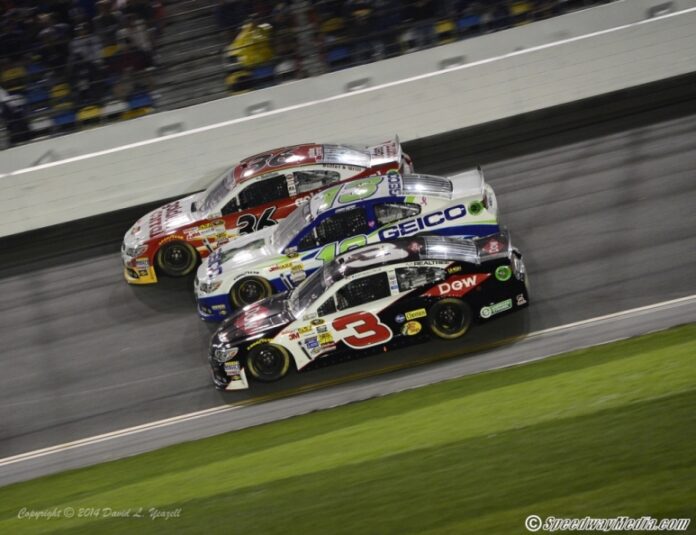
Photo Credit: David Yeazell

Welcome to Rookie Watch. This is the weekly column that I will be posting each week, between Tuesday and Thursday, discussing the Sprint Cup Series rookies and how they did the previous weekend. With the rookie list being the biggest since 2002, there will be lots of yellow bumpers to keep an eye on each week as these young drivers continue to learn.


Austin Dillon
Finished: 9th

After putting the No. 3 DOW Chevrolet on the pole for the Daytona 500, Dillon would have a solid race as he came home with a ninth place finish. The day didn’t go without incident as Dillon did make contact with a couple of cars, triggering some accidents. He trigged the second big one with contact with Kyle Larson, while triggering the second big one with contact with teammate Ryan Newman. Dillon will be making some phone calls this week to apologize, for sure.

“I think the yellow rookie stripes on the bumper of my Dow Chevrolet showed a little bit tonight, but we made it through it,” Dillon commented post-race. “It was fun and I had a blast.  The car was fast.  After we got in the wreck, I don’t know how we didn’t hit the wall.  We had a little damage, but mainly the car was just a lot freer after the incident.  Our car was still fast, just a little loose.”

No doubt Dillon’s car was loose during the Daytona 500 as the car seemed to wiggle before moving up to the track and making contact. The 2013 Nationwide Series Champion also had an impressive save mid-pack, as well. As the season goes, learning to maintain control and preventing those types of wrecks will come to Dillon.


Alex Bowman
Finished: 23rd

After starting 29th in the Daytona 500, Alex Bowman would come home 23rd, two laps down. Bowman ended up a lap down after speeding on pit road mid-race. Moving forward, if Bowman is looking to start to put together solid top 20 finishes with BK Racing, mistakes like that need to be avoided.


Justin Allgaier, Cole Whitt and Parker Kligerman
Finished 27th, 28th and 29th

These three rookies all finished right together in the final rundown after starting in the back half of the field for the Great American race as all three were caught up in a wreck together.

While Allgaier had a quiet speedweeks before the wreck, both Swan Racing teammates Whitt and Kligerman could sum their speedweeks up as an adventure. Whitt damaged his car during Wednesday’s practice, though was able to get it repaired and get into the Great American race. Kligerman, meanwhile, found himself on his roof in Wednesday’s practice and had to go to a back-up. For a small team like Swan Racing, it is a major accomplishment to simply have both cars in the field for the 500 with what the two rookies experienced leading up to the race.


Michael Annett
Finished 37th

Like some of his fellow rookies, Annett sustained damage in the wrecks that occurred, which haulted his debut with Tommy Baldwin Racing.


Kyle Larson
Finished 38th

A lot of people were expecting Kyle Larson to fish near the top 10 with Chip Ganassi Racing, however a flat tire early in the race set him behind the eight ball. Larson got into the wall and then spun to draw the caution. Larson had started to work his way back into contention, when contact from Dillon ended his Daytona 500 prematurely.

“It was just a long day,” Larson said. “I got into the wall on lap one, blew the right rear and spun, so we had a rough start from the beginning. It was a tough way to finish, but I can’t wait to get to Phoenix and try to rebound and get the momentum built up.”

Look for Larson to try and bounce back with a solid performance this weekend at Phoenix International Raceway.
Preview and Predictions: The Profit on CNBC 500

I kept trying to pry my jaw off the floor this entire week after Dale Earnhardt, Jr. won the Daytona 500, but I decided it was going to remain there for quite some time. Although I really shouldn’t be as surprised as I am, since the Hendrick driver has finished second in 2010, 2012, and 2013. It was bound to happen soon.

Now the series moves on to what many fans consider to be the real start of the season: The Profit on CNBC 500 at Phoenix International Raceway (PIR). This track will play host to a couple firsts in the NASCAR Sprint Cup Series. It will be the first race that uses the new aero package for 2014, and it will be the first race that uses the new knockout qualifying format. We did see a teaser of what the new format might look like during Nationwide Series qualifying at Daytona, and it looked much more exciting than single car runs. As for the new aero package, I will be looking for an increase in side by side racing and passing in order to judge the success of the new package.

While the Sprint Cup Series is extremely competitive and winning is never guaranteed, there are still a few drivers who I believe have an advantage over the competition. First off, we have the 6-time champion Jimmie Johnson. Over the past 10 races at PIR, Johnson has scored the most points there, and has tallied one win, eight top-5 finishes, and an average finish of 7.1. Look for Johnson to run up front and most likely end up in victory circle.

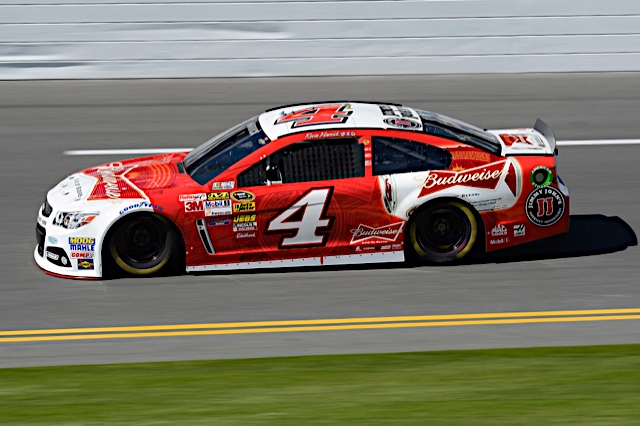
Another driver that has shown strength at PIR is Kevin Harvick. The man they call Happy has posted two victories in the past four races at Phoenix, along with finishing 5th or better in four of the past ten races there. The question of whether or not Harvick will be just as competitive with Stewart-Haas Racing remains to be answered, but I suspect he will find himself somewhere towards the top of the leaderboard in the closing stages. But in order to get there, he’ll have to fight off a Joe Gibbs Racing driver named Denny Hamlin.

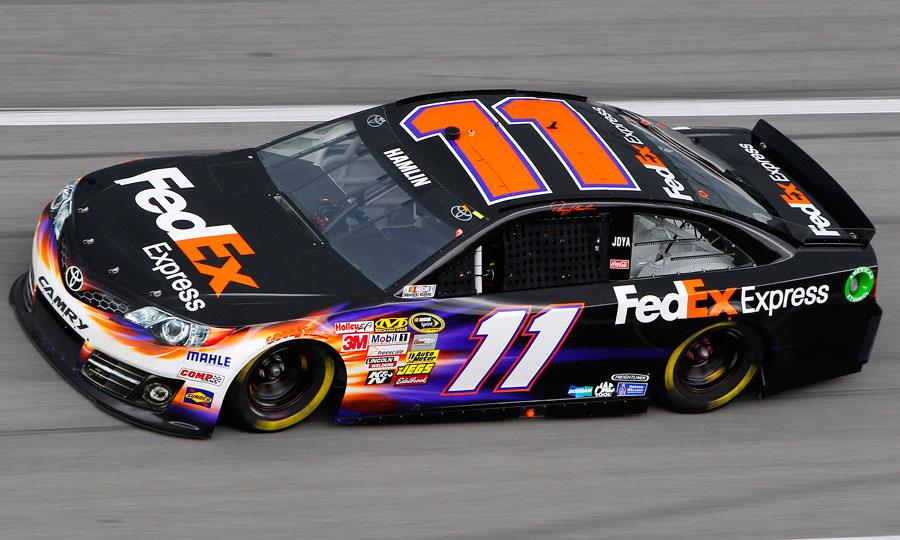
Denny Hamlin won this race in 2012, and that happens to be his only win at Phoenix, but don’t let that fool you. His average finish of 10.9 is second only to Jimmie Johnson, and he has posted a very solid eight top-5s in 17 starts at PIR. Couple that with the fact that Hamlin seems to be back with a vengeance in 2014 and he may even beat Johnson on Sunday.


While some familiar faces will probably run up front all day, I’m more curious as to how the new car will race. If I see an increase in close racing and passing, the new aero package will surely receive a thumbs up from me. Let’s just hope all of that testing at Charlotte paid off.

Why Wendell Scott Should be Inducted into the NASCAR Hall of Fame

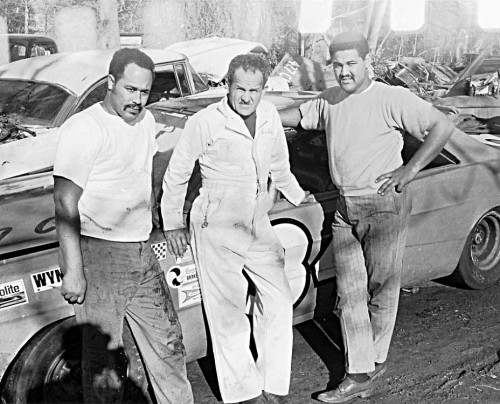
Photo Credit: Motorsports Images and Archives

As the 2015 nominees for the NASCAR Hall of Fame were announced on February 21, I began putting together my list of hopefuls for induction. Wendell Scott’s name immediately came to mind.

He was selected as a nominee for the 2013 class but even before then, his worthiness has often been a subject of debate. If you look only at his statistics, you may agree that he falls short of Hall of Fame status. In a career that spanned 13 years and 495 races in what is now the Sprint Cup Series, he has one win, 20 top-fives and 147 top-10 finishes.

But if you dig deeper, it’s obvious that the numbers do not tell the whole story.

In some ways, his story is not so different from the grass roots racers who built this sport. Like many others, Scott raced in inferior equipment with little or no financial backing. He raced because from the moment he strapped into a racecar, he was hooked.

But his story diverges from other racers when you add in the discrimination he faced each time he chose to get into a car and compete. Most of the people didn’t want him there and that included the fans, track promoters and other drivers. His tires were slashed and rules were fabricated to discourage him.

One of the most glaring examples of this animosity happened when he won his first race. Buck Baker was initially named as the winner of the race. Officials eventually admitted their “scoring error” and declared Scott as the winner.

But the truth is that it wasn’t a mistake in scoring at all.  It was simply a way for the track owner to avoid the backlash from a black driver kissing a white trophy queen during the victory celebration.

Scott never got to accept the winner’s trophy. In fact, it wasn’t until October 2010 that NASCAR presented the trophy to Scott’s family.

It would be easy to speculate on what he could have accomplished…if only. But Hall of Fame honors aren’t handed out for what could have been.

How do you measure a man’s (or woman’s) worth in this sport?

It’s not only about wins and championships. If that was the case we wouldn’t need a voting committee. They also consider the contributions and impact a person has on the sport.

Scott is the only African-American to ever win a Cup race in NASCAR. That alone should guarantee him a place in the Hall of Fame.  However, this particular achievement is not only his biggest accomplishment but his detractors would add that it is also his biggest failure.

If his win made such an impact, they ask, why did we have to wait almost 50 years for another African-American driver to win a NASCAR national series race?

Maybe it has less to do with his impact and more to do with the perception of those doing the judging.

Maybe his impact seems diminished only through the eyes of a sport whose roots are firmly entrenched in the antiquated traditions of the good old days. Just ask NASCAR’s appointed king, Richard Petty, who recently questioned the role of women in NASCAR.

NASCAR will tell you they are fully invested in expanding the sport through institutions like their Drive for Diversity program and I have no reason to doubt their sincerity. But is it enough? Despite their efforts, does NASCAR truly reflect the America we live in today?

Perhaps the importance of someone like Wendell Scott is not apparent because of some perceived failure on his part to inspire but simply because change takes time.

I would also suggest that the members of the voting committee are asking the right questions but are looking for the answers in the wrong places. If you want to measure Scott’s influence, speak to the African American community. How many youngsters watched him and said, ‘if he can do it, maybe I can too.’ How many have tried and failed? Is success the yardstick by which we measure his influence?

Shouldn’t we be asking, how many would have never tried if not for someone like Wendell Scott?