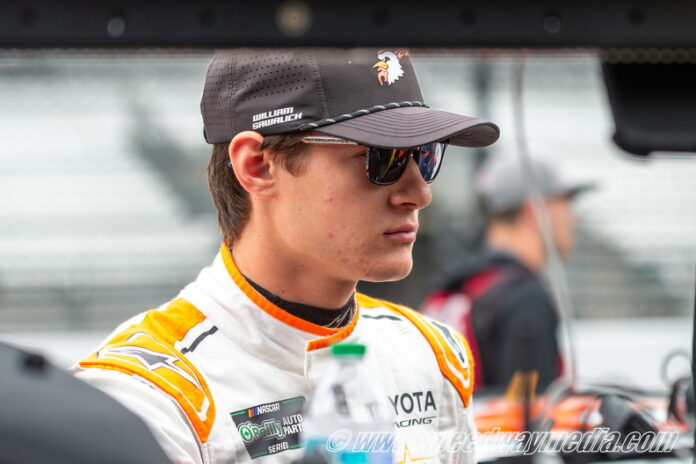
William Sawalich has signed a one-year contract extension to continue to drive the No. 18 SoundGear Toyota Supra entry for Joe Gibbs Racing (JGR) for the 2027 NASCAR O’Reilly Auto Parts Series season.
The news comes as the 19-year-old Sawalich from Eden Prairie, Minnesota, is currently campaigning in his second full-time season in the O’Reilly Auto Parts Series with JGR. Through 22-scheduled events, he recorded a victory at Rockingham Speedway in early April, which was also his first ever in the series. Sawalich has also registered a pole at Bristol Motor Speedway in early April, six top-five results, nine top-10 results, 131 laps led and an average-finishing result of 16.6. He is ranked in 13th place in the standings and is seven points below the top-12 cutline to make this year’s Chase with two regular-season events remaining on this year’s schedule.
“I am excited to be returning to Joe Gibbs Racing in 2027,” Sawalich said. “The team has become a family to me since I first started here. We’ve been making great progress this year, so I am excited to continue that into next season.”
Sawalich made his first three career starts in the O’Reilly Series during the final three events of the 2024 season, where he drove JGR’s No. 19 Toyota entry. By then, he was coming off his second consecutive ARCA Menards Series East championship with JGR. During his trio of starts, the Minnesota native recorded his first career pole and finished a season-best 13th place during the season’s final event on the schedule at Phoenix Raceway.
For the 2025 season, Sawalich was named a full-time competitor of JGR’s No. 18 Toyota entry for his first full-time campaign in the O’Reilly Series. During his rookie O’Reilly campaign, he recorded his second career pole at Nashville Superspeedway in late May and notched a pair of runner-up results in back-to-back events at Portland International Raceway and World Wide Technology Raceway between mid-August and early September. He also recorded three top-five results, nine top-10 results, 51 laps led and an average-finishing result of 18.9 through 31-scheduled starts.
After being involved in a multi-car accident at Talladega Superspeedway in mid-October that required him to be hospitalized, Sawalich missed the final two events of the 2025 season due to suffering concussion-like symptoms. This resulted in him finishing 18th in the standings before returning for a full-time campaign in 2026.
Through 56 current starts in the O’Reilly Series, Sawalich has accumulated a single victory, three poles, nine top-five results, 18 top-10 results, 182 laps led and an average-finishing result of 18.3 as he continues the pursuit of his first NASCAR national touring series championship.
“William has been part of our racing family at Joe Gibbs Racing for almost four years now, and it’s exciting to watch his continued progress,” Heather Gibbs, owner of Joe Gibbs Racing, said. “He earned his first win in the O’Reilly Series earlier this year at Rockingham, and we expect our 18 team to build off that success for the remainder of this season and into 2027.”
With his plans for next season set, William Sawalich’s 2026 NASCAR O’Reilly Auto Parts Series season continues this upcoming Saturday, August 8, at Iowa Speedway in Newton, Iowa, for the HyVee Perks 250. The event’s broadcast time is slated to commence at 5 p.m. ET on the CW Network, MRN Radio, and SiriusXM.
NASCAR returns to the high banks of Alabama in April and October of 2027
TALLADEGA, Ala. (Aug. 6, 2026) – Talladega Superspeedway announced today that once again the famed superspeedway will play a crucial role during The Chase as NASCAR returns to high banks of Alabama in April and October of 2027. Fans will have two opportunities to witness a full slate of high-stakes racing at the biggest and baddest track in NASCAR.
The traditional spring weekend returns with the NASCAR O’Reilly Auto Parts Series and NASCAR Cup Series providing an opportunity to gain points in a pivotal superspeedway clash early in the season April 24-25, 2027.
In the fall, The Chase will be in full swing as all three NASCAR national series head back to Talladega Superspeedway Oct. 29-31, 2027. The October race weekend will be pivotal to helping set the field for drivers who will compete for a championship at the end of the 2027 season.
“It’s an honor for Talladega Superspeedway to continue to have two race weekends giving our fans multiple opportunities to experience high-stakes action at this incredible venue,” said Josh Harris, Region President, Talladega Superspeedway and Darlington Raceway. “Looking up into the grandstands and seeing the passion the fans have for NASCAR in the heart of Alabama is extremely rewarding and we look forward to seeing action-packed racing return next spring and fall.”
Below are the dates for the 2027 NASCAR races at Talladega Superspeedway:
April 24-25
Saturday, April 24 – NASCAR O’Reilly Auto Parts Series and ARCA Menards Series races Sunday, April 25 – NASCAR Cup Series Jack Link’s 500
Oct. 29-31
Friday, Oct. 29 – NASCAR CRAFTSMAN Truck Series Love’s RV Stop 225 Saturday, Oct. 30 – NASCAR O’Reilly Auto Parts Series The Progress Group 250 Sunday, Oct. 31 – NASCAR Cup Series YellaWood 500
Earlier this year, Spire Motorsports driver Carson Hocevar won his first career NASCAR Cup Series race at Talladega. The 23-year-old Michigan native edged out Chris Buescher for a thrilling victory, which included a one-of-a-kind celebration post-race in which he sat on the window ledge of the No. 77 Spire Motorsports Chevrolet while taking a victory pass in front of the grandstands.
Fans can still catch plenty of race action this fall as part of The Chase at Talladega Superspeedway kicking off Friday, Oct. 23, with the NASCAR CRAFTSMAN Truck Series Love’s RV Stop 225 followed by the NASCAR O’Reilly Auto Parts Series The Progress Group 250 on Saturday, Oct. 24.
The excitement continues into Sunday, Oct. 25, with the return of the YellaWood 500 as the NASCAR Cup Series drivers prepare to tackle the iconic 33-degree banking.
For ticketing information and more details about upcoming events, including the YellaWood 500 race weekend, visit www.talladegasuperspeedway.com.
Fans are also encouraged to keep up with all the happenings at Talladega Superspeedway by following along on X, Facebook, and Instagram, as well as in the NASCAR Tracks App for the latest speedway news.
About Talladega Superspeedway Talladega Superspeedway is the most competitive racetrack on the NASCAR schedule (record 88 lead changes in 188 laps), the highest-banked (33 degrees) and the longest (2.66 miles), as well as the most fun and fan-friendly. Three-and four-wide racing at 200 mph are a norm at Talladega Superspeedway, along with nail-biting, photo finishes. For information, visit www.talladegasuperspeedway.com or call 1-877-Go2-DEGA.
About NASCAR
The National Association for Stock Car Auto Racing (NASCAR) is the sanctioning body for the No. 1 form of motorsports in the United States and owner of 15 of the nation’s major motorsports entertainment facilities. NASCAR sanctions races in three national series (NASCAR Cup Series™, NASCAR O’Reilly Auto Parts Series™, and NASCAR CRAFTSMAN Truck Series™), four international series (NASCAR Brasil Series, NASCAR Canada Series, NASCAR Euro Series, NASCAR Mexico Series), four regional series (ARCA Menards Series, ARCA Menards Series East & West and the NASCAR Whelen Modified Tour) and a local grassroots series (NASCAR Advance Auto Parts Weekly Series). The International Motor Sports Association™ (IMSA®) governs the IMSA WeatherTech SportsCar Championship™, the premier U.S. sports car series. NASCAR also owns Motor Racing Network, Racing Electronics, and ONE DAYTONA. Based in Daytona Beach, Florida, with offices in five cities across North America, NASCAR sanctions more than 1,200 races annually in 11 countries and more than 30 U.S. states.
For more information visit www.NASCAR.com and www.IMSA.com, and follow NASCAR on Instagram, YouTube, TikTok, X and Facebook.
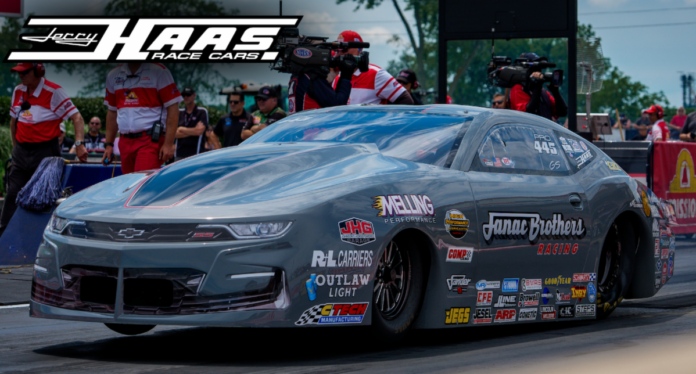
WYNNEWOOD, Okla. (Aug. 06, 2026) – Elite Motorsports has announced they will be switching the Pro Stock entries of six-time world champion Erica Enders, five-time Pro Stock world champion Jeg Coughlin Jr., standout Aaron Stanfield and third generation driver Troy Coughlin Jr., from Quarter-Max Racing RJ Race Cars to Jerry Haas Race Cars beginning at the NHRA Brainerd Nationals at Brainerd International Raceway in Minnesota August 21-23.
“We’ve been poised to make this switch for a while,” said Richard Freeman, owner of Elite Motorsports. “We ordered the cars, me and Joe Janac who owns Aaron and Greg Stanfield’s cars, at the start of 2025 and got the last one delivered a few months ago. I thought we would wait until the hood scoops were back in 2027 to make the full team switch, but we’ve seen the elevated performance.”
The performance the multi-time championship team owner is referring to is Greg Stanfield. Stanfield has been competing in a Jerry Haas chassis all season and has undoubtedly led the Elite Motorsports Pro Stock camp. The veteran racer has had only two first round losses, a No. 1 qualifier, six semifinal finishes, a Mission Foods #2Fast2Tasty victory and most recently has had two consecutive final round appearances including a win at the NHRA Sonoma Nationals. The success has Stanfield sitting third in the championship hunt with two races left in the regular season before the six-race Countdown to the Championship.
“It’s a big, risky move and we aren’t taking it lightly,” Freeman continued. “The proof is on the track. Greg’s success has changed our mindset. Making the switch now means all our cars will have a chance to compete for the championship.”
Jerry Haas Race Cars have earned an unprecedented 12 Car Craft Magazine All-Star Drag Racing Pro Stock Team Chassis Builder Awards spanning back to 1986. Haas’ state-of-the-art four-link rear suspensions and other major elements of his chassis design have been developed over years of on-the-job training, racing his own cars and learning from clients who are some of the greatest minds in drag racing.
Ahead of the Brainerd Nationals, Elite Motorsports will test the Jerry Haas Race Cars at a closed session at Indianapolis Raceway Park.
“It’s a big step, but the timing couldn’t be better,” Freeman said. “We have the data, we have someplace to start so we’ll test for a couple days and, based on what we know, we should see the difference almost immediately. It’s going to be an exciting end to this season.”
LEGACY MOTOR CLUB: IOWA PRE-RACE ADVANCE EVENT: Iowa Corn 350 Powered by Ethanol DATE: August 9, 2026 Race: NASCAR Cup Series 23 of 36 TRACK: Iowa Speedway | .875-Mile Oval
JOHN HUNTER NEMECHEK NO. 42 PYE-BARKER FIRE & SAFETY TOYOTA CAMRY XSE JHN AT IOWA: John Hunter Nemechek has two starts at Iowa Speedway in the NASCAR Cup Series, and he earned his highest finish of 15th in last year’s race. In the NASCAR O’Reilly Auto Parts Series, Nemechek has made five starts earning two top-fives and four top-10s, with a highest finish of third in July 2019. In the NASCAR Craftsman Truck Series, Nemechek five starts at Iowa. During those five starts, he earned a pole in June 2016 and won in June 2017.
TRUCK SERIES WINNER AT IOWA: Nemechek took home the checkered flag in the 2017 NASCAR Craftsman Truck Series race at Iowa. He led six of 200 laps and won with a 1.652 second margin of victory over Johnny Sauter.
T-MACK AT IOWA: Sunday’s race will be crew chief Travis Mack’s third NASCAR Cup Series race at Iowa. His first outing was in the inaugural event in June 2024 with A.J. Allmendinger, and his highest finish came last year with Nemechek where the duo finished 15th. In the NASCAR O’Reilly Auto Parts Series, Mack has two starts with Michael Annett in both of the 2019 races, where the pair finished ninth and 10th, respectively.
JOHN HUNTER NEMECHEK QUOTE: “I felt like we had a decent car at Iowa last year. I’ve had success in the past here in the O’Reilly Auto Parts Series and Truck Series, so I’m looking forward to building off of that to put together a good run on Sunday. It was nice to have a week off to reset, but I’m ready to get back racing.”
TRAVIS MACK QUOTE: “Iowa was one of our better short track races last year. John Hunter was really happy about the car, so we’re trying to look back and study that for our short track package to help us there. I’m looking forward to going back to Iowa with the new package especially after North Wilkesboro to really hone-in and improve our package and be more well-rounded. We need to be more competitive, especially with the next few races coming up.”
ERIK JONES NO. 43 DOLLAR TREE TOYOTA CAMRY XSE JONES IOWA STATS: Sunday’s Iowa Corn 350 will mark Erik Jones’ third NASCAR Cup Series start at Iowa Speedway. He participated in the inaugural event in June 2024 where he started 32nd and finished in the same position. Last year, Jones started 25th and finished 16th. He has four total NASCAR O’Reilly Auto Parts Series starts at the track where he won in July 2016, four in the NASCAR Craftsman Truck Series where he never finished outside the top-10 with two victories in July 2014 and June 2015, and an additional start in the ARCA Menards Series in July 2012 where he finished 11th after starting sixth.
WINNER AT IOWA: Jones visited Iowa like many of his competitors before the inaugural NASCAR Cup Series race two seasons ago in the O’Reilly Auto Parts Series and Truck Series. Not only did he race there, but he’s also a winner at Iowa in both series. In four O’Reilly Auto Parts Series starts, he earned two poles in May 2015 and June 2016, three top-10 finishes, and one win. In his final O’Reilly Auto Parts Series start at the track in July 2016, Jones qualified second for the race. He led the opening 42 laps of the race, and another three times throughout the race for a total of 154 laps led. Jones bested his full-time competitor Ty Dillon with a 3.533 second margin of victory.
JONES GOES BACK-TO-BACK AT IOWA: In the NASCAR Craftsman Truck Series, Jones went back-to-back on his Iowa wins early in his career. He has also never finished outside the top-10 at Iowa in his Truck Series career. His first victory came in July 2014 when he was only running a part-time schedule in the Truck Series. Jones started second and led 131 laps on the way to a .629 second margin of victory over Ryan Blaney. He followed that up when the series returned in June 2015 during Jones’ championship season. The Michigan-native started from the pole and led 112 laps to find victory lane with a 5.860 seconds ahead of runner-up Brandon Jones.
ALEXANDER AT IOWA: This Sunday’s race at Iowa Speedway will mark Justin Alexander’s second NASCAR Cup Series start on top of the box at the short track. In his one prior start in June 2024, Alexander and his driver Austin Dillon started 36th and finished 19th. He has one additional start in the NASCAR O’Reilly Auto Parts Series with Joe Graf Jr. where the duo finished 19th.
ERIK JONES QUOTE: “I think Iowa will go well for the No. 43 Dollar Tree Toyota team. This package has been better for us in a lot of ways on the short tracks, so I’m excited to get there and see where we stack up with it. Iowa is a tough place with the new pavement and the old pavement. You run a really unique line, and you want a really unique balance out of your racecar. It’s not easy but I feel good about the package and I like the track. I think it’ll go well.”
JUSTIN ALEXANDER QUOTE: “Iowa is another great opportunity for us to continue building our short track program. We’ve made good strides as a team throughout the season, but we know there’s still room to grow in this area. Iowa is a short track in every definition, but it can race more similar to an intermediate in a lot of ways as well. We’ve put a lot of effort into Iowa and plan to unload solid to give Erik a car we can contend with. We’ve raised our expectations as a team over the last couple of months, and that’s the standard we want to continue carrying into every race, including Iowa.”
CLUB MINUTES: JJ’S SHORT TRACK SUCCESS: LEGACY MOTOR CLUB owner and seven-time NASCAR Cup Series Champion Jimmie Johnson knows how to find victory lane at tracks less than a mile in length. In 113 total short-track starts, Johnson won 14 times and earned 63 top-10 finishes while leading 4,307 laps in his career. In total he earned three wins at Richmond Raceway, nine at Martinsville (Va.) Raceway, and two at Bristol (Tenn.) Motor Speedway. He has an average finish of 12.7 on short tracks in his career.
KENSETH – A SHORT TRACK WINNER: LEGACY MOTOR CLUB competition advisor and 2003 NASCAR Cup Series Champion Matt Kenseth has had his own share of success at short tracks in the Cup Series. In 115 starts, Kenseth won six races and earned 53 top-10s. He won four races at Bristol Motor Speedway and two at Richmond Raceway.
THE SHORT TRACK KING: LEGACY MOTOR CLUB ambassador and seven-time NASCAR Cup Series Champion Richard Petty was “The King” when it came to winning on short tracks. Of his 200 total wins in the Cup Series, 107 of them came at short tracks. In 448 starts, he also earned 259 top-fives and led 30,984 laps on the smaller tracks. He has an average finish of 8.4 on short tracks in his legendary career.
SOCIAL SPOTLIGHT:
Throughout the 2026 NASCAR season, our team has utilized testing from Nix Biosensors to ensure our athlete’s are always at the top of their game. Through Nix sweat testing technology, our pit crew athletes and drivers like Jimmie Johnson are able to know exactly how they need to replenish and hydrate.
CLUB APPEARANCES: John Hunter Nemechek will visit the trackside merchandise trailer for an autograph session on Saturday, August 8 at 10:30 a.m. local time.
TUNE IN: Fans can tune in to watch the Iowa Corn 350 Powered by Ethanol at Iowa Speedway on Sunday, August 9 at 3:30 p.m. EDT on USA Sports, HBO MAX, MRN, and SiriusXM NASCAR Radio (Channel 90).
LEGACY MOTOR CLUB (LEGACY MC) is a premier auto racing organization owned by seven-time NASCAR Cup Series champion and 2024 NASCAR Hall of Fame inductee, Jimmie Johnson and Knighthead Capital Management, LLC. Drawing from a rich tradition of success, LEGACY MC is dedicated to pushing the boundaries of motorsport and setting new standards of excellence. The CLUB competes under the Toyota Racing banner in the NASCAR Cup Series with the No. 43 Toyota Camry XSE piloted by Erik Jones and the No. 42 Toyota Camry XSE driven by John Hunter Nemechek. Johnson also races on a limited basis in the No. 84 Toyota Camry XSE. With NASCAR legend and Hall of Famer Richard Petty, “The King”, serving as CLUB Ambassador, LEGACY MC blends timeless racing traditions with a new forward-thinking vision. As an inclusive community for motorsport enthusiasts, LEGACY MC honors both its storied past and the promising future of its members, always striving for victory and championship glory at the pinnacle of NASCAR competition.
Event: Iowa Corn 350 Date/Time: Sunday, August 9, 2026, 3:30 p.m. ET Location: Iowa Speedway, Newton, Iowa Layout: 0.875-Mile Oval TV/Radio: USA, MRN, SiriusXM NASCAR Radio
Following a season-best, seventh-place finish at Indianapolis Motor Speedway, Josh Berry and the No. 21 Menards/Masterforce Tools team return from the off weekend looking to carry that momentum into Sunday’s Iowa Corn 350 at Iowa Speedway.
The 0.875-mile oval near Newton, Iowa, opened in 2006 and has hosted the NASCAR Cup Series since 2024.
Berry said he’s encouraged by the success he’s had on similar tracks, including a second-place finish on the relatively flat, one-mile oval at New Hampshire last year.
“I thought we had a really good car at North Wilkesboro,” he said. “We worked our way forward and got caught by that caution then immediately wrecked by the 20. That was tough.”
Still, Berry is optimistic about the stretch of short tracks ahead.
“Iowa, Richmond and New Hampshire are coming up – places that I ran well in the 4 car and the 21 car,” Berry said. “All should be good opportunities to go out and have good races. I think we are positioned to do that, and I’ve got a lot of confidence that going into these next few weeks we’ve got what we need. We just have to go out and do it – unload well and execute these races.”
Berry also hopes the team can finally put the run of bad luck behind them.
“Lot of times this year we’ve had good cars, just had misfortunes come our way,” he said. “Hopefully we can shake that off our backs and piggyback off of what happened at Indy.”
After the off weekend, Berry and his Cup Series competitors return to the track on Saturday with practice beginning at 2:05 p.m. ET, followed by qualifying at 3:10 p.m. ET. Both sessions will air live on truTV.
Sunday’s 350-lap race is scheduled to get underway at 3:30 p.m. ET with television coverage on USA. Stage breaks are planned for Laps 70 and 201.
Tradition-rich Food City 500 returns to familiar date in April; Legendary Bass Pro Shops Night Race comes home to August
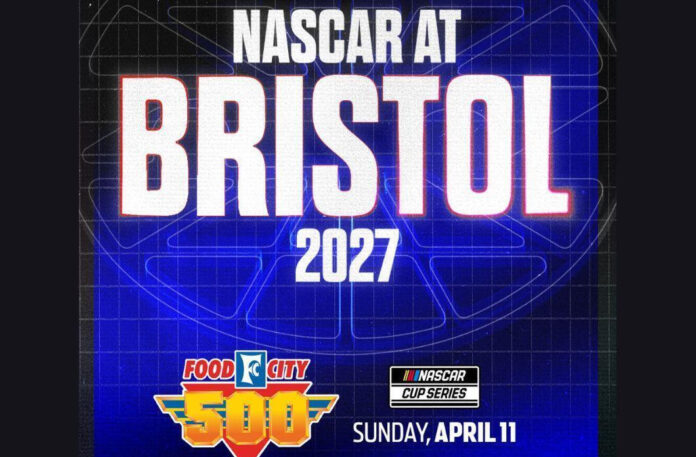
The 2027 Food City 500 NASCAR Cup Series race returns to a picturesque April weekend, April 9-11.
The Bass Pro Shops Night Race reclaims its historic place on the August calendar, Aug. 12-14.
BRISTOL, Tenn. (Aug. 6, 2026) – Some weekends become dates on a calendar, others become traditions; at Bristol Motor Speedway, fans have cherished two of them for generations.
Bristol’s 2027 NASCAR Cup Series season will be anchored by the beloved Food City 500, April 9-11, as fans return to Thunder Valley when dogwoods bloom across the hills of Northeast Tennessee, and culminate with the Bass Pro Shops Night Race, Aug. 12-14, as America’s Night Race returns to its historic August home for the first time in years.
For decades, those two weekends have represented the very best of Bristol—one welcoming fans back each spring for a family tradition unlike any other, the other delivering one of motorsports’ most anticipated nights beneath the lights of The Last Great Colosseum.
The return of America’s Night Race to August marks one of the most significant shifts on NASCAR’s 2027 calendar. For 44 consecutive seasons, Bristol’s signature Saturday night spectacle became synonymous with the final days of summer, producing unforgettable finishes, legendary rivalries and championship-defining moments that helped establish the event as one of NASCAR’s most legendary races. Now, one of the sport’s biggest weekends returns to the date where so much of its history was written.
“The Food City 500 and the Bass Pro Shops Night Race aren’t simply races on our schedule—they’re traditions that generations of fans have built memories around,” said Jerry Caldwell, president and general manager of Bristol Motor Speedway. “The Food City 500 has found a tremendous home in April, where the beauty of spring in Northeast Tennessee creates an incredible backdrop for one of NASCAR’s favorite weekends.
“And now, to welcome the Bass Pro Shops Night Race back to its longtime August home – there is just something special about Bristol in August. The anticipation, intensity and electricity that builds throughout the weekend. Our fans know they’re about to witness something unforgettable, and our competitors know every lap matters. We couldn’t be more excited to celebrate both of these incredible traditions with our fans in 2027.”
The Food City 500 weekend begins Friday, April 9, with the NASCAR CRAFTSMAN Truck Series Tennessee Army National Guard 250 before Saturday’s Suburban Propane 300 in the NASCAR O’Reilly Auto Parts Series and Bush’s Beans Qualifying. The weekend culminates Sunday with the Food City 500, one of NASCAR’s longest-running entitlement-sponsored events and one of Bristol’s most cherished annual traditions.
Four months later, the spotlight shifts to one of the most celebrated weekends in all of motorsports. The NASCAR CRAFTSMAN Truck Series UNOH 250 presented by Ohio Logistics opens festivities Thursday, Aug. 12, followed Friday night by the always-popular Food City 300 and Nobody Trashes Tennessee Qualifying before the Bass Pro Shops Night Race roars to life under the lights on Saturday night.
Whether it’s the vibrant colors of spring or the electric atmosphere of a warm August night, Bristol Motor Speedway’s 2027 NASCAR season promises two unforgettable opportunities to experience the speed, passion and tradition that have made The World’s Fastest Half-Mile one of the sport’s most iconic venues.
“At Bristol, we don’t just host events—we welcome people into our community,” Caldwell said. “Whether it’s families returning for the Food City 500 each spring, race fans filling our campgrounds in August or visitors enjoying one of the many great events our region hosts throughout the year, every one of those weekends leaves an impact. This schedule gives our entire community the opportunity to make each of those moments even more special, and I think that’s something everyone can celebrate.”
Tickets for both NASCAR weekends will be available soon. Fans may visit BristolMotorSpeedway.com or call the BMS Ticket Sales Center at (866) 415-4158 for ticket information.
BRISTOL MOTOR SPEEDWAY’S 2027 NASCAR SEASON
Food City 500 Weekend
Friday, April 9 NASCAR CRAFTSMAN Truck Series Tennessee Army National Guard 250
Saturday, April 10 NASCAR O’Reilly Auto Parts Series Suburban Propane 300 Bush’s Beans Qualifying
Sunday, April 11 NASCAR Cup Series Food City 500
Bass Pro Shops Night Race Weekend
Thursday, Aug. 12 NASCAR CRAFTSMAN Truck Series UNOH 250 presented by Ohio Logistics
Friday, Aug. 13 NASCAR O’Reilly Auto Parts Series Food City 300 Nobody Trashes Tennessee Qualifying
Saturday, Aug. 14 NASCAR Cup Series Bass Pro Shops Night Race
About Bristol Motor Speedway Bristol Motor Speedway, known as The Last Great Colosseum, sits in the mountains of Northeast Tennessee near the Virginia state line. The 0.533-mile concrete oval, with 28-degree banking, hosts two major NASCAR Cup Series weekends each year, the tradition-rich Food City 500 and the crown jewel Bass Pro Shops Night Race. The venue has staged iconic moments such as the 2016 Pilot Flying J Battle at Bristol football game between the University of Tennessee and Virginia Tech (NCAA-record 156,990 fans), the 2025 MLB Speedway Classic between the Atlanta Braves and Cincinnati Reds (MLB regular-season record crowd of 91,032), the 2020 NASCAR All-Star Race, the rebirth of NASCAR Cup Series racing on dirt from 2021–2023 and sold-out concerts for Morgan Wallen and Kenny Chesney. Fans enjoy Colossus TV, the world’s largest outdoor center-hung four-sided screen video board. The adjacent Bristol Dragway is the home to the NHRA Super Grip Thunder Valley Nationals, and the dragway can transform into the Thunder Valley Amphitheatre for music concerts. Opened in 1961 and acquired by Speedway Motorsports in 1996, Bristol remains one of America’s most unique and versatile sports and entertainment destinations. For more information, please visit www.bristolmotorspeedway.com.
Motorsport creators face a peculiar editing problem after every race: the audience already knows the result. A useful recap therefore has to do more than arrange dramatic clips around the finishing order. It must explain the strategic decision, restart, pit sequence, tire change, or traffic pattern that changed the contest, and it must do so while interest is still high.
Small channels and fan-led publications rarely have a broadcast production team ready on Sunday night. They may have notes, licensed photographs, timing screenshots they are permitted to use, and an analysis drafted shortly after the flag. An AI Video Maker can help turn that material into a structured visual recap, provided the creator begins with a defensible race thesis and respects footage rights. The following workflow is designed for explanation, not artificial spectacle.
Race Results Alone Do Not Explain Performance
A finishing table records where each driver ended, but it cannot show why a fast car lost track position or how an apparently quiet stint created a late advantage. Recaps become more useful when they distinguish outcome from performance. A driver may finish well after avoiding incidents, while another may have shown greater pace but lost time through strategy or mechanical trouble.
This distinction also protects creators from forcing the race into a simple winner-and-loser narrative. Viewers who followed the event want the missing connections: when the decisive window opened, what alternatives existed, and which information was available to a team at the time.
Build the Recap Around One Race Thesis
Before editing, complete one sentence: “This race changed when…” The answer might concern a caution, a fuel window, tire degradation, changing weather, or the difficulty of passing in traffic. That statement becomes the spine of the video and determines which moments deserve screen time.
Establish the Pre-Race Expectation
Briefly state what conditions shaped strategic thinking before the start: qualifying position, forecast, tire allocation, stage format, or known track characteristics. Include only context that later helps explain a decision. A long preview inside a recap delays the question viewers came to answer.
Identify the Decisive Sequence
Find the shortest sequence of events that changed the race. It may span several laps rather than one spectacular moment. Note the order precisely so the edit does not imply that a pit stop, radio message, or caution occurred earlier than it did.
Explain the Available Alternatives
Show what a team could reasonably have done instead. Staying out, taking two tires, short-pitting, saving fuel, or protecting track position all carry tradeoffs. Explaining the alternative makes strategy understandable without pretending the correct choice was obvious in real time.
Separate Evidence From Interpretation
Timing data, official classifications, and visible on-track events are evidence. Claims about driver confidence, internal team disagreement, or motivation require reliable sourcing. When the available material only supports an interpretation, label it as analysis rather than presenting it as fact.
Visualize Strategy Without Broadcast Footage
Creators who lack licensed race footage can still produce a strong analysis video. Track maps, position timelines, pit-window graphics, simple car markers, tire labels, and narrated still images can explain a race more clearly than a generic montage. Original graphics also give the channel a recognizable analytical style.
An AI Image Maker can assist with neutral backgrounds, scene-setting illustrations, thumbnail concepts, or consistent graphical textures. It should not be used to fabricate a realistic crash, alter a driver’s actions, or create an image that viewers could mistake for authentic race photography. When accuracy matters, schematic visuals are safer and often more informative.
Map Position Changes Clearly
Select only the cars involved in the argument and show their relative order at a few meaningful checkpoints. Too many markers turn a clear strategy story into a miniature timing screen. Use consistent colors and explain any abbreviation when it first appears.
Show Pit Windows as Ranges
A pit window is rarely one magic lap. Display it as a range and explain what can move it: fuel consumption, tire wear, traffic, cautions, or weather. This communicates uncertainty honestly and helps viewers understand why teams can make different choices from similar information.
Label Reconstructions Openly
If an animation reconstructs a lane choice, restart, or pit sequence, call it a reconstruction on screen. Avoid camera shake, broadcast-style logos, or photorealistic treatment that makes the sequence look like recovered live footage. The graphic exists to clarify spatial relationships, not to impersonate coverage.
Match Editing Pace to Race Analysis
Begin with the decisive question, then give the minimum background needed to answer it. A useful structure is question, context, sequence, alternatives, outcome, and assessment. This mirrors how technically curious fans evaluate a race and prevents the conclusion from appearing before the evidence.
Let complex graphics remain visible long enough to read. Fast cuts can communicate intensity, but strategy explanations need pauses. Narration should point to what changes on screen instead of describing every visible element. If a position chart shows three cars, the voiceover can explain the reason for the gap rather than reciting their names and positions.
Avoid Common AI Recap Errors
Generative systems can introduce small but damaging mistakes: incorrect car numbers, distorted sponsor marks, invented track layouts, inconsistent liveries, and unrealistic cockpit details. Motorsport audiences notice these quickly. Use generated images as designed illustration, not as a substitute for factual reference material.
Creators should also avoid hindsight language. A strategy that failed was not necessarily irrational when chosen. Review the information available at that lap, including caution probability, traffic, tire life, and points priorities. Credit official data sources within the video or accompanying copy where required, and confirm usage rights before incorporating photographs, radio audio, logos, or clips.
Maintain a race-note sheet that records the lap, source, observation, and confidence level for every major claim. Mark confirmed facts separately from provisional interpretations made during live viewing. When the official classification or penalty report changes the picture, the script can be corrected without rebuilding the entire analysis. This habit is particularly valuable during chaotic finishes, when broadcast commentary, unofficial timing, and social posts may disagree for several minutes.
Before export, inspect every generated asset at full resolution and compare it with a reliable reference. Numbers, wheel orientation, track direction, and manufacturer details should be checked deliberately rather than assumed correct because the overall image looks convincing. If a visual cannot pass that review, replace it with a diagram whose informational limits are obvious.
Accurate Recaps Reward Curious Race Fans
The strongest race recap starts with a focused thesis, reconstructs the decisive sequence in the correct order, explains credible alternatives, and clearly separates recorded evidence from interpretation. Original diagrams and restrained illustrative assets can make that analysis accessible even when a creator does not control broadcast footage.
Over time, this method builds something more valuable than a fast post-race upload: editorial trust. Viewers learn that the channel will explain uncertainty, correct details, and respect the difference between analysis and invention. AI can shorten assembly and help standardize visuals, but the creator’s knowledge, sourcing, and judgment remain the reasons a motorsport recap is worth watching.
Every input a driver makes — steering, braking, accelerating — reaches the road through four contact patches, each roughly the size of an adult hand. Everything else in the car exists to influence what happens across those small areas of rubber. It is a strange fact of motoring that the component doing the most safety-critical work is the one most drivers think about least, usually only when something has already gone wrong.
Tyres are also the part of a car where the legal minimum and the sensible minimum are furthest apart.
What the law actually requires
In the UK, cars and light vans must have at least 1.6mm of tread depth across the central three-quarters of the tread width, around the entire circumference. Tyres must also be free from certain defects — cuts over 25mm or 10 per cent of the section width, bulges, lumps, exposed cords, and damage to the ply or cord structure.
The penalties are steep and, importantly, apply per tyre: up to £2,500 and three penalty points each. A car on four illegal tyres is theoretically exposed to twelve points, which for most drivers means disqualification. Insurers also take a dim view of a claim involving a vehicle that was not roadworthy.
The more useful number, though, is not 1.6mm. Wet braking performance falls off well before that point, as the reduced tread depth loses the ability to clear water from the contact patch. Braking distances on a wet road increase substantially between 3mm and the legal limit. Most tyre professionals recommend replacement at around 3mm rather than running to 1.6mm, and the cost difference over the life of the tyre is small compared with the safety margin it buys.
Checking is easy. A 20p coin inserted into the main tread grooves gives a quick indication: if the outer band of the coin is visible, the tread is likely close to or below the limit and the tyre needs professional assessment. Check in several places around the tyre and across its width, because wear is rarely even.
What uneven wear is telling you
That last point matters. A tyre wearing evenly across its width is doing its job. A tyre wearing unevenly is reporting a fault elsewhere in the car.
Wear concentrated on both outer edges with the centre relatively intact usually indicates chronic under-inflation. Wear down the centre strip with healthy shoulders points to over-inflation. Wear on one edge only generally means the alignment is out, and replacing the tyre without correcting the geometry simply starts the process again on a new tyre. Patchy or scalloped wear can indicate worn suspension components.
Reading the wear pattern before replacing a tyre is worth a minute of anyone’s time, because it turns a repeat expense into a one-off one.
Pressure, and why it drifts
Correct pressures are printed on a placard inside the driver’s door shut, in the fuel filler flap, or in the handbook — not on the tyre itself, where the figure shown is the maximum the casing can take rather than the recommendation for your car.
Tyres lose pressure naturally, typically a small amount each month, and more in cold weather as the air contracts. Under-inflation increases rolling resistance and fuel consumption, causes the sidewalls to flex more than they were designed to, and generates heat, which is the mechanism behind most catastrophic tyre failures at speed. Check pressures cold, roughly monthly, and remember to adjust for a heavily loaded car.
Tyre pressure monitoring systems have been mandatory on new cars in the UK for over a decade, and they help — but the sensors have batteries with a finite life, and a warning light that has been on for months is a warning light nobody is reading any more.
Age, not just wear
A tyre with plenty of tread is not automatically a good tyre. Rubber degrades over time regardless of use, hardening and losing grip, and the process is accelerated by UV exposure and heat. Cars that cover low annual mileage often reach the point where the tyres are aged out long before they are worn out.
Every tyre carries a four-digit DOT date code on the sidewall giving the week and year of manufacture — 2523 means the twenty-fifth week of 2023. Many manufacturers suggest inspection from five years and replacement by ten regardless of tread. It is worth checking the spare, too, which will typically be the oldest tyre on the vehicle by some margin.
When a puncture can be repaired — and when it cannot
Not every puncture means a new tyre, and not every puncture can be legitimately repaired.
Under the relevant British Standard, a repair is permissible only within the central portion of the tread — the shoulder and sidewall are outside the repairable area entirely. The damage must be within a specified size limit, the tyre must be removed from the wheel for internal inspection, and a permanent plug-and-patch repair fitted from the inside. Any tyre that has been run flat, shows internal damage, or has a puncture in the sidewall is scrap.
This is why external plug kits and sealants are emergency measures to get you moving, not repairs. A reputable fitter will always demount and inspect rather than plugging from outside, and will tell you honestly when a tyre cannot be saved.
The practical problem of getting it done
The awkwardness of tyre work is that it tends to arise at the least convenient moment, and often when the car cannot safely be driven. A flat on a driveway on a Sunday, a slow puncture discovered before an early start, a sidewall gash from a kerb on the school run — none of these fits neatly around a garage’s opening hours, and a car that should not be driven cannot be taken to one.
This is the gap that mobile fitting fills. A properly equipped van carries the same tyre machine, balancer and torque equipment as a workshop, and the work is done wherever the vehicle is. For drivers in the capital, mobile tyre fitters in London now operate around the clock, which removes both the recovery cost and the wait.
Whoever does the work, the standards are the same and worth watching for: wheels torqued to the manufacturer’s specification with a torque wrench rather than an impact gun, dynamic balancing after fitting, TPMS sensors serviced or relearned, valves replaced with the tyre, and the old casing taken away for proper disposal.
One final habit worth adopting: after any wheel has been removed and refitted, re-check the wheel nuts after 30 to 50 miles. It takes two minutes and it is the cheapest insurance in motoring.
On 26 July 2026, Swiss driver Robin Faustini won the 48th Ayent-Anzère hillclimb in the canton of Valais. The weather didn’t cooperate. Faustini won anyway, stretching his streak in the Swiss Hillclimb Championship to 19 consecutive rounds.
In hillclimb racing, drivers don’t race each other. They race the clock. Cars start one at a time, at set intervals, and the climb time decides everything. So a streak of 19 straight wins isn’t about grabbing a good starting slot – it means being fastest, round after round, whatever the weather throws at you and whoever else turns up. The Swiss Hillclimb Championship runs several of these rounds a year on closed mountain roads across the country, and every round’s points feed into the season standings. Get the tyre choice wrong, or catch one extra drop of rain on the tarmac, and a driver can lose their spot. Nineteen wins in a row means driver, car and setup lining up correctly, again and again, without a single off day.
Second place in the overall classification went to Joël Volluz, with Victor Darbellay third. Organizers logged 222 entrants – a strong field for a national championship round, and one that pulled drivers from well outside Valais.
This year marked the 48th running of Ayent-Anzère – a history long enough that the race has been drawing both overall and regional contenders for decades.
Swiss hillclimb racing runs several classifications inside one round: the overall table compares every entrant’s time regardless of equipment, while the regional classification ranks the same round separately. Same track, same weekend, two different stories: a commanding lead up top, and a knife-edge fight one level down.
A day earlier, on 25 July, the regional category came down to thousandths of a second. Mattia Stacchi beat Patrick Jakober by just 0.004 seconds, with Michael Meneghel third. Hillclimb timing runs to the thousandth for exactly this reason – margins that small sit right at the edge of what a stopwatch can even measure. Next to Faustini’s streak, which looks close to unbeatable, this result is a reminder of how thin the gap between first and second can be, on the same track, the same weekend. Four thousandths of a second. That’s the kind of number hillclimb fans track closely – not just who won, but by how much. Rolling Slots players know that instinct too, watching bonus terms and payout rates just as closely and rollingslots-swiss.com has built a following among motorsport fans and betting regulars over the past few seasons.
Nineteen wins in a row is a strong case against coincidence. To break a run like that, rivals need more than one good lap. They need Faustini himself to slip for several rounds running, and there’s no sign of that yet. Every race left this season is really just another test of whether the streak holds one more round.
The 0.004-second gap between Stacchi and Jakober was one of the tightest finishes of the Ayent-Anzère weekend. It’s exactly this kind of result that keeps the discipline gripping even when the overall table looks like a foregone conclusion: trackside fans already know who tops the standings, but they have no idea who’ll win the fight next door, settled by a margin measured in fractions of a second.
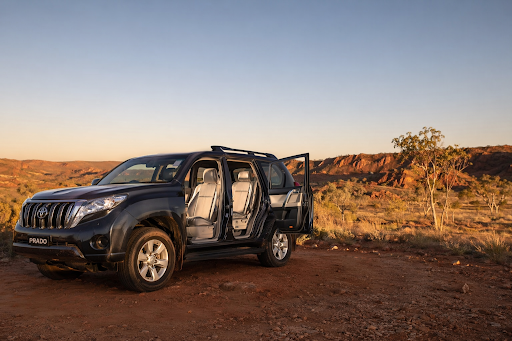
Toyota Prado seat covers help guard against spills, stains, daily use, and UV exposure across Australia.
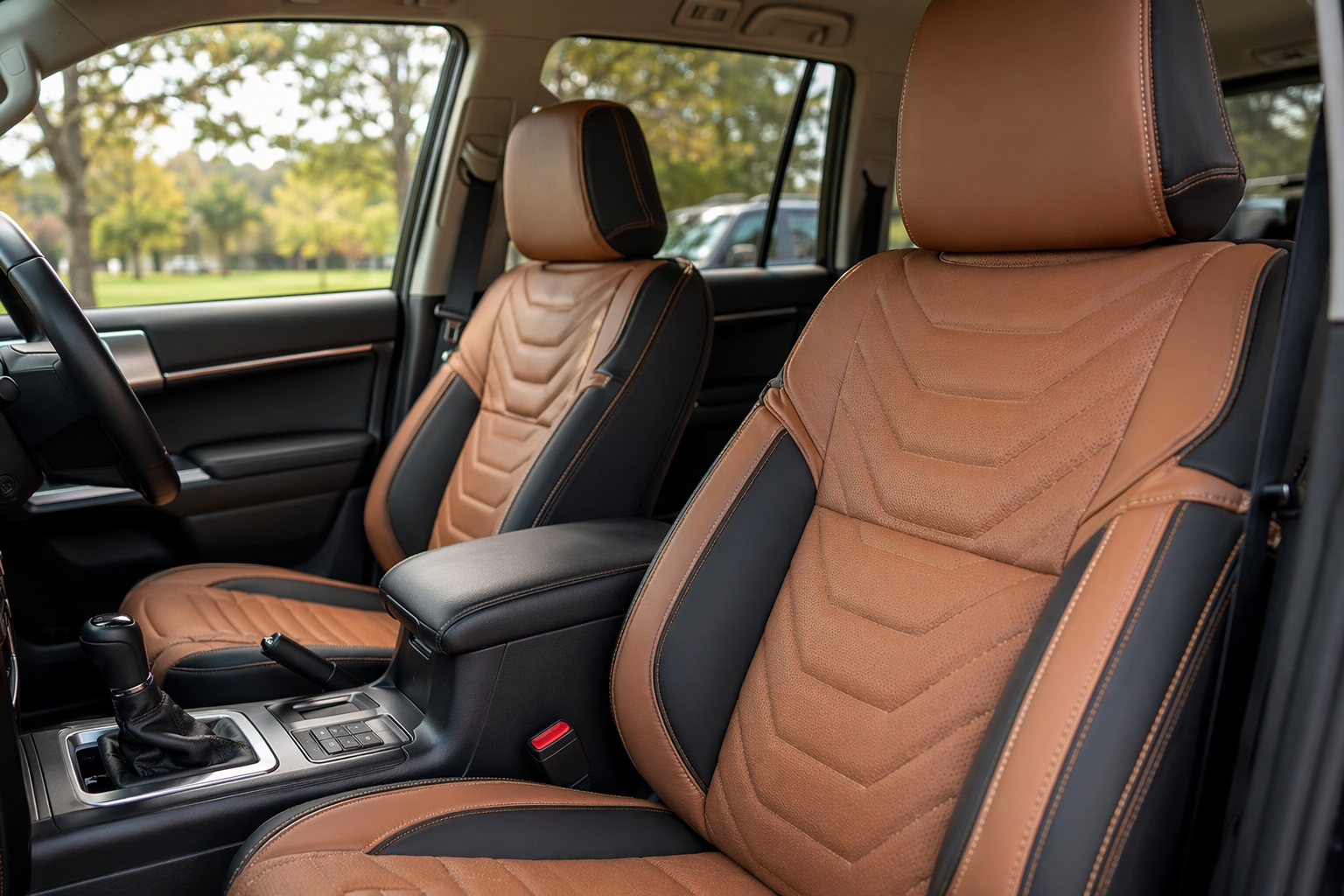
A precise fit matters because custom seat covers sit neatly and support comfort in front seats and rear seats.
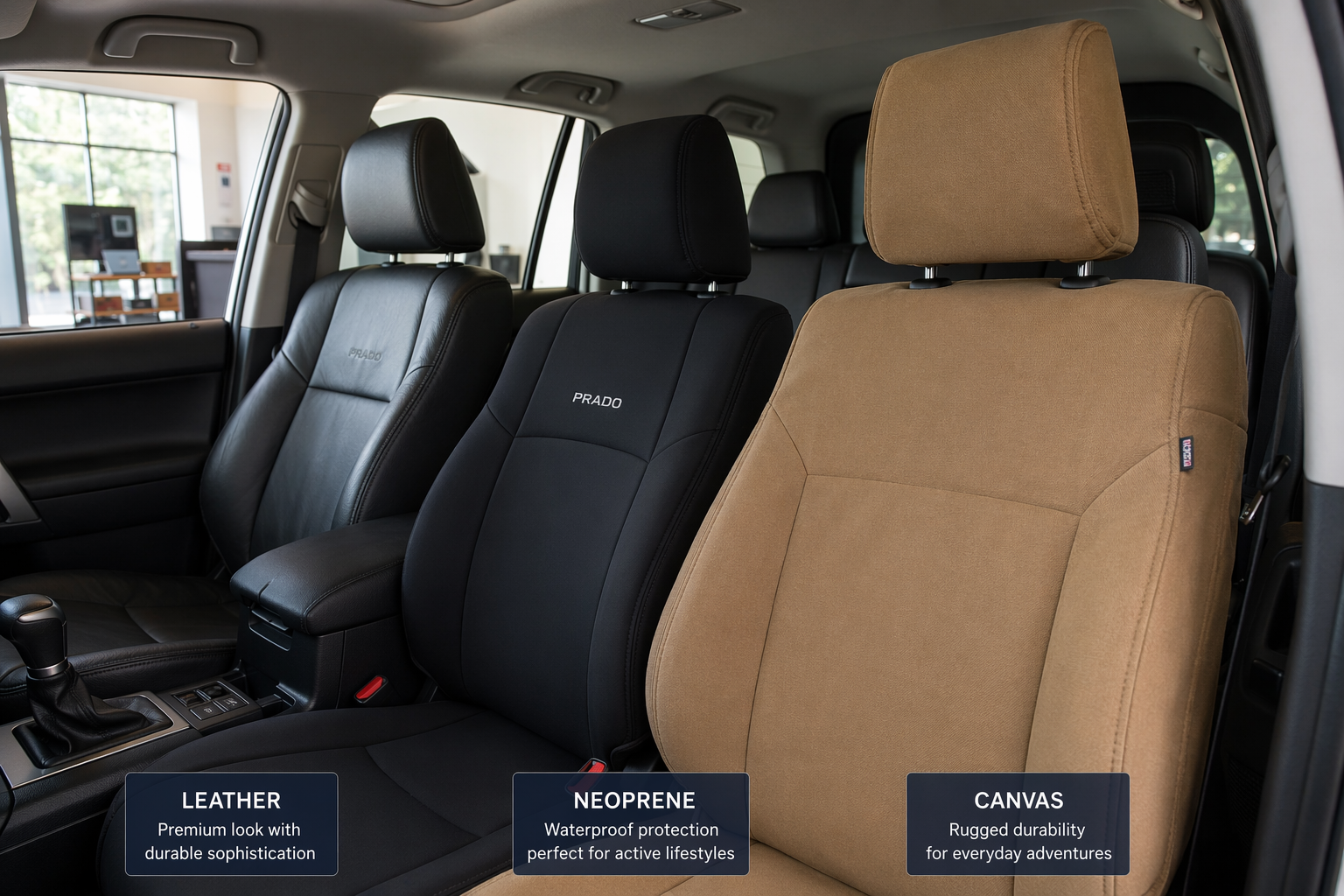
Waterproof seat covers in neoprene and heavy-duty canvas options suit touring, work, and family use.
Airbag safe design and child seat anchoring access give extra peace of mind.
Durable materials can help keep seats in pristine condition and support resale value.
Check warranty and shipping details before you choose.
Introduction
Your Prado works hard, so your seats do too. The best Toyota Prado seat covers give you comfort, interior protection, and durability for daily use in Australia, whether you drive to work, head off-road, or load up the kids after sport. That matters when mud, moisture, food spills, and direct sunlight all hit the cabin. If you want covers that look right and last through normal use, the details of material, fit, and safety features make a real difference.
Why Invest in Toyota Prado Seat Covers for the Australian Lifestyle
Life in Australia is tough on vehicle interiors. Daily use, direct sunlight, and UV rays can wear factory seats faster than many owners expect, especially if your Prado is used for family trips, touring, or work.
That is why Toyota Prado seat covers are more than an accessory. They help protect against spills and stains, support resale value, and keep the cabin looking cleaner for longer. The next two sections break down where that protection really shows up.
Everyday Protection Against Spills, Stains, and Sun Damage
Yes, they do. Toyota Prado seat covers protect seats from spills and stains effectively when you choose the right material and a precise fit. That is especially useful for daily use, where food, wet clothes, dust, and sunscreen can quickly mark factory trim.
Think about a common weekend. You finish a beach trip, the kids climb in, and moisture and sand end up on the seats. A cover creates a barrier that helps keep the original trim in more pristine condition and reduces wear from UV exposure and sun damage.
Neoprene seat covers offer water-resistant protection and a comfortable feel.
Canvas seat covers suit rougher jobs where dirt and gear are part of the routine.
A form-fitting design helps stop bunching that can leave exposed areas.
Maintaining Comfort and Resale Value in Harsh Environments
Seat covers are not only about blocking mess. In harsh environments across Australia, they also help maintain comfort over months of use. Foam-backed options can feel better on longer drives, which matters if your Prado is used for touring or long work days.
There is also the resale value angle. Seats that stay cleaner and show less wear can make the whole cabin look better when it is time to sell or trade. That gives you one less thing to worry about later.
A genuine benefit of model-specific covers over generic ones is fit. A tailored set follows the seat shape more closely, looks tidier, and gives more peace of mind in normal use without loose fabric moving around.
Most Durable Materials for Toyota Prado Seat Covers
The two material types that stand out for Toyota Prado seat covers are neoprene seat covers and canvas seat covers. Both are built for durability, but they suit different jobs. Neoprene is water-resistant and comfortable, while canvas is aimed at heavier wear.
For buyers comparing options after months of use, that difference matters. Foam backing can improve comfort, and checking the warranty is smart if you want coverage for defects. Once you know the material, the next step is matching it to how your Prado is really used.
Real-World Example: Heavy-Duty Materials for Off-Road Adventures
Picture a Prado used for touring tracks one week, and school runs the next. On corrugated roads, your suspension takes the hit, but your seats still face dust, moisture, and constant movement. That is where heavy-duty material choice becomes practical, not cosmetic.
Razorback 4×4 lists GP4 Neoprene as water-resistant with a comfy rubber backing and form-fitting design. Its XP7 Heavy-Duty Canvas is designed for worksites and tough 4×4 tracks, with foam-backed comfort. Free shipping Australia-wide also helps when ordering online.
Top Choices for Toyota Prado Seat Covers by Model and Fit
Fit should drive your choice first. A precise fit helps custom seat covers sit properly around seat shapes, headrests, and access points. For Prado owners, that becomes important when comparing the Prado 150 Series with newer or older layouts.
If you are choosing a 7-seater or looking at waterproof protection, focus on model-specific covers, airbag compatibility, and practical details like foam backing and warranty. The next section gives a simpler way to judge what is right for your Prado.
Custom and Waterproof Seat Cover Solutions for the Prado 150 Series and Older Models
Yes, it is possible to find custom-fit, waterproof options for the Prado 150 Series and older models. The compiled range includes the Toyota Land Cruiser Prado 150 Pre-Facelift from November 2009 to June 2021, which answers a common question from owners of older models like the 2009 version.
When choosing the right seat covers for a Prado 150 Series 7-seater, check the fitment details first. Then look at how the cover works with safety features and daily use. A neat fit is usually better than a one-size-fits-most product.
Confirm access for child seat anchoring before you buy.
Choose airbag safe designs where side airbags are fitted.
Pick neoprene for water resistance or canvas for heavier wear.
If you own several vehicles, you may also compare 4WD seat covers for other models, such as Toyota Hilux seat covers, Ford Ranger Wildtrak seat covers, Isuzu D-Max seat covers, and Triton car seat covers, but your Prado still needs its own model-specific fit.
Conclusion
In conclusion, investing in high-quality Toyota Prado seat covers not only enhances your comfort but also safeguards your vehicle’s interior against the rigours of the Australian lifestyle. With options tailored for different models and conditions, you can find the perfect fit that offers both durability and style. By choosing the right materials, you ensure that your seat covers withstand spills, stains, and sun damage, essentially prolonging the life of your seats while maintaining their resale value. Remember to consider your specific needs and preferences when selecting seat covers.
Frequently Asked Questions
Are there seat covers that will fit my older Toyota Prado?
Yes. Custom seat covers are available for older models, including the Prado 150 Pre-Facelift from November 2009 to June 2021. The key is a precise fit matched to your year and seat layout. Before ordering, check warranty terms and shipping details for your location in Australia.
Do seat covers interfere with airbag deployment or child seat anchoring?
They should not if you choose covers designed with those safety features in mind. Look for airbag-safe fitment and confirm access to child seat anchoring points. That gives better peace of mind. If anything seems poorly made or misaligned, check for defects before installing and using it.
How do I clean and maintain Toyota Prado seat covers for longevity?
Keep them clean with regular wipe-downs and remove dirt before it settles in. For neoprene, quick cleaning after wet or dirty trips helps maintain comfort and appearance over months of use. Simple maintenance also helps keep the seats underneath in pristine condition for longer.