
Stenhouse Jr. To Compete Full Time In Sprint Cup In 2013
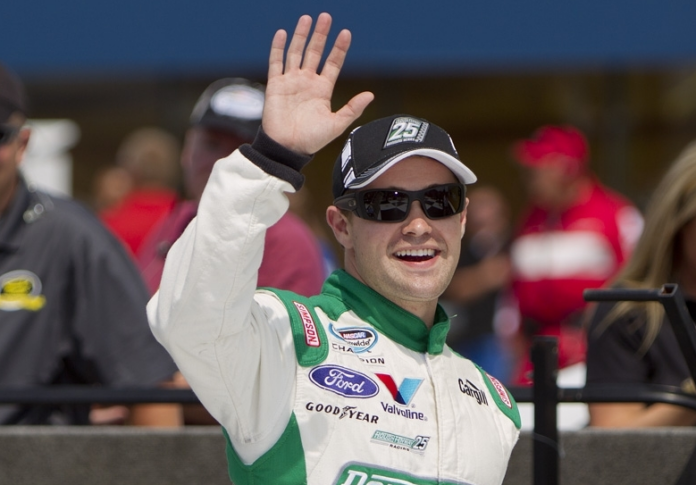
[media-credit name=”Dan Sanger” align=”alignright” width=”215″]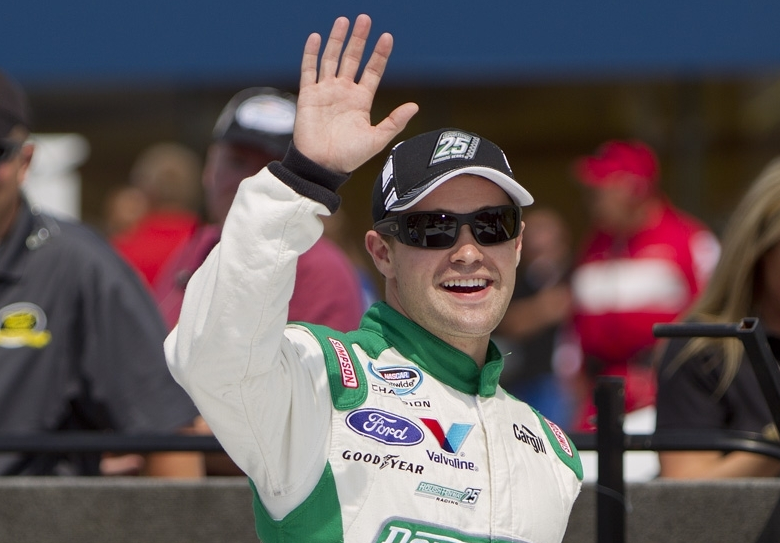 [/media-credit]Concord, NC- Ricky Stenhouse Jr, the 2011 NASCAR Nationwide Series Champion, will take over the No. 17 Ford in the Sprint Cup Series beginning in 2013. Matt Kenseth and Roush Fenway Racing will part ways at the end of the 2012 season.
“Ricky Stenhouse Jr. has more than proved his abilities on the race track,” said team co-owner Jack Roush. “We feel that he is not only a key piece of our team’s future, but a key piece of the future of the sport. Roush Fenway is an organization with a wonderful past and present, as well as an extremely promising future, and I can’t think of a better candidate than Ricky to usher in the next era of success for the team.
“Of course, I’d like to thank Matt Kenseth for his many years of loyal service,” added Roush. “Matt has been an integral part of this organization for well over a decade, and we are extremely appreciative of his accomplishments and contributions to the team, and will always consider him a part of the Roush Fenway family.
“We’re fortunate that we were able to tap into Matt’s potential and bring him on board many years ago, and I’m proud that together we were able to combine the tools and the resources of Roush Fenway with his talent and determination to forge a partnership that yielded a championship at the Cup level and all of his 22 Cup victories, including two Daytona 500 wins,” continued Roush. “The No. 17 is positioned extremely well this season, and I’m committed to providing the team the best resources to continue their run for the 2012 championship. I have no doubt that Matt will do his part.”
Roush- Fenway Racing currently has three drivers in their development program. Ricky Stenhouse Jr, Trevor Bayne, 2011 Daytona 500 winner, and Chrris Buescher, ARCA driver who has won seven races in 42 starts. Buescher is also being trained for a future in Sprint Cup with Roush Fenway.
HOORAHS AND WAZZUPS: FIVE HOUR ENERGY DRINK AND A DELICIOUS GLASS OF WINE

 During the NASCAR Sprint Cup weekend at Sonoma we witnessed a former dirt track driver from Kansas prove that he can turn left and right on asphalt with the best of them. We marveled at the performance of a first time winner in the NASCAR Nationwide Series, we all agreed that Danica Patrick looked good in this race and Kurt Busch received a lot of attention, for all the right reasons. With those thoughts in mind, let’s begin with:
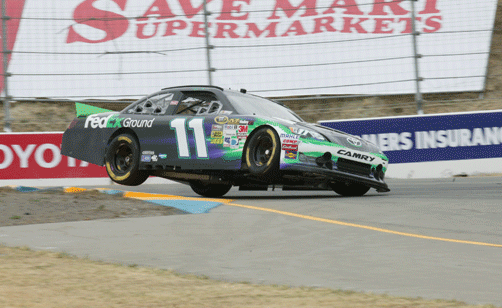
HOORAH to Clint Bowyer for winning the Toyota Save Mart 350, at Sonoma Raceway, following an outstanding driving performance from a guy not exactly noted for his road racing skills. Bowyer led a race high 71, of 112, laps on the way to his first win of the season and sixth career win.
HOORAH to Michael Waltrip Racing, (MWR), for an excellent weekend at Sonoma that proved the organization’s pre-season hard work and investments are reaping dividends.
HOORAH to MWR driver Brian Vickers. In addition to Bowyer’s win, there was the fourth place finish from Vickers subbing for Mark Martin in the #55 Toyota.
WAZZUP with Martin Truex Jr getting taken out in the final laps of the race? Truex’s MWR was strong during this race and was certainly on the way to a top ten, maybe even top five, finish before he was collected in a back of the pack crash that occurred during the race’s green-white-checker restart. The incident led to a disappointing 22nd place finish.
HOORAH to winning crew chief Brian Pattie for an outstanding job calling the shots on top of the pit box. During the middle of a post race, live television, interview, his driver began the celebratory burn out. Pattie stopped in mid sentence and screamed “that’s bas ass !”
WAZZUP with Bowyer having to walk to victory lane? It turned out the car was out of gas. He likely used up his fuel doing those “bad ass” burnouts.
HOORAH to Bowyer’s pit crew. On lap 75 they changed four tires, packed the tank full of fuel and had their driver on his way in 13.5 seconds.
HOORAH to Five Hour Energy Drink for getting their first win as a Sprint Cup sponsor. Part of the Sonoma victory lane tradition includes a glass of northern California’s finest wine. Now I’m wondering what happens when you combine Five Hour Energy Drink with a northern California Merlot. I know what happens when you mix Grey Goose Vodka with Red Bull.
*************
HOORAH to driver Kurt Busch for outstanding performances in two different races, two different series and two different tracks located in two different states not even close to each other. Busch drove his brother’s Toyota in the Nationwide Series race at Road America, located in Wisconsin, and drove his regular his regular Phoenix Racing Sprint Cup ride at Sonoma in California. There was a lot of back and forth flying to meet both of the race schedules.
In the Nationwide Series event, Busch missed the practice sessions due to the California schedule. His first run on Road America, a track he’s never raced on before, came while driving the speedway’s official pace car prior to qualifying. Adding insult to injury, he had to start from the rear of the field due to a transmission change. Busch was a factor, running in the top five, towards the end of the race before he got caught up in an incident not of his making and lost some track position. Still he managed to work his way back to an eighth place finish.
Busch really deserves a HOORAH for his performance in the Sonoma Sprint Cup event. Driving a sponsor less Phoenix Racing Chevrolet, under the worst possible economic conditions, he made his presence well known at the front of the field all throughout the day. Unfortunately a late race encounter with a tire barrier caused some damage to the car’s panard bar. Despite that, Busch started the green-white-checker finish on the front row and managed to finish in third place in that battered race car. Tony Stewart, who passed Busch for second on the final lap, later said “I don’t how Kurt was able to drive that car.”
HOORAH to Busch for a very gracious post race interview. With a voice heavily choked with emotion, he sincerely thanked the members of both teams for their effort. That included thanking brother Kyle for coming up with the chartered private plane that made the back and forth traveling so much easier.
WAZZUP with that lap 40 contact between Busch and A J Allmendinger? Okay, this was a racing deal, synonymous with road course racing, that didn’t alter the course of the race. However, consider the fact that Allmendinger was driving the car Busch was released from last year. Also consider the fact that these two drivers had a run in during last year’s Sonoma race. Following last Sunday’s run in, Allmendinger came over the radio and swore that he was going to catch up with Busch and wreck him. Surprisingly, a very calm Busch came over his radio and requested someone to check the front nose for possible damage.
WAZZUP with “The Jerry Springer Show’s” sudden decision not to sponsor Kurt Busch and team owner James Finch? There were a lot of NASCAR observers who really wanted to see this happen. First off, this team is deserving of a major primary sponsorship. They certainly proved that at Sonoma. Let’s face it, the business combination of Kurt Busch and Jerry Springer would have really been a lot of fun.
**********************
HOORAH to Nelson Piquet Jr for scoring his first Nationwide Series win, in only three starts, at Road America. Driving for Turner Motorsports, Piquet was driving the same car that won this race last year, with Reed Sorenson behind the wheel, and with the same winning crew chief, Trent Owens. A native of Brazil, he is only the fifth driver, born outside of the United States, to win a major NASCAR event. His exploits as a regular in the NASCAR Camping World Truck Series have already garnered a lot of attention. This is going to be a driver to keep an eye on in the future.
Okay, let’s get to what topped the Monday morning water cooler debate list. WAZZUP with road course ringer Jacques Villeneuve, or Jack Vanilla Wafer as I like to call him, taking out Danica Patrick on the final lap of the Nationwide Series race at Road America? After the race Vanilla Wafer said he was pinned down to the grass which caused him to enter the turn with a bad case of wheel hop and the contact with Patrick was unavoidable. Yes, you have to consider the plausibility of the theory.
Meanwhile, at the Monday morning water cooler, a lot of NASCAR fans were thinking: “so, the new term for have at it boys is now wheel hop?”
HOORAH to Danica Patrick for an outstanding driving job during this race. Yes, I know, in the past I’ve been one of these people who kept saying “wow, that’s a lot of national television coverage for someone who consistently finishes around 25th.” But, in all honesty and fairness, this driver was on her game during the Road America race and was a major player all through the event. It’s two bad that the white flag lap “wheel hop” incident turned a potential winning final run into a 12th place finish.
HOORAH to Patrick for being a class act by deciding to take the high road during her post race interview. She could have easily ripped into “Vanilla Wafer”. Most drivers would have. Instead, she chose to accent the positive by praising her team for a well prepared race car and commented on what she learned from driving at Road America. Referencing the final lap incident, she said: “it’s typical with road racing in stock cars, at the end there’s going to be bumpers.” Very Classy.
*************************
WAZZUP with driver Justin Allgaier’s problems with, of all things, a bottle of water during the Nationwide Series race? Somehow the errant water bottle got loose rolled under his pedals on the floorboard. That’s not a great place for a water bottle, especially during a road course event. During an ensuing green flag pit stop, a crew member crawled inside of the passenger window and tried to retrieve the bottle. Unfortunately, the situation became worse when the bottle rolled underneath the driver’s seat. The time on pit road, and the loss of precious track position, was devastating.
However Allgaier did manage to turn the situation into a top ten finish and that earns him the HOORAH for making chicken salad out of chicken do do.
*****************
Whether or not this next item is a HOORAH or a WAZZUP probably depends on your feelings regarding the use of the “F Bomb.” During a practice session, for the Nationwide Series at Road America race, driver Brad Sweet crashed his Turner Motorsports Chevrolet and the team had to roll out a back up car. During the Saturday morning qualifying session, Sweet ran a good lap that guaranteed him a decent, 16th place, spot in the starting field. The decision was made to conclude the qualifying run early. That’s when Sweet came over the radio and said: “I’m bringing it in because I didn’t want to f**k it up.”
Unfortunately the “F Bomb” made a live, on the air, television appearance and the ESPN broadcast booth had to issue a quick live, on the air, apology. WAZZUP with that? Was there no three second delay switch, and someone standing near it, in the network control truck? I’m giving this one a HOORAH because I thought it was very funny.
**********
In some final thoughts, WAZZUP with a NASCAR Sprint Cup race, at the Sonoma Road Course, only having two yellow flags, with both of them coming late in the race? I didn’t even think that was possible. For a week, leading up to this race, we were told, by the NASCAR themed television shows, to be prepared for carnage that would make Bristol look like a square dance. It didn’t happen.
That leads to a HOORAH to the Cup drivers for their display of car control. There were plenty of aggressive, thump and bump, moments during this race. They just didn’t turn into the multi-car melees we were all expecting.
HOORAH for the bumper cam the TNT Network place on Juan Pablo Montoya’s Cup car at Sonoma. It gave us high quality perspective on what it takes to drive a high speed race car around a road course.
On the subject of television cameras: WAZZUP with a high velocity of champagne spray taking out an ESPN camera during the victory lane celebration at Road America? As Darrell Waltrip would say: “that was ‘pensive.”
The absolute final thought of the week goes to the very fine Road America track in the beautiful community of Elkhart Lake, Wisconsin. NASCAR should seriously consider scheduling a Sprint Cup race there. Saturday’s Nationwide race was outstanding and definitely a HOORAH.

