Full-body protective gear can help reduce injuries when a motorcycle crash happens. A good helmet, sturdy jacket, gloves, protective trousers, and boots give riders a layer of protection between their bodies and the road.
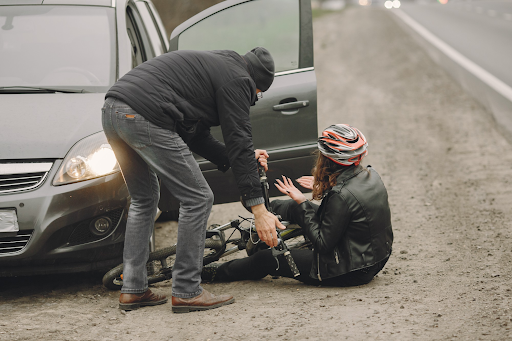
Even a quick trip can go wrong. lose gravel, a sudden stop, or a driver who fails to check their blind spot can send a rider tumbling onto the pavement. Following simple safety tips, like wearing the right gear before setting off, may help prevent a bad crash from becoming even worse.
In this article, we will explore the role of full-body protective gear in reducing injuries in motorcycle accidents.
How Does Full-Body Protective Gear Reduce Motorcycle Injuries?
Unlike car drivers, motorcyclists have little between them and the road when a crash happens. They can be thrown onto the pavement or dragged across it, sometimes before they have time to react. The right gear won’t stop every injury, but it can protect the skin and cushion blows to vulnerable parts of the body.
The danger is reflected in the numbers. The National Highway Traffic Safety Administration (NHTSA) reported 6,228 motorcyclist deaths in the United States in 2024, accounting for 16% of all traffic fatalities. NHTSA research also shows that helmets reduce the risk of death by 22% to 42% and the risk of brain injury by 41% to 69%.
The rest of the body needs protection, too. A tough jacket can help prevent painful road rash, while knee armor can cushion some impacts. Gloves are just as useful. When a rider falls, reaching out to catch themselves is often an instinctive reaction, and bare hands can take the worst of it.
Is Full-Body Protective Gear Required by Motorcycle Law?
Motorcycle laws vary by state. Some U.S. states require all riders to wear helmets, while others only require certain riders to wear them. Protective jackets, trousers, and boots generally aren’t legally required.
Federal regulation 49 CFR § 571.218 sets safety standards for motorcycle helmets sold in the U.S., while state laws determine who must wear one.
The difference is clear in helmet use. NHTSA reported that in 2021, 86.1% of riders observed in states with universal helmet laws wore compliant helmets, compared with 53.4% in states without them. Even when full-body gear isn’t required, wearing it can help protect you when a ride goes wrong.
Full-Body Protective Gear Includes
Each item protects a different area of the body:
Helmet: Helps protect the head and brain. Choose one that meets recognized safety standards and fits securely.
Armored jacket: Protects the upper body from road friction and helps absorb impacts to the shoulders and elbows.
Protective trousers: Shield the hips, thighs, and knees from scrapes and some impact injuries.
Gloves: Protect the hands and improve grip on the handlebars.
Motorcycle boots: Cover the feet and ankles, helping protect them from twisting, crushing, and abrasions.
Reflective clothing: Makes riders easier to see in traffic, particularly at night.
How Can Riders Choose Effective Protective Gear?
Expensive gear isn’t always the best fit, and cheap gear isn’t always a bargain. Look for sturdy materials, reliable fasteners, and armor that stays in place when you move. Your gear should feel comfortable, too, because protection only helps if you actually wear it.
A few safety tips can help you choose wisely:
Choose a certified helmet that fits snugly, and fasten the chin strap.
Look for tough jackets and trousers with built-in armor.
Wear gloves that protect your hands without making it hard to grip the handlebars.
Choose boots that cover your ankles.
Wear bright or reflective details so drivers can spot you more easily.
Check your gear for tears or damage and replace worn-out items.
Points to Remember
Full-body gear helps reduce the severity of motorcycle injuries.
Helmets lower the risk of death and brain injury.
Armored clothing, gloves, and boots protect other vulnerable areas.
Helmet laws vary by state, but protective gear is worthwhile regardless.
Proper fit, good materials, and regular inspections matter.
Reflective clothing helps other drivers see riders.
Safe riding and protective gear work best together.
There’s something about fall that makes people want a new look. Maybe it’s the cooler weather, the new wardrobe or just the feeling of a fresh start. Whatever the reason, hair salons get busy this time of year.
If you’ve been thinking about a change but don’t know where to start, two of the most popular fall updates are a new cut and a new color. And two options keep coming up again and again: the layered bob and dark auburn hair.
Why a New Cut Is the Easiest Refresh
A haircut is one of the quickest ways to change your whole look. You don’t have to commit to a big color process, and a good cut can make your hair look thicker, healthier and more styled with less effort.
The bob has been one of the most-requested cuts for years, and it’s easy to see why. It works on most hair types and face shapes, and it’s easy to grow out if you change your mind.
Why the Layered Bob Works for So Many People
A classic blunt bob can look sharp, but it can also feel a bit heavy, especially if you have thick hair. That’s where layers come in.
Adding layers to a bob takes out bulk, adds movement and creates shape. If your hair is fine, layers can make it look fuller. If it’s thick, they make it lighter and easier to style. And if you have waves or curls, layers help your natural texture show off instead of falling flat.
There are lots of ways to wear it, too. A shaggy layered bob feels relaxed and a little ’70s. A sleek, softly layered bob looks polished and grown-up. A bob with curtain bangs adds a romantic, face-framing touch.
For photos, celebrity inspiration and tips on what to ask your stylist, this guide to the layered bob is a great place to start.
Why Fall Is the Season for Warm Color
If you’d rather keep your length, a color change might be the way to go.
Fall is all about warm, rich shades, and auburn is right at the top of the list. It sits somewhere between red and brown, with deep copper and mahogany tones that look amazing against fall colors like camel, burgundy and forest green.
Dark auburn in particular is a great choice if you’re nervous about going full red. It’s subtle in low light, glows in the sun and works on a wide range of skin tones. Brunettes can usually get there with a gloss or a demi-permanent color, without heavy bleaching.
Stars like Jessica Chastain, Emma Stone and Sophie Turner have all worn versions of the shade over the years, which shows just how flattering it can be.
If you want to see the different shades and celebrity examples side by side, check out this guide to dark auburn hair before you book your appointment.
Should You Do Both?
Honestly, a layered bob in dark auburn is one of the best fall combos out there. The layers catch the light and show off all the different tones in the color, and the warm shade gives the cut extra depth.
If you want a big change, doing both at once is a fun way to completely refresh your look. If you’d rather take it slow, start with the cut and add color a few weeks later.
Tips Before You Go to the Salon
Bring photos. Words like “short” and “auburn” mean different things to different people. Pictures help your stylist see exactly what you want.
Be honest about your routine. If you don’t blow-dry your hair every day, tell your stylist so they can cut layers that work with your natural texture.
Think about upkeep. Auburn and red shades fade faster than other colors, so a color-safe shampoo and a gloss every few weeks will keep it looking rich.
Ask about your skin tone. A good colorist can tweak the shade to be warmer or cooler so it suits you best.
Plan your styling. A layered bob looks best with a little texture, so a light sea salt spray or a round brush can help the layers show up.
The Bottom Line
You don’t need a dramatic transformation to feel like a new person this fall. A layered bob, a shade of dark auburn or both can make a big difference with very little stress.
Few moments feel bigger to a teenager than getting a driver’s license. That small plastic card means freedom. No more begging for rides, no more waiting in the school pickup line. For parents, it can mean relief and a whole new level of worry.
Handing a sixteen-year-old the keys to a two-ton vehicle is a serious responsibility. Teen drivers face real risks while they’re still learning, and every crash involving a young driver reignites the debate about whether the system starts them too early.
Proposals for raising the driving age to 18 pop up regularly, and they spark strong reactions on both sides. Supporters point to safety. Critics point to practical realities. The truth sits somewhere in a complicated middle that deserves a closer look.
Why Teen Drivers Face Unique Challenges Behind the Wheel
Experience can’t be rushed. New drivers simply haven’t seen enough situations to recognize hazards quickly. A ball rolling into the street, a car drifting toward the lane line, or brake lights several cars ahead may not register as danger right away. Spotting trouble takes practice.
Judgment is still developing too. The parts of the brain involved in impulse control and risk assessment continue maturing into the mid-twenties. That doesn’t make teens reckless by default, but it can make split-second decisions harder under pressure. The science backs that up.
Peer influence and distraction pile on. A car full of friends, a buzzing phone, or loud music can pull attention away from the road. Research on young drivers consistently highlights passengers and phones as major sources of distraction. Those risks add up quickly.
The Argument for Making Teenagers Wait Longer
Supporters of a higher driving age focus on crash risk. Young drivers, especially in their first months of independent driving, have historically shown higher crash rates than more experienced adults. Delaying full privileges, they argue, could prevent tragedies. Fewer crashes means fewer funerals.
Maturity is another big part of the argument. An eighteen-year-old may handle pressure, peer influence, and risky situations differently than a sixteen-year-old. A couple of extra years could mean better judgment by the time someone drives without supervision. Time does some of the teaching.
More supervised practice is also possible with a later start. Teens could spend additional time learning with experienced drivers before going solo. That longer runway might help them build skills gradually, rather than jumping into full independence the moment they turn sixteen. Patience can pay off.
Why Raising the Driving Age Could Create New Problems
Families depend on teen drivers in very practical ways. Working parents may rely on older kids to drive themselves to school or pick up siblings. Taking away that option could create real scheduling and financial strain for many households. Logistics matter more than lawmakers sometimes admit.
School and work access matter too. Many teens hold jobs that help their families or save for college. Without a license, getting to work, sports practice, or community college classes could become difficult, especially where public transportation is limited or nonexistent.
Rural mobility is a major concern. In small towns and farm communities, driving may be the only practical way to get anywhere. Critics also argue that age alone doesn’t make someone a safe driver, since an inexperienced eighteen-year-old is still inexperienced. Skill comes from practice.
Could Better Training Be More Effective Than a Higher Age Limit?
Graduated driver licensing programs offer a middle path. Instead of handing over full privileges at once, these systems phase them in. New drivers start with a learner’s permit, move to a restricted license, and earn full privileges over time. Every state uses some version.
Supervised practice requirements help build real experience. Many programs require a certain number of hours behind the wheel with a licensed adult, including some nighttime driving. That practice helps new drivers handle situations before they’re on their own. Reps build reflexes.
Passenger restrictions and nighttime limits target specific risks. Limiting how many young passengers a new driver can carry reduces distraction, while curfews reduce exposure during riskier late-night hours. Evidence-based approaches like these aim to manage danger without simply waiting for a birthday. Readiness matters more than the calendar.
Conclusion
The debate over teen driving touches safety, independence, and family logistics all at once. Raising the driving age to 18 has passionate supporters and equally passionate critics, and both sides raise points worth considering. Easy answers are hard to find.
Teen drivers do face real challenges, from limited experience to distraction. But age is only one factor. Graduated licensing, supervised practice, and smart restrictions may address many of the same risks while preserving practical mobility. Training and age can work together.
The real question is when drivers are ready, not just how old they are. Balancing public safety with practical transportation needs, and leaning on proven driver education strategies, can help teens build the skills that keep everyone safer.
Picture a four-way stop on a busy afternoon. A driver waves another through. A cyclist rolls slowly, deciding whether to go. A kid on a scooter hovers at the curb. Humans read this chaos with glances and nods. Machines have to figure it out from data.
Teaching a car to drive itself sounds simple until you realize how much of driving is unwritten. Eye contact, hand signals, hesitation, and gut instinct fill gaps the rulebook never covers. Programming all of that into software is an enormous challenge.
That’s why the dangers of self-driving cars deserve a clear-eyed look. The question isn’t whether the technology is impressive. It clearly is. The question is how it handles the messy, unpredictable situations real roads throw at every driver, human or not.
Why Driving Is Harder Than Following Traffic Rules
If driving were just following rules, computers would ace it. Stop at red lights, stay in your lane, obey the speed limit. But real roads demand constant prediction. Will that car merge? Is that pedestrian about to step out? Guessing right is the whole game.
Ambiguous situations are everywhere. A police officer directing traffic might override a green light. A delivery truck double-parked might require crossing a center line. Human drivers improvise in these moments, often bending rules slightly to keep everyone safe and moving.
Unexpected conditions add another layer. A mattress in the road, a flooded underpass, or a fallen tree branch demands quick judgment. Humans can draw on years of experience and common sense. Automated systems have to recognize the situation and respond correctly, every single time.
The Situations That Can Confuse Automated Driving Systems
Construction zones are notorious trouble spots. Lane lines shift, cones appear in odd places, and workers wave vehicles through unconventional paths. Systems trained on normal road layouts may struggle when the road suddenly looks nothing like the map they expected.
Weather and visibility cause problems too. Heavy rain, snow, fog, and blinding glare can interfere with cameras and other sensors. Dirt or ice on a sensor can limit what the system sees. When the inputs get fuzzy, the decisions can get shaky.
Emergency vehicles and unpredictable people round out the list. A fire truck approaching from behind requires a quick, correct response. Jaywalkers, erratic drivers, and cyclists weaving through traffic can behave in ways that are difficult to predict, even for very sophisticated software.
Why Not All Self-Driving Technology Is the Same
The term self-driving gets tossed around loosely. Plenty of vehicles marketed with fancy names actually offer driver-assistance features, like adaptive cruise control or lane-centering. These systems help, but they still require a human to watch the road and stay ready.
Engineers often describe automation in levels, ranging from no automation to full automation. Lower levels support a human driver, who remains responsible for monitoring the road. Higher levels can handle driving tasks within specific conditions, sometimes without a human taking over.
Confusing those categories can be dangerous. A driver who treats an assistance system like a fully autonomous chauffeur might stop paying attention at exactly the wrong moment. Knowing what a vehicle can actually do, and what it can’t, matters enormously. Marketing isn’t a manual.
Who May Be Responsible When Automated Technology Contributes to a Crash?
Human drivers often remain part of the equation. If a vehicle requires supervision and the driver was distracted or ignored warnings, that driver may bear responsibility. Using an assistance system doesn’t automatically erase the duty to drive carefully. The driver’s seat still comes with obligations.
Manufacturers and software developers may also face scrutiny. If a defect in design, sensors, or programming contributed to a crash, product liability claims might come into play. Marketing that overstates what a system can do could also become part of the analysis.
Other parties can be involved too, like fleet operators, maintenance providers, or companies running robotaxi services. There’s no single universal rule. Responsibility depends on the technology involved, the facts of the crash, and the laws that apply where it happened.
Conclusion
Automated driving technology is impressive and evolving fast. Still, the road is full of human unpredictability, and machines have to handle all of it safely. That challenge sits at the heart of every conversation about automated vehicles. Progress and caution can coexist.
Safety depends on what each system can actually do, how well it’s been tested, and whether humans supervise it properly when required. Treating driver assistance like full autonomy creates real risk. Clear expectations matter as much as clever engineering.
The future of driving still has plenty of human questions. Anyone involved in a crash where automated technology may have played a role can talk with a qualified attorney about how responsibility might be evaluated. Answers usually start with the evidence.
Defective seat belts can make car accident injuries worse by failing to hold occupants securely, releasing during impact, or placing excessive force on vulnerable body parts. Even when a collision is unavoidable, a properly functioning restraint can reduce the risk of serious injury by limiting movement and spreading crash forces across stronger areas of the body.
Chicago, Illinois, has busy expressways, crowded intersections, and heavy commuter traffic, creating many situations where sudden braking or collisions can occur. The city’s Kennedy and Dan Ryan Expressways experience frequent stop-and-go traffic, increasing the likelihood of sudden stops and rear-end collisions.
Illinois law generally requires drivers and passengers covered by the state’s seat belt law to wear properly fastened restraints. When a defective belt contributes to injuries, a motor vehicle accident attorney serving Chicago may assess the relevant evidence and applicable legal responsibilities.
Retractor Problems Increase Impact Injuries
The retractor should allow normal belt movement but lock during sudden deceleration. If its locking mechanism fails, the occupant may travel farther forward before hitting the steering wheel, dashboard, or another surface. This extra movement increases the risk of chest injuries, facial fractures, and brain trauma.
False Latching Creates Hidden Danger
A buckle may appear connected without securely engaging its locking mechanism. Occupants might believe they are protected, even though the belt can actually separate under pressure. Manufacturing defects, worn components, or damaged buckles may cause this problem, making proper inspection important after unusual belt behavior.
Damaged Webbing Can Break Under Pressure
Seat belt webbing may withstand substantial forces during a crash. Fraying, cuts, chemical damage, prior crash-induced stress, or manufacturing flaws can weaken its fibers and compromise its restraint. If the material tears, the occupant may suffer injuries that a properly functioning belt could have helped prevent.
Incorrect Belt Position Can Damage Internal Organs
While the shoulder belt should cover the chest, the lap belt should lie low across the hips. If defective components allow the belt to ride over the abdomen or fit improperly, crash forces can damage abdominal organs, ribs, and the spine. Severe cases may involve internal bleeding.
Faulty Pretensioners Can Reduce Protection
Pretensioners tighten seat belts rapidly during certain crashes, helping restrain occupants before they move too far forward. A defective pretensioner may fail to activate, leaving excess slack during impact. Faults in restraint systems can also affect how forces are managed, potentially increasing the risk of chest and shoulder injuries.
Failed Restraints Can Injure Other Passengers
An occupant whose belt fails may collide with nearby passengers or strike the driver as they move through the cabin. Unrestrained rear-seat occupants can also injure people sitting in front. Therefore, a defective restraint can increase injury risks beyond the person wearing the faulty belt.
Legal Responsibility Depends on the Evidence
Liability may involve a vehicle or seat belt manufacturer, a parts supplier, or another responsible party, depending on the defect and circumstances. Product liability claims generally require evidence connecting a defect to the injury. Maintenance history, crash data, photographs, medical records, and professional inspections can help establish what happened.
Preserve Evidence After a Collision
Keep the damaged belt and buckle intact when possible, and avoid repairs until an appropriate inspection is completed. Photograph visible damage, retain repair and purchase records, and seek medical assessment for injuries. In Illinois, deadlines and legal requirements can affect claims, so documenting the defect and its connection to the crash is important.
Wrapping Up
Buckle failures can leave occupants unrestrained during impact.
Retractor and pretensioner defects may increase forward movement.
Damaged webbing can tear under crash forces.
Poor belt positioning can injure the abdomen and spine.
Failed restraints may expose other passengers to additional harm.
Product liability depends on evidence, causation, and applicable law.
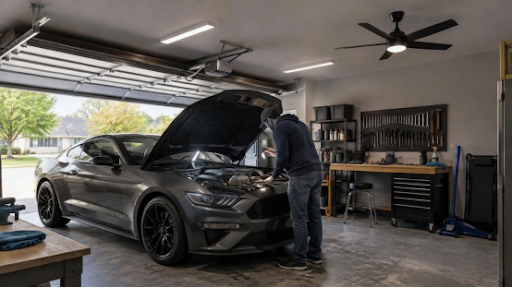
It’s amazing how quickly an ordinary garage can become a frustrating place to work. You’re halfway through a simple job, the hood is up, and the ceiling light is shining on everything except the part you need to see. Then you look up and realize the garage door tracks take up half the space where you might put better lighting or a fan.
The fix isn’t necessarily a bigger toolbox or a complete remodel. A more useful place to start is the environment itself: where the light falls, how air moves, how much room you have to work, and whether the setup is safe for the jobs you actually do.
Map the Garage Around the Work You Actually Do
First, forget the picture-perfect garage for a minute. Think about an ordinary Saturday. Are you washing the car, checking fluids, changing wheels, sorting parts on a bench, or working through a restoration project that takes up the whole weekend? Those jobs use the same floor, but they don’t need the same lighting or the same amount of space.
Detailing is a good example. You might need light from the side to pick up fine marks in the paint, then a different portable light to check the wheel wells. Mechanical work brings its own problems: an open hood creates deep shadows, and a floor jack or creeper needs a clear path beside the car. If you mainly park and store gear, simpler lighting and clear walkways may be all you need.
Before buying anything, park the vehicle where it normally sits. Open the doors and hood. Raise the garage door. Stand at the workbench. It’s a better test than an empty-room measurement.
Layer Lighting for Parking, Detailing, and Repairs
One bright fixture in the middle of the ceiling can make a garage look well lit until you start doing real work. Your body blocks the beam, the hood throws a shadow, and suddenly the bolt you need hides in the dark. That’s why it helps to think in layers instead of looking for one light that does everything.
Start with general lighting so you can walk around the car, find equipment, and spot anything on the floor. Then add task lighting where you actually work. A movable inspection light is handy under the hood or beneath a dashboard. For paint correction or detailing, focus on the direction and quality of the light, not just the claimed brightness on the box.
In a garage that doubles as a hobby room or general-purpose hangout, some people consider ceiling fans with lights to combine circulation and overhead illumination. That can be a sensible use of a ceiling position if the particular fixture is rated for the environment and fits the space. Just don’t expect a fan-mounted light to replace a proper inspection light when you’re checking a paint finish or hunting for an oil leak.
Balancing overhead illumination with dedicated work lights makes any repair job significantly smoother. Upgrading your primary setup with a high-quality ceiling light fixture ensures you have consistent, bright ambient coverage across the entire garage.
Neutral or daylight-looking light can help with detailed tasks, but glare, shadows, and fixture quality matter just as much. Test the light where your eyes and hands will actually be.
Separate Air Movement From Hazardous-Air Ventilation
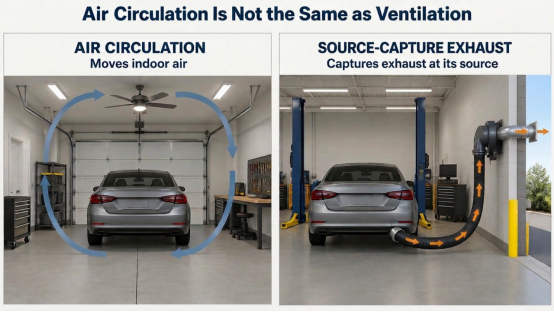
A stuffy garage makes even a short job feel longer. It’s tempting to point a big fan at the workbench and call the problem solved. For comfort, that may help. Moving air across your skin can make a hot afternoon feel more bearable. But here’s the distinction worth remembering: moving air around the room isn’t the same as getting contaminated air out of it.
A ceiling fan, floor fan, or wall fan mainly circulates air. Exhaust ventilation is designed to remove air, and some automotive jobs call for much more specific controls. Running engines, spraying coatings, welding, and using certain solvents can introduce hazards a normal circulation fan can’t address. Poor placement can spread dust or vapors.
The carbon-monoxide warning is especially important. The CDC advises against running a vehicle inside an attached garage even with the garage door open. If a repair task requires an engine to run, don’t treat an open door and a household fan as an exhaust system. Professional shops use appropriate procedures and, where needed, dedicated exhaust capture and ventilation designed for the activity. Painting and other hazardous operations may require purpose-built equipment and controls.
For routine comfort, choose where you want airflow and check that it doesn’t scatter lightweight parts, dust, or paperwork. For fumes and combustion gases, address the source and ventilation first. They’re two different jobs, and it’s safer to keep them that way.
Check Ceiling Clearance Before Adding Overhead Equipment
Garage ceilings are busier than they look. Even a fairly empty two-car garage may have a door opener, tracks, storage racks, lights and electrical runs competing for the same overhead space. The real test isn’t whether a fan fits while the door is closed. It’s whether the entire installation works through the door’s full range of motion and around everything else that moves or projects into the space.
If you’re considering garage ceiling fans with lights, measure the complete installed height and the lowest part of the fixture, not just its blade diameter. Check the manufacturer’s required clearances and location rating. A ceiling that looks high enough from the floor may leave surprisingly little space once a vehicle roof rack, open hatch, storage platform, or raised garage door comes into play.
A workbench under a fan isn’t automatically a problem, but a lift, ladder, or tall piece of equipment can change the clearance calculation. Use the exact model’s instructions and, where appropriate, a qualified installer. There’s no benefit in gaining a little airflow at the cost of an awkward or unsafe overhead layout.
Match Fan Type to Garage Size and Work Zones
Not every garage needs something hanging from the ceiling. A small space where you work in one corner may be better served by a directional fan you can move as the job changes. A wall-mounted unit might keep the floor clear, as long as there’s a suitable mounting spot. A ceiling fan can make sense when the room has enough unobstructed overhead space, and you want more general circulation while you’re in the garage.
A bigger hobby workshop is a different story. One giant fan won’t necessarily serve all three areas, particularly if walls, cabinets or equipment interrupt the airflow. Separate work zones may make more sense.
For those larger layouts, large shop ceiling fans are one category worth evaluating alongside smaller directional equipment. Look beyond blade span: the documented airflow, mounting height, controls, environmental rating, and nearby obstructions all matter. Also think about what happens when you open a roll-up door or move a lift. The best position on an empty floor plan may be the worst during a normal workday.
And keep the terminology straight. A comfort fan isn’t an exhaust fan, and industrial styling doesn’t prove a fan is rated for harsh conditions. Check the actual product documentation rather than buying by the name or appearance alone.
Make Long Garage Sessions Easier on the Body
Comfort isn’t only about temperature. Anyone who’s spent a long afternoon working beside a car knows how often you end up kneeling, reaching sideways, or twisting around something that seemed easy to access ten minutes earlier. A few small changes can make the space less awkward without turning it into a professional race shop.
Put frequently used tools where you can reach them from your usual working position. If you spend time at a bench, get the height right for the tasks you do there, and leave enough light to see small fasteners clearly. A stable mechanic’s stool may help for wheel-level jobs; a suitable creeper can help with under-car access when the vehicle is properly secured. Anti-fatigue mats can help at standing stations, but keep them out of paths where wheeled equipment needs to move.
Don’t overlook the simple things: a dry floor, a place for a portable light, room to set down a removed part, and somewhere to step back from the vehicle. It’s not glamorous, but it helps.
When a Garage Becomes a Professional Auto Shop
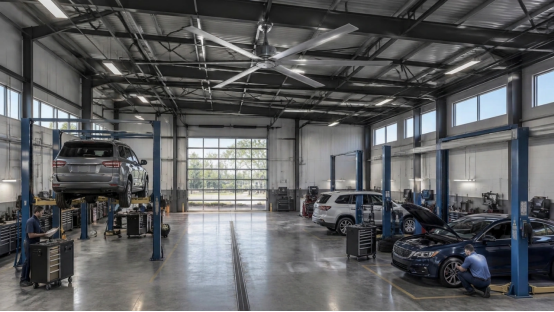
Scale changes the conversation. In a home garage, the question might be where to put one workbench and whether a fan clears the door tracks. In a professional shop with multiple service bays, you’re dealing with vehicle lifts, taller equipment, shared work areas, overhead lighting, building systems, and workers who aren’t all doing the same task at the same time.
Some high-ceiling facilities may evaluate commercial HVLS fans for broad, low-speed air circulation across open areas. They are not simply oversized household fans, and they’re not right for every repair building. Structural support, installed height, sprinkler and other overhead systems, electrical compatibility, control zones and interaction with existing ventilation all have to be reviewed for the actual site.
The ventilation point still stands. A large circulation fan does not take the place of vehicle-exhaust capture, spray-booth ventilation, or other controls required by hazardous work. In fact, airflow equipment should be planned so it doesn’t undermine those systems. If you’re fitting out a real service facility, involve the people responsible for building safety, mechanical systems, and installation before picking equipment from a product page.
The goal is better comfort without disrupting the systems that keep the shop safe.
Build a Practical Garage Improvement Plan
It’s easy to turn a garage upgrade into a shopping list. A better approach is to change one problem at a time and see whether the fix actually works. Start by watching where you stand and what you struggle to see during your next job. If the bench is dark, deal with the bench light. If an open hood blocks the overhead fixture, try a movable task light before rewiring the whole garage.
Next, check the serious stuff: any exhaust or chemical exposure concerns, the clear travel of the garage door, and the position of ladders, lifts or tall gear. Those aren’t details to figure out after you’ve mounted a new ceiling fixture. Once the space is properly planned, you can decide whether a floor, wall or ceiling fan would add useful comfort.
Finally, use the garage for a while before adding more gear. You may discover that better light and a clearer work area solve most of the annoyance. The best garage upgrade isn’t always the biggest one. It’s the one you notice because the next job goes more smoothly.
A good garage doesn’t have to look like a TV workshop. It just has to work for your car and the jobs you enjoy doing. Light the places where you need to see, move air where it helps with comfort, handle fumes with the proper controls, and keep the overhead space clear. Get those basics right and the garage starts feeling less like a storage room you happen to work in, and more like a place built for the job.
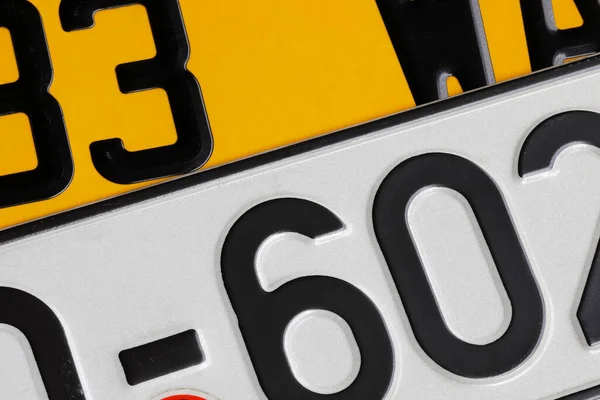
Number plate cloning, the British version of someone copying your license plate, is climbing fast. The UK’s Driver and Vehicle Licensing Agency (DVLA) logged 11,394 reports of cloned plates in 2025. That’s up 9% from the previous year and 54% higher than in 2020. In London alone, penalty notices canceled because of cloning rose from 22,450 in 2021 to 36,794 in 2023, according to a BBC investigation.
A camera that only checks one thing
Britain leans heavily on Automatic Number Plate Recognition (ANPR) cameras. More than 18,000 of them make around 90 million plate reads a day, and every one of those reads assumes the plate is genuine. They enforce speed limits, bus lanes, low-emission zones and London’s congestion charge, and every fine is mailed automatically to the registered keeper of the plate the camera reads.
That’s where cloning comes in. A criminal finds a car that matches theirs in make, model, and color, often from an online sales listing. They have a set of plates made up with that car’s registration and bolt them on. From then on, every camera that spots them bills the real owner.
Jon Kirkbright, Sales Director at RegHunters, one of the UK’s largest DVLA-recognized plate suppliers, says the system is working exactly as designed, and that’s the problem.
“Every one of those cameras is doing its job perfectly. It reads the plate, matches it to a name and sends the bill. The trouble is, the plate is the only thing it checks, and anyone can get one made.”
Why the plates are so easy to get
Around 34,000 businesses are registered to sell number plates in Britain, and getting registered costs a one-off £40, roughly $50. The plates themselves carry no holograms, chips or watermarks. The British Number Plate Manufacturers Association has told lawmakers that the UK and Ireland are the only countries in Europe without security features in their plates.
How victims find out
There’s no alert and no database to check. Most people discover the problem when a parking ticket arrives from a town they’ve never visited, or a speeding notice is timed while their car sat in the driveway. Others hear from debt collectors over unpaid fuel, or from police asking where they were on a particular day.
“We’re taking two or three calls a day from people in this position,” says Jon. “Some of them are dealing with half a dozen different councils at once, each with its own appeals process.”
The strongest evidence is usually the camera image itself. Cloners copy the basics, but wheels, roof racks, trim and dents rarely match. Owners who keep dated photos of their own car from every angle have a much easier time proving the difference.
Getting back on track
The advice from police and the trade is consistent. First, report the cloning to the police and get a crime reference number, because every appeal depends on it. Next, notify the DVLA and tell your insurer. Then answer every penalty notice in writing before its deadline, even the ones that look ridiculous. In the UK, ignoring a speeding notice can lead to prosecution for failing to name the driver.
“Speed matters,” Jon says. “The sooner you get a crime reference number and start answering notices, the less of a mess you’re left to untangle.”
The final step is the one many victims overlook: moving the car onto a new registration. The cloned plate stays out there, but it no longer leads back to the owner.
“A fresh registration is the closest thing to a clean slate,” says Jon. “The old number is still on someone else’s car, but it stops pointing at you.”
The checkered flag
Until British plates get the kind of security that protects a credit card, cloning looks set to keep rising. For now, the best defenses are simple: blur your plate in any photo you post online, fit tamper-resistant screws, open every letter promptly, and act the moment something doesn’t add up.
For a deeper look at cloned, ghost, and stealth plates, RegHunters has published a full guide to number plate cloning.
Broken headlight pieces can provide valuable clues when investigators are trying to identify a vehicle involved in a hit-and-run. The fragments may reveal the type of headlight, the vehicle’s make or model, and sometimes its approximate year of manufacture. When combined with surveillance footage, witness statements, paint transfer, and other physical evidence, these small pieces can help investigators narrow their search and connect a particular vehicle to a collision.
When the responsible party leaves the scene of a crash, it can be difficult for injured victims to identify the driver or obtain compensation. However, after a hit and run accident, even seemingly insignificant debris may become important evidence. A headlight fragment left on the road can help investigators reconstruct the collision, determine which vehicle was involved, and develop leads that might otherwise be missed.
What Headlight Fragments Can Reveal
Modern vehicle headlights are made from several components, including plastic lenses, housings, reflectors, and mounting brackets. When a vehicle strikes another car, a pedestrian, or a fixed object, some of these parts may break off and remain at the scene.
Investigators can examine the fragments for identifying marks, manufacturer logos, part numbers, and molded symbols. These details may help match the debris to a particular headlight assembly or a group of compatible vehicles.
The shape and construction of the fragments can also provide clues. Different manufacturers use distinct headlight designs, and components may change between model years. Although a fragment may not identify one specific vehicle by itself, it can help eliminate unlikely possibilities and guide further investigation.
How Investigators Connect Debris to a Vehicle
Identifying a vehicle usually requires comparing physical evidence with other information gathered during the investigation. Investigators may document the location of the debris, photograph the fragments, and compare their features with replacement parts or manufacturer records.
Several forms of evidence can strengthen the process:
Part numbers and manufacturer markings: These may help narrow down compatible vehicle makes, models, and production years.
Paint transfer: Paint found on the debris or another damaged surface may provide clues about the vehicles involved.
Vehicle damage: A suspected vehicle with a missing headlight or matching damage may warrant closer examination.
Surveillance footage: Security cameras, traffic cameras, or nearby business recordings may capture the vehicle before or after the collision.
Witnessdescriptions: Information about the vehicle’s color, size, direction of travel, or visible damage can help investigators evaluate potential matches.
Investigators must consider whether the evidence genuinely connects the vehicle to the crash. A matching headlight part may narrow the search, but it does not automatically prove that a particular driver caused the collision.
Why Preserving the Scene Matters
Physical evidence can disappear quickly after a crash. Passing vehicles may scatter debris, rain can wash away traces, and road maintenance crews may remove fragments. Promptly documenting the scene can therefore make a difference.
Anyone involved in a collision should prioritize safety and seek medical assistance when necessary. Witnesses should contact law enforcement and provide factual information about what they observed. People should not enter traffic or approach a dangerous location to collect debris themselves.
Photographs taken from a safe location may help document the scene, vehicle damage, road conditions, and the position of visible fragments. Investigators can then collect and examine relevant evidence using appropriate procedures.
Maintaining records of where evidence was found can also help establish its relevance. If the debris is moved or handled without documentation, questions may arise about whether it came from the collision under investigation.
How Physical Evidence Can Support a Compensation Claim
When a hit-and-run driver is identified, physical evidence may help establish the connection between the vehicle and the crash. This can support an investigation into liability and assist an injured person pursuing an insurance claim or personal injury lawsuit.
Victims should preserve medical records, repair estimates, photographs, police report information, and communications with insurance companies. If the driver cannot be identified, uninsured motorist coverage may provide benefits in some circumstances, depending on the policy and applicable law.
Legal deadlines and insurance reporting requirements can affect available options. Seeking guidance early may help victims understand which evidence to preserve and what steps to take next.
Important Points to Remember
Broken headlight fragments may contain markings that help identify a vehicle’s make, model, or headlight assembly.
Investigators compare debris with vehicle damage, paint transfer, surveillance footage, and witness accounts.
Physical evidence should be documented and collected appropriately to preserve its reliability.
Headlight fragments can provide investigative leads but do not independently prove who was driving.
Prompt reporting and careful documentation can help protect an injured person’s legal and insurance options.
Venue: Talladega Superspeedway Event: Love’s RV Stop 225 Date: Friday, October 23 Location: Lincoln, AL Track Description: 2.66-mile tri oval Distance: 85 laps, 226.1 miles (3:00 p.m. ET, FOX Sports 1, Motor Racing Network, SiriusXM)
Hemric Trending Towards the Top Entering Talladega
Trending Towards the Top … Daniel Hemric has been delivering his best performances of the season when it’s mattered the most. Over the last five races, the driver of the No. 19 Motion Industries Chevrolet Silverado RST has tallied four top-10 finishes, including a seventh-place result last Friday at Phoenix Raceway. Hemric looks to rejoin the top five in the NASCAR CRAFTSMAN Trucks Series (NCTS) Chase standings by extending that streak on Friday afternoon at Talladega Superspeedway. Since mid-August, the North Carolinian has been a model of consistency by scoring 30 points or more in five of the last six races and looks to notch his first Chase victory at the biggest superspeedway on the planet.
Knack for the Front … Despite the natural unpredictability that’s in ‘Dega’s DNA, Hemric has had a consistent knack for finding the front of the field in his 12-year career in NASCAR’s national series. While he’s hunting his first top-five finish on the 2.66-mile speedway in NCTS competition, Hemric has scored top-five results in both the NASCAR Xfinity Series and NASCAR Cup Series, and has led laps in six different Talladega races. His debut with MHR last season at Daytona International Speedway netted his best superspeedway result behind the wheel of the No. 19 Chevrolet, with a seventh-place finish and seven laps led.
Season to Date … Three consecutive top-10 runs in the Chase briefly bumped Hemric inside the top-five in the NCTS Chase standings after Charlotte Motor Speedway but enters ‘Dega sixth in points. Through 22 of the 25 events, Hemric has recorded three top-five’s and 11 top-10 finishes with one stage win and an average finish of 13.7.
Tune In … Coverage from Talladega commences Friday at 12:30 p.m. ET with qualifying on FOX Sports 2, followed by the green flag at 4:00 p.m. ET on FOX Sports 1. Stay connected with the No. 19 Motion Industries team by following @BMR_NASCAR on Twitter, @bmr_nascar on Instagram, and Bill McAnally Racing on Facebook.
Daniel Hemric Quote:
On superspeedway racing:
“This No. 19 team has done a great job being consistent as we’ve gotten into the Chase. Talladega is a huge equalizer. There’s a lot of guys that see this as a big opportunity to get a win and race with a lot of desperation. We want to get a win too. You need to be running at the end to have a shot at it and manage risk throughout the day to get there. Hopefully we can do that with our Motion Industries Chevrolet and work with our teammates to make the right moves at the right time.”
Daniel Hemric 2026 Statistics
Starts: 22
Wins: 0
Top-5’s: 3
Top-10’s: 11
Poles: 0
Laps Led: 5
Stage Wins: 1
Average Finish: 13.7
2026 NCTS Points Position: 6th
Motion is a leading distributor of maintenance, repair, and operation replacement parts, and a premier provider of industrial technology solutions. Products include bearings; mechanical power transmission products; electrical and industrial automation components; hose, belting, and gaskets; hydraulic/pneumatic components; process pumps; industrial/safety products; seals and accessories; material handling solutions; and more.
With the goal of increasing customers’ productivity, the Company offers many valued-added services, including engineering, fabrication, repair, and Industry 4.0 solutions across these product groups. To learn more, visit Motion.com.
LEGACY MOTOR CLUB: TALLADEGA II PRE-RACE ADVANCE EVENT: YellaWood 500
DATE: October 25, 2026 RACE: NASCAR Cup Series 34 of 36 TRACK: Talladega (Ala.) Superspeedway | 2.66-Mile Oval
JOHN HUNTER NEMECHEK NO. 42 PYE-BARKER FIRE & SAFETY TOYOTA CAMRY XSE JHN AT TALLADEGA: John Hunter Nemechek has seven NASCAR Cup Series starts at Talladega, where he has earned two top-10 finishes. He finished eighth in both races in 2020. In the NASCAR O’Reilly Auto Parts Series, Nemechek has made four starts, including two top-10 finishes in April 2018 and April 2019. In his seven starts in the NASCAR Craftsman Truck Series, he earned one pole award in October 2022 and two top-10 finishes, including a best finish of fourth in October 2021.
JOHN HUNTER NEMECHEK QUOTE: “I’m excited for Talladega. We’ve shown speed at superspeedways in the past, so I’m hopeful that will translate into a solid run for us this weekend. We’ve only got a few races left, so I want to bring home a good finish as we begin to close out the season.”
ERIK JONES NO. 43 DOLLAR TREE TOYOTA CAMRY XSE JONES TALLADEGA STATS: Sunday’s YellaWood 500 will mark Erik Jones’ 20th NASCAR Cup Series start at the 2.66-mile, behemoth track of Talladega Superspeedway. In total, he’s earned three top-five and eight top-10 finishes at Talladega. He’s been especially consistent as of late, finishing in the top-10 in seven of his last 11 races while leading a total of 75 laps. He earned a best finish of second in October 2020, where he finished .086 seconds behind race winner Denny Hamlin. In the NASCAR O’Reilly Auto Parts Series, Jones has three starts at Talladega, never qualifying outside the top-10 and securing a best finish of fifth in May 2017, where he led five laps after starting 10th. In the NASCAR Craftsman Truck Series, the 2015 champion made two starts at Talladega, boasting an average starting position of 4.5 and an average finish of fifth. Jones earned a best finish of fourth in October 2015 and never finished outside of the top-10 in the Truck Series.
ERIK JONES QUOTE: “I’m excited to get to Talladega. It’s a track where we’ve been really close, have been competitive, and had a shot to win a couple of races. Just haven’t had it work out yet. You have to put yourself in those positions at superspeedways time and time again to finally win a few along the way. I feel like we’ve done that, and hopefully, this is the one where it pays off and everything plays out so we can grab a win this Sunday.”
CLUB NOTES: JJ AT TALLDEGA: LEGACY MOTOR CLUB owner and seven-time NASCAR Cup Series Champion Jimmie Johnson has 38 career Cup Series starts at Talladega Superspeedway. He earned two wins, seven top-fives, 13 top-10s, and led 474 laps. He scored back-to-back poles in his first two starts there in both of the 2002 races. His first victory came in May 2006 when Johnson started 16th and led the final lap of the race to beat Tony Stewart by .120 seconds. Johnson won his second race at Talladega in April 2011 after starting second and leading 14 laps. He bested Clint Bowyer by .002 seconds. Johnson has an additional two NASCAR O’Reilly Auto Parts Series starts at Talladega with a best finish of 28th in April 2001.
KENSETH TALLADEGA STATS: LEGACY MOTOR CLUB competition advisor and 2003 NASCAR Cup Series Champion Matt Kenseth has run 38 Cup Series races at Talladega. He earned one win, six top-fives, 10 top-10s and led 524 laps at the 2.66-mile, behemoth oval. He won at Talladega in October 2012 after starting 15th and leading 33 laps, beating Jeff Gordon under caution. Kenseth has an additional six starts in the NASCAR O’Reilly Auto Parts Series at Talladega. He earned one top-five and three top-10s in his starts with a best finish of fourth in April 1999.
THE KING WINS AT TALLADEGA: LEGACY MOTOR CLUB ambassador and seven-time NASCAR Cup Series Champion Richard Petty owns 46 Cup Series starts at Talladega. During his legendary career, the NASCAR Hall of Famer collected two wins, 11 top-fives, and 18 top-10s as well as led 273 laps. He scored his first victory in August 1974 when he started third, led 34 laps and bested David Pearson. He followed that up in May 1983 when he started 15th and led a total of 52 laps en route to a victory over Benny Parsons.
SOCIAL SPOTLIGHT:
LEGACY MOTOR CLUB opened the doors of its Statesville, North Carolina shop to fans for Day with the CLUB, the team’s fan day, on Thursday, October 8, ahead of the Charlotte race weekend. Fans met and got autographs from Jimmie Johnson, Matt Kenseth, Erik Jones, Richard Petty, and Dale Inman, shopped for merchandise, watched live pit stops and more. Some fans even camped out overnight to be first in line for autographs.
CLUB APPEARANCES: John Hunter Nemechek will be at the trackside merchandise trailer for an autograph session on Sunday, October 25 at 8:30 a.m. local time.
TUNE IN: Fans can tune in to watch the YellaWood 500 at Talladega Superspeedway on Sunday, October 25 at 2 p.m. EDT on NBC, MAX, MRN, and SiriusXM NASCAR Radio (Channel 90).
ABOUT LEGACY MOTOR CLUB: (LEGACY MC) is a premier auto racing organization owned by seven-time NASCAR Cup Series champion and 2024 NASCAR Hall of Fame inductee, Jimmie Johnson and Knighthead Capital Management, LLC. Drawing from a rich tradition of success, LEGACY MC is dedicated to pushing the boundaries of motorsport and setting new standards of excellence. The CLUB competes under the Toyota Racing banner in the NASCAR Cup Series with the No. 43 Toyota Camry XSE piloted by Erik Jones and the No. 42 Toyota Camry XSE driven by John Hunter Nemechek. The No. 84 Toyota Camry XSE driven by Riley Herbst will debut full time in the 2027 season, while Johnson will make his final NASCAR Cup Series start at the 2027 DAYTONA 500 in the No. 48 Toyota Camry XSE. With NASCAR legend and Hall of Famer Richard Petty, “The King”, serving as CLUB Ambassador, LEGACY MC blends timeless racing traditions with a new forward-thinking vision. As an inclusive community for motorsport enthusiasts, LEGACY MC honors both its storied past and the promising future of its members, always striving for victory and championship glory at the pinnacle of NASCAR competition.