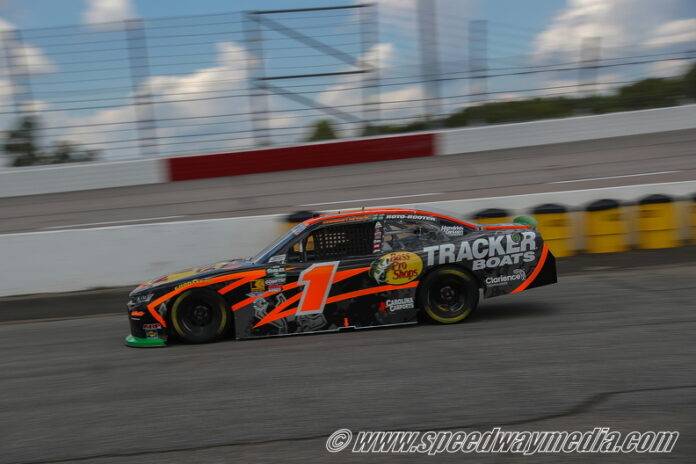
Carson Kvapil was awarded the pole position for the Blue Cross NC 300 at Charlotte Motor Speedway on Saturday, October 10.
The event’s starting lineup was determined by a qualifying metric formula that evaluated competitors’ finishing results from a previous-scheduled event and respective entries in the owner’s standings. This was due to this weekend’s on-track qualifying session at Charlotte being canceled due to inclement weather.
Kvapil is coming off a strong runner-up result during last weekend’s NASCAR O’Reilly Auto Parts Series’ Chase event at Las Vegas Motor Speedway and is currently ranked in the runner-up spot in the 2026 Chase standings. Therefore, the 23-year-old native from Mooresville, North Carolina, was awarded the top-starting spot for Saturday’s fifth Chase event of this season at Charlotte. Kvapil is also currently trailing the points lead by 19 points as he has five Chase events remaining on his schedule, including this weekend at Charlotte, to make up his deficit and contend for his first series’ championship.
Kvapil will share the front row with Corey Day, the latter of whom won last weekend at Las Vegas following a dramatic duel with Kvapil in the closing laps. Jesse Love, Brent Crews, Sam Mayer, Taylor Gray, Austin Hill, Sheldon Creed, William Sawalich and Rajah Caruth complete the top-10 starting grid, respectively.
With eight of 12 Chase contenders (Kvapil, Day, Love, Mayer, Gray, Hill, Creed and Caruth) starting in the top 10 on the grid, the remaining Chasers that include Sammy Smith, Parker Retzlaff, Justin Allgaier and Brandon Jones will start 13th, 16th, 23rd and 28th, respectively.
With 39 competitors vying for 39 starting spots, all made the main event.
Charlotte – Starting Lineup:
Carson Kvapil
Corey Day
Jesse Love
Brent Crews
Sam Mayer
Taylor Gray
Austin Hill
Sheldon Creed
William Sawalich
Rajah Caruth
Jeremy Clements
Anthony Alfredo
Sammy Smith
Ryan Sieg
Harrison Burton
Parker Retzlaff
Dean Thompson
Brennan Poole
Austin Green
Carson Brown
Jeb Burton
Kyle Sieg
Justin Allgaier
Garrett Smithley
Patrick Staropoli
Matt DiBenedetto
Lavar Scott
Brandon Jones
Mason Maggio
Blaine Perkins
Joey Gase
Josh Bilicki
Ryan Ellis
Myatt Snider
Derek Lemke
Jake Finch
Dawson Cram
JJ Yeley
*Bold indicates Chase Drivers
The 2026 Blue Cross NC 300 at Charlotte Motor Speedway is scheduled to occur on Saturday, October 10, at 4 p.m. ET on the CW Network, PRN Radio and SiriusXM.
Layne Riggs | Chandler Smith Charlotte Motor Speedway NASCAR CRAFTSMAN Truck Series Race Report Charlotte Motor Speedway 200 Date: Friday, October 9, 2026 Event: Race 21 of 25 Series: NASCAR CRAFTSMAN Truck Series Location: Charlotte Motor Speedway (1.5-miles) Length of Race: 134 laps over one hour, 43 minutes, 15 seconds
FRM Finish:
Layne Riggs (Started 13th, Finished 1st / Running, completed 134 of 134 laps) Chandler Smith (Started 10th, Finished 5th / Running, completed 134 of 134 laps)
Layne Riggs won his seventh race of the season and 12th of his career with tonight’s victory.
The win completes a Charlotte season sweep after he took the checkered flag in May, as well.
Riggs is now only four wins away from tying Greg Biffle (16) as Ford’s all-time wins leader in the series.
“It was a great race tonight,” said Riggs. “Front Row Motorsports gave me a great No. 34 BKB Bare Knuckle Boxing Ford F-150. We’ve been working a lot at the Ford Racing simulator to get better for this race. We kind of fine-tuned our setup that we had here in the Spring and brought the same truck back. I feel like the bumps and characteristics of this track make it really, really difficult to hit it just right, but the truck was good enough, and I was confident enough behind the wheel that I was able to drive it up to the front.”
“Our No. 38 Mystik Lubricants Ford F-150 was really good tonight,” said Smith. “Obviously, we ran top three the whole race until we had that problem. Man, I don’t even know what to call it back there. It’s something. I didn’t like it. I joked to the guys, ‘please, don’t put me in this spot again. I hate it back here. I’m scared.’ I was joking because we haven’t had nothing go for us and then we dodged that wreck and I came on the radio and was like, ‘I want to praise the Lord for us dodging that wreck’ because that would have been the topping on the cake for tonight. To rebound and finish top five, I’m humbled.”
ABOUT FRONT ROW MOTORSPORTS
Front Row Motorsports (FRM) is a winning organization competing in the NASCAR Cup Series and the NASCAR CRAFTSMAN Truck Series. Founded in 2004 by entrepreneur Bob Jenkins, FRM has earned top honors including a 2021 Daytona 500 victory and the 2022 CRAFTSMAN Truck Series championship. Based in Mooresville, N.C., FRM fields the No. 4, No. 34, and No. 38 entries in the NASCAR Cup Series, along with the No. 34 and No. 38 teams in the CRAFTSMAN Truck Series. For more information, visit FrontRowMotorsports.com and follow Front Row Motorsports on social media — X: @Team_FRM, Instagram: @teamfrm, Tik Tok: @Team_FRM, YouTube: @FrontRowNASCAR, and Facebook: facebook.com/FrontRowMotorsports.
Eckes Notches Second Straight Runner-Up at Charlotte
Christian Eckes’ stout Chase run continued with a brilliant drive towards a runner-up finish at Charlotte Motor Speedway on Friday evening. The driver of the No. 91 NAPA Nightvision Chevrolet Silverado RST was methodical and opportunistic in his second-straight second-place effort. A late charge from fourth to second in final 11 circuits netted him one position in the NASCAR CRAFTSMAN Trucks Series Chase standings and sits fourth after his eighth top-five finish of the season.
Eckes’ evening began from the eighth position but was met with a tight handling condition at the drop of the green flag. While he navigated the chaotic traffic at the outset, Eckes directed his NAPA Nightvision Chevrolet towards the top-five despite a “super tight” chassis balance. As the opening 30-lap stage progressed, so did the No. 91, while an improved handling condition allowed Eckes to muscle his way inside the top-five and collect seven points at lap 30 while running in fourth position.
The first pit stop of the evening posed a dose of adversity to the team as Eckes was blocked in his pit stall by the No. 88 machine, who was pitted directly in front. Eckes’ pit exit was hampered and subsequently lined up 10th for the lap 38 restart. Within two circuits, Eckes was back inside the top-five and scored six additional points at the close of Stage 2 on lap 60 in fifth position.
The second four-tire pit stop of the night under caution saw a second instance of Eckes being blocked in on pit road, thus dropping him back to 12th. The pit lane woes couldn’t keep him buried for long as he drove back into he top five in 21 laps. He ran fifth when a cycle of green flag pit stops began and was third when a fortuitous caution flew on lap 99, allowing him to pit under yellow.
Quality pit work by the NAPA team kept Eckes in the top-five and restarted fourth on lap 106. A pair of cautions and a restart on lap 124 set up an 11-lap run to the checkers. Eckes immediately took third position on the restart and closed in on the top two jockeying for position. He pounced on the leader stumbling in Turn 4 with five laps remaining to take second and began tracking down the new leader. Eckes ultimately ran out of time, but scored his best-career finish at CMS, coming home second to equal his best result of the year.
Christian Eckes Quote:
“Not only on our team, but all of McAnally-Hilgemann Racing. We have three in the top-10, so that’s good to see progress across the board. Our NAPA Nightvision Chevrolet was really solid all day. We were kind of just slow down the straightaways and struggled with a couple balance items. Still good to finish second, that’s back-to-back weeks. Obviously, we want to win and I feel like we’re on the cusp of doing that. We’ll move on to Phoenix and hopefully we can do it there.
Consistency can be an elusive attribute for drivers, but Daniel Hemric has found it and generating momentum after a sixth-place finish at Charlotte Motor Speedway (CMS) on Friday evening. The driver of the No. 19 Delphi Chevrolet Silverado RST continued his progress up the NASCAR CRAFTSMAN Trucks Series (NCTS) Chase standings by moving to fifth in points. Hemric’s string of consistency now includes fourth top-10 results over the last five races, and three finishes of eighth or better in the last four races.
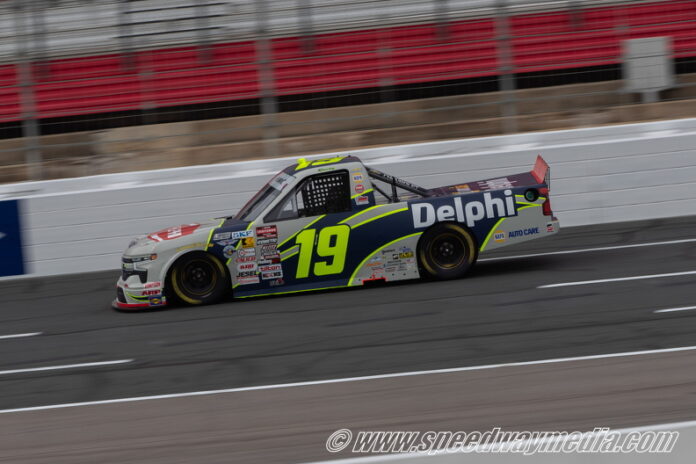
Hemric’s Delphi Chevrolet featured a tribute scheme to Kyle Busch’s 2007 NASCAR Busch Series car, and the North Carolinian made sure to deliver an effort worthy of Rowdy’s scheme. He took the green flag in 16th position and instantly moved forward. By lap four, Hemric climbed to 11th but began to contend with a loose handling balance during the opening run. The entirety of Stage 1 ran under green flag conditions as Hemric was scored 13th at the end of the segment on lap 30.
During the stage caution, crew chief Kevin Bellicourt armed Hemric with a fresh set of Goodyear tires, fuel, and an adjustment to improve his balance. He restarted in 18th position on lap 38 and immediately made another charge forward. The outside lane provided timely momentum as the neon No. 19 rocketed back into the top-10 by lap 40. The ensuing 24-lap run showed Hemric’s durability as he maintained the 10th position to score a stage point at the end of the segment at lap 60.
After the second pit stop of the evening for four tires, fuel, and an adjustment, Hemric lined up 13th for the lap 69 restart. Cooler temps and increased grip levels gradually improved the No. 19’s outright speed as Hemric drove to ninth by lap 73. The following green flag period ran long enough to begin a cycle of pit stops but was interrupted by a timely caution flag on lap 99 while running fifth. Hemric made his final pit stop of the evening under the yellow flag and restarted seventh on lap 106. Two subsequent restarts with elevated intensity settled the evening and saw Hemric run as high as fourth with 11 laps remaining. He ultimately finished sixth for his 10th top-10 finish of the season and was one of three MHR entries to finish in the top-nine.
Daniel Hemric Quote:
“Super special to carry that Delphi throwback paint scheme. Just disappointed we couldn’t finish a little better than we did but the reality is we finished better than we ran all day. Just got fortunate with the yellow that caught a couple of the guys that we were kind of around and racing. That was a break, netted us two or three spots. Had a couple restarts go our way. We thought we were going to claw out a fouth-place finish there and the front tires shut off. Disappointed we let a top-five slip away, but where we were in Stage 1, Stage 2, we’ll count our blessings and go to the next one.”
NCTS RACE RECAP: CHARLOTTE MOTOR SPEEDWAY II Event: Ecosave 200 (134 laps / 201 miles) Round: 21 of 25 (Chase) Track: Charlotte Motor Speedway Location: Concord, NC Date & Time: Friday, October 9 | 5:00 PM ET
No. 45 J.F. Electric Chevrolet Silverado RST Driver: Landen Lewis | Crew Chief: Phil Gould
Key Takeaway: Landen Lewis and the J.F. Electric team had a great outing in Charlotte. Lewis started off on the right foot after nabbing his best-career qualifying effort in fifth-place. The No. 45 team fell back in the opening two stages as they fought a tight-handling condition, and nearly lost all track position once the caution flew during the green flag pit cycle. Lewis rose to the occasion in the last run of the night and rallied back to finish in seventh-place, marking his fifth top-10 finish of the season.
Landen Lewis’ Post-Race Thoughts: “Honestly, this is a really good finish for us, especially considering this is only my second mile-and-a-half race I’ve ran. It felt like we ran inside the top-10 all day long. We maybe fell out of it once or twice, but we had a lot of speed. I learned a lot running up front against those guys who have been doing it for a long time. Obviously, the pit call Phil (Gould) gave me to not pit once we were coming down when the yellow came out was a good call for us. We lost a little bit of track position since we were already on pit road, but it could have been much worse. My pit crew was really quick tonight and they helped put us in a good spot to still get a solid finish. It was a good night for us on the J.F. Electric team.”
About J.F. Electric: J.F. Electric is an electrical contractor that provides engineering expertise, backed by construction and installation know-how in a diverse range of service offerings, from utilities and commercial projects, to industrial and telecommunications customers. When having a long family history in an industry, a company not only builds on its knowledge and experience, it takes pride in cultivating a solid understanding of client needs, all the while nurturing strong relationships with its employees. Evolving through five generations of the Fowler family, J.F. Electric has matured into a well-managed and thoughtfully diversified electrical contractor which is poised to continue its growth and expansion into the future.
No. 44 Telcel Chevrolet Silverado RST Driver: Andrés Perez de Lara | Crew Chief: Wally Rogers
Key Takeaway: Andrés Pérez de Lara and the Telcel team had fortune on their side as they were able to capitalize on a well-deserved top-10 finish in Charlotte. Pérez de Lara laid down a quick lap in qualifying and started in ninth-place. In the first two stages, the No. 44 team made swings at the balance of the truck on pit road. Once the changes were implemented ahead of the final stage, Pérez de Lara made strides on the track. He crossed the line in eighth-place for his third top-10 result of the year.
Andrés Pérez de Lara’s Post-Race Thoughts: “It feels great for us to be able to get a solid top-10 result tonight. One finally fell our way! The team played a good strategy there, we got some good positioning after the last pit stop, and we were able to execute and keep it up front. I’m happy with our result; we’ll take the eighth-place finish and keep building on it for good momentum to end the year. Thank you to everyone at Telcel, Acceptance Insurance, Niece Motorsports, and Team Chevy for supporting our team.”
About Telcel: Telcel is Mexico’s leading telecommunications company, providing nationwide coverage, cutting-edge mobile connectivity, and high-speed internet services to millions of users. With over 30 years of experience, Telcel continues to innovate in digital communication, offering solutions that keep people connected anytime, anywhere.
No. 4 Utilitra Chevrolet Silverado RST Driver: Matt Mills | Crew Chief: Mike Shiplett
Key Takeaway: Matt Mills and the Utilitra team battled through a considerable amount of adversity in Charlotte. Rolling off from 19th, Mills ran conservatively early on in his first start since last year’s season finale. As the night progressed, Mills began his advance through the field. Unfortunately, his No. 4 Silverado became damaged after getting involved in a multi-truck crash on lap 119. Shortly after, Mills was forced to pit under green as he had a left-front tire go down due to the damage. In his series return, Mills came home posted in 23rd-place.
Matt Mills’ Post-Race Thoughts: “It was good to be back, and I had a lot of fun out there tonight. It was tough to go so long without making a start and feel comfortable off the bat, but I felt like we showed speed tonight. Right when we finally got some track position, we got in the big wreck on the backstretch and had to go to the back after we fixed the damage. On the next restart, we had more damage that made the left-front tire go down under green. I really feel like we just needed track position and green flag laps tonight and we could’ve had a solid finish, but I was just glad to be out there. Huge thanks to everyone at Utilitra, J.F. Electric, and Niece Motorsports for the opportunity.”
About Utilitra: Utilitra is a woman-owned firm specializing in utility and technology solutions with a diverse team of specialized professionals. Utilitra is committed to solving their client’s unique challenges, whether one expert or a team of experts is needed. By adapting to the needs of their respective industries, Utilitra has built a range of services for their utility and technology partners.
No. 42 Comprehensive Logistics Chevrolet Silverado RST Driver: Conner Jones | Crew Chief: Landon Polinski
Key Takeaway: Conner Jones and the Comprehensive Logistics team had their night end early due to a mechanical failure in Charlotte. Jones earned his best qualifying result of the year in 11th, and was optimistic for a solid evening. Once the race began, Jones did not maintain his pace and fell behind. The No. 42 team made several adjustments throughout the race, but a rear gear issue ultimately brought their efforts to a halt with 20 laps to go. Jones was credited with a 34th-place result in his fourth start of the year.
Conner Jones’ Post-Race Thoughts: “Just had an unfortunate set of circumstances for us tonight. Our Comprehensive Logistics Chevy was fast in qualifying earlier today, but we just couldn’t go much further in the race. My guys worked hard to try and make it better, but I something broke in the rear end on the truck that kept us from finishing. We will move onto the next one and hope for a better race.”
About Comprehensive Logistics: Comprehensive Logistics (CLI) is a full-service inbound-to-manufacturing logistics partner specializing in high-volume, high-velocity, and highly complex operations, including warehouse management, value-added services, sequencing, transportation, and sub-assembly manufacturing. By integrating advanced technology, data-driven insights, and process engineering with experienced teams, CLI delivers high-precision, reliable logistics solutions tailored to evolving customer needs. For more information, please visit complog.com.
About Niece Motorsports: Niece Motorsports is a professional auto racing team that has competed in the NASCAR CRAFTSMAN Truck Series since 2016. The team is owned by Josh Morris of DQS Solutions and Staffing and the Fowler Family of J.F. Electric and Utilitra, and was founded by United States Marine Corps Veteran Al Niece. At its 80,000 sq. ft. headquarters in Salisbury, NC, Niece Motorsports is a full-service race vehicle build shop as well as a customizable fabrication shop for any manufacturing needs.
Follow the Team: To keep up to date with the latest team news, visit niecemotorsports.com or connect on Facebook and Instagram (@NieceMotorsports) as well as X (@NieceMotorsport).
Daniel Hemric muscled his way to a strong sixth-place result in the 2026 Ecosave 200 at Charlotte Motor Speedway on Friday, October 9.
The 2021 NASCAR O’Reilly Auto Parts Series champion from Kannapolis, North Carolina, rolled off the starting grid from his 16th-place qualifying spot while sporting a throwback paint scheme to his No. 19 Delphi/McAnally-Hilgemann Racing Chevrolet Silverado RST entry that pays tribute to the late two-time Cup Series champion, Kyle Busch, and the scheme Busch piloted when he drove for Hendrick Motorsports during the 2007 O’Reilly season.
Hemric spent the entirety of the first stage period racing within the top-15 mark. After carving his way up as high as 11th place in the early laps, Hemric settled in 13th place at the first stage’s conclusion. Restarting in 17th place for the start of the second stage period that commenced on Lap 37, Hemric managed to navigate his way back up to 11th place by the Lap 40 mark before he cracked the top-10 mark for the first time during the following lap, where he was ranked in 10th place. Ultimately, Hemric retained the spot and netted a single stage point when the second stage period concluded on Lap 60.
After starting the final stage period with 66 laps remaining in 14th place, Hemric steadily carved his way back into the top-10 mark and he raced his way up to seventh place within the final 40-lap mark. Amid a late cycle of green flag pit stops that featured a handful of front-runners pitting, Hemric remained on the track and was ranked in fifth place when a caution for an on-track incident occurred with 36 laps remaining. This allowed the Kannapolis native to pit with the leaders and restart in eighth place for the next restart with 29 laps remaining.
Through two additional cautions and restarts, Hemric carved his way within the top-six mark and was up into fourth place following an 11-lap dash to the finish. After appearing to have fourth place solidified, he was overtaken by Bayley Currey and Chandler Smith in the final laps before he took the checkerd flag in sixth place. The result enabled Hemric to notch his ninth top-10 result of the 2026 Craftsman Truck Series season, his second in a row in the Chase and his highest-finishing result at Charlotte in the series. It also places his current average-finishing result within the first three Chase events of this season at 7.3.
“[I’m] Disappointed we couldn’t finish a little better than we did, but the reality is, we finished better than we ran all day,” Hemric said. [I] Just got fortunate there with the yellow that caught a couple of the guys that we were around and racing closely to. That was a break. It netted us two or three spots. I had a couple of restarts go our way. I thought we were gonna claw out a fourth-place finish there and the front tires shut off with like five [laps] to go.
Prior to Charlotte, Hemric was ranked in sixth place in the Chase standings and trailed the points lead by 87 points. After Charlotte, he jumped a single spot to fifth place in the standings despite his deficit to the points lead growing to 109. With the consistent runs and results generated on the track, Hemric strives to cap off the 2026 campaign on a strong note.
“I’m not a momentum guy, but I am a guy who believes that when your product gets better, you run better and that makes momentum,” Hemric said. “I feel like our trucks and our processes are beginning to be where they need to be. We’re showing that with our results week in and week out. This is not by accident. I look forward to continuing on the next four weeks.”
Daniel Hemric’s 2026 NASCAR Craftsman Truck Series season continues next Friday, October 16, at Phoenix Raceway in Avondale, Arizona. The event’s broadcast time is scheduled to commence at 7:30 p.m. ET on FS1, NASCAR Racing Network and SiriusXM.
On a standard bicycle, gears let your legs stay efficient on hills and at speed. On an e-bike, the motor helps with both, which is why the single-speed e-bike is a genuine option rather than a compromise. The right choice depends on your terrain, your cargo, and how much maintenance you want to think about.
This guide compares single-speed and multi-speed e-bikes across hills, starting power, range, maintenance, and reliability, so you can match the drivetrain to your route — and avoid overpaying for gears you will never use.
The short version: flat, relaxed city riding suits a single-speed beautifully; hills, long distances, cargo, or sporty riding reward a multi-speed drivetrain. Everything below explains the practical difference.
What Single Speed Means on an E-bike
A single-speed e-bike has one gear ratio, so it has no derailleur, shifter, chain tensioner, or gear cables. You simply pedal, and the motor assists in the selected mode. Because the drivetrain has so few moving parts, it is quiet, cheap to maintain, and hard to break — a genuinely attractive package for urban riders on flat ground.
The limitation is flexibility. On steep hills or against a strong headwind, a single gear forces you to pedal slowly or push hard, and while the motor helps, it cannot change the gear ratio. If your route is flat, you will rarely notice; if it includes real climbs, you will feel it every day.
Single-speed e-bikes are also the lightest and cheapest drivetrains, which shows up in a lower price and easier lifting. If your town is genuinely flat, that simplicity is a feature, not a compromise.
What Multi-Speed Adds
A multi-speed drivetrain — typically 3 to 8 hub gears, or 7 to 12 derailleur gears — lets you keep your cadence comfortable whether you are climbing, cruising, or riding empty. On an e-bike, the bigger benefit is efficiency: with the right gear, you keep the motor working in its efficient range, which extends both battery range and component life.
The costs are weight, complexity, and maintenance. Derailleur systems need adjustment and are exposed to weather and knocks; hub gears are heavier but almost fully sealed. For most buyers, the real question is not whether gears are better, but whether the routes you ride need them.
If you do choose gears, decide between hub and derailleur early: a 3-speed hub covers most city needs with almost no maintenance, while a 7–8 speed hub or derailleur adds the range for hills and faster cruising. On a 25 km/h pedelec, anything beyond 8 speeds adds weight without much extra usefulness.
Hills, Starts and Commuting: Where Gearing Counts
Gearing matters most at two moments: starting from a standstill on a slope, and grinding up a long climb. On a multi-speed e-bike, you drop into a low gear, let the motor pull smoothly, and pedal comfortably. On a single-speed, you rely entirely on the motor’s torque — and if that torque is modest, steep starts become hard work.
In flat stop-and-go traffic, the difference nearly disappears. A single-speed e-bike with 45 Nm of torque handles junctions and red lights effortlessly, and many commuters prefer the simplicity. Test your own hills before assuming you need gears: an e-bike with strong torque may climb surprisingly well in one gear.
Cadence also matters for comfort: in a too-high gear you pedal slowly and push hard; in the right gear you spin smoothly. On multi-speed bikes, you control that; on a single-speed, your legs adapt to the ratio.
Range and Battery Efficiency
Gears also affect range, though less than battery size. A multi-speed drivetrain lets you choose an efficient cadence, which keeps the motor drawing less current on climbs and at speed. The difference matters on long rides and is negligible on short commutes.
The practical rule: if range matters more than simplicity, multi-speed helps; if your trips are short and flat, the battery difference between a single-speed and a multi-speed bike will be hard to notice.
Maintenance and Reliability
This is where single-speed e-bikes win clearly. Fewer parts mean fewer failures: no derailleurs to knock out of alignment, no cables to stretch, no indexed shifting to drift. A single-speed drivetrain is effectively a chain and a chainring, which any shop — or any confident home mechanic — can service quickly.
If you do choose multi-speed, hub gears (3–8 speeds) offer the best reliability-for-convenience balance on a commuter, because the mechanism is sealed inside the rear wheel. Derailleur gears give more ratios and lighter weight, but expect an annual tune-up and more care in wet weather.
Whichever you choose, keep the chain clean and lubricated — a dry or gritty chain is the most common cause of early drivetrain wear on any e-bike, single speed or multi.
Single Speed vs. Multi-Speed: Which Fits Your Riding?
Riding profile
Best drivetrain
Why
Flat city commuter
Single speed
Simple, quiet, low maintenance, plenty of torque
Hilly town
Multi-speed (hub or derailleur)
Low gears keep climbing smooth and efficient
Long-distance rider
Multi-speed
Efficient cadence protects range on long rides
Cargo and family hauling
Multi-speed
Low gears help with heavy loads on hills
Casual leisure rider
Single speed
Nothing to think about, nothing to adjust
Drivetrain Choices by E-Bike Type
A city e-bike aimed at daily commuting usually offers a multi-speed option, and for good reason: towns have hills, pavements and junctions, and a low gear turns awkward climbs into easy pedaling. If your town is flat, the single-speed version of the same bike will serve you just as well.
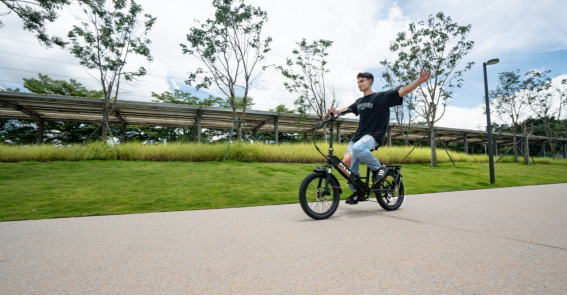
Retro and cruiser e-bikes, meanwhile, lean towards comfort-first gearing: a retro e-bike with a relaxed frame and a multi-speed drivetrain, such as PIXAR’s M9 with its Shimano 7-speed system, pairs easy pedaling with long-range batteries for unhurried weekend rides.
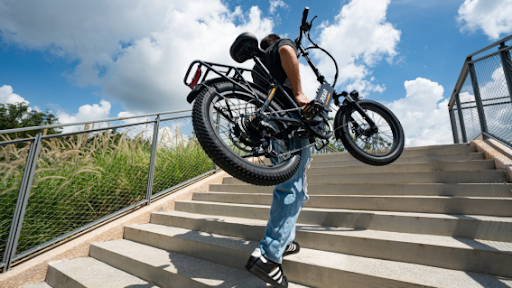
Folding e-bikes split both ways: compact single-speed folders suit flat, short urban hops, while multi-speed folders earn their keep on hills and mixed commutes.
Frequently Asked Questions
Do single-speed e-bikes climb hills well?
They climb, but not always comfortably. With strong torque (55 Nm or more) a single-speed e-bike handles moderate hills fine; steep, long climbs are much more pleasant with a low gear. Test the exact hill before you decide.
Are multi-speed e-bikes harder to maintain?
Slightly. Derailleurs need periodic adjustment and care in wet weather; hub gears are sealed and need little attention. Both are manageable, but if maintenance avoidance is your priority, single speed wins.
Does a single speed save battery?
Not necessarily. A multi-speed drivetrain can actually extend range on hills by keeping the motor in an efficient cadence. On flat ground, the difference is minimal — battery size matters far more.
How many gears do I really need on an e-bike?
For most flat-city riders, one gear or a 3-speed hub is plenty. Riders facing hills, cargo, or long distances benefit most from 7–8 speeds. More than 8 speeds adds weight and cost without much benefit on a 25 km/h pedelec.
Are hub gears better than derailleurs on an e-bike?
For commuting and cargo, usually yes: hub gears are sealed, weather-resistant, and need almost no adjustment, which suits the stop-start, all-weather life of a city e-bike. Derailleurs offer more ratios and less weight for sportier riding.
Final Words
The honest answer to single speed vs. multi-speed is that most riders who never try a single-speed overestimate how much they need gears. If your route is flat and simple, save the weight and the maintenance and enjoy the simplicity. If hills, loads, or distance are part of your week, a multi-speed drivetrain will repay you every ride. Choose for your route, not for the spec sheet.
And if you are still unsure, err on the side of simplicity: a single-speed e-bike with strong torque is rarely regretted on flat ground, while the multi-speed option is there when the terrain demands it. Either way, the motor does most of the work — gears are there to make the ride feel right.
You are already through immigration when you realize the problem: the phone still has no local data plan. Maybe you forgot to arrange one before the flight, expected airport Wi-Fi to be enough, or only decided after landing that your home carrier’s roaming option was not worth using.
The good news is that arriving at the destination does not automatically make it too late to buy a Travel eSIM. Because an eSIM is delivered digitally rather than collected as a physical card, it can usually still be purchased after arrival.
There is one catch: you need some form of internet access to complete the purchase and download the eSIM profile. That makes the first available Wi-Fi connection the bridge between having no travel data and setting up your own mobile connection.
Yes, You Can Buy After Arrival—But You Need Internet First
Buying an eSIM after landing changes the order of the setup, not the basic requirements.
Your phone still needs to support eSIM, it should be carrier-unlocked, and you need an internet connection while purchasing and installing the profile. Airport Wi-Fi is often the easiest option, but hotel Wi-Fi, a café network, a trusted hotspot from a companion, or temporary access through your existing carrier can also work.
The important point is that the Wi-Fi only needs to get you through the purchase and installation. Once the new eSIM connects to a supported mobile network, it can provide the data connection for the rest of the trip.
This is different from buying a physical local SIM, where you may need to locate a shop, wait for it to open, and collect the card in person.
Where Can You Set It Up After Landing?
The best place is not necessarily the place with the strongest mobile signal. It is the place where you have stable internet and enough time to finish the setup without rushing.
At the Airport
Airport Wi-Fi can be convenient because you can arrange the eSIM before leaving the terminal. This is especially useful if the next step is booking a rideshare, finding a train platform, or navigating to accommodation.
The drawback is that public airport networks can occasionally be slow or require a login page. If the connection is unstable, moving closer to the main terminal area or using another trusted network may be easier than repeatedly restarting the eSIM installation.
At the Hotel or Accommodation
If you can reach the hotel without mobile data, its Wi-Fi may be a calmer place to complete the process. You have more time to check the plan, read the installation instructions, and confirm that the correct line is selected.
The downside is obvious: you still need to get from the airport to the hotel first.
Using Temporary Roaming as a Bridge
Some travelers briefly use their home carrier’s roaming data only long enough to purchase and install the travel eSIM. Whether that makes sense depends on the carrier’s pricing. If roaming triggers an expensive daily charge, airport Wi-Fi is usually the better bridge.
Check the Phone Before You Pay
Landing without a data plan can create pressure to buy quickly, but device compatibility still matters.
Before checkout, confirm:
the phone supports eSIM;
the device is carrier-unlocked;
you are buying coverage for the country you are currently in;
the plan’s validity and data allowance fit the remaining trip;
the phone has a stable internet connection for installation.
This check becomes even more important after arrival because you may already need the connection urgently. Buying the wrong plan or discovering a carrier lock after payment only creates another problem.
If the trip includes several countries, do not automatically buy a plan for the current location only. A regional option may make more sense if another border crossing is coming soon.
Why Digital Delivery Matters More When You Are Already Abroad
Once you have landed, speed and simplicity matter more than they did while planning at home. You do not want to create an account, wait for shipping, or search for a physical pickup point when the immediate goal is simply to get online.
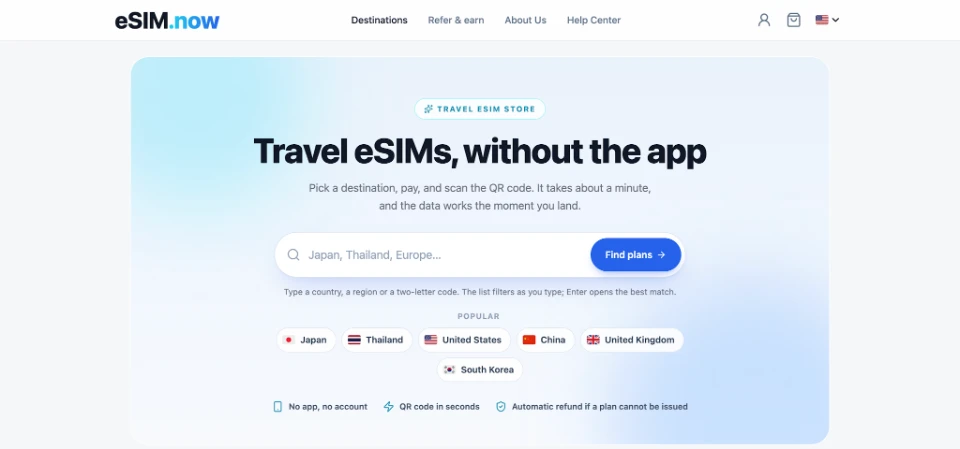
That is where the purchase flow on esim.now is useful for someone who has already arrived. Travelers choose the destination and plan online, complete payment, and receive the QR code on the order page and by email. The site does not require a mandatory app or account simply to receive the eSIM. eSIM.now says QR codes are issued as soon as payment clears.
The plan pages also show the data allowance, validity, service type, network information, hotspot availability, and device-transfer rule before purchase. This means a traveler who is already in the destination can still compare what is needed for the remaining days rather than buying blindly because the trip has already started.
For eSIM.now plans, service is data-only and the traveler’s existing number remains on the primary SIM. The plan normally starts when the installed travel eSIM first connects to a supported destination network. If you buy after arrival, that means the validity period can begin soon after installation and connection, rather than losing days before the purchase.
Do Not Leave the Wi-Fi Zone Until the New Line Works
Buying the plan is not the end of the process. Test it while you still have the connection that helped you install it.
After the profile has been added:
Turn the travel eSIM line on.
Select it as the phone’s mobile-data line.
Enable data roaming on the travel eSIM if the plan instructions require it.
Temporarily turn Wi-Fi off.
Open a map or ordinary webpage.
If the page loads, the travel eSIM is carrying data and you can leave the Wi-Fi area with much more confidence.
If it does not work, reconnect to Wi-Fi before changing anything major. Re-read the setup instructions, confirm the correct data line, and avoid deleting the profile as a first troubleshooting step.
That test is particularly valuable at an airport because discovering the problem beside a working Wi-Fi network is much easier than discovering it in a taxi queue outside the terminal.
When Buying After Arrival Makes Perfect Sense
Forgetting to buy beforehand is not the only reason someone might intentionally wait.
You may want to see whether free Wi-Fi is sufficient before paying for mobile data. A business traveler might discover after arrival that hotel Wi-Fi is unreliable. Someone extending a stop unexpectedly may suddenly need local data for several more days. Another traveler may change countries and realize the existing plan does not cover the new destination.
In these situations, digital delivery means the purchase can respond to the trip as it actually unfolds.
The trade-off is that buying after arrival depends on having temporary internet access first. If you know you will need maps, ride-hailing, messages, or tickets immediately after leaving the aircraft, arranging the eSIM before departure is still more convenient.
Buying Late Is Fine; Getting Stranded Offline Is the Real Problem
A travel eSIM does not have to be purchased before the flight. If you have already arrived, you can still buy and install one as long as the phone is compatible, unlocked, and temporarily connected to the internet.
Use airport or hotel Wi-Fi to complete the setup, choose the plan around the days and destinations that remain, and test the cellular connection before walking away from the Wi-Fi.
Buying before departure removes one task from arrival day. Buying afterward is still a practical fallback when plans change—or when you simply forgot. The key is making sure one temporary connection is available long enough to create the mobile connection you will use for the rest of the trip.
Some injuries do not end when the bruising fades or the first round of treatment is over. Pain can continue for months. It may affect how you work, sleep, drive, walk, lift, or care for your family.
Long-term pain can be frustrating because it is not always visible. You may look fine to others while still dealing with headaches, back pain, nerve pain, joint pain, or stiffness every day.
You may be able to include long-term pain in an injury claim if it is connected to the accident and supported by evidence. A personal injury lawyer can review medical records, treatment history, and daily limitations to determine how lasting symptoms may affect compensation.
Long-Term Pain Can Be a Real Damage
Pain is not always short-term. Some accident injuries lead to chronic symptoms that continue after initial treatment.
Long-term pain may involve:
Back pain
Neck pain
Nerve pain
Joint pain
Headaches
Shoulder pain
Knee pain
Soft-tissue pain
Pain from scarring or surgery
A claim involving long-term pain must show more than discomfort. It should explain how the accident caused or worsened the condition and how that pain affects your life.
For example, pain that keeps you from working full shifts, lifting your child, sleeping through the night, or driving comfortably may be part of the damages analysis.
Medical Records Make the Pain Easier to Prove
Long-term pain claims depend heavily on medical documentation. Since pain is personal, records help show that symptoms were reported, evaluated, and treated over time.
Helpful records may include:
Emergency care notes
Follow-up appointments
Imaging results
Specialist reports
Physical therapy notes
Pain management records
Prescription records
Surgery recommendations
Consistent records can show the history of your symptoms. They can also show what treatment helped, what did not help, and what doctors recommend next.
If pain continues, keep telling your providers. If the symptom is not documented, an insurance company may argue it was not serious or was unrelated to the accident.
Chronic Pain Can Affect Compensation
Compensation in a personal injury claim may include both financial and personal losses. Long-term pain can affect both.
It may support damages for:
Medical bills
Future medical care
Lost income
Reduced ability to work
Pain and suffering
Loss of normal activities
Help needed at home
The value of the claim depends on how severe the pain is, how long it lasts, what treatment is needed, and how it affects daily life. A person who has occasional soreness may have a different claim than someone who needs ongoing care and cannot return to normal activities.
Future Treatment Should Be Considered
A settlement should not ignore future care. If pain is expected to continue, doctors may recommend ongoing treatment.
Future care may include:
Physical therapy
Medication
Specialist visits
Pain management
Injections
Surgery evaluation
Medical equipment
Future damages usually need medical support. A doctor’s opinion can help explain what care may be needed and why it relates to the accident.
This is why settling too early can be risky. If you accept an offer before doctors understand your long-term condition, the settlement may not include future medical needs.
Insurance Companies May Challenge Chronic Pain
Insurance companies often question long-term pain claims because pain is not always shown clearly on an X-ray or MRI. They may argue that symptoms are exaggerated or caused by something else.
Common insurer arguments include:
The pain came from a prior condition
Treatment gaps weaken the claim
Imaging does not explain the symptoms
The injury should have healed by now
The person can still work
The treatment is excessive
These arguments do not automatically defeat a claim. They do show why consistency matters. Medical records, symptom notes, and provider opinions can help counter claims that the pain isn’t real or accident-related.
Other Evidence Can Show Daily Impact
Medical records explain the diagnosis and treatment. Other evidence can show how pain affects your life outside the doctor’s office.
Useful support may include:
Pain journals
Photos of injuries
Statements from family members
Work restriction notes
Wage records
Prescription receipts
Activity logs
Notes about missed events or changed routines
A Palm Bay personal injury lawyer may use these materials, along with medical records, to explain the full impact of chronic pain. This can be especially helpful when symptoms affect sleep, work, household tasks, or mobility.
Prior Conditions Do Not Always Prevent Recovery
Some people already had back pain, arthritis, migraines, or other health conditions before an accident. That does not automatically prevent a claim.
The key question is what changed after the accident. Did the pain become worse? Did symptoms become more frequent? Did you need new treatment? Did your doctor recommend restrictions that were not needed before?
Before-and-after medical records can help answer these questions. A claim may focus on new pain or aggravation of an existing condition, not your entire medical history.
Florida Laws May Affect Your Claim
Florida follows a modified comparative negligence rule. In negligence actions covered by the statute, a person found greater than 50 percent at fault for their own harm may not recover damages. If the person is partly at fault but not over that limit, compensation may be reduced by their percentage of fault.
Florida law also allows 2 years for negligence claims. This deadline matters in long-term pain claims because treatment may continue while the legal time limit runs.
Evidence should be preserved early. Medical records, photos, witness statements, and expense documents can all affect how the claim is evaluated.
What You Should Do If Pain Continues
If pain does not improve, take it seriously.
You should:
Seek all follow-up medical care
Tell providers about all of your symptoms
Follow treatment recommendations
Keep appointment records and prescriptions
Save all of the bills and paid receipts
Track work limits and daily problems
Avoid settling before your prognosis is clear
Do not minimize symptoms because you think they should have healed already. Accurate reporting helps your doctors treat you and helps document your claim.
Conclusion
Long-term pain after an accident in Palm Bay may be part of a personal injury claim when it is supported by medical evidence and connected to the accident. Chronic symptoms can affect medical costs, income, daily life, and future care needs.
The strength of the claim depends on documentation, consistent treatment, and proof of daily impact. FK Legal can review your situation and explain how lasting pain may affect your personal injury claim.
The examiner says the words, the L plates come off in the car park, and the newly qualified driver goes home to a family that is relieved and a group chat that wants a lift on Saturday. Nobody mentions that the most dangerous year of their driving life has just started.
The numbers are not in dispute. Drivers in their first year after passing are involved in a disproportionate share of serious collisions in Britain, and the first six months are the worst of that year. Around one in five new drivers has a collision of some kind within twelve months of passing. The test proves competence in a controlled situation on familiar roads. It does not prove experience, and experience is what prevents accidents.
What the test leaves out
A practical test lasts around forty minutes, in daylight, on roads near the test centre, with an examiner in the passenger seat. It never includes a motorway. It rarely includes a rural road at speed, a dual carriageway slip road in heavy traffic, driving at night in rain, or an unfamiliar town with a satnav giving instructions late. Those are the conditions in which new drivers come unstuck.
They are also the conditions a new driver meets in the first few weeks, usually alone, usually with passengers, and usually without anyone to tell them that the thing they just did was dangerous.
What Pass Plus is
Pass Plus is a six-module course designed by the Driver and Vehicle Standards Agency for drivers who have already passed their test. It covers town driving, all-weather driving, driving out of town on rural roads, night driving, dual carriageways and motorways. There is no test at the end; the instructor signs off each module when the driver has shown they can handle it. The whole course takes around six hours, usually spread over two or three sessions.
The value is in the modules that the test could not include. A new driver’s first motorway miles are safer with an instructor beside them than with a friend in the passenger seat looking at a phone. A first drive on an unlit country road in the rain is better done with someone who can explain why the speed that felt fine is too fast for the bend ahead.
Motorway lessons
Since 2018, learners in England, Scotland and Wales have been allowed on motorways with an approved instructor in a dual-control car. Many never take that opportunity because the test does not require it. The result is a generation of drivers whose first experience of a motorway is on their own, often at night, often on the M25.
A single motorway lesson, before or after the test, teaches the things that matter: joining from a slip road at the right speed, lane discipline, reading the signs on the gantries, what to do when a lane is closed, and how to handle the moment when a lorry pulls out in front of you. Two hours covers it. For a driver who will commute by motorway, it is the most useful two hours of tuition they will ever have.
The insurance angle
Insurance for a seventeen-year-old is brutal, and Pass Plus used to be the standard way to reduce it. Fewer insurers now give a direct discount for the certificate, but several still do, and a number of regional schemes and some local authorities subsidise the course. It is worth asking the insurer before booking, because on a premium of several thousand pounds even a modest reduction pays for the course several times over.
Even where there is no direct discount, the course changes the driver. Insurers price risk from claims, and a driver who does not have a collision in the first year moves into a very different bracket in the second.
When to book it
The best time is within a month of passing, while the discipline of lessons is still fresh and before bad habits have set in. Most schools will fit the modules around a new driver’s own car if they have one, or use the instructor’s car. Anyone looking for a Pass Plus course in Essex will find the same instructors who teach learners, and the best of them treat it as the last part of the job rather than an add-on.
The conversation worth having
Parents pay for most driving lessons in this country and stop paying on the day of the test. The strongest argument for Pass Plus is to the person holding the chequebook: the cost of six more hours of tuition is a small fraction of the excess on a first-year claim, and it is the only part of the whole process that is designed to deal with the year in which that claim is most likely to happen.