Home Blog Page 6418

Surprising and Not Surprising: Darlington Showtime Southern 500

[media-credit name=”CIA Stock Photo” align=”alignright” width=”283″][/media-credit]Honoring one of NASCAR’s most historic race tracks, as well as celebrating their mothers, NASCAR’s most elite drivers battled the track dubbed as “too tough to tame.”
Here is what was surprising and not surprising for the Showtime Southern 500 at Darlington Raceway this Mother’s Day weekend.

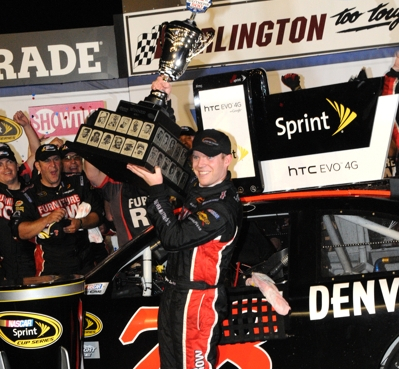
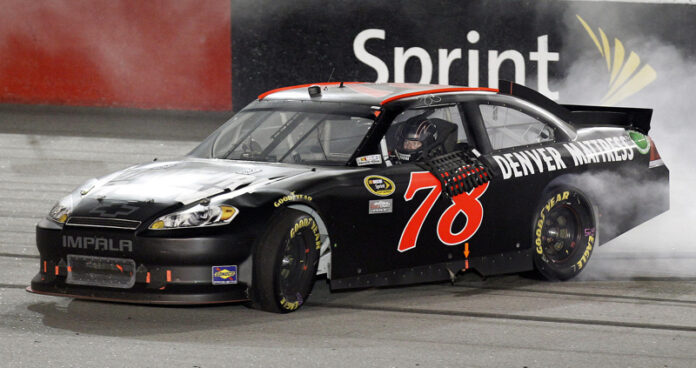
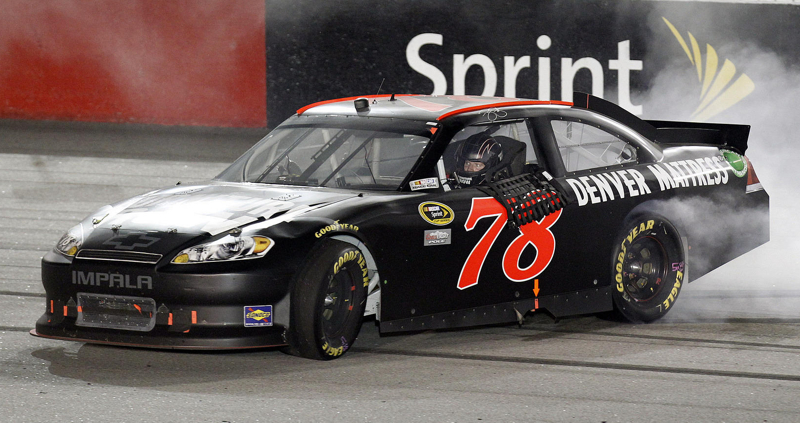
Surprising:  With his mother Lee unable to accompany him due to her work with animals impacted by the tornados in Alabama, a most surprised and emotional Regan Smith, driver of the No. 78 Furniture Row Chevrolet, finally got that elusive first Cup win.

Smith led just eleven laps during the race. The 27 year old driver had his fastest lap at the end when it counted, just barely holding off a hard-charging Carl Edwards.

With his voice choking and tears dotting his cheeks, Smith sincerely thanked his crew chief and his team for enabling him to finally achieve his dream to win a race.

“I can’t believe it, you guys,” Smith said. “This is the Southern 500. We’re not supposed to win this thing.”

“This race is so special and so meaningful,” Smith continued. “We were standing there looking at the names and the faces on the trophy, and you think, ‘My face is going to be there right next to these guys, and it’ll be there forever.’”

Not Surprising:  After attending to the birth of his second child, son Michael, it was not surprising that Carl Edwards, driver of the No. 60 Aflac Ford for Roush Fenway Racing, continued his big week with a runner up finish at Darlington.

“First of all, congratulations to Regan,” Edwards said graciously. “I’m sure that will feel good tomorrow, but right now, I wanted to win that race.”

“I guess if I had to get beat, it’s all right to get beat by him,” Edwards continued. “We’re leading the points so we’ll just go to the next one.”

Surprising: At the track where getting the infamous ‘Darlington stripe’ is more a question of when not if, it was surprising to see the number of problems on pit road instead of on the track.

Several drivers had a tough time getting into their pit stalls, including Dale Earnhardt, Jr., driver of the No. 88 Amp Energy Sugar Free/National Guard Chevrolet, who just nicked the commitment cone coming in for his pit stop.

Martin Truex, Jr., in the No. 56 NAPA Auto Parts Toyota, also had trouble getting to his pit box. Yet Truex was trumped by Paul Menard, driver of the No. 27 Turtle Wax/Menards Chevrolet, who spun into the pits ending up head first into his stall.

Four-time champion Jeff Gordon, this week in his No. 24 Drive to End Hunger Chevrolet, also experienced pit difficulties, dragging his gas man almost out of the pit stall on exit.

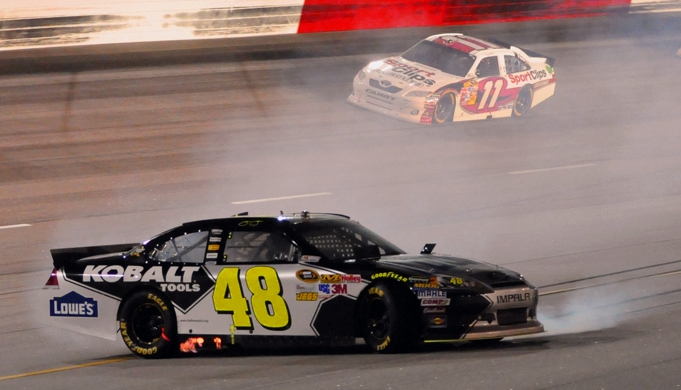
His Hendrick Motorsports teammate Jimmie Johnson was unlucky in his pit stall as well, hanging a lug nut on the No. 48 Lowes/Kobalt Tools Chevrolet, and having to return to pit road for repairs.

Not Surprising:  While it was not surprising that the ‘Lady in Black’ brought out the dark side of many drivers’ temperaments, it was Kyle Busch versus Kevin Harvick, rather than Juan Pablo Montoya and Ryan Newman, that took center stage after the race’s overtime finish.

The two tangled dramatically on the track in the waning part of the race, trading pushes and shoves, which then carried over as both tried to make their way to pit road.

Harvick struck first, blocking Busch’s entrance to pit road. Busch tried has best evasive action, going back onto the track and even backing up to get away from the driver of the No. 29 Budweiser Chevrolet.

Unhappy Harvick continued the pursuit, hopping out of his car to confront the driver of the No. 18 Wrigley’s Doublemint Camry. Busch had the last ‘word’, bumping Harvick’s driver-less car into the wall on pit road.

“It was tight racing after the restart there,” Busch said. “I gave him (Harvick) room but he came off the wall and lifted early and then drove in the back of me,”

“It was just uncalled for, just unacceptable racing.”

For his side of the story, Harvick had little to say as he emerged from the NASCAR hauler.

“Obviously, we were just racing hard and doing what we had to do at the end,” Harvick said. “And things happen. That’s it.”

Busch finished the race in eleventh, while Harvick came in 17th. Both drivers held position in the point standings, third and fifth respectively.

Surprising: While Kurt Busch, behind the wheel of the No. 22 Shell/Pennzoil Dodge, continued his struggles, wrecking his primary car during practice and not having much better luck in his back up car during the race, the other half of the Penske duo had a surprisingly good finish.

Piloting the Blue Deuce, Brad Keselowski, mirroring Smith’s decision to stay out on the late caution, had a good run at race end, taking the checkered flag in third.

“To have a chance at it I was going to have to get the first restart and I just wasn’t strong enough to do that,” Keselowski said. “I ended up giving Regan a whale of a push and once he cleared Carl, he was gone.”

“I’m really happy for Regan and wanted to make sure that if I couldn’t win, he would and it looks like it worked out for him and his whole team,” Keselowski continued. “It’s a win for the underdogs tonight.”

Not Surprising: Kasey Kahne, after qualifying his No. 4 Red Bull Toyota on the pole, was strong from the drop of the green flag to the end of the race. Although he led the most laps, Kahne also had a collision with the wall, which relegated him to a fourth place finish.

“We were tight and we had to keep tuning the car up and fixing the car,” Kahne said after the race. “I killed the crush panel so I’m covered in fumes and rubber and stuff.”

“We didn’t finish as good as we should have,” Kahne continued. “But fourth’s good for as hard as I hit the wall.”
NASCAR’s ‘Have At It’ Policy Needs to be Reexamined

“And there’s a fight in the infield between Donnie Allison and Cale Yarborough…”

[media-credit name=”David Yeazell” align=”alignright” width=”225″][/media-credit]It’s been over thirty years since that historic day in Daytona Beach, Florida, and seemingly since then NASCAR has been attempting to recapture that entertaining magic of the 1979 Daytona 500. The larger the sport grew, the more blasé it became to long time fans, eventually culminating with NASCAR’s 2010 proclamation of the “Have At It” philosophy.

Ardent purist racing fans applauded, happy that drivers would finally have the chance to once again settle their problems on the track. Excitement grew with the knowledge that their favorite driver will once again be able to carry their emotions on their sleeve for all to see.

Now, a little over a year after NASCAR’s announcement, we as the followers of the sport have to step back and question if the spirit of this statement is being followed.

In the past year we have had a driver feud escalate to point of sending a car careening into the catch fence at 180 miles per hour. Those same drivers were involved in an altercation in which one was spun, driver’s side, directly into the path of the entire field merely out of spite and the thirst for victory. Tonight, we had one driver purposefully send a driver-less car down a pit road full of people.

Entertaining? Perhaps. But there comes a point when enough is enough. NASCAR’s attitude on enforcing this policy is eerily similar to their stance on driver safety fifteen years ago. The thought that “As long as the product is entertaining, why should we intervene?” seems to be the driving force behind what exactly is too much emotion.

Eventually, if this continues, someone will be injured. It could be another driver, a team member or even a fan. Is that small injection of entertainment truly worth that price?

By all means, let the drivers show their emotions both on and off the track. Let them duke it out at 170 miles per hour or out back behind the haulers. There needs to be limits, however, to make sure events like tonight do not have a more tragic result.

So please, for the sake of the sport, and all of those in it, let the boys “Have At It”…  just not at the risk to others safety.

The Southern 500: A Lesson Not Learned

[media-credit name=”David Yeazell” align=”alignright” width=”261″][/media-credit]For those who think that the races at places like California, Chicago, Kansas, and any number of what has been called the “cookie cutter” tracks, I give you Darlington. For every boring finish at one of those clones, we get one Darlington (and luckily, thank God) two Martinsville’s. It’s not fair that we only see one race at the track “too tough to tame,” but that’s all we have. It’s money that matters.

Instead of two cars piggy-backing on each other to create speed, as we saw at Daytona and Talladega (and it seems is the favorite of the fans), we saw real racing and lots of action. We saw a Ford Fusion open up a Toyota like a can of tuna. We saw the usual suspects run in the back while others ran up front. We saw beating and banging, temper flaring, and even extracurricular action. We saw a race that can’t happen when everyone has four lanes to run in and it’s an easy place to run.

It seems that after NASCAR became “the thing” back in the early 90’s that the sport went out of its way to make things easier for the drivers. No longer was it a challenge for the drivers because it didn’t matter so much. The important thing was that the stars of the sport were there and were successful. It wasn’t about the racing. It was more about the money. All of a sudden, International Speedway Corporation and Speedway Motorsports began to either take over or build new tracks. Bruton Smith did it two ways. As the CEO of Speedway Motorsports, every track he built was a clone of Charlotte Motor Speedway. You know the drill. Moderately banked tracks with a tri-oval approximately 1.5 miles in length. To give Smith credit, he did change it up a bit at Las Vegas by reconfiguring the track when it didn’t race like the fans wanted and changed Atlanta also. But he changed Bristol to “offer more room to race,” which has been a disaster for fans and the attendance at the races there show it. Fans didn’t want more room to race. They wanted to see the action. I really am sad to report this, but the last two races at Bristol nearly bored me to sleep.

International Speedway Corporation seemed to create tracks in the image of Michigan International Speedway. When they bought Roger Penske’s tracks, that seemed to be the formula. California, Chicago, and others seemed to fit that mold. Easy on the drivers and less action were the key. They didn’t have to worry about the fans, they were going to come anyway.

Fast forward to 2008. The economy was in the dumpster. Ticket prices were through the roof and fans for the first time had to wonder if spending $1,000 dollars for a weekend was worth it . Attendance suffered and TV ratings went way down. Smith closed Rockingham and NASCAR took away one of its iconic races at Darlington to get other races at his newer clone tracks. Attendance was listed as the problem, but when attendance at California and other tracks didn’t improve the situation, excuses were there in spades. Excuses cannot change what has happened over the last ten years. History be damned. While baseball loves Fenway Park and Wrigley Field, NASCAR put its history in the trash can in favor of more modern facilities and the revenue that could be generated. It’s sad.

Tonight, we saw why fans rushed to NASCAR. Action. We saw it at Martinsville in March, and we’ll see it again in the fall when we go back there. We sacrificed the iconic tracks that made the sport what it was for luxury suites and bling, even if the racing was less than good. And so it goes.

Maybe there’s a lesson here, but I doubt it. A friend who has gone to Charlotte for eons told me this week that he got his Charlotte tickets for the 600. The tickets had raised by nearly $20. He was trying to sell the tickets and could not find any takers. Maybe the economy will improve and people will have more disposable income in the future and NASCAR will rise again, but if that magic doesn’t happen, it won’t change the fact that places like Darlington need to be put in place as what NASCAR is and should be. Taking a race from Darlington was wrong. Taking away the Labor Day weekend from Darlington was criminal. When will they learn?