Pest activity can vary depending on a region’s climate, warm, humid climate may pose some difficulties for pest control compared to cooler climates. Therefore, in order to protect their homes from pests, homeowners living in tropical climates need to look beyond occasional treatments.
Relying on pest treatments only when infestations become noticeable makes it difficult to ensure regular protection. On the contrary, a proactive approach implies the continuous surveillance of the house and addressing any conditions that might promote pest activity.
Hence, why is regular pest management absolutely necessary in tropical climates? Regular checks, treatments, and prevention of pest activity can allow homeowners to prevent future infestation. Here are five reasons why regular pest management matters.
Pests Never Get A Seasonal Break
Many pests remain active in South Florida where warm temperatures and high humidity seldom slow their activity even during the winter. This climate provides year-round favorable conditions for breeding and foraging, where colder temperatures can naturally reduce insect activity. Working with experienced West Palm Beach exterminators involves developing a treatment plan around this reality, rather than relying on the fact that a seasonal lull will eventually come.
If that year-round strategy is not used, then the pests have the opportunity to continue reproducing between treatments. One “off” season at another location may result in a reduced-size pest population in the spring, but with the tropical climate, there will be no natural control on the size of the colonies.
Humidity Can Increase The Risk Of Wood And Structural Damage. In other climates, the seasonal slowdown is natural, but not with consistent scheduling.
Humidity Can Increase The Risk Of Wood And Structural Damage
Termites and wood-destroying pests love moisture, and few places provide it as often as a warm, humid tropical climate. Termites have a longer opportunity to develop a colony and to extend their reach here because wood framing, trim, and support materials remain moist for extended periods of time. This process progresses more rapidly than in a more arid climate where, between rainfalls, wood would dry out and would not be able to provide the same amount of water continuously.
Many homeowners think of pest control as a once-in-a-while thing and don’t realize that it can happen so quickly; they imagine that it takes as long for damage to occur as it does in other parts of the house. Actually, it is compounded by the humidity, since the wood softened by the moisture becomes vulnerable faster and remains vulnerable for a longer period of time between treatments.
Regular inspections will detect this damage before it can begin affecting the structure. If regular checks are not made, the termites will have more time to work and fewer hindrances.
Reproduction Cycles Move Faster In The Heat
In most pest species, heat stimulates biological processes and reduces the interval between generations and the total population increase. Common insects like ants and roaches are more likely to reproduce rapidly in an environment that is continually warm, but not in one where temperatures drop frequently. This quicker cycle results in a small, localized problem becoming a large infestation in a much shorter time.
A treatment that may give months of control in a cooler area may be ineffective in this area because the next generation comes along sooner. It is not uncommon to see pests come back long before the scheduled date under a less frequent treatment program; this is because homeowners usually expect the same intervals from their pest control service as they do from the other pest control services they receive.
In aligning the frequency of treatment with this accelerated reproductive cycle, populations are prevented from increasing in numbers between treatments. Less often means there is enough time for pests to outpace the treatment schedule.
One-Time Treatments Lose Effectiveness Quickly
With a single application treatment, it is only successful at a particular moment in time when the pests are active, but once they move in from elsewhere or eggs already laid hatch, the treatment is no longer effective. In a tropical climate, this fade is faster, as warm, humid conditions allow for continuous pest movement and breeding, instead of a temporary respite after treatment.
People who use one-time service tend to see pests come back in weeks, not months, which can lead to repeated service calls that don’t really solve the problem. For every new treatment, the problem being treated is seen again; no step is taken to break the pattern.
Recurring treatment plans eliminate this by providing a barrier that doesn’t go away with each treatment. This continual treatment is the most appropriate way to treat pests in this climate since they do not wait for one treatment.
Recurring Plans Can Support Year-Round Pest Management
Plans for pest control that are specifically tailored to tropical and subtropical areas take into consideration the year-round activity, humidity, and faster reproduction cycles mentioned throughout this article. Perimeter treatments, landscape baiting, and inside checks are all part of a coordinated system, not an individual response to individual reports of sightings.
This is important because every element will be solving a different aspect of the problem. Perimeter treatment keeps the bugs at bay, landscape treatment kills them before they get to the house, and indoor treatment kills those that do. A lack of any one of these steps leaves a vulnerable spot that can be exploited by pests if they have enough time in this climate.
Selecting a plan that is designed for the unique requirements of this climate, not a typical seasonal strategy, will help to maintain protection year-round. It’s a systematic method that is just what a tropical climate demands in order to hold pest activity under control.
Consistency Is Key To Long-Term Pest Management
Tropical climates may provide fewer seasonal interruptions to pest activity. This includes year-round breeding, increased humidity damage, and more frequent reproduction cycles, as well as the limited duration of one-time treatments.
In this climate, regular and planned pest management is not an added precaution. It’s an important part of maintaining consistent protection against recurring pest activity.
Telecommunications, military, and test lab engineers continually invest in systems that cut down costs and streamline operations. GPS antenna splitters are in demand in these commercial sectors.
The devices take a single signal from your GPS antenna and distribute it to several GPS receivers. They are applicable in many military, commercial, and industrial applications to boost system reliability.
They are available in active and passive options. Passive splitters divide the signal, making them simple but somewhat unreliable because of the significant signal loss. Active models feature a built-in amplifier to compensate for the signal loss. The unique infrastructure ensures each receiver gets a strong signal.
Before you invest in a GPS antenna splitter, stay tuned to learn how they affect signal reliability and strength.
1. Compensates for Intrinsic Splitter Loss
A splitter splits the signal into several parts, reducing the strength. In fact, substandard splitters lose almost half the power. The loss weakens the signal, making the receiver unable to acquire the satellites. This means your GPS receiver cannot lock onto satellites. It won’t even provide position and timing data, reducing system performance and reliability.
An active GPS antenna splitters reduces signal loss to negligible percentages. Its built-in Low Noise Amplifier (LNA) boosts the signal before the division. The system pre-calibrates the amplification to compensate for the intrinsic split loss. That ensures the signal strength sent to the receiver equals what it receives on a direct antenna connection.
Active splitters maintain the signal power above the receiver’s acquisition threshold, enabling connected devices to reliably lock onto satellites and provide continuous timing, navigation, and position data.
2. Preserves Signal-to-Noise Ratio
GPS signal splitting also introduces electronic noise into the signal path. The noise originates from the splitter’s internal components such as connectors, resistors, and amplifiers. These components generate thermal noise and critical electrical interference.
The noise can make the signal difficult to distinguish from the background noise floor. Engineers measure it as the Signal-to-Noise Ratio. When this ratio is lower, your GPS receiver won’t reliably detect the satellite’s unique pseudorandom code.
Buy a high-quality active splitter to resolve this problem. These devices strategically place a Low Noise Amplifier (LNA) first in the signal chain. This placement ensures the device can amplify the signal with minimal noise.
LNA establishes a solid, clean signal. The splitter can divide it without degrading the signal-to-noise ratio in the subsequent stages. It locks in signal quality before the inevitable losses and noise contributions prevalent with most splitting cables and networks.
3. Prevents Receiver Interference
Image by Mohamed Hassan from Pixabay
Connecting multiple receivers to the same antenna usually affects signal strength. This happens because the Local Oscillator (LO) in GPS receivers usually leaks a negligible signal. Without protection, the leaked signal from one receiver can travel through the splitter back to the antenna and into another receiver. This interferes with signal capacity and prevents the receiver from getting a position fix.
High-quality receivers use ultra-efficient port-to-port isolation to solve this problem. This technology limits the possibility of leaked local oscillator, signal, and noise from flowing back into the antenna and into other connected GPS receivers. Isolation ensures that any leaks from the Internal Local Oscillator can never affect the efficiency of other receivers. Devices with superior isolation of about 40 dB or more can reduce such interference by up to 10,000 factor.
4. Maintains Signal Integrity on Unused Ports
In 4-way splitters, many people use only 2 ports. The unused ports can cause signal reflections. This is an impedance mismatch in your device’s RF circuit. Because receivers, antennas, splitters, and cables must operate at a characteristic impedance of 50 ohms, leaving a port unused presents an infinite impedance instead of the expected 50 ohms.
The mismatch usually causes signals traveling to the open port to reflect into your splitter instead of being absorbed. The reflected signals bounce between your splitter’s internal components and the open port. They can create signal echoes and standing waves that interfere with clean signal flow.
Many high-quality GPS antenna splitters support terminating unused output ports with a 50-ohm terminator. The dummy load is a small connector containing a 50-ohm resistor precision-matched to your system impedance.
Connecting it to the unused port absorbs all the signal energy reaching that port. It also converts the loss into heat instead of letting it reflect into the system. The unique setup helps to maintain proper impedance matching throughout the splitter. It eliminates reflections and keeps VSWR low. Also, it ensures all active receivers continue to get clean, stable signals.
Wrapping Up
GPS antenna splitters play an integral role in modern systems. This happens in systems where multiple devices share a single antenna. These devices help maintain reliable access to GPS signals without impacting quality and stability. The best splitters can maintain signal integrity on unused ports.
High-quality active splitters address signal loss and noise at the source. They amplify the signal before it splits into multiple directions. That ensures all connected receivers get a clean, strong signal. Always choose a high-quality antenna splitter for your project size and type. You can barely trust a telecommunications splitter for military operations or financial timing.
For most of the 20th century, engines relied on mechanical systems to manage fuel delivery, ignition timing, and emissions. Carburetors mixed air and fuel based on vacuum pressure, and distributors fired spark plugs on a fixed schedule. These systems worked, but they left performance and efficiency gains on the table.
The introduction of electronic engine controls — beginning in the late 1970s and accelerating through the 1980s — changed all of that. By replacing mechanical approximations with sensor-driven, real-time adjustments, electronic controls made engines cleaner, more powerful, and far more reliable. Today, even heavy-duty platforms that require specialized services like Caterpillar repair from Diesel ECM Exchange depend on the same foundational shift from mechanical to electronic management.
Replacing Carburetors With Electronic Fuel Injection
Carburetors operate on simple physics: airflow creates a vacuum that draws fuel into the intake manifold. The air-to-fuel ratio shifts with engine speed and load, but a carburetor can only approximate the correct mixture.
Electronic fuel injection (EFI) eliminated that guesswork. An electronic control unit (ECU) reads data from multiple sensors — including the mass airflow sensor, throttle position sensor, and oxygen sensor — and calculates the precise amount of fuel each cylinder needs. The ECU then opens the fuel injectors for an exact duration, measured in milliseconds.
The result is a consistently accurate air-fuel ratio across all operating conditions. This leads to:
Lower fuel consumption at partial throttle
Smoother cold starts and idle
Reduced unburned hydrocarbons in exhaust
Optimizing Ignition Timing in Real Time
Mechanical distributors advance or retard spark timing using centrifugal weights and vacuum diaphragms. These components wear over time, and they cannot account for variables like fuel octane or humidity.
Electronic ignition systems replaced these mechanical parts with crankshaft and camshaft position sensors. The ECU uses data from these sensors — along with knock sensors that detect premature detonation — to adjust spark timing on every combustion cycle.
This continuous adjustment serves two purposes. It maximizes power output by firing the spark plug at the optimal moment. It also prevents engine knock, which can cause serious internal damage over time.
Meeting Emissions Standards Through Closed-Loop Control
Emissions regulations tightened steadily from the 1970s onward. Catalytic converters can reduce harmful exhaust gases, but they work efficiently only within a narrow air-fuel ratio window — roughly 14.7 parts air to 1 part fuel, known as stoichiometric.
Electronic controls made it possible to maintain that ratio with precision. Oxygen sensors in the exhaust stream send voltage signals back to the ECU, which adjusts fuel delivery in a continuous feedback loop. This closed-loop system keeps the catalytic converter operating at peak efficiency and allows modern engines to meet strict emissions thresholds for:
Carbon monoxide (CO)
Nitrogen oxides (NOx)
Unburned hydrocarbons (HC)
Without electronic closed-loop control, meeting current emissions standards with an internal combustion engine would not be feasible.
Enabling On-Board Diagnostics
Before electronic controls, diagnosing an engine problem required physical inspection, test equipment, and significant experience. A misfire, vacuum leak, or rich-running condition could take hours to isolate.
On-board diagnostics (OBD) changed the process entirely. The ECU continuously monitors sensor inputs and actuator outputs. When a reading falls outside expected parameters, the system logs a diagnostic trouble code (DTC) and illuminates the check engine light.
The second-generation standard, OBD-II, became mandatory in the United States in 1996. It standardized connector types, communication protocols, and code definitions across all manufacturers. A technician — or a vehicle owner with a basic scan tool — can now retrieve codes and pinpoint the failing system in minutes rather than hours.
Laying the Foundation for Advanced Engine Technologies
Electronic controls did more than improve existing engine functions. They created a platform for technologies that would have been impossible with mechanical systems alone.
Variable valve timing adjusts intake and exhaust valve overlap based on engine speed and load, improving both low-end torque and high-RPM power.
Turbocharger boost control uses electronic wastegate actuators and boost pressure sensors to manage forced induction with precision.
Direct injection places fuel injectors inside the combustion chamber and requires precise timing coordinated with piston position—a task only an ECU can manage at high RPM.
Cylinder deactivation shuts down individual cylinders during light-load cruising to save fuel, then reactivates them instantly when the driver demands power.
Each of these systems depends on the ECU’s ability to process sensor data and make adjustments within milliseconds.
Final Note
Electronic engine controls represent one of the most consequential shifts in automotive engineering. They replaced imprecise mechanical systems with sensor-driven, adaptive management of fuel, spark, and emissions. The gains in efficiency, reliability, and power are measurable and well-documented. Just as important, electronic controls built the foundation for every major engine advancement that followed — from variable valve timing to direct injection to hybrid powertrains.
Motorsports betting used to feel almost old school: a ticket window, a bookmaker’s board, and a driver priced at 8/1 before qualifying. Online casinos had their own separate rhythm, with slots on one screen and roulette on another. Now both areas share the same technical engine. Live data, instant payments, mobile wallets, identity checks, and smarter odds feeds shape every click. A fan watching Spa on Sunday can place a prop bet on pit-stop timing, then play a blackjack hand during a red flag. Simple. Behind the screen, the details decide whether that feels safe. Platforms that explain local rules matter too, so players may visit onlinecasinoduitsland.com for the dutch market before opening an account. The shift is not flashy for its own sake. It changes prices, speed, trust, and the way risk is shown to ordinary players who just want clear screens and fair terms.
Fast signup meets sharper checks
The fastest casino account is still useless if withdrawals stall for four days. Newer platforms answer that with bank verification, document scans, device fingerprints, and payment rails that report status in minutes. No mystery queue.
Before depositing, serious players compare popular buitenlandse casino with attractive bonuses and read the small print on wagering, game limits, and withdrawal caps. A bonus that looks huge can shrink fast if table games count only ten percent.
One sentence later, the next check is quality, not hype. Players who choose a reliable online buitenlandse casino with top casino games should still test live chat at a quiet hour, set a deposit limit, and make a small withdrawal first. That boring test reveals more than a banner ad. Motorsports bettors use the same habit. They check if odds update after a safety car, if cash-out freezes too long, and if bet history lists every stake clearly.
Live data makes odds breathe
A race changes in milliseconds. A tire blister, a slow stop at lap 23, or rain touching only sector three can move a market before the commentator finishes a sentence. Old pre-race bets still exist, but the action now sits inside live micro-markets.
Data suppliers pull timing loops, telemetry summaries, weather radar, and steward messages into trading models. The model adjusts prices, then risk staff or automated rules decide what goes on screen. Good books pause markets during a crash because a two-second delay gives some users a free shot.
This speed makes betting more exciting, yet it also makes bad design obvious. If an app shows a driver at 3.50 after the feed already proves he has pitted, trust drops. Fast odds need plain labels: suspended, under review, accepted, rejected. Short words help. So does a timestamp beside every live price. For Formula E, where energy targets swing late, that note can be the difference between a fair rejection and a furious support ticket after the chequered flag on Monday morning later.
Mobile screens changed casino habits
Casino play moved to phones, but the real change is not screen size. It is context. A player can spin for five minutes on a train, authenticate with Face ID, and receive a payment notice before the next stop. That creates a sharper need for calm design.
The best mobile casinos make limits visible before the cashier page, not buried under account settings. They load live dealer tables without forcing ten pop-ups. They show game provider names, RTP figures, and session time in places a tired person can find at 11:40 p.m.
Small details carry weight. A sticky balance bar helps players notice losses. A one-tap timeout button beats a help article. In motorsports betting, the same phone-first thinking applies to bet builders and race centers. A tiny sector map, tyre icon, and lap counter do more than a wall of text. If the thumb cannot reach the button, the product is already losing. Designers should watch a real user place one bet with wet hands at a kart track, then take notes.
AI spots risk and patterns
Artificial intelligence has two faces here. One is commercial: pricing engines grade bets, segment customers, and predict which promotions will be ignored. The other is protective. Pattern tools flag behavior that looks harmful, such as repeated deposits after midnight, chasing losses after a crash, or switching games every thirty seconds.
Casinos also use machine learning to catch bonus abuse and account takeovers. A login from Rotterdam, then another one from São Paulo eight minutes later, should trigger questions. So should a fresh device linked to five payment cards.
The danger is lazy automation. A model that blocks a winning motorsports bettor without explanation feels unfair, even if the operator dislikes sharp action. Better systems combine alerts with human review and short, honest messages. Please send ID again is annoying, but clear. Account under review for nine days is the kind of phrase that sends players to forums, screenshots included. The rule should be simple: stop clear fraud fast, but give normal online customers a path to prove their case within one working day.
Payments are faster, rules stricter
Fast payments changed expectations more than flashy graphics ever did. If a slot win reaches an e-wallet in ten minutes, a sportsbook withdrawal held for two days looks ancient. Players notice. They share timestamps on Reddit and Trustpilot, sometimes with bank screenshots blurred at the edges.
Speed still has limits. Regulated operators must check names, age, sanctions lists, source of funds in some cases, and mismatched cards. Crypto adds another layer, because a quick transfer can also hide stolen funds or banned-country traffic. The smart move is upfront clarity. Say which documents are needed before a player wins, not after.
Open banking helps because it confirms ownership and income signals without forcing someone to scan a crumpled utility bill. Instant bank payouts help too. But the cleanest payment page is boring on purpose: fees, limits, pending time, accepted methods, no surprises. Casino users love fun in games. They hate drama at the cashier. For race bettors, the same standard should cover payouts after protests, penalties, and corrected results by noon the next day latest.
What players should check next
Technology keeps adding features, but the player’s checklist stays plain. Before staking on a Monaco qualifying duel or opening a live roulette table, a person should read the licence line, test support, set limits, and search for withdrawal complaints with the operator’s name in quotes. It takes ten minutes.
Motorsports bettors should also compare the data layer. Does the book grade bets from the official FIA result or a third-party feed? Are markets voided after disqualifications? Is there a clear rule for abandoned sessions? These details decide disputes after messy races, especially in feeder series where timing corrections arrive late.
Casino players need the same neat habits. Check RTP pages. Try demo mode if it exists. Read bonus terms on maximum bet size, because a single €6 spin can void a welcome offer with a €5 cap. Then make one small deposit and one small withdrawal. If that feels clean, the fun part can begin with fewer nasty surprises. Start with the next race weekend, and write down every rule that looks fuzzy first.
MCW, short for Mega Casino World, combines casino games, live-dealer tables and sports betting within one online platform. For someone encountering the brand for the first time, the size of the site can be more confusing than helpful: there are several game sections, rotating promotions, account verification rules and different ways to access the service from a phone. This guide takes a closer look at those areas and focuses on what is worth checking before treating any headline offer as a reason to choose the platform.
MCW says it has served the Asia-Pacific market since 2015 and provides both casino and sportsbook products. Its information centre also advertises round-the-clock customer support and describes KYC and anti-money-laundering checks as part of its account controls. Those details matter more to a new player than the number of banners on the home page because they affect how the account works after registration, particularly when withdrawals are involved.
For mobile users, the MCW app is only one part of the experience. The platform can also be reached through a mobile browser, so the important comparison is not simply app versus desktop but whether games, the cashier, account settings and support remain practical on a smaller screen.
MCW at a Glance
A useful way to evaluate MCW is to separate relatively stable platform features from promotions and cashier conditions that can change.
Feature
What to Know
Brand
Mega Casino World (MCW)
Main products
Slots, table games, live casino and sports betting
Operator stated in MCW terms
MCW Consultancy Ltd.
Licensing stated by MCW
Anjouan, Union of Comoros
Mobile access
Smartphone browser and mobile software/access options
Account verification
KYC may be required, particularly for withdrawals
Customer support
MCW advertises 24/7 support
Bonuses
Multiple promotions; individual terms and wagering rules apply
Responsible gaming
Limits, breaks and responsible-play guidance are promoted
Minimum age
Adults only; applicable age and local-law restrictions must be checked
One distinction is especially important. MCW describes itself as operating under an Anjouan licence. That is an offshore regulatory arrangement; it should not be confused with permission from the authorities in the country where a user happens to be located.
What Kind of Games Does MCW Offer?
The casino is structured around several types of play rather than a single slot lobby. That makes it reasonably easy to understand once the categories are separated.
Slots
Slots form one of the broadest sections. As with most multi-provider casinos, the attraction is variety: traditional reel games sit alongside newer video slots with free spins, multipliers, expanding grids and bonus features.
For a new player, the provider name and game rules are more useful than a flashy thumbnail. Before opening a title, check information such as:
return-to-player information where it is provided;
volatility or risk level;
minimum and maximum stake;
paytable and bonus mechanics;
whether a promotion excludes that particular game.
This becomes particularly important when a bonus is active because casinos may apply different wagering contributions to different categories.
Live Casino
The live lobby is aimed at players who prefer streamed tables rather than computer-generated rounds. Common formats on large casino platforms include baccarat, roulette and blackjack, along with game-show-style titles.
Live games can look straightforward, but bonus conditions are often less straightforward. A table may be available for normal balance play while contributing differently — or not at all — toward a particular promotion. Checking the promotion rules first is more sensible than assuming every casino product counts equally.
Table and Other Casino Games
Alongside slots and live dealers, MCW groups other gaming formats into its broader casino offering. The exact catalogue can change as providers and titles are added or removed, so game availability is better treated as a live platform feature than as a fixed number.
That is one reason I would be cautious with reviews that promise an exact game count without a date or source. A useful casino review should tell you what categories exist and how easy they are to browse, not manufacture precision from a constantly changing lobby.
How Good Is the Mobile Experience?
Mobile usability matters more here than it did a few years ago because players increasingly handle nearly everything — browsing, account settings and customer support — from a smartphone.
The basic MCW layout is designed to place major casino categories and account functions within relatively short reach. On a good mobile implementation, the real test is whether a player can move between the lobby and account area without repeatedly returning to the home page.
For anyone comparing mobile and desktop access, I would focus on four things:
Navigation. Game categories and account controls should remain easy to find on a narrow screen.
Performance. Heavy live games naturally demand more bandwidth than simple slots, so connection quality matters.
Account access. Balance, verification and support features should not require switching back to a computer.
Security. Mobile convenience is not a substitute for a strong password and proper control of the registered phone or email account.
A browser version has the advantage of requiring no separate installation. Dedicated mobile access may feel more convenient for frequent users, but there is little value in installing anything from an unverified mirror or third-party download page.
Bonuses Deserve More Attention Than the Headline Percentage
MCW publishes different promotions across its products, and this is an area where third-party reviews become outdated quickly.
The most important rule for newcomers is simple: look at the wagering conditions before looking at the maximum bonus figure.
MCW’s published general promotion rules state that a player can claim only one first-deposit bonus across its Sports, Casino, and Slots & Table Games products. Its rules also say that some promotions have wagering requirements and that void, drawn and certain other bets do not count toward those requirements.
That can make two offers with similar headline values very different in practice.
Suppose one promotion provides a larger match but requires significantly more turnover before withdrawal. Another may offer a smaller amount with easier conditions. The bigger percentage is not automatically the better deal.
Before accepting any offer, check:
minimum qualifying deposit;
maximum bonus amount;
wagering multiplier;
whether wagering applies to the bonus or to deposit plus bonus;
eligible games or markets;
expiry period;
maximum stake while wagering;
withdrawal restrictions.
Promotion pages should be considered the final source for current terms because campaign details can change.
Account Verification and KYC
Verification is one of the least exciting parts of an online casino review, but it is one of the most important.
MCW’s KYC policy says the operator may request documents to establish a customer’s identity and location. Its published process can include government-issued photo identification, a selfie with the identification document, and proof of address such as a bank statement or utility bill.
MCW also states that full verification can become compulsory when a withdrawal is requested or when a transaction triggers additional checks.
This is worth understanding before any money is placed into an account. A common mistake among inexperienced users is to treat verification as something that only matters after a win. In reality, mismatched names, outdated documents or payment accounts belonging to another person can complicate a later review.
The practical lesson is straightforward: account details should be accurate from the beginning, and users should never assume that successful registration means all later financial checks have already been completed.
Payments and Withdrawals
Payment availability is another area where comparison sites often present overly precise information. Minimum deposits, transaction limits, processing routes and individual payment methods can change, so the cashier shown to the account is more useful than a static table copied months earlier.
MCW’s terms state that deposits should come from a payment account or card registered in the customer’s own name. The terms also allow identity checks before withdrawals and indicate that withdrawals are generally expected to return through the original payment route, subject to the operator’s verification procedures.
MCW separately states that accounts without a bonus must complete a 1x wagering requirement before withdrawal, with rejected, void, drawn or tied bets excluded from that turnover.
For a new user researching the platform, the important questions are therefore not merely “Is my favourite wallet listed?” but:
Are the account name and payment name consistent? What is the current minimum? Are there fees? Is verification complete? Is a bonus affecting the available balance? What turnover rule applies?
Those checks can prevent considerably more frustration than choosing a casino because somebody described its withdrawals as “instant.”
Customer Support and Account Help
MCW advertises customer assistance around the clock. For a platform containing casino games, sportsbook products, bonuses and payment functions, support quality is particularly important because many problems are account-specific.
Before relying on any service, it is worth checking whether the support interface is easy to reach while logged in and whether the help centre answers basic questions without requiring a conversation with an agent.
The issues most likely to require support are usually practical rather than gaming-related: verification status, a pending transaction, bonus eligibility, login access or an account restriction.
Keep transaction references and relevant screenshots when dealing with a payment issue. A clear description of the problem generally gets further than repeatedly opening new support requests for the same case.
Licensing, Safety and the Local Legal Position
MCW’s terms identify MCW Consultancy Ltd. and state that the company is registered in Anjouan in the Union of Comoros and operates under its gaming framework. Anjouan’s regulator requires licensed businesses to follow operational and compliance conditions, including rules relating to approved domains and regulatory cooperation.
An offshore licence, however, answers only one question: under which framework does the operator say it conducts its business? It does not establish that online gambling is permitted in every jurisdiction from which the website can technically be reached.
That distinction is especially important for readers researching MCW Casino Bangladesh in 2026. The Gambling Prevention Act 2026 came into effect on July 1 and expressly addresses gambling and online betting. The Cyber Security Ordinance 2025 also contains provisions covering gambling in cyberspace, including participation and promotion.
For that reason, accessibility, local payment presentation or an offshore licence should not be interpreted as proof of local legality. Readers should rely on current legislation and qualified local legal advice rather than promotional claims made by casino or affiliate websites.
Responsible Gaming Is More Than a Footer Link
MCW’s responsible-gaming guidance tells customers to view gambling as entertainment rather than a way of earning money, avoid chasing losses, establish limits and take breaks.
Those principles are sensible regardless of the platform.
Before using any gambling product where it is lawful to do so, decide on a spending limit in advance rather than adjusting it after losses. It is equally useful to set a time limit. Casino games are deliberately fast, which makes the amount spent over an hour less obvious than the cost of an individual round.
Warning signs include increasing stakes to recover losses, borrowing money to continue, hiding gambling expenditure or treating gambling as necessary income. At that point, promotional offers and VIP levels cease to be relevant; stopping and seeking independent help is the more important decision.
What New Players Should Take Away From This Review
MCW is a broad online gaming platform rather than a casino built around one speciality. It combines slots, live tables and other casino formats with sports betting, mobile access, promotions, account verification and support infrastructure.
From a reviewer’s perspective, its large product range is less important than understanding the conditions surrounding it. Bonus values can change. Payment limits can change. Game catalogues can change. Verification requirements can become relevant precisely when someone wants to withdraw.
The most useful approach is therefore to evaluate the platform in this order: legal eligibility first, operator and licensing information second, account terms third, and promotions last.
That order may be less exciting than starting with the biggest bonus banner, but it is far more useful for anyone trying to understand what MCW actually offers and what obligations sit behind the interface.
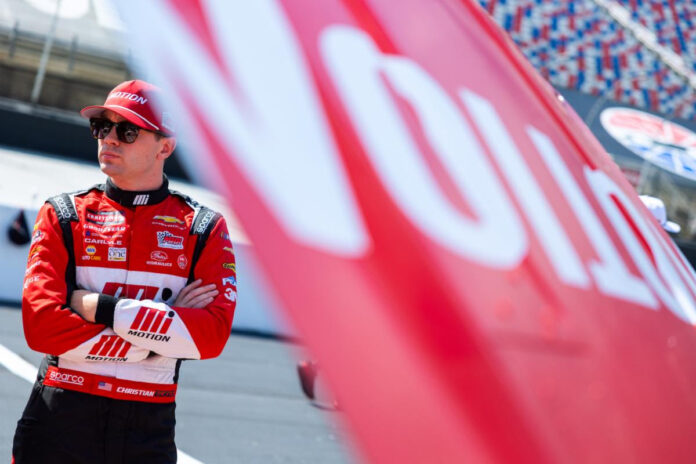
Christian Eckes, driver of the No. 91 Motion Industries Chevrolet Silverado RST
Race Information
Venue: Kansas Speedway Event: Race to Stop Suicide 200 Date: Saturday, September 26 Location: Kansas City, KS Track Description: 1.5-mile tri oval Distance: 134 laps, 201 miles (1:00 p.m. ET, FOX Sports 1, Motor Racing Network, SiriusXM)
Eckes Reseting for Chase Rebound in the Heartland
Going for Two … Former Kansas Speedway winner, Christian Eckes, returns to the Sunflower State in search for his second victory at the 1.5-mile track in a crucial moment of the season. The driver of the No. 91 Motion Industries Chevrolet Silverado RST visited Kansas’ victory lane in September 2023 and looks to use this weekend as a reset in the NASCAR CRAFTSMAN Trucks Series (NCTS) Chase. After beginning the Chase fourth in the standings, a 30th-place finish last week at Bristol Motor Speedway (BMS) has Eckes “behind the sticks” entering the second round at Kansas Speedway. Eckes has three prior NCTS victories at 1.5-mile tracks and looks to add a fourth on Saturday afternoon.
“Are You Experienced?” … Eckes has more experience at Kansas Speedway than any other venue on the NCTS slate. Saturday’s 200-miler marks his 11th NCTS start on the Heartland’s progressive banks, and will be his 13th overall combined with experience in the NASCAR Xfinity Series and ARCA Menards Series (AMS). Eckes not only has been experienced, but also elite in Kansas. In four prior starts with MHR at Kansas Speedway, Eckes has three top-three finishes, including a win in 2023 and has led laps in all four races. In his 10 prior NCTS races, Eckes has led laps in nine of them and collected six top-five’s and eight top-10 finishes. He also claimed an AMS victory in 2019 and has led laps in every series in which he’s competed at Kansas.
Season to Date … Despite opening the Chase with a difficult start at BMS, Eckes is still within 58 points of the lead and sits eighth in the standings. Through 19 races, Eckes has scored six top-five’s, 11 top-10 finishes and has an average finish of 13.9 with three stage victories.
Tune In … The Kansas race weekend gets underway Friday afternoon with practice and qualifying at 5:00 p.m. ET on FOX Sports 2. The green flag drops on Saturday at 1:00 p.m. ET on FOX Sports 1. Stay connected with the No. 91 Motion Industries team by following @BMR_NASCAR on Twitter, @bmr_nascar on Instagram, and Bill McAnally Racing on Facebook.
Christian Eckes Quote:
On returning to Kansas as a former winner:
“Kansas is a place that gives you some of the most options as a driver of anywhere we go. I’ve been fortunate to run pretty well there over the years and have always felt comfortable. It’s been a while since we were at a mile-and-a-half, but our No. 91 team has been looking forward to this ever since we ran so well at Charlotte. Hopefully we can replicate what we did there with our Motion Industries Chevy this weekend. Everybody at MHR, and especially our No. 91 group, put a lot of effort into finding more speed on the intermediates, and felt like we did that at Charlotte. We need improve our execution this weekend and dig ourselves back out of the hole we’re in, but we’re more than capable of it, for sure.”
Christian Eckes 2026 Statistics
Starts: 19
Wins: 0
Top-5’s: 6
Top-10’s: 11
Poles: 0
Stage Wins: 3
Laps Led: 173
Average Finish: 13.9
NCTS Points Position: 8th
Motion is a leading distributor of maintenance, repair, and operation replacement parts, and a premier provider of industrial technology solutions. Products include bearings; mechanical power transmission products; electrical and industrial automation components; hose, belting, and gaskets; hydraulic/pneumatic components; process pumps; industrial/safety products; seals and accessories; material handling solutions; and more.
With the goal of increasing customers’ productivity, the Company offers many valued-added services, including engineering, fabrication, repair, and Industry 4.0 solutions across these product groups. To learn more, visit Motion.com.
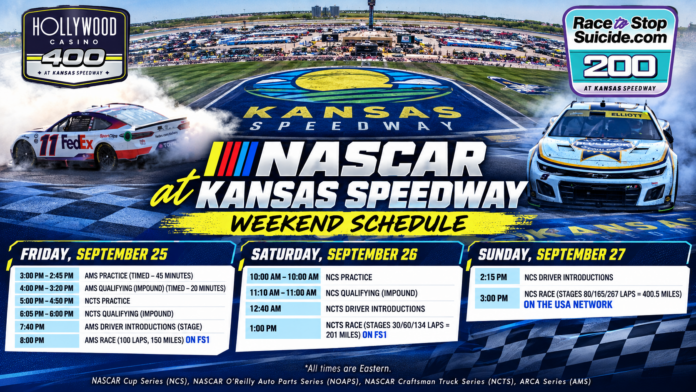
Both the NASCAR Cup Series (NCS) and the NASCAR Craftsman Truck Series (NCTS) head to Kansas Speedway this weekend. The Craftsman Truck Series kicks off the weekend in the Race to Stop Suicide 200 on Saturday at 1 p.m. ET on FS1. Then on Sunday, the NASCAR Cup Series Hollywood Casino 400 begins at 3 p.m. ET on the USA Network.
Founded in 2018, Race to Stop Suicide is a nationally recognized nonprofit organization dedicated to suicide prevention and mental health awareness, and will serve as the entitlement partner for the NASCAR CRAFTSMAN Truck Series Chase race. It’s a powerful platform to raise mental health awareness, encourage meaningful conversations, and connect individuals and families with life-saving resources. Daniel and Randy Dye co-founded the nonprofit, which has become one of the most visible mental health advocacy initiatives in motorsports.
NASCARCup Series Notes for Kansas Speedway:
Kyle Larson became the third driver to lead the points standings this season following Bristol, and Joey Logano gained the most points to the leader at Bristol (35 points, +4 from 7th to 3rd).
Kansas held one Cup Series race from 2001-2010, two races every year since 2011, 42nd race at the track, and Kansas is one of four tracks to host a Chase race every year since its inception in 2004 (Talladega, Martinsville, Phoenix).
The pass for the win came in the final two laps in five of the last seven races, including four last-lap passes; five of the last nine races had a caution within the first eight laps; and four of the last six races ended in overtime, including the last two.
Kyle Larson (3 wins) and Tyler Reddick (2 wins) are the only repeat winners in the last 12 races at Kansas
NASCARCraftsman Truck SeriesNotes for Kansas Speedway:
This is the 20th race of 2026, the second race of the Chase, and the race stages are laps 30, 60, and 134.
Seven drivers gained points on leader Layne Riggs. Kaden Honeycutt gained the most with 22, while Layne Riggs and Christian Eckes lost 18 points.
Christian Eckes (1) and Grant Enfinger (1) are the only winners entered this weekend.
10:00 AM – 10:00 AM: NCS PRACTICE 11:10 AM – 11:00 AM: NCS QUALIFYING (IMPOUND) 12:40 AM: NCTS DRIVER INTRODUCTIONS 1:00 PM: NCTS RACE (STAGES 30/60/134 LAPS = 201 MILES) ON FS1
SUNDAY, SEPTEMBER 27
2:15 PM: NCS DRIVER INTRODUCTIONS 3:00 PM: NCS RACE (STAGES 80/165/267 LAPS = 400.5 MILES) ON THE USA NETWORK *All times are Eastern. NASCAR Cup Series (NCS), NASCAR O’Reilly Auto Parts Series (NOAPS), NASCAR Craftsman Truck Series (NCTS), ARCA Series (AMS)
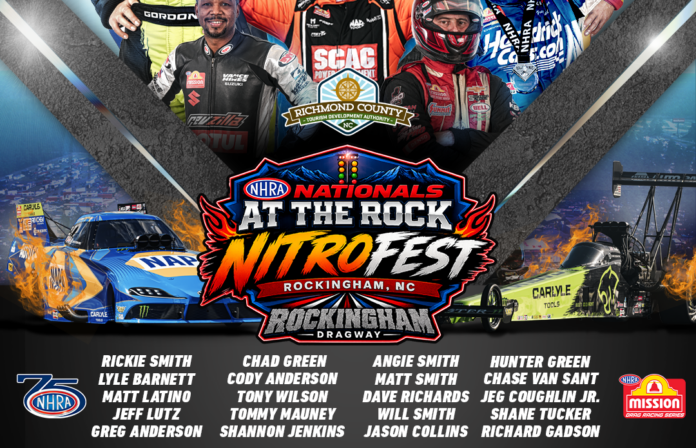
ROCKINGHAM, N.C. (Sept. 23, 2026) – With the NHRA Mission Foods Drag Racing Series set to make its thrilling debut at Rockingham Dragway this weekend for the inaugural NHRA Nationals at The Rock, the official kickoff for the race is set to be a big one for fans in downtown Rockingham.
Featuring NHRA driver meet-and-greets, a free concert from The Lacs, venders, food trucks, a free Kids Zone and much more, NitroFest takes over downtown Rockingham from 6-9 p.m. on Thursday around Harrington Square in downtown Rockingham.
The driver lineup for NitroFest will be huge, with more than 30 drivers slated to take part in the meet-and-greet and autograph session for fans.
That takes place from 6:30-7:15 p.m. on Thursday, with an incredible lineup that features NHRA world champions like Ron Capps, Matt Hagan, J.R. Todd, Shawn Langdon, Tony Schumacher, Jeg Coughlin Jr., Greg Anderson, Dallas Glenn, Matt Smith, Rickie Smith and Richard Gadson, as well as standouts like Maddi Gordon, Jordan Vandergriff, Justin Ashley, Daniel Wilkerson, Will Smith, Dave Richards, Angie Smith, Shane Tucker, Chad Green, Matt Latino, Cody Anderson, Chase Van Sant, Troy Coughlin Jr., Hunter Green, Josh Hart, Alexis DeJoria and more.
It will be a great opportunity for fans to meet some of the biggest stars on the NHRA tour, all before they put on an incredible show at Rockingham Dragway for the first time, all with the added excitement of the Countdown to the Championship playoffs.
The night includes a free concert from The Lacs, which starts at 7:45 p.m. on Thursday. NitroFest also features:
Motorsports and automotive vendors and displays
Race cars on display
A free Kids Zone featuring bounce houses, inflatable slides, a rock climbing wall, and face painting
Food trucks serving a variety of local favorites
A beer garden hosted by Rockingham Dragway
A drag racing practice Tree competition
Family-friendly activities and interactive experiences celebrating the return of nitro-powered racing to The Rock.
NitroFest admission is free, setting the stage for an incredible debut at Rockingham Dragway. Fans will get a full dose of 340-mph, 12,000-horsepower excitement as they to witness the first-ever full national event at the historic facility, all as part of NHRA’s milestone 75th anniversary season.
It is the 16th of 20 races in 2026 and the event will be broadcast on FS1, with elimination coverage beginning at 3 p.m. ET on Sunday.
The Top Fuel ranks have been dominated throughout 2026 by Kalitta Motorsports teammates Shawn Langdon and Doug Kalitta, and that continued at the Countdown opener when Langdon again laid waste to the record book. He moved back into the points lead with a win, while others to watch include Tony Stewart and Antron Brown.
Vandergriff, a Funny Car newcomer for John Force Racing, opened the playoffs with a win and will look to keep rolling against a loaded lineup that includes Hagan, Capps, Todd and back-to-back world champ Austin Prock.
Matt Hartford moved into the Pro Stock points lead in Martin as part of a wild Countdown opener. He’ll look to stay on top going against Glenn, Anderson, Greg Stanfield and Erica Enders.
Reigning Pro Stock Motorcycle champion Gadson holds a slim lead against John Hall, who opened the postseason with a win. Other standouts like Matt and Angie Smith, Gaige Herrera and Van Sant.
The NHRA Nationals at The Rock will also feature the NHRA Lucas Oil Drag Racing Series, as well as the popular JBS Equipment NHRA Pro Mod Drag Racing Series presented by Elite Motorsports.
On Sunday, race fans can enjoy the special pre-race ceremonies that introduce each driver and includes the SealMaster Track Walk. They are invited to congratulate the event winners at the winner’s circle celebration on Sunday. Fans also get a pit pass to the most powerful and sensory-filled motorsports attraction. They can see their favorite teams in action and servicing their cars, get autographs and more.
NHRA Mission Foods Drag Racing Series qualifying will feature two rounds at 1 and 3:30 p.m. ET on Friday and the final two rounds on Saturday at 12 and 2:30 p.m. Final eliminations are scheduled for 11 a.m. ET on Sunday. Television coverage includes qualifying on FS1 at 11 a.m. ET on Sunday and eliminations at 3 p.m.
To purchase tickets to the 2026 NHRA Nationals at The Rock, fans can visit www.NHRA.com/tickets. Children 12 and under are free in general admission areas with the purchase of an adult ticket. For more information about the NHRA, visit www.nhra.com.
About Mission Foods
MISSION®, owned by GRUMA, S.A.B. de C.V., is the world’s leading brand for tortillas and wraps. MISSION® is also globally renowned for flatbreads, dips, salsas and Mexican food products. With presence in over 112 countries, MISSION® products are suited to the lifestyles and the local tastes of each country. With innovation and customer needs in mind, MISSION® focuses on the highest quality, authentic flavors, and providing healthy options that families and friends can enjoy together. For more information, please visit https://www.missionfoods.com/
About NHRA
NHRA is the primary sanctioning body for the sport of drag racing in the United States. NHRA presents 20 national events featuring the NHRA Mission Foods Drag Racing Series and NHRA Lucas Oil Drag Racing Series, as well as the JBS Equipment NHRA Pro Mod Drag Racing Series presented by Elite Motorsports and NHRA Flexjet Factory Stock Showdown™ at select national events. NHRA provides competition opportunities for drivers of all levels in the NHRA Summit Racing Series and NHRA Street Legal™. NHRA also offers the NHRA Jr. Street® program for teens and the Summit Racing Jr. Drag Racing League® for youth ages 5 to 17. With more than 100 Member Tracks, NHRA allows racers to compete at a variety of locations nationally and internationally. NHRA’s Youth and Education Services® (YES) Program reaches over 30,000 students annually to ignite their interest in automotive and racing related careers. NHRA’s streaming service, NHRA.tv®, allows fans to view all NHRA national events as well as exclusive features of the sport. In addition, NHRA owns and operates three racing facilities: Gainesville Raceway in Florida; Lucas Oil Indianapolis Raceway Park; and In-N-Out Burger Pomona Dragstrip in Southern California. For more information, log on to www.NHRA.com, or visit the official NHRA pages on Facebook, Instagram, Twitter, and YouTube.
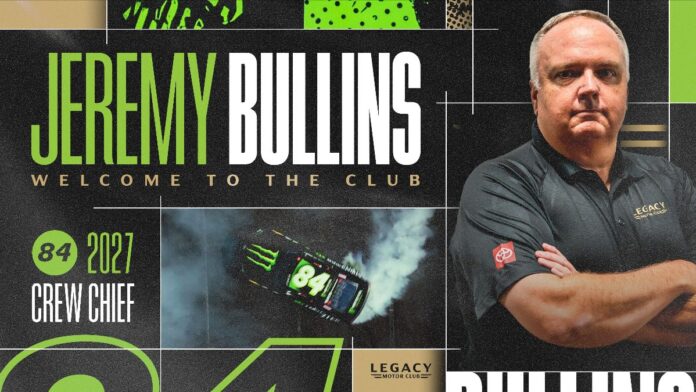
NASCAR veteran joins LEGACY MOTOR CLUB as crew chief for Riley Herbst and the No. 84 Toyota Camry XSE
STATESVILLE, N.C. – (September 23, 2026) LEGACY MOTOR CLUB announced today that NASCAR veteran Jeremy Bullins will join the organization as the crew chief of the No. 84 Toyota Camry XSE for the 2027 NASCAR Cup Series season. Bullins will work alongside recently announced driver Riley Herbst in what will be Herbst’s third full-time season in the Cup Series and the debut of the No. 84 as a full-time chartered entry.
With more than 25 years of NASCAR experience and a proven record of developing drivers and building race-winning teams, Bullins brings a level of accomplishment and credibility that reflects LEGACY’s commitment to establishing the No. 84 into a competitive Cup Series program from day one.
“Jeremy Bullins’ experience and leadership are exactly what we need on the No. 84,” said Jimmie Johnson, co-owner of LEGACY MOTOR CLUB. “He has a proven record of success at every level of NASCAR, but what truly sets him apart is his ability to develop talent, build winning cultures, and embrace innovation. Pairing him with Riley creates a strong foundation for the No. 84 team to compete, evolve, and achieve long-term success.”
Bullins brings a winning pedigree to LEGACY MOTOR CLUB, having won 10 races in the Cup Series and 21 races in the NASCAR O’Reilly Auto Parts Series with a variety of drivers. After studying mechanical engineering at North Carolina State University, he joined the historic Wood Brothers Racing in 1999 to work on the No. 21 car with Elliott Sadler. He moved to Richard Childress Racing in 2005, where he worked as an engineer for Kevin Harvick and Clint Bowyer, accumulating nine Cup Series wins between the two drivers.
In 2012, Bullins joined Team Penske as the crew chief of the No. 22 O’Reilly Auto Parts Series team. After building the program, winning races, and claiming the series Owner’s Championship in 2013, he returned to Wood Brothers Racing in 2015 as the crew chief of the No. 21 car with Ryan Blaney. He later joined forces with Brad Keselowski in 2020, with the duo winning five races between 2020 and 2021. Bullins went on to serve as crew chief for several other Cup Series drivers before joining RFK Racing in 2025.
“Jeremy brings a level of experience and a track record that speaks for itself,” said Riley Herbst, driver of the No. 84 Toyota Camry XSE. “Having someone who has won races and built teams at the highest level of this sport alongside me gives me a lot of confidence heading into 2027. I’m looking forward to getting to work together and building something special with the No. 84 team.”
“I’m very excited to get the opportunity to work with everyone at LEGACY MOTOR CLUB with everything that is being built here,” said Jeremy Bullins, crew chief of the No. 84 Toyota Camry XSE. “There are a lot of positive things happening at the team. I was excited to meet Riley Herbst and see how passionate he is about racing, so I’m excited to give him some leadership to hopefully provide him a good opportunity in 2027.”
“Jeremy is a very respected and successful figure in this sport, and we are thrilled to have him leading the No. 84 program,” said Jacob Canter, SVP, Sporting Director of LEGACY MOTOR CLUB. “His experience building race-winning teams and his ability to develop drivers makes him an outstanding fit for Riley and for what we are building with the No. 84. Jeremy’s also an organizational thinker who will contribute to LEGACY’s overall program to the benefit of Riley’s teammates in the No. 42 and No. 43.”
Bullins will make his LEGACY MOTOR CLUB debut with Herbst at Daytona International Speedway in February 2027.
ABOUT LEGACY MOTOR CLUB: (LEGACY MC) is a premier auto racing organization owned by seven-time NASCAR Cup Series champion and 2024 NASCAR Hall of Fame inductee, Jimmie Johnson and Knighthead Capital Management, LLC. Drawing from a rich tradition of success, LEGACY MC is dedicated to pushing the boundaries of motorsport and setting new standards of excellence. The CLUB competes under the Toyota Racing banner in the NASCAR Cup Series with the No. 43 Toyota Camry XSE piloted by Erik Jones and the No. 42 Toyota Camry XSE driven by John Hunter Nemechek. The No. 84 Toyota Camry XSE driven by Riley Herbst will debut full time in the 2027 season, while Johnson will make his final NASCAR Cup Series start at the 2027 DAYTONA 500 in the No. 48 Toyota Camry XSE. With NASCAR legend and Hall of Famer Richard Petty, “The King”, serving as CLUB Ambassador, LEGACY MC blends timeless racing traditions with a new forward-thinking vision. As an inclusive community for motorsport enthusiasts, LEGACY MC honors both its storied past and the promising future of its members, always striving for victory and championship glory at the pinnacle of NASCAR competition.
18-Year-Old Gets Valuable Speedway Experience Ahead of Full-Time Season in NASCAR O’Reilly Auto Parts Series
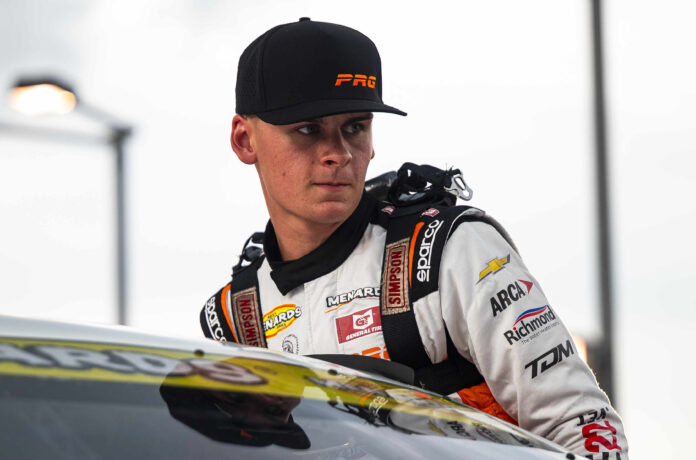
MOORESVILLE, N.C. (Sept. 23, 2026) – Carson Brown comes into the ARCA Menards Series season finale Friday at Kansas Speedway in Kansas City balancing what matters now with what matters next.
In the short term, Brown is looking to secure his second straight ARCA win after a dominating victory last week at Bristol (Tenn.) Motor Speedway. In the long term, the 18-year-old aims to use the knowledge gained at the 1.5-mile, D-shaped oval to better prepare for next year, when he will drive the No. 2 Whelen Chevrolet for Richard Childress Racing (RCR) in the NASCAR O’Reilly Auto Parts Series.
RCR signed Brown to a driver development contract earlier this year, and after wins and poles across ARCA and the ASA STARS National Tour, the organization took the development tag off the New London, North Carolina, native Aug. 26 and named him to its championship-winning O’Reilly Series program for 2027.
Time in ARCA has been crucial to Brown’s preparation, and Kansas represents another important step in building a strong baseline ahead of his rookie season in the stepping-stone division to the elite NASCAR Cup Series.
“I need more experience on big tracks where I can get a better feel for the tire, feel out the aero and really just get a good understanding of how everything works,” said Brown, who will drive the No. 28 Whelen Chevrolet for Pinnacle Racing Group (PRG) at Kansas.
Age limits have been Brown’s biggest impediment to gaining such experience. He needed to be 18 to compete on intermediate-style ovals like Kansas, and Brown didn’t hit that milestone until July 13. While there have been several ARCA races since Brown’s 18th birthday, Kansas is the first intermediate track he has been eligible to run.
“I know these tracks are where I need to get more experience, but I’ve just never been old enough. Finally, I am,” Brown said.
Intermediate tracks are where high speeds, aerodynamics and handling coalesce, forcing drivers to find a balance between raw speed and cornering ability. Feedback comes via the tires.
“You’re turning quite a bit at Kansas, so tires are probably the biggest thing to understand,” Brown said. “You want to know the slip angle of the tire, and that’s determined by the sidewall construction. But the only way you learn anything about that is to get out on the track and experience it firsthand. Heat buildup will also be something I need to get accustomed to, because that softens the tire, but how much?
“I feel like I’ve got a lot of time on short tracks and even bigger flat tracks, but banked speedways like Kansas are where I know I need more laps.”
With speeds eclipsing 170 mph at Kansas, aerodynamics also factor heavily into a car’s overall balance.
“Aero is something we deal with at every track, but it’s on a bigger scale at Kansas,” Brown said. “I want to learn how to work the air and what happens when I move around, especially in traffic. I want to understand how I can use it to my advantage and also not do something that will hurt my momentum.”
Brown has plenty of momentum coming into Kansas. He is a three-time ARCA winner, with two of those victories coming in his last three starts. Brown is also dominating the ASA STARS National Tour, where four wins and three second-place finishes have given him a commanding 176-point lead in the championship standings. To put an exclamation point on his Late Model prowess, Brown earned his maiden CARS Tour West win Aug. 15 at Evergreen Speedway in Monroe, Washington, leading every lap from the pole.
Brown has made 16 of 17 career ARCA starts for PRG, which aims to tap into that momentum at Kansas. In the championship owners’ standings, PRG is second, just 11 points behind Joe Gibbs Racing. Another strong run by Brown in Friday’s season finale could deliver a second straight owners’ title to PRG.
“It’s really cool to be able to factor into the championship,” Brown said. “I honestly haven’t chased points in ARCA because I’ve run a limited schedule that made sense in regard to my overall racing schedule. But Kansas is the last race and knowing that the owners’ title is something that’s a possibility, it’s really important to go out there and perform well.”
From his victory March 5 at Phoenix Raceway through last week’s win at Bristol, Brown has finished among the top-three 12 times, a run that also includes a win Sept. 6 at the DuQuoin (Ill.) State Fairgrounds.
“It’s been a good year – some wins and a really consistent run of podiums – but the process of it all and getting to learn the feel of this big, heavy stock car has been the best part,” Brown said. “There’s really nothing that prepares you for the upper NASCAR levels better than ARCA and time in the simulator. I feel like I’ve done both of those as much as I possibly could, and I’m just going to keep that same work ethic so I’m as prepared as I can be next year at Daytona.”
That preparation begins anew Friday at Kansas, with a 45-minute practice at 2 p.m. CDT/3 p.m. EDT followed by a 20-minute timed qualifying session at 3 p.m. CDT/4 p.m. EDT. The 100-lap race goes green at 7 p.m. CDT/8 p.m. EDT and will be broadcast live on FS1 and streamed on the FOX One app, with SiriusXM NASCAR Radio providing live audio coverage.