REDDICK OVERCOMES MULTIPLE INCIDENTS, LEADS TOYOTA AT TALLADEGA Reddick extends top-15 streak to start season
TALLADEGA, Ala. (April 26, 2026) – Tyler Reddick overcame multiple incidents, including a cut tire in the closing laps to lead Toyota with a 14th-place finish at Talladega. The points leader continued his streak of finishing every race in the top-15 this season.
TOYOTA RACING Post-Race Recap NASCAR Cup Series (NCS) Talladega Superspeedway Race 10 of 36 – 500.08 miles, 188 laps
TOYOTA FINISHING POSITIONS
1st, Carson Hoceva* 2nd, Chris Buescher* 3rd, Alex Bowman* 4th, Chase Elliott* 5th, Zane Smith* 14th, TYLER REDDICK 15th, DENNY HAMLIN 17th, CHRISTOPHER BELL 22nd, JOHN HUNTER NEMECHEK 23rd, ERIK JONES 25th, RILEY HERBST 29th, CHASE BRISCOE 34th, TY GIBBS 36th, BUBBA WALLACE *non-Toyota driver
TOYOTA QUOTES
TYLER REDDICK, No. 45 ROCKSTAR ENERGY DRINK Toyota Camry XSE, 23XI Racing
Finishing Position: 14th
Can you talk how you got this car to a top-15 finish?
“Yeah, we able to overcome problems that we had throughout the day. The second cut tire, I thought was going to be the end of our day, but thankfully we hit it somewhat true enough that all it did was bend stuff, not break it. It was just the day we needed to have with the adversity we had along the way. Bummed we didn’t get ROCKSTAR ENERGY DRINK and Toyota to victory lane today, but all-in-all, I think we did gain more ground on those around us in points, so to wreck and be able to accomplish that is a good deal.”
TY GIBBS, No. 54 SAIA Freight & Logistics Toyota Camry XSE, Joe Gibbs Racing
Finishing Position: 34th
Can you tell us what happened out there?
“Well, we had a really good first stage in our SAIA Camry. Unfortunately, not a lot of people pitted with us, and we just barely made it on the lead lap at the end of the first stage. I thought we were really fast. I thought our car was really good, but didn’t end well. Unfortunate end of the day for us. We will keep working hard. Thanks for SAIA, Monster, Toyota – everyone that supports us. I’m excited for Texas. Not a lot of luck at the roulette table today at Talladega, so we will look forward.”
BUBBA WALLACE, No. 23 Xfinity Toyota Camry XSE, 23XI Racing
Finishing Position: 36th
Can you take us through what happened?
“Got wrecked there, unfortunately. Our Xfinity Toyota Camry was a little unstable getting pushed, but manageable. Maybe that hard of a hit was too much, so unfortunately, we wiped out a bunch of cars. Got to debrief, got to be better. Just kind of riding around, not doing much in the first stage – nothing to show for it at Talladega. Unfortunate, it is a place we come to with a lot of confidence, and it is what it is. We will put this one behind us and go on to Texas and have some fun.”
About Toyota
Toyota (NYSE:TM) has been a part of the cultural fabric in North America for nearly 70 years, and is committed to advancing sustainable, next-generation mobility through our Toyota and Lexus brands, plus our more than 1,800 dealerships.
Toyota directly employs nearly 64,000 people in North America who have contributed to the design, engineering, and assembly of nearly 49 million cars and trucks at our 14 manufacturing plants. In spring 2025, Toyota’s plant in North Carolina will begin to manufacture automotive batteries for electrified vehicles. With more electrified vehicles on the road than any other automaker, Toyota currently offers 31 electrified options.
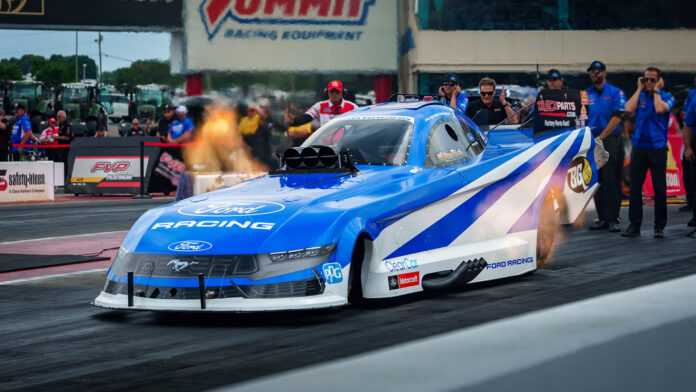
CONCORD, N.C. – April 26, 2026 – Austin Prock and his Ford Racing Nitro Mustang Funny Car faced a challenging but productive weekend at the 2026 NHRA 4-Wide Nationals at zMAX Dragway, qualifying No. 16 and exiting in the opening round of eliminations on Sunday.
The weekend marked another step forward in the team’s ongoing development of its Funny Car combination. While the result was not what Prock and team were looking for, the weekend provided valuable data as the team continues working to harness the horsepower in their Ford Racing Nitro Mustang.
Prock opened qualifying Friday afternoon with a 4.977-second pass at 176.56 mph after the car dropped a cylinder at the hit and moved hard toward the inside. Prock fought to keep the Mustang under control before the car knocked the tires loose.
In Friday’s second session, Prock’s Ford Racing Mustang left the starting line well with a .873 60-foot time, but the run ended early when the car lost traction, resulting in a 6.596 at 118.45 mph. The pass dropped Prock to 16th in the qualifying order.
“Conditions were gorilla tonight, and I haven’t got very many shots in that hot rod in these conditions,” Prock said after Q2. “But this Ford, it left great and it was heading straight down the track. It was anchored down, but I felt the sidewall quivering a little bit. As soon as it cleared up, it chopped the tires off. I can promise you that this Ford is going to run low ET soon.”
Saturday brought two more qualifying attempts as the team continued working through the setup. In Q3, Prock pedaled the car multiple times before shutting off early, recording a 6.083 at 129.19 mph. The run kept him on the bump spot entering the final session.
In Q4, the Funny Car delivered another challenging and disappointing run, posting a 4.833 at 168.26 mph. The pass secured the No. 16 qualifying position and a spot in Sunday eliminations against No. 1 qualifier Ron Capps, along with Chad Green and Spencer Hyde rounding out the quad.
“We made it in the show, but not by anything extravagant by any means,” Prock said. “Made some headway on the engine program this weekend. Got it running clean and we’re now just trying to harness all this Ford horsepower. In Q4, we made it the furthest down the track than we have all weekend with smoking the tires. I stood on the gas and had a great light, but it put a cylinder out at the hit. The Mustang moved hard right, the cylinder relit, and I got it back on track but smoked the tires around half track. We got a chance to win on Sunday and that’s all that matters.”
In Sunday’s opening round of four-wide eliminations, Prock lined up against Capps, Green, and Hyde. Prock left with a .070 reaction time and was on a solid early run, posting a .877 60-foot time, a 2.245 at 330 feet, and a 3.298 at 211.46 mph to the eighth mile. However, the car blew the tires off just after half-track and slowed to a 4.460 at 191.76 mph.
Capps advanced with the quickest Funny Car run of the weekend, while Green moved on in the second transfer position. Prock finished third in the quad, ending the weekend in the first round.
Despite the early exit, the weekend gave Tasca Racing additional direction as the team continues to build consistency with its Ford Racing Nitro Mustang Funny Car. Prock and the team showed improved early numbers and made progress with the engine program but continued with challenges throughout the weekend.
The Tasca Racing team will leave Charlotte focused on turning the weekend’s data into results as the NHRA Mission Foods Drag Racing Series continues next week in Adel, GA for the NHRA Southern Nationals.
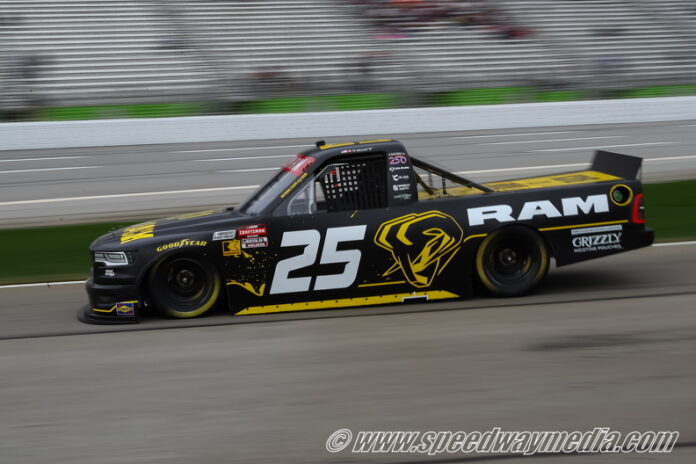
Clint Bowyer and Jamie McMurray have been named drivers of Kaulig Racing’s No. 25 “Free Agent” RAM 1500 entry for one race apiece in this year’s NASCAR Craftsman Truck Series season.
Bowyer, the 2008 NASCAR O’Reilly Auto Parts Series champion and 10-time Cup Series race winner from Emporia, Kansas, will drive the No. 25 RAM 1500 entry at Dover Motor Speedway on May 15. McMurray, the 2010 Daytona 500 & Brickyard 400 champion and seven-time Cup winner from Joplin, Missouri, will pilot the entry during the series’ inaugural event at San Diego’s Naval Base Coronado on June 19.
The announcement was made during NASCAR’s pre-race show before the Cup Series’ Jack Link’s 500 event at Talladega Superspeedway on April 26, where both Bowyer and McMurray work as NASCAR analysts for FOX Sports. It also comes as the Truck Series is set to embark on a six-race consecutive stretch, starting from May 1 to June 6.
“Bringing in veterans like Clint and Jamie adds another level of excitement, which is why we created the Free Agent Program,” Tim Kuniskis, Head of American Brands, SRT Performance, North America marketing/retail strategy at Stellantis, said. “Their experience and success help showcase Ram’s unique approach to America’s motorsport while allowing fans to watch a couple of their favorite drivers get behind the wheel of a Ram 1500 with Kaulig Racing.”
Bowyer has made a total of 15 starts in the Truck Series division. His latest start occurred at Nashville Superspeedway in June 2024 as he finished 17th while driving for Spire Motorsports. He recorded three victories in the series, with his latest occurring at Kansas Speedway in June 2011.
The May 15 event at Dover is scheduled to mark Bowyer’s second series start at the Monster Mile. His first occurred in June 2007 as he finished 34th following an opening lap accident. He has also made a total of 30 Cup starts at Dover, with a win at the track in the O’Reilly Auto Parts Series in September 2009.
“I’m pumped to get back in a truck, especially one with Ram power behind it,” Bowyer said. “Dover is a beast — concrete, tight and unforgiving — and I plan to put this No. 25 Ram Free Agent truck right up front where it belongs.”
Like Bowyer, McMurray is a former Truck Series race winner. He achieved his lone victory at Martinsville Speedway in October 2004. He has also made 25 starts in the series, with his latest dating back to October 2008 at Martinsville, as he embraces the challenge of campaigning in a street course venue for the first time ever.
“Racing on a naval base in San Diego for the very first time is going to be an incredible experience,” McMurray said. “Street courses reward precision and adaptability, and I’m looking forward to teaming with Kaulig and Ram to make some history in that No. 25 truck.”
Kaulig Racing launched its free agent driver program ahead of its inaugural campaign in the Craftsman Truck Series division in November 2025. The program involved featuring various competitors from multiple racing divisions and disciplines to compete in at least a single Truck event in one of Kaulig’s RAM 1500 entries numbered 25. The competitors who compete in the entry would not compete for the 2026 Truck Series driver’s championship, but would be evaluated by their on-track performance for a season-ending program prize.
Currently, Kaulig Racing’s No. 25 entry, which is led by crew chief Alex Yontz, is ranked in 25th place in the 2026 owner’s standings through six of the 25-race schedule. Bowyer and McMurray are set to join Tony Stewart, Ty Dillon, Colin Braun, Corey LaJoie and Carson Ferguson as competitors who have piloted the entry in at least a single event. They will each compete alongside Kaulig’s four RAM 1500s entries: the No. 10 entry piloted by Corey LaJoie, the No. 12 entry piloted by rookie Brenden “Butterbean” Queen, the No. 14 entry piloted by newcomer Timothy “Mini” Tyrrell and the No. 16 entry piloted by Justin Haley.
While Dillon is the only competitor who has piloted the No. 25 entry twice, Braun has recorded the entry’s highest-finishing result of ninth place during the series’ inaugural event at the Streets of St. Petersburg, Florida. Parker Kligerman is scheduled to drive the No. 25 entry this upcoming Friday, May 1, at Texas Motor Speedway. Ferguson is scheduled to compete in the No. 25 entry for a second time at Martinsville on October 30. Kaulig’s selection and reveal of drivers for the remainder of this season remains to be determined.
Clint Bowyer’s Truck Series return with Kaulig Racing is set for May 15 at Dover Motor Speedway in Dover, Delaware. The ECOSAVE 200 will air at 5 p.m. ET on FS1, NASCAR Racing Network and SiriusXM.
Jamie McMurray’s Truck return with Kaulig will occur at San Diego’s Naval Base Coronado on June 19 at 4 p.m. ET on FS1, NASCAR Racing Network and SiriusXM.
Seven-time NASCAR champion to serve as brand ambassador and anchor new licensed product lines
STATESVILLE, N.C. (APRIL 26, 2026) – LEGACY MOTOR CLUB announced today an expanded relationship with Dollar Tree, one of the fastest growing retailers in the country. The agreement includes a personal services deal with seven-time NASCAR Cup Series champion and CLUB owner Jimmie Johnson as a brand ambassador, along with a direct-to-retail licensed product program featuring team branding.
Johnson, one of the most accomplished drivers in motorsports history with 83 Cup Series victories, will serve as a key ambassador for Dollar Tree, helping to amplify the company’s focus on speed, safety, productivity, performance and teamwork. As part of the agreement, Johnson will participate in national marketing campaigns, digital and social content, in-store promotions and select corporate events.
“This partnership is rooted in shared values and a belief in building something meaningful together,” said Rick McNeely, Executive Advisor, Dollar Tree. “Jimmie’s career is defined by consistency, performance and teamwork — qualities that align directly with how we operate as a company. We’re excited to bring his voice and credibility to our customers and associates.”
Johnson said the opportunity reflects a natural alignment between his career and Dollar Tree’s growth. “I’ve always believed success comes from preparation, discipline and the people around you,” Johnson said. “Dollar Tree is building something special, and I’m proud to be part of it. From the products on shelves to the teams behind the scenes, there’s a strong connection in how we approach performance every day.”
In addition to the personal services agreement, Dollar Tree and Johnson have entered a licensing agreement for a new line of co-branded products in Dollar Tree stores beginning this fall. The program will feature Johnson’s name, image and likeness alongside LEGACY MOTOR CLUB branding.
Initial product categories will include an exciting selection of automotive products, supplies, and accessories at an exceptional value. Additional categories, such as toys, health and personal care items and apparel are expected to be added to the assortment at a later date.
“We’re incredibly excited to introduce this new product line, developed in partnership with Jimmie Johnson, one of the most iconic names in NASCAR,” said Brent Beebe, Chief Merchandising Officer, Dollar Tree. “Our collaboration blends performance, style and everyday practicality that I anticipate our customers will love. This partnership is about offering great products that deliver exceptional value and make it easy for our customers to find what they need — while discovering something new every time they walk through our doors.”
Johnson’s role as owner of LEGACY MOTOR CLUB adds a unique dimension to the partnership, connecting competitive performance on the track with a broader consumer platform.
The collaboration reflects a long-term vision for a meaningful, recognizable partnership between motorsports and retail. “This is about more than a traditional endorsement,” Johnson added. “It’s about building a legacy together, creating products and experiences that connect with people in a real way.”
About Dollar Tree: Dollar Tree, Inc., headquartered in Chesapeake, VA, is one of North America’s largest and most loved value retailers, known for delivering great value, convenience, and a “thrill-of-the-hunt” discovery shopping experience. With a team of approximately 150,000 associates, Dollar Tree operates more than 9,200 stores and 18 distribution centers across 48 contiguous states and seven Canadian provinces under the brands Dollar Tree and Dollar Tree Canada. The Company is committed to being a responsible steward of its business – supporting its people, serving its communities, and creating lasting value. To learn more about the Company, visit www.DollarTree.com.
LEGACY MOTOR CLUB (LEGACY MC) is a premier auto racing organization owned by seven-time NASCAR Cup Series champion and 2024 NASCAR Hall of Fame inductee, Jimmie Johnson and Knighthead Capital Management, LLC. Drawing from a rich tradition of success, LEGACY MC is dedicated to pushing the boundaries of motorsport and setting new standards of excellence. The CLUB competes under the Toyota Racing banner in the NASCAR Cup Series with the No. 43 Toyota Camry XSE piloted by Erik Jones and the No. 42 Toyota Camry XSE driven by John Hunter Nemechek. Johnson also races on a limited basis in the No. 84 Toyota Camry XSE. With NASCAR legend and Hall of Famer Richard Petty, “The King”, serving as CLUB Ambassador, LEGACY MOTOR CLUB blends timeless racing traditions with a new forward-thinking vision. As an inclusive community for motorsport enthusiasts, LEGACY MC honors both its storied past and the promising future of its members, always striving for victory and championship glory at the pinnacle of NASCAR competition.
Strong Fan Turnout, Challenging Conditions Bring Excitement to Spec Miata at Michelin Raceway Road Atlanta
HSR Grand Prix Classics Open Wheel Races See Winners Dominate
901 Shop Trio Sweeps Final Endurance Race of Saturday Slate in B.R.M Challenge
BRASELTON, Georgia (April 26, 2026) – The 48th annual HSR The Mitty presented by Hagerty roared to life Saturday at Michelin Raceway Road Atlanta (MRRA), with a packed schedule of sprint and feature races.
A few scattered sprinkles didn’t dampen the spirits of competitors or the many fans spectating or camping at the scenic Georgia road course. Meanwhile, a livestream of Saturday afternoon’s action announced just 24 hours previously attracted 50,000 unique live views, a measure of the growing popularity of Historic SportsCar Racing.
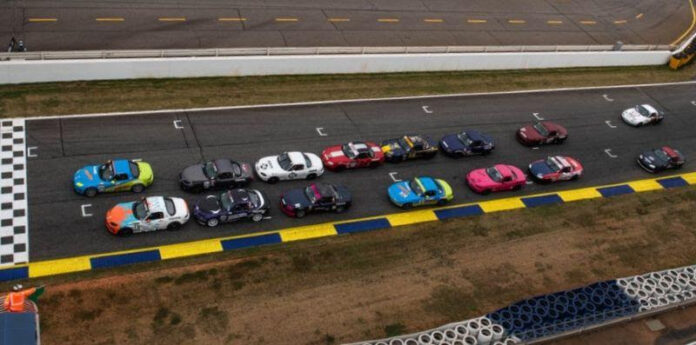
The legendary event surged into high gear, as roaring engines, iconic machinery, and fierce on-track battles set the tone for a marquee day of competition. A light rain swept in to open the day’s on-track action with the Mazda Spec Miata/MX-5 Feature Race, immediately throwing teams into a strategic dilemma. With changing conditions looming over the eight-lap sprint, tire choice became a critical gamble prior to the drop of the green flag.
From the drop of the green flag, the battle for podium positions in both the Spec MX (SMX) and Spec Miata (SM) classes was intense. Camden Gruber, driving the No. 24 Planet Miata 2007 Mazda MX-5, and Wes Duchak in the No. 40 Final Turn Motorsports 2006 Mazda MX-5 Miata surged into the top two positions on the opening lap. Meanwhile, Michelle Squirek, in the No. 75 2011 Mazda MX-5, slipped back to third in the fight for the overall and SMX lead.
Squirek quickly recovered, reclaiming second place on Lap 2, where the top three remained unchanged until the white flag in the SMX class.
In the closing moments, slippery track conditions factored into the outcome. Duchak and Mitchell Lowry, piloting the No. 21 MLR Racing 2006 Mazda MX-5 Miata, both overtook Squirek on the final lap to secure podium finishes.
Up front, Gruber led flag-to-flag to claim the overall and SMX victory. Duchak capitalized on the challenging conditions to finish second, while Lowry completed the podium in third.
In the SM class, late-race battles dramatically reshuffled the order on the final lap. Skyler Cottrell, driving the No. 91 AutoTechnic Racing 2003 Mazda Miata, regained the lead as Todd Buras, in the No. 561 East Street Racing 1999 Mazda Miata, dropped to third. Cottrell secured the class win, while active Mazda MX-5 Cup driver Chuck Mactutus charged from the back of the grid to finish second in the No. 661 2003 Mazda Miata.
“Despite what it may have looked like from the outside, it definitely wasn’t easy,” said Gruber. “I was driving real hard and had a couple of hairy moments in Turn 5. Huge thanks to everybody for the phenomenal set up in this car. I couldn’t be a whole lot happier with how the car drove.
“I was here a couple of weeks ago and we had another like race like this where it was like, ‘Is it wet, is it dry?’ So, I was a lot more comfortable making the call to dry tires. This was a whole lot of fun to race in front of this many fans; I’ve never raced in front of this many people before, so it’s just great to be out here.”
The weekend’s first Grand Prix Classics race for Groups 4A and 4B featured a pair of dominant flag-to-flag drives. Making his return to HSR competition, Tom Fraehlic was the overall winner in the No. 10 Wayne Brown Racing 1979 March Super Vee from Class 4B, a car he has raced for 28 years. He finished 6.530 seconds ahead of the Class 4A winner – Bruce Hamilton in the No. 76 Wulver Racing 1970 Brabham BT36, imported from Australia and presented in its period 1971 Australian Grand Prix livery.
The runners-up were Marc Giroux in the No. 59 GMT Racing 1969 Brabham BT29 in 4A, and Dalton Sizemore in the No. 91 Streamline Motorsports 1990 Reynard 90 SF FC in 4B.
Group 4C’s first Grand Prix Classics race was a much closer affair on the track. Nolan Allaer in the No. 70 RM Motorsports 2007 Panoz DP01/09 hounded Giano Taurino in the No. 01 Taurino Racing 2008 Ferrari A1/GP, closing within 0.2 second after six of the nine scheduled laps. Taurino pulled away and crossed the line first with about a two-second cushion but was assessed 30-second penalty for jumping the rolling start, which relegated him to second place behind Allaer. Alex Berg completed the podium in the No. 21 GMT Racing 1997 Lola T97/20.
“Giano was faster than me the entire race and those are beautiful cars,” Allaer said. “It was such an amazing experience. The beauty of historic racing is having two cars going full push like that and someone like that to race with.”
“I’m sure it was awesome for everyone to watch what these cars can do, and I had a great time out here,” added Taurino. “You can’t have a bad time here at Road Atlanta!”
In the final race of the day — the B.R.M Legacy Endurance Challenge — Todd Treffert delivered a remarkable drive, overcoming mechanical issues both before and during the race, as well as a pit stop penalty. Undeterred, Treffert set the pace overall and in the Vintage class, stretching his lead to as much as 40 seconds to secure victory in the 1972 No. 14 901 Shop Porsche 911 S/T.
“That was a challenge just to make the race,” Treffert said. “We had to change the alternator, but the 901 Shop guys killed it, just knocked it out of the park. We had starter issues in the pit stop, so they had to push-start me. We had a penalty, but I was aware of it so it was just keep pushing and see if we could make it. We kept pushing to the end. Anytime we’re driving these cars, we’re always having fun. That’s what it’s all about. It’s nice to get a medal here at the end, but it’s all about the fun.”
Ricky Park finished second overall and claimed top honors in the Historic class aboard the 1973 No. 44 1973 Porsche 911 RSR, holding off the challenge from Dean DeSantis and David Hinton in the 1974 No. 82 Porsche 911 Carrera RSR fielded by AJR Heritage Motorsports. The duo ultimately finished third overall and second in class. Alan Benjamin and Barry Waddell rounded out the Historic podium in third, sharing the 1992 No. 21 Porsche 964 Carrera Cup car prepared by Boulder Classics.
The Vintage class podium was completed by a 901 Shop sweep. David Agretelis brought home second place in the 1972 No. 66 Porsche 911 S/T, followed by Craig Watkins in third with the 1968 No. 46 Porsche 911 S/T.
The full weekend race schedule continues through Sunday afternoon at Michelin Raceway Road Atlanta before the curtain comes down on the 48th running of the HSR The Mitty.
Tickets for the 48th HSR The Mitty presented by Hagerty at Michelin Raceway Road Atlanta can be purchased at the gate or online at: https://am.ticketmaster.com/ral/buy/Mitty2026 For complete information on the 48th annual The Mitty Presented by Hagerty race weekend, including the event schedule, entry lists and ticket information, visit: https://www.hsrrace.com/the-mitty/.
About HSR: Historic Sportscar Racing (HSR) is the premier vintage and historic racing series in North America. It was formed in the mid-1970s with an inaugural event at Road Atlanta and became a part of International Motor Sports Association (IMSA) in 2022. There was one goal then and it remains true today: to celebrate and enjoy the racing cars from the past. As a “time machine” of sights and sounds, HSR provides a venue for competitors and spectators alike to share in the wonderful history and excitement created by the cars that competed at race tracks around the world. HSR currently sanctions eight vintage and historic racing events at some of the world’s most renowned race tracks, including Daytona International Speedway, Michelin Raceway Road Atlanta, Sebring International Raceway, Watkins Glen International and more. The complete schedule and full event information can be found on HSR’s website at www.HSRRace.com. Look for the HSR Channel on YouTube and follow HSR on Facebook at www.Facebook.com/HSRrace/, on Twitter X @HSR_race and on Instagram @HistoricSportscarRacing.
Ken Roczen Seizes 450SMX Points Lead with Fifth Win of the Season
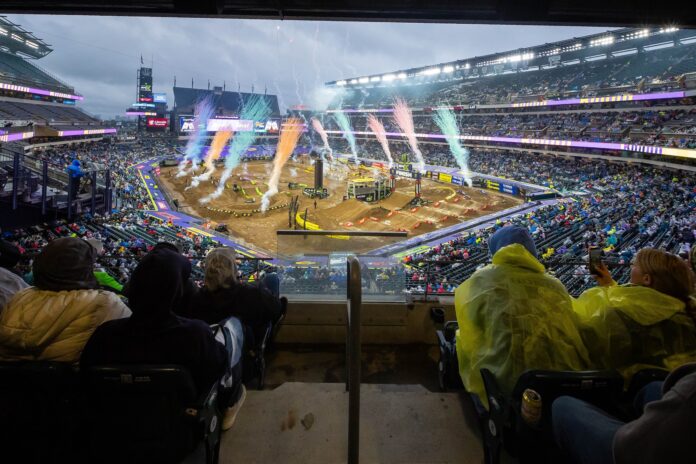
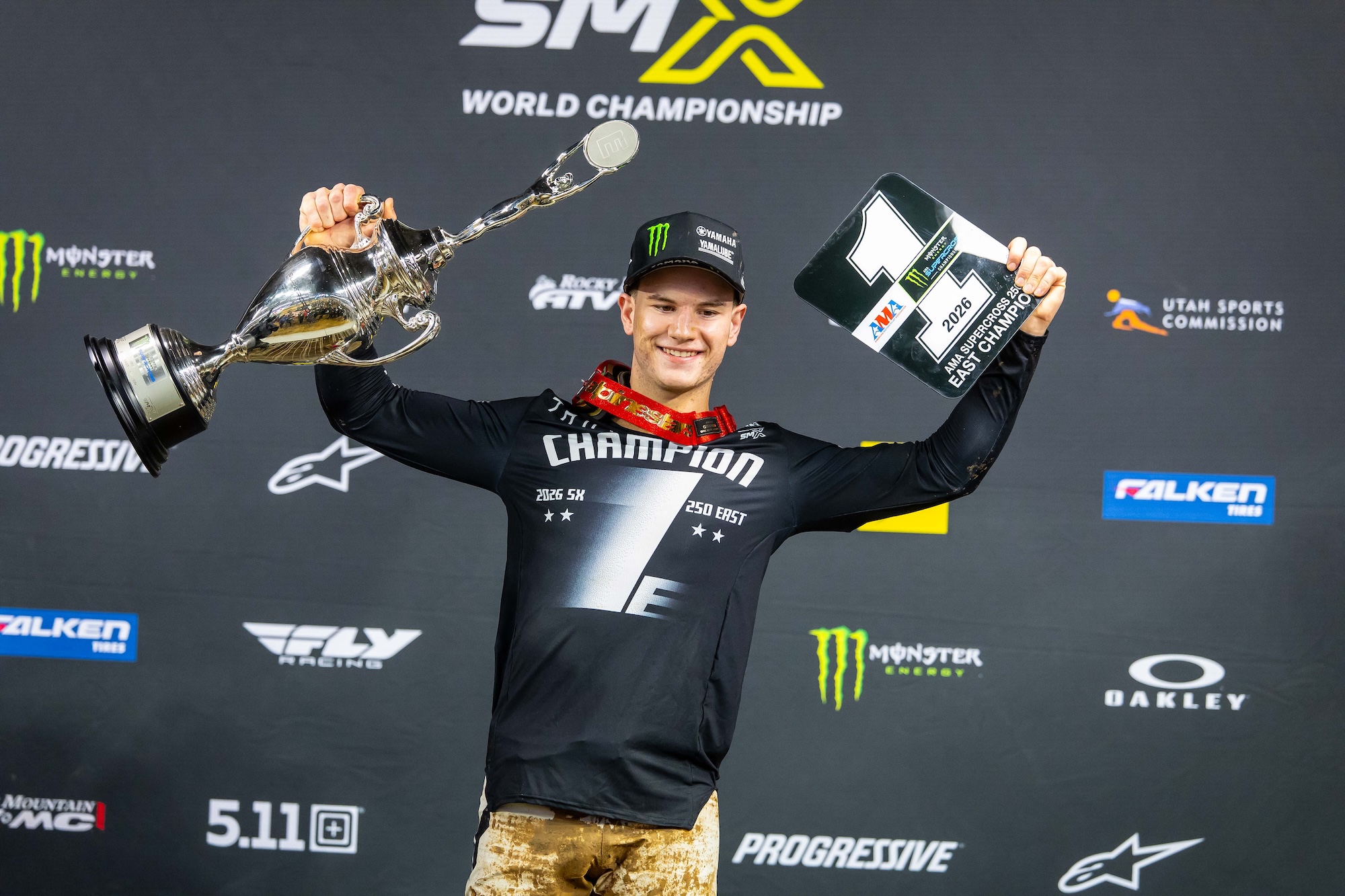
PHILADELPHIA (April 25, 2026) – The final East Coast stop of the 2026 Monster Energy AMA Supercross Championship became the biggest wild card of an already captivating season as Mother Nature became the great equalizer for Round 15 of the Monster Energy SMX World Championship inside Lincoln Financial Field. An afternoon of clear conditions and cool temperatures gave way to intermittent showers for the night show, which saturated the racetrack and made both track position and a patient approach the key to victory. Amidst the most difficult and treacherous conditions of the season, the Eastern Divisional 250SMX Class turned into a championship celebration as 18-year-old New Zealander Cole Davies navigated a chaotic Main Event to secure his fifth victory of the year and clinch his first professional title.
The penultimate race of the Eastern Divisional 250SMX Class Championship featured shortened 12 Minutes + 1 Lap Main Event, which began with Monster Energy Pro Circuit Kawasaki’s Seth Hammaker out front for the holeshot in front of the hometown crowd just ahead of Davies, who slotted in right behind Hammaker. Moments later, the Pennsylvania native crashed his Kawasaki, which nearly collected Davies, and dropped to the tail end of the 22-rider field. That briefly handed the top spot to MX6 Racing Kawasaki’s Derek Kelley before Davies made a pass for the lead. Davies then went down but was able to remount just ahead of Kelley and Rockstar Energy Husqvarna Factory Racing’s Daxton Bennick. A red flag for a downed rider halted the race with 7:22 remaining on the race clock, which necessitated a staggered restart.
When racing resumed, Davies reclaimed his spot out front while Bennick moved up to second. Behind them, the ClubMX Yamaha duo of Devin Simonson and Coty Schock battled for third. Simonson briefly held the position, but Shock made the pass as Simonson tipped over. Hammaker, meanwhile, had fought his way to the cusp of the podium in fourth and made the move around Schock to take control of third. Back out front, Davies rode flawlessly and never faced any pressure en route to an impressive, championship-clinching victory by a margin of 12.9 seconds over Bennick. Hammaker closed within striking distance of Bennick on the final lap and needed a second-place finish to extend the title fight, but went down and was forced to settle for third in a resilient come-from-behind performance.
Hammaker’s inability to get by Bennick became the difference maker in the championship as it gave Davies the necessary advantage to clinch the title one race early. He became the second New Zealand native to win a Supercross title, joining his mentor Ben Townley, and gave Monster Energy Yamaha Star Racing a clean sweep of the divisional titles alongside Haiden Deegan in the Western Division. Moreover, Davies’ victory was the 14th for Yamaha in the 250SMX Class this season, which equals the record for a single season set by both Honda (2023) and Kawasaki (2004). Two races remain for the bLU cRU to set a new all-time standard for success.
Monster Energy Yamaha Star Racing’s Cole Davies withstood a late-race restart to take his fifth win of the season and clinch the Eastern Divisional Championship.
Cole Davies – 1st Place – Eastern Divisional 250SMX Class Champion “[This championship] means everything to me and my family. We’ve sacrificed everything to come over here [and race in the U.S.]. I cannot thank them enough. All the hard work, the ups and downs, it’s all worth it now. This track was treacherous, but we got it done. A dream come true.”
Daxton Bennick – 2nd Place – Eastern Divisional 250SMX Class “[That race] was tough. I rode good in my Heat Race, so I just kept that momentum going into the Main Event. I knew if I could keep my wheels off the ground as much as I could that would put me in a good spot. I’m glad to be back up on the podium.”
Seth Hammaker – 3rd Place – Eastern Divisional 250SMX Class “I’m definitely bummed. I had big title hopes for this season, but I was racing a tough competitor. Congratulations to Cole [Davies] and his team. He’s been riding unreal this year. I felt like, for me, I took a step [forward] this season, even though it may not show it on the results side of things. I felt like my consistency has improved and I’ve been riding good, but nothing fell into place like I would have hoped. All in all, it was still a good season, and we’ve still got one more race to go.”
A shortened 17 Minutes + 1 Lap 450SMX Class Main Event began with the class’ top three title contenders out front as Honda HRC Progressive’s Hunter Lawrence, Progressive Insurance Cycle Gear Suzuki’s Ken Roczen, and Monster Energy Yamaha Star Racing’s Cooper Webb duked it out. The early edge went to Lawrence with the holeshot as he fended off Webb for the early lead, but Roczen then made his way from third to first just a couple minutes into the race. The lead trio then settled into their respective positions as Roczen and Lawrence inched away from Webb. Lawrence then started to pressure Roczen for the lead, as the championship rivals traded momentum. Then, with a little more than nine minutes remaining, Lawrence went down. He lost second to Webb but remounted in third, more than 20 seconds off the lead.
Without the pressure from Lawrence, Roczen was able to ride at his own pace and managed a comfortable margin over Webb through the heart of the Main Event, which became crucial as Roczen was faced with heavy lapped traffic throughout the entirety of the race’s second half. Webb made a final push as time ran out on the race clock and closed within a couple bike lengths of Roczen to initiate a last lap battle for the win. Roczen responded and kept Webb at bay to capture his 28th career victory by a slim margin of 2.4 seconds. Lawrence followed in a distant third on a night when just four riders finished on the lead lap.
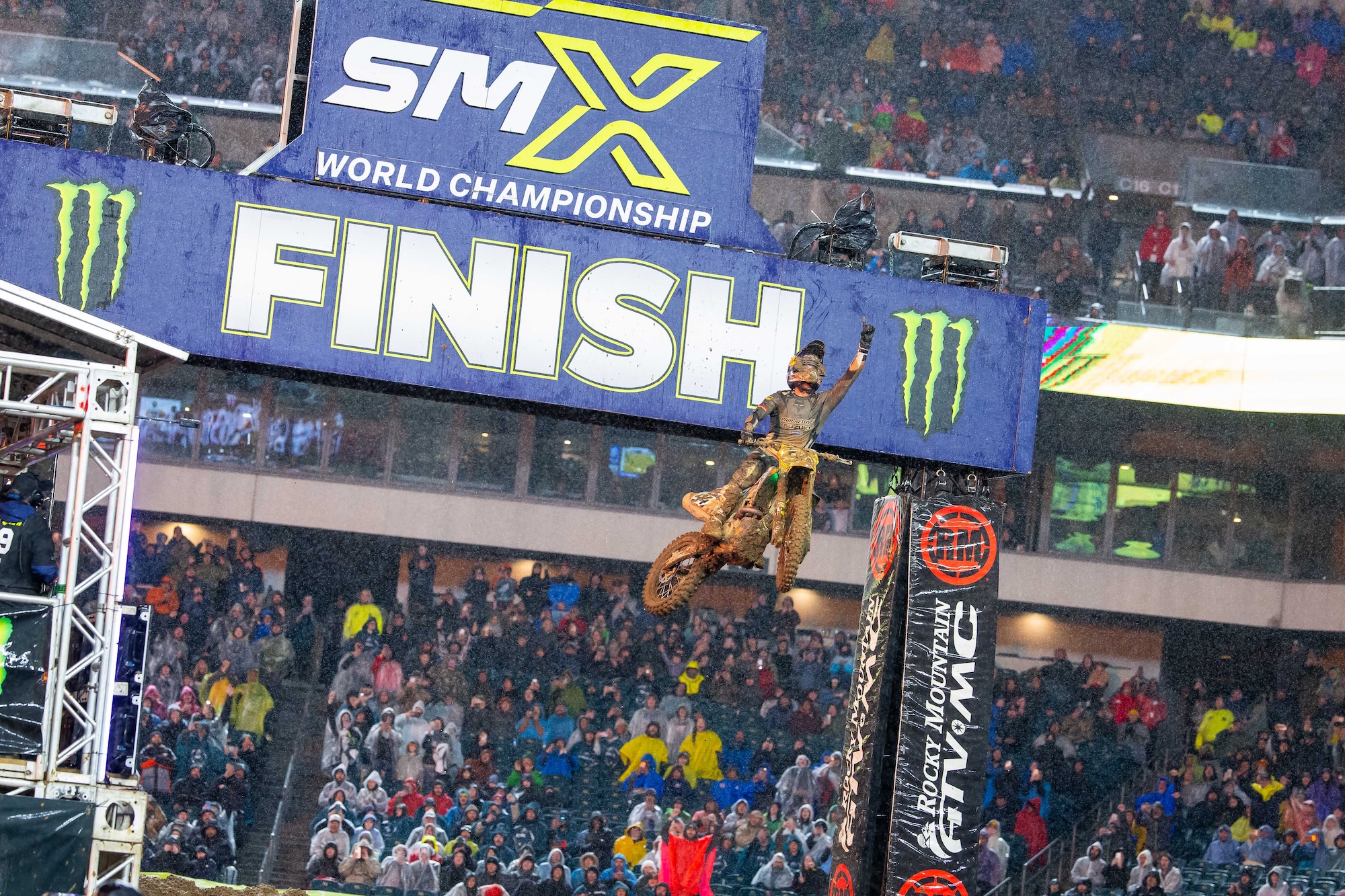
Roczen’s class leading fifth win of the season vaulted him to the top of the championship standings on the heels of four wins over the past five races. It marks the first time in his decorated career that Roczen has had possession of the red plate in the second half of a championship campaign. The German native holds a four-point lead over Lawrence with two races remaining, while Webb lurks in third, 24 points back.
Progressive Insurance Cycle Gear Suzuki’s Ken Roczen has seized control of the 450SMX Class title fight with his fourth win in five races.
Ken Roczen – 1st Place – 450SMX Class “The pressure has been there for a long time, but now I’m just dealing with it on an [every] weekend basis. I just do whatever I need to keep myself calm or whatever mindset I need to be in. There’s certain weekends where you need to be more aggressive and whatnot. This was such an important race. In these conditions things can go sideways in a heartbeat. I am so pumped and proud of my crew and myself for putting all this together when it’s really important. I’m really enjoying it. Hard work pays off.”
Cooper Webb – 2nd Place – 450SMX Class “It got crazy at the end. I just went full send. It’s a bummer to get second after riding that flawless of a race but we were pushing hard. I got close at the end, but lappers dictated some of it at the end and helped Kenny [Roczen] or hurt me, or vice versa. I felt like tonight was an opportunity I needed to make the most of and just didn’t quite pull it off. Overall, a great ride.”
Hunter Lawrence – 3rd Place – 450SMX Class “I’ve got a little extra fuel during the week [losing the points lead]. I look forward to Denver and Salt Lake [City]. They’ve been good to me, and I like racing at altitude. Happy to get out of here in one piece. I had a few ‘oh crap’ moments out there. Damage control with that little crash, so happy with that all things considered because once it happens sometimes the train can go off the tracks. Happy to bring it home.”
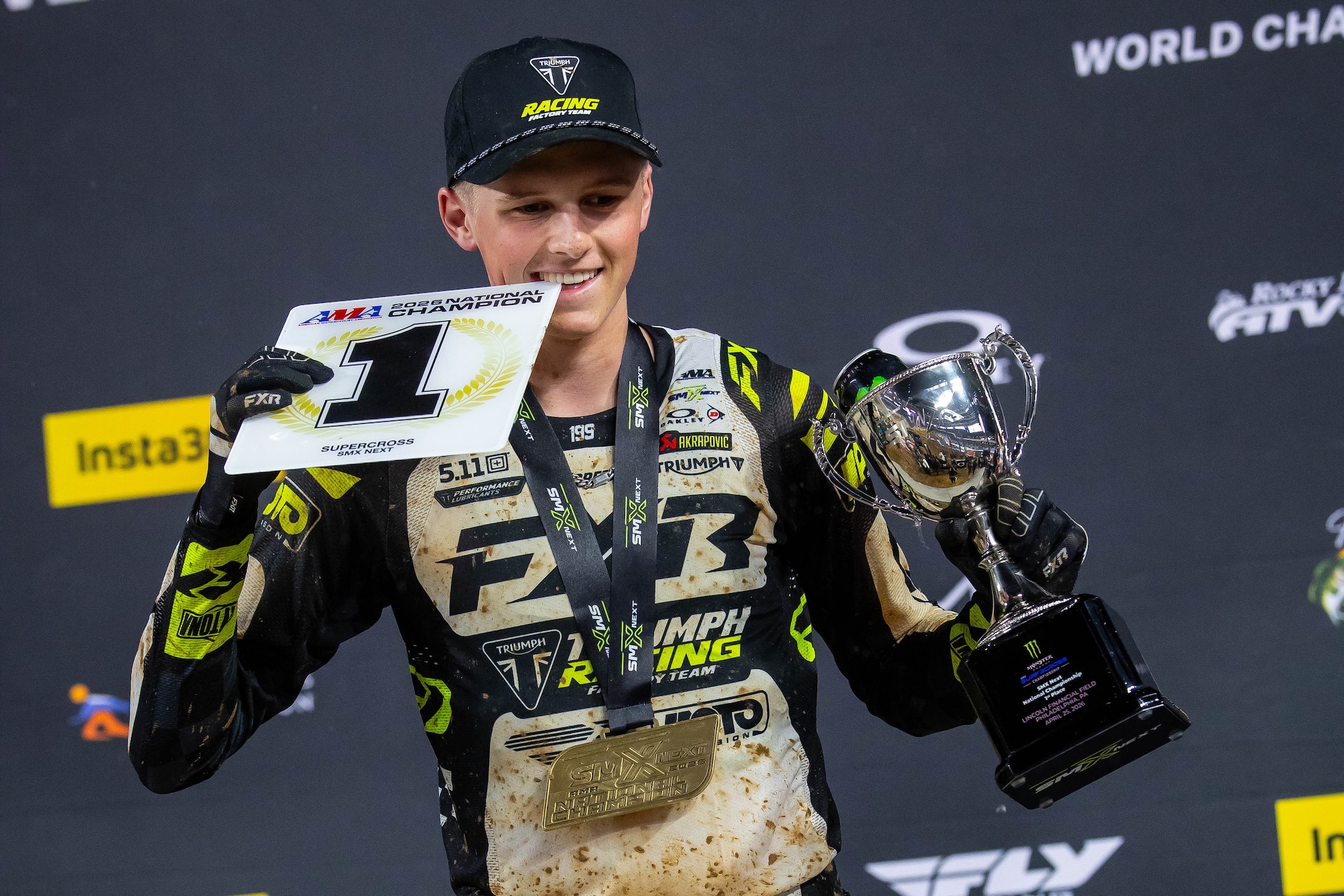
The 6 Minutes + 1 Lap SMX Next – Supercross AMA National Championship Main Event saw the top 18 amateur prospects battle it out in the challenging conditions for a shot at a coveted national title. The action kicked off with the Triumph Factory Racing machine of Deacon Denno out front exiting the first turn, which gave him a clear track to build a gap and assume control of the race. Behind him, Monster Energy Kawasaki Team Green’s Kade Johnson settled into a firm hold of second, while KTM Orange Brigade’s Jeremy Fappani slotted into third. The field quickly spread out as riders navigated the rain-soaked track, with Denno’s lead growing to more than a dozen seconds over the field. The newly turned 18-year-old from Texas kept his Triumph clean and on two wheels and easily completed a wire-to-wire performance by a margin of 9.3 seconds for the biggest win of his budding career. Johnson went unchallenged on the way to a runner-up finish, while Fappani did the same to round out the championship podium in third. Denno, who prevailed at Daytona in March, became the first repeat winner in SMX Next – Supercross this season and was also the only prospect to secure a top five finish at all five races.
Triumph Factory Racing’s Deacon Denno went wire-to-wire to capture the SMX Next – Supercross AMA National Championship.
Deacon Denno – SMX Next – Supercross AMA National Champion “I was just focused on the start. That’s a big part of [racing in] the mud and it’s a big part of any race. I got the rhythms clean and I felt like I rode smooth and calm, which is what you need in the mud. It feels good to make it known I can make it happen anywhere, Daytona, in the mud, wherever I want. A lot of confidence for me heading into the pros.”
The Monster Energy SMX World Championship and Monster Energy AMA Supercross Championship will continue next Saturday, May 2, with Round 16 from Denver’s Empower Field at Mile High. Live comprehensive broadcast coverage will be available exclusively on Peacock, beginning at 1 p.m. ET with Race Day Live, followed by the Gate Drop at 7 p.m. ET. A special encore network presentation will air on NBC on Sunday, May 3, at 2 p.m. ET. Additionally, a domestic Spanish language broadcast is available on Peacock while international viewers can choose from dedicated English, French, and Spanish broadcasts via SMX Video Pass (www.SMXVideoPass.com).
All 17 rounds of the 2026 Monster Energy AMA Supercross Championship and 11 rounds of the Pro Motocross Championship are on sale. Tickets for the SMX World Championship Playoff Rounds and Final are now on sale at SuperMotocross.com. Saturday FanFest will take place at all postseason races, Friday FanFest and camping will be available in Columbus and Ridgedale, additional details to follow.
For information about the Monster Energy SMX World Championship, please visit www.SuperMotocross.com and be sure to follow all of the new SMX social media channels for exclusive content and additional information on the latest news: Instagram: @supermotocross Facebook: @supermotocross X: @supermotocross YouTube: @supermotocross TikTok: @supermotocross
About the Monster Energy SMX World Championship: The Monster Energy SMX World Championship™ is the premier off-road motorcycle racing series in the world that combines the technical precision of stadium racing with the all-out speed and endurance of outdoor racing. Created in 2022, the Monster Energy SMX World Championship Series combines the Monster Energy AMA Supercross Championship and the AMA Pro Motocross Championship into a 28-round regular season that culminates with the season-ending SMX World Championship Playoffs. Visit SuperMotocross.com for more information.
About Monster Energy AMA Supercross Championship: Monster Energy AMA Supercross is the most competitive and highest-profile off-road motorcycle racing championship on the planet. Founded in America and sanctioned by the American Motorcyclist Association (AMA) since 1974. Over 17 weeks, Supercross attracts some of the largest and most impressive crowds inside the most recognizable and prestigious stadiums in North America to race in front of nearly one million live fans and broadcast to millions more worldwide. For more information, visit SupercrossLIVE.com.
About Pro Motocross Championship: The Pro Motocross Championship features the world’s fastest outdoor motocross racers, competing aboard homologated bikes from one of seven competing manufacturers on a collection of the roughest, toughest tracks on the planet. Racing takes place each Saturday afternoon, with competition divided into two classes: one for 250cc machines, and one for 450cc machines. MX Sports Pro Racing, the industry leader in off-road powersports event production, manages the Pro Motocross Championship. For more information, visit ProMotocross.com.
About Feld Motor Sports, Inc.: Feld Motor Sports, Inc. is the worldwide leader in producing and presenting specialized arena and stadium-based motorsports entertainment. Properties include Monster Jam®, Monster Energy AMA Supercross, and the Monster Energy SMX World Championship. Feld Motor Sports, Inc. is a subsidiary of Feld Entertainment, Inc. Visit monsterjam.com, SupercrossLIVE.com, and feldentertainment.com for more information.
About MX Sports Pro Racing, Inc.: MX Sports Pro Racing, Inc., manages and produces the world’s premier motocross racing series – the Pro Motocross Championship, sanctioned by AMA Pro Racing. MX Sports Pro Racing is an industry leader in off-road powersport event production and management, its mission is to showcase the sport of professional motocross competition at events throughout the United States. Through its various racing properties, partnerships and affiliates, MX Sports Pro Racing, Inc., organizes events for thousands of action sports athletes each year and attracts millions of motorsports spectators. Visit MXSportsProRacing.com for more information.
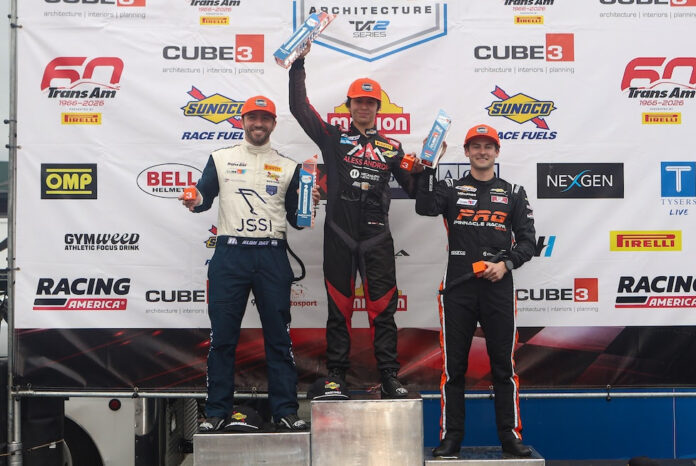
Helio Meza, Alon Day and Connor Mosack Start and Finish 1-2-3; Lanie Buice Takes Western Championship Class, Places Sixth Overall
Overview:
Date: April 25, 2026 Event: Sonoma Doubleheader (Round 3 of 12) Series: Trans Am Series presented by Pirelli Division: CUBE 3 Architecture TA2 Series Location: Sonoma (Calif.) Raceway Layout: 2.52-mile, 11-turn road course Format: 40 laps or 75 minutes
Weather: Cloudy, upper-50s Winner: Helio Meza of TeamSLR
TeamSLR:
● Helio Meza – Started 1st, Finished 1st (Running, completed 40/40 laps)
● Alon Day – Started 2nd, Finished 2nd (Running, completed 40/40 laps)
● Jared Odrick – Started 13th, Finished 11th (Running, completed 40/40 laps)
● Tim Carroll – Started 15th, Finished 20th (Running, completed 40/40 laps)
● John Moore – Started 30th, Finished 30th (Running, completed 38/40 laps)
Noteworthy:
● Meza, the 18-year-old from Houston, is now four-for-four to start his CUBE 3 Architecture TA2 Series career after today’s pole-to-checkered-flag victory. It led TeamSLR’s second consecutive 1-2-3 finish and 10th win in a row, beginning with 15-year-old Tristan McKee’s triumph at the Mid-Ohio Sports Car Course in Lexington last June en route to the 2025 TA2 Series championship. It was also TeamSLR’s third 1-2-3 finish dating back to last June at Road America in Elkhart Lake, Wisconsin. Meza was joined on the podium at the previous round March 14 at Michelin Raceway Road Atlanta by third-place Day and runner-up Andres Perez de Lara, the fulltime NASCAR Craftsman Truck Series driver who was making his first career TA2 Series start with TeamSLR.
● Day, the 34-year-old from Ashdod, Israel, improved one position from his Road Atlanta finish. The four-time NASCAR Euro Series champion made just his third career TA2 Series start Saturday.
● Mosack, the 27-year-old from Charlotte, North Carolina, returned to TeamSLR for the second time this season and the sixth since graduating to the NASCAR and ARCA ranks after fulltime TA2 Series seasons in 2021 and 2022. Saturday’s finish marked his ninth career TA2 Series podium in 41 starts.
● Buice, the 19-year-old from Jackson, Georgia, is a dual entry in this weekend’s field, competing both in the national series and for the first time in the TA2 Western Championship races. Her sixth-place overall finish was best in her five career TA2 Series starts, and was best among the Western Championship competitors in today’s 35-car field, making her the first female driver to win a Western Championship race.
● She moved up two positions on the starting grid for Sunday’s weekend doubleheader nightcap by virtue of the fourth-best overall race lap Saturday. Meza, Day and Mosack logged the top three race laps, respectively, giving TeamSLR a sweep of Sunday’s top four starting spots.
● Odrick, the 2025 TA2 Series Pro-Am Challenge champion, won the class for the second time in three races this season with his 11th-place finish overall in his No. 00 Black Underwear/M1 Racecars Camaro for Troy Benner Autosport. He was also victorious in the March 1 season opener at Sebring (Fla.) International Raceway.
● Two other Western Championship competitors took to the track Saturday in M1 Racecars equipment – Southern Californian Carroll in the No. 46 Carroll Racing Development Ford Mustang, and Northern Californian Moore in the JM Environmental Ford Mustang.
“This feels really good. Man, I don’t even know what to say. This team provides for me day in and day out every weekend, and I just think it all goes to their work ethic. They work so hard – we’re always going super late even when we’re fast, we’re always trying to be better. We know that everyone else is trying to catch up with us, so we can’t get content. We’re working hard, and obviously it showed with a 1-2-3 for TeamSLR, and with Lanie winning the Western Championship race, as well, so congrats to her. It’s a team effort and I can’t thank everyone enough – Alessandros Racing, TeamSLR, Heraldo Media Group, M1 Racecars, all my family from L.A., that came up to watch me, and my brother, Alonso, for coming out. There are a lot of people that make this possible. I’m just the guy that pushes the pedals and turns left and right, so all the credit goes to everyone with me.”
Alon Day, Driver, No. 17 JSSI/SLR-M1 Racecars Chevrolet Camaro:
“This is great. I’m still jet lagging. But, it was pretty good. I mean, I’m very happy for the team, TeamSLR. We did an amazing job. For tomorrow, we are all going to be top-four for start of the race. I want to thank JSSI for giving me the opportunity to be here. We had some of their guests, their employees, here with us today and I was glad that they could be here to celebrate with us. I wish I could do better, challenge Helio a bit, but he’s been doing an amazing job. We will try to be one position better tomorrow.”
Connor Mosack, Driver, No. 48 Friends of Jaclyn/Guthrie’s Garage/SLR-M1 Racecars Chevrolet Camaro:
“I’m speechless. There are a couple of people I really need to say thanks to. First of all, JSSI for giving me the opportunity to be here. Without them, I wouldn’t be here. And TeamSLR, I mean, they worked really hard. Yesterday, we had a bad crash in practice and I couldn’t qualify, and so that’s the reason why I started from the back. Those guys, each one of them, they did a hell of a job giving me a fighter jet. That’s what it felt like.”
Lanie Buice, Driver, No. 27 Sunoco/Guthrie’s Garage/SLR-M1 Racecars Chevrolet Camaro:
“That was a lot of fun. I cannot thank TeamSLR enough, and Chevrolet and Sunoco Race Fuels and Guthrie’s Garage for the opportunity to be out here. Everybody just gave me a really good car this weekend and I’m just super grateful. Congrats to my teammates – they’re all top-three and it’s really cool to see. I’m just super proud to be a part of this. That was my first Western start, and I can’t wait to see what we can do while we’re running for that championship. My door came off on the first lap, I don’t really know what happened there. It didn’t affect me and everything turned out fine. Apparently, I didn’t really need the door. I guess you could say that I blew the door off of it (laughs).”
Next Up:
Round four of the 2026 Cube 3 Architecture TA2 Series is the second race of this weekend’s Sonoma doubleheader Sunday. The 40-lap, 75-minute race around the 2.52-mile, 11-turn circuit is set for 5:10 p.m. EDT. Live streaming video will be provided by RacingAmerica.tv and the @GoTransAm page on YouTube.
About TeamSLR:
TeamSLR (Scott Lagasse Racing) competes fulltime in the Trans Am Series presented by Pirelli in a multifaceted effort that includes dedicated entries in the TA2 division, customer programs, driver coaching and car construction. Its history dates back to 1985 and covers a wide spectrum of motorsports, including NASCAR, IMSA, SCCA, ARCA and ASA. TeamSLR is a family-owned organization run by Scott Lagasse Sr., and Scott Lagasse Jr. The father-and-son duo have combined to win more than 130 races and 10 championships across a variety of series and styles of racecars, from paved ovals to road courses to dirt tracks. TeamSLR would like to thank its supporters CUBE 3 Architecture, Franklin Road Apparel, Kallberg Racing, and Guthrie’s Garage. For more information, please visit us online at www.TeamSLR.com, on Facebook, on Twitter, on Instagram and on LinkedIn.
About M1 Racecars:
M1 is an Official Chassis Supplier to the Trans Am Series presented by Pirelli. M1 Racecars are professionally engineered for the Cube 3 Architecture TA2 Series, SCCA Competition, and Track Day events. We offer chassis only, rolling chassis and complete race-ready builds in Camaro, Mustang, and Challenger body styles. We utilize only the highest quality materials and our race-winning technology to produce the most stable and predictable racecar on the track today. The proprietary chassis design by M1 has been CAD-perfected by our engineering staff to ensure that each completed chassis is identical and performs as expected. Our chassis materials are CNC Mandrel bent and cut to our exacting standards, which results in the most precise and cost-effective build. M1 has selected Scott Lagasse Racing to be the exclusive distributor for M1 Racecars worldwide. The race team also provides M1 with vital technical assistance and on-track feedback to support our performance development efforts. This combination is a powerful asset to M1 and to every M1 customer.
Jesse Love and the No. 2 Whelen Chevrolet Team Lead Laps and Earn Top-10 Result at Talladega Superspeedway
Finish: 7th Start: 1st Points: 3rd
“For some reason, we didn’t have a bubble on our No. 2 Whelen Chevrolet this weekend, like we normally do. Nobody could get to my bumper, and I couldn’t get to theirs, and if I did try to get help, all I did was slow the mile per hour down and not really get a hook up or connection. I’m definitely puzzled, but we’re going to focus on being better. I’m really confident in everybody at RCR and ECR back in Welcome that after this weekend, we’ll put our heads together and not reinvent the wheel, but rethink our strategy, and I think that we can give and take. At the end of the day, I feel like if me and Austin (Hill) have what we need in the pack, we’re going to be tough to beat, and I just feel like we didn’t have it today for some reason.” -Jesse Love
Austin Hill and the No. 21 Bennett Transportation & Logistics Team Rebound for 13th-Place Finish at Talladega Superspeedway
Finish: 13th Start: 6th Points: 8th
“Man, it feels like everything that can go wrong for our No. 21 team is going wrong right now. Our Bennett Transportation & Logistics Chevrolet fired off loose on entry, but Chad (Haney, crew chief) and the guys got the balance tightened up so I could take pushes and stay closed up to the guy in front of me. It felt fine when we were leading the pack, but the runs were building and coming very fast today. During our green flag stop, I stalled the car leaving the box and that cost us a ton of track position. Unfortunately, the race went caution free from that point and we didn’t get a break. That’s our luck right now but I’m proud to be a part of this group and I believe we would have had a shot at the win otherwise.” -Austin Hill
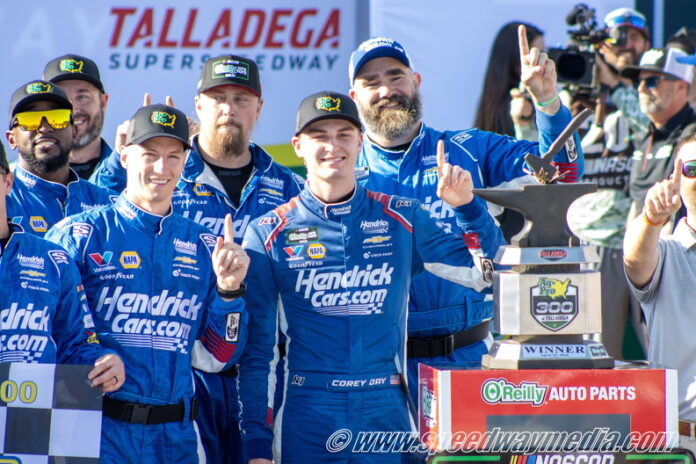
Corey Day reigned supreme when it mattered most as he outdueled the competition on the final lap to score his first NASCAR O’Reilly Auto Parts Series career victory in the Ag-Pro 300 at Talladega Superspeedway on Saturday, April 25.
The 20-year-old Day from Clovis, California, led the final lap of a 113-lap thriller in an event where he qualified in third place and spent the majority of the event battling towards the front amid the draft with his fellow competitors. Despite securing no stage points by not finishing in the top-10 mark through the event’s first two stages, Day positioned himself for victory by navigating his way into the runner-up spot with four laps remaining.
Then on the final lap, Day, who was in the middle of a three-wide battle for the lead that involved Sam Mayer and Sheldon Creed, muscled ahead of both to lead through the first two turns. Day’s first O’Reilly victory was sealed as two separate carnages from the backstretch and through Turns 3 and 4 ignited. This drew a race-winning caution and allowed Day to cap off a strong start to his rookie O’Reilly campaign with a first-ever trip to Victory Lane in the O’Reilly division.
With on-track qualifying that determined the starting lineup occurring on Friday, April 24, Jesse Love claimed the pole position with a pole-winning lap at 182.313 mph in 52.525 seconds. Sam Mayer started alongside Love on the front row with a qualifying lap at 182.168 mph in 52.567 seconds.
Before the event, Ryan Ellis was the only competitor who dropped to the rear of the field. This was due to unapproved adjustments on his No. 02 Young’s Motorsports Chevrolet entry.
When the green flag waved and the event commenced, pole-sitter Jesse Love signaled and received a push from Corey Day from the inside lane to jump ahead of Sam Mayer and the field entering the first two turns. As the field navigated through the early portions of the backstretch, the event’s first caution flew. Patrick Staropoli, racing towards the top-15 mark, was bumped by William Sawalich and turned head-on into the outside wall. Staropoli’s damaged entry then veered back across the track and through oncoming traffic, with David Starr sustaining damage after hitting Staropoli. At the same time, newcomer Tyler Ankrum ran into the rear of Starr.
The start of the next restart on the fourth lap featured Love receiving another strong push from the inside lane, this time by Mayer through the first two turns. As Love started to gap the field, he veered to the right to block a run by Day from the outside lane through the backstretch. With the field fanning out to three lanes entering Turns 3 and 4, Love led the next lap over a hard-charging Mayer as Mayer darted to the outside lane with lots of momentum.
Just past the fifth lap mark, the field had fanned out three lanes deep as Carson Kvapil stormed to the lead ahead of a three-wide action that involved teammate Sammy Smith, Mayer, and Love. Love then spent the sixth lap mark battling alongside Kvapil and in front of the field that had stacked up three lanes deep before he muscled ahead to lead the seventh lap. Despite having to race defensively while veering right and left to both gain and stall any momentum from his competition. Love continued to lead at the Lap 10 mark over Kvapil, Day, Mayer, and Sheldon Creed, respectively.
Through the Lap 15 mark, Mayer, who has led since Lap 12 and was holding strong while leading the inside lane, was also leading the event ahead of Sammy Smith, Love, Kvapil, and Rajah Caruth while Creed, Day, Austin Hill, Jeremy Clements, and Justin Allgaier were racing in the top 10, respectively. Kvapil, Love and Mayer each took turns swapping and leading at least a lap from Laps 16 through 24.
When the first stage period concluded on Lap 25, Kvapil, who had led since Lap 23, edged teammate Sammy Smith by 0.005 seconds to record his first stage victory of the 2026 season. Creed, Caruth, Thompson, Blaine Perkins, Mayer, Harrison Burton, Love, and Clements were in the top 10, respectively. Austin Hill, Gray, Day and Allgaier were mired within the top-15 mark. By then, the event featured eight lead changes for three different leaders
Under the event’s first stage break period, the field led by Kvapil pitted for the first time while JJ Yeley, Lavar Scott, Joey Gase, Ryan Ellis, Dawson Cram, and Natalie Decker remained on the track. Following the pit stops, Kvapil exited pit road first. Love, Jones, Harrison Burton, Hill, Sammy Smith, Gray, Thompson, Day, and Crews followed in the top-10. Not long after, Yeley, Scott, Gase, Ellis, Cram, and Decker all pitted under caution, and it cycled Kvapil back to the overall lead of the event.
The second stage period started on Lap 31 as Kvapil and Harrison Burton occupied the front row in front of Love, Hill, Jones and Sammy Smith. At the start, Kvapil and Burton dueled for the top spot entering the first two turns until Hill pushed Burton ahead of Kvapil and to the lead from the outside lane. The rest of the field, led by the drafting duo of Kvapil and Smith, caught back up to Hill and Burton through the backstretch. As the field fanned out through the tri-oval, Kvapil managed to lead the next lap. With the field fanning out to three-wide formation over the next three laps, Love cycled back to the lead on Laps 33 and 34 until Hill assumed command for the next three laps.
At the Lap 40 mark, Justin Allgaier, who trailed his teammate and the leader, Sammy Smith, during the previous two laps, led his first lap of the event while mired in a three-wide battle with his teammates Smith and Kvapil. Kvapil would then lead the next nine laps as he received a strong run from the outside lane to motor ahead of Allgaier and the field by Lap 41.
When the second stage period concluded on Lap 50, Allgaier made a move to teammate Kvapil’s left side entering Turns 3 and 4 to assume the lead and capture his fourth stage victory of the 2026 season. Ryan Sieg, Creed, Thompson, Retzlaff, Kvapil, Harrison Burton, Clements, Austin Green and Hill settled in the top 10, respectively. Jeb Burton, Caruth, Gray, Day, Love, Mayer and Sammy Smith were mired in 11th, 12th, 14th, 15th, 18th, 21st and 23rd, respectively. By then, the event had featured 18 lead changes with seven different leaders. Thirty-six of 38 starters were on the lead lap.
During the event’s second stage break period, nearly the entire field led by Allgiaer pitted while Yeley, Lavar Scott, Decker, Emerling and Cram remained on the track. Following the pit stops, Sawalich jumped 12 spots to exit pit road first ahead of Ryan Sieg, Creed, Gray, Jeb Burton and Thompson. Once Yeley, Scott, Decker, Emerling and Cram pitted, Sawalich cycled to the lead.
With 56 laps remaining, the final stage period commenced as Gray and Jeb Burton occupied the front row in front of Austin Hill, Parker Retzlaff, Crews and Mayer. At the start, Burton capitalized on a push by Hill from the outside lane to storm ahead through the first two turns. The rest of the field caught back up to Hill and Burton amid the draft. Gray, who was hit on the right side by teammate Crews entering Turn 3, drew alongside Burton from the inside lane. Burto, however, managed to lead the next lap by 0.003 seconds. As the field raced in three-wide formation, Burton, Gray and Austin Green each took turns leading at least a lap over the next five laps before Creed led with 50 laps remaining.
Then, with 44 laps remaining, a wave of green flag pit stops commenced as Love, Hill, Jeb Burton, Austin Green, Parker Retzlaff and Anthony Alfredo pitted their respective Chevrolet entries. As Rajah Caruth cycled to a brief lead, Toyota competitors Gray, Brandon Jones, Dean Thompson and Crews pitted. Sawalich received a penalty for speeding while entering pit road. During Sawalich’s speeding penalty, he locked up his front tires and barely hit the right front of Crews while threading his way through a tight opening in between Crews and Jones.
With 40 laps remaining, Caruth led 14 competitors down to pit road for service under green. Unfortunately, Caruth received a penalty for speeding on pit road. With a majority of the field having made a pit stop, six competitors led by Brennan Poole and including Garrett Smithley, Lavar Scott, Josh Bilicki and Mason Maggio have yet to pit. This was despite all of them cycling to the front and being more than 30 seconds ahead of sixth-place Creed. Once Poole, Smithley, Scott, Bilicki and Maggio pitted with 37 laps remaining, Creed and the rest of the field that had pitted earlier than the latter five zipped by all, with Creed cycling to the lead over Love, Alfredo, Mayer, Jeb Burton and Kvapil with 35 laps remaining.
A lap prior to Creed cycling back to the lead, teammates Kvapil and Allgaier received a penalty for violating NASCAR’s blend line rules. that involved moving up in front of the field through the backstretch following a pit service, which caused the field, including Love, to split and avoid contact. As a result, they both dropped out of the top-30 mark and trailed the lead by 20-plus seconds. Meanwhile, Love, who returned atop the leaderboard with 34 laps remaining, was leading over Clements, Sammy Smith, Perkins, Ryan Sieg and Jeb Burton with 30 laps remaining.
Through the next 14 laps and with the competition at the front becoming dicey, Sammy Smith and Love primarily led, with Love taking command with 29 laps remaining and driving defensively amid the draft. With 16 laps remaining, Mayer was battling Creed for the runner-up spot and trying to reel in Love. However, he got turned sideways off the front nose of Retzlaff through the first two turns. But he managed to straighten his entry below the apron and proceed without drawing a caution.
Then after the front-running field spent the next handful of laps racing in single-line formation, the field started to fan out with less than 10 laps remaining as Love led Creed, Ryan Sieg, Perkins, Thompson and Jeb Burton. Creed then executed a bold move to Love’s outside with six laps remaining through the first two turns. As a result, Love was pinned in the middle and dropped back with no drafting help, as Jeb Burton tried to draw alongside Creed for the lead. With Creed leading the next two laps, Corey Day came storming to the front as he battled and overtook Burton for the runner-up spot, while Mayer and Sammy Smith also reeled in.
When the white flag waved and the final lap started, Creed, who was stacked up in a tight three-wide battle for the lead with Day and teammate Mayer a lap prior, was barely ahead over Mayer and Day in three-wide formation through the frontstretch and through the first two turns. Then as Day muscled and moved in front of Creed while trying to fend off Mayer from the inside lane entering the first half of the backstretch, Mayer was sent for a spin by Sawalich towards the backstretch’s infield. Shortly after, Jeb Burton, who scraped the outside wall entering Turn 3 while trying to surge to the front, was involved in a vicious multi-car wreck that involved Ryan Sieg, Harrison Burton and Blaine Perkins.
The caution then flew as Day led the field and approached the frontstretch’s ti-oval. The event officially concluded under caution and Day was awarded the win. He cycled back to the finish line to claim his first checkered flag in the series.
With the victory, Day became the 184th competitor overall to win in the NASCAR O’Reilly Auto Parts Series division, the third first-time winner of the 2026 season and the eighth to record a first O’Reilly career victory at Talladega.
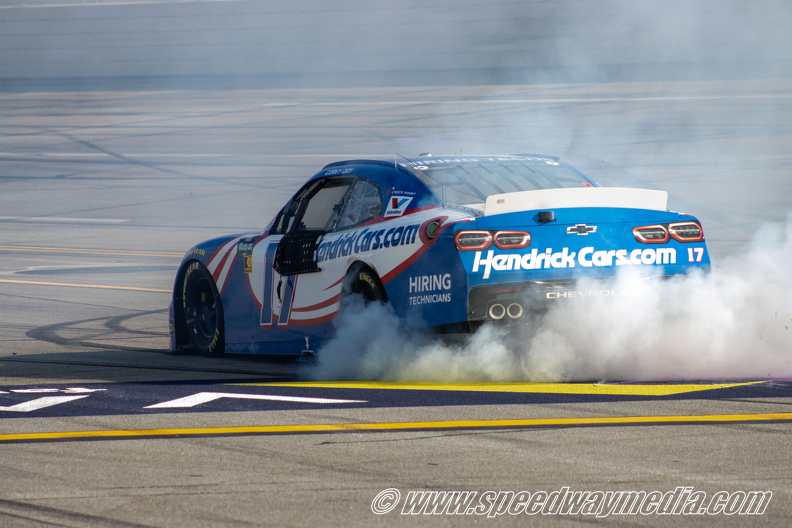
Day also recorded the 28th O’Reilly career victory for Hendrick Motorsports, the organization’s first in the series at Talladega, the fifth for the No. 17 HendrickCars Chevrolet entry and the third for crew chief Adam Wall. The victory was a notable one as Jason Kelce, a former NFL center and Super Bowl champion, served as Day’s crew member for the event.
Photo by Logan Allen for SpeedwayMedia.com.
“I sure as hell didn’t think [my first win] would be at a superspeedway,” Day said in Victory Lane on the CW Network. “It’s awesome. The Hendrick Legacy is so strong at superspeedways. My No. 17 guys just build me a rocket ship. Hats off to [crew chief] Adam [Wall]…everyone back at the shop that builds these things every week for me. I feel like we’ve been close. [I] Had a good day at Rockingham and had a couple of other good days, and just didn’t finish it off. It’s super cool.”
“I thought when I got shucked to the middle there with five to go or whatever it was, that was it and I was gonna drop,” Day added. He continued, saying, “I had help. I don’t know who it was, but thank you, whoever it was. Just so cool. Thank you, Mr. Hendrick, so much for believing in a sprint car kid from California that never ran a pavement car in his life before two years ago. It’s so much fun.”
While Day celebrated a first victory on the track, Sheldon Creed was also victorious. He notched his second $100,000 bonus from the Dash 4 Cash program by being the highest-finishing contender during Saturday’s Talladega event over Jesse Love, Justin Allgaier and Taylor Gray.
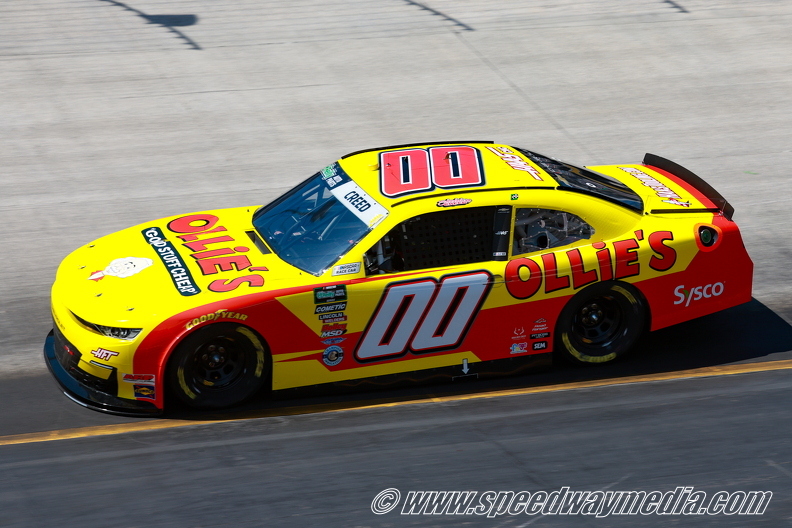
Photo by Chad Wells for SpeedwayMedia.com.
“A really good day,” Creed said. “Obviously, [I] was leading there at the end and maybe just got too far out a couple of times. I thought I missed a good block down the backstretch to [Jeb Burton] to maybe propel me next to [Day]. Obviously, you’re not expecting them all to crash and then, I’m looking at my mirror as they are. It didn’t look like I was gonna build a run to him, but just thankful for O’Reilly’s for doing this Dash 4 Cash. To win two of them back-to-back is awesome for our team. Shoutout to everyone back at the shop for building really good race cars. Just try to keep the ball rolling here.”
Creed will square off against Day, Brent Crews and Sammy Smith for the fourth and final Dash 4 Cash bonus of the 2026 season next Saturday at Texas Motor Speedway.
Brent Crews notched a career-best runner-up result behind Day and over Creed at Talladega. Sammy Smith and Jeremy Clements finished fourth and fifth, respectively. Dean Thompson, Jesse Love, Brandon Jones, Parker Retzlaff and Austin Green completed the top 10 in the final running order, respectively.
There were 38 lead changes for 16 different leaders. The event featured four cautions for 15 laps. In addition, 24 of 38 starters finished on the lead lap.
Following the 11th event of the 2026 NASCAR O’Reilly Auto Parts Series season, Justin Allgaier, who finished 23rd at Talladega following his blend line violation, continues to lead the standings by 105 points over Sheldon Creed, 141 points over Jesse Love, 145 points over Corey Day, and 191 points over Brandon Jones.
Results:
Corey Day, one lap led
Brent Crews
Sheldon Creed led seven laps
Sammy Smith led six laps
Jeremy Clements
Dean Thompson
Jesse Love, 37 laps led
Brandon Jones
Parker Retzlaff
Austin Green led for five laps
JJ Yeley led for two laps
Blaine Perkins
Austin Hill led for three laps
Josh Bilicki
Brennan Poole led for three laps
Patrick Emerling
Mason Maggio
Kyle Sieg
Joey Gase
Garrett Smithley
Ryan Sieg
Carson Kvapil, 22 laps led, Stage 1 winner
Justin Allgaier, four laps led, Stage 2 winner
Lavar Scott, one lap led
Sam Mayer – OUT, Accident, eight laps led
Jeb Burton- OUT, Accident, two laps led
Harrison Burton – OUT, Accident, one lap led
William Sawalich, one lap down
Taylor Gray, one lap down, six laps led
Rajah Caruth, one lap down, five laps led
Anthony Alfredo, one lap down
Tyler Ankrum, one lap down
Natalie Decker, one lap down
Dawson Cram, one lap down
Josh Williams, one lap down
Ryan Ellis, two laps down
Patrick Staropoli, eight laps down
David Starr – OUT, Overheating
Next on the 2026 NASCAR O’Reilly Auto Parts Series schedule is the Andy’s Frozen Custard 340 at Texas Motor Speedway in Fort Worth, Texas. The event is scheduled for Saturday, May 2, and will be broadcast at 3:30 p.m. ET on the CW Network, PRN, and SiriusXM.
CREWS, THOMPSON SET NEW CAREER-BESTS AT TALLADEGA Three top-10s in a strong showing for Team Toyota
TALLADEGA, Ala. (April 25, 2026) – Brent Crews and Dean Thompson both set new career-bests at Talladega Superspeedway in the NASCAR O’Reilly Series race on Saturday evening.
Crews, who finished a career-best second, has three consecutive top-five finishes, while Thompson (sixth) delivered a career-best points total as the California-native earned 44 points today due to strong stage finishes. Brandon Jones (eighth) added a third Toyota GR Supra inside the top-10 as the highest-ranking Toyota driver in points scored his third top-10 in the last four races.
TOYOTA RACING Post-Race Recap NASCAR O’Reilly Auto Parts Series (NOAPS) Talladega Superspeedway Race 11 of 33 – 300.58 miles, 113 laps
TOYOTA FINISHING POSITIONS
1st, Corey Day*
2nd, BRENT CREWS
3rd, Sheldon Creed*
4th, Sammy Smith*
5th, Jeremy Clements*
6th, DEAN THOMPSON
8th, BRANDON JONES
27th, HARRISON BURTON
28th, WILLIAM SAWALICH
29th, TAYLOR GRAY
*non-Toyota driver
TOYOTA QUOTES
BRENT CREWS, No. 19 Mobil 1 Toyota GR Supra, Joe Gibbs Racing
Finishing Position: 2nd
What did you learn today, and how excited are you to go to Daytona?
“I don’t know. It was a lot of fun, and not driving with my eyes closed was easy, but trying to pick a lane – it’s impossible out there, but it is a lot of fun. The whole 19 team – the 19 Mobil 1 Toyota GR Supra was fast it could be. I learned a lot there at the end. We had damage and was able to go up there and build runs and to wind up second was super cool. Happy to be here, thanking the Good Lord for keeping us safe today. It was pretty hectic out there, but I had a lot of fun.”
The Toyotas have had some struggles here at Talladega. Where did you feel like your car had some strengths today?
“Honestly, everywhere. It had great power everywhere. I felt like I could suck up when I wanted to. I think my only critique was when I had a little damage – I could hear the air. I could feel it, I could see it, but other than that, it was really good.”
DEAN THOMPSON, No. 26 Thompson Pipe Group Toyota GR Supra, Sam Hunt Racing
Finishing Position: 6th
Stellar day at Talladega. Top-10 in both stages, and another top-10 finish. How was your race?
“Yeah, just really proud of my guys. I feel like I’m just the lucky guy holding the steering wheel. This is a testament to the work that Kris Bowen (crew chief) and this 26 team have put into this race car, and I’m just blessed to be driving this Thompson Pipe Group, One TPG Toyota GR Supra. It was just wicked fast. From two years ago, when I first raced with them, it felt like a top-15 was a big day for us, and now we are bummed out that we didn’t get a win. I think it’s a huge testament to the work these guys have put into this race car.”
BRANDON JONES, No. 20 Menards/Charbroil Toyota GR Supra, Joe Gibbs Racing
Finishing Position: 8th
Clean day and you finished inside the top-10. Can you talk about your finish?
“Top-10 is kind of borderline a win at these tracks. It is so hard to get to the end of them. I have seen this race, this first race specifically, do this a few times, where in that last stage – the energy picks back up, and you can see it go green at the end like it did. A couple of guys at the end had a couple of wrecks – but nothing to take a lot of cars out with it. Just tried to be smooth all day with it – it is so hard at this race track. It stalls all three lanes out, especially when you have certain cars moving around and blocking each lane, so I was like, I don’t think there is any way I can get up there for stage points. I was trying to use my knowledge of this track and try to use some discipline – if I can’t get my points, then let’s just bail and go to the back. I’ve watched some really good cars do that. I’ve watched Denny Hamlin and some smart racers in the Cup Series make that decision, and it is kind of hard. You don’t want to give up track position, but you know at the right time, if you get in the right lane, you can surge and get back up to the front too. Just tried to be smart all day with our Menards, Charbroil GR Supra. I just wanted to make it to the end, and sometimes you can get a bunch of wrecks at the end, and it nets out, but it is still nice to get a top-10 and finish, and come out of here with some momentum, especially after Kansas was so strong. That penalty hurt so bad, but it was nice to still know we had winning speed and get a top-10 here, so I’m excited to take it to Texas next week.”
About Toyota
Toyota (NYSE:TM) has been a part of the cultural fabric in North America for nearly 70 years, and is committed to advancing sustainable, next-generation mobility through our Toyota and Lexus brands, plus our more than 1,800 dealerships.
Toyota directly employs nearly 64,000 people in North America who have contributed to the design, engineering, and assembly of nearly 49 million cars and trucks at our 14 manufacturing plants. In spring 2025, Toyota’s plant in North Carolina will begin to manufacture automotive batteries for electrified vehicles. With more electrified vehicles on the road than any other automaker, Toyota currently offers 31 electrified options.