When Hungarian players explore options outside the locally licensed market, one number follows them everywhere: RTP. Most see it as a guarantee. Few understand what it actually measures. As someone who has spent years analyzing game mathematics, I want to explain why Return to Player is not a promise of profit but a tool for informed decisions. Understanding it changes how you approach every session at foreign online casinos.
Laszlo Kovacs’s View on the Importance of RTP
RTP in foreign online casinos describes how much of all money wagered on a game is returned to players over a very large number of rounds. A slot with 96% RTP theoretically pays back 96 forints for every 100 wagered, across millions of spins. The remaining 4% is the house edge, which is how the casino generates revenue.
I have spent years working with foreign online casinos data, and the resource I built – casinostrider-hu.com – is designed precisely to give Hungarian players transparent, verified information on international game catalogs. Players who understand RTP before choosing a platform make significantly fewer costly mistakes.
RTP and the Player’s Real Chance of Winning in Foreign Casinos
Understanding RTP in practical terms requires looking at two factors: the percentage itself and the game’s volatility. A slot with 96% RTP and low volatility pays out frequently in small amounts. The same 96% RTP with high volatility may produce hundreds of losing spins before a larger payout appears. The mathematical expectation is identical on paper, yet sessions feel completely different.
To make this difference even clearer for Hungarian players, here is a visual comparison of typical payout patterns in low, medium, and high volatility slots with the same 96% RTP.
Kovács László’s personal advice: From my own experience reviewing thousands of player sessions on casinostrider-hu.com, I always recommend starting with low-volatility games when your bankroll is under 50,000 HUF — it keeps the session enjoyable and dramatically reduces the risk of quick, frustrating losses.
This is why two players at the same game with the same real chance of winning can leave with entirely different results. The math is the same. The variance is not.
Long-Term and Short-Term Results
The difference between long-term results and short-term results is at the heart of every RTP misunderstanding. Mathematical expectation operates over millions of game rounds, not 50 or 500 spins. A game with 97% RTP does not owe you 97% back in a single session.
Based on my experience, players who expect RTP to “self-correct” within a session consistently overextend their bankrolls. Even a high-RTP game can produce losing streaks lasting several hours. The math is correct in the long run. Your session is not the long run.
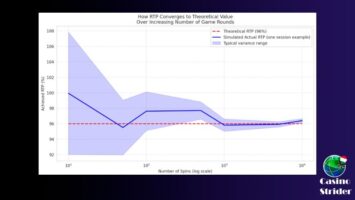
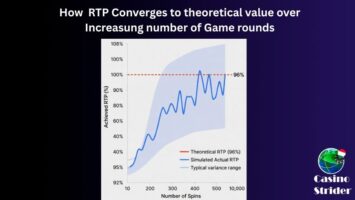
The following graph, based on my own simulations of millions of virtual rounds, shows exactly how the actual RTP approaches the theoretical value as the number of spins increases.
Kovács László’s personal advice: From my own experience analyzing foreign casino data, the biggest mistake I see Hungarian players make is expecting RTP to “self-correct” within a single session. Always treat every session as completely independent and set a strict loss limit before you start playing — this one rule has saved my readers more money than any high-RTP game ever could.
Laszlo Kovacs’s Explanation of the Calculation of RTP in Online Casinos
The RTP calculation in online casinos begins at the development stage. When a provider like NetEnt or Pragmatic Play builds a slot, their mathematicians design the paytable so that the total expected return equals a specific percentage, embedded in the code before anyone plays.
RTP Levels in Foreign Online Casinos
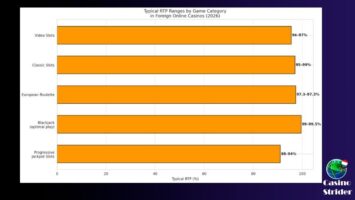
The table below shows typical RTP ranges by game category at reputable foreign online casinos in 2026:
Game Category
Typical RTP Range
Notes
Video slots
94%–97%
Varies by provider and title
Classic slots
95%–99%
Mega Joker by NetEnt reaches 99%
European Roulette
97.3%
Fixed by game rules
Blackjack (optimal play)
99%+
Strategy-dependent
Progressive jackpot slots
88%–94%
Part of RTP feeds the jackpot pool
For a faster visual overview of these RTP ranges, here is a chart summarizing typical values by game category at reputable foreign online casinos in 2026.
Foreign operators licensed by the MGA are generally required to offer games with a minimum RTP of 92%. In practice, most competitive platforms exceed this floor, with the majority of their slot catalogs sitting between 95% and 97%. Hungarian players will find that international catalogs include a far wider range of certified titles than the locally licensed market under SARA oversight.
Laszlo Kovacs’s Interpretation of High and Low RTP
From a practical standpoint, I draw the line of acceptable Return to Player differently by game type. For video slots, anything below 95% is low RTP. Between 96% and 97% is a solid standard range, and titles above 98% represent exceptional value. For table games, my threshold is higher: a blackjack or roulette variant below 97% is a meaningful concession. The legújabb online kaszinó válogatás at international platforms typically includes both categories.
Laszlo Kovacs’s Advice on Player Strategy Based on RTP
RTP should inform your game selection, not guarantee your outcome. My personal recommendations come down to three principles: choose games with verified RTP, match volatility to your bankroll, and set realistic session goals. Always verify the RTP in the game’s information menu before playing.
Players who notice any signs of losing control over their habits can benefit from completing a self-assessment questionnaire before their next session.
Choosing a Game and Bankroll According to RTP in Foreign Online Casinos
Here is a practical checklist based on RTP and volatility:
Check the certified RTP in the game’s info menu before playing.
Match volatility to your budget. High-volatility games need at least 100-200x your bet size in reserve.
Set a session loss limit at 20-30% of your total budget and stop when you reach it.
Prefer low-to-medium volatility for extended play time with lower variance.
Learn basic strategy for table games – without it, effective RTP drops significantly.
Accept lower RTP selectively, only when the entertainment value justifies the mathematical cost.
Every player benefits from understanding the warning signs of problematic gaming behavior – recognizing them early is just as important as any bankroll rule. No RTP strategy works if a player has already lost control over session limits or spending patterns.
Final Recommendation from László Kovács:
After years of analyzing game mathematics and player behavior across dozens of foreign online casinos, my strongest advice remains simple yet powerful: treat RTP as a decision-making tool, not as a promise. Always choose verified games with RTP of 96% or higher when possible, match the volatility to your current bankroll and playing style, and never forget that the real edge comes from discipline rather than chasing “hot” slots.
Fear of the unknown holds more people back than any real obstacle ever does. A new job, a new city, even trying something different — it all sets off the same alarm in the head. The brain loves what it knows. Back in the day, that kept people alive by spotting danger early. These days, there’s no predator in the bushes, but the wiring hasn’t changed.
Learning to spot that reaction — and dial it down — is what cracks open doors that have been shut for years.
Why New Things Feel Terrifying
The human brain processes uncertainty as a direct threat. When facing an unfamiliar situation, the amygdala activates the same fight-or-flight response triggered by physical danger:
Heart rate increases
Palms sweat
The mind races through worst-case scenarios
This reaction kept ancestors alive but now prevents reasonable risks.
Several specific worries appear repeatedly among people trying something new. Making a mistake that looks stupid tops the list. Losing money or resources permanently follows close behind. Not understanding the rules quickly enough creates its own anxiety, and looking incompetent to other people adds social pressure on top of everything else.
These worries feel real because the brain cannot distinguish between social danger and physical danger. A mistake that costs money triggers the same neural pathways as a predator attack. The good news is that this response can be trained just like any other habit.
How to Start Without the Fear
The online casino world sees this pattern constantly. New players often freeze before their first session because they worry about clicking the wrong button or losing money without understanding the rules.
Checking no-deposit-casino-nz.online/20-free-chip-no-deposit-bonus shows exactly how low-risk entry points work for cautious beginners. A $20 no deposit bonus NZ allows someone to explore the interface without spending personal funds.
Learning the rules removes most of the fear. Every platform publishes its terms somewhere obvious. Reading them takes ten minutes and prevents ninety percent of beginner mistakes.
A $20 no deposit bonus NZ real money keeps winnings as actual cash rather than locked credits. This transparency builds trust between the player and the platform.
Contacting customer support before playing answers any remaining questions. Support teams exist specifically to help newcomers who feel uncertain about buttons, bets, or withdrawal processes.
Even a $20 no deposit bonus NZ free spins teaches valuable skills. Timing, patience, and rule following all improve with each small interaction. The fear disappears once the first session ends without disaster.
Small Steps Quiet the Alarm
The most effective way to reduce fear of the unknown involves taking tiny actions before attempting anything large. A person afraid of public speaking does not start with a stadium crowd. They practice in front of a mirror, then one friend, then a small group.
Breaking any unfamiliar activity into microscopic steps achieves two things. Each small success builds evidence that disaster will not strike. The brain gradually rewires its threat assessment based on actual outcomes rather than imagined catastrophes.
A person who never changes jobs stays in a role that underpays them by thousands per year
Someone who never invests keeps cash in a savings account that loses value to inflation
The person who never tries anything unfamiliar misses opportunities they never knew existed
Research on regret consistently shows one pattern. Older people regret the risks they did not take far more than the mistakes they made. A failed attempt teaches lessons. A missed chance teaches nothing except how to wonder what might have happened.
Reading Rules Changes Everything
Most fear kicks in when there’s no clue how something actually works. A dark room feels worse than a lit one because the brain fills the blanks with all sorts of nonsense. Same deal with anything unfamiliar. Read the instructions, and the mystery disappears — replaced by something you can follow step by step.
Every platform, game, or service lays out the rules somewhere. Finding them takes five minutes. Understanding them takes another ten. That quarter hour eliminates ninety percent of beginner mistakes and the anxiety that comes with them.
Asking questions works even better than reading alone. Customer support exists precisely to help confused newcomers. A quick message saves hours of frustration and prevents errors that could have been avoided.
Asking for Help Is Not Weakness
Plenty of people won’t ask questions because they don’t want to look stupid. That alone keeps them stuck longer than any real problem. Everyone starts from zero. The gap between someone new and someone experienced usually comes down to how many questions they’ve actually asked.
Support teams, forums, and help sections are there to be used. Ignoring them just slows everything down.
A person who asks for clarification before acting avoids mistakes that someone too proud to ask will definitely make. The smartest people in any field are usually the ones who asked the most basic questions early on.
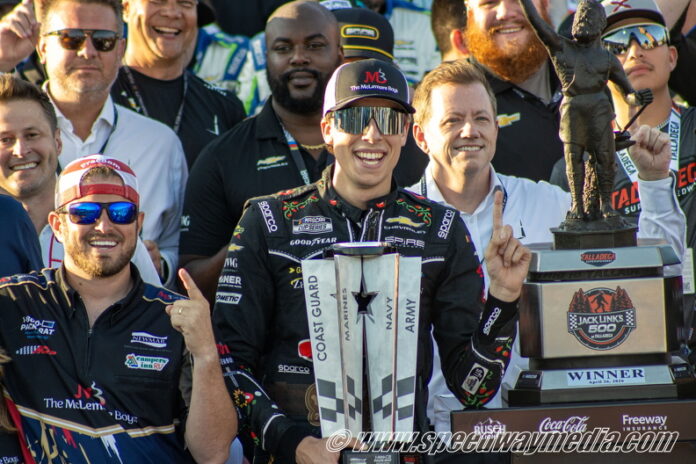
Carson Hocevar elevated his racing status to new heights and became a first-time NASCAR Cup Series race winner after winning the Jack Link’s 500 at Talladega Superspeedway on Sunday, April 26.
The 23-year-old Hocevar from Portage, Michigan, led eight times for 19 of 188 scheduled laps. He took the green flag from 12th place and managed through the event’s first stage period, spanning 98 laps, with fuel management being the primary conversation at the start.
Despite securing no stage points throughout the event’s first two stage periods, he survived a 26-car pileup in the early stages of the second stage period. He then cycled his way up into the top-three mark when the final stage period commenced with 38 laps remaining. After leading for the first time with 37 laps remaining, he spent the remainder of the event dueling against Chris Buescher and managing the draft in front of a stacked field of 20 competitors.
After bumping and sending Erik Jones for a spin to draw a late-race caution with seven laps remaining, Hocevar continued to duel against Buescher for the lead during a three-lap shootout. Then on the final lap, Hocevar capitalized on a strong push from Alex Bowman to storm ahead of Buescher through the frontstretch’s tri-oval and beat Buescher to achieve his first-ever victory in his 91st start in the Cup Series division.
The event’s starting lineup was determined by a qualifying metric formula after rain canceled the qualifying session on Saturday, April 25. Tyler Reddick, winner of last weekend’s Cup event at Kansas Speedway and the series’ points leader, was awarded the pole position, and he shared the front row with Kyle Larson.
When the green flag waved and the event commenced, Kyle Larson rocketed with an early advantage from the inside lane as he then transitioned from the inside to the outside lane from the first two turns and entering the backstretch. Denny Hamlin capitalized on Larson’s move to move into the lead as he was drafted by teammate Chase Briscoe from the inside lane through the backstretch. As the field fanned out three lanes deep within the pack, Hamlin led the first lap.
After Hamlin led the second lap, teammate Briscoe made a move to Hamlin’s right side to challenge him for the lead. Meanwhile, both were racing three lanes deep as Austin Dillon launched a charge from the outside lane towards the outside wall while he was being drafted by Ross Chastain. Briscoe managed to briefly muscle ahead to lead the fourth lap while transitioning from the outside to the middle lane to maintain the drafted momentum, but he was challenged by Austin Dillon towards the outside wall. Amid Dillon’s challenges, Briscoe defensively kept Dillon in front of him as he led the fifth lap mark over teammate Hamlin and Larson.
Through the first 10-scheduled laps, all 40 starters were separated by more than two seconds of each other as Chad Finchum stormed his way to the lead over Briscoe, Cody Ware, Hamlin, Ty Gibbs and Austin Dillon, respectively. Despite being challenged by Briscoe from the middle lane and Ware from the outside lane, Finchum maintained the lead over the next four laps before he motored away from the three-wide action by Lap 15. Finchum proceeded to lead an eight-car breakaway from the pack over the next two laps before he dropped to eighth by Lap 18. Hamlin then reassumed the top spot and led an eight-car breakaway that included teammates Briscoe and Ty Gibbs, John Hunter Nemechek, Cody Ware, Kyle Busch and Austin Dillon, respectively, by Lap 20.
At the Lap 30 mark, a majority of the field raced in single-line formation towards the inside lane while all were managing their navigation within the draft and their fuel mileage throughout the first stage period. With the field separated in three drafting groups, Hamlinm who has led since Lap 18, continued to lead over Briscoe, Gibbs, Nemechek, Ware, Kyle Busch, Austin Dillon, Ty Dillon, AJ Allmendinger and Josh Berry, respectively. Behind, Finchum, Ryan Blaney, William Byron, Jesse Love, Ross Chastain, Joey Logano, Chris Buescher, Daniel Suarez, Alex Bowman and Christopher Bell trailed in the top 20, respectively, while notables Brad Keselowski, Daniel Suarez, Alex Bowman, Bubba Wallace, Christopher Bell, Kyle Larson, rookie Connor Zilisch, Carson Hocevar, Chase Elliott and Tyler Reddick trailed outside of the top-20 mark.
Then on Lap 40, a first wave of green flag pit stops commenced as the leader Hamlin, Briscoe, Gibbs, Nemechek, Cody Ware, AJ Allmendinger, Kyle Busch and Austin Dillon pitted their respective entries for two fresh tires and fuel. This occurred a lap after Ty Dillon pitted all by himself.
Shortly after, Hamlin was forced to drive through pit road a second time after he was penalized for speeding while entering pit road. Teammate Briscoe was also penalized for a safety violation after he slid through his pit box and hit his tire carrier. Amid the early pit scrambles, Ryan Preece cycled to the lead as he led teammate/owner Brad Keselowski, Josh Berry, Austin Cindric and Todd Gilliland, respectively.
On Lap 44, another wave of competitors, primarily Chevrolet drivers, led by Ross Chastain, pitted for service under green. The lead group, primarily Ford competitors led by Preeece, pitted on Lap 47. But as this wave entered pit road, Cindric missed his pit stall and was forced to cycle around the track for another lap before returning to pit road. Another small pack of competitors that included Tyler Reddick pitted during the next lap. Riley Herbst and Chad Finchum were both penalized for speeding on pit road. Zane Smith was also penalized for an uncontrolled tire violation.
Amid the pit stops, Ty Gibbs, who overtook Chastain through the tri-oval, cycled to the lead. Gibbs, who led the first stage’s halfway mark on Lap 49, proceeded to lead the Lap 50 mark over Nemechek, Kyle Busch, Allmendinger, Chastain, Gilliland, Larson, Logano, Carson Hocevar and Ryan Blaney, respectively, while the top-30 competitors were separated by within two seconds.
At the Lap 60 mark, the top-21 competitors were separated by less than two seconds while the top 30 were separated by two seconds. The competitor who was leading was Ty Gibbs, who has led since Lap 49, as he led over Michael McDowell, Nemechek, Kyle Busch, Cody Ware, Allmendinger, Chastain, Shane van Gisbergen, Connor Zilisch and Christopher Bell, respectively. By then, Hamlin and Briscoe, both of whom were mired in 36th and 37th, respectively, lined up in front of teammate Gibbs in the draft to remain on the lead lap category. In addition, Austin Cindric, who had to cycle around the track a second time to pit after he initially missed his pit stall, trailed the lead by more than 32 seconds in 35th place.
Over the next seven laps, Gibbs multi-tasked as he maintained the lead over the field while also keeping teammates Hamlin and Briscoe in front of him as the latter two were trying to remain on the lead lap. Gibbs along with Hamlin, Allmendinger and Nemechek would then peel off the track to pit for a second time by Lap 68, which allowed Austin Dillon to cycle to lead in front of the pack. A wave of Chevrolet competitors led by the leader Dillon pitted under green on Lap 69 as Bell cycled to the lead.
Bell, who opted to keep teammate Briscoe racing in front of him in the draft as Briscoe was trying to remain on the lead lap, led through Lap 82 before he was forced to shove Briscoe out of the draft and pin the latter a lap down. Bell then picked up teammates Gibbs and Hamlin in the draft, with Gibbs trying to remain on the lead lap while Hamlin was trying to avoid losing a second lap to the leaders. With Bell leading, Byron was racing in second place while van Gisbergen, Bowman Erik Jones, Preece, Bubba Wallace, Chris Buescher, Joey Logano and Keselowski were scored in the top 10, respectively.
The top-five competitors, that were racing more than eight seconds ahead of sixth-place Preece, pitted by Lap 88, which included Bell, Byron, van Gisbergen, Bowman and Erik Jones while Chase Elliott also pitted with the group. Their moves allowed Preece to cycle to the lead and he proceeded to lead at the event’s halfway mark on Lap 94 while Ford teammates Buescher, Logano, Keselowski, Josh Berry, Blaney and Noah Gragson trailed in the top seven, respectively.
When the first stage period concluded on Lap 98, Preece, who led since Lap 88 and was initially concerned about not having enough fuel to reach the first stage’s conclusion, fended off late challenges from teammates Keselowski and Buescher along with Logano to capture his first Cup stage victory of the 2026 season. Keselowski, Logano, Buescher, Blaney, Berry, Reddick, Gragson, Gilliland and Chastain were scored in the top 10, respectively. By then, the event featured 17 lead changes for 10 different leaders while 30 of 40 starters were scored on the lead lap, not including Briscoe, Cindric and Hamlin.
Under the event’s first stage break period, nearly the entire lead lap field led by Preece pitted for service while the rest that included Ricky Stenhouse Jr., Carson Hocevar, Bowman, Larson and Reddick, the latter of whom pitted for fuel a lap after the first stage period concluded, remained on the track. Following the pit stops, Wallace, who pitted prior to the first stage’s conclusion but elected to pit for fuel with the field, exited pit road first ahead of Chastain, Logano, Cole Custer, Blaney, Keselowski, Todd Gilliland, Preece, Buescher and Bell. Hocevar, Bowman, Larson, Stenhouse and Reddick pitted as the break progressed, which allowed Wallace to cycle to the overall lead.
The second stage period started on Lap 104 as Wallace and Chastain occupied the front row over Custer, Logano, Preece and Blaney. At the start, Wallace and Chastain dueled for the lead through the first two turns before the outside lane led by Wallace gained a brief advantage. Despite being drafted by Logano, Wallace was drawn in a side-by-side battle with Chastain entering Turns 3 and 4 as Chastain barely led the next lap over Wallace. As the field fanned out three lanes deep, Wallace, who got loose while being drafted by Logano through Turns 3 and 4, managed to lead Lap 106 and Chastain reassumed command over the next four laps before Logano was then drafted to the lead by teammate Blaney.
Then on Lap 114, the caution flew when Wallace, who was leading amid a stack-up as the bumping and intensity towards the front escalated, was bumped by Chastain exiting the backstretch. The bump caused Wallace to lose control as he spun in front of Custer and wrecked against the outside wall entering Turn 3. It also ignited a pileup that involved nearly the entire field, 26 competitors in total, while Preece, Buescher, Chastain and Bell were among select flew who barely escaped the carnage with no contact involved. The carnage was enough to draw the event in a red flag period for nine minutes and 58 seconds. When the red flag lifted and the field led by Preece proceeded under a cautious pace, some led by Preece pitted for service while the rest led by Bell remained on the track.
The next restart on Lap 121 featured Bell and Chastain dueling for the lead in front of a lead lap field of 20 competitors for a full lap. Chastain, who was being drafted by Gilliland on the inside lane, led the next lap while Bell, who was being drafted by Buescher from the outside lane, fought back in a side-by-side duel. Chastain then muscled ahead and went in defensive model by blocking both Gilliland and Bell from the inside and outside lanes during the next lap.
On Lap 123, the caution returned when Gibbs, who was trying to continue after being involved in the Big One earlier, blew a right-front tire and went dead straight into the Turns 3 and 4 outside wall as he also collected Michael McDowell in the process. Compared to his earlier involvement in the Big One, Gibbs’ latest incident eliminated from further contention.
As the event restarted on Lap 129, Chastain received a strong push from Gilliland to motor ahead from the inside lane through the first two turns. Chastain then quickly went on defensive mode as he transitioned from the inside to outside lane to stall Bell’s forwarding progress through the backstretch. Amid Bell’s charge through the tri-oval, both he and Chastain dueled for the lead during the next lap as Bell was being pushed by Stenhouse while Chastain was being drafted by Buescher. The top-18 competitors would run within eight-tenths of a second to one another as both Bell and Chastain continued to duel and swap the lead by Lap 135.
When the second stage period concluded on Lap 143, Chastain, who overtook Bell, edged Bell by 0.034 seconds to claim his second Cup stage victory of the 2026 season. Bell, Buescher, Stenhouse, Gilliland, Preece, Cody Ware, Bowman, Elliott and Zane Smith were scored in the top 10, respectively. By then, the event featured 33 lead changes for 14 different leaders while 20 of 40 starters were scored on the lead lap.
During the event’s second stage break period, nearly the entire lead lap field led by Chastain returned to pit road for service while Gragson remained on the track. Amid the pit stops, van Gisbergen was penalized for speeding on pit road. Once Gragson pitted, Buescher, who exited pit road first, cycled to the lead. Meanwhile, Cindric was awarded the free pass to cycle back on the lead lap after he was the first competitor scored a lap down when the second stage period concluded.
With 38 laps remaining, the final stage period commenced as Buescher and Bowman occupied the front row in front of Hocevar, Stenhouse, Erik Jones and Cody Ware. At the start, Buescher launched ahead from the outside lane and he maintained the lead through the first two turns while Hocevar came storming behind Buescher. The outside lane led by Buescher maintained the top momentum through the backstretch before Buescher blocked Hocevar entering Turn 3. Hocevar then darted alongside Buesche’rs right side and dueled with Buescher while being drafted by Erik Jones during the next lap.
Down to the final 35 laps of the event, the top-20 competitors were separated by nine-tenths of a second as both Buescher and Hocevar dueled in front of two-stacked lanes through every turn and straightaway. While Hocevar had the advantageous lane from the outside as he was being drafted by Erik Jones, Buescher kept within reach from the inside lane as he was being drafted by Bowman and Stenhouse. By then, Elliott, Preece, Ware and Austin Dillon were scored in the top 10 while Zane Smith, Gilliland, Chastain, Nemechek, Bell, Suarez, Reddick, Cindric, Kyle Busch, van Gisbergen, Allmendinger and Gragson were all within reach and on the lead lap category.
With 28 laps remaining, the caution returned due to debris on the track. The debris was a right-front tire carcass that came off of Reddick’s entry after Reddick, who was racing within the mid-pack region, went up the track and hit the outside wall in Turn 2 after he blew a right-front tire. At the moment of caution, Buescher was ruled the leader over Hocevar while Bowman, Erik Jones and Stenhouse were scored in the top five, respectively.
The next restart with 22 laps remaining featured Hocevar outdueling Buescher and muscling ahead through the first two turns and the backstretch. When the field cycled back to the ti-oval, Buescher came storming back from the outside lane and he led the next lap while he was being drafted by Erik Jones. While dueling with Buescher, Hocevar was being pushed from Chevrolet teammates Bowman and Austin Dillon from the inside lane, though Buescher led with 20 laps remaining.
Over the next three laps, Buescher went on defensive mode and transitioned from the outside to the inside lane through every turn and straightaway to keep Hocevar tucked in behind him through the draft. Hocevar then drew alongside Buescher’s right side with 17 laps remaining and both dueled in front of two-stacked lanes for the next lap. With the top-20 competitors separated by seven-tenths of a second, Hocevar was barely ahead over Buescher as the event reached its final 15-lap mark.
Down to the final 10 laps of the event, Buescher and Hocevar remained dead even for the lead in front of Stenhouse, Erik Jones, Elliott, Bowman and the stacked field of 20 competitors. Buescher and Hocevar continued to both duel and swap the lead over the next two laps in front of the field racing two lanes deep. Shortly after, Erik Jones, who was racing in third place, was bumped on the right side by Hocevar and sent for a spin towards the infield and the pit road entrance. The caution then flew during the next lap after Jones got his damaged entry stuck in the tri-oval’s grass. At the moment of caution, Buescher was ruled the leader over Hocevar while Stenhouse, Bowman and Austin Dillon were racing in the top five.
With three laps remaining, the event restarted as Hocevar and Buescher dueled in front of Bowman, Stenhouse and the field through the first two turns. With the field stacked up in two-line formation through the backstretch, Hocevar appeared to have an early advantage from the inside lane through the first two turns, but Buescher stormed back with the advantage and with drafting help from Stenhouse through the backstretch. Hocevar, however, fought back and drew alongside Buescher as Hocevar led the next lap. The latter two continued to duel dead even before Hocevar motored ahead with a strong push by Bowman entering Turn 3.
When the white flag waved and the final lap started, Hocevar and Buescher, the latter of whom started the final lap after receiving a strong push by Stenhouse through the frontstretch’s tri-oval, remained dead even for the lead in front of a field of 20 competitors. As both continued to duel through the first two turns, Buescher started to motor ahead with a strong push by Stenhouse and Elliott through the backstretch, but Hocevar drew back alongside Buescher with a push by Bowman.
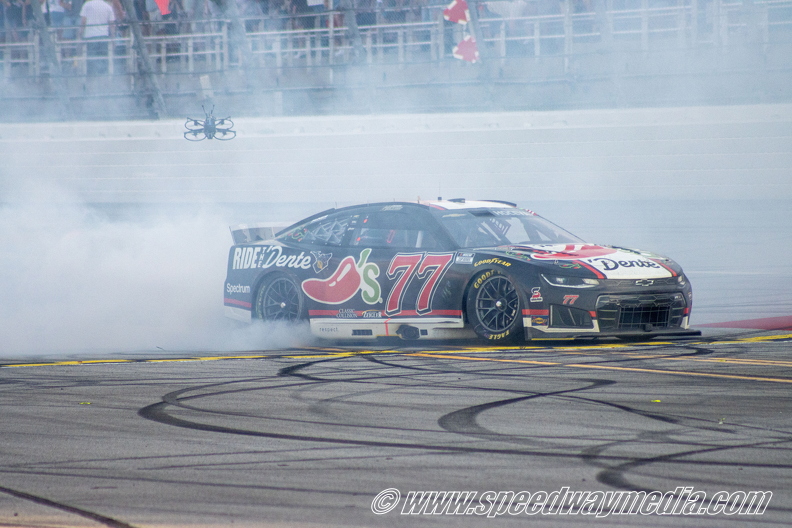
Then as the field approached the frontstretch’s tri-oval, a multi-car wreck ignited when Preece, who was battling for a top-five spot, got bumped by van Gisbergen as both wrecked along with Bell and Austin Dillon towards the outside wall. Meanwhile, Buescher briefly got loose while being pushed from Stenhouse. This allowed Hocevar to motor his No. 77 Chili’s Ride the ‘Dente Chevrolet Camaro ZL1 entry ahead with drafting help from Bowman. With Buescher unable to regain his momentum, Hocevar proceeded to claim the checkered flag for his first career victory by 0.114 seconds.
With the victory, Hocevar, who sat on the driver’s side while piloting his entry during a victory lap celebration in front of the fans and did a nosed burnout on the frontstretch, became the 208th competitor overall to win the Cup Series division , the second first-time winner of the 2026 season and the 13th competitor to achieve a first Cup career victory at Talladega. He also recorded the second career victory for Spire Motorsports and the first for crew chief Luke Lambert since the latter won at Phoenix Raceway in March 2017.
Carson Hocevar’s Cup victory capped off a week of first-time winners at Talladega Superspeedway this weekend. A day prior, Andy Jankowiak celebrated his first ARCA Menards Series career victory while Corey Day achieved his first NASCAR O’Reilly Auto Parts Series career win, both of which also occurred on last-lap passes.
Photo by Logan Allen for SpeedwayMedia.com.
“I feel like every time I’ve ever, just to see the crowd and I really got to hear them, I’ve had to start up for a while and I’ve messed it up every which way to not be able to do it,” Hocevar said on the frontstretch on FOX. He continued, “I would care if it took me 20 minutes or whatever. I was gonna figure out how to do it. It took me a while. I’m out of breath. I’m so thankful. This is the biggest dream I’ve ever thought of. Thank you, everybody! I couldn’t have done it in any better way. Hopefully, my grandpa’s watching. My grandma died last year, so I’m so thankful that I can give my grandpa a trophy now. We rode the ‘dente today, that’s for sure.
Hocevar capped off his interview by stating: “I posted on Instagram that I didn’t really care we were gonna win, and we won. I’m just so thankful. I knew we were gonna win. I really did.”
Chris Buescher, who led 22 laps compared to Hocevar’s 19, settled in the runner-up spot for his second top-three result at Talladega and his first top-five result of the 2026 season. Despite ending up one position shy of winning for the first time both of this season and at Talladega after leading the penultimate lap, Buescher was pleased with posting a strong result as his previous highest-finishing result of the 2026 season with sixth at Las Vegas Motor Speedway in March.
“[I’m] Really proud of everybody,” Buescher said. “That was a fun race all the way there at the end. We had that backboard going. [I] Felt really good where we were at coming off Turn 4 and felt like we were in a spot to take this Kroger/Jack Link’s Ford Mustang into Victory Lane. Man, it was close. Proud of everybody. It was an awesome day. Solid execution. It was a good race for us,” he emphasized, adding, “It really was. It was clean. I’d say we probably needed [Erik] Jones behind us. He was really strong and was giving us excellent runs. When we lost him, it was a little lonely up there. Excellent job by everybody. I was proud of our group and what we did. We’ve been leading the last three times we’ve been here, I guess, so we’re getting closer.”
Like Buescher, Alex Bowman was also left pleased with posting a strong result at Talladega, with the latter ending up in third place for his first top-five result of the 2026 season. Bowman, who missed four races throughout the entire month of March due to a Vertigo diagnosis, had finished no higher than 18th, which occurred last weekend at Kansas Speedway.
“To be blunt, it just feels good to get out of here without crashing,” Bowman said. “I’m getting old and don’t have much of that left in me. Glad to get out of here clean. I felt like we played the race the best we could with kind of the situations we were given and had a good day on pit road. A good day for us. Excited to turn things around a little bit. Hopefully, we can keep that going next week.”
Chase Elliott and Zane Smith finished in the top five while Ricky Stenhouse Jr., Ross Chastain, Austin Cindric, Noah Gragson and Kyle Busch completed the top 10 in the final running order, respectively. Notably, Denny Hamlin, who cycled back on the lead lap prior to the three-lap shootout, settled in 15th while Christopher Bell, Ryan Preece, Austin Dillon and Shane van Gisbergen, all of whom wrecked on the final lap, finished 17th through 20th, respectively.
There were 52 lead changes for 16 different leaders. The event featured six cautions for 30 laps. In addition, 21 of 40 starters finished on the lead lap.
Following the 10th event of the 2026 NASCAR Cup Series season, Tyler Reddick, who finished 14th at Talladega, continues to lead the standings by 110 points over Denny Hamlin, 140 over Ryan Blaney, 144 over Chase Elliott and 162 over Ty Gibbs.
Results:
Carson Hocevar, 19 laps led
Chris Buescher, 22 laps led
Alex Bowman
Chase Elliott
Zane Smith
Ricky Stenhouse Jr., two laps led
Ross Chastain, 22 laps led, Stage 2 winner
Austin Cindric
Noah Gragson, two laps led
Kyle Busch
Todd Gilliland
Daniel Suarez
Ty Dillon
Tyler Reddick, two laps led
Denny Hamlin, 28 laps led
AJ Allmendinger
Christopher Bell, 31 laps led
Ryan Preece, 21 laps led, Stage 1 winner
Austin Dillon, five laps led
Shane van Gisbergen
Cody Ware
John Hunter Nemechek, one lap down
Erik Jones, one lap down
Daniel Dye, two laps down
Riley Herbst, two laps down
Connor Zilisch, three laps down
Jesse love, three laps down
Chad Finchum, six laps down, eight laps led
Chase Briscoe, eight laps down, three laps led
Joey Gase, 11 laps down
Brad Keselowski, 22 laps down, one lap led
Michael McDowell, 39 laps down
Josh Berry – OUT, Accident
Ty Gibbs – OUT, Accident, 17 laps led
William Byron – OUT, Accident
Bubba Wallace – OUT, Accident, three laps led
Ryan Blaney – OUT, Accident
Cole Custer – OUT, Accident,
Joey Logano – OUT, Accident, three laps led
Kyle Larson – OUT, Accident
Next on the 2026 NASCAR Cup Series schedule is the Würth 400 at Texas Motor Speedway in Fort Worth, Texas. The event is scheduled to occur next Sunday, May 3, and air at 3:30 p.m. ET on FS1, PRN Radio, SiriusXM and HBO MAX.
Power Steering Cooler Issue Hampers Lanie Buice and Connor Mosack; M1 Racecars Driver Jared Odrick Sweeps Pro-Am Challenge Class Victories
Overview:
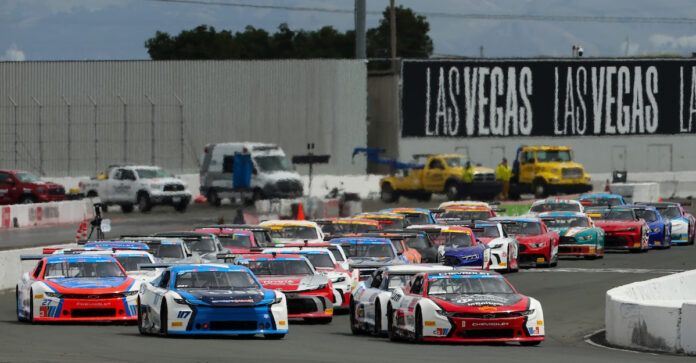
Date: April 26, 2026 Event: Sonoma Doubleheader (Round 4 of 12) Series: Trans Am Series presented by Pirelli Division: CUBE 3 Architecture TA2 Series Location: Sonoma (Calif.) Raceway Layout: 2.52-mile, 11-turn road course Format: 40 laps or 75 minutes Weather: Partly sunny, lower-60s Winner: Helio Meza of TeamSLR
TeamSLR:
● Helio Meza – Started 1st, Finished 1st (Running, completed 40/40 laps) ● Alon Day – Started 2nd, Finished 2nd (Running, completed 40/40 laps) ● Lanie Buice – Started 4th, Finished 25th (Running, completed 36/40 laps) ● Connor Mosack – Started 3rd, Finished 31st (Cooler, completed 12/40 laps)
M1 Racecars:
● Jared Odrick – Started 14th, Finished 7th (Running, completed 40/40 laps) ● John Moore – Started 30th, Finished 21st (Running, completed 38/40 laps) ● Tim Carroll – Started 13th, Finished 23rd (Accident, completed 38/40 laps)
Noteworthy:
● Sunday’s victory was the fourth in four events this season for Meza, the 18-year-old from Houston, and his fifth in five career CUBE 3 Architecture TA2 Series starts dating back to the 2025 season finale at Circuit of the Americas (COTA) in Austin, Texas. It was also the 11th win in a row for TeamSLR dating back to 15-year-old Tristan McKee’s triumph at the Mid-Ohio Sports Car Course in Lexington last June en route to the 2025 TA2 Series championship.
● Day, the 34-year-old from Ashdod, Israel, and four-time NASCAR Euro Series champion, took the runner-up spot for the second day in a row in his fourth career TA2 Series start.
● Buice, the 19-year-old from Jackson, Georgia, who Saturday became the first female winner in the CUBE 3 Architecture TA2 Series Western Championship with her sixth-place finish overall, started fourth Sunday and held position in the top-six before a cooler issue midway through the race sent her to pit lane for repairs, dropping her four laps off the pace.
● Mosack, the 27-year-old from Charlotte, North Carolina, followed up on his third-place finish Saturday with an early exit Sunday, also with a cooler issue. He climbed to second in the opening two laps and held that position until the cooler issue began to develop on lap seven. The car was retired after completing 12 laps.
● Odrick, the 2025 TA2 Series Pro-Am Challenge champion, won the class for the second day in a row and the third time in four races this season with his seventh-place finish overall in his No. 00 Black Underwear/M1 Racecars Camaro for Troy Benner Autosport. He was also victorious in the March 1 season opener at Sebring (Fla.) International Raceway.
● Two other Western Championship competitors took to the track Saturday in M1 Racecars equipment – Southern Californian Carroll in the No. 46 Carroll Racing Development Ford Mustang, and Northern Californian Moore in the JM Environmental Ford Mustang.
“This is unbelievable – five wins in a row, four in my rookie season. Five-for-five. I couldn’t do it without my amazing team, TeamSLR. I did a test with them at the end of last year at Virginia. When I first got to meet them, they were super professional, they were like a family, but they all worked hard, and they’re perfectionists just like I am. I’m always trying to chase those little details, whether it’s trying to get better as a driver, the media, whatever it may be, and they’re always working their butts off to make the cars fast. When you put a combo like that together – and obviously Alon, as well, he has a lot of history, and good results – we’re just a powerhouse of a team and it shows. I’ve got to thank Chevrolet and Alessandros Racing for allowing me to race and have a competitive racecar in the CUBE 3 Architecture TA2 Series. I’ve got to thank Racing America for broadcasting all of this, and my family from L.A., who came up to watch. They’re always supporting me and watching on Racing America. There are just so many people behind me that make this possible, so I can’t thank everyone enough. Now we’re ready for Lime Rock next.”
Alon Day, Driver, No. 17 JSSI/SLR-M1 Racecars Chevrolet Camaro:
“Overall, let’s be honest, it was a very successful weekend, not only for me personally, but also for TeamSLR. I’m very happy with the results we came away with. Unfortunately, Connor and Lanie had issues in today’s race, otherwise everything could’ve been even better. But I’m very happy with the JSSI car. We got quite a lot of points, which is the most important thing right now for the championship. And there is always work to do. Somebody needs to stop Helio from winning so much. (Laughs.) In the end, he’s my teammate and he’s a good guy, but I’m here to win. The special thing about this team is we all work together and we all learn from each other, no matter if you’re 18 years old or 34.”
Lanie Buice, Driver, No. 27 Sunoco/Guthrie’s Garage/SLR-M1 Racecars Chevrolet Camaro:
“I’m really excited about the weekend that we put together. I feel great about the progress that we made, winning my first race with Trans Am in the Western Championship and being competitive both days, qualifying well. Starting fourth overall today was really exciting, as well. We were running, I think, fifth or sixth when my power steering went off, went out today, which was very unfortunate. But super proud of the Sunoco Race Fuels/Guthrie’s Garage Chevrolet that TeamSLR brings to the racetrack, and couldn’t be more grateful for the hard work that they put into weekends like this. These doubleheaders are a little rough. They’re long weekends. But I’m glad we made it as far as we did. Hopefully we’ll come back at Lime Rock in a few weeks and we’ll be up front again.”
Connor Mosack, Driver, No. 48 Friends of Jaclyn/Guthrie’s Garage/SLR-M1 Racecars Chevrolet Camaro:
“It was something with the cooler related to the power steering, I’m not totally sure. I didn’t lose power steering, completely, it was kind of cutting in and out and it basically just made things super unpredictable and it was starting to get worse. It wasn’t really worth crashing the thing, trying to ride around in whatever position we were at that point. We were kind of hoping for a caution, so we stayed out there for a few laps, but it didn’t seem like we were going to get one. Definitely a tough break. I feel like we made a really good couple of adjustments from yesterday. It made the car quite a bit better. We got in second at the start and were kind of riding there behind Helio. It felt like we were pretty even with him. I was just planning to save my stuff for the second half of the race but never got an opportunity to see where we were going to end up. So, an unfortunate end. I felt like it could’ve been a pretty interesting race there at the end, but unfortunately we didn’t get to see.”
Next Up:
Round five of the 2026 Cube 3 Architecture TA2 Series takes competitors to New England for the traditional Memorial Day weekend race at Lime Rock Park in Lakeville, Connecticut May 21-23. The event kicks off with a pair of TA2 test sessions Thursday (May 21) at 11:45 a.m. and 4:50 p.m. EDT. Official TA2 practice is set for 11:50 a.m. Friday (May 22), followed by TA2 qualifying at 4:45 p.m. The 68-lap, 75-minute race around the 1.478-mile, seven-turn circuit is set for 3 p.m. Saturday (May 23) with live streaming video provided by RacingAmerica.tv and the @GoTransAm page on YouTube.
About TeamSLR:
TeamSLR (Scott Lagasse Racing) competes fulltime in the Trans Am Series presented by Pirelli in a multifaceted effort that includes dedicated entries in the TA2 division, customer programs, driver coaching and car construction. Its history dates back to 1985 and covers a wide spectrum of motorsports, including NASCAR, IMSA, SCCA, ARCA and ASA. TeamSLR is a family-owned organization run by Scott Lagasse Sr., and Scott Lagasse Jr. The father-and-son duo have combined to win more than 130 races and 10 championships across a variety of series and styles of racecars, from paved ovals to road courses to dirt tracks. TeamSLR would like to thank its supporters CUBE 3 Architecture, Franklin Road Apparel, Kallberg Racing, and Guthrie’s Garage. For more information, please visit us online at www.TeamSLR.com, on Facebook, on Twitter, on Instagram and on LinkedIn.
About M1 Racecars:
M1 is an Official Chassis Supplier to the Trans Am Series presented by Pirelli. M1 Racecars are professionally engineered for the Cube 3 Architecture TA2 Series, SCCA Competition, and Track Day events. We offer chassis only, rolling chassis and complete race-ready builds in Camaro, Mustang, and Challenger body styles. We utilize only the highest quality materials and our race-winning technology to produce the most stable and predictable racecar on the track today. The proprietary chassis design by M1 has been CAD-perfected by our engineering staff to ensure that each completed chassis is identical and performs as expected. Our chassis materials are CNC Mandrel bent and cut to our exacting standards, which results in the most precise and cost-effective build. M1 has selected Scott Lagasse Racing to be the exclusive distributor for M1 Racecars worldwide. The race team also provides M1 with vital technical assistance and on-track feedback to support our performance development efforts. This combination is a powerful asset to M1 and to every M1 customer.
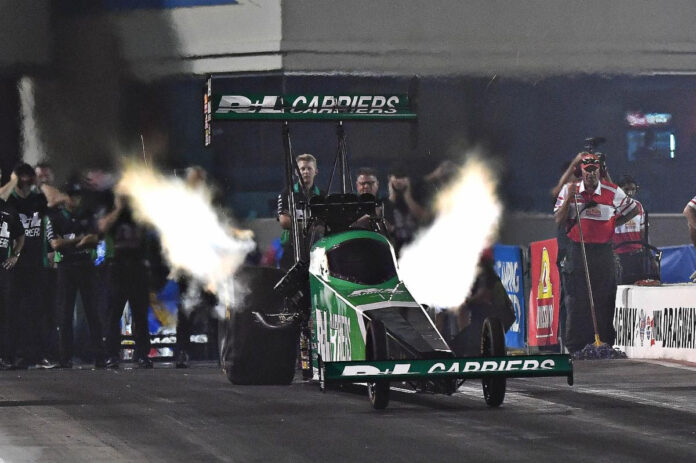
NHRA 4-WIDE NATIONALS RECAP: TONY STEWART TAKES R+L CARRIERS TO FINAL QUAD TONY STEWART, R+L Carriers Top Fuel dragster Qualifying: No. 12 3.808 seconds, 329.91 mph
Race Results:
E1: 3.727 at 331.36 def. Billy Torrence 3.731 at 335.98, Josh Hart 3.753 at 333.16, Tony Schumacher Broke.
E2: 3.776 at 328.22 Lost to Shawn Langdon 3.748 at 329.02; def. Spencer Massey 3.798 at 326.56, Billy Torrence 3.785 at 324.44.
Final Quad: 10.663 at 66.89 Lost to Doug Kalitta 3.692 at 342.98, Shawn Langdon 3.727 at 338.51, Leah Pruett 3.724 at 329.42.
“We had a shaky start to the weekend; qualifying didn’t go quite the way we wanted but these R+L guys they kept their heads down and got to work. Mike Green and Joe Barlam pulled us together and we were able to make a decent run to pull data from. But I love the four-wide, especially on race day. It’s like two heat races and then the feature. The weather was on our side today; cooler conditions gave way for some really stout racing. This class is so tight, the competition is unreal and we saw that today. Lining up in the final quad with Leah, that was special. It wasn’t the final run we needed wanted to make, we wanted to give them all a run for their money, but it just wasn’t in the cards. But reaching the finals, picking up semifinal points, that’s nothing to hang our heads about. The great part is we get to turn around and do it all over again in just a few days. I’m looking forward to it.”
“Huge thank you to Jason Cox and all the R+L folks we had out here this weekend, Sergeant Major Houle and his son who spent the weekend with us through HBOT4Heroes, the friends and family who came out to support, we had Tommy DeCarlo’s family out, Kyle Larson came by, had a chance to meet Scott McLaughlin — it was a busy weekend in the pits and on the race track.”
RICK WARE RACING Jack Link’s 500 Date: April 26, 2026 Event: Jack Link’s 500 (Round 10 of 36) Series: NASCAR Cup Series Location: Talladega (Ala.) Superspeedway Format: 188 laps, broken into three stages (98 laps/45 laps/45 laps)
Race Winner: Carson Hocevar of Spire Motorsports (Chevrolet) Stage 1 Winner: Ryan Preece of RFK Racing (Ford) Stage 2 Winner: Ross Chastain of Trackhouse Racing (Chevrolet)
RWR Finish:
● Cody Ware (Started 36th, Finished 21st / Running, completed 188 of 188 laps)
RWR Points:
● Cody Ware (35th with 85 points)
RWR Notes:
● Ware earned his third top-25 of the season and his fourth top-25 in 12 career NASCAR Cup Series starts at Talladega.
● Ware finished seventh in Stage 2 to earn four bonus points.
Race Notes:
● Carson Hocevar won the Jack Link’s 500 to score his first career NASCAR Cup Series victory. His margin over second-place Chris Buescher was .114 of a second.
● Hocevar is the 14th driver to score his first NASCAR Cup Series win at Talladega. He joins Richard Brickhouse (September 1969), Dick Brooks (August 1973), Lennie Pond (August 1978), Ron Bouchard (August 1981), Bobby Hillin Jr. (July 1986), Davey Allison (May 1987), Phil Parsons (May 1988), Ken Schrader (July 1988), Brian Vickers (October 2006), Brad Keselowski (April 2009), Ricky Stenhouse Jr. (May 2017) and Bubba Wallace (October 2021).
● This was Chevrolet’s 883rd all-time NASCAR Cup Series victory and its second of the season. Chase Elliott won for the Bowtie Brigade March 29 at Martinsville (Va.) Speedway.
● This was Chevrolet’s series-leading 46th NASCAR Cup Series victory at Talladega. Chevrolet won its first race at Talladega on May 5, 1977 with NASCAR Hall of Famer Darrell Waltrip.
● There were six caution periods for a total of 30 laps.
● Only 21 of the 40 drivers in the race finished on the lead lap.
● Tyler Reddick remains the championship leader after Talladega with a 110-point advantage over second-place Denny Hamlin.
Sound Bites:
“Coming to the checkered flag, they’re all stacking up, and we’re all trying to go for it, trying to make a move. We had a super-fast Super.com Chevrolet all day, and we did a good job keeping her at the front. The cards just didn’t fall in our favor.” – Cody Ware, driver of the No. 51 Super.com Chevrolet
Next Up:
The next event on the NASCAR Cup Series schedule is the Würth 400 on Sunday, May 3 at Texas Motor Speedway in Fort Worth. The race begins at 3:30 p.m. EDT with live coverage provided by FS1 and SiriusXM NASCAR Radio.
Jeff Arend Mooneyes Funny Car Driver for Jim Dunn Racing 4-Wide Nationals April 23-26 | Charlotte, North Carolina
Event Recap
Jeff Arend, driver of the Jim Dunn Racing Mooneyes Funny Car:
Earned No. 13 provisional qualifying position in Q1 on Friday (6.577 ET at 105.74 mph)
Fell to No. 14 provisional qualifying position in Q2 on Friday (4.234 ET at 247.47 mph)
Earned No. 13 provisional qualifying position in Q3 on Saturday (4.080 ET at 305.15 mph)
Secured No. 13 qualifying position based off of Saturday’s Q3 run. The team elected to not make a qualifying run in Q4 on Saturday.
Eliminated following Round 1 on Sunday:
Round 1: 4.100 ET at 309.06 mph, lost to J.R. Todd in first (3.896 ET at 335.32 mph), Alexis DeJoria in second (3.962 ET at 324.36 mph), and Hunter Green in third (4.005 ET at 320.89 mph).
Notes of Interest
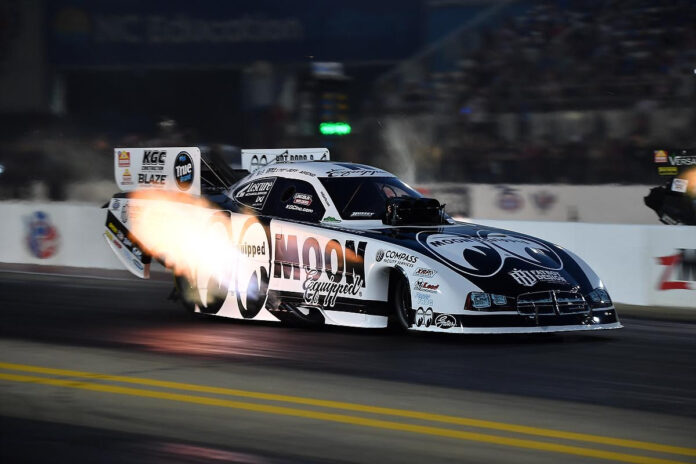
Arend represented Mooneyes this weekend in Charlotte. Mooneyes products and logos are an indelible part of hot rod nostalgia, easily recognizable to gearheads and novices alike. They take pride in producing high-quality products that look great and get the job done right. Mooneyes produces Moon Fuel Blocks, Moon Tanks, Moon Discs, and Moon Valve Covers among other original parts right on site in their machine shop. They also supply various parts and accessories for hot rods and kustoms as well as an expanding like of custom motorcycle products. Located in the same place since it all started back in the 1950s, Mooneyes is located in Santa Fe Springs, California.
The 4-Wide Nationals marked Jim Dunn Racing’s highest qualifying position of the 2026 season.
The NHRA will be racing back-to-back with a thrilling debut next weekend at South Georgia Motorsports Park for the 41st annual NHRA Southern Nationals. The historic Southern Nationals return to a new location during the NHRA’s milestone 75th anniversary campaign. It marks the first of four visits to new facilities for the NHRA in 2026. The festivities kick off from 6-8 p.m. ET on Thursday, April 30 with a “Rev & Rally” race weekend preparty and fanfest from Visit Valdosta at the Rainwater Conference Center.
Arend will be back behind the wheel of the Jim Dunn Racing Funny Car in Georgia and also in Chicago May 14-17 for the Gerber Collision & Glass Route 66 NHRA Nationals presented by PEAK.
Jeff Arend, Driver of the Jim Dunn Racing Mooneyes Funny Car
“I’m proud of the effort and progress this Jim Dunn Racing Mooneyes team showed this weekend. We were able to run consistent without hurting any race car parts. Thank you to all the fans that came out to support us in Charlotte. It was great being back behind the wheel. We kept J.R. (Todd), Alexis (DeJoria), and Hunter (Green) honest during eliminations. We will step up our game in Georgia and Chicago.”
Next Up The next event on the NHRA Mission Foods Drag Racing Series schedule is the NHRA Southern Nationals May 1-3 at South Georgia Motorsports Park in Adel, Georgia.
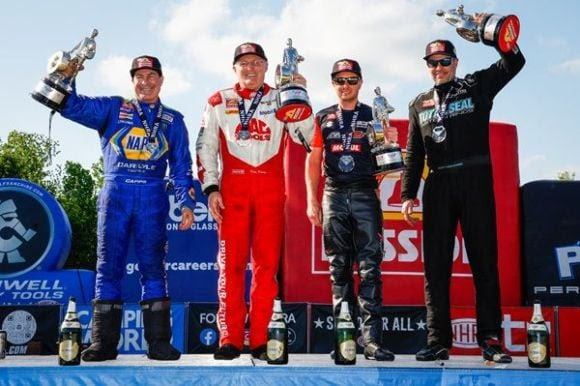
Ron Capps (Funny Car), Doug Kalitta (Top Fuel), Gaige Herrera (Pro Stock Motorcycle) and Matt Hartford (Pro Stock) — left to right — each earned the coveted diamond Wally on Sunday at the 4-Wide Nationals, celebrating NHRA’s 75th anniversary. (CMS/HHP photo)
Top Fuel’s Doug Kalitta powers to historic 342 mph pass to claim victory
Ron Capps (Funny Car), Matt Hartford (Pro Stock) and Gaige Herrera (Pro Stock Motorcycle) also earned Wallys
CONCORD, N.C. (April 26, 2026) – Reigning Top Fuel world champion Doug Kalitta shattered the track speed record in the final round en route to the win on Sunday at zMAX Dragway, beating a loaded final quad of Shawn Langdon, Tony Stewart and Leah Pruett at the 16th annual NHRA 4-Wide Nationals.
Ron Capps (Funny Car), Matt Hartford (Pro Stock) and Gaige Herrera (Pro Stock Motorcycle) also won the fourth of 20 races during the 2026 NHRA Mission Foods Drag Racing Series season.
Kalitta went 3.692-seconds at 342.98 mph in his 12,000-horsepower Mac Tools dragster, setting the track record and making the third-fastest run in NHRA history, as the Top Fuel points leader collected his second win this season and the 60th in his career.
After winning two world titles in the past three years, there has been no let-up from Kalitta, who became the first Top Fuel driver to get two wins in 2026.
“Alan [Johnson, crew chief] thought it was going to run over 340 mph, so that was good. I don’t know how he predicts these things, but the guy’s a wizard tuning these cars and I’m just very, very fortunate,” Kalitta said. “It’s a hell of an opportunity to work with him and Connie’s [Kalitta, team owner] given us everything we need with all three of our cars. I’m sure he is pretty proud of what we accomplished.
“The guys pulled through for me. I was really happy to see that light when it came on. We had a lot of support here and this is the kind of race you want to win.”
Funny Car’s Ron Capps stayed red-hot in the loaded category, winning for the second time in three races thanks to a run of 3.905 at 334.90 in his 12,000-horsepower NAPA Auto Care Toyota GR Supra in the championship round to hold off past world champions Jack Beckman, Matt Hagan and J.R. Todd in a thrilling finale.
Capps had the dominant car all weekend, qualifying No. 1 and making the quickest pass of the weekend in the first round of eliminations when he went 3.865 at 333.00. Capps left first and never trailed in an impressive wire-to-wire victory in the finals, enjoying his 79th career victory and his fifth in Charlotte, the most among active Funny Car drivers. It continued his impressive start to the year, as it gave Capps his third straight final round. The three-time world champion also has a pair of No. 1 qualifiers in 2026, as everything appears to be lining up for a strong championship push for the veteran and points leader.
“I still can’t believe it,” Capps said. “You have cars like this at times in your career and you just don’t want to mess up as a driver. It sounds funny, it sounds strange, but you’re given something that leaves the trailer and all the knobs turn in the right direction to go win a race. Any driver will tell you this and if they don’t, they’re lying, but it’s like you’re given this to not screw up and to cut a light and, most importantly, drive it, keep it as straight as possible in a Funny Car.
“The four-wide brings such a unique mentality to everything. I’m getting older, but it’s just so much fun to get up there and have the confidence from everybody on the team that I could still do it in the seat. This is especially cool because this is the only four-wide race this year. Sunday night’s over with, and you look back and say, man, everybody came together really made this a great event.”
In Pro Stock, Matt Hartford won for the first time at zMAX Dragway, rolling to his second win in four races to open 2026 with a run of 6.526 at 210.05 in his Total Seal Chevrolet Camaro to defeat Cody Coughlin, Greg Anderson and Matt Latino in the finals.
Hartford won the opener in Gainesville, but then struggled in Phoenix and Pomona, losing in the first round at both events. The veteran, though, bounced back in impressive fashion this weekend, getting his second win of the year and 10th in his career. This one sent him to third in points, as Hartford made the most of his opportunities on Sunday in Charlotte.
“If you’re going to win in this class, you pretty much have to leave ahead of everybody and that’s really hard to do,” Hartford said. “I struggle with it. I was .024 in the final and I thought that was great for me, especially on the four-wide, which is hard. You’ve heard from everybody; there’s a lot going on. It’s very confusing, and I just took my time, made sure I was ready and rolled in… To come out here and run and be competitive with these super teams, it’s just incredible, and it’s an honor to have my wife do it alongside me, my brother do it alongside Eddie and me.”
Pro Stock Motorcycle’s Gaige Herrera was back to his winning ways this weekend at zMAX Dragway, capped off by a victory on Sunday with a run of 6.758 at 199.88 on his RevZilla/Motul/Vance & Hines Suzuki to outlast a quad that included teammate and reigning world champion Richard Gadson, Clayton Howey and Chase Van Sant.
It’s the first win of the year for Herrera and, remarkably, the 29th in his young career, a day after winning the Mission #2Fast2Tasty Challenge. After back-to-back world championships in dominant fashion, Herrera finished second to Gadson a year ago. He still enjoyed a strong season and Herrera was back in top form in Charlotte, showcasing a stellar .019 reaction time in the final quad.
“I knew we all were going to push the tree in the final and I think that’s the tightest I’ve seen a four-wide final in the bike category,” Herrera said. “It’s pretty cool to have all Suzukis in the final, too. I had a bracket bike all day long, same with Richard and Clayton, and it’s awesome to get the four-wide win here at zMAX and to get my first diamond in Wally. It’s pretty cool to win in NHRA’s 75th anniversary.
“Losing the second round in Gainesville lit a fire under me and I didn’t want that to happen to me again this weekend. I knew I had to be better as a rider at everything and feel like this weekend I proved it to myself.”
TICKETS: Fans can lock in their seats now for the 2027 NHRA 4-Wide Nationals, returning April 2-4 by renewing through July 31 at www.CharlotteMotorSpeedway.com. The action doesn’t stop there—don’t miss Memorial Day Weekend’s crown jewel, the Coca-Cola 600, May 22-24 at America’s Home for Racing. Tickets can be bought online or by calling 1-800-455-FANS (3267).
REDDICK OVERCOMES MULTIPLE INCIDENTS, LEADS TOYOTA AT TALLADEGA Reddick extends top-15 streak to start season
TALLADEGA, Ala. (April 26, 2026) – Tyler Reddick overcame multiple incidents, including a cut tire in the closing laps to lead Toyota with a 14th-place finish at Talladega. The points leader continued his streak of finishing every race in the top-15 this season.
TOYOTA RACING Post-Race Recap NASCAR Cup Series (NCS) Talladega Superspeedway Race 10 of 36 – 500.08 miles, 188 laps
TOYOTA FINISHING POSITIONS
1st, Carson Hoceva* 2nd, Chris Buescher* 3rd, Alex Bowman* 4th, Chase Elliott* 5th, Zane Smith* 14th, TYLER REDDICK 15th, DENNY HAMLIN 17th, CHRISTOPHER BELL 22nd, JOHN HUNTER NEMECHEK 23rd, ERIK JONES 25th, RILEY HERBST 29th, CHASE BRISCOE 34th, TY GIBBS 36th, BUBBA WALLACE *non-Toyota driver
TOYOTA QUOTES
TYLER REDDICK, No. 45 ROCKSTAR ENERGY DRINK Toyota Camry XSE, 23XI Racing
Finishing Position: 14th
Can you talk how you got this car to a top-15 finish?
“Yeah, we able to overcome problems that we had throughout the day. The second cut tire, I thought was going to be the end of our day, but thankfully we hit it somewhat true enough that all it did was bend stuff, not break it. It was just the day we needed to have with the adversity we had along the way. Bummed we didn’t get ROCKSTAR ENERGY DRINK and Toyota to victory lane today, but all-in-all, I think we did gain more ground on those around us in points, so to wreck and be able to accomplish that is a good deal.”
TY GIBBS, No. 54 SAIA Freight & Logistics Toyota Camry XSE, Joe Gibbs Racing
Finishing Position: 34th
Can you tell us what happened out there?
“Well, we had a really good first stage in our SAIA Camry. Unfortunately, not a lot of people pitted with us, and we just barely made it on the lead lap at the end of the first stage. I thought we were really fast. I thought our car was really good, but didn’t end well. Unfortunate end of the day for us. We will keep working hard. Thanks for SAIA, Monster, Toyota – everyone that supports us. I’m excited for Texas. Not a lot of luck at the roulette table today at Talladega, so we will look forward.”
BUBBA WALLACE, No. 23 Xfinity Toyota Camry XSE, 23XI Racing
Finishing Position: 36th
Can you take us through what happened?
“Got wrecked there, unfortunately. Our Xfinity Toyota Camry was a little unstable getting pushed, but manageable. Maybe that hard of a hit was too much, so unfortunately, we wiped out a bunch of cars. Got to debrief, got to be better. Just kind of riding around, not doing much in the first stage – nothing to show for it at Talladega. Unfortunate, it is a place we come to with a lot of confidence, and it is what it is. We will put this one behind us and go on to Texas and have some fun.”
About Toyota
Toyota (NYSE:TM) has been a part of the cultural fabric in North America for nearly 70 years, and is committed to advancing sustainable, next-generation mobility through our Toyota and Lexus brands, plus our more than 1,800 dealerships.
Toyota directly employs nearly 64,000 people in North America who have contributed to the design, engineering, and assembly of nearly 49 million cars and trucks at our 14 manufacturing plants. In spring 2025, Toyota’s plant in North Carolina will begin to manufacture automotive batteries for electrified vehicles. With more electrified vehicles on the road than any other automaker, Toyota currently offers 31 electrified options.
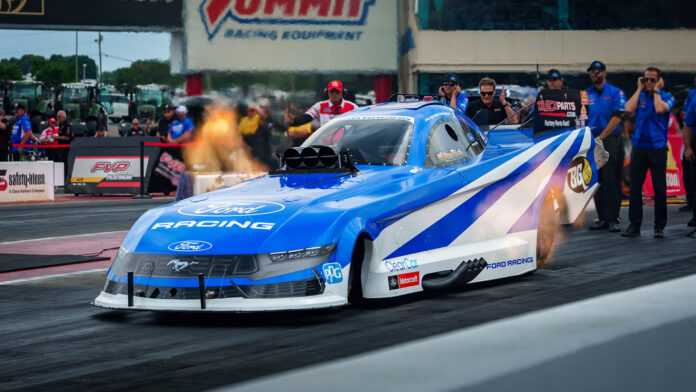
CONCORD, N.C. – April 26, 2026 – Austin Prock and his Ford Racing Nitro Mustang Funny Car faced a challenging but productive weekend at the 2026 NHRA 4-Wide Nationals at zMAX Dragway, qualifying No. 16 and exiting in the opening round of eliminations on Sunday.
The weekend marked another step forward in the team’s ongoing development of its Funny Car combination. While the result was not what Prock and team were looking for, the weekend provided valuable data as the team continues working to harness the horsepower in their Ford Racing Nitro Mustang.
Prock opened qualifying Friday afternoon with a 4.977-second pass at 176.56 mph after the car dropped a cylinder at the hit and moved hard toward the inside. Prock fought to keep the Mustang under control before the car knocked the tires loose.
In Friday’s second session, Prock’s Ford Racing Mustang left the starting line well with a .873 60-foot time, but the run ended early when the car lost traction, resulting in a 6.596 at 118.45 mph. The pass dropped Prock to 16th in the qualifying order.
“Conditions were gorilla tonight, and I haven’t got very many shots in that hot rod in these conditions,” Prock said after Q2. “But this Ford, it left great and it was heading straight down the track. It was anchored down, but I felt the sidewall quivering a little bit. As soon as it cleared up, it chopped the tires off. I can promise you that this Ford is going to run low ET soon.”
Saturday brought two more qualifying attempts as the team continued working through the setup. In Q3, Prock pedaled the car multiple times before shutting off early, recording a 6.083 at 129.19 mph. The run kept him on the bump spot entering the final session.
In Q4, the Funny Car delivered another challenging and disappointing run, posting a 4.833 at 168.26 mph. The pass secured the No. 16 qualifying position and a spot in Sunday eliminations against No. 1 qualifier Ron Capps, along with Chad Green and Spencer Hyde rounding out the quad.
“We made it in the show, but not by anything extravagant by any means,” Prock said. “Made some headway on the engine program this weekend. Got it running clean and we’re now just trying to harness all this Ford horsepower. In Q4, we made it the furthest down the track than we have all weekend with smoking the tires. I stood on the gas and had a great light, but it put a cylinder out at the hit. The Mustang moved hard right, the cylinder relit, and I got it back on track but smoked the tires around half track. We got a chance to win on Sunday and that’s all that matters.”
In Sunday’s opening round of four-wide eliminations, Prock lined up against Capps, Green, and Hyde. Prock left with a .070 reaction time and was on a solid early run, posting a .877 60-foot time, a 2.245 at 330 feet, and a 3.298 at 211.46 mph to the eighth mile. However, the car blew the tires off just after half-track and slowed to a 4.460 at 191.76 mph.
Capps advanced with the quickest Funny Car run of the weekend, while Green moved on in the second transfer position. Prock finished third in the quad, ending the weekend in the first round.
Despite the early exit, the weekend gave Tasca Racing additional direction as the team continues to build consistency with its Ford Racing Nitro Mustang Funny Car. Prock and the team showed improved early numbers and made progress with the engine program but continued with challenges throughout the weekend.
The Tasca Racing team will leave Charlotte focused on turning the weekend’s data into results as the NHRA Mission Foods Drag Racing Series continues next week in Adel, GA for the NHRA Southern Nationals.