Creature design is usually treated as a surface problem — scales, plating, texture, lighting — when it is really a reading problem. A viewer decides what a thing is from its outline long before any surface detail registers. vofy sits on the image side of this work rather than the rules side, and its monster generator is most useful at the stage where the shape is still undecided, because that is the stage where a change costs almost nothing and a mistake costs everything downstream.
Concept sketching is not a modern habit. Disney’s first feature, Snow White, went into production in the 1930s, and its artists spent years on paper working out the forests, the cottages and the animal forms before any of it was animated. Those sketches existed to answer questions that could not be answered once a drawing was finished — and they were answered in greyscale, at the size of a postage stamp.
The question a thumbnail answers
It is worth stating those questions precisely, because two of the three are silhouette questions. starryai’s guide to creature concept art puts the job this way: a sketch has to establish whether the anatomy supported the story, whether the silhouette read clearly, and whether the creature felt dangerous, gentle, comic or mysterious — all of it before a final asset was made.
Read the list again and notice the order. Anatomy comes first, because a shape that contradicts how the thing is supposed to move will not survive contact with an animator or a modeller. Silhouette comes second, and it is the constraint that does the most work: if the outline does not communicate the creature, no amount of rendering will. Tone comes third, and it is the part people mistake for the whole job. It is really the residue of the first two. A shape that reads as a low, forward-loaded mass will feel predatory regardless of what colour it ends up being.
The practical weight of “before a final asset was made” is that these are cheap questions asked early. A thumbnail that fails costs a few minutes. The same failure discovered after a full render, a model, or a printed handout costs a week.
Write the brief before opening the generator
The most useful line in starryai’s guide is short: write the brief before opening the generator. It sounds like an obvious workflow rule, and it is the one most often skipped, because a text box invites you to start typing and see what appears.
A brief is four or five answers: what the creature does for a living, where it lives, what it eats, how it moves, and what the story needs from it. starryai’s example is a desert scavenger, and its reference list is the part worth copying — a bird reference for the forward tilt of the head, a reptile reference for dry skin and heat management, and a hyena or vulture reference for feeding behaviour. Three references, three specific jobs. None of them is there for the mood.
That is the test of whether a reference is doing work. If you cannot say which part of the design it is meant to inform, it is decoration — and decoration is what makes a creature read as generic.
The same discipline applies to the mood board, which the guide frames as a single question rather than a collection of images: what does believable mean for this creature? For a scavenger, believable means thin limbs, an opportunistic gait, and proportions that suggest it eats whatever it finds. For an armoured grazer, believable means mass and a low centre of gravity. A mood board that answers that question is a design constraint. One that answers “which colours do I like” is not.
Posture is not a detail
The guide’s sharpest line is a comparison: a stalking predator and a burrowing grazer shouldn’t share the same posture. Posture is the fastest way to communicate behaviour, because behaviour is what a silhouette encodes. A stalker is low and forward-loaded, with its weight over the front limbs and its head held level. A burrower is compact and wedge-shaped, with nothing protruding that would catch on a tunnel wall. Draw either outline and a viewer can guess which is which without a single surface detail — which is the entire point.
The test costs nothing. Fill the shape solid black, shrink it to thumbnail size, and look at it for two seconds. Can you tell which end is the head? Which way it is facing? Whether it runs or ambles? If those answers are unclear at that size, more detail will not fix the design; it will only hide the problem.
Specificity in the brief protects this. A useful instruction names what it wants and what it does not — the guide’s example, “use beetle plating, but avoid a symmetrical shell”, is a good one, because a symmetrical shell collapses into a shape that reads identically from every angle, which is the opposite of a memorable profile. Asymmetry gives the eye an entry point: a heavier shoulder on one side, a jaw that juts past the line of the body, a limb that breaks the outline. Prompting this way takes more thought than a list of nouns, and it returns shapes that are recognisable rather than merely ornate.
Where the image tool sits in the sequence
The standard creature design sequence has five steps — inspiration and concept development, then thumbnails, then detailed sketching, then selection, then refinement — and only the first two are volume work.
Thumbnails are volume work, and so is the first pass of selection. This is the part that text-to-image tools changed. Producing thirty shapes used to be an evening of drawing; it is now a matter of writing a clear brief and iterating a few times. That is a real change to how much ground you can cover, and it is the honest case for reaching for a generator early rather than late. Other AI image tools arrived at the same affordance from different directions, and the affordance is identical: cheap candidates.
The rest of the sequence is judgement. Selection is deciding which of thirty shapes reads most clearly at the size your players or readers will actually see it. Refinement is deciding what the chosen shape needs — a jaw that is more clearly a jaw, a chest that carries the weight forward, a limb arrangement that matches how it moves. A generator can propose; it cannot decide what the creature is for. That came from the brief, which is why the brief has to exist before the first prompt.
There is a second kind of tool that shares the name and does something else entirely. Search results for creature generators mix image tools with tabletop utilities that produce stat blocks, and the tabletop tools are not random number machines. cros.land, a 5e stat-block generator, describes itself the same way a game master would: a math engine sets the numbers: armour class, hit points, attack bonuses, save DCs and damage all derive from the challenge rating you pick, on curves calibrated against the monsters in the 5e SRD, while the AI layer only names the creature, writes its lore and proposes a signature ability. That is a balance engine, and its output is something you run rather than something you look at. The image side answers a different question — what does it look like — and the two are not substitutes.
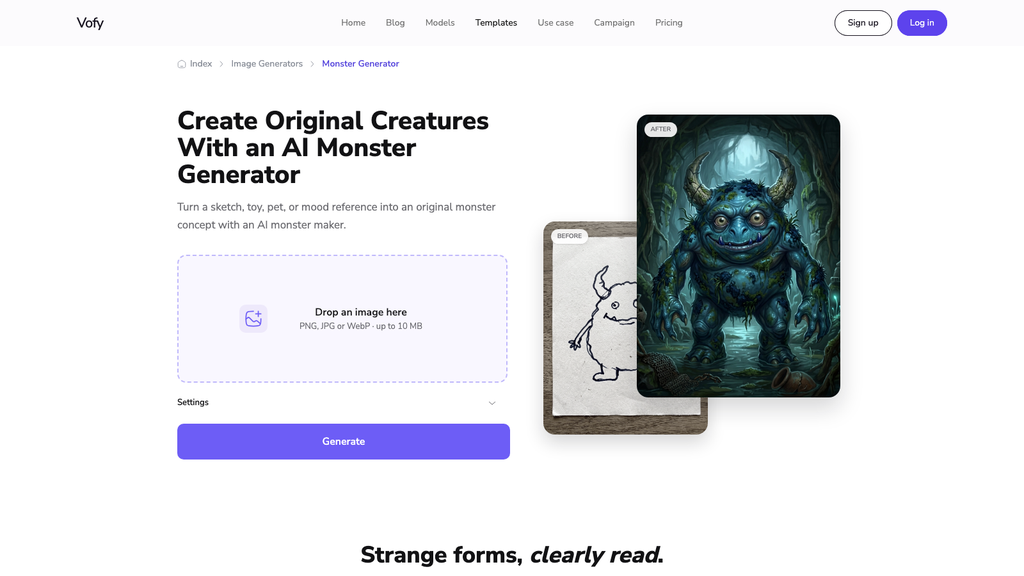
Which brings the review step back to the silhouette. Before accepting a candidate, shrink it, strip the colour, and ask the three questions from the 1930s version of this job: does the anatomy make sense, does the outline read, and does the thing feel dangerous, gentle, comic or mysterious? A candidate that fails the second question is not worth refining, however good its surface looks.
The takeaway
Silhouette first is not an aesthetic preference; it is an ordering of decisions by cost. The outline is the cheapest thing to change while it is still a thumbnail and the most expensive thing to change once it has been rendered, modelled, or printed on a handout. Everything after the shape — plating, texture, lighting, colour — multiplies a design that already reads. None of it rescues one that does not.
The reason to state that plainly is that the tooling changed and the discipline did not. Generating thirty candidate shapes is now a matter of minutes, which means the bottleneck moved to the part machines do not do: choosing. Concept sketching has been answering the same three questions since the 1930s, and the second one — whether the silhouette reads — is still what decides whether a creature survives contact with an audience.