It’s amazing how quickly an ordinary garage can become a frustrating place to work. You’re halfway through a simple job, the hood is up, and the ceiling light is shining on everything except the part you need to see. Then you look up and realize the garage door tracks take up half the space where you might put better lighting or a fan.
The fix isn’t necessarily a bigger toolbox or a complete remodel. A more useful place to start is the environment itself: where the light falls, how air moves, how much room you have to work, and whether the setup is safe for the jobs you actually do.
Map the Garage Around the Work You Actually Do
First, forget the picture-perfect garage for a minute. Think about an ordinary Saturday. Are you washing the car, checking fluids, changing wheels, sorting parts on a bench, or working through a restoration project that takes up the whole weekend? Those jobs use the same floor, but they don’t need the same lighting or the same amount of space.
Detailing is a good example. You might need light from the side to pick up fine marks in the paint, then a different portable light to check the wheel wells. Mechanical work brings its own problems: an open hood creates deep shadows, and a floor jack or creeper needs a clear path beside the car. If you mainly park and store gear, simpler lighting and clear walkways may be all you need.
Before buying anything, park the vehicle where it normally sits. Open the doors and hood. Raise the garage door. Stand at the workbench. It’s a better test than an empty-room measurement.
Layer Lighting for Parking, Detailing, and Repairs
One bright fixture in the middle of the ceiling can make a garage look well lit until you start doing real work. Your own body blocks the beam, the hood throws a shadow, and suddenly the bolt you need is hiding in the dark. That’s why it helps to think in layers instead of looking for one light that does everything.
Start with general lighting so you can walk around the car, find equipment and spot anything on the floor. Then add task lighting where you actually work. A movable inspection light is handy under the hood or beneath a dashboard. For paint correction or detailing, pay attention to the direction and quality of the light, not simply the claimed brightness on the box.
In a garage that doubles as a hobby room or general-purpose hangout, some people consider ceiling fans with lights to combine circulation and overhead illumination. That can be a sensible use of a ceiling position if the particular fixture is rated for the environment and fits the space. Just don’t expect a fan-mounted light to replace a proper inspection light when you’re checking a paint finish or hunting for an oil leak.
Neutral or daylight-looking light can be useful for detailed tasks, but glare, shadows and the quality of the fixture matter just as much. Test the light where your eyes and hands will actually be.
Separate Air Movement From Hazardous-Air Ventilation
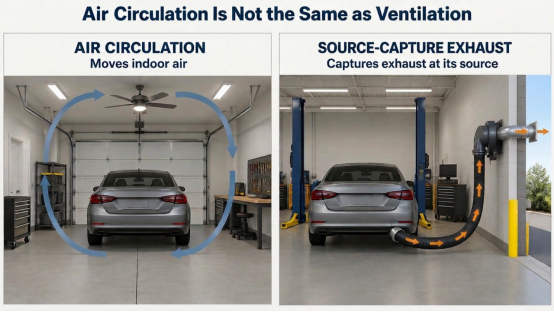
A stuffy garage makes even a short job feel longer. It’s tempting to point a big fan at the workbench and call the problem solved. For comfort, that may help. Moving air across your skin can make a hot afternoon feel more bearable. But here’s the distinction worth remembering: moving air around the room is not the same thing as getting contaminated air out of it.
A ceiling fan, floor fan or wall fan mainly circulates air. Exhaust ventilation is designed to remove air, and some automotive jobs call for much more specific controls. Running engines, spraying coatings, welding and using certain solvents can introduce hazards that a normal circulation fan cannot fix. Poor placement can spread dust or vapors.
The carbon-monoxide warning is especially important. The CDC advises against running a vehicle inside an attached garage even with the garage door open. If a repair task requires an engine to run, don’t treat an open door and a household fan as an exhaust system. Professional shops use appropriate procedures and, where needed, dedicated exhaust capture and ventilation designed for the activity. Painting and other hazardous operations may require purpose-built equipment and controls.
For routine comfort, choose where you want airflow and check that it doesn’t scatter lightweight parts, dust or paperwork. For fumes and combustion gases, deal with the source and proper ventilation first. They’re two different jobs, and it’s safer to keep them that way.
Check Ceiling Clearance Before Adding Overhead Equipment
Garage ceilings are busier than they look. Even a fairly empty two-car garage may have a door opener, tracks, storage racks, lights and electrical runs competing for the same overhead space. The real test isn’t whether a fan fits while the door is closed. It’s whether the entire installation works through the door’s full range of motion and around everything else that moves or projects into the space.
If you’re considering garage ceiling fans with lights, measure the complete installed height and the lowest part of the fixture, not just its blade diameter. Check the manufacturer’s required clearances and location rating. A ceiling that looks high enough from the floor might leave surprisingly little space once a vehicle roof rack, open hatch, storage platform or raised garage door enters the picture.
A workbench under a fan isn’t automatically a problem, but a lift, ladder or tall piece of equipment can change the clearance calculation. Use the exact model’s instructions and a qualified installer where appropriate. There’s no benefit in gaining a little airflow at the cost of an awkward or unsafe overhead layout.
Match Fan Type to Garage Size and Work Zones
Not every garage needs something hanging from the ceiling. A small space where you work in one corner may be better served by a directional fan that can be moved as the job changes. A wall-mounted unit might keep the floor clear, provided there’s a suitable mounting spot. A ceiling fan can make sense when the room has enough unobstructed overhead space and you want more general circulation while you’re in the garage.
A bigger hobby workshop is a different story. One giant fan won’t necessarily serve all three areas, particularly if walls, cabinets or equipment interrupt the airflow. Separate work zones may make more sense.
For those larger layouts, large shop ceiling fans are one category worth evaluating alongside smaller directional equipment. Look beyond blade span: the documented airflow, mounting height, controls, environmental rating and nearby obstructions all matter. Also think about what happens when you open a roll-up door or move a lift. The best position on an empty floor plan may be the worst position during a normal working day.
And keep the terminology straight. A comfort fan isn’t an exhaust fan, and industrial styling doesn’t prove a fan is rated for harsh conditions. Check the actual product documentation rather than buying by the name or appearance alone.
Make Long Garage Sessions Easier on the Body
Comfort isn’t only about temperature. Anyone who’s spent a long afternoon working beside a car knows how often you end up kneeling, reaching sideways or twisting around something that seemed easy to access ten minutes earlier. A few small changes can make the space less awkward without turning it into a professional race shop.
Put frequently used tools where you can reach them from your usual working position. If you spend time at a bench, get the height right for the tasks you do there, and leave enough light to see small fasteners clearly. A stable mechanic’s stool may help for wheel-level jobs; a suitable creeper can be useful for under-car access when the vehicle is properly secured. Anti-fatigue mats can help at standing stations, but keep them out of paths where wheeled equipment needs to move.
Don’t overlook the simple things: a dry floor, a place for a portable light, room to set down a removed part, and somewhere to step back from the vehicle. It’s not glamorous, but it helps.
When a Garage Becomes a Professional Auto Shop
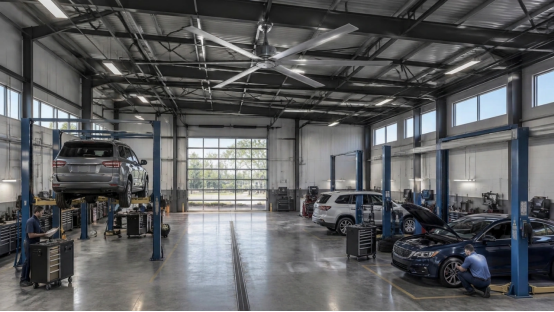
Scale changes the conversation. In a home garage, the question might be where to put one workbench and whether a fan clears the door tracks. In a professional shop with multiple service bays, you’re dealing with vehicle lifts, taller equipment, shared work areas, overhead lighting, building systems and workers who aren’t all doing the same task at the same time.
Some high-ceiling facilities may evaluate commercial HVLS fans for broad, low-speed air circulation across open areas. They are not simply oversized household fans, and they’re not right for every repair building. Structural support, installed height, sprinkler and other overhead systems, electrical compatibility, control zones and interaction with existing ventilation all have to be reviewed for the actual site.
The ventilation point still stands. A large circulation fan does not take the place of vehicle-exhaust capture, spray-booth ventilation or other controls required by hazardous work. In fact, airflow equipment should be planned so it doesn’t undermine those systems. If you’re fitting out a real service facility, involve the people responsible for building safety, mechanical systems and installation before picking equipment from a product page.
The goal is better comfort without disrupting the systems that keep the shop safe.
Build a Practical Garage Improvement Plan
It’s easy to turn a garage upgrade into a shopping list. A better approach is to change one problem at a time and see whether the fix actually works. Start by watching where you stand and what you struggle to see during your next job. If the bench is dark, deal with the bench light. If an open hood blocks the overhead fixture, try a movable task light before rewiring the whole garage.
Next, check the serious stuff: any exhaust or chemical exposure concerns, the clear travel of the garage door, and the position of ladders, lifts or tall gear. Those aren’t details to figure out after you’ve mounted a new ceiling fixture. Once the space is properly planned, you can decide whether a floor, wall or ceiling fan would add useful comfort.
Finally, use the garage for a while before adding more gear. You may discover that better light and a clearer work area solve most of the annoyance. The best garage upgrade isn’t always the biggest one. It’s the one you notice because the next job goes more smoothly.
A good garage doesn’t have to look like a TV workshop. It just has to work for your car and the jobs you enjoy doing. Light the places where you need to see, move air where it helps with comfort, handle fumes with the proper controls, and keep the overhead space clear. Get those basics right and the garage starts feeling less like a storage room you happen to work in, and more like a place built for the job.