A spare part can leave the workshop looking well packed and still arrive inside a loose, damaged bundle. The packaging straps may remain unbroken while the cartons shift beneath them. For teams moving components between suppliers, workshops and race venues, material selection starts with that distinction: holding a strap together is not the same as keeping the package fit for use.
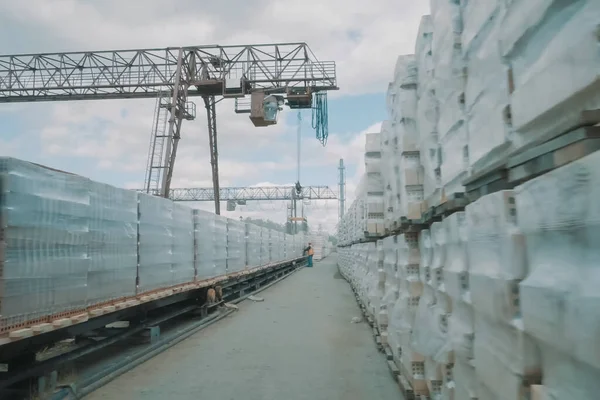
PET strapping is a candidate for palletized and bundled goods, but it needs a suitable roll, joint and application method. This guide follows the package from dispatch through arrival and storage. It concerns packaging restraint; it does not approve a packaging band as a vehicle tie-down, towing strap or lifting sling.
Define the package before choosing plastic strapping
Start with what the packing must hold together. Cartons of small spares, a supported assembly and a bundle of profiles have different contact points and different ways of moving, so write down whether the strap closes a box, reinforces a bundle or helps unitize packages on a pallet before choosing the material. “Strong banding” says too little.
ASTM’s guide for flat strapping selection describes evaluating material and application methods under handling, transit and storage conditions. Its public scope also advises consulting carriers about applicable requirements and explains that the guide is a starting point for testing, not a prescribed arrangement for every shipment.
Check the carrier’s packaging requirements before settling the design. If the package will be transferred between handlers, account for those transfers in the evaluation. A neat bundle on the workshop floor has not yet demonstrated that its supports, edge protection and strapping will remain in place through the actual route.
Where PET rolls fit into parts packaging
PET strapping is worth evaluating when the package needs a repeatable tensioned restraint and the operation can form an appropriate joint, provided the trial connects that behavior to the actual packed goods rather than treating the stiffest or widest band on the shelf as the winner. The package decides.
UD Packaging describes PET rolls for compressed, palletized and bundled goods, with hand, semi-automatic and machine-grade options. The page relates performance to working elongation, retained tension, joint quality and the load itself, and cautions that a larger nominal strap can still be wrong for the equipment.
For a workshop dispatch bench, identify the strapping tools and the expected package shapes before ordering a coil, while a supplier with a packing line should also include the machine and feed requirements because the same material name can cover very different roll formats. Match the application first. Then judge the completed package in a trial.
When lighter packaging or steel deserves consideration
PET should not become the automatic choice just because a shipment contains automotive parts. A small carton and a heavy fabricated assembly do not need identical packaging. Choosing more tension than the container can tolerate can create a new problem while trying to solve an imagined strength shortage.
The manufacturer’s limitations guidance identifies lighter cartons as candidates for polypropylene or another suitable plastic banding option. It also flags sharp edges, sustained hot contact and restraint requirements allowing very little stretch as reasons to reconsider PET and evaluate a different material system.
That is a selection screen, not permission to swap materials without review. Steel has its own handling and contact requirements, while lighter plastic strapping still needs a compatible joint and suitable package. If the assembly arrives warm, has exposed edges or needs a tightly engineered restraint arrangement, resolve those conditions before asking a supplier for a convenient roll.
Protect contact points instead of hiding them
The strap path determines where force reaches the package. An edge protector can spread contact, but only if it stays where the strap bears against the load. A cover that moves away during handling may leave a bracket edge exposed beneath a band that still looks tight from the outside.
UD Packaging warns that concentrated or poorly protected edges can cut or initiate splitting in plastic strapping under tension. Its selection advice calls for validated edge protection or evaluation of another suitable system, rather than assuming that a stronger nominal PET strap removes the edge problem.
During a package trial, examine corners and support points after tightening and again after representative handling, looking for movement, crushed packaging and changes in the strap path that could explain visible slack without assuming that the original tension setting was the cause. Find what moved. Repeated tightening can worsen settlement or contact damage.
The joint deserves its own acceptance check
A packing team may judge a band by pulling on it, but that tells little about a completed seal or weld. The joining method is part of the selected system. Smooth or embossed surface, compatible tool settings and the condition of the joining area need attention when a roll changes.
ASTM’s specification for nonmetallic strapping addresses joining methods as well as strap properties. Its abstract lists joint strength where applicable among the test considerations, separately from breaking strength and elongation. The existence of that specification does not establish that a particular supplied roll or joint complies with it.
Ask for the evidence required by the purchase specification and evaluate the actual joint on the intended package. Retain the tool identity and material reference with the result. If a connection separates after handling, preserve useful photographs and the failed sample where practical; replacing it immediately can erase the distinction between joint failure and damage elsewhere in the band.
Plan unpacking before the shipment leaves
Arrival is part of the packaging decision. Before a recipient releases any restraint, the load should be assessed for stability and supported under the site’s safe unpacking procedure. A strap can be holding displaced material as well as the intended package together. Do not assume that cutting it is harmless because the truck journey has ended.
Provide clear access to the intended opening area and tell the recipient about handling constraints specific to the contents, so the unpacking plan does not force someone to reach under an unstable assembly or stand where material could move when the restraint is released. Plan the access. Trained staff should follow their workplace procedure for cutting and protective equipment.
Record arrival condition before removing the evidence. Photographs of the pallet, joint, corners and strap path can reveal whether the package settled, protection moved or a connection opened. That record is more useful to the next packaging decision than a photograph of a loose band on the floor after everything has been dismantled.
Keep unused rolls identifiable in storage
A partly used roll can outlast the job that prompted its purchase. Store it according to the supplier’s instructions and the workplace’s handling rules, retaining the identification that distinguishes its grade, surface and dimensions. Protect the coil from damage and contamination rather than leaving it among unpacked parts and discarded packaging.
When replenishing stock, the polyester roll information from UD Packaging helps frame questions about coil length, core, surface, and application method. Keep those details attached to the stored item so that the next operator can distinguish an approved replacement from an unidentified leftover.
Core fit matters even in a small workshop. If identification is lost or the roll is damaged, resolve its suitability before returning it to service, including whether it works with the intended holder and tool arrangement rather than an improvised substitute chosen simply because someone found it available in storage. Familiar colour proves little.
Turn arrival findings into a better packing choice
The useful feedback loop connects dispatch conditions with what the recipient actually found. Keep the observations tied to a recognizable package and roll reference, so the next material decision rests on the shipment rather than memory.
Describe the contents, supporting package and intended strap path.
Confirm the material, coil format, tool and joining method.
Check edge protection and package condition after application.
Evaluate handling, transit and storage conditions relevant to the route.
Compare arrival photographs with the dispatch record before changing the specification.
A successful choice lets the parts arrive in a package that can be handled and opened as intended. An intact band is useful evidence, but it is only part of that result. Approve the material together with the joint, contact protection and packing method, then preserve that combination when ordering the next roll.
A workshop wash system may spray well during a quick demonstration yet become troublesome during a busy shift. Operators pause to move a component, another bay starts drawing water, and the pressure changes. Inlet starvation and bypass heating deserve attention alongside the cleaning pressure written on the pump label.
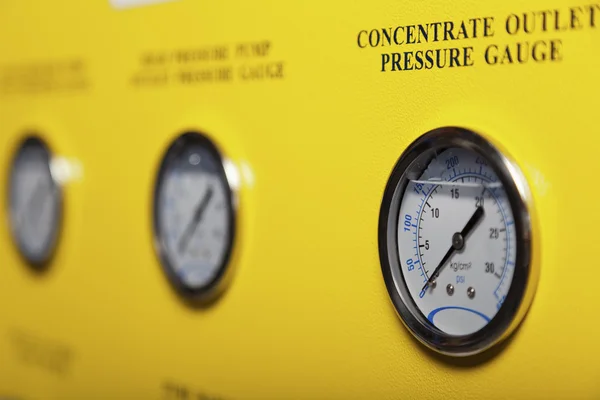
A high pressure plunger pump must fit the whole working cycle. Ceramic plungers and a suitable drive are only part of that choice. The feed supply, nozzle, unloader and return plumbing determine what happens while a gun is open, while it is closed and when cleaning resumes.
What the pump supplies to a cleaning circuit
A reciprocating plunger pump draws liquid through inlet valves and discharges it through outlet valves as its plungers move. BBP describes triplex configurations with ceramic plungers, stainless high-pressure wetted parts, and forced lubrication. These construction details belong to the pump; the complete cleaning circuit also needs compatible controls, hoses and working tools.
Start with the workpiece. Removing contamination from a bare metal casting differs from cleaning around delicate finishes, joints or electrical assemblies, so select the package around a method permitted by the equipment and workpiece instructions rather than treating higher available pressure as evidence of a better workshop result. More pressure does not settle suitability.
Define the required flow and pressure together, at the working point. Give the supplier the intended liquid and how the operator uses the gun. A package selected from a peak pressure headline leaves too much of the actual job unspecified.
Check inlet supply while the workshop is busy
In its troubleshooting guidance, Cat Pumps identifies excessive supply-line demand, restrictions, clogged filters, and low tank levels as causes of starvation, and calls for checking liquid availability while other systems are operating rather than relying on a test conducted when the workshop is quiet. Shared demand matters.
Trace the entire feed route. Record shared branches, shutoff valves, filter condition, and any hose that could kink or collapse, then compare the installation with the selected pump’s inlet requirements rather than accepting a hose that fits the port as proof that adequate water will reach the machine. Confirm the requirements with the manufacturer.
Resolve inadequate supply before increasing the cleaning workload. Replacing ceramic plungers or fitting a larger motor will not make missing water appear at the inlet. Record the operating conditions used for acceptance so future staff know what the original supply check actually covered.
Keep tank sediment and return turbulence away from the inlet
A holding tank introduces its own design questions. Cat Pumps recommends keeping the pump feed away from sediment pickup and separating it from the fill and bypass return regions to reduce air bubbles entering the pump. Its guidance also discusses baffling and cooling when warm liquid returns to a tank.
A full tank is not enough. Inspect the fill, return, and pickup positions together because adequate level alone cannot show whether the water reaching the pump contains sediment from the tank bottom or air introduced near the return, both of which matter when judging the feed arrangement. Check the water path, not just the level.
Plan filter access and cleaning around the actual liquid condition. Reclaimed wash water needs a defined treatment arrangement; stainless high-pressure wetted parts do not make a pump indifferent to abrasive contamination. Get the liquid limits and filtration requirements for the chosen assembly before connecting a recycling circuit.
Understand what happens when spraying stops
Bypass operation requires a deliberate return and temperature-control arrangement. Cat Pumps’ guidance addresses excessively hot liquid in a bypass returned to the pump inlet and calls for adequate cooling where warm return liquid enters a holding tank. Closing the gun does not make the thermal behavior of the system irrelevant.
Get the bypass conditions in writing. Ask the package supplier to identify the return destination, permitted operation and shutdown or cooling provisions for the actual circuit, making clear whether operators pause briefly to move a component or leave the system waiting through an extended interruption. Those are different operating patterns. Limits belong to the configured system.
Operators need a clear procedure for waiting, restarting, and stopping work. Where the job involves frequent pauses to reposition components, include that pattern in selection. Bypass heating is a system-design issue as well as an operating issue, so a warning label alone is an incomplete answer.
Select the unloader by its full operating range
Published unloader data from Cat Pumps separates minimum and maximum flow, pressure limits, port details, and bypass connections, illustrating why selection remains unfinished when a replacement valve matches the pressure rating, but its flow range and return arrangement have not been checked against the intended circuit. Read the complete specification.
Use the supplier-approved unloader for the pump package and working arrangement. Confirm the intended behavior when a gun closes and when it opens again. An accessory listed for another manufacturer’s pump is evidence about that accessory, not evidence of compatibility with a BBP installation.
Replacement decisions need the installed valve identity and its documentation. Changing an unloader to cure poor spraying without checking the nozzle and inlet supply can replace a healthy part. Equally, a correct pump cannot compensate for a control component selected outside its operating range. Treat pump, valve and circuit as a matched assembly.
Make nozzle inspection part of pump maintenance
Nozzle wear can reduce pressure without a failed pump. Cat Pumps warns against compensating for worn nozzles by adjusting the pressure regulating valve, because doing so risks overpressure and damage. Its troubleshooting approach puts nozzle condition among the early checks for a low-pressure complaint.
Keep the approved nozzle specification with the cleaning equipment. Check replacements against the required duty and tool configuration rather than choosing by thread size or spray appearance alone. A borrowed lance may alter the operating conditions while leaving the pump itself unchanged.
When spraying deteriorates, record the nozzle fitted, the supply condition, and whether the problem occurs with every approved tool. Follow the manufacturer’s inspection and replacement procedure. A pressure adjustment should follow an authorized setup process, not serve as a convenient response to every weak cleaning result.
Specify sustained operation as a complete duty
The BBP high-pressure pump range distinguishes compact configurations from heavy-duty process equipment and describes electric and diesel drive options. Its selection material also identifies forced lubrication and application-based configuration. These are starting points for a duty discussion rather than a blanket promise about any workshop installation.
Describe the working day. Include active spraying, pauses, and shutdowns alongside the available power supply, liquid condition, and surrounding environment, and make the bypass portion explicit so the supplier can distinguish continuous motor operation from continuous productive flow through the cleaning nozzle when selecting the package. The running pattern is part of the specification.
Request confirmation of the selected package’s operating limits and maintenance requirements. Choose the configuration that supports the documented cycle, with suitable controls and cooling. The distinction between compact and heavy-duty equipment is useful only when it leads to a specific, supportable choice for the site.
Separate wet-end care from drive-end care
BBP describes ceramic plungers, stationary sealing components, and forced lubrication as parts of its plunger-pump construction. Clean feed protects the pumping end, while correct lubrication supports the mechanical drive. Attending to only the most visible service point leaves the other side of the machine unaccounted for.
Keep maintenance entries specific. Organize filter inspection, seal condition, oil checks, and control checks around the model manual, with each task identifiable in the record, so a recurring symptom can be compared with what was actually done instead of disappearing behind a vague “pump serviced” entry. Record unresolved defects separately.
Assign defects to the right component before ordering parts. A sound oil level does not rule out inlet starvation, and clean feed does not prove that the lubrication system is functioning. Each observation answers a limited question. Combine them to decide whether the package is ready for its next operating period.
Accept the system across its working cycle
Cat Pumps’ troubleshooting guidance connects cleaning-system symptoms with feed conditions, temperature, nozzles, seals and pressure controls. Acceptance should therefore reflect the intended circuit and operating cycle. An isolated pressure reading cannot demonstrate that all those conditions are suitable.
Have qualified personnel follow the package’s commissioning procedure using approved tools, guarded equipment and pressure-rated connections. Observe active spraying, the permitted pause condition, and the restart response. Check shared-water demand under normal safe operating conditions without deliberately starving the pump.
Record the approved configuration and the limits the operator must follow. A reliable workshop system is one whose supply, control behavior and maintenance requirements remain understandable between jobs. That is a more useful outcome than achieving a dramatic pressure reading during a short demonstration.
Obtaining a license in Australia is the ultimate means of becoming a safe and confident driver. The test is structured to gauge a person’s driving skills, awareness of traffic law, and ability to manage diverse traffic conditions whilst behaving responsibly. While the specific requirements will differ by state or territory, there is no doubt that proper preparation makes it a lot easier to deal with this test.
Understanding the Driving Test Process
Before booking a practical driving test, learners should check that they meet their local requirements. These can include passing a theory test, holding a learner license for a set period, and completing a required number of supervised driving hours. Rules vary across Australia, so it’s best to confirm the details with the relevant state or territory transport authority.
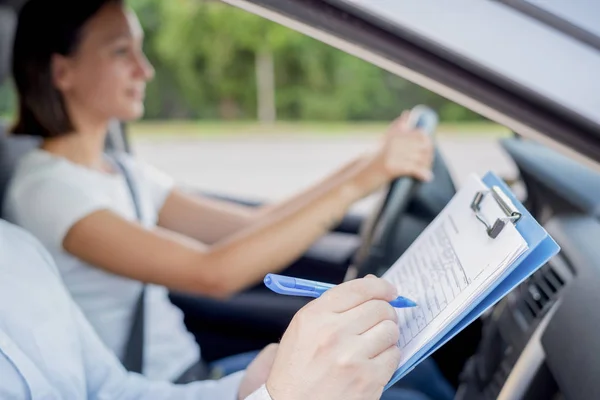
During the test, an examiner observes how safely and confidently the learner drives on public roads. They may be asked to perform tasks such as turning, changing lanes, and parking, while also checking blind spots and following traffic signals.
Essential Skills to Practice
Thorough preparation can make a real difference to your chances of passing. Practice often with a trusted supervisor or driving instructor, and pay close attention to safe gaps between vehicles, steady speed, clear signaling, and mirror checks before turning or changing lanes.
In the Orientation test Australia practical assessment, the most important things to look out for are observation, decision-making, and road safety compliance. Keep your composure, carefully consider instructions, and do not rush or overreact in any move you find yourself making.
Parking is a skill that plays a great role. It helps to start practicing early with parallel parking, reverse parking, and other maneuvers based on your regional testing requirements. Gaining confidence lets you avoid test day jitters.
Common Mistakes That You Want to Avoid
Many learners lose marks because they do not check blind spots, speed too fast, forget indicators, or think too long when they are about to make a safe decision. Another big mistake is not giving way correctly or not leaving enough space between you and the next vehicle.
For the Driving Test Australia assessment, learners would benefit from familiarising themselves with the local road signs, practicing under diverse traffic scenarios, and establishing deliberate observation habits. Do not be in a hurry to complete maneuvers and be prepared, as safety always comes before speed in the final analysis.
Tips for Your Test Day
Be early, bring the proper identification and license documents, and confirm the vehicle can pass tests. Get sufficient sleep the night before and listen closely to how the examiner speaks. You need to demonstrate what is safer and not just to be allowed through. If you mess up, if it was a small one, just keep your focus and drive carefully rather than giving in and letting the rest of the test be impacted by the nerves.
Conclusion
Passing a driving test takes more than knowing how to handle a car. It calls for steady practice, patience, and a good grasp of road safety. Learners can feel more prepared by mastering key maneuvers, understanding the rules in their area, and keeping their nerves in check. Over time, these habits make the Australian driving test a useful milestone on the way to driving independently.
Good cricket information is useful only when its source and context are understood. This article covers pitch characteristics and their limits for readers exploring Winbuzz pitch report. It separates facts from assumptions, highlights common mistakes, and offers a checklist for making more informed decisions. No statistic, match preview, or platform claim can guarantee a cricket result or a financial outcome.
Read conditions as evidence, not certainty
Pitch and weather reports can help explain possible match conditions, but they do not guarantee a score or result. Surfaces may change during play, and humidity, cloud cover, wind or dew can affect players differently. Check who published the report, when it was updated, and whether it refers to the exact venue and fixture.
Check the competition rules
Rain may delay play, reduce overs, produce a revised target, move a match to a reserve day, or lead to abandonment. The exact process depends on the competition’s playing conditions. Do not assume a general explanation applies to every format. Read the official regulations when a tie, shortened match or no-result decision is possible.
Confirm official status
Live displays may not update at the same moment as match officials’ announcements. Check the tournament organiser or a recognised scorecard for the latest status and timestamp. If sources conflict, wait for confirmation rather than relying on an old screenshot or forwarded message.
Apply the topic carefully
For readers focused on pitch characteristics and their limits, the key is to separate confirmed facts from interpretation. Keep the format, source, date and relevant rules in view. Information can improve understanding, but it cannot remove uncertainty from cricket or turn a sporting outcome into a guaranteed result. Treat the guide as a way to ask better questions, not as a promise of success.
Practical checklist
Before relying on information about Winbuzz pitch report, check the exact source, publication date, terms and any restrictions that apply. For live cricket facts, confirm the fixture and status through an official or recognised source. For a website, verify the exact domain independently, read its privacy and account conditions, and do not disclose credentials through informal messages. If any essential point remains unclear, pause rather than guessing.
Additional guidance
A familiar logo, confident wording, positive comment or repeated brand name is not enough to authenticate a website. Check the full address, policy wording and source of any important claim. If someone demands a password, one-time code, or urgent payment, stop and verify the request independently.
Keep passwords, one-time verification codes, full payment credentials and recovery codes private. If you suspect an account has been exposed, change the password from a trusted device and secure the linked email account. Contact a financial provider promptly if payment information may have been compromised. Keeping this distinction clear makes research more reliable and helps avoid decisions based on incomplete information.
Legal requirements vary by jurisdiction and can change over time. Check current official government or regulator guidance for your location instead of relying on an old blog post. Respect age limits, and do not participate if the service or activity is not lawful where you live.
More Information
A useful habit is to record the source and date of a claim about Winbuzz pitch report. This helps identify outdated information and prevents a partial quotation from being mistaken for a complete rule. When a detail affects an account, payment or match interpretation, confirm it with an independently verified source. Keeping this distinction clear makes research more reliable and helps avoid decisions based on incomplete information.
Cricket outcomes depend on many variables, including format, player roles, conditions and decisions made during play. Even accurate background information cannot eliminate uncertainty. Use the information to understand the sport rather than to justify rushed decisions or assume that a particular result is inevitable.
A familiar logo, confident wording, positive comment or repeated brand name is not enough to authenticate a website. Check the full address, policy wording and source of any important claim. If someone demands a password, one-time code, or urgent payment, stop and verify the request independently. Keeping this distinction clear makes research more reliable and helps avoid decisions based on incomplete information.
Conclusion
In short, informed cricket followers check context before drawing conclusions. Use reliable match or tournament sources for factual updates, read the applicable website terms, and protect personal information. A page calling itself “official Winbuzz” should still be verified through independent, trusted references. Avoid claims of guaranteed returns and remember that sporting outcomes cannot be predicted with certainty. If gaming stops being enjoyable or begins affecting finances, relationships, sleep, or work, take a break and seek appropriate support.
Jesse Love Proves Patience is Key, Rallying for a Third-Place Finish with the No. 2 Samsara Chevrolet at Talladega Superspeedway to Maintain Points Lead
Finish: 3rd Start: 1st Points: 1st
“It’s a phenomenal top-5. I’ve never been so happy to push someone to a win, I’ve never been so happy to not finish first, and I feel great about it. I’m happy for Sammy Smith as well, they’re a great group. I gave it my best college try for sure, but by the end of Stage 2 I realized I needed to try less hard for sure. I needed to just got along with the ball game, and we were kind of in the JRM, Hendrick, Haas sandbox. So I just tried to be there with the No. 2 Samsara Chevrolet at the end, and capitalize when they made a move, at least be in the position to push somebody, I knew that I wasn’t going to win the race, honestly, unless somebody crashed, or they got stuck side-by-side and I got a huge run and they didn’t block it. I knew I had no help, so I was just going to commit to whoever I liked the most, and push them to the win. I pride myself on taking a bad situation and trying to be smart about it, and trying to turn it into a good one. So I was okay with it.” -Jesse Love
Eventful Day for Austin Hill and the No. 21 Distributor Wire & Cable Chevrolet Team at Talladega Superspeedway
Finish: 35th Start: 5th Points: 9th
“We just didn’t have a great day with our Distributor Wire & Cable Chevrolet. I’m not sure what happened there with the wreck with the No. 54. He (Taylor Gray) got turned in front of me and we did get some damage from it. The front end was knocked in, but that moment honestly had nothing to do with how our day went. Even after going for the spin, we drove back forward. We came from the back multiple times. We ended up getting a right front flat which is what got us behind at the end, because we had to pit under green. Our car was capable of winning, just didn’t get to show it.” -Austin Hill
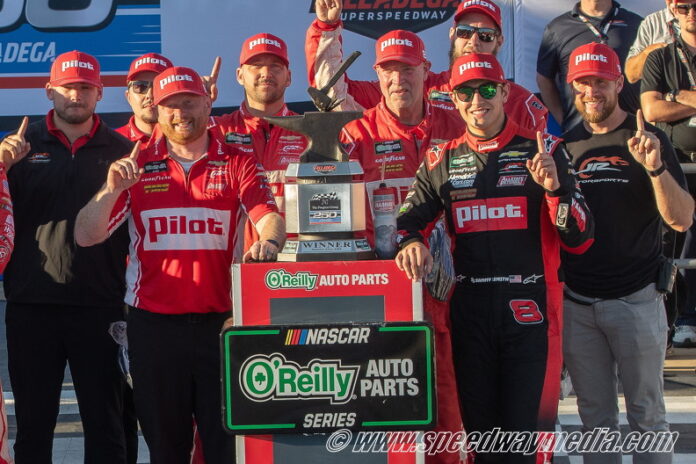
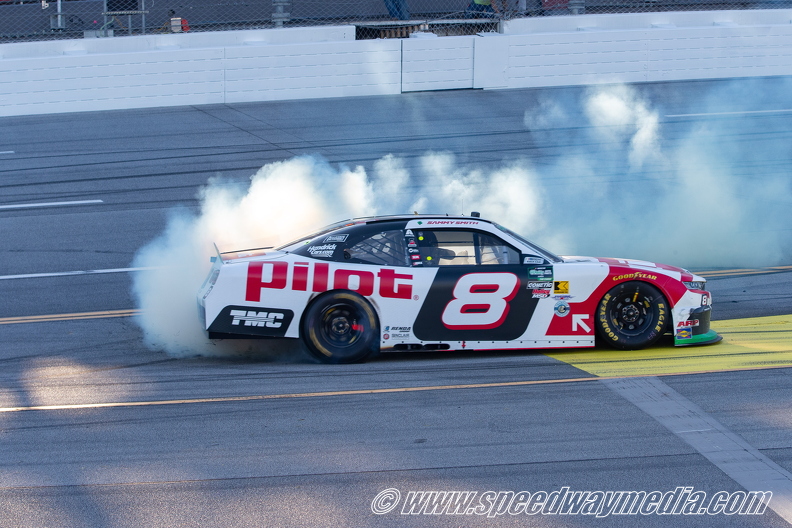
Sammy Smith nabbed a final-lap slingshot, overtake, and edge on teammate Carson Kvapil to win The Progress Group 250 at Talladega Superspeedway on Saturday, October 24.
The two-time ARCA Menards Series East champion from Johnston, Iowa, led only the final lap of the event’s 94 scheduled laps. Smith qualified in 11th place and spent the event’s entirety mixing up the competition within the draft with his fellow competitors, Chase contenders, Chevrolet-affiliated competitors, and JR Motorsports’ teammates. After finishing in 15th place at the conclusion of the first stage period and notching eight stage points by finishing in third place in the second stage period, Smith was lined up in second place behind Kvapil within the draft amid a 16-lap dash to the finish.
After spending a majority of the closing laps tucked behind Kvapil amid the draft, Smith seized a draft by teammate Justin Allgaier through the backstretch on the final lap to reel in Kvapil and execute a slingshot move to Kvapil’s left. Both Smith and Kvapil dueled for the lead approaching the tri-oval until the former received a push by Jesse Love to motor ahead with the inside lane. With Kvapil unable to quickly reel in his deficit, Smith capitalized on the late surge to notch his first elusive NASCAR O’Reilly Auto Parts Series victory of the 2026 season and his second win of this weekend following Friday’s Craftsman Truck Series victory at Talladega.
With on-track qualifying determining the starting lineup, points leader Jesse Love notched his third O’Reilly pole of the 2026 season with a pole-winning lap of 182.626 mph in 52.435 seconds. Jake Finch qualified in second place with a lap of 182.619 mph in 52.437 seconds as he shared the front row with Allgaier.
Prior to the event, Chase contender Corey Day dropped to the rear of the field due to an engine change. Lee Pulliam also dropped to the rear of the field due to unapproved adjustments.
When the green flag waved and the event commenced, pole-sitter Jesse Love and Jake Finch dueled for the lead in front of Carson Kvapil, Sam Mayer and the field through the first two turns until Finch was shoved ahead of Love by teammate Kvapil through the backstretch. Amid Finch’s early defensive drive, Kvapil made a move to Finch’s right side and managed to lead the first lap by 0.022 seconds.
With the field fanning out in three-wide formation amid a tight pack during the second lap, Kvapil led the latter lap before he was challenged by Finch for the lead. As teammate Rajah Caruth tried to ignite a third drafted lane towards the outside lane, Kvapil managed to fend off Finch to lead the next lap while being pushed by Austin Hill in the middle lane. By then, Sam Mayer, who was racing upfront in the early laps before he was shuffled out of the draft, was the third competitor mired in the middle lane behind Hill and Anthony Alfredo.
As Kvapil utilized defensive driving to maintain his early lead by the fifth lap mark, Caruth, Sheldon Creed, Justin Allgaier and Corey Day were in the top five while Love, Finch, Mayer, Hill and Brent Crews filled in the remaining top-10 spots, respectively. For the following lap, Finch got shuffled back to 16th place as six Chevrolet competitors led by Kvapil and including Caruth, Creed, Allgaier, Day and Mayer raced upfront towards the outside lane while Love tried to ignite a charge while leading the inside lane. A majority of the field would line up in single-file formation behind Kvapil towards the outside wall, while a few led by Love remained on the inside lane.
Through the first 10 laps, Kvapil was leading ahead of teammate Caruth, Creed, teammate Allgaier and Day while Mayer, Brandon Jones, Parker Retzlaff, William Sawalich and Connor Mosack were in the top 10, respectively. Behind, Taylor Gray, Anthony Alfredo, Love, Austin Hill and Sammy Smith occupied the top-15 spots while Finch was mired in 16th place ahead of Jeremy Clements, Brent Crews, Josh Williams and Ryan Sieg, respectively. In addition, all 38 starters on the track were separated by eight seconds of one another as Kvapil continued to lead at the Lap 15 mark.
At the Lap 20 mark, a majority of the field, led by the race leader Kvapil, continued to race in single-file formation towards the outside wall while Mayer tried to ignite a run from the inside lane as he was followed by Retzlaff, Alfredo, Hill and Mosack. With the latter group blending back within the long single-line formation by the next lap, Mayer drifted back to 17th place as Caruth, Creed, Allgaier, Day, Gray, Mosack, Finch, Clements and Sawalich followed suit in the top-10 mark behind Kvapil, respectively. Retzlaff then spun through the grass entering the third turn, but he remained below the track’s apron and the event remained under green flag conditions as the front-runners began to fan out and shuffle behind the leader Kvapil.
When the first stage period concluded on Lap 25, Kvapil edged Caruth by 0.055 seconds to win his fifth O’Reilly stage period of the 2026 season. Caruth settled in second ahead of Allgaier, Day and Crew while Mosack, Gray, Finch, Clements and Sawalich were scored in the top 10, respectively. With six of 12 Chase contenders (Kvapil, Caruth, Allgaier, Day, Creed and Gray) racking up the event’s first round of stage points, the remaining Chasers that include Hill, Mayer, Jones, Sammy Smith, Love and Retzlaff were scored in 12th, 13th, 14th, 15th, 17th and 38th, with Retzlaff mired two laps behind the leaders.
Under the event’s first stage break period, nearly the entire field led by Kvapil pitted while Ryan Ellis, Patrick Staropoli, Nick Leitz, Caesar Bacarella and Joey Gase remained on the track. Once the latter five pitted during the next lap, Day, who exited pit road first, cycled to the lead ahead of Creed, Sawalich, Gray, Caruth, Finch, Jones, Allgaier, Mayer and Love, respectively. During the pit stops, Kvapil stalled his entry while leaving his pit box and was mired back in 12th place. In addition, Austin Hill spent an extensive time in his pit stall to have radio issues addressed while teammate Love was sent to the tail end of the field as a penalty for improper fueling.
The second stage period started on Lap 31 as Day and Sawalich occupied the front row. At the start, early shuffling that fanned out the field ensued as Day motored ahead of the field through the first two turns. Through the backstretch, Sawalich lost a bevy of spots while racing on the inside lane as a majority of the field migrated back up towards the outside lane behind Day. As Day led the next lap Creed, Caruth, Allgaier, Gray and Finch were the next five competitors lined up behind Day’s entry while Kvapil tried to ignite a charge from the inside lane. As Kvapil, Creed and Day battled three wide for the lead for the next lap, Dean Thompson nearly got sideways amid contact, but he managed to keep his entry straight as Kvapil slid his way back into the lead over Day.
Just past the Lap 35 mark, Kvapil led both the event and a long line of competitors filed towards the outside lane while Hill, who jumped out of line just past the start/finish line, tried to ignite a charge while leading the inside lane that included Sawalich, Creed and Mayer. By then, Day, Caruth, Allgaier, Gray, Thompson and Sammy Smith were lined up behind Kvapil as Hill drew closer to the front by navigating his way up to second place by Lap 38. Hill would be scored in fourth place at the Lap 40 mark and Kvapil retained the lead over Day and Caruth, respectively, as the lead pack was mired by two-stacked lanes.
For the following lap, Allgaier gave Hill a strong shove that enabled Hill and the competitors racing on the inside lane, including Allgaier, Sammy Smith, Mayer and Jones, to gain the advantage. As Kvapil led Lap 41 by 0.009 seconds over Hill, the latter then assumed command before Allgaier made a move beneath Hill and motored his way to the front for the next lap. With a variety of shuffling ensuing at the front and within the leaderboard, Allgaier maintained the lead on Lap 45 in front of a stacked, three-wide field and ahead of Kvapil, Love, Smith, Jones, Alfredo, Caruth, Hill, Finch, Mosack, Day, Crews, Harrison Burton, Clements, Dean Thompson, Leland Honeyman Jr., Blaine Perkins, Gray, Creed, Sawalich, Lee Pulliam, Mayer and Josh Williams, respectively.
When the second stage period concluded on Lap 50, Allgaier fended off the field to notch his 12th O’Reilly stage victory of the 2026 season. Kvapil, Smith, Hill, Day, Creed, Harrison Burton, Crews, Alfredo and Honeyman were scored in the top-10 mark, respectively. With Allgaier, Kvapil, Smith, Hill, Day and Creed racking up the event’s second round of stage points, the remaining Chasers that include Gray, Mayer, Love, Jones, Caruth and Retzlaff were mired in 11th, 12th, 15th, 16th, 19th and 38th, respectively.
During the event’s second stage break period, nearly the entire field led by Allgaier returned to pit road for service while the rest led by Joey Gase, Nick Leitz, Caesar Bacarella, Ryan Ellis and Josh Bilicki remained on the track. Once the latter five pitted, Harrison Burton, who only pitted for two tires, cycled to the lead along with Gray and Sawalich, the latter two of whom also pitted for two tires. Kvapil, the first competitor with four fresh tires, exited in fourth place ahead of Allgaier, Day, Jones, Hill, Sammy Smith and Creed, respectively.
With 38 laps remaining, the final stage period commenced as Harrison Burton and Gray occupied the front row. At the start, Burton, who restarted on the inside lane, was drafted by Kvapil ahead of Gray and the field through the first two turns and the backstretch before the outside lane led by Gray came storming back atop the competition.
Seconds later as the field navigated through the tri-oval, the caution returned when Burton, who was trying to fend off Kvapil from the inside lane and Gray on the outside lane simultaneously, made contact with Gray’s left front while trying to move to the right and stall Gray’s momentum. The contact caused Gray to spin through the tri-oval and in front of the field as Hill, who made contact with Gray’s spinning entry, also spun. Jones also spun to avoid Hill’s spinning entry as the latter was just dodged by Finch. Brennan Poole and Honeyman also spun further at the rear of the field while the rest of the competition dodged the incident. Amid the incident, Burton retained the lead over Kvapil, Smith, Allgaier, Sawalich, Mayer, Day, Creed, Love and Crews, respectively.
The next restart with 32 laps remaining featured Kvapil getting pushed by teammates Smith and Allgaier ahead of Burton and the field that fanned out through the first two turns and the backstretch. As Burton got pinned in the middle lane, Kvapil, who was pushed to the lead from the inside lane, led the next lap before he and teammates Smith and Allgaier transitioned from the inside to outside lane to stall a charge by Day and a multitude of competitors just past the frontstretch. As Crews tried to ignite a charge from the inside lane, a majority of the field migrated in single-file formation towards the outside wall as Kvapil led with 30 laps remaining.
Down to the final 25 laps, Kvapil led a long line of competitors in single-file formation, with Smith, Allgaier, Day, Mayer, Creed, Love, Clements, Alfredo, Perkins, Thompson, Mason Maggio, Williams, Mosack, Jones, Jeb Burton, Retzlaff, Hill, Joey Gase, Sawalich and Caruth following suit in the top-21 mark, respectively. A lap prior, Caesar Bacarella spun through the tri-oval’s grass, but he managed to proceed without drawing a caution. Meanwhile, Gray was mired a lap down in 36th place as Kvapil retained the lead over the next three laps.
With 21 laps remaining, the caution flew due to debris detected in the first turn. At the time of caution, Kvapil was leading ahead of Smith, Allgaier, Day, Mayer, Creed, Love, Clements, Alfredo and Perkins, respectively while the top-35 competitors were separated by seven seconds of one another. During this latest caution period, some, including Caruth, Austin Hill, Kyle Sieg, Daniel Dye, Patrick Staropoli, Ran Sieg, Will Rodgers and Jake Finch, pitted while the rest, led by Kvapil, remained on the track.
For the next restart with 16 laps remaining, Kvapil was pushed ahead of Mayer by teammate Smith as Jones tried to ignite a third drafting lane through the middle within the top-10 mark. As Jones transitioned from the inside and middle lanes while storming his way to the front, Kvapil fended off the fanned-out field to lead the next lap. Jeb Burton then tried to mount a charge from the inside lane as he got close within the top-five mark by the following lap while being pushed by Jones. By then, a majority of the field still opted to line up in single-line formation behind Kvapil towards the outside lane as Smith, Mayer, Allgaier, Day, Love, Creed, Alfredo, Perkins and Jones settled in the top 10, respectively.
Down to the final 10 laps and with nearly the entire field lined up in single-file formation on the outside lane, Kvapil led Smith, Mayer, Allgaier, Day, Love, Creed, Alfredo, Perkins and Jones while Thompson, Jeb Burton, Harrison Burton, Maggio, Crews, Nick Leitz, Bilicki, Ryan Sieg, Caruth, Joey Gase, Gray, Mosack and Retzlaff followed suit, respectively, as the top-35 competitors were separated by two seconds. By then, Hill made an unscheduled pit stop after he hit the wall and cut a tire, which dropped him out of the lead lap category.
As the laps dwindled, Kvapil maintained the lead in front of a long line of competitors, with Smith, Mayer, Allgaier, and Day, all of whom were in the top-five mark, electing to remain behind Kvapil within the draft as Kvapil continued to lead with five laps remaining and over the next three laps.
When the white flag waved and the final lap started, Kvapil remained in the lead over Smith as third-place Mayer darted his No. 41 Starkey Chevrolet Camaro entry to the left in his final-lap bid to the front. Kvapil quickly transitioned to the inside lane to block Mayer through the first two turns. As Mayer struggled to file back in line within the draft, Smith received a strong shove from Allgaier to reel in Kvapil before Smith darted his No. 8 Pilot Flying J Chevrolet Camaro entry to the left and drew alongside Kvapil’s No. 1 Bass Pro Shops Chevrolet Camaro entry entering Turns 3 and 4. With two-stacked lanes charging through the tri-oval and the front-runners fanning out, Smith and Kvapil continued to duel until Smith, who was pushed by Love, started to motor ahead. Kvapil tried to fight back while being pushed by Allgaier, but Smith managed to cross the finish line by 0.084 seconds and claim the victory.
With the victory, Smith, who only led the final lap, notched his fourth career win in the O’Reilly Auto Parts Series division, his second in the series at Talladega and his first overall victory since he was awarded a win at Rockingham Speedway in April 2025.
Smith, who also won Friday’s Craftsman Truck Series event at Talladega, became the first-ever competitor to notch two NASCAR national touring series victories during the fall Talladega weekend festivities. He also became the fifth competitor (Ernie Irvan, Dale Earnhardt, Mark Martin and Dale Earnhardt Jr.) to achieve multiple national touring series victories at Talladega in the same weekend. The Iowa native is the eighth competitor overall to achieve multiple O’Reilly victories at Talladega and he delivered JR Motorsports’ fifth O’Reilly victory at Talladega and the organization’s 16th victory of the 2026 season.
Smith’s Talladega victory was a sentimental one as he is down to his final two events both in the O’Reilly Auto Parts Series division and with JR Motorsports. Next season, he will be competing in the Truck Series division on a full-time basis with TRICON Garage.
Photo by John Knittel for SpeedwayMedia.com.
“Man, I’m out of breath,” Smith said on the frontstretch on the CW Network. “That was mentally drained. Just thank you to everybody. It was a great-executed race by [JR Motorsports] and Corey [Day]. We did a good job sticking to our plan with getting those guys stage points. I’m sure they wanted them to win, but I had a good run there to take it. [Spotter] Tyler Green did a great job up top to help me get backed up. Thanks to Jesse [Love] for pushing me. I’m sure I’m his biggest fan right now, helping him [in the championship points battle], but really, I’m just happy for everyone on this No. 8 Pilot Chevrolet. It’s been a tough year this year. Thank you to everyone, [crew chief] Cory Shea, doing a good job just giving me fast race cars. I’m looking forward to Martinsville next week.”
Teammate Carson Kvapil, who led a race-high 69 laps, settled in second place for his 12th top-five result of the 2026 season. Prior to Talladega, Kvapil was scored 79 points behind the points lead. After notching a combined 19 stage points along with his runner-up result, he shaved off 20 points of his deficit and is ranked in fifth place in the Chase standings entering next weekend’s penultimate event of this season at Martinsville Speedway. Nevertheless, he remained disappointed at not gaining the maximum points for the Talladega victory.
“We’ve kind of been, if not the best car, one of the best cars at all the speedways this year, so I knew going into this weekend, it was gonna be a big opportunity for us to have a big points day and really eat away at that [points] gap,” Kvapil said. “I just feel like we’re a little too far to have that Hail Mary day at Martinsville. We can go out and win both stages and win the race. A few guys can have a bad day, and there might be an opportunity for that, but I just feel like today was more the day for that. ”
Meanwhile, Jesse Love rallied his way from his improper fueling pit road penalty early in the event to finish in third place after he pushed Sammy Smith to the victory. Despite recording no stage points, Love, who was satisfied with his Talladega result, maintains his points lead by 19 points over Justin Allgaier as he sets his sights on the final two events of this season, including next weekend’s event at Martinsville, and continues his pursuit for his series title defense.
“The middle part of that race, if you would’ve told me I was gonna finish third, I would’ve been jumping up and down out of joy,” Love said. “[I’m] Happy to leave here with the [points] lead. Probably, not the most challenging, but the most strategically, challenging race I’ve ran here ever. Even on a day like that where literally 42 things are working against us, we’re still able to have a good day. Very proud of that. We don’t know yet what Martinsville’s gonna look like, but I know for sure that if there’s an opportunity there for us, we’ll take it and make the most of it.”
Justin Allgaier, who led 11 laps, settled in fourth place while Sheldon Creed finished in fifth place. Corey Day, Blaine Perkins, Dean Thompson, Brandon Jones and Anthony Alfredo finished in the top 10. With seven Chase contenders (Smith, Kvapil, Love, Allgaier, Creed, Day and Jones) finishing in the top 10, the remaining Chasers that include Sam Mayer, Rajah Caruth, Taylor Gray, Parker Retzlaff and Austin Hill finished 13th, 17th, 21st, 31st and 35th, respectively.
The seventh O’Reilly Auto Parts Series’ Chase event of the 2026 season at Talladega saw 11 lead changes among eight leaders, and four cautions over 20 laps. In addition, 34 of 38 starters finished on the lead lap.
Results:
Sammy Smith, one lap led
Carson Kvapil, 67 laps led, Stage 1 winner
Jesse Love
Justin Allgaier, 11 laps led, Stage 2 winner
Sheldon Creed
Corey Day, four laps led
Blaine Perkins
Dean Thompson
Brandon Jones
Anthony Alfredo
Jeb Burton
Mason Maggio
Sam Mayer
Ryan Sieg
Nick Leitz
Josh Bilicki
Rajah Caruth
Jeremy Clements
Connor Mosack
Joey Gase, one lap led
Taylor Gray, one lap led
Lee Pulliam
Josh Williams
Harrison Burton, eight laps led
Will Rodgers
Brennan Poole
Garrett Smithley
Kyle Sieg
William Sawalich
Ryan Ellis, one lap led
Parker Retzlaff
Patrick Staropoli
Daniel Dye
Brent Crews
Austin Hill, two laps down
Leland Honeyman Jr., six laps down
Caesar Bacarella, nine laps down
Jake Finch – OUT, Accident
*Bold indicates Chase Drivers
After the seventh Chase event of the 2026 NASCAR O’Reilly Auto Parts Series season, Jesse Love leads the standings by 19 points over Justin Allgaier, 29 over Corey Day, 50 over Sheldon Creed and 59 over Carson Kvapil. The rest of the 12-car Chase field is displayed below.
Chase Standings:
Jesse Love
Justin Allgaier -19
Corey Day -29
Sheldon Creed -50
Carson Kvapil -59
Sam Mayer -96
Sammy Smith -108
Taylor Gray -155
Austin Hill -168
Brandon Jones -189
Parker Retzlaff -201
Rajah Caruth -218
Next on the 2026 NASCAR O’Reilly Auto Parts Series’ Chase schedule is Martinsville Speedway in Ridgeway, Virginia, for the National Debt Relief 250. The event is scheduled to occur next Saturday, October 31, and air at 4 p.m. ET on the CW Network, MRN Radio, and SiriusXM.
THOMPSON MAKES INCREDIBLE SAVE ON WAY TO TOP TOYOTA HONORS AT TALLADEGA The Sam Hunt Racing driver delivers consecutive top-10 runs for the first time in his career
TALLADEGA, Ala. (October 24, 2026) – Dean Thompson delivered an incredible save mid-race and recovered to finish eighth to lead Toyota in the NASCAR O’Reilly Series race at Talladega Superspeedway on Saturday afternoon. Thompson followed his seventh-place run at Phoenix with another strong performance – his first consecutive top-10 finishing streak of his NASCAR O’Reilly Series career.
Brandon Jones (ninth) also recovered from a mid-race spin to suffer no damage and the Georgia-native was able to drive from the 30s back to the top-10 to move back inside the top-10 in points.
TOYOTA RACING Post-Race Recap NASCAR O’Reilly Auto Parts Series (NOAPS) Talladega Superspeedway Race 31 of 33 – 250.04 miles, 94 laps
TOYOTA FINISHING POSITIONS
1st, Sammy Smith*
2nd, Carson Kvapil*
3rd, Jesse Love*
4th, Justin Allgaier*
5th, Sheldon Creed*
8th, DEAN THOMPSON
9th, BRANDON JONES
21st, TAYLOR GRAY
24th, HARRISON BURTON
29th, WILLIAM SAWALICH
34th, BRENT CREWS
*non-Toyota driver
TOYOTA QUOTES
DEAN THOMPSON, No. 26 Thompson Pipe Group Toyota GR Supra, Sam Hunt Racing
Finishing Position: 8th
Another solid superspeedway top-10. Can you tell us about your race?
“I just want to thank Thompson Pipe Group, Sam Hunt Racing and Toyota. Really solid day for us. I wish we could have gotten some more stage points, but with the tire stuff happening in the truck race yesterday, that was an iffy thing – so we just played it safe all day and came away with a good finish.”
Can you tell us how you saved it there?
“That was wild. I was hand-over-hand, but testament to how good these race cars drive at Sam Hunt Racing. Thanks to the guys.”
BRANDON JONES, No. 20 Menards/Atlas Toyota GR Supra, Joe Gibbs Racing
Finishing Position: 9th
Clean race car, and a top-10 at a superspeedway. I know you wanted more, but how was your race as a whole?
“I think the save – I don’t know if you call that a save, but it was a no contact spin which was pretty epic there. Half of it was driver, half of it was luck, I think, when it came to that, but I was happy we didn’t tear up our Atlas, Menards Supra up there. I think we made a lot of really solid moves. There are a lot of people – I think a lot of the other manufacturers are just out for themselves, and it is kind of hard to get some guys going with you, so with that kind of that mindset in play, I thought we did a really good job of keeping ourselves with people that were really shoving us really aggressively, and really hard. We made some really good moves at times. It was kind of difficult at times to generate those runs by yourself. People tonight kind of ran around single-file for most of the race. I see that here, the second race, everyone really gets tight on that cut line on the Chase, and people don’t put themselves in quite as risky scenarios that you would in the Spring, so you typically see more of a conservative race here for that reason every time. I think all things considered, a top ten is great. I would have like to have been up there in the stages more, but it is kind of timing those runs correctly and getting in the right lane whenever it builds and has momentum. There is always room to improve on the driver side and the car side, but I’ll take this, and it is definitely something we can build off of. There was a lot of good moves that we can go back and study and look at and see what was good, and maybe there was some that I made that weren’t quite as good, so I can study those too.”
About Toyota
Toyota (NYSE:TM) has been a part of the cultural fabric in North America for nearly 70 years, and is committed to advancing sustainable, next-generation mobility through our Toyota and Lexus brands, plus our more than 1,800 dealerships.
Toyota directly employs nearly 64,000 people in North America who have contributed to the design, engineering, and assembly of over 50 million cars and trucks at our 14 manufacturing plants. In 2025, Toyota’s plant in North Carolina began to assemble automotive batteries for electrified vehicles.
TALLADEGA, Ala. (October 24, 2026) – Joe Gibbs Racing driver Chase Briscoe was made available to the media on Saturday after willing the pole for the NASCAR Cup Series race at Talladega Superspeedway.
This is Chase Briscoe’s first pole of the year, and fourth consecutive top-four start. It is his 10th career pole, and first at Talladega Superspeedway. Briscoe is also the reigning fall Talladega race winner.
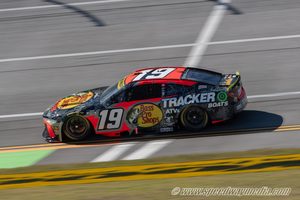
CHASE BRISCOE, No. 19 Bass Pro Shops Toyota Camry XSE, Joe Gibbs Racing
Can you take us through your qualifying lap?
“The lap, for my standpoint, was relatively smooth, I guess, outside of just bouncing around. So yeah, just tried to, I mean, as cliche as it sound, just tried to push my foot as hard as I could on the pedal, like my son (Brooks) always tells me, just with how much we’re bouncing, sometimes you can come up off of wide open. So yeah, I just tried to literally push the thing through the floorboard, and I don’t know if that even made a difference, but in my head, it was doing something. So, yeah, obviously I have a great starting spot tomorrow for our Bass Pro Shops Toyota, but who knows what to expect with just the handling and obviously that fuel first run, it’s going to be all about fuel savings. We will probably have the blinker on pretty early trying to not have the lead, but, yeah, we’re going to see how it plays out.”
How much of an advantage is it to win at pole at Talladega?
“I mean, definitely, from a pride standpoint, there’s a lot that goes into just all the little, tiny details that add up. I mean, it’s literally thousandths, probably, but you stack enough of those together, just the pride, I think that comes along with that from the guys goes a long way and the confidence and from a racing standpoint, it’s hard to say. I mean, if you have a yellow flag pit stop, having that first pit stall is obviously an advantage, but if it’s a green flag pit stop, it’s a little bit of a disadvantage. So, I don’t know, it goes both ways. I guess with the package, nobody knowing what to expect, maybe being out front, if there’s a wreck early, maybe save you from that. But, yeah, I don’t know. There are definitely pros and cons of it. It does show that we have a fast car. So, if it’s typically if it’s fast by itself, it’s normally fast in the draft too. So hopefully, that’ll be good for us tomorrow.”
That is fastest Talladega pole run in the Next Gen car. Did it feel that fast in the car?
“I don’t know if my time was actually better in the second round, but I felt slower the second run than the first run, just from like an engine tone standpoint, but it’s so hard inside the car. Like that first round, obviously, we were really, really good, but inside the car, very well could have been 27th. I had no idea what it was going to be. Then, obviously when the time came up, I knew it was good. Yeah, inside the car, it’s honestly pretty hard to tell. I wouldn’t have been able to tell you that it was three miles an hour faster. In the pack, I think, it’ll feel faster though.”
Does it make you more hopeful for tomorrow that you may be able to form a third lane?
“Yeah, I think so. I mean, it was kind of wild to me after Daytona, there was a couple guys that felt like the package was no different, and I felt like it was drastically different, just how it drove, just, you were way more on the edge at all times. Historically, that race at Daytona is like the easiest race we have of the year from the balance standpoint. This place could be absolutely out of control. It’ll be interesting to see how that plays out tomorrow.”
Are you surprised with how long it took to get you the first pole of the year?
“A little bit, yeah, because last year, truthfully, it felt easy. Like everywhere we would go, if we weren’t on the pole, we were in the top two or three. This year, yeah, we just haven’t been as strong from a qualifying standpoint. It’s kind of flipped. Last year I thought we were just incredible on the mile and a half tracks in qualifying. In the race, we wouldn’t be quite as good. It was kind of the opposite on short tracks. We wouldn’t qualify very good. Well, this year, we’ve been really good, honestly, short track qualifying. Haven’t had the poles, but mile and a half wise, we’ve not been near as good in qualifying, but we’ve been really good in the races. So, yeah, going into this into this season, you would have told me it would have taken until race 33 to get a pole, I probably wouldn’t have believed you. But this sport is just extremely hard. That was a place where we just haven’t been as strong as what we were last year. So yeah, I just have to continue to get better.”
Are you just focusing on your team with as many Joe Gibbs Racing teams competing for the championship?
“I mean, truthfully, I haven’t really had like an actual conversation or anything, but I think just everywhere we go, we typically are racing for the win and obviously it’s different this time of the year just for the championship and things on the line. But yeah, I think it’s kind of unspoken. Coach (Joe Gibbs, owner, Joe Gibbs Racing) knows that we’re all going to be in it for ourselves at the end of the day. I want the 19 to win the championship. Denny (Hamlin) wants the 11 win the championship. Christopher (Bell) wants the 20. We all know that at the end of the day that we’re all going to do what’s best for ourselves, but also I do think we all do a really good job of trying to help each other out when we can. At the end of the race, it might be hard to do that sometimes, but I do think we’re all still very aware of what’s going on and we don’t want to cost both of us a shot at it or all three of us a shot at it. So you’re just aware of that the whole time.”
How do you feel like you have to execute this weekend with the other drivers around you being really good at Martinsville?
“Yeah, I think it’s massive. I mean, we’re at the point of the season now, especially with how tight the points are that, I mean, literally one point can be the difference in you being the champion or not. I think when you look at this weekend, this is the one that’s the most wide open of what can happen where Martinsville and Homestead are just a little bit more traditional. But yeah, out of the all the tracks in the Chase, I would say Martinsville, for us on the 19 group, has been the biggest struggles. Yeah, I mean, every point we can get, you know, this week is extremely important. Just like I said, it’s going to come down to one point probably. So, yeah, execution’s going to be at extremely high level this weekend. Just the green flag pit stops, everything else that comes along with it. You just don’t want to make a mistake and take yourself out of it. It’s one thing if you get caught up in the crash. I mean, hopefully that doesn’t happen, but you, as a driver, don’t want to, to be the reason that you get a speeding penalty or something like that.”
About Toyota
Toyota (NYSE:TM) has been a part of the cultural fabric in North America for nearly 70 years, and is committed to advancing sustainable, next-generation mobility through our Toyota and Lexus brands, plus our more than 1,800 dealerships.
Toyota directly employs nearly 64,000 people in North America who have contributed to the design, engineering, and assembly of over 50 million cars and trucks at our 14 manufacturing plants. In 2025, Toyota’s plant in North Carolina began to assemble automotive batteries for electrified vehicles.
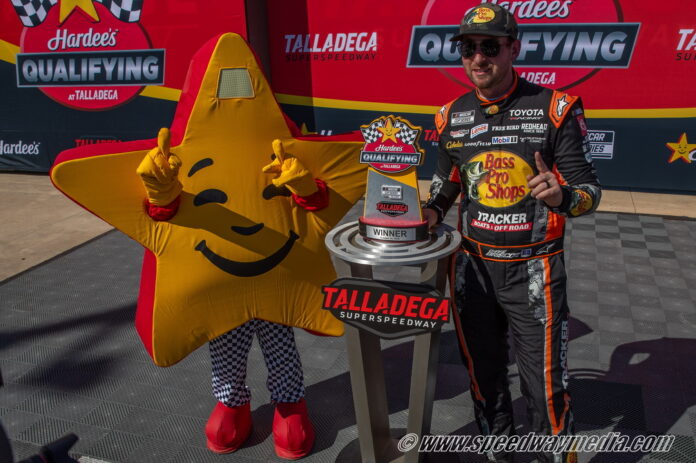
Chase Briscoe snatched the Busch Light Pole Award for the YellaWood 500 at Talladega Superspeedway on Saturday, October 24.
The event’s starting lineup was determined through a two-round qualifying session. The first session featured 36 competitors battling for 38 starting spots, all of whom cycled once around Daytona to post the fastest lap. At the end of the first session, the top-10 fastest qualifiers advanced to the second and final round, where they contested pole position.
Briscoe was the fastest qualifier during the first qualifying round at 186.047 mph in 51.471 seconds. After being one of 10 competitors to transfer to the second and qualifying round, he was the last competitor to qualify. During his lap, his single lap stood at 186.065 mph in 51.466 seconds. The lap was enough for the two-time Southern 500 champion from Mitchell, Indiana, and driver of the No. 19 Bass Pro Shops/Joe Gibbs Racing Toyota Camry XSE entry to knock Austin Hill and the latter’s No. 33 United Rentals/Richard Childress Racing’s Chevrolet Camaro ZL1 entry off the top of the qualifying charts and achieve the top-starting spot for Sunday’s main event at Talladega.
With the pole, Briscoe, who won seven poles in 2025, notched his first elusive NASCAR Cup Series pole position of the 2026 season, the 10th of his career for his 214th series’ start and first at Talladega. He also notched the eighth pole of the 2026 Cup season for Joe Gibbs Racing as all four of the latter organization’s entries have secured at least one pole this season.
Briscoe is currently ranked in third place in the 2026 Chase standings and trails points leader Kyle Larson by 24 points. Having won at Talladega a year ago in the fall, Briscoe will attempt to both defend his series’ victory and reel in Larson for the points lead with three-scheduled events remaining to contend for his first Cup Series championship.
Photo by John Knittel for SpeedwayMedia.com.
“It’s definitely been a while [since I won a pole],” Briscoe said. “I think last year we had seven, and this year, we’ve not just been as good of a qualifer as we were last year for whatever reason. It’s a testament to these [No. 19] guys. This is definitely one of those team pole session. There’s not a whole lot I can really do to benefit, but I can certainly screw it up. I just did an amazing job on our Bass Pro Shops, Tracker [Boats] Toyota. Hopefully, we can back up what we did here last year. That’d be pretty special, especially just the timing and everything we’re racing for. I got a fast car, obviously see if we can keep it up there now.”
Briscoe will share the front row with Austin Hill, the latter of whom is making his 24th Cup start of the 2026 season and earned his first front row starting spot for a Cup event. Hill, who was initially in prime position of achieving his first Cup career pole, posted the second-fastest qualifying lap at 185.949 mph in 51.498 seconds.
Connor Zilisch, teammate Shane van Gisbergen and Chris Buescher will start in the top five, respectively. Christopher Bell, Alex Bowman, Ty Gibbs, Denny Hamlin and points leader Kyle Larson, all of whom transferred to the second and final qualifying round along with Briscoe, Hill, Zilisch, van Gisbergen and Buescher, complete the top-10 starting grid.
With six of 16 Chase contenders (Briscoe, Buescher, Bell, Gibbs, Hamlin and Larson) qualifying in the top-10 mark, the remaining Chasers that include Daniel Suarez, Joey Logano, William Byron, Chase Elliott, Ryan Preece, Bubba Wallace, Carson Hocevar, Ryan Blaney, Austin Cindric and Tyler Reddick (last weekend’s winner at Phoenix Raceway) will start 13th, 16th, 17th, 18th, 19th, 25th, 26th, 27th, 28th and 33rd, respectively.
With 40 competitors vying for 40 starting spots, all made the main event.
Talladega – Starting Lineup:
Chase Briscoe, 186.065 mph, 51.466 seconds
Austin Hill, 185.949 mph, 51.498 seconds
Connor Zilisch, 185.877 mph, 51.518 seconds
Shane van Gisbergen, 185.707 mph, 51.565 seconds
Chris Buescher, 185.607 mph, 51.593 seconds
Christopher Bell, 185.549 mph, 51.609 seconds
Alex Bowman, 185.506 mph, 51.621 seconds
Ty Gibbs, 185.301 mph, 51.678 seconds
Denny Hamlin, 185.101 mph, 51.734 seconds
Kyle Larson, 184.822 mph, 51.812 seconds
Cody Ware, 184.858 mph, 51.802 seconds
Austin Dillon, 184.847 mph, 51.805 seconds
Daniel Suarez, 184.790 mph, 51.821 seconds
Riley Herbst, 184.776 mph, 51.825 seconds
Ross Chastain, 184.719 mph, 51.841 seconds
Joey Logano, 184.694 mph, 51.848 seconds
William Byron, 184.683 ph, 51.851 seconds
Chase Elliott, 184.644 mph, 51.862 seconds
Ryan Preece, 184.644 mph, 51.862 seconds
Cole Custer, 184.630 mph, 51.866 seconds
Josh Berry, 184.516 mph, 51.898 seconds
Brad Keselowski, 184.356 mph, 51.943 seconds
Michael McDowell, 184.310 mph, 51.956 seconds
Ricky Stenhouse Jr., 184.264 mph, 51.969 seconds
Bubba Wallace, 184.225 mph, 51.980 seconds
Carson Hocevar, 184.211 mph, 51.984 seconds
Ryan Blaney, 184.026 mph, 52.036 seconds
Austin Cindric, 184.026 mph, 52.036 seconds
Erik Jones, 183.889 mph, 52.075 seconds
Ty Dillon, 183.850 mph, 52.086 seconds
Zane Smith, 183.758 mph, 52.112 seconds
John Hunter Nemechek, 183.691 mph, 52.131 seconds
Tyler Reddick, 183.638 mph, 52.146 seconds
Casey Mears, 183.227 mph, 52.263 seconds
Todd Gilliland, 183.224 mph, 52.264 seconds
Daniel Dye, 183.010 mph, 52.325 seconds
AJ Allmendinger, 182.553 mph, 52.456 seconds
Joey Gase, 182.157 mph, 52.570 seconds
Noah Gragson, 181.797 mph, 52.674 seconds
Gray Gaulding, 181.106 mph, 52.875 seconds
*Bold indicates Chase Drivers
The 2026 YellaWood 500 at Talladega Superspeedway is scheduled to occur on Sunday, October 25, at 2 p.m. ET on NBC, MRN Radio, SiriusXM and HBO MAX.
Ford Racing Notes and Quotes NASCAR Cup Series YellaWood 500 Qualifying — Talladega Superspeedway Saturday, October 24, 2026
Ford Qualifying Results:
5th – Chris Buescher
16th – Joey Logano
19th – Ryan Preece
21st – Josh Berry
22nd – Brad Keselowski
27th – Ryan Blaney
28th – Austin Cindric
31st – Zane Smith
35th – Todd Gilliland
39th – Noah Gragson
CHRIS BUESCHER, No. 17 Kroger Ford Mustang Dark Horse – “That’s solid. We had a lot of speed here today. I know it’s single car, but it translated really well at Daytona, so I’m proud of everybody to be able to go into the second round and have a shot at this thing. I’m not sure how far we missed it by, but we were there. I’m proud of everybody. We’ll take this Thomas’ Protein English Muffins Ford and be up in sight of everything that we want to see. We’ll be in good shape for tomorrow. This track has been good to us. It’s kicked us in the throat a few times, but we’ve been running well when it’s happened, so I’m looking forward to it.” A LOT OF QUESTIONS ABOUT THE CHANGE IN PACKAGE. WILL WE SEE MUCH DIFFERENCE? “I hope we have some handling. I do. We didn’t get past stage one in Daytona, but everything was going well until it wasn’t. We’re leaning on our teammates a little bit for that info. I felt like even though it went into night time, Daytona still had some handling come into play. That gives us hope and some confidence that we’re gonna be in good shape here. I hope it’s enough to really make it a problem at Talladega – a good problem. This place is so big. The corners are so banked, so much radius around. It’s been quite a while since we’ve had any real balance issues here, so hopefully this is the start of something more fun.”
JOEY LOGANO, No. 22 Shell/Pennzoil Ford Mustang Dark Horse – YOU HAVE A FULL BASKETBALL TEAM AT HOME. “Yeah, we’ve got a full team now, for sure. We’ve been blessed to be able to do that. The facts are there are a lot of great kids out there that need a home and need somebody to love them and hug on them and tell them about their potential. We’ve had a lot of people that pushed us along to do it and we’ve always came up with reasons why it was too hard and we weren’t ready and all that, and, really, a lot of that is just in our head. It’s tough, but it’s easier than we made it out to be, and I think it’s like that in life a lot of times. So, if you’re thinking about it, do it. I think that’s the message. That’s why I’m talking about it more than anything is just try to encourage others to do the same thing.”
WHAT MAKES IT SPECIAL? “Where do you want to start? You’re giving a couple kids the opportunity to become whatever they want to be, and I think that’s probably the most rewarding part, but also seeing my biological children and how they have shown how big their hearts are. I’ve always kind of wondered about my kids sometimes because when you’re home you always see how your kids can sometimes do things that push you to the edge, but to see how opening they’ve been about helping – they share rooms now and they’ve got to share all their stuff now. It’s just a different life and they’ve been great. My wife is the super hero of this. I feel bad that I get any credit. I shouldn’t get much at all. Really, the kids should get the most of it because they go through the most. It was a very special moment there in the courthouse because the last time they were there was a really bad experience for them, so walking into the same room with a really awesome experience like this was a real tear jerker. I told everyone that we had to rehydrate after that day. There were a lot of tears.”
SO ARE YOU A THREE-TIME CHAMPION OR A FIVE-TIME CHAMPION? “Yeah, I know. I had a trophy for every kid before. Now, I’ve got to win a couple more (laughing). Uh oh.”
CAN YOU EXPAND ON HOW BRITTANY HAS LED THAT PROCESS? “To start, anyone who has gone down this road before they understand that just becoming a foster parent is hard to do like getting your license and all the classes and all the things you’ve got to do. A lot of paperwork. It’s a lot. It’s too much to be honest with you, but it’s a lot. So, that process is a big deal and then getting the placement and then going through the adoption paperwork. Brittany did all the paperwork. She’s done all of it. Like I said, I can’t take much credit. I’d go home and I’d shut racing off and I’d say, ‘What do you need me to do, honey.’ And that’s when I plug in. If that’s playing with the kids or helping around the house cleaning up, whatever it may be, I do it. You’ve got to think that we’re gone a lot and we don’t hire help. We want to raise our own kids, so she’s really doing a lot of it with the school work and all that stuff too. They go to a hybrid type school, so there’s a lot going on. She’s a super woman.”
HOW DO YOU FEEL ABOUT THIS SMALLER SPOILER CHANGE? IS THERE STILL EXCITEMENT THERE? “Yeah. I think there are still a lot of unknowns on how the draft is gonna work out here at Talladega. Daytona and Talladega are completely different and even if it was the same rules package as we had at Daytona, Talladega is still gonna race differently. So, I think the things I’m looking for more than anything are just the lanes themselves. The third lane has always been pretty touchy here. It could work, but it also more than likely it takes kind of a perfect storm to make it grow. How does this package affect that? Does it make it better or worse? That’s kind of one of the first things I’m looking for when the race starts.”
DO YOU LOOK AT TALLADEGA AS AN OPPORTUNITY TO DO SOMETHING OR ARE YOU MORE DEFENSIVE AND DON’T WANT TO SCREW UP EVERYTHING? “I would say let’s not screw it up if we were 44 points ahead. Instead, we’re 44 points behind and you’ve got to attack at that point. We’ve got to get points every stage and we’ve got to go out there and be in contention to win this thing at the end of the day. It’s just the facts of where we are with three races left and 44 back and you’re sixth. It’s one thing if we were second and 44 back, which we have a lot of cars in front of us we’ve got to pass to do that too. It’s close and it’s very achievable. We definitely can do it, but you can’t afford to be much further back than where we are right now and realistically think you’re gonna pull this off.”