RFK RACING RICHMOND RACEWAY – EXECUTIVE SUMMARY Date: August 15, 2026 Series: NASCAR Cup Series Location: Richmond Raceway (.75 mile oval) – Richmond, VA Format: 300 miles / 400 laps with three stages. Stage 1: Ends at lap 70, Stage 2: Ends at lap 230, Stage 3: Ends at lap 400
RFK RACING RACE SUMMARY:
With two cars starting inside the top ten Saturday night, Roush Fenway Keselowski (RFK) Racing was among the strongest cars in the field when the green flag dropped at Richmond Raceway. As the night wore on though, the challenges mounted. Tire management was paramount with teams burning through rubber quickly throughout the 400 lap race. Ryan Preece proved up to the challenge, bringing home a 17th place finish. Long green-flag runs and the timing of cautions also repeatedly impacted the running order especially for Chris Buescher and Brad Keselowski. Both found themselves caught laps down after making green flag stops, which were followed shortly thereafter by caution periods. Ultimately Buescher finished 21st and Keselowski 26th.
DRIVER HIGHLIGHTS
Ryan Preece – No. 60 Castrol Ford Mustang Dark Horse
Finish: 17th Start: 6th Laps Led: Stage Results: S1-11th, S2-14th Headline takeaway: Preece had speed throughout the night, including an early run inside the top 10. Managing tire wear and overcoming changing track conditions, Preece recorded a solid 17th place finish.
Preece Quote: “It was a challenging day. Grip and tire wear was really the battle. Especially having to go 100 laps knowing I only had two sets left and was averaging 37 laps on stickers. Disappointing, especially after a P6 qualifying effort. But we were in the mix of it. I got better on the long runs, but the way the cautions fell with our strategy, it just didn’t pan out. Heading to New Hampshire though, my home track, so ready to strike there and just look ahead.”
Chris Buescher – No. 17 Kroger / Grab Kleenex Ford Mustang Dark Horse
Finish: 21st Start: 19th Laps Led: Stage Results: S1-17th, S2-24th Headline takeaway: Despite having speed and fighting through traffic much of the night, an ill-timed caution in the midst of a green flag cycle, caught Buescher a lap down. Clawing back from that, he finished 21st.
Buescher Quote: “We had a tough day. We were faster than we ended up there. A caution there (during green flag stops) when it hadn’t cycled through, kind of caught us and it pretty much snow balled from there. We got close at times but just couldn’t get back in contention.”
Brad Keselowski – No. 6 Buildsubmarines.com Ford Mustang Dark Horse
Finish: 26th Start: 9th Laps Led: — Stage Results: S1-20th, S2–25th Headline takeaway: A top ten qualifying performance and strong opening laps fueled early optimism. However, two cautions during green-flag pit cycles, trapped him laps down and left him fighting from behind for much of the night before finishing 26th.
Keselowski Quote: “We started out strong. Had a good qualifying effort and the car felt really good early. But we just couldn’t catch a break tonight. We pitted under green a couple times and then the yellow would come out and we’d be trapped. It’s frustrating to say the least. We’ll go back to work and be ready for New Hamshire next week.”
Point Standings:
Buescher: 10th Preece: 17th Keselowski: 19th
Next Up:
The next event on the NASCAR Cup Series schedule is August 23 at New Hampshire, Speedway ( 1 Mile Oval Speedway – Loudon, NH). The race begins at 3:00 p.m. EDT with live coverage provided by USA Network and the Performance Racing Network.
About RFK Racing
RFK Racing, in its 39th season in 2026, features an ownership lineup pairing one of the sport’s most iconic names, Jack Roush, along with NASCAR Champion, Brad Keselowski, and Fenway Sports Group owner John Henry. Roush initially founded the team in 1988 and it has since become one of the most successful racing operations in the world, propelling him to be the first NASCAR owner to amass three hundred wins and capturing eight championships, including back-to-back NASCAR Cup titles in 2003 and 2004. Keselowski, a former owner in the NASCAR Truck Series, is the 2012 NASCAR Cup Series Champion. In 2007, Roush partnered with Henry, who also owns Major League Baseball’s Boston Red Sox, English Premier League’s Liverpool F.C., and the NHL’s Pittsburgh Penguins, to form Roush Fenway Racing. Off the track, RFK is a leader and proven winner in NASCAR marketing solutions, having produced multiple award-winning social media, digital content and experiential marketing campaigns. Visit https://www.rfkracing.com/ and follow the team on all social platforms @rfkracing.
Event: Cook Out 400 Location: Richmond Raceway, Richmond, Virginia Date: Sunday, August 15, 2026 Start: 3rd Finish: 8th
Despite a late-race skirmish that appeared to hinder the speed of the No. 21 Motorcraft/Quick Lane Ford Mustang Dark Horse, Josh Berry battled to an eighth-place finish in Saturday night’s Cook Out 400 at Richmond Raceway, extending his streak of top-10 finishes to three consecutive races.
Berry, who entered Richmond following finishes of seventh at Indianapolis and fourth at Iowa, started a season-best third and showed strong pace from the outset. He ran inside the top five throughout the opening 70-lap Stage before finishing fifth to earn six Stage points.
Following a pit stop during the Stage break, Berry restarted the second Stage in seventh. He initially slipped to 10th before working his way back to fifth ahead of a round of green-flag pit stops. Berry made his stop, but the caution flag flew before the remainder of the field completed its stops, dropping the No. 21 to 16th and forcing the team to take the wave-around to rejoin the lead lap.
Once back under green, Berry steadily worked his way through the field, returning to the top 10 by Lap 192 and climbing to sixth by the end of Stage 2 to collect another five Stage points.
Berry was running fourth when the caution came out for the stalled car of Carson Hocevar on Lap 285 of 400. The Motorcraft/Quick Lane team elected to stay on track, preserving a set of fresh tires for later in the race.
On the ensuing restart, Berry found himself in the middle of an aggressive battle for position and was shuffled back to 10th following contact. The Motorcraft/Quick Lane Mustang Dark Horse appeared to lose some speed as a result, but Berry remained inside the top 10 for most of the closing stretch and gained two positions over the final 10 laps to secure the eighth-place finish.
“It was a decent night,” Berry told reporters at the track. “I felt like we left a little bit out there… That one restart I got tight and got jammed up behind the 48, and we were one of the last cars that stayed out there.
“That one didn’t work out, but all in all, the car was pretty good. For getting trapped under yellow twice and waving around and all that, it was still a solid day with Stage points.
“We’ll just go to New Hampshire and try to do better.”
The NASCAR Cup Series heads next to New Hampshire Motor Speedway for Sunday’s Dollar Tree 301, where Berry will look to continue his recent momentum at a track that has been one of his strongest. He finished second at the one-mile oval last season.
Format: 400 laps, broken into three stages (70 laps/160 laps/170 laps)
Race Winner: Joey Logano of Team Penske (Ford)
Stage 1 Winner: Ryan Blaney of Team Penske (Ford)
Stage 2 Winner: Joey Logano of Team Penske (Ford)
RWR Finish:
● Cody Ware (Started 37th, Finished 34th / Running, completed 392 of 400 laps)
RWR Points:
● Cody Ware (35th with 191 points)
Race Notes:
● Joey Logano won the Cook Out 400 to score his 39th career NASCAR Cup Series victory, his second of the season and his third at Richmond. His margin over second-place Chase Briscoe was .392 of a second.
● There were four caution periods for a total of 31 laps.
● Only 11 of the 37 drivers in the race finished on the lead lap.
● Denny Hamlin remains the championship leader after Richmond with a 115-point advantage over second-place Ryan Blaney.
Sound Bites:
“A frustrating race on top of a frustrating weekend. We broke a transaxle in practice – kind of a freak issue – and that limited us in practice, and then we didn’t get to qualify. So, that put us on the back foot to start the race. We started off tight in the middle of the corners and just stayed that way. We kept making adjustments, but the car just didn’t react. Ready to put this weekend behind us.” – Cody Ware, driver of the No. 51 Rocket Doctor Chevrolet
Next Up:
The next event on the NASCAR Cup Series schedule is the Dollar General 301 on Sunday, Aug. 23 at New Hampshire Motor Speedway in Loudon. The race begins at 3 p.m. EDT with live coverage provided by USA Network and SiriusXM NASCAR Radio.
BRISCOE RUNNER-UP AT RICHMOND Chase Briscoe, Christopher Bell clinch Chase berths
RICHMOND, Va. (August 15, 2026) – Chase Briscoe delivered his first Richmond top-10 in fine fashion, leading the most laps and finishing second on Saturday evening to lead Toyota. His teammate Denny Hamlin was scored fourth at his home race, while Christopher Bell led the alternate strategy to finish seventh.
Briscoe’s second-place finish continued a unique streak for Team Toyota as a Toyota driver has finished second in every race since May’s All-Star Race at Dover – a run of 13 consecutive races. Briscoe has three of those runner-ups (Dover, Sonoma, Richmond), Bell has six (Charlotte, Nashville, Chicago, Atlanta, Indianapolis, Iowa), while Erik Jones (Michigan), Tyler Reddick (Pocono), Bubba Wallace (San Diego) and Hamlin (North Wilkesboro) have had one each. Team Toyota has finished either first or second in 22 of 24 races this season.
Chase Briscoe and Christopher Bell have clinched their Chase berths with two races remaining – giving Toyota a record-tying five drivers in the post-season. Joe Gibbs Racing has all four of their entries in the field for the first time since 2024 with Bell, Briscoe, Ty Gibbs and Denny Hamlin, while 23XI Racing has Tyler Reddick already clinched, with Bubba Wallace 70 points to the good with two races remaining.
TOYOTA RACING Post-Race Recap NASCAR Cup Series (NCS) Richmond Raceway Race 24 of 36 – 300 miles, 400 laps
TOYOTA FINISHING POSITIONS
1st, Joey Logano*
2nd, CHASE BRISCOE
3rd, Austin Cindric*
4th, DENNY HAMLIN
5th, Chase Elliott*
7th, CHRISTOPHER BELL
11th, TYLER REDDICK
15th, TY GIBBS
20th, BUBBA WALLACE
22nd, JOHN HUNTER NEMECHEK
24th, RILEY HERBST
27th, ERIK JONES
*non-Toyota driver
TOYOTA QUOTES
CHASE BRISCOE, No. 19 Bass Pro Shops Toyota Camry XSE, Joe Gibbs Racing
Finishing Position: 2nd
What more did you need there at the end?
“I thought I was in a great position, really that whole final run. I had built a lead. I had a three-second lead, but I lost brakes and got really, really loose and let him get all the way back to me and pass me right before we did our final pit stop. Just one bad run, and that was the difference maker. We had him where we needed him, we just didn’t have it that one run. I thought we were going to get a win there for our Bass Pro Shops, TRACKER Boats Toyota, but just close for sure.”
DENNY HAMLIN, No. 11 Bob’s Discount Furniture Toyota Camry XSE, Joe Gibbs Racing
Finishing Position: 4th
Tell us about coming through the field there late, Denny, for another good run.
“Really, really good Bob’s Discount Furniture Toyota that third stage, we just had 10 seconds of extra pit stop there. Our left side jack stop was broke, so couldn’t quite get the jack up under it, so that cost us 10 seconds, and that’s right about where we ended up behind the front. Really good car that last stage, and great to overcome that to come back for a top-five.”
CHRISTOPHER BELL, No. 20 DEWALT Toyota Camry XSE, Joe Gibbs Racing
Finishing Position: 7th
What was going through your mind late?
“I mean, we weren’t really competitive enough to race for the win, but the alternate strategy kind of gave me hope. I thought it was going to be a lot closer than it was, but whenever they got to me with 20 to go or whatever, I was like dang, I thought it was going to be a lot closer to the end of the race, but it didn’t work out that way for this DEWALT Toyota team. On to New Hampshire.”
About Toyota
Toyota (NYSE:TM) has been a part of the cultural fabric in North America for nearly 70 years, and is committed to advancing sustainable, next-generation mobility through our Toyota and Lexus brands, plus our more than 1,800 dealerships.
Toyota directly employs nearly 64,000 people in North America who have contributed to the design, engineering, and assembly of over 50 million cars and trucks at our 14 manufacturing plants. In 2025, Toyota’s plant in North Carolina began to assemble automotive batteries for electrified vehicles.
Ford Racing Notes and Quotes NASCAR Cup Series Cook Out 400 — Richmond Raceway Saturday, August 15, 2026
JOEY LOGANO CONTINUES MUSTANG HOT STREAK WITH RICHMOND CUP WIN
Joey Logano won his second race of 2026 today.
This marks Ford’s third Cup win in the last five races.
The win is Logano’s 39th of his Cup Series career and 37th with Ford.
Those 37 wins put him third on the all-time Ford win list.
Logano has now finished seventh or better in 13 of the last 17 Richmond races.
Team Penske has won 111 times in the Cup series with Ford.
Today’s win is Ford’s 752nd all-time in NASCAR Cup Series competition.
JOEY LOGANO, No. 22 Shell/Pennzoil Ford Mustang Dark Horse – VICTORY LANE INTERVIEW – WHAT GAVE YOU THE EDGE TO WIN THAT RACE? “My team did a great job. The pressure was on everybody to make the right calls, to execute the runs, to have a good pit stop there. We were door-to-door pretty much onto pit road. That tested everything we had. I thought we were gonna be in good shape because the run before that we were a lot faster than the 19 right at the end, but we weren’t able to be the same amount of good as we wanted to be. This is the first time I’ve had all of my kids here for a win, so this is a real special one for our family. I’m looking forward to enjoying it.”
HOW SWEET IS THIS AFTER THE WAY THE SEASON STARTED? “It’s a great recovery so far. There’s a long way to go in the season, but we can see the front from here. We’ve still got a couple more to gain some more points to set ourselves up better.”
THE FANS LOVED THE BURNOUT IN VICTORY LANE. WHAT WAS THE DESIGN BEHIND THAT? “I just like doing burnouts. That’s really all there is to it. I thought it was a cool opportunity to do a burnout right here. I might get my hand slapped, but it was worth it.”
Ford Finishing Results:
1st – Joey Logano
3rd – Austin Cindric
8th – Josh Berry
13th – Ryan Blaney
17th – Ryan Preece
18th – Noah Gragson
21st – Chris Buescher
26th – Brad Keselowski
30th – Todd Gilliland
35th – Josh Bilicki
36th – Zane Smith
JOSH BERRY, No. 21 Motorcraft/Quick Lane Mustang Dark Horse – “It was a decent night. I felt like we left a little bit out there. We just kind of that one restart I got tight and got jammed up behind the 48 and we were one of the last cars that stayed out there. That one didn’t work out, but, all in all, the car was pretty good. For getting trapped under yellow twice and waving around and all that, it was still a solid day with stage points. We’ll just go to New Hampshire and try to do better.”
WHEN YOU GOT THE CONTACT ON THAT ONE RESTART, DID THAT DAMAGE THE CAR? “I don’t know. We should have pitted, but we didn’t and the 48 kind of got on my outside. I got tight and then I just got ate up by the cars that had tires and then the race went green. Like I said, I’m a little disappointed with that, but nothing really went our way strategy-wise. We were always fighting from behind all night, but everybody still did a good job for another top 10.”
THAT’S THREE TOP 10S IN A ROW. HOW DOES IT FEEL TO SHOWCASE YOUR SKILLS? “Yeah, obviously, these are a lot of good tracks for us and me, but at least I can run good at some tracks I guess, people will say. A good stretch. I’m excited to get to Loudon.”
AUSTIN CINDRIC, No. 2 Menards/Quaker State Ford Mustang Dark Horse – DID YOU HAVE TO STAY ON TOP OF THE TIRES ALL NIGHT? “Yeah, that’s kind of the name of the game here, especially since they introduced this right side here last year. I thought that was one of our strengths. We could fire off good enough, but I thought I was one of the best cars, especially after about 30 laps. We were a little too good too late in the runs, but, overall, like I said, it was a much needed run for our Quaker State/Menards Ford Mustang.”
IS THIS THE MOST COMPLETE RACE FOR YOU THIS YEAR? “I feel like car performance-wise, for sure. You saw that from all four of our cars. Obviously, with Joey getting the win, the 21 was super strong all night and Ryan had pace, so I think it’s important for everyone in the company and we need to keep doing it.”
YOUR STRATEGY PAID OFF. “Yeah, absolutely, I mean I think from an execution standpoint but also just car speed all weekend. With the exception of qualifying really, I’m super proud of the race car and the package. Everybody at Team Penske, all four cars that came out of that building this week were super strong. I felt like I had a car that could have won tonight and we didn’t and that’s my only frustration, but as far as the big picture goes for the season, it was a very important night for us to capitalize on a good car.”
NASCAR Cup Series Richmond Raceway Cook Out 400 Team Chevy Post-Race Report
August 15, 2026
Elliott Earns Top-Five Finish at Richmond; Clinches Early Berth into The Chase
In a strategy-filled evening under the lights at “The Action Track”, Chase Elliott and the No. 9 Hendrick Motorsports Chevrolet team led the Bowtie brigade to the checkered flag in the Cook Out 400 with a fifth-place finish. His sixth top-five finish of the season, along with a strong points run, saw the former champion earn an early clinch into the 2026 NASCAR Cup Series Chase. The top-10 of the final leaderboard all four Hendrick Motorsports Chevrolet’s with Elliott leading Kyle Larson in sixth, William Byron in ninth and Alex Bowman rounding out the top-10.
RACE RECAP:
Stage One:
William Byron led the Bowtie brigade in Friday’s qualifying session at Richmond Raceway, driving his No. 24 Chevrolet to a fifth-place starting position for this evening’s Cook Out 400. Taking the green flag, three-wide racing in the opening laps saw the North Carolina native lose track position but stay within the top-10. Despite battling an ill-handling car during the opening run, Byron was able to maintain a top-10 running position through much of the first half of the stage as the first green flag pit cycled ensued. Crew chief, Rudy Fugle, opted to make the call to pit road late in the cycle, ultimately giving his driver four-lap fresher tires compared to the leader to battle back up through the field. Upon the completion of the pit cycle, it was his Hendrick Motorsports teammate, Chase Elliott, that took his turn at the front of the Chevrolet camp as he made his first appearance in the top-10 of the evening. While maneuvering through lap traffic during the closing laps, Elliott made his way up into the ninth position to lead the manufacturer to the stage end.
Stage Two:
With a two position gain in the race off pit road, Byron lined up in the ninth position to begin Stage Two. But a stack-up just ahead of him opened up the opportunity to capitalize on the track position, muscling up into the sixth position to start the second run. With another long green flag run en route to their next trip to pit road, Byron reported that he was lacking turn in his Chevrolet-powered machine. Staying consistent within the top-seven during a longer run on tires, Byron was just on the brink of his call to pit road when a caution flew on Lap 126. Taking four tires, fuel and an air pressure adjustment, the No. 24 pit crew delivered their driver yet another position gained on pit road to lineup fifth for the restart with 98 laps to go in the stage. But it was a monstrous move by Ross Chastain on the restart when he put his Chevrolet in the top lane to take it three-wide and climb up into sixth behind his Team Chevy teammate. With split strategies throughout the field, a two-stop plan by the Alan Gustafson-led team, along with long run pace in their Chevrolet, saw Elliott remain a steady fixture within the top-seven throughout the remainder of the stage, going on to collect seventh-place points at the second green-white checkered flag.
Final Stage:
Maintaining their position following the trip to pit road, Elliott lined back up into the seventh position to take the green flag for 162 laps to go of the race. Mirroring his move from his impressive restart in the previous stage, Chastain quickly found the outside lane to make it three-wide and go from outside the top-10 into the seventh position on the opening lap. The only natural caution of the final stage came when mechanical woes brought Carson Hocevar and the No. 77 team’s evening to an early end. Sharing a similar two-stop pit strategy for the final stage, it was all four Hendrick Motorsports drivers that brought home strong top-10 runs for the Bowtie brigade – led by Elliott and the No. 9 team with a fifth-place finish.
Team Chevy Unofficial Top-10 Results
Pos. Driver
5th – Chase Elliott
6th – Kyle Larson
9th – William Byron
10th – Alex Bowman
Chevrolet’s season statistics with 24 NASCAR Cup Series races complete:
Wins: 6
Poles: 5
Top-Fives: 39
Top 10s: 82
Stage Wins: 16
The 2026 NASCAR Cup Series season continues at New Hampshire Motor Speedway with the Dollar Tree 301 on Sunday, August 23, at 3 p.m. ET. Live coverage can be found on the USA Network, PRN and SiriusXM NASCAR Radio Channel 90.
Post-Race Driver Quotes:
Ross Chastain, No. 1 Trackhouse Racing Chevrolet
Finished: 12th
What is your mindset with two races to go left in the regular season?
“We just need to keep running in the top-10 like we did tonight. If we would have been doing this all summer, we would be in a lot different spot. This is way above where the summer was for this No. 1 Jockey 150th Anniversary Chevrolet team. We want more, but we’re getting better.”
Austin Dillon, No. 3 Richard Childress Racing Chevrolet
Finished: 19th
“Not the night any of us wanted here at Richmond Raceway for the No. 3 Bass Pro Shops/Winchester Supreme Long Range Chevrolet. We struggled with the car’s balance the whole night despite the best efforts of the entire team, nothing they did or I did seemed to work. While we were tight in Stage 1, we trended loose the remainder of the race. I couldn’t turn, and I couldn’t get down the straight away. It felt like the car was dog tracking from the moment we took the green. It seemed like we were only able to make progress through the field in runs that were 35-40+ laps. We’re thankful for the success we’ve had here the past two years, but after tonight, we’re going back to the drawing board when we get home to Welcome, North Carolina.”
Chase Elliott, No. 9 Hendrick Motorsports Chevrolet
Finished: 5th
“I thought we were kind of hovering around seventh and eighth, somewhere in there. And then, obviously most of the field committed to three-stopping the last stage up until that caution. We elected to stay out and I know a few guys chose to pit there, put on some scuffs, and maybe burn a set of stickers. It ended up working out pretty well for us. Obviously it’s not a win, but for how things have been going the last few months, it feels nice to just have a really solid night and hopefully we can get things rolling in the right direction. There’s been a lot of hard work put in across the board; everyone on this No. 9 UniFirst Chevrolet team and Hendrick Motorsports. I appreciate that effort. Everyone shows up with it each week, even after a bad day, so hopefully we can get things rolling here.”
Austin Hill, No. 33 Richard Childress Racing Chevrolet
Finished: 23rd
“Really proud of everyone on this No. 33 team. Our Morgan & Morgan Chevrolet was strong tonight and while the finishing position does not show the full story, we had speed from the start. After the initial green flag, we steadily moved forward and I knew we were going to be in good shape. On the first green flag stop, we had a tire get away and lost a lap on our pass thru penalty. We put ourselves in position for a break but it unfortunately never came. No one gave up all night though. We consistently ran lap times that would have put us inside the top-10, so this was something to build off of moving forward.”
Carson Hocevar, No. 77 Spire Motorsports Chevrolet
Sidelined with a mechanical failure during the final stage.
Finished: 37th
“Really unfortunate end to a really tough night for the No. 77 Zeigler Chevrolet team. We were hoping to salvage a decent finish with pit strategy in the last stage, but we had some mechanical issues the team will have to take a look at. I hate it for the guys, Chevy, and everyone at Spire. Hopefully we can turn this all around the next two weeks and bridge the points gap.”
“We were better than what we qualified. We were making gains on our No. 97 Mitti Chevrolet throughout the race, similar to the front-half of the top-20, maybe better. And then, the strategy put us into the top-15 and gained us a lot, so that was great. The line I used during the Truck race seemed to work for us, especially when the tires wore out. I could roll the top and gain quite a few spots. Clean air, as well, seemed to work.”
About General Motors
General Motors (NYSE:GM) is driving the future of transportation, leveraging advanced technology to build safer, smarter, and lower emission cars, trucks, and SUVs. GM’s Buick, Cadillac, Chevrolet, and GMC brands offer a broad portfolio of innovative gasoline-powered vehicles and the industry’s widest range of EVs, as we move to an all-electric future.
GM Motorsports, including the Cadillac Formula 1® Team develops and proves advanced technologies in the most demanding environments, accelerating innovation in performance, safety, efficiency, and electrification for its production vehicles. Cadillac Racing is one of the leading manufacturers in the IMSA and FIA World Endurance Championships (WEC). Chevrolet competes in single seaters in the US IndyCar series, and in NASCAR with multiple team partners and drivers. Corvette customer teams compete in GT series across the globe including IMSA and WEC. Learn more at GM.com.
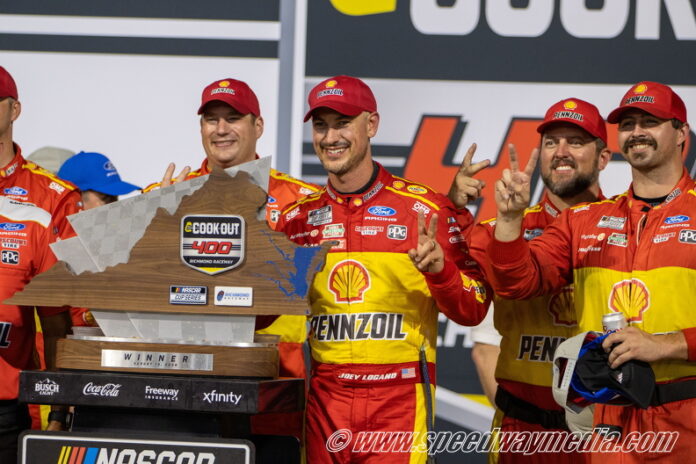
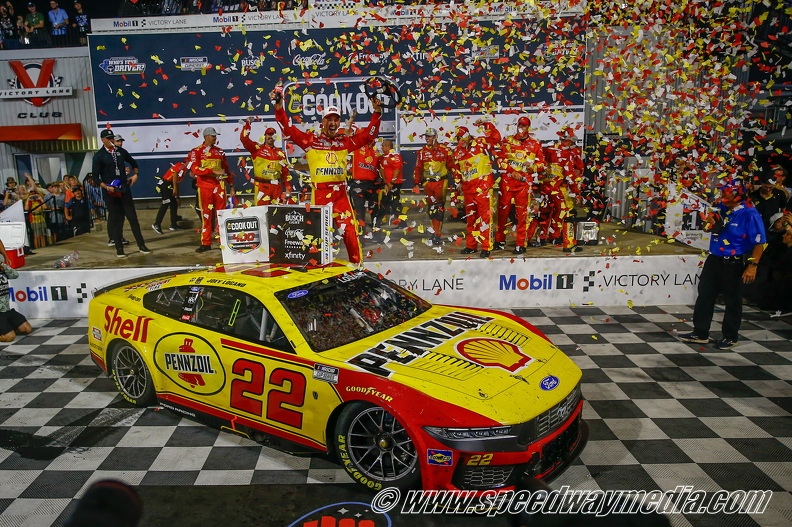
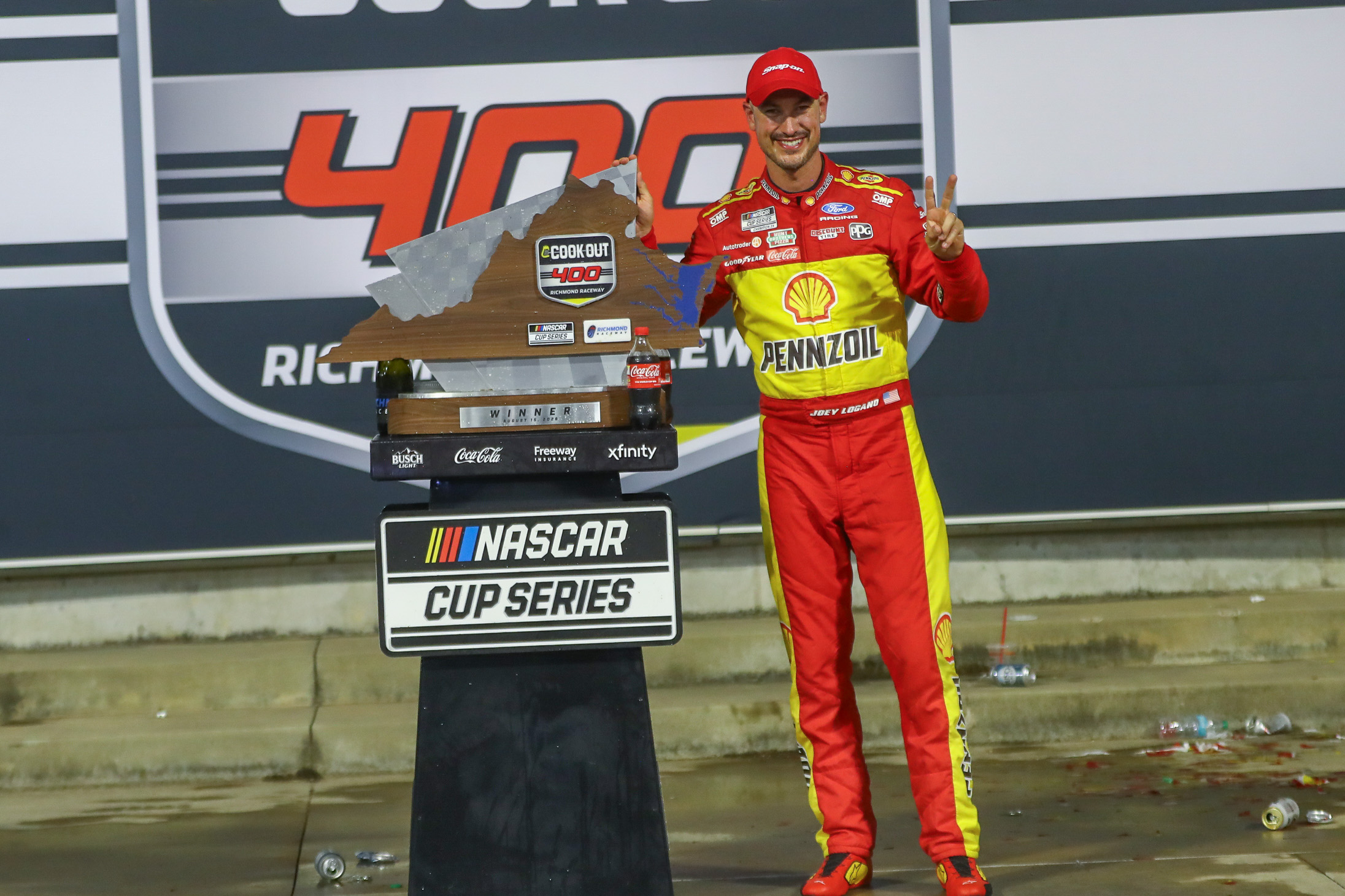
Joey Logano made an emphatic statement under the lights at Richmond Raceway that he is back and in it to contend for his fourth NASCAR Cup Series championship. He etched the statement after he fended off Chase Briscoe to win the Cook Out 400 on Saturday, August 15.
The three-time Cup Series champion from Middletown, Connecticut, led six times for 95 of 400-scheduled laps in an event where he qualified in 10th place, secured a fourth-place result in the first stage period and battled at the front throughout the second stage period through various pit strategies, in which he claimed the latter stage’s victory.
After spending the majority of the final stage period battling Chase Briscoe for the lead amid more pit strategies, Logano’s key move to victory occurred with 39 laps remaining when he pitted under green a lap after he reeled down and overtook Briscoe on the track for the lead. Remaining ahead of Briscoe when he cycled back on the track, Logano then reassumed the lead from Christopher Bell amid the latter’s tire disadvantage with 24 laps remaining. Despite being mired in lapped traffic and having Briscoe reeling from behind, Logano spent the event’s remainder fending off the latter and managing to cross the finish line first to notch his second victory of the 2026 season and gain a momentous cushion towards his Chase hopes.
Photo by John Knittel for SpeedwayMedia.com
With on-track qualifying that determined the starting lineup occurring on Friday, August 14, Ryan Blaney won his fourth Cup pole position of the 2026 season and the 16th of his career with a pole-winning lap at 121.485 mph in 22.225 seconds. Chase Briscoe qualified in second place and started alongside Blaney on the front row with a lap of 121.212 mph in 22.275 seconds.
When the green flag waved and the event commenced, pole-sitter Ryan Blaney and Chase Briscoe dueled against one another for a full circuit around Richmond in front of a stacked field. When the field cycled back to the frontstretch, Briscoe, who started on the outside lane, barely led the first lap over Blaney. As Josh Berry and Ty Gibbs dueled for third place, where Berry eventually outdueled Gibbs for the spot, both Briscoe and Blaney remained dead even against one another while swapping for the lead through the event’s first eight laps until Blaney managed to motor ahead and have both clean air and all racing lanes to his sole possession by the ninth lap.
Through the first 20 laps, Blaney stretched his early advantage to more than a second over Berry and Briscoe trailed in third place by two-and-a-half seconds while Ty Gibbs, Bubba Wallace, Brad Keselowski, Ryan Preece, Christopher Bell, Joey Logano and William Byron were racing in the top-10 mark, respectively. Behind, Connor Zilisch occupied 11th place in front of Chase Elliott, Denny Hamlin, John Hunter Nemechek and AJ Allmendinger while Austin Cindric, Riley Herbst, Chris Buescher, Ross Chastain and Austin Dillon trailed in the top-20 mark ahead of Alex Bowman, Daniel Suarez, Erik Jones, Michael McDowell and Cole Custer, respectively. Meanwhile, Shane van Gisbergen occupied 26th place in front of Austin Hill, Todd Gilliland, Carson Hocevar and Zane Smith while Kyle Larson and Tyler Reddick were mired in 31st and 34th, respectively.
Ten laps later, Blaney stabilized his advantage to more than a second over Berry as Briscoe, Gibbs and Wallace continued to trail in the top-five mark. Another lap later, the event’s first cycle of green flag pit stops commenced as Preece, Austin Dillon, Larson, Logano, Austin Cindric, Zane Smith, Erik Jones, Reddick, Bowman, McDowell and Noah Gragson pitted. Blaney then pitted from the lead on Lap 32 along with Briscoe, Keselowski, Elliott, Nemechek and Austin Hill before Berry, Hamlin, Allmendinger, Chris Buescher and Cody Ware pitted during the next lap. Gibbs, Bell, Herbst, Suarez, van Gisbergen, Hocevar and Todd Gilliland pitted under green by Lap 35 before more names like Byron, Zilisch and Chastain followed suit. Amid the pit stops, Gibbs was penalized for speeding on pit road while Austin Hill was also penalized for an uncontrolled tire violation.
By Lap 37, Blaney cycled his No. 12 BODYARMOR Ford Mustang Dark Horse entry back as the leader once Wallace pitted under green. As Blaney led just past the Lap 40 mark, Briscoe trailed in the runner-up spot by three seconds while Logano, Berry, Cindric, Preece, Hamlin, Bell, Wallace and Keselowski occupied the top-10 spots, respectively. Blaney proceeded to lead by more than a second over both Briscoe and Berry at the Lap 50 mark before his lead slightly shrank to six-tenths of a second over Briscoe when the 60th lap struck.
When the first stage period concluded on Lap 70, Blaney, who was mired in lapped traffic, fended off Briscoe to claim his sixth Cup stage victory of the 2026 season. Briscoe settled in second place by half a second ahead of Logano, Cindric and Berry while Wallace, Hamlin, Bell, Elliott and Byron were scored in the top 10, respectively. By then, 27 of 37 starters were scored on the lead lap while names like Noah Gragson, Ricky Stenhouse Jr., Carson Hocevar, Todd Gilliland, Zane Smith, AJ Allmendinger, Ty Dillon and Austin Hill were scored a lap down.
Under the event’s first stage break period, the lead lap field led by Blaney returned to pit road for service. Following the pit stops, Blaney exited pit road first ahead of Briscoe, Cindric, Logano and Hamlin while Wallace, Berry, Bell, Byron and Elliott followed suit, respectively.
The second stage period started on Lap 79 as Blaney and Briscoe occupied the front row. At the start, Blaney and Briscoe dueled for the top spot until the latter used the outside lane to motor the No. 19 Bass Pro Shops Toyota Camry XSE entry ahead entering the backstretch. As Briscoe led the next lap while Wallace tried to recover from going wide in Turns 3 and 4 amid slight contact with Berry, Blaney pursued Briscoe in the runner-up spot while teammates Cindric and Logano, along with Hamlin, followed suit. With a variety of on-track actions and shuffling ensuing within the field, Briscoe led Blaney by a tenth of a second on Lap 85.
At the Lap 100 mark, Briscoe was leading by four-tenths of a second over Blaney while Cindric, Logano, Hamlin, Byron, Berry, Preece, Wallace and Chastain were racing in the top-10 mark ahead of Reddick, Bell, Herbst, Elliott, Keselowski, Buescher, Bowman, Austin Dillon, Erik Jones and Suarez, respectively. By Lap 106, Blaney drew alongside Briscoe and challenged the latter for the lead. Blaney then motored ahead of Briscoe by Lap 107, and he proceeded to stretch his advantage to more than a second just past the Lap 110 mark while Cindric, Logano and Berry trailed in the top five.
On Lap 116, another cycle of green flag pit stops started to commence as Keselowski and Zilisch pitted. By then, McDowell pitted as Buescher, Austin Dillon and Allmendinger pitted by Lap 117. Shane van Gisbergen pitted on Lap 118, and Preece pitted a lap later while Blaney continued to lead by more than a second over Briscoe, Cindric, Logano and Berry. Then on Lap 121, Gibbs, Austin Hill and Ty Dillon pitted, with Nemechek and Cole Custer pitting during the next lap before Wallace pitted from the top-10 mark on Lap 123. Seconds later, Berry pitted from fifth place, and he was followed by Reddick before the caution flew on Lap 124. The caution was due to Zane Smith getting loose and spinning his No. 38 Aaron’s Ford Mustang Dark Horse entry in Turn 2 before he made hard contact against the outside wall.
During the caution period due to Smith’s incident, the top-15 competitors led by Briscoe, all of whom were scored on the lead lap, pitted. Following the pit stops, Briscoe exited pit road first ahead of Logano, Blaney, Hamlin and Byron, Cindric, Elliott, Chastain, Herbst and Erik Jones. Amid the pit stops, numerous competitors took the wave around to cycle back on the lead lap, which placed 27 of 37 starters on the lead lap category
The next restart on Lap 132 featured Briscoe motoring away from Logano to retain the lead. Behind, Chastain challenged Cindric for sixth place as Blaney, Hamlin and Bryon all raced in the top-five mark in front of a stacked field while Briscoe proceeded to lead just past the Lap 135 mark. As Blaney reeled in teammate Logano for the runner-up spot, Briscoe extended his advantage to more than a second by Lap 140 while Elliott, Jones and Bowman occupied the remaining top-10 spots.
Through the Lap 150 mark, Briscoe continued to lead by more than a second over Logano as Blaney, Hamlin, Cindric, Byron, Chastain, Elliott, Jones and Bowman followed suit in the top-10 mark ahead of Bell, Herbst, Suarez, Berry, Reddick, Gragson, Larson, Wallace, Gibbs and Buescher, respectively. Over the next 10 laps, Hamlin, who made contact with Blaney, managed to motor around the latter for third place. While Cindric maintained fifth place, Logano continued to trail the leader, Briscoe, by a second on Lap 160 while Preece, Zilisch (who was eventually penalized for speeding) and Austin Dillon strategically pitted under green.
Then on Lap 171, Logano reeled in and overtook Briscoe for the lead following a full-lap duel despite both being mired between the lapped competitor of Cole Custer. By then, select names, including van Gisbergen, McDowell, and Larson, dropped out of the lead lap category by pitting under green. Just past Lap 175, select names like Bowman, Bell and Jones pitted before Byron pitted two laps later. On Lap 178, Logano pitted from the lead along with Briscoe, Wallace, Reddick, Nemechek, Gragson and Suarez before Hamlin, Cindric, Elliott, Berry and Gibbs pitted a lap later. During the pit stops, Cindric nearly collided with Suarez as the latter was exiting his pit stall while the former was trying to enter his. Seconds later, more names like Blaney, Chastain, Gilliland and Hocevar pitted as Logano cycled back to the lead ahead of Briscoe. With Hamlin, Bell and Elliott cycling up into the top-five mark, Logano proceeded to lead by seven-tenths of a second by Lap 190.
At the halfway mark on Lap 200, only 16 of 37 starters were scored on the lead lap as Logano maintained his lead by two seconds over Briscoe while Hamlin, Blaney, Elliott, Cindric, Bell, Byron, Berry and Bowman trailed in the top-10 mark, respectively. Logano proceeded to extend his advantage to more than four seconds on Lap 210 before he added another three seconds to his lead by Lap 220.
When the second stage period concluded on Lap 230, Logano notched his second Cup stage victory of the 2026 season. Hamlin made a late overtake on teammate Briscoe to claim the runner-up spot while Cindric, Blaney, Berry, Elliott, Bell, Reddick and Byron were scored in the top 10, respectively. By then, 12 of 37 starters, including Chastain and Bowman, were scored on the lead lap while Larson was the first competitor scored a lap down in 13th place. In addition, 13 competitors scored a lap down while seven were mired two laps down.
During the event’s second stage break period, the lead lap field led by Logano pitted. Following the pit stops, Logano retained the lead by exiting pit road first ahead of Hamlin, Briscoe, Berry and Blaney while Cindric, Elliott, Bell, Byron and Reddick followed suit, respectively.
With 161 laps remaining, the final stage period commenced as Logano and Hamlin occupied the front row in front of Briscoe, Berry, Blaney and Cindric. At the start, Briscoe used the inside lane to challenge Logano for the lead through the first two turns. Logano managed to lead the next lap amid his side-by-side battle with Briscoe while Berry, who went three-wide with Hamlin and Cindric through Turns 3 and 4 a lap prior, muscled his way up to third place in front of the latter two, though Hamlin gave Berry a displeased bump to Berry for slight contact from the latter. As a variety of on-track battles ensued within the field, Logano and Briscoe continued to duel before Briscoe motored ahead of Logano through the first two turns with 157 laps remaining.
With 150 laps remaining, Briscoe was leading by within four-tenths of a second over Logano while Cindric, Berry and Hamlin were racing in the top Five ahead of Elliott, Blaney, Chastain, Byron and Bell, respectively. By then, van Gisbergen, who was trying to execute a strategic pit run while scoring in 14th place, pitted under green. Following his pit stops, van Gisbergen, who was mired back in 25th place, was able to utilize his fresh tires to quickly cycle past the leaders to regain one of his two laps lost. With only 13 of 37 starters scored on the lead lap and Gibbs scored the first competitor a lap down in 14th place, Briscoe stretched his late lead to more than a second over Logano with 140 laps remaining.
Then with less than 125 laps remaining, a late cycle of green flag pit stops commenced as Hamlin pitted. By then, names like Nemechek, Herbst, Keselowski, Custer, Preece, and Austin Dillon pitted, while more like Bell, Byron, and Buescher pitted behind Hamlin. Logano then pitted from the runner-up spot with 122 laps remaining before the leader, Briscoe, along with Cindric, Berry, Blaney, Chastain, Gibbs, Austin Hill, Zilisch, and Jones, pitted a lap later. More names like McDowell, Stenhouse, Elliott, Bowman, Suarez, Hocevar, Allmendinger and Zane Smith pitted as Larson and Reddick, both of whom have yet to pit, occupied the top-two spots in front of Briscoe.
As Larson pitted under green from the lead with 117 laps remaining, the caution flew a lap later when Hocevar, who missed a shift through the frontstretch and was falling off the pace through the first two turns and the backstretch, stopped his No. 77 Zeigler Chevrolet Camaro ZL1 entry on the track towards the outside wall in Turn 3. At the moment of caution, Reddick, who had yet to pit, was leading while Briscoe, Logano, Hamlin and Cindric were scored in the top five. During the caution period, select names including Reddick, Blaney and Hamlin pitted while the rest, led by Briscoe, remained on the track.
As the event restarted with 108 laps remaining, Briscoe fended off Logano from the inside lane to retain the lead from the first two turns and the frontstretch while the field behind fanned out beyond three and four lanes from the backstretch through Turns 3 and 4. As Berry nearly got turned while turning across the front nose of Chastain, Briscoe proceeded to lead by half a second over Logano with 100 laps remaining. Meanwhile, Reddick cycled his way up to third place ahead of Bell and Cindric while Elliott, Blaney, Byron, Hamlin and Bowman occupied the top-10 spots ahead of Berry, van Gisbergen, Chastain and Larson, all of whom were scored on the lead lap.
As the event reached its final 85-lap mark, Briscoe was leading by more than one-and-a-half seconds over Logano while Bell outdueled Reddick for third place and Cindric trailed in fifth place by three seconds. While select names like Keselowski and Preece started to strategically pit under green over the next handful of laps, more like Buescher, Zilisch, Herbst, Gibbs and Cindric also pitted before Briscoe pitted from the lead with 77 laps remaining. Bowman also pitted behind Briscoe as Logano pitted a lap later along with Elliott, Berry, Chastain, van Gisbergen and Gragson before Hamlin followed suit during the next lap.
With the field cycling through the green flag pit stops and the laps dwindling, Bell, who has yet to pit, was leading Reddick while Blaney and Larson, all of whom also have yet to pit, raced in the top-four mark as Byron, who was briefly racing in the top-five mark, pitted. Meanwhile, Briscoe, who pitted, was up to fifth place, and he was four seconds ahead of Logano while Cindric, Elliott, Bowman, Berry and Hamlin followed suit. Shortly after, Larson pitted while Bell remained in the lead by more than a second with 65 laps remaining. As both Briscoe and Logano charged up to second and fourth, respectively, Bell continued to lead by seven-tenths of a second with 60 laps remaining before he pitted two laps later.
Down to the final 50 laps, Briscoe, who overtook teammate Bell to cycle back as the leader with 59 laps remaining, was leading by more than a second over Logano while Cindric, Elliott and Bowman were scored in the top five ahead of Hamlin, Berry, Byron, Larson and Chastain. Meanwhile, Bell and Reddick, the latter of whom pitted with 60 laps remaining, were mired in 12th and 13th, though both strategically planned to go the remainder of the event’s scheduled distance without making another pit stop. In addition, Blaney, who pitted three laps earlier, was mired back in 16th place and racing as the third competitor a lap down.
With 40 laps remaining, Logano and Briscoe dueled for the lead before they both made their final scheduled pit stop under green a lap later along with Cindric. By then, another late cycle of green-flag pit stops ensued as several, including Bowman, Buescher, Hill, Herbst, Gibbs, Berry, and Byron, pitted. Following the pit stops, Logano managed to beat Briscoe off of pit road first. Meanwhile, Bell, who is striving to go the event’s remainder on his older tires, cycled to the lead with 36 laps remaining. Reddick occupied third place, and he trailed the lead by less than three seconds while Larson trailed in the runner-up spot by more than a second. Amid the late cycle of pit stops, Logano cycled his No. 22 Shell/Pennzoil Ford Mustang Dark Horse entry up to fourth place ahead of Briscoe.
Down to the final 30 laps, Bell was leading by more than three seconds over Reddick while Logano trailed hard in third place by four seconds. Logano would then overtake Reddick to move into the runner-up spot two laps later. Despite being mired in lapped traffic, Logano spent the next three laps erasing Bell’s advantage amid the latter’s disadvantage on worn tires before Logano zipped past Bell to reassume the lead with 24 laps remaining. Briscoe followed suit as he trailed Logano by six-tenths of a second while Bell started to lose track of the top-two leaders.
With 20 laps remaining, Logano stabilized his lead to six-tenths of a second over Briscoe while Bell trailed in third place by nearly four seconds. Behind, Reddick and Cindric trailed in the top-five mark while Elliott, Byron, Berry, Hamlin, Larson, Bowman and Blaney rounded out the lead lap field. Briscoe spent the next five laps decreasing his deficit down to half a second behind Logano, with the latter mired in lapped traffic, but Logano managed to use the next five laps to maintain his lead by half a second.
Photo by John Knittel for SpeedwayMedia.com.
Starting with nine laps remaining, Briscoe reeled in Logano as the former’s deficit shrank down to three-tenths of a second over the leader, Logano. Despite Briscoe’s efforts to narrow the deficit down to as low as two-tenths of a second over the next seven laps, Logano maintained a steady lead during the span.
When the white flag waved and the final lap started, Logano remained in the lead by four-tenths of a second over Briscoe. Amid Briscoe’s late-race charge, Logano managed to fend off the latter for a final cycle around Richmond before he returned to the frontstretch to claim the checkered flag by three-tenths of a second.
With the victory, Logano notched his 39th career win in the NASCAR Cup Series division, his third at Richmond and his second of the 2026 season. Logano’s victory, which was also the fourth of this season for both Team Penske and Ford, boosted him from 13th to ninth in the regular-season standings, and he is now 142 points above the top-16 cutline to make this year’s Chase with two regular-season events remaining.
Photo by John Knittel for SpeedwayMedia.com
“Don’t let the boys get hot! We’re pretty strong now!” Logano said on the frontstretch on USA Network. “It’s awesome to see the speed in the No. 22 again. Gosh, it was a great car. We’ve had a great car here the last five races, and we haven’t been able to capitalize on the win. Been so close. Sweet redemption today. We got a strong team, no doubt. [Crew chief] Paul [Wolfe] made some great calls there. [Spotter] Coleman [Pressley] did a good job, but [Briscoe] was better than us that last run. I was trying to just manage the tires, but keep that gap. Just kind of a fun back-and-forth battle…It was a typical Richmond race, so pretty cool to get one here. Onto Loudon. Get another one.”
Briscoe, who led a race-high 171 laps compared to Logano’s 95, settled in second place for his 10th top-five result of the 2026 season and notched his first career top-10 result in his 10th start at Richmond. Amid the strong run, Briscoe was left disappointed after being one spot short of capping off a dominant run with a victory.
“I don’t know what more I needed,” Briscoe said. “I thought that last run, I was a little bit better than [Logano] to get there at the end. The prior run to the pit stop, I just lost brakes and got really, really loose. I gave up a three-second advantage, and that was ultimately the difference. I just had one bad run, and that was the difference-maker there at the end. It’s weird to be mad running second here. It’s been a real struggle for me at this place. I think it’s my first-ever top 10 here even, but just to be that close and not get it done is still frustrating. I had a really fast Bass Pro Shops/Tracker [Boats] Toyota and just wasn’t able to seal the deal there at the end.”
Austin Cindric capped off a strong run racing at the front by securing a third-place result, which marks his highest-finishing result through 24-scheduled events in 2026. To go along with a pair of fourth-place results in the event’s first two stage points, he jumped from 16th to 15th in the standings and is 57 points above the cutline to make the Chase.
Denny Hamlin and Chase Elliott finished in the top five while Kyle Larson, Christopher Bell, Josh Berry, William Byron and Alex Bowman completed the top 10 in the final running order, respectively. Tyler Reddick was the final competitor to score on the lead lap, finishing 11th.
This event featured 29 lead changes for 10 different leaders, and four cautions for 31 laps.
Following the 24th event of the 2026 NASCAR Cup Series season, Denny Hamlin continues to lead the regular-season standings by 115 points over Ryan Blaney. The duo, along with Ty Gibbs, Tyler Reddick, Chase Briscoe, Chase Elliott and Christopher Bell, have secured their berths for this year’s Chase.
Currently, Kyle Larson, Joey Logano, Chris Buescher, Carson Hocevar, William Byron, Daniel Suarez, Bubba Wallace, Austin Cindric and Shane van Gisbergen occupy the remaining vacant berths to the Chase, with van Gisbergen being 50 points ahead of Ryan Preece, 63 over Ross Chastain, 78 over Brad Keselowski and 81 over Erik Jones with two regular-season events remaining.
Results:
Joey Logano, 95 laps led, Stage 2 winner
Chase Briscoe, 171 laps led
Austin Cindric
Denny Hamlin, three laps led
Chase Elliott
Kyle Larson, two laps led
Christopher Bell, 29 laps led
Josh Berry, one lap led
William Byron
Alex Bowman
Tyler Reddick, seven laps led
Ross Chastain, one lap down
Ryan Blaney, one lap down, 88 laps led, Stage 1 winner
Shane van Gisbergen, one lap down
Ty Gibbs, one lap down, one lap led
Daniel Suarez, one lap down
Ryan Preece, two laps down
Noah Gragson, two laps down
Austin Dillon, two laps down
Bubba Wallace, two laps down, three laps led
Chris Buescher, two laps down
John Hunter Nemechek, two laps down
Austin Hill, three laps down
Riley Herbst, three laps down
Connor Zilisch, three laps down
Brad Keselowski, three laps down
Erik Jones, four laps down
Michael McDowell, four laps down
Cole Custer, four laps down
Todd Gilliland, four laps down
Ricky Stenhouse Jr., four laps down
Ty Dillon, six laps down
AJ Allmendinger, six laps down
Cody Ware, eight laps down
Josh Bilicki, nine laps down
Zane Smith, 34 laps down
Carson Hocevar – OUT, Engine
Next on the 2026 NASCAR Cup Series schedule is New Hampshire Motor Speedway in Loudon, New Hampshire, for the Dollar Tree 301. The event is scheduled to occur next Sunday, August 23, and air at 3 p.m. ET on USA Network, PRN Radio, SiriusXM, and HBO MAX.
Key Takeaway: Landen Lewis and the J.F. Electric team earned a top-15 finish at Richmond Raceway. After slipping up on his qualifying lap and having to start 24th, Lewis gained track position in the first stage. Noting that his truck was tight, the No. 45 team made several changes to shift the balance more to Lewis’ liking. He made up ground in the final stage, charging to 14th-place in the final run to the checkered flag.
Landen Lewis’ Post-Race Thoughts: “Our short-run speed was really good at the end of the race. In the first stage, our short-run speed was good, but I was way too tight through the center of the corner. We tried to free it up, but that hurt our long-run speed. We paid for it at the end of the run for sure, but it was still a solid day. It’s not what we want by any means, but we have an idea of what we need to do for New Hampshire, and we’re going to change directions and to make a swing at it. I’m proud that we continue to fight every single week on our J.F. Electric team. I need to work on some qualifying efforts and I think we’ll be okay. Starting in the back taught me a lot about my race craft and I picked up on things I need to do when racing around other guys.”
About J.F. Electric: J.F. Electric is an electrical contractor that provides engineering expertise, backed by construction and installation know-how in a diverse range of service offerings, from utilities and commercial projects, to industrial and telecommunications customers. When having a long family history in an industry, a company not only builds on its knowledge and experience, it takes pride in cultivating a solid understanding of client needs, all the while nurturing strong relationships with its employees. Evolving through five generations of the Fowler family, J.F. Electric has matured into a well-managed and thoughtfully diversified electrical contractor which is poised to continue its growth and expansion into the future.
Key Takeaway: Parker Eatmon and the Vetted Ventures team ran consistently throughout the 250-lap event in Richmond. Eatmon nabbed his best-career qualifying effort with a sixth-place starting position. In the first stage, the No. 42 team lost track position but held serve around the top-15. The rookie managed a solid pace and remained on the lead lap all race long. Eatmon crossed the finish line in 16th-place.
Parker Eatmon’s Post-Race Thoughts: “We had a decent day today, but I just feel like I didn’t fire off as well as everybody else. I think that’s just experience, but once I got settled in, we were running some decent lap times and were able to keep up in stage one and stage two. The final stage was a little difficult with the handling on our Vetted Ventures Chevy with no grip on the rear tires. Overall, it wasn’t a bad day. It wasn’t a great one, but we’ll keep fighting onto Loudon next week.”
About Vetted Ventures: Vetted Ventures is a pioneer in revolutionizing private sales and acquisitions management through an ecosystem of exclusive clients with the ability to be represented by one company across different industries. We aim to provide our clients with the opportunities they seek backed by the service they deserve. To learn more about the company, please visit www.Vetted-Ventures.com.
No. 44 DQS Solutions & Staffing Chevrolet Silverado RST Driver: Andrés Perez de Lara | Crew Chief: Wally Rogers
Key Takeaway: Andrés Pérez de Lara and the DQS Solutions & Staffing team had a hard-fought day in Richmond. Pérez de Lara qualified inside the top-10 in eighth-place, but lacked long-run pace and slid down the running order early on. The driver reported that his truck was free on entry and tight in the center, which prompted adjustments after going a lap down. Though the team worked hard to shift the balance, Pérez de Lara was unable to make up the lost ground. He was credited with a 23rd-place finish.
Andrés Pérez de Lara’s Post-Race Thoughts: “It was a tough day at the office with our DQS Chevy today. We struggled a lot with balance, and we knew we were going to have a difficult time with our long-runs based off yesterday’s practice. We tried to fix it, but could never figure out the best setup today. It was a frustrating day, but we have our eyes on New Hampshire where we had a good result last year, so we will hopefully go back next week and have a good race.”
About DQS Solutions & Staffing: Guided by a mission to achieve excellence and adaptability, DQS partners with clients to create custom solutions that address unique business challenges. Recognized as Michigan’s fastest-growing company and #22 in the nation on the Inc. 5000 list, DQS drives industry growth while giving back through its nonprofit, Foundation for Pops, and partnerships like the River Rouge School District.
No. 4 TowneBank / Breeden Concrete Chevrolet Silverado RST Driver: Connor Hall | Crew Chief: Mike Shiplett
Key Takeaway: Connor Hall and the TowneBank / Breeden Concrete team battled adverse conditions at Richmond Raceway. Hall started towards the rear of the field in 31st, but passed several trucks in the opening stage. With a blistering pace set by the leaders, the No. 4 truck fell a lap down and was unable to contend for the free pass. Hall and the No. 4 team struggled with the balance during the opening two stages, leading the team to make major adjustments. Unfortunately, the Virginian did not get the result he hoped for, finishing the race in 28th-place.
Connor Hall’s Post-Race Thoughts: “It was a long race for us today in Richmond. I wish we could have ran a little bit better for the hometown crowd, but I am still very thankful for the opportunity. Mike Shiplett and the boys did a good job making changes throughout the race to get our TowneBank / Breeden Concrete Silverado handling better, but we were already trapped down a couple laps and it made it difficult to make any ground up. We all have some things to work on before the next race, but I appreciate everyone’s efforts today.”
About TowneBank: TowneBank started in 1999, based on the idea of strong relationships, excellent service, and the most respected and experienced bankers in each market we serve. Building on the idea of serving others and enriching lives, we now provide a full range of banking and other financial services. Dedicated to a culture of caring, we value each employee and member by embracing their diverse talents, perspectives, and experiences.
Today, TowneBank operates nearly 70 banking offices throughout Hampton Roads, Central Virginia, and Northeastern and Central North Carolina. As a practical expression of its mission, TowneBank is intentional about being a local leader in each community—actively promoting social, cultural, and economic growth.
About Niece Motorsports: Niece Motorsports is a professional auto racing team that has competed in the NASCAR CRAFTSMAN Truck Series since 2016. The team is owned by Josh Morris of DQS Solutions and Staffing and the Fowler Family of J.F. Electric and Utilitra, and was founded by United States Marine Corps Veteran Al Niece. At its 80,000 sq. ft. headquarters in Salisbury, NC, Niece Motorsports is a full-service race vehicle build shop as well as a customizable fabrication shop for any manufacturing needs.
Follow the Team: To keep up to date with the latest team news, visit niecemotorsports.com or connect on Facebook and Instagram (@NieceMotorsports) as well as X (@NieceMotorsport).
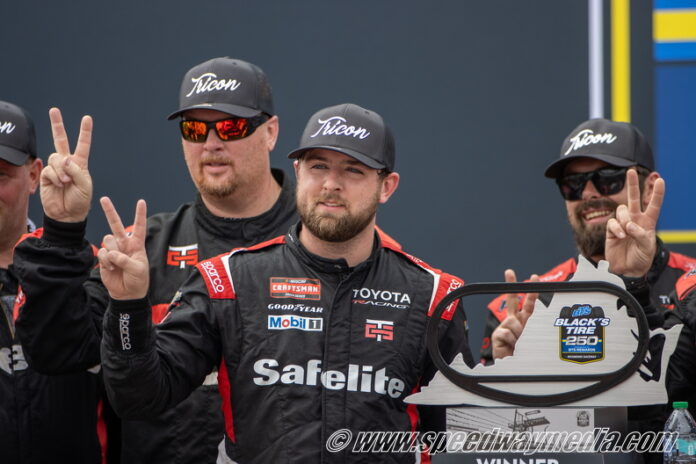
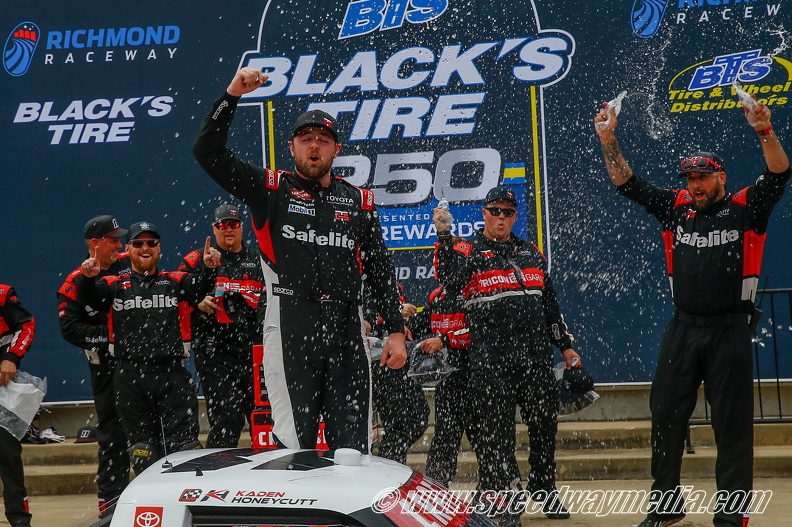
Kaden Honeycutt capped off a dominant run from the drop of the green flag with a rain-postponed victory in the Black’s Tire 250 at Richmond Raceway on Saturday, August 15.
The 2024 CARS Pro Late Model champion from Willow Park, Texas, led three times for a race-high 225 of 250-scheduled laps in an event where he quickly assumed the lead from pole-sitter Shane van Gisbergen on the third lap and proceeded to sweep the event’s first two stage periods.
Amid a late cycle of green flag pit stops, Honeycutt utilized a late caution that flew with 35 laps remaining to pit and line up next to Grant Enfinger for an upcoming restart with 28 laps remaining. During the restart, Honeycutt reassumed the lead and used the event’s duration to fend off teammate Corey Heim before he captured his second career Truck Series victory and his first series win in three months.
With on-track qualifying that determined the starting lineup occurring on Friday, August 14, Shane van Gisbergen secured his first career pole position with a pole-winning lap at 116.540 mph in 23.168 seconds. Kaden Honeycutt qualified in second place and shared the front row with van Gisbergen with a lap at 116.470 mph in 23.182 seconds.
Prior to the event, Leland Honeyman Jr. dropped to the rear of the field due to replacing Christopher Bell in the No. 62 Halmar Friesen Racing Toyota entry. Bell, who was initially scheduled to compete on Friday, was unable to do so on Saturday due to a conflict.
When the green flag waved and the event commenced, the field quickly fanned out through the frontstretch as pole-sitter Shane van Gisbergen dueled with Kaden Honeycutt from the outside lane entering the first two turns. Amid his continuous side-by-side duel with Honeycutt, van Gisbergen managed to lead the first lap. Both van Gisbergen and Honeycutt continued to duel against one another for the second lap, which was led by the former before the latter used the inside lane from the backstretch to motor ahead and clear van Gisbergen entering Turns 3 and 4. With the lead in his possession, Honeycutt led by three-tenths of a second by the fifth lap mark.
Through the Lap 10 mark, Honeycutt was leading by half a second over van Gisbergen while Chandler Smith, Ty Majeski, Grant Enfinger, Nick Leitz, Layne Riggs, Parker Eatmon, Tyler Ankrum and Andres Perez De Lara were racing in the top-10, respectively. By then, Christian Eckes was mired in 11th place ahead of Stewart Friesen, newcomer Tristan McKee, Justin Haley and Corey Heim while Jake Garcia, Ben Rhodes, Giovanni Ruggiero, Tanner Gray and Daniel Hemric occupied the top-20 spots, respectively, as Elliott Sadler was mired in 35th place of the 36-truck field.
At the Lap 20 mark, Honeycutt slightly stretched his early advantage to eight-tenths of a second over van Gisbergen while Chandler Smith, Majeski and Enfinger trailed by as far back as two seconds in the top-five mark. Honeycutt’s advantage grew to more than a second by Lap 30 mark, and it stabilized to the exact mark by the Laps 40 and 50 marks before it slightly shrunk to eight-tenths of a second on Lap 60, in which van Gisbergen retained the runner-up spot over Enfinger, Majeski, Riggs, Chandler Smith, Eckes, Nick Leitz, Ankrum and McKee, respectively.
When the first stage period concluded on Lap 70, Honeycutt cruised to his third Truck stage victory of the 2026 season. Van Gisbergen trailed in the runner-up spot by seven-tenths of a second while Enfinger, Majeski, Riggs, Chandler Smith, Eckes, Ankrum, McKee and Leitz were scored in the top 10, respectively. By then, 18 of 36 starters were scored on the lead lap.
Under the event’s first stage break period, the field led by Honeycutt pitted for the first time. Following the pit stops, Honeycutt retained the lead after he exited pit road first ahead of van Gisbergen while Riggs jumped to third place in front of Enfinger and Chandler Smith. During the pit stops, Ankrum and Mason Massey were penalized after their crew members jumped over the pit wall too early.
The second stage period started on Lap 80 as Honeycutt and van Gisbergen occupied the front row. At the start, Honeycutt used the inside lane to fend off van Gisbergen through the first two turns before the former used his No. 11 Safelite Toyota Tundra TRD Pro entry to clear the field through the backstretch. As the field cycled back to the frontstretch while jostling for spots, Honeycutt led the next lap over van Gisbergen while Riggs, Enfinger and Chandler Smith were scored in the top five ahead of Eckes, Majeski, Heim, Hemric and McKee. While Honeycutt proceeded to lead to the Lap 85 mark, Majeski and Heim made contact through the frontstretch on Lap 83 while both battled fiercely for seventh place.
On Lap 87, Majeski pitted his No. 88 Menards Ford F-150 entry with a flat left-front tire after contact from Heim, as the two made contact for a second time on Lap 85. With Majeski dropping out of the lead lap category in the process, Honeycutt continued to lead by eight-tenths of a second over van Gisbergen just past the Lap 90 mark. Honeycutt grew his lead back up to a second over van Gisbergen when the 100th lap occurred as Riggs, Enfinger, Eckes, Chandler Smith, Heim, Leitz, Hemric and Garcia pursued in the top-10 mark.
At the Lap 110 mark, half of the 36 competitors racing in the field were scored on the lead lap as Honeycutt extended his advantage to two seconds over van Gisbergen. As Honeycutt stabilized his lead to more than two seconds over van Gisbergen by the event’s halfway mark on Lap 125, Majeski was the fourth competitor a lap down in 22nd place while Riggs, Enfinger, Eckes, Chandler Smith, Heim, Leitz, Hemric and Jake Garcia trailed in the top 10.
When the second stage period concluded on Lap 140, Honeycutt cruised to his second consecutive Truck stage victory of the event and his fourth of the 2026 season. Riggs carved his way into the runner-up spot ahead of Enfinger, Eckes and van Gisbergen while Chandler Smith, Leitz, Hemric, Heim and Garcia were scored in the top 10, respectively. By then, Leland Honeyman Jr. was ahead of Majeski as the first competitor to score a lap down while racing in 19th place and earning the free pass spot.
During the event’s second stage break period, the field led by Honeycutt returned to pit road for service. Following the pit stops, Honeycutt retained the lead by exiting pit road first ahead of Enfinger, van Gisbergen, Eckes and Smith while Riggs, who had a slow pit service, dropped to sixth place. Amid the pit stops, van Gisbergen was sent to the tail end of the field after being penalized for an uncontrolled tire violation.
With 100 laps remaining, the final stage period commenced as Honeycutt and Enfinger occupied the front row. At the start, the field fanned out as Honeycutt used the first two turns to fend off Enfinger prior to entering the backstretch. As Honeycutt led the next lap, he then proceeded to lead by seven-tenths of a second with 90 laps remaining while Enfinger, Eckes, Chandler Smith and Riggs pursued in the top-five mark.
Down to the final 75 laps, Honeycutt continued to lead by more than a second over Enfinger while Eckes, Riggs and Chandler Smith raced in the top five ahead of Heim, Hemric, Ankrum, Garcia and Leitz. Meanwhile, van Gisbergen was mired in 17th place behind Landen Lewis while Friesen occupied 11th place in front of McKee, Ruggiero, Ben Rhodes and Tanner Gray. With fuel strategy arising as a topic while the laps dwindled, Honeycutt stretched his lead to two seconds over Enfinger with 60 laps remaining.
Then with 58 laps remaining, pit strategies started to occur as Chandler Smith pitted from ninth place. More names, including Leland Honeyman Jr., Landen Lewis, Ruggiero, McKee, Riggs, Andres Perez De Lara, Kris Wright, Eckes and Heim, pitted over the next five laps before the leader Honeycutt pitted with 53 laps remaining. By then, Enfinger, who had decided to stretch his fuel tank to the event’s scheduled distance, cycled to the lead. Amid the pit stops, Riggs made another pit stop to have a left-front wheel tightened.
With 45 laps remaining and with most of the field pitting under green, the top-seven competitors were scored on the lead lap as Enfinger continued to lead by a second over Hemric. Behind, Ankrum, Friesen and van Gisbergen were in the top five while Honeycutt was mired in sixth place. Enfinger retained the lead by a healthy margin over the next 10 laps before the caution flew due to Friesen wrecking in the first turn. During this latest caution, Enfinger, along with van Gisbergen and Honeycutt, pitted, with Enfinger retaining the lead ahead of Honeycutt, Heim, Eckes, van Gisbergen, and Chandler Smith.
The next restart with 28 laps remaining featured Honeycutt dueling with Enfinger for half a lap before the former, who restarted on the outside lane, motored ahead and returned atop the leaderboard through Turns 3 and 4. As Honeycutt led the next lap, teammate Heim used the outside lane to duel and overtake Enfinger through the frontstretch for the runner-up spot while van Gisbergen trailed in fourth place. Amid Heim’s late charge, Honeycutt led by a second with 25 laps remaining. Honeycutt stabilized his lead to a second with 20 laps remaining before he added another second to it over the following five laps over Heim.
Down to the final 10 laps, Honeycutt had his lead shrink back down to a second over teammate Heim, but the former maintained the top spot as Eckes, van Gisbergen and Enfinger pursued in the top five ahead of Garcia, Chandler Smith, McKee, Ruggiero and Hemric. Honeycutt continued to lead by a second over Heim with five laps remaining.
When the white flag waved and the final lap started, Honeycutt remained in the lead by a second over Heim. Amid lapped traffic, Honeycutt smoothly cycled his way around Richmond for a final time before he returned to the frontstretch victorious for his second career checkered flag in the series and of the 2026 season.
With the victory, Honeycutt became the 86th competitor overall to achieve multiple wins in the Truck Series division, and he became the fifth competitor to record multiple victories in 2026. Honeycutt also became the 15th competitor to win a Truck event at Richmond, though the series will not return to the venue in 2027.
Honeycutt’s Richmond victory was also the fifth of this season for TRICON Garage, the sixth for Toyota and the second consecutive year where TRICON’s No. 11 Toyota team won at Richmond.
Photo by John Knittel for SpeedwayMedia.com.
“We never give up,” Honeycutt said on the frontstretch on FS2. “We’ve had a rough last couple of weeks. We just wondered what the heck was going on. We’re not a seventh-place, 10th-place team. It’s all thanks to [crew chief] Scott Zipadelli, everyone on this Safelite No. 11 team. We just stay on it; we just don’t give up, and I just can’t thank them enough. What a dominant day. I’ve never been able to do something like that before. Really good confidence for me, and hopefully we go out to Loudon and do the same thing next week. Thanks to all my friends and family back home. I love you guys, I love you, Mom and Dad. Just really cool. Hopefully we can go into this Chase and win this championship.”
Heim, who outdueled Honeycutt at Rockingham Speedway and Michigan International Speedway for race victories in April and June, respectively, settled in second place for his fifth top-five result in his seventh Truck start of the 2026 season. Christian Eckes, Shane van Gisbergen and Grant Enfinger finished in the top five.
Jake Garcia, Chandler Smith, Tristan McKee, Giovanni Ruggiero and Daniel Hemric completed the top 10 in the final running order.
This event featured six lead changes for four different leaders, and three cautions for 24 laps. In addition, 16 of 36 starters finished on the lead lap.
Following the 17th event of the 2026 NASCAR Craftsman Truck Series season, Layne Riggs continues to lead the regular-season standings by 61 points over Kaden Honeycutt.
Layne Riggs, Kaden Honeycutt, Chandler Smith, Christian Eckes, Giovanni Ruggiero and Ty Majeski have clinched berths to this year’s Chase. Grant Enfinger, Ben Rhodes, Daniel Hemric and Tyler Ankrum retain the final four vacant spots to the Chase, with Ankrum being 20 points ahead of Stewart Friesen, 21 over Jake Garcia, 47 over Brenden Queen, 49 over Andres Perez De Lara and 59 over Tanner Gray entering next Saturday’s regular-season finale event at New Hampshire Motor Speedway.
Results:
Kaden Honeycutt, 225 laps led, Stages 1 & 2 winner
Corey Heim
Christian Eckes
Shane van Gisbergen, two laps led
Grant Enfinger, 22 laps led
Jake Garcia
Chandler Smith
Tristan McKee
Giovanni Ruggiero, one lap led
Daniel Hemric
Tyler Ankrum
Nick Leitz
Tanner Gray
Landen Lewis
Layne Riggs
Parker Eatmon
Leland Honeyman Jr., one lap down
Ben Rhodes, one lap down
Ty Majeski, one lap down
Brenden Queen, two laps down
Corey LaJoie, two laps down
Cole Butcher, three laps down
Andres Perez De Lara, three laps down
Derek Lemke, three laps down
Mason Massey, three laps down
Dawson Sutton, three laps down
Justin Haley, three laps down
Connor Hall, three laps down
Mini Tyrrell, three laps down
Frankie Muniz, four laps down
Kris Wright, four laps down
Elliott Sadler, four laps down
Timmy Hill, four laps down
Spencer Boyd, six laps down
Dystany Spurlock, 11 laps down
Stewart Friesen – OUT, Accident
Next on the 2026 NASCAR Craftsman Truck Series schedule is the Team EJP 175 at New Hampshire Motor Speedway in Loudon, New Hampshire, which is this year’s regular-season finale event and will officially determine this year’s Chase field. The event is scheduled to occur next Saturday, August 22, at 1:30 p.m. ET on FS1, the NASCAR Racing Network, and SiriusXM.
HONEYCUTT DOMINATES AT RICHMOND, TAKES SECOND CAREER VICTORY In one year anniversary of first Toyota start, Honeycutt leads a TRICON 1-2 finish
RICHMOND, Va. (August 15, 2026) – Kaden Honeycutt made his one year anniversary with Team Toyota count as he led 225 of 250 laps and claimed his second victory of his season and Truck Series career. Honeycutt led more laps today than he led in his previous 75 starts combined, and became the first driver since Timothy Peters in August 2012 to lead more than 200 laps in a single truck race.
It was a strong performance for TRICON Garage as they finish 1-2 with reigning Truck Series champion Corey Heim finishing second. All five of TRICON’s Tundras finished in the top-15 with Gio Ruggiero in ninth, Nick Leitz in 12th and Tanner Gray in 13th.
TOYOTA RACING Post-Race Recap NASCAR CRAFTSMAN Truck Series (NCTS) Richmond Raceway Race 17 of 23 – 187.5 Miles, 250 Laps
TOYOTA FINISHING POSITIONS
1st, KADEN HONEYCUTT 2nd, COREY HEIM 3rd, Christian Eckes* 4th, Shane van Gisbergen* 5th, Grant Enfinger* 9th, GIO RUGGIERO 12th, NICK LEITZ 13th, TANNER GRAY 17th, LELAND HONEYMAN JR. 33rd, TIMMY HILL 36th, STEWART FRIESEN *non-Toyota driver
What a dominate performance today. How was your race?
“Thank you. All hats off to these guys – Scott Zipadelli (crew chief), David (Gilliland, partner, TRICON Garage), my entire team. We were down in the dumps after the last couple of weeks, and we were wondering what we have going on. Just great turnaround today. It was a great race today. Hate we had the caution at the midpoint of the cycle, but man thanks Safelite, TRICON Garage, TOYOTA RACING – everyone for this opportunity. I can’t thank them enough for it.”
What was going through your mind on the final restart?
“I thought we were going to stay out, but we ended up pitting and just needed a good restart on Grant (Enfinger). I knew I was better than him, just needed to get out in front of him to solidify it, and that is what we did. Thanks to Scott (Zipadelli, crew chief) – everyone did a great job today. Really awesome to win.”
What more did you need to challenge your teammate?
“I thought it was going to be a long day after stage one. I climbed a couple of spots from 16th – where I qualified – and ended up 12th. We were slowly climbing up through the second stage and kind of thought that was going to be our day – riding along in the teens, but we made really good adjustments and kind of climbed forward. Never like finishing second by any means, but a better day than I thought it was going to be after practice and qualifying and stage one. Seth (Smith, crew chief) did a great job on the box. The pit crew did great – every stop they gained spots, that is something they have been building towards this year, so hats off to the 23XI pit crew guys. Good day, but not a great day. Steady climb – but thank you to Toyota, TRICON – this Alpha Craft Tundra was okay in practice and just made it better throughout the day.”
About Toyota
Toyota (NYSE:TM) has been a part of the cultural fabric in North America for nearly 70 years, and is committed to advancing sustainable, next-generation mobility through our Toyota and Lexus brands, plus our more than 1,800 dealerships.
Toyota directly employs nearly 64,000 people in North America who have contributed to the design, engineering, and assembly of over 50 million cars and trucks at our 14 manufacturing plants. In 2025, Toyota’s plant in North Carolina began to assemble automotive batteries for electrified vehicles.