18-Year-Old Racer Leads Every Lap From the Pole to Earn Third Career ARCA Victory
Date: Thursday, Sept. 17 Event: Bush’s Best 200 Series: ARCA Menards Series Location: Bristol (Tenn.) Motor Speedway (.533-mile oval) Length: 200 laps (106.6 miles) Start/Finish: 1st / 1st (Running, completed 200 of 200 laps)
Overview:
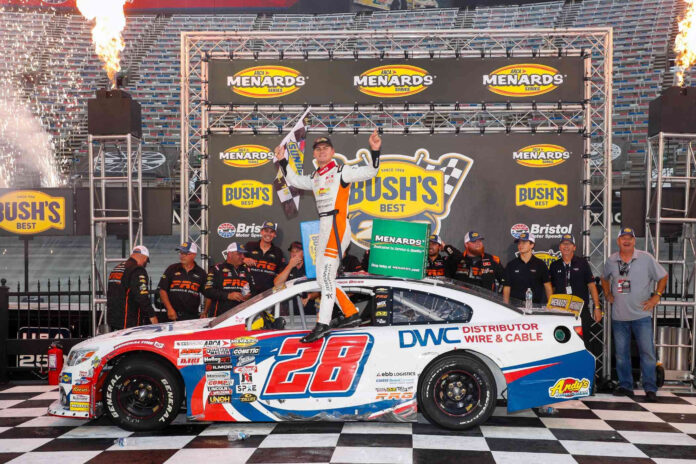
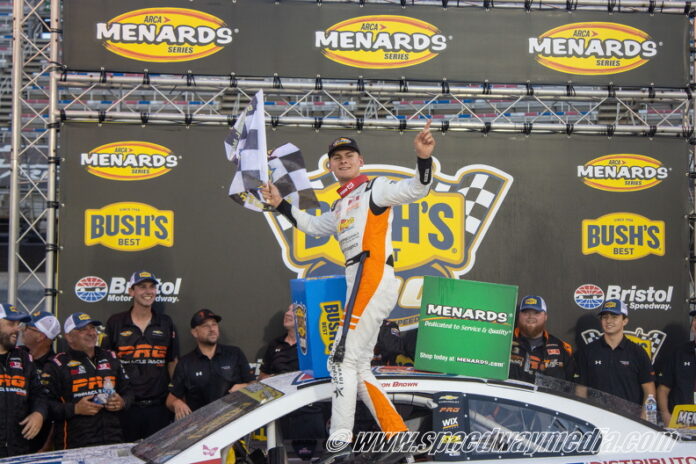
Carson Brown dominated the Bush’s Best 200 ARCA Menards Series race Thursday night at Bristol (Tenn.) Motor Speedway. The driver of the No. 28 Distributor Wire & Cable Chevrolet for Pinnacle Racing Group (PRG) started from the pole and led all 200 laps to take his third career ARCA victory. Despite the domination, it was far from easy. Brown had to thread his way through lapped traffic during the entire race, and do it quickly as his PRG teammate Tristan McKee was in second place and poised to take advantage of any hiccup, as was third-place Kaden Honeycutt. It never happened. Brown was steady in slicing through the field, taking the checkered flag by a healthy 2.056 seconds over McKee.
Carson Brown, driver of the No. 28 Distributor Wire & Cable Chevrolet for Pinnacle Racing Group:
“This victory ranks pretty high up there, to be honest. Just a big thank you to everyone at Distributor Wire & Cable, RCR, Wise Optimization, Chevrolet and Pinnacle Racing Group, and Derek Nealon, my spotter up there on the tower. He was working his butt off to help me out and be my other set of eyes. Lapped traffic kind of forced me to the top line, and it was rolling really fast there at the end. I was just doing everything I could to move around, chase that top line, and make it as easy as possible to get by some of those lapped cars and not cut anything too close. It was a tough one, and I’m glad I was able to bring it to victory lane for all these guys. We’ve been really strong all year, had a lot of speed. Just been missing this factor, right? Knew that this was one everyone here wanted, and we worked really hard for it.”
Notes:
● This was Brown’s third career win in the ARCA Menards Series. Brown earned his maiden ARCA victory March 5 at Phoenix Raceway when he started from the pole and led every lap. He won his second race Sept. 6 at the DuQuoin (Ill.) State Fairgrounds, where he again started from the pole and led all but 10 of the race’s 100 laps.
● This was Brown’s eighth overall victory of 2026. In addition to his three ARCA wins, Brown has four ASA STARS National Tour victories. He won Feb. 10 at New Smyrna (Fla.) Speedway, March 14 at Five Flags Speedway in Pensacola, Florida, June 21 at Slinger (Wis.) Speedway and July 25 at Newport (Tenn.) Speedway. Brown also earned his first CARS Tour West win Aug. 15 at Evergreen Speedway in Monroe, Washington, by leading every lap from the pole.
● This was Brown’s first start of any kind at Bristol (Tenn.) Motor Speedway. You’d never know it, as Brown led practice with a best time of 15.427 seconds at 124.379 mph, scored the pole with a time of 15.334 seconds at 125.134 mph and won the race by leading all 200 laps.
● This was Brown’s seventh career ARCA pole – a number that includes National and East/West divisions. It was also Brown’s sixth pole in the last three months. Brown won his first ARCA pole March 5 at Phoenix.
● This was Brown’s 17th career ARCA start, a number that includes National and East/West divisions. He has now finished among the top-three 12 times, a mark highlighted by his three wins this season.
Next Up:
It will be back-to-back ARCA races for Brown. The 18-year-old from New London, North Carolina, returns to the developmental series next weekend driving the No. 28 Whelen Chevrolet for Pinnacle Racing Group in the season-ending Menards 150 on Sept. 25 at Kansas Speedway in Kansas City.
The 2026 ARCA Menards Series season continued tonight at the famous Bristol Motor Speedway for what was their second-to-last race of the year, the penultimate round of the national tour championship before they head to Kansas Speedway next weekend to determine this year’s overall champion. Carson Brown, the newly signed Richard Childress Racing driver for the 2027 NASCAR O’Reilly Auto Parts Series season, qualified on the pole position with a lap time of 15.334 seconds at 125.134 mph. This would be the scene of the night as he went on to lead every lap of the race to win the race.
“Man, just a big thank you to everyone at Distributor Wire & Cable, Pinnacle Racing Group,” Brown said to Fox Sports 1 in victory lane. “(Spotter) Derek Kneeland up on the tower, he was working his butt off to help me out there and honestly, just be my other set of eyes. This was a tough one. I’m glad I was able to bring it to Victory Lane for these (No.28) guys. Before we came, they were like, ‘Bristol owes us one.’ So, I’m just glad I could do that for them. Just trying to catch up to Kyle Busch’s legacy here.”
Meanwhile, this event was also a combination event with the East Series, which saw their champion crowned tonight as well. Heading into their last race of the season, two drivers who have battled each other all season long were separated by one point. Those two drivers were young phenoms: Spire Motorsports’ Tristan McKee and Joe Gibbs Racing’s Max Reaves. Reaves won the previous ARCA Menards Series event at Salem Speedway, just four days ago.
For either driver to win the championship, one would have to finish ahead of the other, but if the points end in a tie, McKee would win the championship as he had the tiebreaker due to having more wins than Reaves of 4-2. Before the bonus points, Reaves would have to finish two spots ahead of McKee. For qualifying, McKee qualified third and Reaves seventh. The championship would be decided at the end of the 200-lap race. There was also a halfway race break, which occurred at Lap 105.
Thomas Annunziata led the first lap over Brown after taking the lead on the bottom, but Brown would retake the lead on the second lap as Annunziata had a restart violation. Annunziata had to serve a pass-through on pit road after beating Brown to the start/finish line. After serving the penalty, Annunziata was relegated to 33rd, 1 lap down.
At Lap 25, Brown still had the lead over current ARCA Menards Series national points leader Jake Bollman by 0.577 seconds. McKee was third and Reaves fifth. The first caution of the evening fell at Lap 37 for the No. 34 of Ivis Earley, who was stopped on the frontstretch. Earley was sent spinning off Turn 4 after getting bumped from behind.
The race resumed at Lap 43 with Brown and Bollman on the front row, but it was short-lived with another caution coming out a lap later for a multi-car accident on the front stretch. On the replay, it showed the No. 95 of Hunter Wright getting loose off Turn 4 and going around sideways before hitting the inside wall and suffering major front-end damage.
Meanwhile, Bobby Dale Earnhardt in the No. 89 machine also got sideways coming out of Turn 4 and went spinning. Others involved in the incident were the No. 06 of Con Nicolopoulos and the No. 85 of Quinn Davis as well.
Following the lengthy cleanup, the green flag came back out at Lap 54. The third yellow came out at Lap 90 for the No. 53 of Zachary Tinkle. Tinkle was stopped on the frontstretch after cutting down a right-front tire.
The race went to green again at Lap 98 and the halfway race break was extended to Lap 105 due to the late yellow. Despite the extension of the scheduled break, Brown was scored as the leader. He was followed by Bollman, Gavan Boschele, Isaac Kitzmiller, Isabella Robusto, McKee, Reaves, Kaden Honeycutt, Andy Jankowiak, and Jake Finch in the Top 10. Brown had led every lap of the race up to this point.
After the break, it was time to go back racing with 86 laps to go. Annunziata was back on the lead lap in 16th position. Another yellow was called with 73 laps to go for the No. 06 of Nicolopoulos, who had heavy front-end damage after wrecking on the frontstretch and hitting the inside wall. There was a brief fire on the motor, but it was quickly put out by safety officials.
Once the long cleanup was over due to oil leaking from Nicolopoulos, the green flag waved with 52 laps to go, with Brown and Isaac Kitzmiller on the front row. McKee moved to the second position a few laps later following the restart and was ahead of Reaves, who was in the sixth spot. With 30 laps to go, McKee was 0.629 seconds behind Brown. Five laps later, McKee lost ground and was 1.6 seconds back.
With 10 laps to go, Brown had the advantage of 0.722 seconds over McKee, who was challenged by Honeycutt. Brown maintained his pace and went on to lead every lap to win the Bush’s Best 200 at Bristol Motor Speedway over McKee by 2.346 seconds. It was Brown’s first victory since the DuQuoin State Fairgrounds win at the start of this month and the fourth win for the No. 28 by the Pinnacle Racing Group of the season. Furthermore, it was the third overall victory of the year as well. The win also counted toward the East Series since it was a combination event.
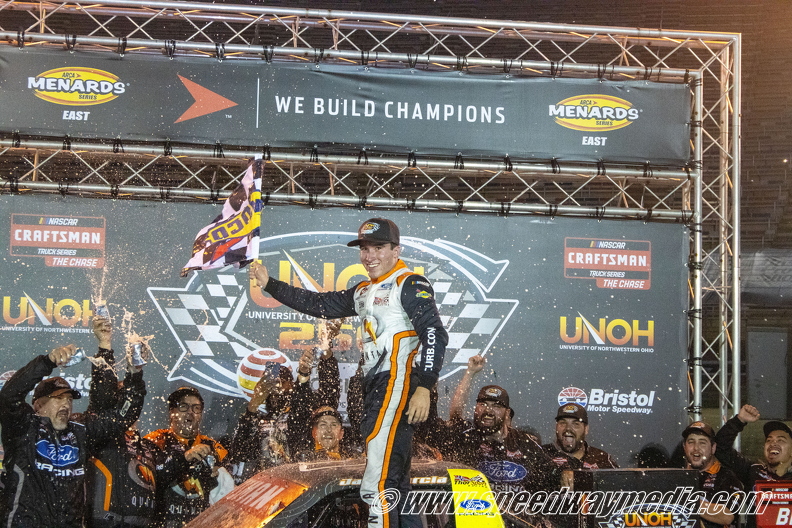
However, the bigger story was McKee, as he finished two spots ahead of Reaves (finished fourth) to win the 2026 ARCA Menards East Series championship by three points over Reaves. It was McKee’s first career ARCA title in his career, but his first championship since winning the Trans Am 2 championship last year.
“(The championship) feels really good,” McKee said to Fox Sports 1 on pit road. “It means a lot just to get a championship in Trans-Am and the lower levels of NASCAR starting out. It’s definitely really cool. We had a good year and I knew we just had to put it together here today. The whole (Pinnacle Racing Group) group’s done a really good job. It’s been a good year.”
There were five cautions for 55 laps and zero lead changes among one driver.
Official Race Results Following Bristol Motor Speedway
Carson Brown, led all 200 laps
Tristan McKee
Kaden Honeycutt
Max Reaves
Isaac Kitzmiller
Jake Bollman
Jade Avedisian
Andy Jankowiak
Thomas Annunziata
Taylor Mayhew, 1 Lap Down
Jason Kitzmiller, 1 Lap Down
Andrew Patterson, 1 Lap down
Gavan Boschele, 1 Lap Down
Ty Fredrickson, 1 Lap Down
Gabriel Casagrande, 1 Lap Down
Jackson McLerran, 4 Laps Down
Craig Pellegrini Jr, 6 Laps Down
Austin Vaughn, 8 Laps Down
Brian Weber, 8 Laps Down
Isabella Robusto, 12 Laps Down
Alex Clubb, 16 Laps Down
Chase Buscaglia, 18 Laps Down
Jeff Maconi, 20 Laps Down
Takuma Koga, 21 Laps Down
Quinn Davis, 26 Laps Down
Michael Maples, 38 Laps Down
Ivis Earley, 50 Laps Down
Jake Finch, OUT, Mechanical
Con Nicolopoulos, OUT, Accident
Zachary Tinkle, OUT, Accident
Brad Smith, OUT, Mechanical
Hunter Wright, OUT, Accident
Bobby Earnhardt, OUT, Accident
Brad Perez, OUT, Mechanical
Nate Moeller, OUT, Mechanical
Up Next – The 2026 ARCA Menards Series season concludes next Friday night with the national championship at Kansas Speedway, live on Fox Sports 1 and MRN Radio at 8 p.m./ET. Bollman leads Annunziata by 16 points heading into the last event of the ARCA Menards Series season. The next ARCA Menards West Series race is next Saturday night at Madera Speedway, live on Flo Racing.
Selling a used car today involves more than washing the body, taking good photos, and preparing maintenance records. Before contacting a seller, many buyers search the vehicle identification number online. A single VIN can lead them to old listings, auction pages, photographs, mileage records, damage descriptions, and other information collected over the years. That makes a vehicle’s online footprint an important part of preparing it for the used-car market.
Why Buyers Search a VIN Before Purchasing a Car
A VIN gives potential buyers a convenient starting point for researching a vehicle. Instead of relying entirely on an advertisement, they can compare the seller’s description with information available through search engines, vehicle databases, and archived auction pages. This is particularly common with vehicles that have previously appeared at salvage or insurance auctions.
The information found online can provide useful context, but older pages do not always reflect the vehicle’s current condition. A car photographed immediately after an accident may later have been professionally repaired and driven for years. Nevertheless, the original images can remain searchable long after the circumstances surrounding them have changed.
A VIN search may lead a buyer to several types of historical information:
auction photographs showing the vehicle at the time it was listed;
lot numbers and previous auction locations;
recorded mileage from an earlier point in the vehicle’s history;
primary or secondary damage descriptions;
sale dates, auction status, and previous bid information;
technical specifications copied from an original listing.
Taken separately, these details may represent only one stage in a much longer ownership history. For a buyer, however, they can strongly influence the first impression of a vehicle before the current seller has an opportunity to explain repairs, maintenance, or changes made since the original listing.
Old Auction Photos Can Remain Searchable for Years
Cars sold through large auctions often generate a considerable amount of digital information. An auction listing can include numerous photographs as well as the VIN, mileage, damage type, specifications, location, and sale details. After the auction ends, copies of this information may remain on vehicle databases and aggregator websites.
This creates a digital footprint that does not disappear simply because the vehicle has changed owners. Services such as HideAutoVin can be relevant when an owner wants to identify and manage publicly accessible VIN-related records before putting a vehicle back on the market. The process should be viewed separately from the seller’s responsibility to provide accurate information about the vehicle and its material condition.
Check the Vehicle Online Before Creating the Sale Ad
Sellers routinely inspect tires, paint, lights, fluids, and interior condition before advertising a car, yet many never perform the same online search a prospective buyer is likely to make. Searching the complete VIN before publishing an advertisement can reveal what information is already associated with the vehicle and whether old pages are still appearing in search results.
A basic digital check before selling should include several steps:
search the complete VIN in quotation marks to locate exact matches;
review image results for old auction or salvage photographs;
check whether outdated listings are still publicly accessible;
compare historical information with the documents currently available;
identify records that may require context when speaking with a buyer.
This preparation is useful even when the seller has no intention of requesting removal of any online record. Knowing what buyers can find makes it easier to answer questions consistently and prevents an old auction photograph or listing from becoming an unexpected issue during negotiations.
Transparency Still Matters When Selling a Used Vehicle
Managing public online records should not be confused with misrepresenting a car. If a vehicle has a relevant accident, title, repair, or ownership history that must be disclosed, removing a third-party webpage does not change those facts. Sellers should follow applicable disclosure requirements and provide accurate information about the vehicle they are offering.
At the same time, there is a meaningful difference between legitimate vehicle history and an outdated third-party page that continues circulating photographs or information without context. Owners may reasonably want to understand where such records appear and what options are available for managing them while still communicating honestly with prospective buyers.
A Car Now Has a Digital Footprint as Well as a Mechanical History
Used-car preparation has expanded beyond the garage. Mechanical condition, maintenance records, appearance, and documentation remain essential, but searchable online information has become another factor sellers should consider. A buyer with a smartphone can investigate a VIN before making a call, arranging an inspection, or visiting the vehicle.
Checking that footprint in advance gives the seller a clearer picture of what the other side of the transaction may already know. It also creates an opportunity to prepare documents, explain older records, and address outdated public information before negotiations begin. In a market where vehicle research often starts online, understanding what a VIN reveals has become a practical part of preparing a car for sale.
Modern motorsport events rely on much more electrical infrastructure than the vehicles themselves. A temporary paddock may require lighting, communications, laptops, networking equipment, refrigeration, chargers, tools, and mobile workshops, with power demand changing throughout the day. Generators have traditionally supplied this electricity because they are flexible and familiar, but running an engine continuously is not always necessary for every auxiliary load.
As temporary power requirements become more variable, operators are increasingly examining whether a generator-only setup is always the most practical approach. Generator-plus-battery systems can provide another way to manage fluctuating demand by allowing stored energy to support suitable loads during selected operating periods. Understanding how these hybrid systems work, where they can provide practical benefits, and what limitations buyers should consider can help motorsport teams and event operators make more informed temporary power decisions.
Why Generator-Only Power Can Become Challenging
Generators remain an important solution for temporary events, particularly where substantial continuous power is needed. The challenge appears when electrical demand stays well below the generator’s available output for long periods. A generator operating below an efficient load range may still consume fuel while serving relatively modest loads. It also continues producing engine noise and requires routine attention even when demand is intermittent.
Temporary motorsport sites can make these issues more noticeable. Loads may rise during preparation, fall during quieter periods, and change again when teams begin using workshops or support equipment. Night-time operation can also create concerns where nearby residents, venues, or event rules place limits on noise. Fuel delivery, maintenance access, and generator placement add further logistical considerations. Generators remain useful; the question is whether every hour of operation requires the engine to be running.
What Actually Consumes Power in a Mobile Motorsport Operation?
The electrical profile of a paddock is often broader and more variable than it first appears. Lighting may be needed across garages, walkways, work areas, and temporary facilities. Teams and event staff can rely on laptops, displays, routers, switches, radios, charging equipment, and communications infrastructure throughout the day. Refrigeration may support food, drinks, or other temperature-sensitive supplies, while tools and mobile workshop equipment can create short periods of higher demand.
These loads do not necessarily operate at the same time or at the same power level. A communications network might need relatively steady power, while workshop tools may create short bursts. Lighting can change according to daylight and event schedules, while refrigeration cycles rather than drawing its maximum load continuously. This mixture of steady, intermittent, and peak demand is important because it creates opportunities for a battery energy storage system to support selected loads while a generator handles longer-duration or higher-demand requirements.
Where Battery Storage Fits Into the Power Architecture
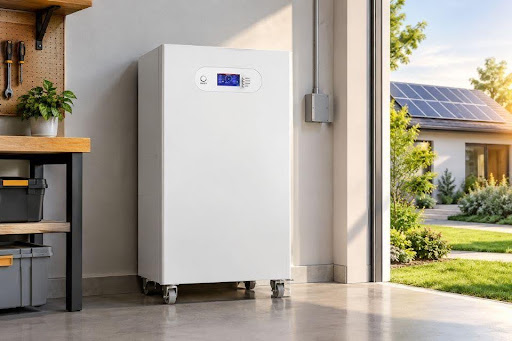
A stationary battery can act as an additional layer in a temporary power system rather than replacing the generator entirely. When the battery has sufficient state of charge, it can supply suitable auxiliary loads without requiring the generator to run continuously. If demand rises beyond the battery’s practical power capability, the generator can take a larger role. Depending on the control strategy, the generator can also recharge the battery when needed.
The value of this arrangement depends on system design. Battery capacity determines how much energy can be stored, while power rating determines how much load the system can support at a given moment. The generator’s output, charging rate, event duration, and expected load profile also matter. Selecting a battery simply because it has a large kWh figure can therefore be misleading. The system needs to be sized around actual operating patterns, including peak demand and the duration of lower-load periods.
How Generator + Battery Hybrid Systems Work
A generator-battery hybrid system uses controls to coordinate two different sources of electrical power. During periods of relatively modest demand, the battery may supply selected connected loads or a defined portion of site demand. When demand increases, the generator can start or increase its contribution. The battery may then absorb charging power when appropriate, allowing the generator to operate for a useful period rather than repeatedly starting and stopping for small changes in demand.
This approach can be particularly relevant when loads fluctuate throughout an event. Instead of treating every change as a reason to run the generator, the energy-management system can use stored energy to handle shorter variations. The exact sequence depends on the equipment and controls, but planning should start with average demand, peak demand, critical loads, operating hours, and periods when quieter operation is desirable.
Generator sizing should also be considered carefully. A generator that is too large for the normal load may spend much of its time underutilized, while one that is too small may struggle when several high-demand loads operate together. A battery can change this relationship, but it does not remove the need for appropriate sizing, protection, and electrical integration.
Why Hybrid Power Can Offer More Than Fuel Savings
Fuel reduction is often one reason to examine hybrid power, but it should not be the only consideration. A battery may allow a generator to remain off during selected lower-demand or quiet periods, which can reduce engine noise around temporary work areas. This can be useful during overnight operations or scheduled periods when continuous generator operation is undesirable.
Hybrid systems can also provide greater flexibility when electrical demand changes quickly. A battery can respond to short-duration load changes without requiring the generator to react to every fluctuation. Depending on the design, this may also reduce unnecessary engine cycling and give operators another layer of resilience for selected auxiliary loads.
The actual benefit is project-specific. A well-designed hybrid system may reduce generator runtime, but the result depends on battery capacity, generator characteristics, load patterns, control settings, charging requirements, and operating conditions. It is therefore better to evaluate the complete power profile than to assume a fixed percentage of savings.
Battery Storage in Hot and Island Markets
Environmental and logistical conditions become especially important when stationary battery systems are deployed in hot climates or locations where equipment transportation and service access can be challenging. A LiFePO4 system may be considered for these applications, but chemistry alone does not determine whether a particular system is suitable. Buyers also need to examine operating-temperature limits, thermal management, enclosure protection, installation requirements, and monitoring capabilities.
For example, stationary systems considered for markets such as the Philippines may need to account for heat, humidity, transportation distances, and the availability of technical support. Buyers researching LiFePO4 battery Philippines options should therefore look beyond chemistry and examine the complete system, including its BMS, environmental protection, installation requirements, monitoring capabilities, and service arrangements. The same principle applies to temporary event power, where environmental conditions can directly affect equipment selection and operating requirements.
What Commercial Buyers Should Check Before Choosing Battery Hardware
Commercial buyers should look beyond nominal energy capacity when comparing battery hardware. Usable energy, continuous power output, peak capability, cycle life, thermal management, and the battery management system can all affect suitability. Certifications and safety documentation are also important for commercial installations with defined technical and regulatory requirements.
Communication and monitoring also deserve attention. Depending on the project, buyers may need protocols that allow the battery to interact with inverters, energy-management systems, site monitoring platforms, or other controls. Warranty terms should be reviewed alongside conditions covering cycle count, operating temperature, depth of discharge, and installation environment. Documentation and technical support can become particularly important when systems are deployed across multiple projects.
When comparing solar battery companies, buyers can evaluate manufacturing capacity, engineering resources, product consistency, and OEM/ODM support alongside core specifications. Avepower, for example, manufactures LiFePO4 energy-storage systems and reports more than 10 years of industry experience, a 20,000 m² manufacturing base, 15+ production lines, and more than 50 R&D and technical engineers. Its OEM/ODM capabilities may suit buyers seeking customized configurations or repeatable supply.
Procurement should also consider documentation, production capacity, communication support, and after-sales service.
When a Hybrid System May Not Be the Right Choice
Hybridization is not automatically appropriate for every temporary power project. A generator-only setup may remain practical where loads are consistently high, operating periods are long, fuel logistics are already efficient, or the additional battery infrastructure would provide little operational value. Some sites may also have space, transport, or integration constraints that make a hybrid system less attractive.
The right decision should therefore start with the actual electrical profile rather than with a preference for one technology. Operators should consider the duration of the event, average and peak demand, critical loads, environmental conditions, available charging opportunities, noise requirements, and the total cost of ownership before selecting the architecture.
A Practical Planning Checklist
Before designing a temporary hybrid power system, commercial teams can work through a few basic questions:
What equipment will operate, and what are its peak and average loads?
Which loads are critical and which can be managed flexibly?
How many hours of operation are required each day?
When is quiet operation most important?
What generator capacity is actually required?
What battery power and usable energy are needed?
What environmental and installation conditions must the system handle?
Which monitoring and communication interfaces are required?
What warranty, service, and technical support will be available?
This process helps connect equipment selection with the site’s real operating requirements instead of choosing a battery based only on its headline capacity. It also makes the comparison between generator-only and hybrid architectures more practical because both options can be evaluated against the same operating data.
Final Takeaway
Mobile motorsport operations are not necessarily moving away from generators; they are reconsidering how generators should be used. For suitable temporary applications, combining a generator with stationary battery storage can provide a more flexible way to manage variable auxiliary loads, reduce unnecessary generator runtime, and support quieter operating periods.
The appropriate configuration depends on the event’s load profile, operating schedule, environment, power requirements, and commercial constraints. For energy-storage distributors, installers, EPC partners, and OEM/ODM buyers, evaluating those factors alongside battery quality, BMS capability, certifications, communication, manufacturing capacity, and supplier support can lead to a more practical system design.
For businesses exploring commercial energy-storage manufacturing or OEM/ODM opportunities, Avepower is one manufacturer that can be evaluated alongside other qualified suppliers based on the project’s technical, documentation, production, and procurement requirements.
FAQs
1. Why are motorsport operations reconsidering generator-only power?
Because paddock power demand can fluctuate significantly. Battery storage can support lower or intermittent loads without requiring the generator to run continuously.
2. How does a generator-battery hybrid system work?
The battery supplies suitable loads when possible, while the generator provides additional power when demand rises or the battery needs charging.
3. Can battery storage replace a generator at a motorsport event?
Not always. Generators may still be needed for high or continuous loads, while batteries can support selected loads and quieter operating periods.
4. What are the benefits of generator-battery systems?
They can reduce unnecessary generator runtime, handle short-term load changes, and provide more flexible power management.
5. What should buyers consider when choosing battery storage?
Buyers should check usable energy, power rating, BMS, thermal management, certifications, environmental protection, communication, warranty, and service support.
A Carfax report costs $44.99 direct from Carfax.com. The same report is $4.49 through VinCheckFast, which operates on dealer access and passes the volume rate to private buyers, with credit packs bringing it to around $3 per report and payment through PayPal.
What this covers:
How much a Carfax report costs in 2026
Whether Carfax discount codes and coupons work
The cheapest way to get a Carfax report
How VIN report prices vary between providers
Whether low-cost reports are reliable
What free VIN checks actually return
Finding a VIN when the listing does not show one
How much does a Carfax report cost?
A single Carfax report costs $44.99 direct from Carfax.com in 2026. Multi-report bundles lower the per-report figure, and Carfax also sells a monthly subscription, but both require a larger payment up front and suit people running reports continuously rather than someone comparing a handful of cars.
For a private buyer checking one vehicle, $44.99 is the number that applies. Anyone shortlisting four or five cars is looking at $180 to $225 in reports alone, which is why most buyers end up running one report on the car they have already decided on.
What is the cheapest way to get a Carfax report?
Buying through a service that operates on dealer access. Dealerships and auction buyers obtain Carfax reports at volume rates far below the consumer counter price, and services built on that access resell at a fraction of retail.
A cheap carfax report through that route costs $4.49, which is a tenth of what Carfax.com charges for the same document. Credit packs bring it to around $3 per report. Payment runs through PayPal, so a first purchase from a service you have not used before carries buyer protection.
Source
Price per report
What you receive
Carfax.com, single report
$44.99
Carfax report
VinCheckFast, single report
$4.49
The same Carfax report
VinCheckFast, credit pack
from $3.00
The same Carfax report
Free VIN decoder
$0
Specification only, no history
Are there Carfax discount codes or coupons?
Public Carfax promo codes almost never work. Searching for one returns aggregator pages listing codes that fail at checkout, alongside seasonal offers that expired years ago and were never removed. Coupon sites earn on the click rather than on whether the code functions, so nobody has any reason to prune the list.
One partner discount is real. AAA lists a member discount on the Carfax Vehicle History Report among its automotive benefits, published on AAA’s own discounts site. Access it through the AAA member portal rather than through a code found elsewhere. AAA does not publish the amount, and membership costs money in its own right, so it only makes sense if you are already a member.
No standing military discount exists at Carfax, and no current Costco discount could be found. Coupon pages listing either redirect to Carfax with the full price intact. The test is simple: enter the code in the Carfax checkout and watch the order total. If the number does not move, the code is dead regardless of what the page claimed.
Set any of this against dealer pricing. A working promo code, in the years when they existed, took a few dollars off $44.99. Dealer access takes off roughly ninety percent and does not expire.
How does the price of VIN reports vary between providers?
Widely, and the variation reflects the data source rather than the depth of the report. At one end sit free VIN decoders, which return the specification a VIN encodes and nothing about the car’s history. In the middle sit history reports drawing on national databases. At the top sits Carfax retail pricing.
The distinction that matters is which report you are actually buying. A service that will not name the report it delivers is usually not delivering the one you assumed. VinCheckFast states the product plainly: the Carfax report itself, at $4.49, with the same accident records, title brands, odometer readings, reported service entries, and open recalls as one bought at full price.
Are low-cost Carfax reports reliable?
The report is identical, so its reliability is whatever a Carfax report’s reliability is. What changes at $4.49 is where you bought it, not what it contains.
The real limitation applies at any price. A Carfax report covers events that entered a reporting system. Accidents that reached an insurer, title brands recorded by a state, and odometer readings captured at registration or service. A collision repaired privately and paid in cash leaves no record, and a recent accident can take weeks to appear. A clean report means no reported problems, which is narrower than no problems.
For anyone shopping performance cars, one gap is worth naming. Track use never appears on a report. HPDE days, autocross, club racing and drag passes generate no insurance claim and no title change, so a heavily tracked car reads the same as a commuter. That decision comes from inspecting the car, not from the report.
What about free VIN checks?
Free tools return a specification decode: year, make, model, engine, trim, and factory equipment. Useful for confirming a listing matches the car in the photos, and not a history report. No accident records, no title brands, no odometer trail.
Any site promising a full history report at no cost is collecting an email, showing the decode, then asking for payment. Nobody gives away a paid report.
Finding a VIN when the listing does not show one
Plenty of private listings omit the VIN, and some sellers are slow to hand it over. It is often legible in the photos anyway, on the windshield plate or a door jamb sticker, and a VIN check with photos pulls it straight from the image so you can run the report before contacting anyone.
That changes the order of operations. Screen from the listing photos, eliminate the cars with branded titles or recorded accidents on paper, then spend your time on the ones that survive.
What running multiple reports actually buys you
At $44.99 a report, buyers ration them and check the car they have already talked themselves into, which is the point at which a report changes the fewest decisions. At $4.49, the report moves to the front of the process, where it can still rule a car out before anyone drives anywhere.
That matters most on cars passing through salvage and insurance auctions, and on anything sold with an out-of-state title and a story attached. Title branding standards are set state by state, and a car written off in one state can be retitled in another where the brand does not carry across. Checking the current title alone will not catch that. A report covering the full multi-state registration history will.
The short answer on price
Carfax charges $44.99 for a single report. The same report costs $4.49 through dealer access, or around $3 with a credit pack, paid by PayPal. Discount codes are largely dead, and the AAA member offer is the only genuine partner discount, neither of which comes close to the gap between retail and dealer pricing.
Historically, competition is an important part of daily life in a lot of Asian societies. Which is natural, since huge populations create an environment where getting your piece of cake calls for doubling the effort. In modern Japan, it mostly manifests as playful regional feuds, historical samurai competitions, and a popular storytelling trope that emphasizes mutual respect and self-improvement. That’s the energy they bring into sports as well.
The Japanese have entered 2026 with a league system that has become far more international and competitive than its 1990s version, contributing to the fanbase and online betting opportunities.
Since its launch in 1993 (10 clubs at the time), the professional game has expanded into a three-tier structure and developed a strong reputation for producing technically gifted players who later often move to Europe.
Over the course of history, the Japan Professional FL has gradually earned trust and respect from fans and other professionals. After a Melbet registration, staying updated on teams’ information gets easier, but statistics merely reflect results – not the way up there.
True identities are molded by rivalries, charity work, personal records, and, of course, scandals. So what exactly do we know about sportsmen who came from the Land of the Rising Sun?
Setting the Pace
The modern J.League has several established powers:
Kawasaki Frontale
Yokohama F. Marinos
Urawa Red Diamonds
Kashima Antlers
All of them have played major roles in shaping the competition, with the latter particularly important. They won the inaugural Japan Professional FL title in 1993 and have collected more J1 championships than any other club.
Urawa offers a very different picture. The huge fan base makes matches at Saitama Stadium some of the most intense occasions in Japanese football. The Reds have also become one of Asia’s most successful teams, winning the AFC Elite multiple times.
Yokohama F. Marinos are one of the originals and have maintained a strong connection with attacking football. Their rivalry with nearby Kawasaki Frontale is especially famous, since both have competed for major domestic honors.
Nippon Stars That Shine Domestically and Worldwide
Of course, the major factor in the league’s appeal in 2026 is its players. Their success has changed the game, earning various opportunities for the country. A domestic career can now be part of a longer route toward major European competitions.
So let’s put names to achievements in our personal Top 10:
1. Hidetoshi Nakata Played for Perugia, Roma, Parma, Bologna, and Fiorentina in Serie A and won the Scudetto with Roma in 2001.
2. Keisuke Honda One of Japan’s most recognizable footballers of the 2010s. Was in CSKA Moscow, AC Milan, and several clubs around the world. Scored in three consecutive World Cups, in 2010, 2014, and 2018.
3. Shunsuke Nakamura Famous for his exceptional free kicks and technique. He became a Celtic legend, won the Scottish Premier League three times, and was named the 2007 PFA Scotland Player of the Year.
4. Kazuyoshi Miura Known as King Kazu, he began his career in the 1980s and continued into his 50s.
5. Makoto Hasebe A long-serving Japan captain who spent most of his European career in Germany. He played for Wolfsburg, Nürnberg, and Eintracht Frankfurt, winning the Bundesliga with Wolfsburg in 2009.
6. Shinji Kagawa One of Japan’s most successful modern players. He won two Bundesliga titles with Borussia Dortmund and later won the Premier League while playing for Manchester United.
7. Yuto Nagatomo A hugely recognizable full-back who spent many years at Inter Milan. He won the Coppa Italia, FIFA Club World Cup, and Supercoppa Italiana with Inter.
8. Takumi Minamino A product of Cerezo Osaka who established himself in Europe (Salzburg, Liverpool, and Monaco).
9. Takefusa Kubo One of the biggest current stars. Known as Take Kubo, he developed in Barcelona’s youth system and later became highly important for Real Sociedad and Japan.
10. Kaoru Mitoma
Recognized internationally, he amazes with his dribbling and attacking style, which made him a standout at Brighton after moving from Kawasaki Frontale.
The Power of Competition
Japanese football has several locally legendary rivalries, such as Gamba Osaka VS Cerezo Osaka or Urawa VS Kashima Antlers. One of the most interesting aspects of those is that they often develop through repeated competition rather than centuries-old hostility. The J.League itself is relatively young, so clubs have spent the last three decades creating their own traditions.
Sure, there’s always a touch of negative emotion when it comes to competitiveness, but local culture teaches us to look at it from a different angle. Even in Japanese storytelling — ranging from classic folklore to modern anime and manga — rivals are rarely pure villains.
To show what, we’ve even compiled a watch-list, containing some of the most popular sports-related stories that illustrate this approach:
Haikyuu!! 🏐
Blue Lock ⚽
Slam Dunk 🏀
Kuroko’s Basketball 🏀
Captain Tsubasa ⚽
Ace of Diamond ⚾
Hajime no Ippo 🥊
Nippon Today
The J.League is now part of a much larger football ecosystem. Japanese sportsmen regularly move abroad, foreign players continue to arrive, and Asian competitions give domestic clubs additional opportunities to test themselves.
It also has a strong youth-development culture. Managers invest heavily in academies, which means many J1 members have spent years improving their local sports.
Japan’s rise on the international stage has been closely connected to the development of domestic football. The country has reached the knockout stage of several recent World Cups, while more Japanese participants than ever have established careers in Europe’s top teams.
In 2026, the J.League therefore sits at an interesting point. Its traditional clubs and rivalries remain central to its identity, but the competition is increasingly connected to the global football market.
The most exciting question is what comes next. Japan has already shown that it can develop players capable of succeeding abroad. Meanwhile, we are staying tuned for more.
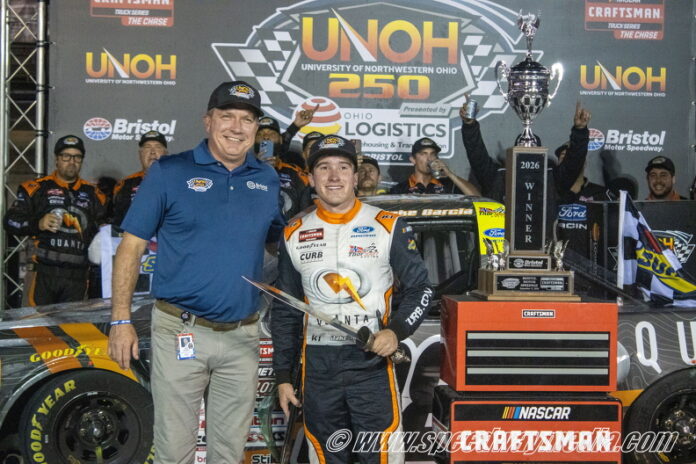
Jake Garcia commenced the 2026 NASCAR Craftsman Truck Series’ Chase by pulling off the upset and serving as the spoiler by wheeling his way to his first career victory in the UNOH 250 at Bristol Motor Speedway on Thursday, September 17.
The 21-year-old Garcia from Monroe, Georgia, led three times for 104 of 250-scheduled laps in an event where he took the green flag from a 12th-place starting spot from a qualifying metric formula due to inclement weather canceling the event’s on-track qualifying session. After motoring his way to finish fourth at the first stage’s conclusion, he was among select names who strategically pitted during the first stage’s break period prior to the second stage period. The pit move paid off as Garcia carved his way back towards the front and notched another fourth-place result at the second stage’s conclusion.
Then, before the final stage period, Garcia, who pitted with the lead-lap field, only pitted for fuel while most of his competition behind pitted for fresh tires. Nevertheless, Garcia made both the clean air and outside lane work to his advantage as he maintained the lead through two late-race restarts. Despite losing the lead during a tight three-wide battle with Stewart Friesen and Bayley Currey during the final restart with 31 laps remaining, Garcia reeled in and reassumed the lead from Friesen with 21 laps remaining. From there, Garcia motored away to his first elusive victory in the Truck Series division under the lights at the Last Great Coliseum.
The event’s starting lineup was determined through a qualifying metric formula after on-track qualifying scheduled for Thursday was canceled due to inclement weather. As a result, Chaser Layne Riggs was awarded the pole position, and he shared the front row with teammate Chaser Chandler Smith.
Before the event, Connor Hall and Caden Kvapil dropped to the rear of the field after unapproved adjustments to their respective entries.
When the green flag waved and the event commenced, Layne Riggs, who opted to start on the outside lane, rocketed his No. 34 Love’s Ford F-150 entry away from the field for a full circuit as he then proceeded to lead the first lap. With the clean air working to his advantage in the early stages, Riggs proceeded to lead by two-tenths of a second over teammate Chandler Smith on the fifth lap while Tristan McKee, Kaden Honeycutt, Stewart Friesen, Ty Majeski, Daniel Hemric, Justin Haley, Jake Garcia and William Sawalich trailed in the top 10, respectively.
Through the Lap 10 mark, Riggs slightly increased his early advantage up to four-tenths of a second over Smith, while Honeycutt, McKee, Majeski, Hemric, Garcia, Friesen, Haley and Sawalich continued to trail in the top-10 mark, respectively. By then, half of the Chase competitors (Riggs, Smith, Honeycutt, Majeski and Hemric) were racing in the top 10 on the leaderboard while the rest of the Chasers, including Grant Enfinger, Ben Rhodes, Tyler Ankrum, Christian Eckes and Giovanni Ruggiero, were mired in 11th, 12th, 13th, 15th and 24th, respectively.
With Riggs approaching the tail end of the field by Lap 18, including Regan Smith, he led by two-tenths of a second at Lap 20 over Smith while third-place Honeycutt trailed by half a second in third place. Riggs, who lapped seven competitors over the previous 12 laps, stretched his lead up to nine-tenths of a second over Smith on Lap 30 before the former’s lead increased up to a second over both Smith and Honeycutt at the Lap 40 mark.
On Lap 42, Eckes made an unscheduled pit stop for repairs under green after he made contact with Enfinger by sliding up and getting turned sideways by Enfinger towards the outside wall in the backstretch. With Eckes then getting penalized for having too many pit crew members over the pit wall, he lost multiple laps in the process. Meanwhile, Riggs continued to lead by two seconds over Honeycutt and Smith by Lap 50 as Honeycutt overtook Smith for the runner-up spot. Behind, Majeski navigated his way up to fourth place ahead of teammate Garcia and McKee while Hemric, Rhodes, Friesen and Haley trailed in the top 10, respectively.
When the first stage period concluded on Lap 65, Riggs cruised to his 10th Truck stage victory of the 2026 season with an advantage of nearly three seconds. Honeycutt and Smith followed suit in second and third, respectively, while Garcia, Majeski, McKee, Hemric, Rhodes, Friesen and Haley were scored in the top 10, respectively. By then, 19 of 36 starters were scored on the lead lap. In addition, six Chasers (Riggs, Honeycutt, Smith, Majeski, Hemric and Rhodes) were awarded the event’s first round of stage points while the remaining Chasers that include Ankrum, Enfinger, Giovanni Ruggiero and Eckes were mired in 13th, 14th, 15th and 35th, respectively.
During the event’s first stage break period, split strategies ensued as some led by Garcia and including Chasers Hemric, Ankrum, Enfinger and Ruggiero pitted. Friesen, Haley, Bayley Currey, Sawalich, Cole Butcher, Tanner Gray, Landen Lewis and Nick Lietz also pitted while the rest, led by Riggs, remained on the track.
The second stage period started on Lap 76 as Riggs and Honeycutt occupied the front row. At the start, Riggs used the outside lane to motor ahead of Honeycutt and the field through the first two turns while Smith, who restarted behind Riggs, followed suit in second place. Riggs led the next lap and he proceeded to lead Smith by four-tenths of a second while Honeycutt trailed in third place by nine-tenths of a second. Meanwhile, Garcia, the highest-running competitor with fresh tires, motored his No. 98 Quanta/Curb Records Ford F-150 entry up to fourth place ahead of teammate Majeski and McKee while Rhodes, Friesen, Hemric and Tanner Gray were racing in the top 10, respectively.
At the Lap 90 mark, Front Row Motorsports’ duo of Riggs and Smith led the field, with Riggs leading the event by half a second over Smith. Behind, Honeycutt and Garcia trailed by a second in third and fourth, respectively, while Majeski settled in fifth ahead of McKee, Rhodes, Friesen, Hemric and Sawalich. By then, six of 10 Chasers settled in the top 10 on the track while Ankrum, Ruggiero, Enfinger and Eckes were mired in 14th, 15th, 18th and 35th, respectively, with Eckes being pinned six laps behind.
On the Lap 100 mark, Riggs, who was mired in lapped traffic, maintained the lead by six-tenths of a second over Smith as Honeycutt reel in on Smith for the runner-up spot. Honeycutt proceeded to overtake Smith for a second time for the runner-up spot and both Garcia and Majeski continued to occupy the remaining top-five spots, respectively, while Riggs led by a second just past the Lap 110 mark. With half of the field lapped by Riggs, the latter stabilized his lead by more than a second at the event’s halfway mark on Lap 125.
When the second stage period concluded on Lap 130, Riggs powered to his second Truck stage victory of the event and the 11th of the 2026 season. Honeycutt, Smith, Garcia, Majeski, Friesen, Nick Leitz, Tanner Gray, Bayley Currey and McKee were scored in the top 10, respectively. By then, only four Chasers (Riggs, Honeycutt, Smith and Majeski) received the event’s second wave of stage points while the remaining Chasers that include Rhodes, Hemric, Ankrum, Ruggiero, Enfinger and Eckes were mired in 12th, 14th, 15th, 16th, 18th and 35th, respectively.
During the event’s second stage break period, the lead lap field led by Riggs pitted for service. Following the pit stops, Garcia, who only opted for fuel to his entry, exited pit road first and he was followed by Friesen, the latter of whom pitted for two fresh tires. Smith, Honeycutt, Currey, Riggs, Ruggiero, Hemric, Majeski and Leitz followed suit, respectively. Following the pit stops, Smith was sent to the tail end of the field after he was penalized for speeding on pit road.
With 109 laps remaining, the final stage period commenced as Garcia and Friesen occupied the front row. At the start, Garcia motored ahead of Friesen to lead through the first two turns and the backstretch while Honeycutt, who restarted behind Garcia, followed suit. As Garcia led the next lap, Riggs used the outside lane to reel in on Honeycutt for the runner-up spot. Amid Riggs’ charge through the turns from the outside lane, Honeycutt managed to move up and fend off Riggs’ charge on multiple occasions. Riggs would then lose slight momentum and be challenged by Friesen for third place with 105 laps remaining. With teammate Smith mired in 20th place, Riggs managed to fend off Friesen for third place while Garcia, who was holding strong with worn tires, led by seven-tenths of a second over Honeycutt with 100 laps remaining.
Down to the final 90 laps, Garcia was leading by nine-tenths of a second over Honeycutt while third-place Riggs trailed by. Behind, Friesen and Currey were racing in the top five ahead of Ruggiero, Leitz, Majeski, Haley and Hemric while Ankrum, Enfinger, McKee, Sawalich and Landen Lewis trailed in the top 15 over Corey LaJoie, Rhodes, Smith, Dawson Sutton, Tanner Gray and Andres Perez De Lara, all of whom were scored on the lead lap.
A lap later, Riggs, who endured a slow pit service during the second stage’s break period, pitted under green to have a loose wheel (potentially around the right-rear area) addressed. By the time Riggs returned on the track, he was mired two laps down in 27th place. Then with 82 laps remaining, the caution flew due to Nick Leitz, who was racing in sixth place, getting loose entering Turn 3 while reeling in on teammate Ruggiero and hitting the outside wall. Behind, Kris Wright got loose and smacked the frontstretch’s inside wall while Majeski got loose and spun below the track through the frontstretch. The trio of incidents placed the event in a red flag period for 14 minutes and 20 seconds to have the track cleared and inspected for potential oil spilled.
When the red flag lifted and the field restarted with 69 laps remaining, Garcia retained the lead through the first two turns before he transitioned from the outside to the inside lane. This allowed Honeycutt to use the outside lane and duel with Garcia for a lap before he briefly got loose an was outdueled by Garcia shortly after. As Garcia maintained a steady lead over Honeycutt with 65 laps remaining, Currey tried to reel in from third place while Friesen, Haley and Ruggiero occupied the top-six spots in front of Enfinger, Ankrum, Smith and Hemric. Amid the battles within the field, Garcia led by eight-tenths of a second over Honeycutt with 60 laps remaining.
As the event reached its final 50-lap mark, Garcia retained the lead by six-tenths of a second over Honeycutt while Currey, Friesen, Ruggiero, Haley, Enfinger, McKee, Smith and Sawalich raced in the top 10 ahead of Ankrum, Hemric, Rhodees and Majeski, respectively. Meanwhile, Riggs and Eckes were the two lowest-running Chasers in 26th and 34th, respectively, while also mired two and eight laps behind. As Garcia extended his late lead by a second with 40 laps remaining, Honeycutt, who radioed a vibration in his entry and had initially kept Garcia within his sights, lost the runner-up spot to teammate Currey.
With 38 laps remaining, the caution flew due to debris on the track. During this caution period, Honeycutt, Hemric, Tanner Gray, LaJoie and Leitz pitted, with Chasers Honeycutt and Hemric pitting for four fresh tires, while the rest led by Garcia remained on the track. By then, Ruggiero was the highest-running Chaser in fourth place while Chandler Smith was up in eighth place.
The next restart with 31 laps remaining featured a tight three-wide battle between Friesen, Garcia and Currey through the first two turns and the backstretch. Amid a slight bobble and tap from Currey into Garcia as Garcia almost got Friesen loose, Friesen, who restarted in fourth place, used the outside lane towards the outside lane to bolt ahead into the lead for the next lap. As the field scrambled and jostled for late spots, Friesen maintained a narrow lead over Garcia and Currey with 25 laps remaining.
Meanwhile, Riggs sustained heavy left-side damage to the left side of his entry as he rubbed fenders with Leitz within the mid-pack area. The event remained under green as Garcia, who intimidated Friesen for the lead, used the inside lane through the first two turns and with Friesen running a little too high to reassume the lead with 21 laps remaining. Garcia started to slowly pull away over the next two laps while Currey challenged Friesen for the runner-up spot. Meanwhile, Haley lurked and reeled in from fourth place along with McKee while Ruggeiro was the highest-running Chaser in sixth place.
Down to the final 15 laps, Garcia led by eight-tenths of a second over Friesen while Currey, Haley and McKee, all of whom were not in the Chase, occupied the top-five spots ahead of Ruggiero and Sawalich. Behind, Chasers Majeski, Honeycutt, Smith, Enfinger, Rhodes, Hemric and Ankrum were running from eighth through 14th, and Riggs was mired 11 laps down in 33rd place while Garcia stretched his late lead up to a second with 10 laps remaining. With Chandler Smith reporting a potential flat tire to his entry, slowly slipping out of the top-10 mark and eventually pitting under green, Garcia continued to lead by more than one-and-a-half seconds over Friesen and Currey.
When the white flag waved and the final lap started, Garcia remained in the lead by more than a second over Currey as the latter outdueled Friesen for the runner-up spot. With no competition reeling in from behind, Garcia smoothly cycled his way around Bristol for a final time before he returned to the frontstretch victorious for his first-ever checkered flag in the series.
With the victory, Garcia, who won in his 94th series’ start and had notched five top-five results prior to the Bristol victory, became the 129th competitor overall to win in the Truck Series division, the second first-time winner of the 2026 season and the sixth competitor to achieve a first Truck career victory in the UNOH 250 event since 2014.
Garcia’s Bristol victory was also the ninth of the 2026 campaign for Ford and the first for ThorSport Racing since the organization last won the 2024 finale at Phoenix Raceway, the exact event in which they also won their latest championship. Garcia also became the first competitor to win the Truck opener at Bristol as a non-Chase contender since Sam Mayer achieved the previous feat in 2020.
Photo by Logan Allen for SpeedwayMedia.com.
“I’ve been pushing for it for 94 starts,” Garcia said on the frontstretch on FS1. “Really proud of all my guys. They brought an amazing truck tonight. It was good today, but qualifying got rained out. We had a good strategy that helped us come from the back. Get some track position, start Stage 3 with the lead and just kind of took off from there. I had some adversity during that last restart, but fortunately, the truck was fast enough to overcome that. Just really proud of this moment. ThorSport Racing’s a really strong team, especially historically. Just proud of all my guys on the No. 98 team for being able to end that winless streak. It’s been so long since we’ve got a win. It feels really good to be the one to get it done.”
Bayley Currey, who works as a Truck chief at TRICON Garage and made his first national touring series start behind the wheel since the 2025 finale at Phoenix Raceway, notched a career-best runner-up result in his 84th Truck career start. Stewart Friesen, who, like Garcia, missed the 2026 Chase by a slim margin, settled in third place for his third top-five result of this season.
Justin Haley achieved the highest-finishing result for himself and Kaulig Racing’s RAM Truck Series program thus far by finishing in fourth place and Tristan McKee, the 2026 ARCA Menards Series East champion, achieved his first top-five result in the Truck division by finishing in fifth place. Thus far, McKee has finished no lower than eighth in his three Truck starts.
Giovanni Ruggerio emerged as the highest-finishing Chase contender in sixth place ahead of William Sawalich while a host of Chasers that include Kaden Honeycutt, Ty Majeski, Grant Enfinger, Ben Rhodes, Daniel Hemric and Tyler Ankrum finished eighth through 13th, respectively, on the track. Meanwhile, Chandler Smith, Christian Eckes and Layne Riggs ended up 24th, 30th and 32nd, respectively.
The 2026 Craftsman Truck Series’ Chase opener at Bristol generated five lead changes for four different leaders, and four cautions for 38 laps. In addition, 19 of 36 starters finished on the lead lap.
Race Results:
Jake Garcia, 104 laps led
Bayley Currey
Stewart Friesen, 10 laps led
Justin Haley
Tristan McKee
Giovanni Ruggiero
William Sawalich
Kaden Honeycutt, one lap led
Ty Majeski
Grant Enfinger
Ben Rhodes
Daniel Hemric
Tyler Ankrum
Landen Lewis
Dawson Sutton
Tanner Gray
Andres Perez De Lara
Corey LaJoie
Luke Baldwin
Nick Sanchez, one lap down
Brenden Queen, one lap down
Timmy Hill, one lap down
Regan Smith, two laps down
Chandler Smith, three laps down
Connor Mosack, four laps down
Mini Tyrrell, five laps down
Kris Wright, six laps down
Cole Butcher, six laps down
Connor Hall, seven laps down
Christian Eckes, eight laps down
Parker Etamon, nine laps down
Layne Riggs, 16 laps down, 135 laps led, Stage 1 & 2 winner
Frankie Muniz, 19 laps down
Nick Leitz – OUT, Suspension
Caden Kvapi – OUT, Engine
Jackson Macenko – OUT, Too Slow
*Bold indicates Chase Drivers
Following the first Chase event of the 2026 NASCAR Craftsman Truck Series season, Layne Riggs leads the Chase standings by three points over Kaden Honeycutt. The rest of the 10-truck Chase field is displayed below.
Chase Standings:
Layne Riggs
Kaden Honeycutt -3
Chandler Smith -30
Ty Majeski -35
Giovanni Ruggiero -39
Grant Enfinger -53
Daniel Hemric -56
Christian Eckes -58
Ben Rhodes -61
Tyler Ankrum -71
The 2026 NASCAR Craftsman Truck Series Chase, which has officially commenced, continues next Saturday, September 26, at Kansas Speedway in Kansas City, Kansas, for the Race to Stop Suicide 200. The event is slated to begin at 1 p.m. ET on FS1, NASCAR Racing Network, and SiriusXM.
16-Year-Old Phenom Becomes Youngest Champion in Series History
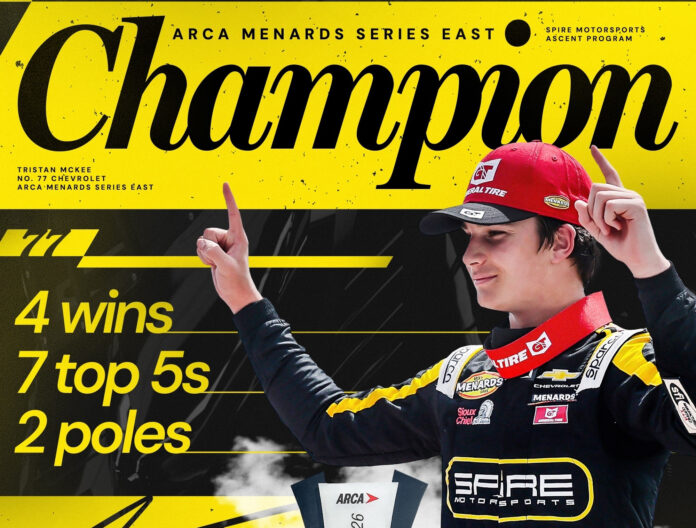
MOORESVILLE, N.C. (Sept. 17, 2026) – When the checkered flag waved in Thursday night’s ARCA Menards Series East race at Bristol (Tenn.) Motor Speedway, Tristan McKee was crowned the 2026 series champion. At just 16 years, 1 month and 14 days old, McKee became the youngest driver to earn the ARCA Menards Series East Champion title on the strength of four wins, seven top fives and seven top 10s in the No. 77 Freeway Insurance Chevrolet for Pinnacle Racing Group (PRG).
“It means a lot just to get a championship in the Trans Am TA2 Class and then in the lower levels of NASCAR to start out. It’s definitely really cool. We had a good year, and I knew we just had to put it together here today,” said McKee. “Thanks to all the PRG guys, Chevrolet, Josh Wise, everyone at Spire, Freeway and all our sponsors from each and every race this year. I wish we could have closed it out with a sword up there, but I think we’ll be able to get it done here later in the truck.”
The Williamsburg, Va., native made his NASCAR CRAFTSMAN Truck Series debut last month at Richmond (Va.) Raceway where he earned an eighth-place finish in the No. 77 Chevrolet Silverado RST for Spire Motorsports. He followed that up with a sixth-place showing at New Hampshire Motor Speedway on Aug. 22 and will start fourth in his third CRAFTSMAN Truck Series start at Bristol in Thursday night’s UNOH 250 Presented by Ohio Logistics.
In January 2025, McKee was announced as the first driver signed to Spire Motorsports’ driver development program. At that time, he was already recognized as the youngest winner in zMAX CARS Pro Late Model Tour history after claiming a win at Dillon (S.C.) Motor Speedway at 12 years old and owned a 2024 Carolina Pro Late Model Series victory at one of the nation’s most iconic paved short tracks – Hickory (N.C.) Motor Speedway. McKee started off 2025 with a zMAX CARS Pro Late Model win at Cordele (Ga.) Motor Speedway and two dominate wins in the CUBE 3 Architecture TA2 Series at Mid-Ohio Sports Car Course and Watkins Glen (N.Y.) International.
On August 8, 2025, just five days after his 15th birthday McKee made his ARCA Menards Series debut at Watkins Glen (N.Y.) International. He started fourth and led the final three circuits to become the second-youngest race winner in series history. He made five total starts, earning four top-five finishes, while also competing full time in the CUBE 3 Architecture TA2 Series with Team SLR. McKee was crowned the 2025 TA2 Series champion by a whopping 169 points with four wins, eight podiums and 114 laps led. He became the youngest winner in series history at 15 years, two months and 16 days of age, and also claimed the Rookie of the Year title and Young Guns Award.
Following Thursday night’s CRAFTSMAN Truck Series race, McKee will continue building his resume with two additional starts in the No. 77 Chevrolet Silverado RST for Spire Motorsports at Phoenix Raceway (Oct. 16) and Martinsville (Va.) Speedway (Oct. 30).
About Spire Motorsports … Spire Motorsports fields full-time entries in the NASCAR Cup Series, NASCAR CRAFTSMAN Truck Series and Interstate Batteries High Limit Racing.
The team, co-owned by longtime NASCAR industry executive Jeff Dickerson and TWG Motorsports CEO Dan Towriss earned its inaugural NASCAR Cup Series victory in its first full season of competition when Justin Haley took the checkered flag in the Coke Zero Sugar 400 at Daytona (Fla.) International Speedway July 7, 2019. Less than three years later, William Byron drove Spire Motorsports’ No. 7 Chevrolet Silverado its first NASCAR CRAFTSMAN Truck Series win April 7, 2022, at Martinsville (Va.) Speedway. The team’s most recent victory came May 24, 2026, when Daniel Suárez won the NASCAR Cup Series’ Coca-Cola 600 at Charlotte (N.C.) Motor Speedway.
In 2026, Spire Motorsports campaigns the Nos. 7, 71 and 77 Chevrolet Camaro ZL1s in the NASCAR Cup Series and the Nos. 7 and 77 Chevrolet Silverado RSTs in the NASCAR CRAFTSMAN Truck Series. The Mooresville, N.C., organization also fields the No. 77 410 sprint car in Interstate Batteries High Limit Racing competition.
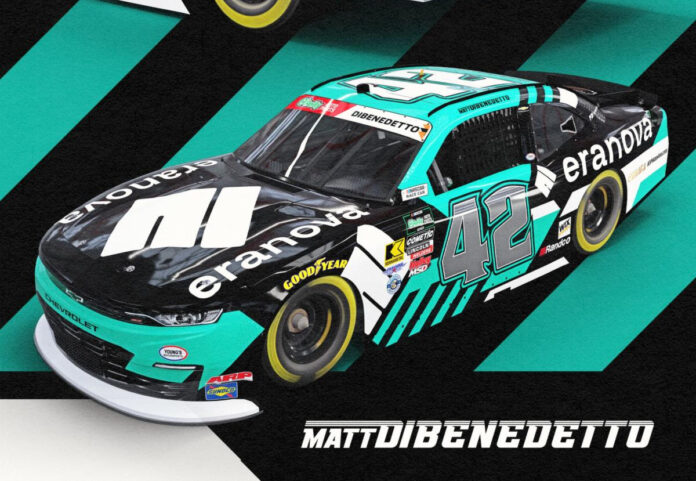
MOORESVILLE, N.C.: Matt DiBenedetto’s return to NASCAR competition with Young’s Motorsports is expanding.
One week after the veteran driver makes his anticipated return to the NASCAR O’Reilly Auto Parts Series at Las Vegas (Nev.) Motor Speedway, DiBenedetto will return to the No. 42 Young’s Motorsports Chevrolet for the Blue Cross NC 300 at Charlotte (N.C.) Motor Speedway on Saturday, Oct. 10.
The additional race comes through a new partnership with Eranova, a Charlotte-based enterprise AI software company making its first venture into NASCAR competition.
Eranova’s entry into the sport provides the growing company an opportunity to introduce its brand to NASCAR’s passionate fan base while strengthening its presence and developing new relationships throughout the transportation and logistics industries.
As an enterprise AI software company, Eranova provides a platform and suite of AI agents that automate work across supply chain and back-office finance operations.
Eranova’s agents work across existing core systems to automate workflows ranging from shipment quoting, booking and tracking to document processing, accounts payable and accounts receivable.
Headquartered in the heart of NASCAR country, Eranova sees a natural connection between its roots in supply chain and NASCAR’s deep ties to transportation, technology and innovation.
The partnership with DiBenedetto and Young’s Motorsports provides the company with a national platform to connect with new customers, build relationships and continue expanding its growing brand.
“We’re incredibly excited to partner with Matty D and Young’s Motorsports for our first NASCAR sponsorship,” said Eranova Head of Engineering & Deployment Ethan Barnes. “NASCAR has an incredibly loyal fan base and strong connections throughout the transportation and logistics industries, making it a great fit for Eranova.
“We look forward to becoming part of the NASCAR community, building new relationships and showcasing how AI agents can automate the work behind supply chain and finance operations.”
For DiBenedetto, the addition of Charlotte extends his NASCAR return to consecutive weekends after previously announcing plans to compete for Young’s Motorsports at Las Vegas Motor Speedway on Oct. 3.
The Las Vegas race will mark DiBenedetto’s first NASCAR national-series start since October 2025 and his debut with the Mooresville, N.C.-based Young’s Motorsports organization.
“I’m really excited to add Charlotte to our schedule and incredibly thankful to Eranova for stepping up and making another race possible,” said DiBenedetto.
“What makes this partnership even cooler is that Eranova is based right here in Charlotte, so having their first NASCAR sponsorship happen at their home track makes a lot of sense.
“They’re doing some really innovative things with AI in the transportation and logistics industries, which have such strong connections throughout NASCAR.
“I’m looking forward to helping introduce their brand to our fans, representing them well on and off the track and hopefully giving them a memorable first experience in the sport.”
Young’s Motorsports team principal Tyler Young also welcomed Eranova to the organization.
“We’re excited to welcome Eranova to Young’s Motorsports and NASCAR,” said Young. “Having a Charlotte-based company choose its hometown race for its first involvement in the sport makes this partnership even more meaningful.
“Matt brings a tremendous amount of experience to our No. 42 program, and having him behind the wheel for consecutive weekends gives us an opportunity to build some continuity from Las Vegas into Charlotte.
“We appreciate Eranova believing in Matt and our organization, and hopefully this is the beginning of a relationship that can continue growing well beyond Charlotte.”
DiBenedetto, 35, brings more than 240 NASCAR Cup Series starts and 127 NASCAR O’Reilly Auto Parts Series appearances to his upcoming Young’s Motorsports debut. His NASCAR résumé also includes a NASCAR CRAFTSMAN Truck Series victory at Talladega (Ala.) Superspeedway in 2022.
The NASCAR veteran will make his return to Charlotte Motor Speedway’s 1.5-mile oval, where he has competed in each of the past two NASCAR O’Reilly Auto Parts Series spring events.
DiBenedetto earned a 26th-place finish after qualifying 14th with RSS Racing in 2024 before returning with Viking Motorsports in 2025, qualifying 16th before a suspension issue prematurely ended his afternoon.
For more on Matt DiBenedetto, please visit mattdracing.com, like his Facebook page (Matt DiBenedetto Racing), or follow him on Instagram (@mattdracing) and TikTok (@mattdracing).
For more on Young’s Motorsports, please visit YoungsMotorsports.com, like them on Facebook (Young’s Motorsports), and follow them on Instagram (@youngsmotorsports) and X |Twitter (@youngsmtrsports).
The Blue Cross NC 300 (200 laps | 300 miles) is the 29th of thirty-three (33) NASCAR O’Reilly Auto Parts Series races on the 2026 schedule. Practice will occur on Sat., Oct. 10, 2026, from 10:30 a.m. to 11:20 a.m. Qualifying will begin immediately after, at 11:35 a.m. The field will take the green flag later in the day, shortly after 4:00 p.m., with live coverage on The CW Network, the Performance Racing Network (Radio), and SiriusXM NASCAR Channel 90. All times are local (ET).
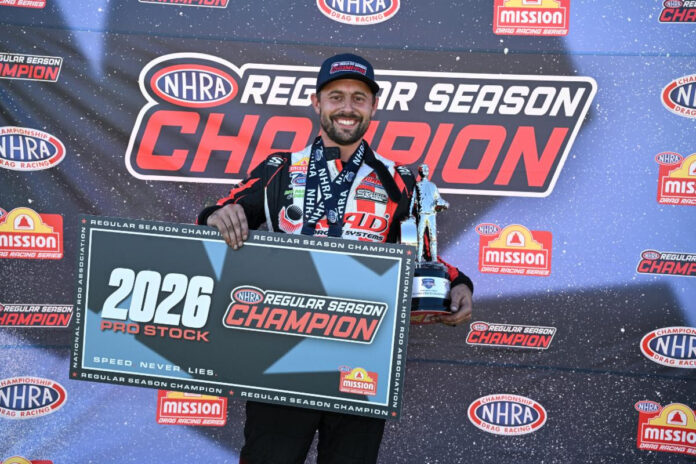
MARTIN, Mich. (Sept. 17, 2026) – Reigning Pro Stock world champion Dallas Glenn enters this weekend’s inaugural Dodge NHRA Great Lakes Nationals presented by MOPAR leading the ultra-competitive field as the NHRA Mission Foods Drag Racing Series heads into its Countdown to the Championship playoffs.
Glenn secured the regular season championship in Indianapolis with a victory in his RAD Torque Systems Chevrolet Camaro at the legendary race. With four wins on the 2026 season, he hopes to carry his success in Indy into the first race of the Countdown at U.S. 131 Motorsports Park.
“Going into Monday at the U.S. Nationals, I was more focused on trying to win the race than worrying too much about points,” said Glenn. “After my early exit in Brainerd, I decided to just focus on Indy and not even think about the points. Greg (Anderson) was going to have to lose early, and I didn’t want to root against anybody on my team. I just set out to do my job, and then Greg lost early and it was like, ‘Okay, now it’s time to do my job.’”
The highly anticipated debut at US 131 Motorsports Park is the first of six playoff races and the 15th of 20 events during NHRA’s 75th anniversary season. The 2026 Dodge NHRA Great Lakes Nationals presented by MOPAR will also be broadcast on FS1, with elimination coverage beginning at 2 p.m. ET on Sunday, Sept. 20.
Glenn knows the importance of kicking off the Countdown on a high note. En route to his first world championship last season, Glenn won four of the five playoff races. The inaugural Dodge NHRA Great Lakes Nationals presented by MOPAR will be an equal playing field for the Pro Stock class as it is NHRA’s first trip to the standout facility. With only 24 rounds of competition left in the 2026 season, Glenn and the rest of the field will try to capitalize on every possible point.
“It’s definitely going to be a lot different going to Martin, where we’ve never been down the track before,” Glenn said. “I’ve never set foot on that property, so I’m excited to add a new track to the list. We also have a short turnaround between Martin and Rockingham, so we’ve been working to make sure everything is ready to go.”
Also on track this weekend will be Glenn’s teammate and six-time world champion Greg Anderson. Anderson has four wins this season and is second in points. Others to watch include Greg Stanfield in third place as well as Matt Hartford, Aaron Stanfield and six-time champ Erica Enders.
Reigning Pro Stock Motorcycle world champion Richard Gadson secured the 2026 regular season championship in Indy and with another world championship in sight, Gadson knows he has a steep road ahead of him during the Countdown to the Championship playoffs.
“Winning the regular-season championship was definitely big,” said Gadson. “Gainesville was one stamp, but the regular season championship was the period at the end of the sentence. People could say I got saved by the Countdown, but not this time. At the same time, I know it’s not finished. You enjoy it for a short period of time, and then you have to funnel your energy and focus into the Countdown and continue doing the same things that kept you in front.”
Gadson rides for Pro Stock Motorcycle powerhouse Vance & Hines on the RevZilla/Motul/Vance & Hines Suzuki. The team has 16 world championships to its credit, including the last three with Gaige Herrera in 2023 and 2024 and Gadson in 2025. Gadson will face plenty of competition in the Countdown, including teammate Herrera, who has wins in Charlotte and Bristol this season, as well as longtime Vance & Hines rival and six-time world champion Matt Smith, who enters the playoffs second in points following his Indy victory.
Other riders in at the Dodge NHRA Great Lakes Nationals presented by MOPAR will be Maryland winner Angie Smith, John Hall, Ryan Oehler and Chase Van Sant.
The Top Fuel ranks have been dominated this season by Michigan-based Kalitta Motorsports. Reigning world champion Doug Kalitta secured the regular season championship, while teammate Shawn Langdon won in Indy after setting the NHRA speed record at 345 mph earlier this season in Valdosta. The two will be up against the likes of longtime Dodge driver Leah Pruett, Top Fuel rookie standout Maddi Gordon, four-time world champ Antron Brown and motorsports legend Tony Stewart.
To add to the magnitude of the weekend, Doug, Connie and Scott Kalitta will all be honored during the weekend as part of NHRA’s 75th anniversary celebration. Connie and Doug will both be recognized as two of the Top 75 drivers in NHRA history.
The Funny Car class is currently led by longtime Dodge driver Matt Hagan, who locked up the regular-season championship in Indy. Three-time world champion Ron Capps enters the Countdown second in points, with Indy winner Jack Beckman in third. The loaded Funny Car field will also feature J.R. Todd, Jordan Vandergriff and reigning world champion Austin Prock.
Race fans at US 131 Motorsports Park can enjoy the special pre-race ceremonies that introduce each driver and includes the fan favorite SealMaster Track Walk. They are also invited to congratulate the event winners at the winner’s circle celebration on Sunday to crown the first-ever national event winners in Martin. As always, fans get a pit pass to the most powerful and sensory-filled motorsports attraction on the planet. Fans can see their favorite teams in action and servicing their cars, get autographs and more. They can also visit NHRA’s Manufacturers Midway, where sponsors and vendors create an exciting atmosphere.
NHRA Mission Foods Drag Racing Series qualifying will feature two rounds at 12:15 and 2:45 p.m. ET on Friday, Sept. 18 and the final two rounds of qualifying on Saturday, Sept. 19 at 12 and 2:30 p.m. Final eliminations are scheduled for 10:30 a.m. ET on Sunday, Sept. 20. Television coverage includes qualifying on FS1 at 12 p.m. ET on Sunday before eliminations action at 2 p.m.
To purchase tickets to the Dodge NHRA Great Lakes Nationals presented by MOPAR, fans can visit www.NHRA.com/tickets. Children 12 and under are free in general admission areas with the purchase of an adult ticket. For more information about the NHRA, visit www.nhra.com.
About Mission Foods
MISSION®, owned by GRUMA, S.A.B. de C.V., is the world’s leading brand for tortillas and wraps. MISSION® is also globally renowned for flatbreads, dips, salsas and Mexican food products. With presence in over 112 countries, MISSION® products are suited to the lifestyles and the local tastes of each country. With innovation and customer needs in mind, MISSION® focuses on the highest quality, authentic flavors, and providing healthy options that families and friends can enjoy together. For more information, please visit https://www.missionfoods.com/
About NHRA
NHRA is the primary sanctioning body for the sport of drag racing in the United States. NHRA presents 20 national events featuring the NHRA Mission Foods Drag Racing Series and NHRA Lucas Oil Drag Racing Series, as well as the JBS Equipment NHRA Pro Mod Drag Racing Series presented by Elite Motorsports and NHRA Flexjet Factory Stock Showdown™ at select national events. NHRA provides competition opportunities for drivers of all levels in the NHRA Summit Racing Series and NHRA Street Legal™. NHRA also offers the NHRA Jr. Street® program for teens and the Summit Racing Jr. Drag Racing League® for youth ages 5 to 17. With more than 100 Member Tracks, NHRA allows racers to compete at a variety of locations nationally and internationally. NHRA’s Youth and Education Services® (YES) Program reaches over 30,000 students annually to ignite their interest in automotive and racing related careers. NHRA’s streaming service, NHRA.tv®, allows fans to view all NHRA national events as well as exclusive features of the sport. In addition, NHRA owns and operates three racing facilities: Gainesville Raceway in Florida; Lucas Oil Indianapolis Raceway Park; and In-N-Out Burger Pomona Dragstrip in Southern California. For more information, log on to www.NHRA.com, or visit the official NHRA pages on Facebook, Instagram, Twitter, and YouTube.