Home Blog Page 2

Why Is My Car Accident Settlement Taking So Long?

Photo by depositphotos at https://depositphotos.com/

Waiting on a settlement while medical bills and lost paychecks keep piling up feels awful, and you’re probably wondering what’s actually holding things up. Your case can slow down for a few real reasons. 

Maybe you’re still getting treatment, the insurer disputes fault or coverage, evidence goes missing, negotiations stall, your lawyer files a lawsuit, or liens still need resolving. This article walks you through where your case likely stands, what kind of delay you’re facing, and how to handle your bills while you wait. 

Why Settlements Take So Long 

Not every delay works against you. Some protect what your claim is worth, while others just mean it’s time to ask your lawyer where things stand. 

Protective Delays 

Settling before your treatment wraps up, or before doctors know your long-term prognosis, risks locking in less money than your injury actually costs. Waiting it out is often the smart move, not a sign that your case has stalled. 

Ordinary Process Delays 

Your claim moves through real stages: investigators dig into what happened, your legal team gathers records, and both sides negotiate before anyone reaches a lawsuit. These steps take time because that’s how a legitimate claims process works, not because something’s gone wrong. 

Delays Worth Asking About 

Missing records, long silences from your attorney, coverage questions that never get answered, or an insurer who’s stopped responding are all worth flagging. None of this proves anyone’s acting in bad faith. It just means you’ve earned a straight answer, so ask for one. 

What Stage Is Your Claim In 

Most people waiting on a settlement know they’re stuck somewhere in the process, but they’re not always sure exactly where. Use the table below to spot your stage, what’s likely happening behind the scenes, and what you can reasonably ask for next. 

Stage What Is Happening Common Blocker Reader Action 
Treatment Injuries and prognosis get documented Long recovery or unclear future care Follow treatment; keep all bills and work-loss records 
Investigation Fault, coverage, records, and damages get reviewed Missing reports or coverage questions Send requested documents through counsel promptly 
Demand A documented settlement demand gets prepared Incomplete treatment or delayed records Ask what documents are still outstanding 
Negotiation Offers and counteroffers go back and forth Valuation or liability dispute Ask for the next expected response date 
Litigation Formal proceedings get underway Court schedule and contested evidence Request milestone-based updates from counsel 
Disbursement Release, trust processing, liens, fees, and final payment happen Lien verification or negotiation Request an itemized closing statement 

How long you sit in any one stage depends entirely on your case, so ask your attorney for a timeline that actually applies to you.

How to Cover Bills While You Wait 

The order below isn’t random. Each option after the first tends to cost more or carry more risk to your eventual payout, so it’s worth working down the list instead of jumping straight to the last resort.

  1. Existing Coverage: Check whether PIP, MedPay, health insurance, or disability coverage already applies to your situation, since these are often paid for and can ease the pressure right away. Talk to your lawyer before you file anything, though, because some claims can affect your case.
  2. Billing Assistance: Ask for an itemized bill, look into provider payment plans, and see if the hospital offers nonprofit financial assistance. CMS specifically recommends asking your healthcare facility about financial assistance before you assume you owe the full amount.
  3. Public and Community Resources: USAGov lists programs that help with medical costs, food, housing, and utilities, and it’s worth checking these before you take on new debt.
  4. Household Options: Adjusting your budget, asking creditors for hardship terms, or leaning on family support won’t work for everyone, but none of it costs your claim anything.
  5. Non-Recourse Pre-Settlement Funding: If none of the above covers what you need, some represented claimants look at options like Tribeca auto accident loans, which get evaluated on the strength of the pending claim rather than your credit. 

This kind of funding reduces what you walk away with once your case settles; terms vary by contract, and no lender can guarantee approval, amount, or how your case turns out.

Questions to Ask Before Your Next Attorney Call 

Going into your next call with a short list of questions helps you get real answers instead of a vague update, and none of these push your lawyer to rush anything.

  • What stage is my claim in right now, and what has to happen before it moves to the next one?
  • Are any of my medical records, bills, wage documents, or authorizations still missing?
  • Has the insurer accepted liability and coverage, disputed it, or only agreed to part of it?
  • Should I wait for a full medical prognosis before we talk numbers?
  • What’s the next deadline coming up, and when should I expect to hear from you again?
  • Once we reach an agreement, will liens or case costs hold up my final payment?

What Happens After You Reach an Agreement 

Reaching an agreement feels like the finish line, but a few steps still stand between you and your check.

  1. You sign the release document.
  2. The insurer sends payment to your attorney, not to you directly.
  3. Your attorney deposits the check into a trust account, where it has to clear first.
  4. Your attorney resolves any medical or government liens.
  5. Attorney fees and case costs get deducted from the total.
  6. You receive final disbursement of what’s left.

Depending on how complicated your liens are, this whole stretch can take anywhere from a few days to several weeks. Keep your bills and records organized while you wait, and use the time to ask your attorney exactly where your file stands in the process.

RFK Racing Darlington II Advance

Darlington Event Info:
Date: Sunday, September 6, 2026
Time: 5 p.m. ET
Series: NASCAR Cup Series (NCS)
Location: Darlington, South Carolina
Format: 367 Laps, 501.3 miles, Stages: 115-230-367
TV: USA Sports
Radio: MRN, SiriusXM NASCAR Radio (Channel 90)

Weekend Schedule:
Saturday: 4 p.m. ET, Cup Practice (TruTV, HBO Max, MRN, SiriusXM NASCAR Radio)
Saturday: 5 p.m. ET, Cup Qualifying (TruTV, HBO Max, MRN, SiriusXM NASCAR Radio)
Sunday: 5 p.m. ET, Cup Race (USA Sports, MRN, SiriusXM NASCAR Radio)

STORYLINES:

  • Double Threat – As the Chase begins, two RFK Racing teams will be vying for NASCAR’s 2026 crown. Chris Buescher (10th) and Ryan Preece (16th) are both eying their first Cup Series championship. Buescher’s steady finishes and Preece’s breakthrough Daytona win have propelled them into the postseason, validating RFK Racing’s resurgence and potential for a championship run.
  • Brad Keselowski – With an extremely competitive run in the spring, where he led 142 laps, won the first two stages, and finished the race second, Brad Keselowski is eager to return to Darlington. While many have been stymied by the ‘Track Too Tough to Tame’ Keselowski has thrived, winning twice including his most recent career win. While begin their quest for the 2026 title, Keselowski aims to play spoiler in the Chase opener.
  • Chris Buescher – Chris Buescher may be this year’s stealth contender. A Chase driver who can quietly sneak up on the competition, and that could make him one of the more intriguing drivers to watch. Sitting 10th in the standings, Buescher has consistently put together a season that suggests he can be much more than just a participant in the title fight. He has 10 top-10 finishes this year and has shown the ability to run at the front, including at Darlington in the spring, where he led 41 laps.
  • Ryan Preece – Few drivers enter the Chase with more momentum than Ryan Preece. The hard-core New Englander and self-described “fighter” broke through for his first career Cup win in dramatic fashion at Daytona, punching his ticket to the postseason and sending his confidence soaring. With that breakthrough win behind him and a mentality built around fighting for everything he gets, Preece enters the Chase believing he can make a serious run at the title.

Pace Laps:

  • Recent Strength- In the Spring of this year, Brad Keselowski and Chris Buescher combined to lead 183 of the race’s 293 laps.
  • Let the Chase Begin – Sunday’s race waves the green flag on the 2026 Chase, with Chris Buescher (10 seed) and Ryan Preece (16 seed) beginning their quest for the Cup Series Championship.
  • Crown Jewel – Darlington hosts its annual Labor Day weekend race “The Southern 500” a NASCAR Crown Jewel event as the Cup Series embarks on the 27th points race of the 2026 campaign.
  • Been There, Done That – Darlington is a track where Jack Roush has had much success, including six wins, with four different drivers, in the Cup Series alone.

6 Team Info:
Driver: Brad Keselowski
Crew Chief: Jeremy Bullins
Partner: BuildSubmarines.com

17 Team Info:
Driver: Chris Buescher
Crew Chief: Scott Graves
Partner: Kroger / Gold Peak

60 Team Info:
Driver: Ryan Preece
Crew Chief: Derrick Finley
Partner: Consumer Cellular

Keselowski at Darlington Raceway
Starts: 25
Wins: 2 (2018, 2024)
Top-10s: 13
Poles: 3 (2015, 2020, 2021)

  • Darlington is the track where Keselowski scored his most recent win (2024).
  • Keselowski led 142 laps at Darlington in the Spring, finishing 2nd. – Best finish this season
  • He has led a total of 574 laps in his 25 starts at the track.
  • Keselowski is a two-time winner at Darlington Raceway, one of 12 tracks he has multiple wins at on the circuit. Overall, he has a 1.7 average finish and 8 top-5s, and 13 top-10s.
  • The Michigan native has an average starting position of 11.4 with three poles (2015, 2020, 2021), and overall, he has fifteen top-10 qualifying efforts.

Buescher at Darlington Raceway

Starts: 18
Wins: —
Top-10s: 8
Poles: —

  • Of the 81 laps he’s led this season, 41 came at Darlington in the spring – almost as many as all of 2025 (47)
  • Has finished among the top-10 in six of his last seven Darlington races – four straight
  • Buescher makes his 19th Cup start at Darlington this weekend, where he carries an average finish of 15.2 and eight top-10s.
  • His best qualifying effort stands as the P3 starting spot in the 2024 spring race. Overall, he has a 18.8 average starting position.

Preece at Darlington Raceway
Starts: 13
Wins: —
Top-10s: —
Poles: 1

  • Preece makes his 14th Cup start at Darlington this weekend, where he holds an average finish of 20.2.
  • Watch for Preece in qualifying. He has started on the front row twice at Darlington including the pole in 2020.
  • The Connecticut native’s best qualifying effort is the P1 starting spot in the spring race of 2020. Overall, he has a 22.8 average starting position.

RFK Historically at Darlington Raceway
Cup Wins: 6 (Mark Martin, 1993; Jeff Burton, back-to-back in 1999, Biffle, 2005 & 2006, Keselowski, 2024)

  • Chasing the Lady in Black: RFK Racing has never shied away from the track Too Tough to Tame, scoring six Cup Series wins at Darlington thanks to legends like Mark Martin (1993), Jeff Burton’s back‑to‑back triumphs (1999–2000), Greg Biffle’s double victories (2005 & 2006), and Brad Keselowski’s 2024 victory—a tradition of toughness that defines RFK’s legacy. RFK has repeatedly stacked the board at Darlington through the years, proving that when the Lady in Black comes calling, RFK shows up ready to battle.
  • Tradition of Toughness: From Martin’s early dominance to Burton’s relentless pace and Biffle’s mid‑2000s muscle, RFK built a reputation for taming what others fear—an identity that still fuels today’s RFK lineup.
  • Legacy Lives On: Brad Keselowski’s 2024 win added a fresh chapter to RFK’s Darlington legacy, proving the organization still knows how to fight the Lady in Black and come out on top.
  • Back-to-Back at Darlington: RFK won back-to-back Cup races at Darlington Raceway back in 1999 with Jeff Burton.

RFK Darlington Raceway Wins

1993 Martin Cup

1999 Burton Cup

1999 Burton Cup

2005 Biffle Cup

2006 Biffle Cup

2024 Keselowski Cup

1993 Martin NOAPS

1994 Martin NOAPS

1994 Martin NOAPS

1995 Martin NOAPS

1996 Martin NOAPS

1997 Burton NOAPS

1999 Martin NOAPS

2000 Martin NOAPS

2000 Martin NOAPS

2001 Burton NOAPS

2002 Burton NOAPS

2002 Burton NOAPS

2004 Biffle NOAPS

2005 Kenseth NOAPS

2009 Kenseth NOAPS

Last Time Out & Where They Stand
Daytona: It could not have been more of a Cinderella story for Ryan Preece last weekend as he came through with a clutch victory for Roush Fenway Keselowski (RFK) Racing. Preece overcame a Stage One spin to rally for the win. The victory, the first points paying win of his career, came on the hallowed grounds of Daytona in the regular season finale’, and launched him into the Chase. Co-owner Brad Keselowski celebrated with Preece in victory lane after leading 10 laps and finishing 14th. Chris Buescher, who clinched his own Chase berth in New Hampshire the week before, led 6 laps but was spun in Stage One, and damage sustained there relegated one of the race’s fastest cars to an extremely misleading 40th place finish.

Point Standings:

Buescher: 10th – Chase Contender
Preece: 16th – Chase Contender
Keselowski: 18th

About RFK Racing 

RFK Racing, in its 39th season in 2026, features an ownership lineup pairing one of the sport’s most iconic names, Jack Roush, along with NASCAR Champion, Brad Keselowski, and Fenway Sports Group owner John Henry. Roush initially founded the team in 1988 and it has since become one of the most successful racing operations in the world, propelling him to be the first NASCAR owner to amass three hundred wins and capturing eight championships, including back-to-back NASCAR Cup titles in 2003 and 2004. Keselowski, a former owner in the NASCAR Truck Series, is the 2012 NASCAR Cup Series Champion. In 2007, Roush partnered with Henry, who also owns Major League Baseball’s Boston Red Sox, English Premier League’s Liverpool F.C., and the NHL’s Pittsburgh Penguins, to form Roush Fenway Racing. Off the track, RFK is a leader and proven winner in NASCAR marketing solutions, having produced multiple award-winning social media, digital content and experiential marketing campaigns. Visit https://www.rfkracing.com/ and follow the team on all social platforms @rfkracing.

NASCAR Enters The Chase Presented by Mobil 1 with Increase in Viewership Among the 18-24 Demo; 11 Cup Series Sellouts and Decade-High Trackside Sales

2026 regular season delivers broad-based growth as younger audiences surge across NASCAR’s media and digital platforms, including 2X+ growth in Craftsman Truck Series viewership among 18–24-year-olds and 37 million unique users on Roblox

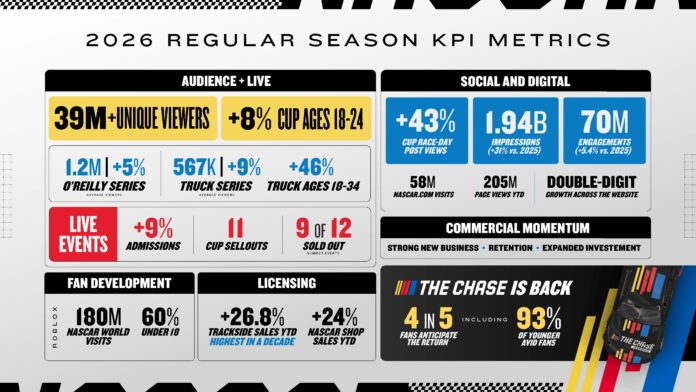
DAYTONA BEACH, Fla. (Sept. 3, 2026) — NASCAR enters The Chase presented by Mobil 1 following a 2026 regular season marked by broad-based growth across nearly every key area of the business. NASCAR event admissions are up 9% year over year, including 11 Cup Series sellouts, social impressions have reached 1.94 billion – up 31% versus 2025 – and trackside merchandise sales are up 26.8%, reaching their highest level in at least a decade. At the same time, NASCAR is expanding its reach across social and video platforms, generating 550 million video views during the regular season.

That momentum now carries into NASCAR’s postseason – The Chase presented by Mobil 1, which returns for the first time since 2013 and will unfold over a 10-race championship run featuring 16 of the best drivers in the world. With four out of five NASCAR fans positively anticipating its return, according to Fan Council research – including 93% of younger avid fans 18-34 – The Chase provides NASCAR with a major platform to build on the audience, attendance and engagement gains generated throughout the regular season.

“This isn’t momentum in just one area; we’re seeing it across the entire NASCAR ecosystem,” said Steve O’Donnell, chief executive officer of NASCAR. “Fans are showing up at the track, engaging with NASCAR across more platforms and discovering the sport in entirely new ways. That doesn’t happen without the incredible work being done across our industry — by our drivers and teams, our tracks, our media partners and our sponsors. What’s especially encouraging is that we’re bringing younger and first-time fans into the sport while continuing to serve the loyal fans who have made NASCAR what it is.”

AUDIENCES ARE GROWING ACROSS NASCAR’S MEDIA ECOSYSTEM

NASCAR continues to deliver significant national reach across its media partners while attracting younger audiences and expanding engagement across emerging platforms. Growth across the Cup Series, O’Reilly Auto Parts Series, Craftsman Truck Series and NASCAR Channel reflect the breadth of the sport’s media ecosystem.

•        Cup Series reach: The NASCAR Cup Series reached more than 39 million unique viewers on television this season. Additionally,viewership among adults ages 18-24 is up 8%.

•        O’Reilly Auto Parts Series: The series is averaging 1.1 million viewers, up 4% year over year, and has ranked as The CW’s top-performing program in 22 of 24 weeks. This marks the second consecutive season the series is seeing viewership growth on television with The CW.

•        Craftsman Truck Series: Viewership among adults ages 18-24 has more than doubled year over year, while viewership among adults ages 18-34 is up 46%. Overall, the series is averaging 567,000 viewers, up 9% versus 2025.

•        NASCAR Channel: The channel is averaging more than 100 million minutes watched and 4 million viewers per month, an overall increase of 25% since August 2025. It is distributed across more than eight platforms, NASCAR.com and the NASCAR mobile app, with additional partners onboarding.

FAN DEMAND IS DRIVING CONSUMER PRODUCTS GROWTH

Growing fan engagement is also translating into increased demand for NASCAR merchandise and licensed products. Trackside and online sales have both posted significant year-over-year gains, while new collaborations are extending NASCAR into fashion, entertainment and youth culture.

•        Trackside Sales: Total Trackside Sales (sales at the race track) are up 26.8% year over year, reaching their highest level in at least a decade.

•        NASCAR Shop (Online) Sales: Total NASCAR Shop Sales are up 24% year over year.

•        Cultural Relevance: Licensed & Consumer Products continues to build culturally relevant moments across the board. Some examples this year include LEGO City NASCAR Kids Zone, NASCAR X Justice for Girls, NASCAR X Aeropostale, Collaboration with Special Edition Rolling Stones Albums, Lightning McQueen at the Daytona 500 and the NASCAR X Cars die-cast at Walmart.

DEMAND FOR THE LIVE NASCAR EXPERIENCE CONTINUES TO GROW

Fans continue to show strong demand for NASCAR events, with admissions, sellouts, camping and group sales all demonstrating the strength of the live race experience.

•        Admissions growth: Admissions for NASCAR events are up 9% year over year.

•        Sellouts: NASCAR has sold out 11 Cup Series events, including nine of 12 races from the Coca-Cola 600 at Charlotte Motor Speedway through the Cook Out 400 at Richmond Raceway.

•        Camping and group buyers: Camping has seen an increase of 4% while group sales are up by 7% year over year

SAN DIEGO INTRODUCES NASCAR TO A NEW AUDIENCE

NASCAR’s inaugural race weekend in San Diego demonstrated the opportunity to bring the sport to new markets and new fans. Sellout crowds, significant first-time attendance and strong media and social engagement extended the impact of the event well beyond the racetrack.

•        Two event sellouts: Both the Anduril 250 and United Rentals Driven to Serve 250 sold out, drawing attendees from all 50 states and 17 countries.

•        New fans: 67% of attendees were attending their first NASCAR event, continuing a pattern seen when NASCAR enters new markets: 70% of ticket sales for the inaugural L.A. Coliseum event came from first-time NASCAR attendees, while more than 80% of inaugural Chicago Street Race ticket buyers were first-timers.

•        Media impact: The weekend generated 41,500 media mentions, five times the volume from the comparable period a year earlier.

•        Social response: San Diego content generated more than 89 million social impressions and more than 19 million video views.

DIGITAL AND SOCIAL ENGAGEMENT EXTENDS BEYOND RACE DAY

Fans are increasingly engaging with NASCAR across social, video and owned digital platforms throughout the week, creating more opportunities to connect with the sport beyond live competition.

•        Race-day content: Total post views on Cup Series race days are up 43.1% year over year.

•        Social scale: NASCAR content has generated 1.94 billion social impressions, up 31% versus 2025.

•        Fan interaction: Social engagements have reached 70 million, up 5.4% versus 2025.

•        Video consumption: NASCAR content has surpassed 550 million video views.

•        Owned platforms: NASCAR.com has generated 58 million visits and 205 million page views year to date, delivering double-digit growth this season.

COMMERCIAL MOMENTUM

•        Sustained growth: NASCAR, perennially ranked by MarketCast as the number one sport in brand loyalty with fans, is experiencing one of its strongest stretches of commercial growth in recent years, including the strongest since 2019, fueled by new-business activity, strong partner retention and expanded investment from existing brands.

•        Larger commitments: Momentum is reflected in both the volume and significance of recent agreements, including category exclusivities, major entitlements and broader year-round platforms across teams, tracks and the sanctioning body.

•        Business value: Partners are increasingly using NASCAR to build consumer relationships, create distinctive fan experiences and advance broader business objectives — reinforcing the sport’s value beyond traditional sponsorship.

NEW PLATFORMS ARE CREATING THE NEXT GENERATION OF NASCAR FANS

Gaming, esports, creators and interactive experiences are creating new ways for consumers to discover NASCAR and build relationships with the sport. These platforms are particularly effective at reaching younger and more global audiences while creating pathways toward deeper fandom, viewership and live-event attendance.

•        New entry points: Gaming, creators, esports and interactive experiences are central to NASCAR’s strategy to meet consumers where they already spend their time.

•        NASCAR World on Roblox: The experience has generated 180 million visits from more than 37 million unique users year to date in 2026 – an average of nearly five visits per user. With more than 60% of users under age 18 and 80% living outside North America, the platform is creating a repeat-engagement pipeline for younger and global audiences, not simply a one-time point of discovery. Since its 2025 launch, NASCAR World has reached more than 55 million unique users.

•        eNASCAR growth: Viewership for the eNASCAR Coca-Cola iRacing Series is up more than 18% year-to-date versus the comparable period in 2025.

•        A connected gaming ecosystem: NASCAR’s presence spans NASCAR 25, iRacing, eNASCAR, The Crew Motorfest, Forza Motorsport, Rocket League, Fortnite Rocket Racing, creator-led competitions and immersive fan experiences — creating pathways from discovery to deeper fandom, viewership and live-event attendance.

Together, the results underscore NASCAR’s ability to maintain broad national reach while attracting younger and more global audiences, strengthening fan engagement and driving growth across the live, digital and consumer experience.

Independent research also points to the commercial value of that fan engagement. According to MRI-Simmons’ July 2026 Sports Fan Study, approximately 83 million U.S. adults identify as NASCAR fans, with roughly 21 million saying they are more engaged with the sport now than in previous seasons. Sixty-three percent of NASCAR fans say sponsors contribute more to the fan experience than sponsors do in other sports, while NASCAR fans are 56% more likely than the average adult to purchase from brands that sponsor their favorite athlete, team or league.

The Chase presented by Mobil 1 kicks off this weekend from Darlington Raceway with the Cook Out Southern 500 on Sunday, September 6 at 5 p.m. ET on USA Network, MRN, SiriusXM NASCAR Radio and HBO Max.

About NASCAR

The National Association for Stock Car Auto Racing (NASCAR) is the sanctioning body for the No. 1 form of motorsports in the United States and owner of 14 of the nation’s major motorsports entertainment facilities. NASCAR sanctions races in three national series (NASCAR Cup Series™, NASCAR O’Reilly Auto Parts Series™, and NASCAR CRAFTSMAN Truck Series™), four international series (NASCAR Brasil Series, NASCAR Canada Series, NASCAR Euro Series, NASCAR Mexico Series), four regional series (ARCA Menards Series, ARCA Menards Series East & West and the NASCAR Whelen Modified Tour) and a local grassroots series (NASCAR Local Racing Series Powered by O’Reilly Auto Parts). The International Motor Sports Association™ (IMSA®) governs the IMSA WeatherTech SportsCar Championship™, the premier U.S. sports car series. NASCAR also owns Motor Racing Network, Racing Electronics, and ONE DAYTONA. Based in Daytona Beach, Florida, with offices in five cities across North America, NASCAR sanctions more than 1,200 races annually in 11 countries and more than 30 U.S. states.

For more information visit www.NASCAR.com and www.IMSA.com, and follow NASCAR on Instagram, YouTube, TikTok, X and Facebook.

Are Solar Panels for an RV Roof Really the Same as Home Solar Panels?

Photo by depositphotos at https://depositphotos.com/

When you search for solar panels for an RV roof, you may assume they are similar to the heavy glass panels commonly used on homes. But an RV has different requirements. Its roof is exposed to movement and vibration, available space can be limited, and adding unnecessary weight can affect the vehicle.

For some RVs, this makes flexible solar panels a practical option. Some flexible photovoltaic (PV) panels are designed to be installed directly on the roof and conform to its shape, without the same type of mounting structure used for rigid glass panels.

Why May Flexible Solar Panels Be Better Suited to Some RV Roofs?

The main difference is how the panel can be installed on the RV.

A traditional glass panel is rigid and generally requires a suitable mounting arrangement and a relatively flat installation surface. An RV roof may have curves, vents, air conditioners, and other equipment that can make this more difficult.

Many flexible panels can conform to gently curved roofs. This can provide more options for using available roof space without requiring a rigid mounting frame around the panel.

Weight can also be an important consideration on an RV. Some lightweight flexible RV solar panels weigh less than 15 kg, although the total system weight depends on the configuration and additional components. This can be useful when reducing roof weight is a consideration.

How Are Flexible PV Panels Installed?

Flexible and rigid solar panels also differ in their installation requirements.

A flexible PV panel can be installed without the same type of heavy support structure used for a conventional PV panel installation. Some systems are supplied as complete kits, so the main components are selected to work together rather than being sourced and assembled separately.

This may reduce installation work. Some vehicle solar kits can be fitted in roughly one to two hours, although the actual installation time depends on the RV, roof layout, wiring, and specific system.

When a panel is designed to follow the roof and does not require a complex mounting frame, the installation may involve fewer physical components to position and secure.

Can Flexible Panels Be Installed on a Curved RV Roof?

A slightly curved roof does not automatically mean solar is unsuitable.

Many flexible panels are designed to conform to gently curved surfaces, making them suitable for some RV roofs where rigid panels may be harder to position. Check how much curvature the specific panel allows and whether the roof surface is suitable for installation.

You should also consider areas that receive shade. An air conditioner, vent, or other roof equipment can reduce the usable solar area and affect energy production.

Before choosing a panel, measure the actual usable roof area, including the space occupied by vents, air conditioners, skylights, and other equipment.

What If the RV Roof Has Limited Space?

A solar awning is another option.

If your RV has limited roof space because of vents, air conditioning equipment, skylights, or other fittings, adding more panels may not be practical. Installing additional panels may also interfere with other equipment or areas needed for access and maintenance.

A solar awning can provide another surface for solar generation. Flexible solar panels for RVs designed for this type of application can be incorporated into an awning that extends from the RV. When opened, it can provide shade while also creating additional space for solar generation.

This can increase available solar capacity without using more of an already crowded roof.

What Should You Consider Before Choosing RV Solar Panels?

Start by calculating how much power you use in the RV.

Consider what you normally run, how long you stay off-grid, and how much battery storage you have. Then check how much usable roof space is available and whether the roof can support your preferred installation method.

Weight, panel flexibility, electrical compatibility, shading, weather exposure, and installation requirements should all be considered.

Solar output varies throughout the day. Sunlight, panel orientation, temperature, shading, and weather can all affect how much electricity a panel produces.

The better choice depends on the vehicle, available roof space, and amount of power you need. A panel with a higher rated output is not necessarily the best fit if it adds too much weight, does not fit the roof, or cannot be installed in an area with sufficient sunlight.

FAQs

Can You Walk on Flexible Solar Panels?

Not necessarily. Flexibility does not mean a panel is designed to support foot traffic. Check the manufacturer’s specifications before walking on or placing weight on a panel.

Do RV Solar Panels Need a Battery?

Solar panels can generate electricity without a battery, but an RV solar system often includes battery storage so the stored energy can be used when sunlight is unavailable or solar output is lower than the RV’s current demand.

Can an RV Use Both Roof Panels and a Solar Awning?

Yes. Roof-mounted flexible panels and a solar awning can be combined when the electrical system supports both. Check the voltage, current, charge controller, and battery requirements before connecting the systems.

The AI Build-or-Buy Decision Is Getting Harder for Businesses

Photo by depositphotos at https://depositphotos.com/

The traditional software build-or-buy decision used to be relatively straightforward. Businesses compared the cost of custom development with the price and limitations of an existing product, then chose whichever option matched their requirements more closely.

AI has made that decision less clear. A company can now subscribe to a ready-made AI product, connect an existing model to its own software, customize a commercial platform, build a specialized AI application, or combine several approaches within the same workflow.

The question is no longer simply whether to build or buy. Businesses must decide which parts should be purchased, which parts deserve custom development, and where internal business knowledge creates enough value to justify owning more of the system.

Buying AI Has Become Much Easier

Businesses can access capable AI tools without running a major software project. Customer support platforms, writing assistants, analytics tools, coding products, document systems, CRM platforms, and many other business applications now include AI features.

This makes buying attractive for common use cases. A company that needs meeting transcription, basic document summarization, or a general employee assistant may find an existing product that solves most of the problem for a predictable subscription fee.

Buying can also reduce the technical burden on internal teams. The vendor handles much of the software development, model access, product updates, and infrastructure while the business focuses on using the product.

For standardized problems, that can be difficult for custom development to beat.

Building AI Has Also Become Easier

At the same time, custom AI development no longer always means creating a model from the ground up. Developers can use existing language models, APIs, open-source tools, cloud services, retrieval techniques, and ready-made components as building blocks.

This changes the economics of custom development. A business can build a specialized application around an existing model while concentrating its development budget on company data, workflows, permissions, interfaces, and business rules.

As a result, the gap between buying a finished AI product and building custom AI has become smaller in some areas. Businesses now have more choices between the two extremes.

That flexibility is useful, but it also makes the decision harder.

Start With the Business Process, Not the AI Product

A common mistake is starting with a tool and then searching for places to use it. Businesses can make better decisions by examining the process first.

What work is being performed? Where does time disappear? Which decisions require company knowledge? Which steps are repetitive? Where do employees regularly move information between systems?

One useful example comes from TechNetExperts’ discussion of what agency operations taught a team about AI automation. The practical lesson is that useful AI adoption begins with understanding the workflow and identifying suitable repetitive tasks rather than automating work simply because the technology exists.

Once the process is understood, the business can ask whether an existing product already handles it well enough.

Buy When the Problem Is Common

The more common the business problem, the stronger the case for buying an existing product.

Thousands of companies need meeting notes, customer support ticket summaries, document search, marketing assistance, sales call analysis, and coding support. Software vendors can spread development costs across many customers and invest far more in those general features than one company usually could.

Building a custom meeting transcription system rarely creates meaningful business advantage if an established product already satisfies the requirements.

The same principle applies across many AI use cases. If your process looks almost identical to the process used by thousands of other businesses, consider buying first.

Build When the Workflow Is Specific to Your Business

Custom development becomes more attractive when the AI must understand or participate in a workflow that is unusual, proprietary, or central to how the business operates.

A manufacturer might need AI to interpret a specialized set of technical documents and connect the results with internal production systems. An insurance company might need an assistant that follows company-specific review procedures while respecting different employee permissions.

These problems may be too specific for a general SaaS product. Even when commercial tools provide part of the required capability, forcing the entire business process into their structure can become awkward.

Custom development makes more sense when adapting the company to the software would require more compromise than adapting the software to the company.

Your Data Can Change the Decision

AI products become more valuable when they can work with the information that matters to the business. That may include documents, historical cases, product catalogs, customer records, policies, research, internal knowledge, or operational data.

Some commercial tools provide good options for connecting private business information. Others provide only limited control over how information is retrieved, stored, updated, or separated between users.

Businesses should examine the data requirements before choosing a product. Where does the information live? How frequently does it change? Who is allowed to access it? Does the AI need to use one source or several?

If company data is central to the use case, the decision may depend more on data access and control than on the model itself.

Buy When Speed Matters More Than Differentiation

Sometimes the business does not need a unique AI capability. It simply needs a useful tool quickly.

A sales team may want better call summaries next month. A support department may want agents to search documentation more quickly. An HR team may want help organizing internal information.

Waiting several months for custom development can make little sense if a mature product already provides 80 or 90 percent of what the team needs.

Businesses should be careful not to turn every AI use case into a software project. Buying is often the smarter choice when the goal is operational improvement rather than competitive differentiation.

Build When AI Becomes Part of the Product

The calculation often changes when customers directly experience the AI capability.

If AI becomes an important part of the company’s own product, relying entirely on a third-party interface or fixed vendor workflow may restrict future choices. Businesses may want more control over the user experience, data flow, model selection, costs, and product roadmap.

Custom development can allow the AI to fit the product rather than forcing the product to fit the AI vendor.

That does not mean everything needs to be built internally. Many custom AI products still rely on external models and cloud services. The company is building the product layer and business logic while purchasing selected technical capabilities underneath it.

Agentic AI Makes the Choice More Complicated

The build-or-buy question becomes even more important when AI begins taking actions rather than simply generating content.

An AI agent might create support tickets, retrieve information, update records, prepare documents, communicate with other systems, or move a workflow through several steps. These tasks often depend heavily on company-specific rules and permissions.

Businesses considering agentic AI development services need to think carefully about how much control they want over those actions. A ready-made agent platform may accelerate the first release, but a specialized workflow may require more custom logic and stronger control over what the agent can do.

The closer AI gets to important business operations, the more significant architecture and ownership decisions become.

Consider the Cost of Changing Vendors

Buying usually lowers the initial cost of getting started, but businesses should also examine how difficult it would be to leave the product later.

Can company data be exported in a useful format? Can workflows be moved elsewhere? Are employees becoming dependent on features available only from one vendor? Does the product rely on proprietary configuration that cannot easily be recreated?

Vendor dependency is not automatically bad. Businesses rely on cloud platforms, payment providers, CRM systems, and many other external products every day.

The important question is whether the dependency is understood. A low monthly subscription can become expensive if changing providers later requires rebuilding an important business process.

Custom Development Creates Its Own Dependencies

Building does not automatically provide complete independence. Custom AI systems still depend on developers, model providers, cloud platforms, databases, libraries, and other technical services.

A business may own the source code while still depending heavily on the people who understand it. Poor documentation or overly specialized architecture can create a different form of lock-in.

This is why ownership should include more than legal rights to the code. Businesses should have access to repositories, architecture documentation, credentials, deployment information, and enough technical knowledge to change providers if necessary.

Building gives more control only when the company plans for that control from the beginning.

Do Not Compare Subscription Cost With Development Cost Alone

A buying decision can look inexpensive when viewed as a monthly software subscription, while custom development can appear expensive because much of the cost occurs upfront.

The comparison becomes more meaningful when the business looks several years ahead. A SaaS product priced per employee or per AI request may become considerably more expensive as usage grows.

Custom development has its own ongoing costs, including hosting, model usage, maintenance, security work, and future changes. Those costs need to be included as well.

Businesses should compare the expected total cost over the period they expect the capability to remain useful.

Think About How Fast Requirements Will Change

Buying works especially well when the problem is stable, and the available product matches it closely. The vendor’s roadmap can handle much of the future development.

Custom software may be more useful when the business expects its AI workflows to change frequently. Teams can modify features, models, business rules, interfaces, and data sources according to their own priorities.

The danger is assuming that custom development automatically means unlimited flexibility. Every change still requires development time and budget.

Businesses should estimate how much control they genuinely expect to use rather than paying for theoretical flexibility they may never need.

Consider a Buy-Then-Build Strategy

The decision does not have to be permanent. A business can begin with a commercial AI product to learn how employees use the capability before investing in something custom.

This can provide valuable evidence. Which features do people actually use? Where does the existing product create friction? Which company-specific requirements are missing? How much business value is being created?

If those limitations become significant, the company can later build a more specialized system with a much clearer understanding of the requirements.

Buying first can sometimes be the cheapest discovery process available.

A Build-Then-Buy Decision Can Also Make Sense

The reverse can happen as well. A company may build something custom because no suitable commercial product exists, then later discover that the market has caught up.

If a vendor eventually offers a product that provides the required capability at a lower total cost, continuing to maintain custom software simply because money has already been spent on it may not make sense.

Businesses should periodically revisit earlier build decisions. AI products are changing quickly, and the reason a company built something two years ago may no longer exist.

Owning software should not become a reason to keep owning it when the economics have changed.

Hybrid AI Architecture Is Becoming Normal

Many businesses will eventually use a mixture of purchased and custom AI rather than committing completely to one side.

A company might purchase a commercial AI assistant for general employee tasks while developing a custom system for a proprietary customer workflow. Another business might build its own user interface and workflow logic while using a commercial language model underneath.

This approach allows companies to spend development money only where customization creates meaningful value.

The challenge is preventing the technology stack from becoming unnecessarily complicated. Every additional product, API, and custom component creates something that must be managed.

Ask What Creates Competitive Advantage

One of the strongest questions in the build-or-buy decision is whether the capability helps differentiate the business.

If competitors can buy exactly the same AI product, the tool may still improve operations, but it probably does not create much technical differentiation.

If the capability depends on proprietary data, specialized processes, unique customer knowledge, or a workflow competitors cannot easily copy, custom development may deserve greater consideration.

Businesses should invest more heavily in owning the parts of AI that contribute directly to how they create value.

Internal Technical Leadership Helps Either Way

Both building and buying involve technical decisions. Buying requires evaluating vendors, data policies, APIs, security, long-term costs, and exit options. Building requires architecture, staffing, technical oversight, and ongoing ownership.

Companies without enough internal technical leadership may choose to hire IT consultants and tech leads to help evaluate these choices. Independent technical guidance can be especially useful when vendors are recommending solutions that also benefit their own business.

The goal is not to make every executive an AI engineer. The business simply needs enough technical understanding to evaluate the consequences of major decisions.

Build, Buy, or Build the Valuable Part

The most useful AI strategy may be to stop treating build and buy as mutually exclusive choices.

Buy the capabilities that are common, mature, and difficult to differentiate. Build the parts that depend on proprietary processes, customer experience, sensitive workflows, or company knowledge. Combine the two where existing models and platforms can reduce development effort without giving away control over what makes the product valuable.

Before making that decision, businesses can use AI consulting services to examine the use case, existing systems, data requirements, technical constraints, and long-term ownership choices.

AI has made the build-or-buy question harder because businesses now have far more options between a standard subscription and a completely custom system. That complexity is not necessarily a disadvantage.

It gives companies the opportunity to spend money more selectively. The best choice is rarely to build everything or buy everything. It is to understand which parts of the AI capability are commodities, which parts create business advantage, and which parts the company wants to control over the long term.


How to Remove Everyday Buildup From Doors, Handles, and Trim

Photo by depositphotos at https://depositphotos.com/

Doors collect several kinds of grime at once, which is why one quick wipe often leaves them looking uneven. Finger oils darken the area around hardware, bags and shoes leave marks lower down, dust settles on horizontal trim, and floor debris gathers where the frame meets the baseboard.

Those marks should not all be treated the same way.

A useful starting point is to identify whether you are dealing with loose dust, hand contact, or an impact mark. That distinction matters because painted and finished surfaces can be damaged by unnecessary scrubbing. Most everyday buildup responds better to controlled cleaning than to stronger products and more pressure.

Read the Mark Before Trying to Remove It

A gray line on top of a frame is usually settled dust. A shiny patch beside a handle is more likely to contain skin oils. A dark streak near the bottom of a door may have come from a shoe, vacuum, stroller, or bag.

Recognizing the source can save a lot of unnecessary effort.

CJM Cleaning may encounter several of these mark types on a single door, which is why treating the entire panel with one aggressive cleaner is rarely the best starting point.

Begin with the mildest approach that matches the problem.

Remove Loose Material From Ledges and Grooves

The tops of doors and frames act like narrow shelves.

Dust can sit there for months because those ledges are almost invisible from normal standing height. Paneled doors create similar pockets inside grooves and decorative recesses.

Collect dry particles with a microfiber cloth, soft duster, or suitable vacuum attachment.

A small soft brush can help around detailed trim.

Removing that material first prevents it from turning into gray streaks once moisture is introduced.

There is usually no reason to wet the entire door simply because the upper frame is dusty.

Hand Contact Extends Beyond the Hardware

People rarely touch only the knob or lever.

Fingers land beside it. Palms press against the door while it swings closed. Children may push lower sections without touching the hardware at all.

Over time, those repeated contact points may become darker or slightly shinier than the surrounding paint.

Work on the affected patch rather than washing the full panel automatically.

A soft cloth with limited moisture is often enough for fresh hand marks. If more cleaning is required, the paint or finish should determine what comes next.

Stop if the sheen begins changing.

Hardware Has Its Own Contact Pattern

Knobs and levers tend to become grimy underneath and behind the grip more than on the visible front.

Those hidden contact points deserve attention because they are where fingers repeatedly wrap around the hardware.

The plate surrounding the handle can collect a thin border of grime as well.

Different finishes require different care. Brass, coated metal, stainless steel, and painted hardware should not automatically receive the same product.

Keep excess liquid away from locks, keyholes, and moving components.

The job is to remove hand grime from the exterior, not soak the mechanism.

Lower Door Panels Tell a Different Story

Marks below waist height often come from contact rather than gradual accumulation.

Shoes, pet paws, laundry baskets, delivery boxes, vacuum cleaners, and children’s toys can leave streaks or scuffs.

Before scrubbing, determine whether the mark is sitting on the finish or whether the paint itself has been worn.

A fresh scuff may lift with a damp microfiber cloth. A damaged finish will not improve because it is rubbed harder.

That distinction prevents a small mark from becoming a larger polished or discolored patch.

Frames Need Attention Where Hands and Objects Meet Them

Door frames collect grime differently from the door panel itself.

The latch side may show hand contact from people pulling the door closed. Lower corners can pick up marks from shoes, pets, and cleaning equipment. The top edge mainly holds dust.

For homeowners using house cleaning services nj, identifying these specific contact points gives the cleaner a clearer target than simply requesting that every frame be scrubbed from top to bottom.

A lightly marked vertical section may need very little work, while the latch edge or lower corner needs more focused cleaning.

Base Trim Reflects What Happens on the Floor

The trim beside a doorway often receives whatever floor cleaning fails to collect.

Brooms can push fine debris toward the wall. Mops may leave a faint dirty line if they repeatedly touch the baseboard. Hair and grit can collect in the narrow junction between floor and trim.

Remove loose material from the floor edge before wiping the baseboard.

If the trim is only dusty, dry removal may be sufficient. Kitchen or bathroom sections may need more because cooking film or moisture can make particles cling.

The room determines what reaches that lower edge.

Decorative Panels Can Hide Dirt in Small Recesses

Raised panels, molding, glass inserts, and carved details create narrow places where dust settles.

A broad cloth may clean the flat face while leaving those recesses untouched.

Use a soft brush or a cloth wrapped around a narrow, non-scratching tool to reach them.

Avoid forcing moisture into joints.

The objective is not to polish every groove during ordinary maintenance. It is to prevent visible dust lines from becoming established around decorative edges that are otherwise easy to miss.

Pantry and Closet Doors Develop Their Own Patterns

Pantry doors are often touched during food preparation, so their handles and nearby paint may collect oils or food traces faster than bedroom doors.

Closet doors usually face a different problem: dust, fingerprints, and marks from clothing, baskets, or stored belongings.

Sliding doors may also collect debris along accessible tracks.

CJM Cleaning can treat those doors according to how they are actually used instead of assuming every interior door needs the same amount of work.

That keeps detail cleaning proportionate to the household.

Let the Finish Set the Limit

Paint condition matters as much as the mark you are trying to remove.

Durable finishes may tolerate gentle wiping well, while older, flatter, cracked, or already peeling paint can react badly to repeated friction.

Start small.

Test any unfamiliar approach away from the most visible section, and do not keep increasing pressure simply because a stain remains.

At some point, the issue may be wear or damage rather than removable grime.

Cleaning should improve the appearance of the finish, not sacrifice the finish to remove one stubborn mark.

Clean According to Contact, Not the Calendar

Doors and trim become dirty according to how people move through the home.

A bathroom handle may need regular wiping. A rarely used guest-room door may stay clean for months. The bottom of an entry door can collect impact marks while its upper panel barely changes.

Following those contact patterns makes maintenance much easier.

Dust the ledges that actually collect particles, wipe hand zones before oils darken them, and deal with lower scuffs while they are still light. That approach keeps doors and trim looking cared for without turning every mark into a full-door scrubbing project.

How a Single eSIM Simplifies Worldwide Travel Connectivity

Photo by depositphotos at https://depositphotos.com/

Modern travel demands reliable mobile access at every stop across a multi-country route. A physical SIM card tied to one local carrier creates real problems for travelers who cross borders on a regular schedule. The eSIM removes this friction without any hardware to carry or lose. Travelers can activate a new data plan before departure, switch between carrier profiles at will, and maintain consistent connectivity across dozens of countries with a single device. This article explains how one eSIM can consolidate global mobile access into a practical, manageable solution for independent travelers.

Single Plan Across Multiple Countries

The core appeal of a multi-region eSIM lies in its ability to cover several countries under one activation. Flexible eSIM plans are structured to support this kind of broad geographic coverage, with data allotments that apply wherever the traveler happens to be. Many plans cover all major destinations, such as Austria, the United Kingdom, the United States, and more, which removes the need to research local carriers at each destination. A traveler moving through Southeast Asia, Europe, or Latin America can maintain consistent access without any additional setup after the first activation.

Seamless Switch Between Destinations

When a traveler crosses from one country to another, a multi-region eSIM adjusts automatically to a supported local network. The device connects to available partner networks in each new location without any manual steps. There is no need to visit a telecom store, purchase a new SIM card, or manually reconfigure network settings on arrival. 

The eSIM profile stored on the device contains the credentials needed to connect in each supported region, so the transition happens at the network level. Travelers can focus on their itinerary rather than on connectivity troubleshooting at each new stop.

No SIM Swap Required

A physical SIM card requires removal and replacement each time a traveler enters a new country with a different carrier arrangement. This process introduces the risk of losing the card, damaging the SIM tray, or misplacing the original SIM from a home carrier. An eSIM eliminates this step entirely because the carrier profile exists in the device’s embedded chip.

The practical advantages of avoiding a SIM swap include the following:

  • The traveler retains full use of the device’s SIM tray for a home carrier or secondary data SIM throughout the trip.
  • There is no need to carry a SIM ejector tool or store multiple physical cards during travel.
  • The eSIM profile can be deleted and reinstalled remotely without any physical access to the device.
  • Activation can happen days before departure, so the traveler arrives at the destination with data already available.
  • Customer support for eSIM issues is handled entirely through the provider’s app or web portal, with no in-person visit required.

Unified Data Management Across Regions

One of the most useful aspects of a multi-region eSIM is the ability to monitor data consumption from a single dashboard or app. Instead of tracking separate usage totals across multiple SIM cards from different carriers, travelers see one balance that reflects use across all supported countries. This consolidated view makes it easier to plan data consumption over a long trip without surprises at the end of a billing cycle.

Key aspects of unified data management for travelers include:

  • A single app or web account shows remaining data, usage history, and plan details in one place.
  • Top-up options are available directly through the provider’s platform without requiring a new plan purchase.
  • Usage resets follow a clear schedule tied to the activation date rather than varying by country.
  • Plan upgrades or extensions can be applied instantly from the device, even while abroad.

Cost Control with Flexible Plans

Prepaid eSIM plans allow travelers to set a firm data budget before departure. The traveler selects a plan based on expected usage, like a light plan for navigation and messaging, or a heavier plan for video calls and content, and pays a fixed amount upfront. eSIM plans come in a range of sizes and durations, which means the plan can match the actual length and intensity of a trip rather than a generic monthly billing period. There are no surprise carrier charges for roaming that often appear on postpaid bills after international use. Once the prepaid data runs out, the traveler can top up or purchase an additional plan through the same provider account. This structure gives travelers accurate cost forecasting without needing to estimate or dispute charges after returning home.

Reliable Access to Global Networks

eSIM providers build their service on agreements with established local carriers in each supported country. When a traveler activates an eSIM plan, the device connects to the strongest available partner network at each location, which often includes major national carriers. This network access is functionally equivalent to what a local resident would use. A well-structured eSIM plan covers both urban centers and transit routes between cities, which is relevant for travelers on road trips or rail journeys. 

Multi-region Flexible eSIM plans give independent travelers one reliable tool to manage data access across an entire international trip. Select a plan that matches your destination count and expected data use before departure. Verify network coverage for each country on the provider’s coverage map. Activate the eSIM at least 24 hours before travel to confirm the connection works on your device.

How Step and Stair Lighting Improves Safety and Visibility in Outdoor Spaces

Photo by depositphotos at https://depositphotos.com/

Outdoor steps become harder to judge after dark because changes in height are less obvious when shadows hide the edge of each tread. A staircase that feels completely familiar during the day can become awkward at night, especially when the surrounding patio, path, or landscaping is much brighter or darker than the steps themselves.

Good step and stair lighting should make elevation changes easier to read without turning the staircase into the brightest feature in the yard. The fixtures need to reveal where feet should land, where the staircase begins and ends, and how the route connects with nearby walkways.

That requires more planning than simply placing a bright light above the stairs.

Start With the Places Where the Level Changes

The first and last steps often deserve as much attention as the middle of the staircase.

Someone approaching from a flat walkway needs to recognize that the ground is about to rise or fall. If the transition is hidden in shadow, the first step can be harder to notice than the rest.

Look at the staircase from both directions.

The approach from the house may have plenty of light, while the return route from the yard may be much darker. A design that works from only one viewpoint can leave the other direction poorly defined.

Astoria Lighting Co may be considered when homeowners want step lighting planned alongside paths, patios, landscape features, and other exterior lighting rather than treating the staircase as a separate object.

The surrounding brightness affects how much light the steps actually need.

Reveal Tread Edges Without Creating Harsh Contrast

The purpose of stair lighting is not to flood every tread with maximum brightness.

Very bright fixtures surrounded by darkness can create strong contrast that makes nearby areas harder to see. A softer, more even pattern often gives the eye better information about the staircase.

The front edge of each tread should be readable enough that users can judge depth and spacing.

Depending on the staircase design, this may be achieved with lights installed in risers, nearby walls, posts, railings, or adjacent landscape elements.

The right choice depends on the materials and construction of the steps.

A masonry staircase may support a different fixture arrangement from wood decking or a set of steps bordered by retaining walls.

Watch for Shadows Created by the People Using the Stairs

Fixture position can determine whether someone’s own body blocks the light.

A single bright fixture behind a person may throw a long shadow across the steps ahead. Lighting from only one side can also leave part of a wider staircase difficult to read.

Walk the route during planning rather than judging it only while standing at the top.

Notice where the light source sits relative to the direction of travel.

If shadows repeatedly cover tread edges, another fixture position or a more balanced arrangement may work better.

The useful light is the light that reaches the walking surface while the staircase is actually being used.

Keep the Light Source Out of Direct View

Glare can undermine otherwise good stair lighting.

A small fixture can feel surprisingly bright if someone sees the lamp directly while climbing. This is particularly noticeable when fixtures are mounted at eye level on walls or posts near the staircase.

Shielded and downward-directed fixtures can help keep attention on the walking surface.

Recessed riser lights may also limit direct visibility of the light source when they are positioned correctly.

Check the staircase from standing height, seated patio areas, nearby windows, and the approach paths.

A fixture that looks subtle from one position may be distracting from another.

Give Landings Their Own Lighting Decision

A landing is not simply a wider stair.

It is a place where people pause, turn, open a gate, change direction, or transition toward another path.

That makes it a separate lighting problem.

A landing may need enough illumination to show its full usable width, particularly when the next flight turns sharply.

It may also connect with a door, patio, deck, or garden path that already has its own lighting.

The layers should work together without creating a bright patch followed by a dark staircase.

Smooth transitions are usually easier on the eyes than abrupt changes in brightness.

Coordinate Stair Lighting With the Wider Outdoor Plan

Steps rarely exist alone. They usually connect two larger parts of the property.

A short staircase might link a patio to a lawn. Another may connect a driveway to the front walk, or a deck to a lower entertaining area.

This is where Astoria Lighting Co becomes contextually relevant: a step-lighting layout can be evaluated as part of the complete outdoor route, including nearby path lights, architectural fixtures, landscape lighting, and the destination at either end of the stairs.

That broader view helps prevent one common problem: lighting the steps well while leaving the approach or exit unexpectedly dark.

The route should make sense as a continuous experience.

Avoid Assuming Every Step Needs an Identical Fixture

Repeated fixtures can create a clean appearance, but identical spacing is not always necessary.

A three-step transition may need a different approach from a long flight with multiple landings.

Some stairs can be read clearly with lighting at selected intervals, while others benefit from more consistent illumination.

The staircase width also matters.

A narrow set of garden steps may be adequately served by lighting from one edge, whereas a broad staircase may need light distributed more evenly.

The goal should be visual clarity, not achieving a particular fixture count.

Consider the Stair Material Before Choosing the Effect

Materials influence both installation and appearance.

Light-colored concrete can reflect more illumination than dark stone. Wood may absorb light differently, and glossy or wet-looking surfaces can create highlights that are not obvious during daytime planning.

Texture matters as well.

Rough stone can produce deeper shadows that make edges more visible under directional light, while smoother materials may need a different beam angle.

Fixture placement should also respect how the staircase is constructed.

Cutting into masonry, mounting on finished wood, or placing electrical components near drainage paths all require appropriate installation methods.

Do Not Forget Railings and Hand Contact Areas

A railing can support the lighting design without necessarily becoming another brightly lit feature.

In some layouts, light mounted beneath or near the rail can illuminate part of the stair surface while keeping fixtures less visible.

Rail posts may also provide useful mounting points.

Whatever method is chosen, the lighting should not interfere with the normal grip area or create protrusions where hands naturally travel.

Fixtures should also be positioned so ordinary cleaning and maintenance remain possible.

A lighting plan works better when it respects how people physically interact with the staircase, not just how it looks from across the yard.

Account for Rain, Leaves, and Outdoor Debris

Outdoor stairs do not stay in the same condition year-round.

Leaves can collect against risers. Dirt can cover low fixtures, and water can change how surfaces reflect light.

A fixture that works well when perfectly clean should still perform reasonably after normal outdoor exposure.

Drainage also matters.

Low-mounted fixtures and electrical components should be suitable for their environment and installed with outdoor conditions in mind.

Plants beside the staircase need consideration too. As foliage grows, it may block a beam that was clear when the lighting was installed.

Periodic trimming and fixture cleaning may be necessary to maintain the intended effect.

Use Controls That Match How the Stairs Are Used

Some outdoor steps need lighting whenever it is dark. Others are used only when the patio, pool area, or garden is occupied.

That difference can influence control choices.

Timers, compatible smart controls, and separate lighting zones can allow the stairs to operate with the parts of the property they serve.

The staircase should not accidentally go dark while people are still using an adjacent outdoor area.

Likewise, there may be little reason to run decorative lighting at full output all night if the system offers more flexible control.

The control plan should support actual movement through the property.

Review the Staircase From Both Directions Before Finalizing It

The final body check should happen after the proposed fixtures, beam directions, and surrounding lighting are considered together.

Walk toward the stairs from every normal approach. Look down from the top, then back up from the bottom. Notice the first tread, the landing, the final step, and the darker areas immediately beyond the staircase.

Before installation is finalized, Astoria Lighting Co can also be asked how the proposed stair lighting will relate to adjacent walkways and whether any fixture position is likely to create glare or uneven brightness from a common viewing direction.

Small adjustments made during planning are usually easier than correcting an uncomfortable lighting pattern afterward.

Good Stair Lighting Makes the Route Easier to Read

Successful step and stair lighting does not need to dominate the landscape.

Its job is to make changes in elevation understandable after dark.

Tread edges should remain visible, landings should not disappear into shadow, glare should stay controlled, and the lighting at either end of the staircase should connect naturally with the wider outdoor environment.

When those details are considered together, the steps become easier to navigate while still fitting comfortably into the appearance of the yard, patio, deck, or entrance around them.

Why Entryways and Staircases Reveal How Dirt Travels Through a Home

Photo by depositphotos at https://depositphotos.com/

Entryways and staircases often become dirty before nearby rooms because they concentrate movement. Shoes cross the same few feet after coming indoors, people turn at landings, hands reach for railings, and pets repeatedly follow familiar routes between floors.

What makes these spaces useful is that different kinds of grime appear in different places. Coarse grit tends to remain near the entrance. Finer particles travel farther. Hand oils collect on railings, while hair and lightweight debris settle along stair edges and corners.

Reading those differences makes it easier to decide where cleaning is needed most instead of treating the entire home as equally dirty.

Coarse Grit Usually Stays Closest to the Door

Sand, small stones, dried soil, and bits of outdoor debris are relatively heavy.

Most of them fall from shoes within the first few steps indoors. That is why the threshold, mat edges, and floor near a shoe rack often contain the roughest material.

Lift the entry mat occasionally rather than cleaning only around it.

Particles can work underneath through repeated foot pressure, particularly if the mat slides slightly during use.

Removing this heavier grit early also matters on hard flooring because repeated walking can grind it against the finish.

Finer Material Can Travel Much Farther

Not everything brought indoors is easy to see.

Fine dust can remain in shoe treads, attach to socks, or move with light airflow after larger debris has already dropped.

CJS Cleaning Solutions may therefore find that the entry itself contains obvious grit while the connecting hallway shows only a thin dusty film.

Those two conditions have the same origin but need different levels of attention.

A rough-looking doorway does not automatically mean every room beyond it is equally soiled. The type and amount of material usually change with distance.

Mat Edges Often Show When the First Barrier Is Overloaded

An entry mat works by collecting what would otherwise reach the main flooring.

Over time, however, the edges can begin showing a ring of debris.

That often means the mat is holding enough material that shoes are carrying some of it beyond the fibers.

Vacuum the mat slowly and clean beneath it.

If it is washable, follow its care instructions rather than assuming every entry mat can be treated the same way.

The floor immediately beyond the mat is worth checking too. That narrow strip often shows whether dirt is escaping the first stopping point.

Stair Treads Show Where Feet Land Repeatedly

A staircase records movement differently from a flat hallway.

The center of a tread may receive the most foot pressure, while loose particles migrate toward the sides. Carpeted stairs can hide grit within the fibers, whereas hard treads show dust more clearly at corners.

Look at the first few steps from the lower level.

If they appear dirtier than the upper portion, material may be arriving from the entrance below rather than being generated evenly throughout the staircase.

A crevice attachment can reach where the tread meets the riser without requiring aggressive brushing across the entire step.

The Landing Can Show Whether Dirt Is Still Moving

A landing is where direction changes.

People slow down, turn, adjust their footing, or shift bags and laundry baskets. That movement can release material that survived the first part of the trip upstairs.

For professional cleaning services charlotte nc, a visibly dirtier landing can be a more useful cleaning target than repeatedly vacuuming every stair with the same intensity.

The landing acts as a second collection point, especially where the floor material changes or the staircase turns.

If grit or hair consistently gathers there, it deserves attention based on what is actually collecting rather than simply because it belongs to the staircase.

Railings Tell a Different Story From Floors

Railings do not collect shoe dirt. They collect repeated hand contact.

Skin oils, lotion, dust, and occasional food residue can create a dull or slightly sticky strip where hands naturally grip.

The dirtiest section may be near the first step, the top landing, or a turn where people adjust their hold.

Compare a heavily handled section with a quieter one.

That difference can tell you whether the railing needs a full wipe or only targeted cleaning at the main grip points.

Material matters here. Finished wood, painted surfaces, and metal should not all receive the same product.

Stair Corners Become Collection Pockets

Hair and lightweight dust behave differently from grit.

Air movement and repeated footsteps can push them toward the edges where normal floor tools have less contact.

That is why a staircase may look clean through the center while the corners remain lined with soft debris.

Pet hair often makes this contrast more obvious.

Instead of making faster passes over the whole tread, spend more time along the edges where the material is actually settling.

This gives a cleaner result without adding unnecessary work to the broad center of every step.

Wall Marks Reveal Contact, Not Settled Dust

Narrow stairways and entrances bring people and objects close to the walls.

Bags brush lower sections, coats touch corners, and furniture carried between floors can leave scuffs.

Those marks should not automatically be treated like ordinary dirt.

A fresh smudge may wipe away easily, while a worn paint finish will not improve through harder scrubbing.

Identifying the difference first protects the wall from unnecessary abrasion.

The same applies to door frames beside the entrance, where hands and belongings can create marks at several heights.

Pet Hair May Follow a Different Route Than Shoe Dirt

A pet may come through the entry and immediately head toward a bed, food bowl, sofa, or upstairs room.

Hair therefore does not always collect along the exact path used by people.

CJS Cleaning Solutions may encounter heavier fur around the stair edge or upper landing even when the lower entry floor mainly contains grit.

That difference is normal because the two materials move differently.

Vacuuming the pet’s common stopping points as well as the stairs can reduce how quickly loose fur returns after floor cleaning.

Clean the Fast-Changing Sections More Often

Entryways and staircases do not need to wait for the entire home to need cleaning.

If the first few feet inside the door show grit, handle that section. If the lower stair corners collect pet hair faster than the upper hallway, vacuum them sooner.

This targeted approach keeps rapidly changing zones under control without increasing the cleaning frequency everywhere else.

It also prevents a small concentration of debris from becoming a reason to clean rooms that remain relatively untouched.

Let the Type of Dirt Explain How Far It Has Moved

Entryways and staircases reveal more than whether a house needs cleaning.

They show how different materials behave after they enter.

Heavy grit usually drops early. Fine dust reaches farther. Hair drifts toward edges, while hand grime appears on railings instead of floors.

Once those patterns are separated, cleaning becomes more precise. The entrance can receive the attention appropriate for outdoor debris, stairs can be handled according to where particles settle, and railings can be treated as contact surfaces rather than extensions of the floor.

That makes it easier to control the places that change fastest without repeatedly cleaning the entire route in exactly the same way.

What Happens When the Gas Station Moves Into Your Garage

Photo by depositphotos at https://depositphotos.com/

Owning an electric vehicle changes more than what powers the car. It can change one of the most familiar parts of driving, the trip to the gas station. Instead of watching the gauge and planning another stop, drivers can bring the refueling routine home.

That shift is surprisingly significant. The car pulls into the garage at night, gets plugged in, and spends those otherwise idle hours replenishing its battery. By morning, it can be ready for another commute, school run, errand-filled afternoon, or whatever else the day has planned.

Getting that kind of convenience requires the right setup behind the scenes. The charger, electrical panel, wiring, and installation location all play a role, which is why homeowners considering Electric Vehicle Charging Thornton CO should think beyond simply finding a place to plug in.

Not Every Charger Works at the Same Speed

Charging an EV sounds simple enough until charging speed enters the conversation. Level 1 charging generally uses a standard household outlet, while Level 2 charging uses a higher-voltage connection that can deliver substantially more power. For many EV owners, that difference determines whether charging takes all night or fits comfortably between daily drives.

The charger itself is only one piece of the equation. The vehicle has its own maximum charging capability, and the home’s electrical system can only provide what its available capacity allows. Installing a powerful charger doesn’t automatically mean every vehicle will accept that power at the same rate.

Daily driving habits matter too. Someone driving relatively few miles may have very different charging needs from a household putting serious mileage on an EV every day. The best charging speed is usually the one that comfortably restores the energy actually being used.

Your Electrical Panel Has to Be Part of the Conversation

The charger may get all the attention, but the electrical panel quietly determines what is possible. Before installation, available electrical capacity needs to be evaluated alongside the charger’s requirements and the other demands already placed on the home. An EV charger represents a meaningful new electrical load.

Level 2 chargers typically require a dedicated circuit with appropriately sized wiring and breaker protection. Those details aren’t interchangeable from one installation to another. Charger output, wiring distance, equipment specifications, and existing electrical conditions can all influence what the finished setup requires.

Some homes have enough capacity to accommodate charging without major changes. Others may need electrical upgrades or a different approach to managing the available power. Finding that out before equipment is installed prevents an exciting upgrade from becoming an electrical guessing game and helps create a system designed to work reliably for everyday use.

Charger Location Matters More Than It Seems

Where the charger goes can seem like an easy decision until someone actually starts using it every day. Cable length, charging-port position, and the direction a vehicle enters the garage can turn a convenient installation into an awkward one. A few feet can make a surprisingly noticeable difference.

Indoor garages offer obvious installation possibilities, but plenty of vehicles are parked outside. Outdoor charging equipment needs to be suitable for the environment and positioned where plugging in remains practical through changing weather. The goal isn’t simply to reach the vehicle, but to make charging easy enough that it becomes effortless routine.

It’s also smart to picture a different vehicle in the same parking spot. Charging ports aren’t located in identical places on every EV. A location that works beautifully for today’s car should ideally offer enough flexibility to work with tomorrow’s vehicle without requiring another major electrical project.

Think Beyond the Car You Drive Right Now

An EV charger can remain part of a home much longer than a particular car. That makes planning around today’s minimum requirements a little shortsighted. A future vehicle may have a larger battery, support faster charging, or simply be driven considerably more miles than the current one.

The household itself can change too. A second electric vehicle might eventually appear in the driveway, creating new questions about charging two cars from the same electrical system. Depending on available capacity and driving patterns, that could influence equipment choices or how the original installation is planned.

Nobody needs to build an oversized charging setup for possibilities that may never happen. Still, thinking a few years ahead can reveal inexpensive decisions that create valuable flexibility. Conduit placement, panel capacity, charger location, and wiring choices made today can determine whether tomorrow’s upgrade is relatively simple or requires starting over.

Conclusion

Home charging removes one of the routines drivers have accepted for generations. Instead of making a separate trip to refuel, the vehicle can recharge during hours when it’s already sitting at home. That convenience is one of the quieter changes that can make electric vehicle ownership feel remarkably different.

The experience works best when the electrical details receive as much attention as the charger itself. Charging speed, panel capacity, circuit requirements, wiring, and equipment location all affect how useful and reliable the finished installation becomes. Good planning makes those pieces work together rather than treating them as separate decisions.

There is also value in looking beyond the immediate need. Cars change, households add vehicles, and charging technology continues to develop. A thoughtfully planned home charging setup doesn’t merely serve the EV parked in the garage tonight. It creates an electrical foundation that can keep making everyday driving easier for years.