

Home Blog Page 26

THE BEST OF BRISTOL RETURNS IN 2027

Tradition-rich Food City 500 returns to familiar date in April; Legendary Bass Pro Shops Night Race comes home to August

  • The 2027 Food City 500 NASCAR Cup Series race returns to a picturesque April weekend, April 9-11.
  • The Bass Pro Shops Night Race reclaims its historic place on the August calendar, Aug. 12-14.

BRISTOL, Tenn. (Aug. 6, 2026) – Some weekends become dates on a calendar, others become traditions; at Bristol Motor Speedway, fans have cherished two of them for generations.

Bristol’s 2027 NASCAR Cup Series season will be anchored by the beloved Food City 500, April 9-11, as fans return to Thunder Valley when dogwoods bloom across the hills of Northeast Tennessee, and culminate with the Bass Pro Shops Night Race, Aug. 12-14, as America’s Night Race returns to its historic August home for the first time in years.

For decades, those two weekends have represented the very best of Bristol—one welcoming fans back each spring for a family tradition unlike any other, the other delivering one of motorsports’ most anticipated nights beneath the lights of The Last Great Colosseum.

The return of America’s Night Race to August marks one of the most significant shifts on NASCAR’s 2027 calendar. For 44 consecutive seasons, Bristol’s signature Saturday night spectacle became synonymous with the final days of summer, producing unforgettable finishes, legendary rivalries and championship-defining moments that helped establish the event as one of NASCAR’s most legendary races. Now, one of the sport’s biggest weekends returns to the date where so much of its history was written.

“The Food City 500 and the Bass Pro Shops Night Race aren’t simply races on our schedule—they’re traditions that generations of fans have built memories around,” said Jerry Caldwell, president and general manager of Bristol Motor Speedway. “The Food City 500 has found a tremendous home in April, where the beauty of spring in Northeast Tennessee creates an incredible backdrop for one of NASCAR’s favorite weekends.

“And now, to welcome the Bass Pro Shops Night Race back to its longtime August home – there is just something special about Bristol in August. The anticipation, intensity and electricity that builds throughout the weekend. Our fans know they’re about to witness something unforgettable, and our competitors know every lap matters. We couldn’t be more excited to celebrate both of these incredible traditions with our fans in 2027.”

The Food City 500 weekend begins Friday, April 9, with the NASCAR CRAFTSMAN Truck Series Tennessee Army National Guard 250 before Saturday’s Suburban Propane 300 in the NASCAR O’Reilly Auto Parts Series and Bush’s Beans Qualifying. The weekend culminates Sunday with the Food City 500, one of NASCAR’s longest-running entitlement-sponsored events and one of Bristol’s most cherished annual traditions.

Four months later, the spotlight shifts to one of the most celebrated weekends in all of motorsports. The NASCAR CRAFTSMAN Truck Series UNOH 250 presented by Ohio Logistics opens festivities Thursday, Aug. 12, followed Friday night by the always-popular Food City 300 and Nobody Trashes Tennessee Qualifying before the Bass Pro Shops Night Race roars to life under the lights on Saturday night.

Whether it’s the vibrant colors of spring or the electric atmosphere of a warm August night, Bristol Motor Speedway’s 2027 NASCAR season promises two unforgettable opportunities to experience the speed, passion and tradition that have made The World’s Fastest Half-Mile one of the sport’s most iconic venues.

“At Bristol, we don’t just host events—we welcome people into our community,” Caldwell said. “Whether it’s families returning for the Food City 500 each spring, race fans filling our campgrounds in August or visitors enjoying one of the many great events our region hosts throughout the year, every one of those weekends leaves an impact. This schedule gives our entire community the opportunity to make each of those moments even more special, and I think that’s something everyone can celebrate.”

Tickets for both NASCAR weekends will be available soon. Fans may visit BristolMotorSpeedway.com or call the BMS Ticket Sales Center at (866) 415-4158 for ticket information.

BRISTOL MOTOR SPEEDWAY’S 2027 NASCAR SEASON

Food City 500 Weekend

Friday, April 9
NASCAR CRAFTSMAN Truck Series Tennessee Army National Guard 250

Saturday, April 10
NASCAR O’Reilly Auto Parts Series Suburban Propane 300
Bush’s Beans Qualifying

Sunday, April 11
NASCAR Cup Series Food City 500

Bass Pro Shops Night Race Weekend

Thursday, Aug. 12
NASCAR CRAFTSMAN Truck Series UNOH 250 presented by Ohio Logistics

Friday, Aug. 13
NASCAR O’Reilly Auto Parts Series Food City 300
Nobody Trashes Tennessee Qualifying

Saturday, Aug. 14
NASCAR Cup Series Bass Pro Shops Night Race

About Bristol Motor Speedway
Bristol Motor Speedway, known as The Last Great Colosseum, sits in the mountains of Northeast Tennessee near the Virginia state line. The 0.533-mile concrete oval, with 28-degree banking, hosts two major NASCAR Cup Series weekends each year, the tradition-rich Food City 500 and the crown jewel Bass Pro Shops Night Race. The venue has staged iconic moments such as the 2016 Pilot Flying J Battle at Bristol football game between the University of Tennessee and Virginia Tech (NCAA-record 156,990 fans), the 2025 MLB Speedway Classic between the Atlanta Braves and Cincinnati Reds (MLB regular-season record crowd of 91,032), the 2020 NASCAR All-Star Race, the rebirth of NASCAR Cup Series racing on dirt from 2021–2023 and sold-out concerts for Morgan Wallen and Kenny Chesney. Fans enjoy Colossus TV, the world’s largest outdoor center-hung four-sided screen video board. The adjacent Bristol Dragway is the home to the NHRA Super Grip Thunder Valley Nationals, and the dragway can transform into the Thunder Valley Amphitheatre for music concerts. Opened in 1961 and acquired by Speedway Motorsports in 1996, Bristol remains one of America’s most unique and versatile sports and entertainment destinations. For more information, please visit www.bristolmotorspeedway.com.


How Motorsport Creators Can Produce Better Race Recap Videos With AI

Motorsport creators face a peculiar editing problem after every race: the audience already knows the result. A useful recap therefore has to do more than arrange dramatic clips around the finishing order. It must explain the strategic decision, restart, pit sequence, tire change, or traffic pattern that changed the contest, and it must do so while interest is still high.

Small channels and fan-led publications rarely have a broadcast production team ready on Sunday night. They may have notes, licensed photographs, timing screenshots they are permitted to use, and an analysis drafted shortly after the flag. An AI Video Maker can help turn that material into a structured visual recap, provided the creator begins with a defensible race thesis and respects footage rights. The following workflow is designed for explanation, not artificial spectacle.


Race Results Alone Do Not Explain Performance

A finishing table records where each driver ended, but it cannot show why a fast car lost track position or how an apparently quiet stint created a late advantage. Recaps become more useful when they distinguish outcome from performance. A driver may finish well after avoiding incidents, while another may have shown greater pace but lost time through strategy or mechanical trouble.

This distinction also protects creators from forcing the race into a simple winner-and-loser narrative. Viewers who followed the event want the missing connections: when the decisive window opened, what alternatives existed, and which information was available to a team at the time.


Build the Recap Around One Race Thesis

Before editing, complete one sentence: “This race changed when…” The answer might concern a caution, a fuel window, tire degradation, changing weather, or the difficulty of passing in traffic. That statement becomes the spine of the video and determines which moments deserve screen time.

  1. Establish the Pre-Race Expectation

Briefly state what conditions shaped strategic thinking before the start: qualifying position, forecast, tire allocation, stage format, or known track characteristics. Include only context that later helps explain a decision. A long preview inside a recap delays the question viewers came to answer.

  1. Identify the Decisive Sequence

Find the shortest sequence of events that changed the race. It may span several laps rather than one spectacular moment. Note the order precisely so the edit does not imply that a pit stop, radio message, or caution occurred earlier than it did.

  1. Explain the Available Alternatives

Show what a team could reasonably have done instead. Staying out, taking two tires, short-pitting, saving fuel, or protecting track position all carry tradeoffs. Explaining the alternative makes strategy understandable without pretending the correct choice was obvious in real time.

  1. Separate Evidence From Interpretation

Timing data, official classifications, and visible on-track events are evidence. Claims about driver confidence, internal team disagreement, or motivation require reliable sourcing. When the available material only supports an interpretation, label it as analysis rather than presenting it as fact.


Visualize Strategy Without Broadcast Footage

Creators who lack licensed race footage can still produce a strong analysis video. Track maps, position timelines, pit-window graphics, simple car markers, tire labels, and narrated still images can explain a race more clearly than a generic montage. Original graphics also give the channel a recognizable analytical style.

An AI Image Maker can assist with neutral backgrounds, scene-setting illustrations, thumbnail concepts, or consistent graphical textures. It should not be used to fabricate a realistic crash, alter a driver’s actions, or create an image that viewers could mistake for authentic race photography. When accuracy matters, schematic visuals are safer and often more informative.

Map Position Changes Clearly

Select only the cars involved in the argument and show their relative order at a few meaningful checkpoints. Too many markers turn a clear strategy story into a miniature timing screen. Use consistent colors and explain any abbreviation when it first appears.

Show Pit Windows as Ranges

A pit window is rarely one magic lap. Display it as a range and explain what can move it: fuel consumption, tire wear, traffic, cautions, or weather. This communicates uncertainty honestly and helps viewers understand why teams can make different choices from similar information.

Label Reconstructions Openly

If an animation reconstructs a lane choice, restart, or pit sequence, call it a reconstruction on screen. Avoid camera shake, broadcast-style logos, or photorealistic treatment that makes the sequence look like recovered live footage. The graphic exists to clarify spatial relationships, not to impersonate coverage.

6a73fd3e1e6b3.webp

Match Editing Pace to Race Analysis

Begin with the decisive question, then give the minimum background needed to answer it. A useful structure is question, context, sequence, alternatives, outcome, and assessment. This mirrors how technically curious fans evaluate a race and prevents the conclusion from appearing before the evidence.

Let complex graphics remain visible long enough to read. Fast cuts can communicate intensity, but strategy explanations need pauses. Narration should point to what changes on screen instead of describing every visible element. If a position chart shows three cars, the voiceover can explain the reason for the gap rather than reciting their names and positions.

Avoid Common AI Recap Errors

Generative systems can introduce small but damaging mistakes: incorrect car numbers, distorted sponsor marks, invented track layouts, inconsistent liveries, and unrealistic cockpit details. Motorsport audiences notice these quickly. Use generated images as designed illustration, not as a substitute for factual reference material.

Creators should also avoid hindsight language. A strategy that failed was not necessarily irrational when chosen. Review the information available at that lap, including caution probability, traffic, tire life, and points priorities. Credit official data sources within the video or accompanying copy where required, and confirm usage rights before incorporating photographs, radio audio, logos, or clips.

Maintain a race-note sheet that records the lap, source, observation, and confidence level for every major claim. Mark confirmed facts separately from provisional interpretations made during live viewing. When the official classification or penalty report changes the picture, the script can be corrected without rebuilding the entire analysis. This habit is particularly valuable during chaotic finishes, when broadcast commentary, unofficial timing, and social posts may disagree for several minutes.

Before export, inspect every generated asset at full resolution and compare it with a reliable reference. Numbers, wheel orientation, track direction, and manufacturer details should be checked deliberately rather than assumed correct because the overall image looks convincing. If a visual cannot pass that review, replace it with a diagram whose informational limits are obvious.


Accurate Recaps Reward Curious Race Fans

The strongest race recap starts with a focused thesis, reconstructs the decisive sequence in the correct order, explains credible alternatives, and clearly separates recorded evidence from interpretation. Original diagrams and restrained illustrative assets can make that analysis accessible even when a creator does not control broadcast footage.

Over time, this method builds something more valuable than a fast post-race upload: editorial trust. Viewers learn that the channel will explain uncertainty, correct details, and respect the difference between analysis and invention. AI can shorten assembly and help standardize visuals, but the creator’s knowledge, sourcing, and judgment remain the reasons a motorsport recap is worth watching.

The Four Contact Patches: Why Tyres Deserve More Attention Than They Get

Photo by depositphotos at https://depositphotos.com/

Every input a driver makes — steering, braking, accelerating — reaches the road through four contact patches, each roughly the size of an adult hand. Everything else in the car exists to influence what happens across those small areas of rubber. It is a strange fact of motoring that the component doing the most safety-critical work is the one most drivers think about least, usually only when something has already gone wrong.

Tyres are also the part of a car where the legal minimum and the sensible minimum are furthest apart.

What the law actually requires

In the UK, cars and light vans must have at least 1.6mm of tread depth across the central three-quarters of the tread width, around the entire circumference. Tyres must also be free from certain defects — cuts over 25mm or 10 per cent of the section width, bulges, lumps, exposed cords, and damage to the ply or cord structure.

The penalties are steep and, importantly, apply per tyre: up to £2,500 and three penalty points each. A car on four illegal tyres is theoretically exposed to twelve points, which for most drivers means disqualification. Insurers also take a dim view of a claim involving a vehicle that was not roadworthy.

The more useful number, though, is not 1.6mm. Wet braking performance falls off well before that point, as the reduced tread depth loses the ability to clear water from the contact patch. Braking distances on a wet road increase substantially between 3mm and the legal limit. Most tyre professionals recommend replacement at around 3mm rather than running to 1.6mm, and the cost difference over the life of the tyre is small compared with the safety margin it buys.

Checking is easy. A 20p coin inserted into the main tread grooves gives a quick indication: if the outer band of the coin is visible, the tread is likely close to or below the limit and the tyre needs professional assessment. Check in several places around the tyre and across its width, because wear is rarely even.

What uneven wear is telling you

That last point matters. A tyre wearing evenly across its width is doing its job. A tyre wearing unevenly is reporting a fault elsewhere in the car.

Wear concentrated on both outer edges with the centre relatively intact usually indicates chronic under-inflation. Wear down the centre strip with healthy shoulders points to over-inflation. Wear on one edge only generally means the alignment is out, and replacing the tyre without correcting the geometry simply starts the process again on a new tyre. Patchy or scalloped wear can indicate worn suspension components.

Reading the wear pattern before replacing a tyre is worth a minute of anyone’s time, because it turns a repeat expense into a one-off one.

Pressure, and why it drifts

Correct pressures are printed on a placard inside the driver’s door shut, in the fuel filler flap, or in the handbook — not on the tyre itself, where the figure shown is the maximum the casing can take rather than the recommendation for your car.

Tyres lose pressure naturally, typically a small amount each month, and more in cold weather as the air contracts. Under-inflation increases rolling resistance and fuel consumption, causes the sidewalls to flex more than they were designed to, and generates heat, which is the mechanism behind most catastrophic tyre failures at speed. Check pressures cold, roughly monthly, and remember to adjust for a heavily loaded car.

Tyre pressure monitoring systems have been mandatory on new cars in the UK for over a decade, and they help — but the sensors have batteries with a finite life, and a warning light that has been on for months is a warning light nobody is reading any more.

Age, not just wear

A tyre with plenty of tread is not automatically a good tyre. Rubber degrades over time regardless of use, hardening and losing grip, and the process is accelerated by UV exposure and heat. Cars that cover low annual mileage often reach the point where the tyres are aged out long before they are worn out.

Every tyre carries a four-digit DOT date code on the sidewall giving the week and year of manufacture — 2523 means the twenty-fifth week of 2023. Many manufacturers suggest inspection from five years and replacement by ten regardless of tread. It is worth checking the spare, too, which will typically be the oldest tyre on the vehicle by some margin.

When a puncture can be repaired — and when it cannot

Not every puncture means a new tyre, and not every puncture can be legitimately repaired.

Under the relevant British Standard, a repair is permissible only within the central portion of the tread — the shoulder and sidewall are outside the repairable area entirely. The damage must be within a specified size limit, the tyre must be removed from the wheel for internal inspection, and a permanent plug-and-patch repair fitted from the inside. Any tyre that has been run flat, shows internal damage, or has a puncture in the sidewall is scrap.

This is why external plug kits and sealants are emergency measures to get you moving, not repairs. A reputable fitter will always demount and inspect rather than plugging from outside, and will tell you honestly when a tyre cannot be saved.

The practical problem of getting it done

The awkwardness of tyre work is that it tends to arise at the least convenient moment, and often when the car cannot safely be driven. A flat on a driveway on a Sunday, a slow puncture discovered before an early start, a sidewall gash from a kerb on the school run — none of these fits neatly around a garage’s opening hours, and a car that should not be driven cannot be taken to one.

This is the gap that mobile fitting fills. A properly equipped van carries the same tyre machine, balancer and torque equipment as a workshop, and the work is done wherever the vehicle is. For drivers in the capital, mobile tyre fitters in London now operate around the clock, which removes both the recovery cost and the wait.

Whoever does the work, the standards are the same and worth watching for: wheels torqued to the manufacturer’s specification with a torque wrench rather than an impact gun, dynamic balancing after fitting, TPMS sensors serviced or relearned, valves replaced with the tyre, and the old casing taken away for proper disposal.

One final habit worth adopting: after any wheel has been removed and refitted, re-check the wheel nuts after 30 to 50 miles. It takes two minutes and it is the cheapest insurance in motoring.

Faustini wins 19th consecutive race at the Ayent-Anzère hillclimb

On 26 July 2026, Swiss driver Robin Faustini won the 48th Ayent-Anzère hillclimb in the canton of Valais. The weather didn’t cooperate. Faustini won anyway, stretching his streak in the Swiss Hillclimb Championship to 19 consecutive rounds.

In hillclimb racing, drivers don’t race each other. They race the clock. Cars start one at a time, at set intervals, and the climb time decides everything. So a streak of 19 straight wins isn’t about grabbing a good starting slot – it means being fastest, round after round, whatever the weather throws at you and whoever else turns up. The Swiss Hillclimb Championship runs several of these rounds a year on closed mountain roads across the country, and every round’s points feed into the season standings. Get the tyre choice wrong, or catch one extra drop of rain on the tarmac, and a driver can lose their spot. Nineteen wins in a row means driver, car and setup lining up correctly, again and again, without a single off day.

Second place in the overall classification went to Joël Volluz, with Victor Darbellay third. Organizers logged 222 entrants – a strong field for a national championship round, and one that pulled drivers from well outside Valais.

This year marked the 48th running of Ayent-Anzère – a history long enough that the race has been drawing both overall and regional contenders for decades.

Swiss hillclimb racing runs several classifications inside one round: the overall table compares every entrant’s time regardless of equipment, while the regional classification ranks the same round separately. Same track, same weekend, two different stories: a commanding lead up top, and a knife-edge fight one level down.

A day earlier, on 25 July, the regional category came down to thousandths of a second. Mattia Stacchi beat Patrick Jakober by just 0.004 seconds, with Michael Meneghel third. Hillclimb timing runs to the thousandth for exactly this reason – margins that small sit right at the edge of what a stopwatch can even measure. Next to Faustini’s streak, which looks close to unbeatable, this result is a reminder of how thin the gap between first and second can be, on the same track, the same weekend. Four thousandths of a second. That’s the kind of number hillclimb fans track closely – not just who won, but by how much. Rolling Slots players know that instinct too, watching bonus terms and payout rates just as closely and rollingslots-swiss.com has built a following among motorsport fans and betting regulars over the past few seasons.

Nineteen wins in a row is a strong case against coincidence. To break a run like that, rivals need more than one good lap. They need Faustini himself to slip for several rounds running, and there’s no sign of that yet. Every race left this season is really just another test of whether the streak holds one more round.

The 0.004-second gap between Stacchi and Jakober was one of the tightest finishes of the Ayent-Anzère weekend. It’s exactly this kind of result that keeps the discipline gripping even when the overall table looks like a foregone conclusion: trackside fans already know who tops the standings, but they have no idea who’ll win the fight next door, settled by a margin measured in fractions of a second.

Best Toyota Prado Seat Covers for Comfort and Interior Protection

Key Highlights

  • Toyota Prado seat covers help guard against spills, stains, daily use, and UV exposure across Australia.
  • A precise fit matters because custom seat covers sit neatly and support comfort in front seats and rear seats.
  • Waterproof seat covers in neoprene and heavy-duty canvas options suit touring, work, and family use.
  • Airbag safe design and child seat anchoring access give extra peace of mind.
  • Durable materials can help keep seats in pristine condition and support resale value.
  • Check warranty and shipping details before you choose.

Introduction

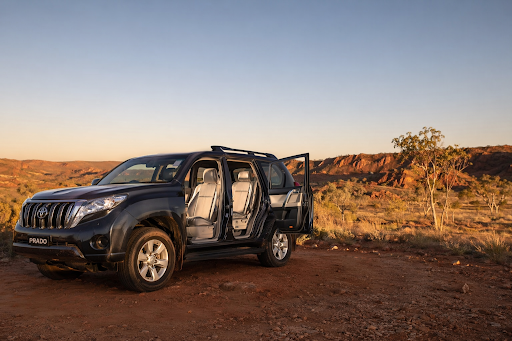
Your Prado works hard, so your seats do too. The best Toyota Prado seat covers give you comfort, interior protection, and durability for daily use in Australia, whether you drive to work, head off-road, or load up the kids after sport. That matters when mud, moisture, food spills, and direct sunlight all hit the cabin. If you want covers that look right and last through normal use, the details of material, fit, and safety features make a real difference.

Why Invest in Toyota Prado Seat Covers for the Australian Lifestyle

seat

Life in Australia is tough on vehicle interiors. Daily use, direct sunlight, and UV rays can wear factory seats faster than many owners expect, especially if your Prado is used for family trips, touring, or work.

That is why Toyota Prado seat covers are more than an accessory. They help protect against spills and stains, support resale value, and keep the cabin looking cleaner for longer. The next two sections break down where that protection really shows up.

Everyday Protection Against Spills, Stains, and Sun Damage

Yes, they do. Toyota Prado seat covers protect seats from spills and stains effectively when you choose the right material and a precise fit. That is especially useful for daily use, where food, wet clothes, dust, and sunscreen can quickly mark factory trim.

Think about a common weekend. You finish a beach trip, the kids climb in, and moisture and sand end up on the seats. A cover creates a barrier that helps keep the original trim in more pristine condition and reduces wear from UV exposure and sun damage.

  • Neoprene seat covers offer water-resistant protection and a comfortable feel.
  • Canvas seat covers suit rougher jobs where dirt and gear are part of the routine.
  • A form-fitting design helps stop bunching that can leave exposed areas.

Maintaining Comfort and Resale Value in Harsh Environments

Seat covers are not only about blocking mess. In harsh environments across Australia, they also help maintain comfort over months of use. Foam-backed options can feel better on longer drives, which matters if your Prado is used for touring or long work days.

There is also the resale value angle. Seats that stay cleaner and show less wear can make the whole cabin look better when it is time to sell or trade. That gives you one less thing to worry about later.

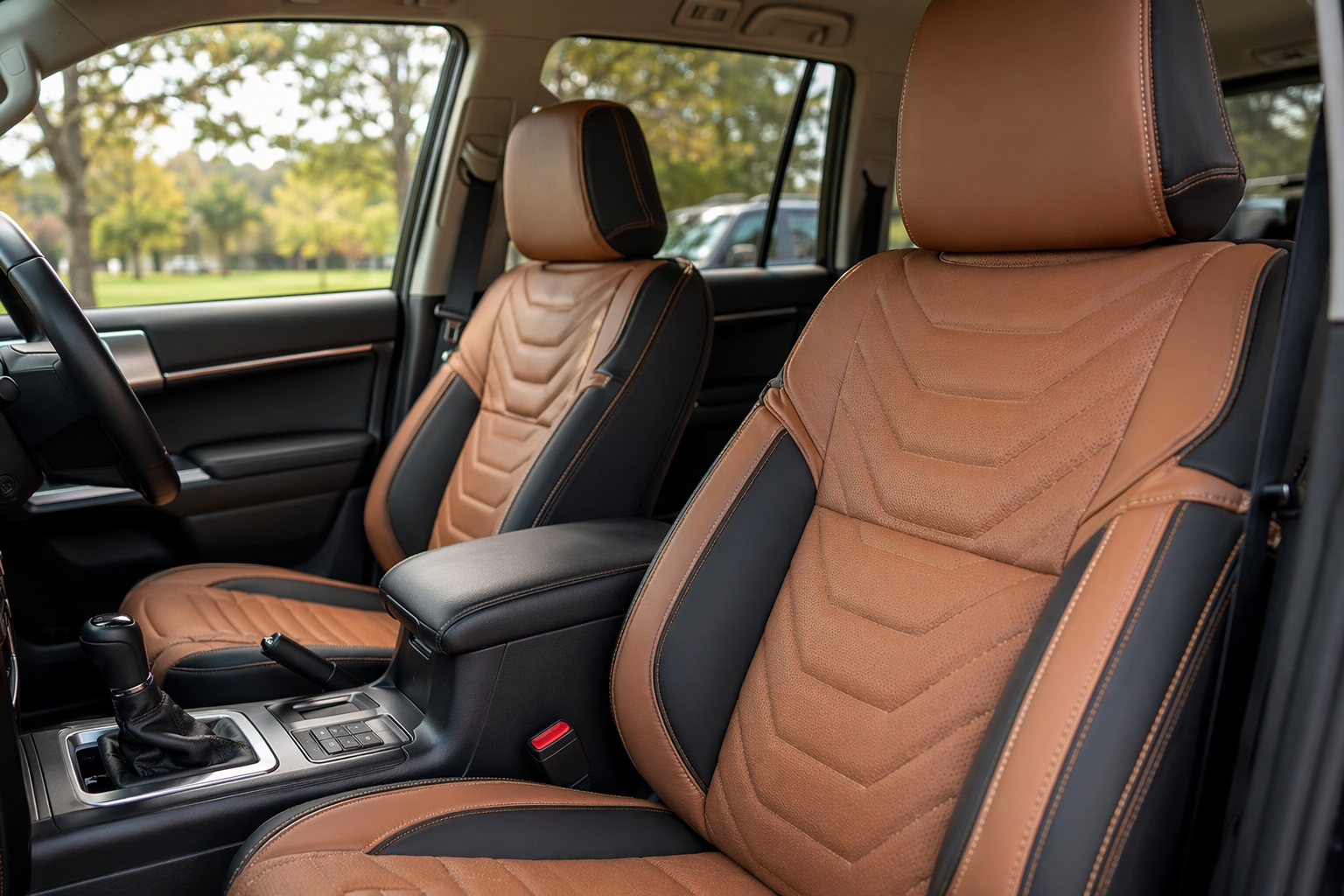
A genuine benefit of model-specific covers over generic ones is fit. A tailored set follows the seat shape more closely, looks tidier, and gives more peace of mind in normal use without loose fabric moving around.

Most Durable Materials for Toyota Prado Seat Covers

seats

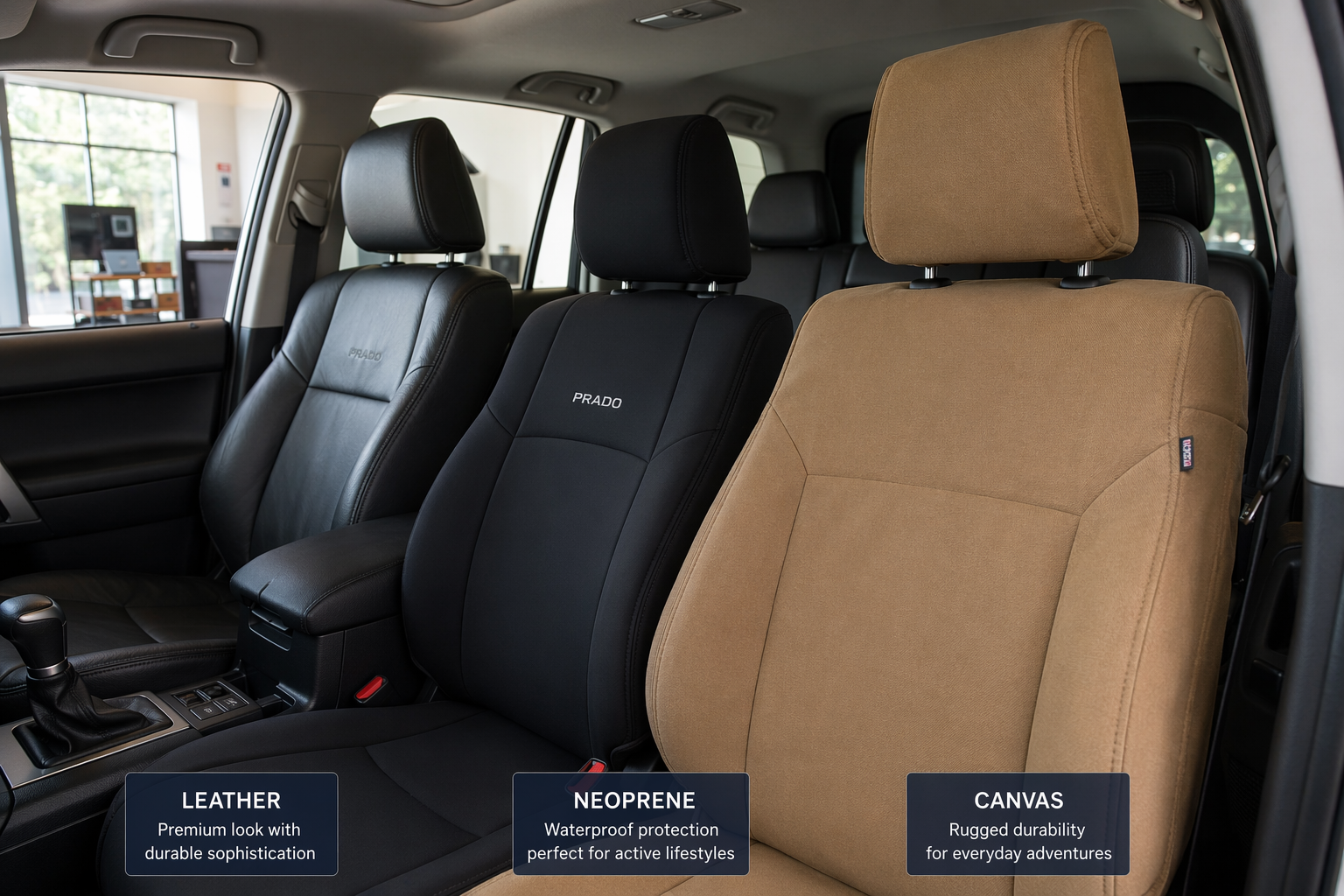
The two material types that stand out for Toyota Prado seat covers are neoprene seat covers and canvas seat covers. Both are built for durability, but they suit different jobs. Neoprene is water-resistant and comfortable, while canvas is aimed at heavier wear.

For buyers comparing options after months of use, that difference matters. Foam backing can improve comfort, and checking the warranty is smart if you want coverage for defects. Once you know the material, the next step is matching it to how your Prado is really used.

Real-World Example: Heavy-Duty Materials for Off-Road Adventures

Picture a Prado used for touring tracks one week, and school runs the next. On corrugated roads, your suspension takes the hit, but your seats still face dust, moisture, and constant movement. That is where heavy-duty material choice becomes practical, not cosmetic.

Razorback 4×4 lists GP4 Neoprene as water-resistant with a comfy rubber backing and form-fitting design. Its XP7 Heavy-Duty Canvas is designed for worksites and tough 4×4 tracks, with foam-backed comfort. Free shipping Australia-wide also helps when ordering online.

Top Choices for Toyota Prado Seat Covers by Model and Fit

Fit should drive your choice first. A precise fit helps custom seat covers sit properly around seat shapes, headrests, and access points. For Prado owners, that becomes important when comparing the Prado 150 Series with newer or older layouts.

If you are choosing a 7-seater or looking at waterproof protection, focus on model-specific covers, airbag compatibility, and practical details like foam backing and warranty. The next section gives a simpler way to judge what is right for your Prado.

Custom and Waterproof Seat Cover Solutions for the Prado 150 Series and Older Models

Yes, it is possible to find custom-fit, waterproof options for the Prado 150 Series and older models. The compiled range includes the Toyota Land Cruiser Prado 150 Pre-Facelift from November 2009 to June 2021, which answers a common question from owners of older models like the 2009 version.

When choosing the right seat covers for a Prado 150 Series 7-seater, check the fitment details first. Then look at how the cover works with safety features and daily use. A neat fit is usually better than a one-size-fits-most product.

  • Confirm access for child seat anchoring before you buy.
  • Choose airbag safe designs where side airbags are fitted.
  • Pick neoprene for water resistance or canvas for heavier wear.

If you own several vehicles, you may also compare 4WD seat covers for other models, such as Toyota Hilux seat covers, Ford Ranger Wildtrak seat covers, Isuzu D-Max seat covers, and Triton car seat covers, but your Prado still needs its own model-specific fit.

Conclusion

In conclusion, investing in high-quality Toyota Prado seat covers not only enhances your comfort but also safeguards your vehicle’s interior against the rigours of the Australian lifestyle. With options tailored for different models and conditions, you can find the perfect fit that offers both durability and style. By choosing the right materials, you ensure that your seat covers withstand spills, stains, and sun damage, essentially prolonging the life of your seats while maintaining their resale value. Remember to consider your specific needs and preferences when selecting seat covers.

Frequently Asked Questions

Are there seat covers that will fit my older Toyota Prado?

Yes. Custom seat covers are available for older models, including the Prado 150 Pre-Facelift from November 2009 to June 2021. The key is a precise fit matched to your year and seat layout. Before ordering, check warranty terms and shipping details for your location in Australia.

Do seat covers interfere with airbag deployment or child seat anchoring?

They should not if you choose covers designed with those safety features in mind. Look for airbag-safe fitment and confirm access to child seat anchoring points. That gives better peace of mind. If anything seems poorly made or misaligned, check for defects before installing and using it.

How do I clean and maintain Toyota Prado seat covers for longevity?

Keep them clean with regular wipe-downs and remove dirt before it settles in. For neoprene, quick cleaning after wet or dirty trips helps maintain comfort and appearance over months of use. Simple maintenance also helps keep the seats underneath in pristine condition for longer.

How Motorcycle Transport Interstate Works in Australia

Key Highlights

  • Interstate motorcycle transport in Australia usually starts with a quote, booking, and simple bike preparation.
  • A reliable service uses specialist equipment for secure transport and steady loading.
  • Professional motorcycle transport often includes depot or home delivery options across major routes.
  • Clear pricing depends on distance, vehicle details, and any added storage needs.
  • With utmost care, carriers secure the front tire and strap the rear for safer transit.
  • Tracking updates can give you peace of mind during the trip.

Introduction

If you are trying to understand motorcycle transport interstate in Australia, the process is usually simpler than many riders expect. Most motorcycle transport services follow a clear path: request a quote, confirm the booking, prepare the bike, track the shipment, and accept delivery at home or a depot. That straightforward system matters when your motorbike is traveling long distances. Knowing how it works gives you more peace of mind and helps you avoid last-minute issues before moving your bike.

Understanding Motorcycle Transport Interstate in Australia

Motorcycle transport interstate means moving a motorbike from one state to another using specialist freight equipment and trained drivers. In Australia, this is a dedicated service, not an afterthought added onto general removalists or standard car transport.

What makes the process work well is professionalism. Carriers with years of experience rely on tested systems, careful handling, and route coverage between cities such as Sydney, Melbourne, Adelaide, Perth, Brisbane, and Darwin. That focus on excellence is what keeps a bike stable during transit.

What Is Interstate Motorcycle Transport and When Is It Needed?

Interstate motorcycle transport moves your bike across state lines using equipment built specifically for motorcycles. This ensures secure transport over long distances, with setups that hold the front tire and strap down the rear to minimize movement.

This service is useful when riding isn’t practical—such as during a relocation, after buying from another city, or sending a bike to a dealership. It’s also ideal for routes that are too long or inconvenient.

For example, if you buy a Honda on the Sunshine Coast and need it delivered to Melbourne, interstate motorcycle transport saves time and keeps your bike safe during transit.

Common Reasons for Moving Motorcycles Between States

People choose bike transport for convenience, distance, and safety. Professional transport is often better for valuable, new, or relocated bikes, especially on routes between the East Coast and Western Australia.

Common reasons include:

  • Moving house and sending a motorbike with other vehicles.
  • Buying from an out-of-state dealership (e.g., a Honda on the Sunshine Coast).
  • Delivering collector, prestige, or race bikes needing extra care.
  • Use depot storage when immediate pickup isn’t possible.

Timing is another factor. If your schedule doesn’t allow for a long ride, interstate delivery streamlines the process and eliminates hassle.

Types of Motorcycle Transport Services Available

Not all motorcycle transport services work the same way, even when the route is similar. The main differences usually come down to how the bike is carried and where it is collected or delivered. Those choices affect convenience, protection, and sometimes pricing.

You may be booking between capital cities or sending a bike to regional areas, so it helps to know the service type first. Once you understand the options, it becomes easier to compare secure transport features and ask for clear pricing that matches your trip.

Open vs Enclosed Motorcycle Carriers Explained

Enclosed transport is the safest option for extra protection, shielding your motorcycle from exposure and keeping it in pristine condition. While open carriers are common in wider freight networks, enclosed transport minimizes risk from road debris and external conditions—ideal for high-value bikes.

OptionWhat to know
Open carrierExposed to road debris and outside conditions during transit.
Enclosed transportOffers better protection for your motorcycle during shipment.
Fully enclosed truckPreferred for prestige, collector, or race bikes needing special care.

Door-to-Door and Depot-to-Depot Delivery Options

Yes, interstate door-to-door motorcycle transport is available in Australia, along with depot-to-depot delivery. Door-to-door brings the bike directly to your home or address, while depot-to-depot requires you to drop off and pick up from a depot.

Each option suits different needs:

  • Door-to-door is more convenient and saves time.
  • Depot-to-depot is useful if depots are easier to access.
  • Depot delivery is helpful for regional locations.
  • Some depots offer storage from $50 per day plus GST.

For example, a Sydney buyer who isn’t home on delivery day can use depot-to-depot for added flexibility and short-term storage.

How the Motorcycle Transport Process Works Step-by-Step

Most interstate bookings follow the same core process, which makes planning easier. You request a quote, confirm the transport, prepare the bike using the carrier’s guidelines, track the shipment, and then receive the motorcycle at the selected address or depot.

What matters is how that process is handled. Professionalism shows up in careful loading, the use of specialist supports and straps, and clear communication from booking through delivery. The next two sections break down the quote stage and the pickup-to-drop-off process.

Getting a Personalized Quote and Booking Your Transport

Booking begins with a personalized quote, as pricing depends on the bike, distance, and your specific needs—there’s no fixed per-kilometer rate. Clear pricing upfront is essential.

When requesting a quote, be prepared to confirm:

  • Pickup and drop-off locations
  • Type of motorcycle
  • Need for storage (starting at $50/day plus GST)

Good customer service should make this process easy. After accepting the quote, you confirm your booking and follow the preparation instructions. For example, if you’re moving from Brisbane to Adelaide and require short-term depot storage, that service should be included in your quote before transport starts.

Typical Pick-Up, Transit, and Drop-Off Procedures

After booking, your bike is prepared and picked up from your address or a depot. During pickup, specialist equipment cradles the front tire and secures the rear with straps, protecting sensitive parts like forks and struts.

You can track your bike’s journey with real-time updates—ideal for long interstate routes like Melbourne to Perth or Darwin to Victoria.

The process typically includes:

  • Pickup from home, showroom, or depot
  • Careful loading with specialized equipment
  • In-transit tracking updates
  • Delivery to your chosen address or authorized depot

At delivery, the bike is handled with the same care as at pickup. If you’re not available, depot storage is an option until you’re ready to receive it.

Preparing Your Motorcycle for Long-Distance Transport

Preparation is one of the easiest ways to protect your bike before shipping. Even when a carrier uses specialist equipment, you still want a clear record of the motorcycle’s condition before it leaves. That matters for sports bikes, cruisers, scooters, and custom builds alike.

The basics are simple: check the bike, document its condition, and follow the carrier’s rules on fuel, battery, and accessories. Paying attention to fairings or panniers can also help avoid preventable issues before transit begins.

Cleaning, Inspecting, and Documenting Bike Condition

Start by cleaning the motorcycle so its condition is easy to inspect. Dirt can hide marks, chips, or small scratches, which makes records less useful. Once the bike is clean, walk around it slowly and check visible areas carefully.

Make sure you document:

  • Clear photos from multiple angles.
  • Any existing marks on fairings, wheels, or bodywork.
  • Important details linked to registration or model identification.

This step is especially useful for custom builds and sports bikes, where small cosmetic details matter more. A practical example is photographing both sides, the front, the rear, and close-ups of any pre-existing blemishes. If there is ever a question at drop-off, you have a simple visual record of the bike before transport.

Required Fuel, Battery, and Accessory Preparations

Before handover, follow the preparation guidance provided by the carrier. The compiled information confirms that customers are asked to prepare the vehicle according to set guidelines. That is the best point to confirm fuel level, battery expectations, and any rules around loose accessories.

Pay close attention to:

  • Fuel requirements given by the transporter.
  • Battery instructions before pickup.
  • Removable accessories, such as panniers or add-ons on a cruiser.

This matters because accessories can shift or complicate handling if they are left unsecured. For example, if your cruiser has detachable luggage, confirm whether it should stay fitted or be removed before loading. Small preparation steps like this can make pickup smoother and reduce avoidable delays on transport day.

truck

Conclusion

In conclusion, understanding how motorcycle transport interstate works in Australia is essential for any motorcycle owner considering a move. It’s important to grasp the various services available, from open and enclosed carriers to door-to-door delivery options, ensuring your bike is safeguarded during transit. Preparing your motorcycle adequately will not only facilitate a smoother transport experience but will also help maintain its condition. Remember to document and inspect your bike before transport, as this can be invaluable should you face any issues. If you’re ready to get started, don’t hesitate to reach out for a personalized quote to make your motorcycle transport hassle-free!

Frequently Asked Questions (FAQ)

Curiosity often surrounds the practicalities of motorcycle transport interstate in Australia. To address common inquiries, many riders wonder about the types of motorcycles that can be transported. Most services cater to a wide range of bikes, from cruisers to sports bikes, ensuring secure transport with full insurance coverage. Additionally, riders frequently ask about transit duration; typically, distances between cities like Brisbane and Melbourne may take several days. Ultimately, reliable services, transparent pricing, and commitment to care ensure peace of mind during the entire journey.

How long does it take to transport a motorcycle interstate in Australia?

Transport time depends on the route, distance, and delivery method. Popular routes on the east coast may move differently from long distances, such as Melbourne to Perth,h or shipments involving regional areas. The more kilometres involved, the more important it is to ask for an estimated schedule at the quote stage.

Is my motorcycle insured during interstate transport?

The compiled information does not confirm transit insurance or full insurance coverage details, so you should ask directly before booking. What it does show is a strong focus on utmost care, specialist equipment, and secure transport during the entire journey, which are still important parts of reducing risk.

How do I choose a reliable interstate motorcycle transport company?

Look for a good carrier with years of experience, specialist motorcycle equipment, route coverage, and clear preparation steps. A reliable service should also offer professional motorcycle transport, transparent quoting, and responsive customer service. If tracking and depot options matter to you, confirm those before you book.

Why Every Millisecond Needs a Trusted Timestamp

A timestamp looks like a minor technical detail until two events occur almost together. A promotion expires as an account activates it, a roulette wager reaches the server near the closing signal, or two race cars arrive at the stripe with barely visible separation.

The official order cannot depend on how quickly a screen refreshes. Casinos and race-control teams need a central clock, identifiable events and records that can be checked after the action has finished.

Casino Promotions Run on Recorded Time

A guide to no deposit bonus codes at free-spins-professor.com organises active offers with their stated eligibility and conditions. Behind each promotion, the casino records when it became available, when an account claimed it and when its validity period ends.

Free Spins Professor presents bonus information at the comparison layer, while the operator controls activation and account processing. A promotion at a no deposit bonus casino may have several relevant timestamps rather than one general expiry date.

The system can record:

  • publication of the offer;
  • account registration;
  • activation of the code;
  • crediting of free spins or bonus funds;
  • start and end of the wagering period;
  • completion of the qualifying conditions;
  • expiry of any unused promotional balance.

Clear timing prevents an offer displayed earlier in the day from being applied after it has closed. Published no deposit bonus codes also need version control when a campaign changes its value, eligible games or end date.

Every Casino Round Receives Its Own Clock

A slot request normally carries an account session, game identifier, stake, currency and unique round ID. The server adds a timestamp when it accepts the request. The visible animation can start slightly later, but the accepted record determines whether the round exists.

At an australia no deposit bonus casino, this record can also show whether a qualifying spin used promotional funds or the cash balance. That distinction matters because a no deposit bonus may follow separate wagering and game-contribution rules.

Live games require several timed stages:

Recorded eventWhy its time matters
Betting window opensEstablishes when wagers may begin
Wager reaches the serverConfirms whether it arrived in time
Betting window closesRejects later requests
Result is confirmedIdentifies the completed round
Balance is settledRecords the financial outcome

A no deposit bonus casino still processes an accepted wager through the game server even when no deposit funded the initial promotion. Meanwhile, an online no deposit bonus casino links each resulting balance movement with the relevant account and campaign record.

Gaming Laboratories International requires wager histories to include the time a wager was placed, its amount, the final outcome and the balance after settlement. These details appear in the GLI-19 technical standard, providing an audit trail when the device and server appear to disagree.

Racing Transponders Mark the Car’s Passage

NASCAR cars carry transponders that emit an identifying signal. Detection loops embedded at points around the circuit pick up that signal and send the recorded passage to timing and scoring.

The start-finish line provides the most familiar timestamp, although it is only one measurement point. Additional loops help officials and teams track:

  • lap completion;
  • running order around the circuit;
  • pit-road entry;
  • individual pit segments;
  • pit-road exit;
  • gaps between cars;
  • positions during caution periods.

The system gives every passing car an identity and a time. Timing software can then arrange those records into lap charts, intervals and provisional positions without relying on a person watching dozens of cars cross the stripe.

NASCAR has explained that the loop signals travel back to Race Control, where timing and scoring officials monitor the data alongside camera feeds and other information. The timestamp establishes a measurable event; officials interpret it under the sporting rules.

Pit Road Needs More Than a Stopwatch

A complete pit stop includes time spent approaching the box, standing still and returning to racing speed. Segment timing allows NASCAR to monitor pit-road speed across defined sections instead of relying on one average for the entire lane.

Teams also divide the stop into smaller pieces. They examine the time required to enter the stall, lift the car, change tyres, add fuel and release the driver. Two stops with an identical total can hide different strengths: one crew may complete service faster but lose time while the car enters the box.

These timestamps support decisions during the race. A crew chief can determine whether a slow stop came through traffic, equipment trouble or the physical service. The number gains meaning because it belongs to a specific car, location and stage of the stop.

The Camera Settles What the Transponder Cannot

A transponder sits at a defined point inside the car rather than at its leading edge. In an extremely close finish, its timestamp may not establish which nose crossed the line first.

The 2024 NASCAR Cup race at Kansas Speedway provided a sharp example. Kyle Larson and Chris Buescher reached the finish almost together. Timing and scoring initially placed Buescher ahead because the separation fell inside the transponder system’s margin of error. Examination of the high-speed finish-line image gave Larson the victory by 0.001 seconds, then the closest recorded finish in Cup Series history.

That decision did not make electronic timing useless. The loops supplied the provisional order and alerted officials to a finish requiring closer examination. The camera then answered the specific question the transponder could not: which car’s leading edge reached the vertical plane first.

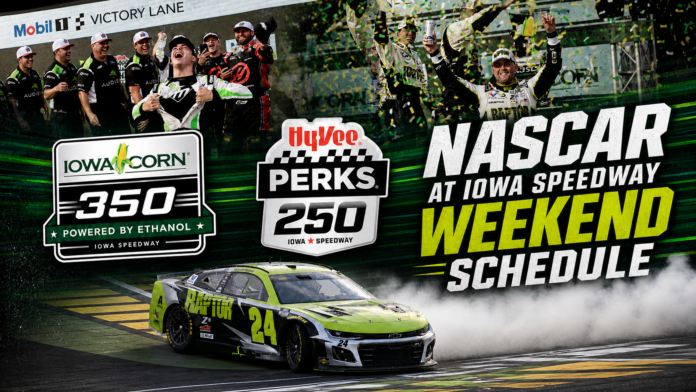
NASCAR at Iowa Speedway Weekend Schedule

The NASCAR Cup Series and the NASCAR O’Reilly Auto Parts Series head to Iowa Speedway. The O’Reilly Auto Parts Series Hy-Vee Perks 205 will begin at 6 p.m. ET on the CW Network. On Sunday, the Cup Series Iowa Corn 350 Powered by Ethanol will begin at 2:30 p.m. ET on the USA Network.

Cup Series Notes for Iowa Speedway:

Only four races remain before the Chase: Iowa (7/8-mile short track), Richmond (¾-mile short track), New Hampshire (1-mile flat oval) and Daytona (2.5-mile high-banked drafting track). Four drivers have clinched Chase spots: Denny Hamlin, Tyler Reddick, Ryan Blaney and Ty Gibbs.

The driver who led the most laps won both Iowa races: Ryan Blaney in 2024 and William Byron in 2025 led the most laps and won those races. Blaney has the best average position in both races at 3.9, and Byron has the best average finish of 1.5.

NASCAR O’Reilly Auto Parts Series Notes for Iowa Speedway:

This weekend’s race will be the third O’Reilly Auto Parts Series race at Iowa since the series returned in 2024, and Sam Mayer has won both races since its return.

Iowa is the third of five short tracks this season, and the last six short-track races have been won by six different drivers, with JR Motorsports winning both short-track races so far this season.

Ross Chastain will return to JR Motorsports No. 9 for his 10th start of the season. Carson Brown will drive Jordan Anderson Racing No. 32 in his series debut, and Derek Lemke will drive DGM Racing No. 91 in his series debut.

Justin Allgaier, Jesse Love, Carson Kvapil, Sheldon Creed, Corey Day, Brandon Jones and Austin Hill clinched Chase spots, with five spots remaining open, with only nine drivers still in contention for those spots.

The Weekend Schedule for Iowa Speedway:

Related: The Iowa Corn 350 at Iowa Speedway Outlook and Picks

FRIDAY, AUGUST 7
2:30 PM – 3:15 PM: AMS PRACTICE (TIMED – 45 MINUTES)
3:30 PM – 3:50 PM: AMS QUALIFYING (IMPOUND) (TIMED – ALL ENTRIES)
5:35 PM: AMS DRIVER INTRODUCTIONS
6:00 PM: AMS RACE (150 LAPS, 131.25 MILES)

SATURDAY, AUGUST 8
10:30 AM – 11:20 AM: NOAPS PRACTICE
11:35 AM – 12:30 PM: NOAPS QUALIFYING
1:05 PM – 1:55 PM: NCS PRACTICE (COMBINED GROUP 1 & 2 (IMPOUND))
2:10 PM – 3:00 PM: NCS QUALIFYING (IMPOUND)
3:25 PM: NOAPS DRIVER INTRODUCTIONS
4:00 PM: NOAPS RACE (STAGES 60/120/250 LAPS = 218.75 MILES – CW NETWORK

SUNDAY, AUGUST 9
1:50 PM: NCS DRIVER INTRODUCTIONS
2:30 PM: NCS RACE (STAGES 70/210/350 LAPS = 306.25 MILES) – USA NETWORK
*All times are Eastern. NASCAR Cup Series (NCS), NASCAR O’Reilly Auto Parts Series (NOAPS), NASCAR Craftsman Truck Series (NCTS), ARCA Menards Series (AMS)

Hendrick Motorsports Media Advance: Iowa

Iowa Speedway
Sunday, Aug. 9
0.875-Mile Oval
3:30 p.m. ET
Location: Newton, Iowa
TV: Fox
Event: NASCAR Cup Series (Race 23 of 36)
RADIO: SiriusXM

5 KYLE LARSON
Age: 34 (July 31, 1992)
Hometown: Elk Grove, California
Last Race: 39th (Indianapolis)
Crew Chief: Cliff Daniels
Standings: 8th

No. 5 HENDRICKCARS.COM Chevrolet

  • Kyle Larson celebrated his 34th birthday on July 31 during the NASCAR off week.
  • Larson has led 80 laps across two NASCAR Cup Series events at Iowa Speedway, the fourth most at the 0.875-mile track.
  • He has five career short track victories, which ranks fourth all-time among Hendrick Motorsports drivers. Four of those victories have come in the Next Gen car.
  • The Elk Grove, California, native is just one lap shy of eclipsing 11,000 career laps led, he would become just the 20th driver in Cup Series history to reach the milestone.
  • The defending champion leads all drivers in laps led on short tracks during the Next Gen era, with 1,839.
  • Larson has finished in the top 10 in 14 of the last 18 short track races

9 CHASE ELLIOTT
Age: 30 (Nov. 28, 1995)
Hometown: Dawsonville, Georgia
Last Race: 37th (Indianapolis)
Crew Chief: Alan Gustafson
Standings: 6th

No. 9 NAPA Auto Parts Chevrolet

  • This weekend, the NASCAR Cup Series heads to Iowa Speedway, where Chase Elliott has a best finish of third (2024).
  • In the Next Gen era on short tracks, Elliott has one win (Martinsville Speedway 2026) and has led the seventh-most laps (675).
  • This season on short tracks, the 30-year-old driver has earned the seventh-most points (94) and led the fifth-most laps (90).
  • Elliott has the fourth-best average running position (8.2), the sixth-best average finish (8.5) and fifth-most points earned (70) across the first two Cup Series races at Iowa.
  • With just four races remaining until The Chase, Elliott is three points out of fifth place in the standings. The 2020 Cup Series champion has remained in the top six throughout the entire season thus far.

24 WILLIAM BYRON
Age: 28 (Nov. 29, 1997)
Hometown: Charlotte, North Carolina
Last Race: 21st (Indianapolis)
Crew Chief: Rudy Fugle
Standings: 12th

No. 24 RAPTOR Chevrolet

  • Among the four remaining tracks in the NASCAR Cup Series regular season (Iowa Speedway, Richmond Raceway, New Hampshire Motor Speedway and Daytona International Speedway), William Byron has four combined victories to lead Hendrick Motorsports.
  • Three of Byron’s last four victories have come on short tracks (Martinsville Speedway in 2024 and 2025, Iowa in 2025). He is the only repeat winner on that style track in the last 10 events and has earned the fourth-most points (280) in the last eight short track events.
  • In the Next Gen era, the Charlotte, North Carolina, native has the second-most wins (four) on short tracks and has led the fourth-most laps (1,041).
  • Over his NASCAR career, Byron has five starts across the top three series at Iowa. He has one victory in each the Cup, O’Reilly and CRAFTSMAN Truck Series, and is the defending Cup winner. He is one of only two drivers to win at Iowa in each series and also finish top five in both Cup races.
  • Byron enters the weekend with an average starting position of third, an average running position of 5.6, and an average finish of 1.5 at Iowa. He’s scored the second-most points (90) and led the second-most laps (141) at the 0.875-mile oval.

48 ALEX BOWMAN
Age: 33 (April 25, 1993)
Hometown: Tucson, Arizona
Last Race: 19th (Indianapolis)
Crew Chief: Blake Harris
Standings: 29th

No. 48 Ally Chevrolet

  • So far in 2026, Alex Bowman has earned three top fives and four top-10 finishes in the NASCAR Cup Series.
  • Bowman is one of five drivers to finish inside the top 10 in both races at Iowa Speedway and has an average finish of 7.5 at the track.
  • Bowman finished eighth in the inaugural Cup race at Iowa (2024) after starting 33rd.
  • The 33-year-old has an average running position of 13th at Iowa, ranking him eighth best in the series. Additionally, Bowman has earned a total of 63 points at the track, seventh most.

17 COREY DAY
Age: 20 (November 28, 2005)
Hometown: Clovis, California
Last Race: 7th (Indianapolis)
Crew Chief: Adam Wall
Standings: 5th

  • Corey Day returns to the track after a seventh-place finish at Indianapolis Motor Speedway, where he earned his 15th top 10 of the NASCAR O’Reilly Series season. With the result, he clinched a spot in The Chase.
  • The 20-year-old driver enters the weekend fifth in the series standings with two wins, one pole and six top-five finishes through the opening 22 races of the 2026 season.
  • The Clovis, California, native returns to Iowa Speedway for his second NOAPS start at the 0.875-mile oval.
  • Following Saturday’s NOAPS race at Iowa Speedway, Day will head to nearby Knoxville Raceway to compete in a sprint car event as part of the 360 Knoxville Nationals, the first of several dirt races on his schedule in August.

Hendrick Motorsports

2026All-TimeIowa
Races221,4392
Wins2322*1**
Poles0259*1**
Top 5201,342*3*
Top 10322,292*5*
Laps Led1,05386,420*223
Stage Wins91461

*Most
**Tied for most

  • The NASCAR Cup Series returns to Iowa Speedway this weekend. Over the course of the series’ first two events at the 0.875-mile oval, Hendrick Motorsports’ one win and one pole are tied for the most while its three top fives and five top 10s are tops among all teams.
  • Hendrick Motorsports drivers have combined to win four of the last eight Cup Series races on short tracks (William Byron two, Chase Elliott one, Kyle Larson one). The organization has also won two of the last six races immediately after an off week.
  • The Hendrick Motorsports engine department enters the weekend with 576 victories across all three national NASCAR touring series, including 17 of 22 events in the NASCAR O’Reilly Series this season.
  • Hendrick Motorsports remains the Cup Series’ all-time standard bearer in wins (322), poles (259), top-five finishes (1,342), top 10s (2,292), laps led (86,420) and championships (15).

QUOTABLE

Kyle Larson, driver of the No. 5 Chevrolet, on getting closer to a win: “I feel like we’ve been inching closer and closer all year. A lot of times, I feel like our sport is so close that you can feel so far from winning and so far from being good, when in reality, I think you’re much closer than you feel. So, yeah, you never know. Maybe if you get a win and your car gets a little bit better, you can go on a string. We still have some room to improve, but hopefully we’re not too far away from it.”

Chase Elliott, driver of the No. 9 Chevrolet, on racing at Iowa Speedway: “I’m looking forward to it. I thought there were moments of hope for us the last couple years out there. Certainly, William (Byron) was really good. I think he’s had some really fast races. So, I’m excited to get out there and see what we’ve got.”

William Byron, driver of the No. 24 Chevrolet, on returning to Iowa Speedway: “Iowa [Speedway] is just a track that has always clicked for me and that I really love. I’ve had success there in all three series and last year’s win really felt great to complete the sweep. I think having the off time, and this being the next track we go to, really gives our team confidence of what we can accomplish. I’m looking forward to it.”

Alex Bowman, driver of the No. 48 Chevrolet, on Iowa Speedway: “We’re ready to head back to the track after some much needed time off to recharge with friends. Iowa [Speedway] is a good track to be headed to; it has been a good one for our Ally 48 team. Track position is important and it’s a track where you have to be smart and aggressive which makes it challenging but a lot of fun to drive.”

Corey Day, driver of the No. 17 Chevrolet, on Iowa Speedway: “Last year at Iowa [Speedway] was my first time there, and honestly, it was a tough weekend for me. Since then, I’ve gained a lot more pavement experience and have spent a lot more time behind the wheel of the No. 17 HENDRICKCARS.COM Chevrolet, so I’m looking forward to going back and seeing what we can do. I feel like I’ve learned a lot this year and I’m hoping we can show some speed and put ourselves in a position to run up front. I’m also looking forward to getting back to a lot of dirt racing throughout August. That always helps me reset and get comfortable again, and I think it carries over when I come back to the pavement.”

Phoenix Raceway Unveils Power-Packed 2027 Race Schedule

Can’t-Miss NASCAR/NTT INDYCAR SERIES weekend returning March 12-14
NASCAR Chase races set for Oct. 22-24 with all three national series in action

AVONDALE, Ariz. (Aug. 5, 2026) – Phoenix Raceway today announced its 2027 schedule, highlighted by the return of one of motorsports’ most exciting weekends. NASCAR and the NTT INDYCAR SERIES will again share the spotlight during a marquee spring doubleheader weekend, March 12-14. That power-packed event will serve as a foretaste for the fall weekend with pivotal NASCAR Chase races in all three national series, Oct. 22-24.

“Phoenix Raceway has long been one of the premier destinations in motorsports, and our 2027 schedule gives fans two exciting weekends to experience the best racing in the world,” said Phoenix Raceway President Latasha Causey. “From the excitement of our NASCAR and NTT INDYCAR SERIES doubleheader in March to the intensity of The Chase in October, Phoenix Raceway will once again shine brightly as one of racing’s most competitive and fan-friendly venues.”

The 2027 spring weekend features a can’t-miss Saturday, March 13, with the NASCAR O’Reilly Auto Parts Series and NTT INDYCAR SERIES sharing center stage in a highly anticipated doubleheader. Weekend action begins Friday, March 12, with an ARCA Menards Series race and concludes Sunday, March 14, when the stars of the NASCAR Cup Series tackle the one-mile doglegged oval in a key early-season showdown.

Phoenix Raceway will once again play a pivotal NASCAR championship role when all three national series return for Chase races on Oct. 22-24. The NASCAR CRAFTSMAN Truck Series opens the weekend on Friday, Oct. 22, followed by NASCAR O’Reilly Auto Parts Series and ARCA Menards Series West races on Saturday, Oct. 23. The weekend culminates with the Freeway Insurance 500 on Sunday, Oct. 24, as the NASCAR Cup Series Chase intensifies with drivers battling for a coveted spot in the championship conversation.

The full 2027 NASCAR and NTT INDYCAR SERIES schedules, along with broadcast details and times, will be released at a later date. Thankfully, fans don’t have to wait until 2027 to experience Phoenix Raceway.

Limited tickets remain available for the track’s upcoming 2026 NASCAR Chase weekend, Oct. 16-18. The weekend will feature Chase races for all three NASCAR national series and also include the penultimate race of the ARCA Menards Series West calendar. Tickets are going fast, so fans are encouraged to secure their seats while supplies last by visiting www.phoenixraceway.com.

About Phoenix Raceway

Phoenix Raceway has been the premier motorsports venue in the Southwest since 1964 and hosts two race weekends each year. Its season-opening weekend March 5-8 features full-throttle excitement with the NASCAR Cup Series, NTT INDYCAR SERIES, NASCAR O’Reilly Auto Parts Series and ARCA Menards Series. NASCAR will also return Oct. 16-18 with intense NASCAR Cup Series, NASCAR O’Reilly Auto Parts Series and NASCAR CRAFTSMAN Truck Series playoff racing. Phoenix Raceway also hosts a variety of events throughout the year, including concerts, corporate meetings and conferences, charity events, weddings, holiday events, sport and endurance competitions, and driving schools. For more information, visit www.PhoenixRaceway.com and download the new NASCAR Tracks App at www.phoenixraceway.com/nascar-tracks-app/.

About NASCAR

The National Association for Stock Car Auto Racing (NASCAR) is the sanctioning body for the No. 1 form of motorsports in the United States and owner of 15 of the nation’s major motorsports entertainment facilities. NASCAR sanctions races in three national series (NASCAR Cup Series™, NASCAR O’Reilly Auto Parts Series™, and NASCAR CRAFTSMAN Truck Series™), four international series (NASCAR Brasil Series, NASCAR Canada Series, NASCAR Euro Series, NASCAR Mexico Series), four regional series (ARCA Menards Series, ARCA Menards Series East & West and the NASCAR Whelen Modified Tour) and a local grassroots series (NASCAR Local Racing Series Powered by O’Reilly Auto Parts). The International Motor Sports Association™ (IMSA®) governs the IMSA WeatherTech SportsCar Championship™, the premier U.S. sports car series. NASCAR also owns Motor Racing Network, Racing Electronics, and ONE DAYTONA. Based in Daytona Beach, Florida, with offices in five cities across North America, NASCAR sanctions more than 1,200 races annually in 11 countries and more than 30 U.S. states.

For more information visit www.NASCAR.com and www.IMSA.com, and follow NASCAR on Instagram, YouTube, TikTok, X and Facebook.